
How to Write a Purpose Statement (Purpose of the Study), with Examples
 By Dr. Robertson Prime, Research Fellow
Updated October 21, 2026
11 min read
About 2,300 words
By Dr. Robertson Prime, Research Fellow
Updated October 21, 2026
11 min read
About 2,300 words
The purpose of the study is a clear statement of what your research sets out to do: the problem it addresses, the method it uses and the people and setting it focuses on. This guide shows you how to write a purpose statement step by step, with weak vs strong examples and templates.
- What it is: how the purpose of the study differs from the problem statement, aims and research questions.
- How to write it: the elements of a purpose statement, a 5-step flowchart and verbs for qualitative and quantitative research.
- What to avoid: common mistakes, plus how a research purpose statement differs from a statement of purpose for grad school.
On this page
Key takeaways
- The purpose of the study states what your research will do, in one or two sentences.
- Name the method, the intent verb, the focus, the participants and the setting.
- Write it after the problem statement, so it answers the problem directly.
- A research purpose statement is not a statement of purpose for graduate school applications.
What Is the Purpose of the Study?
The purpose of the study is the central statement of intent in your research. It tells readers exactly what the study aims to do and how.
- A plain definition: a purpose statement is one or two sentences that state the goal of your research, the research method, the main concept or variables, the participants and the setting.
- Where it appears: in Chapter 1 of a thesis or dissertation, right after the problem statement and before the research questions.
- Why it matters: it connects the problem to the research questions and signals the research methodology that follows.
- How long it is: concise; the core statement is usually one sentence, followed by a short paragraph of explanation.
Purpose of the study vs problem statement
The problem statement and the purpose of the study work as a pair. The problem explains what is wrong or unknown; the purpose explains what your study will do about it.
- Problem statement: “Little is known about how first-generation students experience academic engagement in culturally responsive classrooms.”
- Purpose of the study: “The purpose of this qualitative study is to explore how first-generation college students experience engagement in courses using culturally responsive pedagogy.”
- The link: the purpose should answer the problem directly; see our problem statement guide.
Purpose vs research aims, objectives and questions
The purpose, research aims, objectives and research questions are closely related, but each has a different job.
| Element | What it does | Form |
|---|---|---|
| Purpose statement | States the overall intent, method and focus | One sentence plus explanation |
| Research aim | The broad goal of the study | One sentence |
| Objectives | Specific steps to reach the aim | Three to five statements |
| Research questions | The exact questions you will answer | Two to four questions |
Our guides to research aims and objectives and writing a research question explain each one in detail.
What a Purpose Statement Includes
A strong purpose of the study statement contains five elements. Together they tell the reader what, how, who and where in a single sentence.
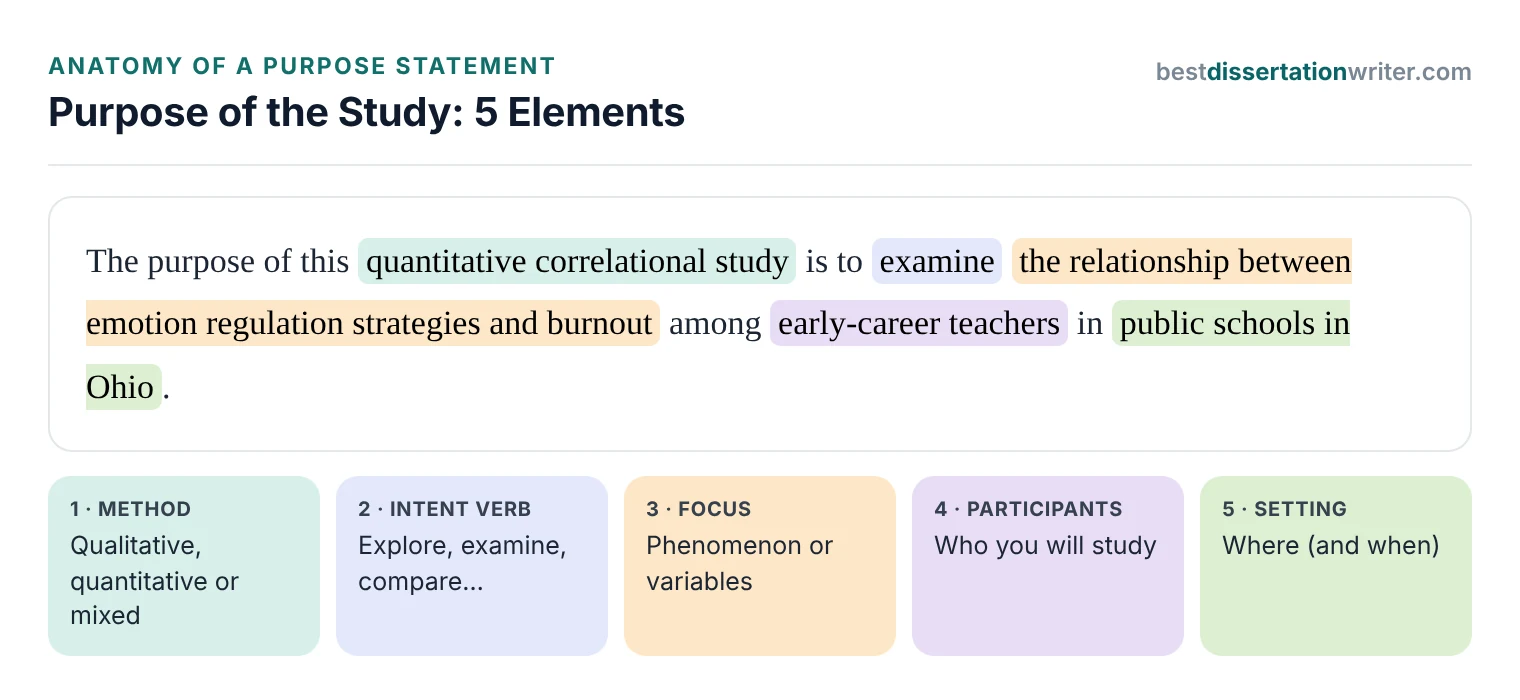
- The research method: qualitative, quantitative or mixed methods, sometimes with the design, such as a case study.
- The intent verb: a verb that matches the method, such as “explore” or “examine”.
- The focus: the central phenomenon in qualitative research, or the variables in quantitative research.
- The participants: the population or group the research explores.
- The setting: the place, organization or time frame of the study.
National University’s research guide on the purpose statement also recommends that the purpose grow out of the problem statement and match its verbs to the research method.
Verbs for qualitative, quantitative and mixed methods
The verb you choose in the purpose of the study signals your research method. Match it carefully.
| Method | Typical verbs | Focus |
|---|---|---|
| Qualitative | explore, understand, describe, discover | A central phenomenon or experience |
| Quantitative | examine, determine, compare, test | Relationships between variables |
| Mixed methods | examine and explore; integrate | Both strands and how they combine |
How to Write a Purpose Statement: Step-by-Step Guide
Follow this step-by-step guide to write a purpose statement for any thesis, dissertation or research paper. The flowchart shows the five steps at a glance.
- Start from the problemWhat needs solving
- Choose the methodQual, quant or mixed
- Pick the verbExplore, examine…
- Name focus and peopleConcept, participants
- Add setting and refineOne clear sentence
- Start from your problem statement. Reread your problem and gap. The purpose of the study must respond directly to that problem, so keep its key terms.
- Identify your research method. State whether the study is qualitative, quantitative or mixed methods, and name the design if your program expects it.
- Choose an intent verb. Pick a verb that fits the method: “explore” for qualitative research, “examine” or “determine” for quantitative research.
- Name the focus and participants. State the central phenomenon or variables and the group you will study, using the same terms as your research questions.
- Add the setting and refine. Add the place or organization, then cut extra words until the statement is concise yet comprehensive.
Purpose statement templates
Copy the purpose of the study template that matches your method and replace the highlighted parts.
Template
Qualitative: The purpose of this qualitative [design, such as case study] is to [explore/understand] [central phenomenon] among [participants] at [setting]. Quantitative: The purpose of this quantitative [design] study is to [examine/determine] the relationship between [independent variable] and [dependent variable] among [participants] in [setting].
Purpose of the Study Examples: Weak vs Strong
These purpose of the study examples show how small changes make a statement clear and researchable. Each pair fixes one problem.
Too vague
Weak
“The purpose of this study is to learn about burnout.”
No method, participants, setting or specific focus.
Strong
“The purpose of this quantitative correlational study is to examine the relationship between emotion regulation strategies and burnout among early-career teachers in public schools.”
Names the method, verb, variables, participants and setting.
Wrong verb for the method
Weak
“The purpose of this qualitative study is to prove that therapeutic communication improves patient outcomes.”
“Prove” assumes the result, and qualitative research does not test outcomes this way.
Strong
“The purpose of this qualitative study is to explore how mental health nurses use therapeutic communication to build relationships with patients in inpatient units.”
An open verb that fits qualitative research and a clear focus.
Purpose confused with significance
Weak
“The purpose of this study is to help managers keep their employees.”
This describes a hoped-for benefit, not what the study will do.
Strong
“The purpose of this quantitative study is to examine how remote work flexibility relates to employee retention in small and midsize technology firms.”
States what the research does; the benefit belongs in the significance section.
Full purpose of the study examples
Qualitative example: case study
The purpose of this qualitative case study is to explore the barriers immigrant families face when accessing child welfare services in one urban county. The study uses interviews with parents and caseworkers to understand these barriers from both perspectives.
Findings are intended to inform more accessible service design and future research. For more on this design, see our guide to case study research design.
Mixed methods example: education
The purpose of this convergent mixed methods study is to examine the relationship between culturally responsive pedagogy and academic engagement among first-generation college students, and to explore students’ experiences of these courses.
Survey data will measure engagement, while focus groups will explain how students experience the teaching. Integrating both strands is intended to give a fuller answer than either method alone.
Common Mistakes to Avoid When Writing Effective Purpose Statements
Writing effective purpose statements is mostly about avoiding a few common errors. Check your draft against these common mistakes before you share it.
- Leaving out the method: readers should know from the purpose of the study whether the study is qualitative or quantitative.
- Using biased verbs: “prove”, “demonstrate” or “show that” suggest you already know the answer.
- Mixing up purpose and significance: the purpose says what you will do; the significance says why it matters.
- Changing terms: the variables or concepts in the purpose must match those in your research questions.
- Writing a thesis statement instead: writing a thesis statement means arguing a claim; a purpose statement describes an inquiry.
- Making it too long: a strong statement is one clear sentence, not a paragraph of background.
These checks help ensure that your research purpose, questions and methods all point in the same direction. They also strengthen the academic writing skills you need for every other part of writing a dissertation.
Purpose Statement vs Statement of Purpose for Grad School Applications
Many students search for “purpose statement” and find advice on a statement of purpose (SOP) for grad school. These are different writing tasks with different readers.

Different writing goals, different readers
- Research purpose statement: the purpose of the study describes what a study will investigate, for examiners and readers of your thesis or research paper.
- Statement of purpose for graduate admission: a personal essay in a graduate school application that explains your academic and professional background, research interests and career goals.
- Personal statement: some programs ask for a personal statement as well, focused more on your story and motivation than on research plans.
How to write a statement of purpose that leaves a lasting impression
If you need to write a statement of purpose for graduate school applications, these points will help you make a strong case.
- Explain why you chose the program: link your interests to the university’s strengths, faculty who are experts in your field and research opportunities.
- Highlight your unique experience: use specific examples from study, work or research rather than general claims.
- Show your direction: describe the research you hope to do and your career goals after the graduate program.
- Create a compelling structure: open with a clear focus, build with evidence and close with your fit for the program.
- Follow instructions: make your statement of purpose fit each program’s length and prompt.
A powerful statement that is focused and specific is more likely to leave a lasting impression than one that lists every achievement. For research-focused applications, our research statement example can also help. For doctoral students moving on to the dissertation stage, see how to write the dissertation introduction and how to write a dissertation.
Purpose of the Study FAQs
What is the purpose of the study in research?
The purpose of the study is a short statement that explains what your research aims to do. It names the research method, the main concept or variables, the participants and the setting, using a verb that matches the method, such as “explore” for qualitative research or “examine” for quantitative research.
It usually appears in Chapter 1, right after the problem statement, and leads into the research questions. A clear purpose statement gives readers an immediate sense of the scope and direction of your study before they read your methodology.
How do you start a purpose of the study?
Most purpose statements begin with a standard phrase such as “The purpose of this qualitative study is to…” or “The purpose of this quantitative study is to…”. This opening names the method immediately, which helps readers understand your approach.
Follow it with an intent verb, the central concept or variables, the participants and the setting. Keep the core statement to one sentence. You can add a short explanation afterward, describing the data sources or design, but the opening sentence should be complete and understandable on its own.
How long should a purpose statement be?
The core purpose statement is usually one sentence, sometimes two for mixed methods studies. In a dissertation, it is often followed by a short paragraph that explains the design, data sources or key terms, so the whole section may run to around half a page.
In a research paper or journal article, the purpose may be a single sentence at the end of the introduction. The aim is to be concise yet comprehensive: include every essential element, but cut background information that belongs elsewhere in the introduction.
Is a purpose statement the same as an SOP?
No. A purpose statement in research describes what a study will investigate and how. A statement of purpose, often shortened to SOP, is a personal essay for graduate school applications that explains your background, interests and goals and why you are applying to a particular program.
The two share similar words, which causes confusion in searches, but they are written for different readers. If you are writing Chapter 1 of a thesis or dissertation, you need a research purpose statement, not an SOP.
What is the difference between purpose and objectives?
The purpose of the study states the overall intent of your research in one sentence, including the method, focus, participants and setting. Objectives break that purpose into specific, measurable steps, such as identifying a pattern, comparing two groups or evaluating an intervention.
A study usually has one purpose and three to five objectives. Keep the terms consistent between them, so readers can see how each objective helps achieve the purpose and how each research question, in turn, supports one or more objectives.
Best Dissertation Writers
Need help writing your dissertation introduction?
Our expert writers can help you draft your background, problem statement, purpose and research questions to your brief.