

How to Write a Research Question, with Examples
 By Dr. Robertson Prime, Research Fellow
Updated October 21, 2026
15 min read
About 3,000 words
A research question is the question your study sets out to answer, and it shapes every decision that follows. If you are learning how to write a research question for a research paper, thesis or dissertation, this guide takes you from a general topic to a clear, focused question you can defend.
- It gives your study direction: a clear research question tells you which sources to read and which data to collect.
- It keeps the research process manageable: a question focused on one problem stops your paper from trying to cover a whole field.
- It leads to your thesis: the answer to your research question often becomes your arguable thesis.
Below you will find a 5-step process with a flowchart, the main types of research questions, the traits of a good research question, and weak vs strong research question examples you can adapt.
On this page
Key takeaways
- Start with a broad topic, then narrow it with preliminary research.
- Ask open-ended “how” or “why” questions, not yes-or-no ones.
- A strong research question is clear, focused, complex and answerable.
- Test every draft against your audience, your timeline and your data.
What Is a Research Question?
Before you learn how to write a research question, it helps to know what one is. A research question is the question you ask to center your research on one problem; it is not a topic and not a thesis, but sits between the two.
- Topic: a broad area of interest, such as “sleep and college students”.
- Research question: the specific question about that topic your study will answer, such as “How does screen time before bed relate to sleep quality among first-year college students?”
- Thesis: the arguable claim you make once your research and analysis answer the question.
Why the research question is the foundation of your paper
The research question is the foundation of academic research because everything else is built to answer it. A well-written question helps in four ways:
- It helps you focus your research: you read only what helps answer the question, so you do not drown in the much research available on a popular topic.
- It guides your research by providing a path: the question sets a path through the research, from literature search to methods to analysis.
- It shapes your design: a question about “how much” or “what relationship” points to quantitative research, while a question about “how people experience” points to qualitative research.
- It links Chapter 1 together: in a dissertation, the research question follows from your problem statement and sits alongside your purpose of the study.
This is why knowing how to write a research question is one of the first skills supervisors check. Put simply, the research question helps a writer direct his or her research toward one answerable problem instead of a general survey of everything written on the subject.
How to Write a Research Question in 5 Steps: Developing a Research Question
Developing a research question is a process, not a single sentence you write once. The flowchart shows how to write a research question in five steps; the guide below explains each one with a running example.
- Choose a general topicStart with a broad interest
- Do preliminary researchSee what is known and debated
- Consider your audienceWho will read, and why it matters
- Ask open-ended questionsBrainstorm “how” and “why”
- Evaluate and refineClear, focused, complex
- Final research questionReady to guide your study
- Choose a general topic. Start with a broad subject you want to learn more about, because you will spend months with it. An example of a general topic is “screen time and health”. At this stage, do not worry about how to write a research question in its final form; just pick an area worth exploring.
- Do preliminary research on your topic. Run quick searches in current periodicals, journals and your library’s research guides to see what is already known and where scholars disagree. Example: early reading shows plenty of studies on teenagers, but fewer on first-year college students living away from home.
- Consider your audience. Always keep your audience in mind: most research papers are written for an academic audience, so the question should matter to people in your field. Example: a question about screen time and sleep matters to student health services and the medical community, so it is worth asking.
- Start asking questions. Ask open-ended “how” and “why” questions about your narrowed topic and write down several versions. Comparing two questions side by side shows the possible paths your research could take. Example: “Why do first-year students use phones late at night?” and “How does screen time before bed relate to sleep quality?”
- Evaluate your question. Check that the question is specific, focused enough to answer in your timeline, and complex enough to require research and analysis rather than a single fact. Example: the second question above is clear, measurable and not answerable with a simple “yes” or “no”, so it becomes the final research question.
Template: research question
How does [independent variable or factor] [affect / relate to / shape] [outcome or experience] among [population] in [setting] during [time frame]?
Types of Research Questions: Match the Question to the Type of Research
Different types of research questions suit different designs, so part of knowing how to write a research question is matching it to the type of research you plan to do. The table shows the main options.
| Type | What it asks | Research question example | Usual design |
|---|---|---|---|
| Descriptive | What is happening, and how much? | “What proportion of first-year students use a phone in bed most nights?” | Quantitative survey |
| Comparative | How do two or more groups differ? | “How does sleep quality differ between students in campus housing and those living at home?” | Quantitative comparison |
| Relational | How are two variables related? | “How does evening screen time relate to sleep quality?” | Quantitative correlational |
| Causal | Does one factor change another? | “Does a phone-free hour before bed improve sleep quality?” | Experimental |
| Exploratory | How do people experience something? | “How do first-year students describe their bedtime phone habits?” | Qualitative interviews |
| Evaluative | How well does a program work? | “How effective is a campus sleep-hygiene workshop?” | Mixed methods |
- Quantitative research: uses descriptive, comparative, relational or causal questions with measurable variables. See our guide to quantitative research questions.
- Qualitative research: uses exploratory “how” and “why” questions about experiences and meanings. See our qualitative research questions guide.
- Mixed methods: pairs a quantitative and a qualitative question, often for evaluation; our guide to mixed methods research questions shows how to link them.
- Frameworks: in health and social care, structured frameworks such as PICO and SPICE help you make a research question with every element in place.
What Makes a Good Research Question? Traits of a Strong Research Question
Knowing how to write a research question is only half the job; the other half is testing it. A good research question, and especially a strong research question, passes three tests: it is clear, it is focused and it is complex enough to need real work. Research questions must also be answerable with the time, data and access you have.
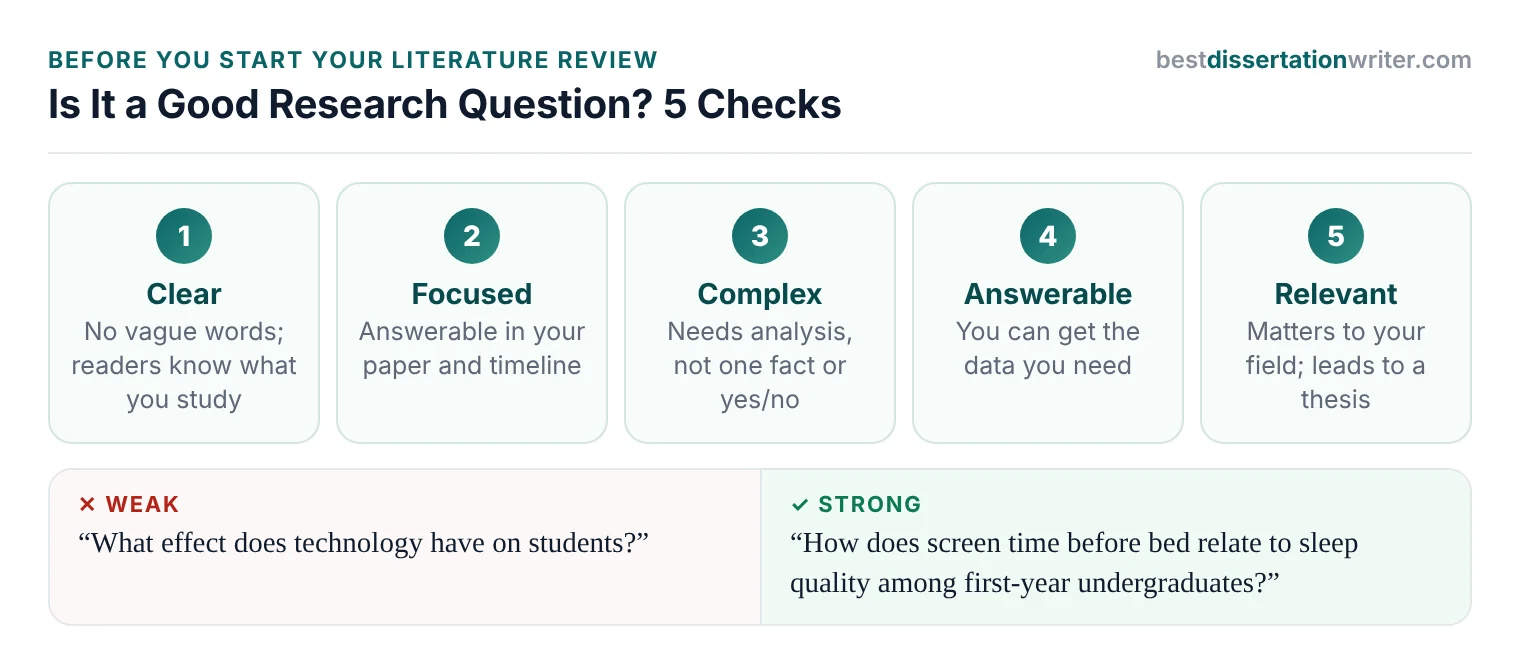
- Clear: the question is specific enough that readers know exactly what you will study, with no vague words such as “impact of technology”.
- Focused: the question is focused enough to answer within your paper or dissertation; if it needs a book to answer, it is still a broad topic.
- Complex: the answer requires synthesis and analysis of ideas and sources, not a single statistic. Good questions require both research and analysis.
- Answerable: you can collect or find the data needed; a research question complex in theory but impossible to study in practice will stall your project.
- Relevant and arguable: the answer matters to your field and can lead to an arguable thesis rather than a fact everyone accepts.
Clear vs unclear: how one question improves
The George Mason guide gives a useful pattern: start with an unclear version of this question, then make each vague part specific.
- Unclear version: “What effect does technology have on students?” The research question is so broad that it could cover any technology, any student and any effect.
- Clearer version: “How does screen time before bed relate to sleep quality among first-year undergraduates?” It names the technology use, the group and the outcome.
How to Narrow a Broad Topic into a Focused Research Question
Most first drafts start too wide, so narrowing is the part of how to write a research question that takes the most time. Each narrowing step should cut the topic without losing what made it interesting.
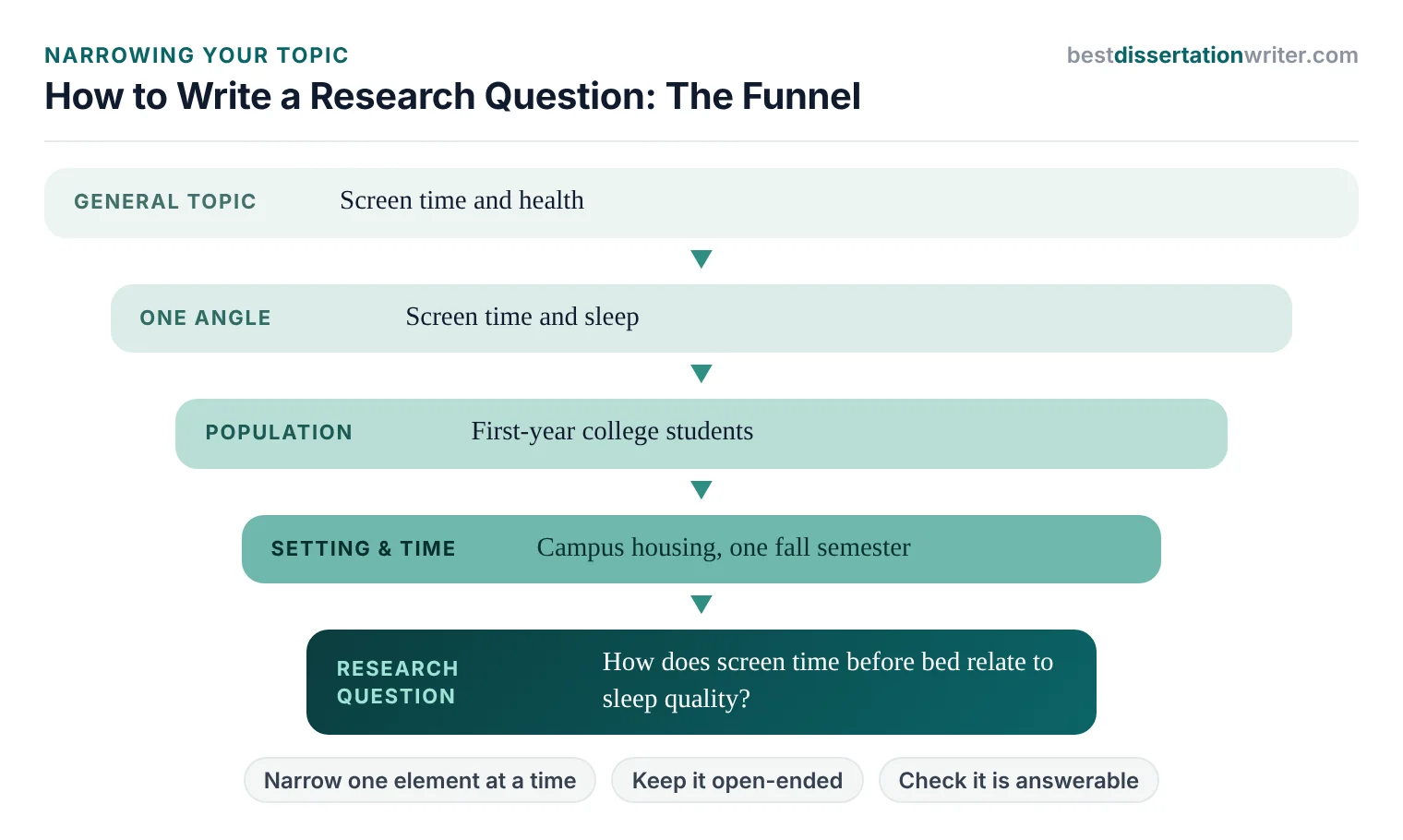
- Pick one angle: choose one aspect of the topic, such as sleep quality rather than “health”.
- Name a population: say who the question is about, such as first-year undergraduates.
- Add a setting: name a place or context, such as campus housing at one university.
- Add a time frame: limit the period, such as one fall semester.
- Use the gap you found: preliminary research and a short literature search help you narrow your focus to what has not been answered yet.
| Stage | Example |
|---|---|
| Broad topic | Screen time and health |
| Narrower topic | Screen time and sleep among college students |
| Draft question | “How does screen time affect students’ sleep?” |
| Focused research question | “How does screen time in the hour before bed relate to sleep quality among first-year undergraduates in campus housing?” |
Once you have worked out how to write a research question that is narrow enough, record its boundaries in your scope and delimitations so readers know exactly what the study covers.
Research Question Examples: Weak vs Strong Sample Research Questions
Comparing a weak and a strong version is the quickest way to see how to write a research question that holds up, and what to fix in your own draft. All examples are illustrative, not taken from published studies.
Too broad
Weak
“How does social media affect teenagers?”
No platform, no group, no outcome; the question could fill a career.
Strong
“How does daily Instagram use relate to body image scores among girls aged 13–17 in U.S. public high schools?”
Names the platform, the population, the setting and a measurable outcome.
Yes-or-no question
Weak
“Is remote work popular with employees?”
Answerable with a single word, so there is nothing to analyze.
Strong
“How does remote work flexibility influence employee retention in small and midsize technology firms?”
Open-ended and needs evidence from several sources to answer.
Assumes the answer
Weak
“Why is minimum wage harmful to small businesses?”
Builds the conclusion into the question, so the study is biased from the start.
Strong
“How did the 2024 state minimum wage increase affect hiring at small businesses in three metropolitan labor markets?”
Neutral wording leaves room for any result.
Not answerable
Weak
“What will education look like in 100 years?”
No data can answer it, so it is speculation rather than research.
Strong
“How does culturally responsive pedagogy relate to academic engagement among first-generation college students?”
Researchable with surveys, interviews or existing records.
Sample research questions by field
Open the field closest to yours. Each example shows how to write a research question in that field, moving from a broad topic to a good research question.
Health and nursing
Broad topic: chronic disease care in low-income communities.
Research question: “How do community health workers influence diabetes self-management among low-income adults in urban clinics?” See a full study built on this topic: community health workers and chronic disease management.
Education
Broad topic: teacher well-being.
Research question: “How do emotion regulation strategies predict burnout among early-career teachers in public schools?” See the example study on emotion regulation and teacher burnout.
Business and management
Broad topic: leadership and teamwork.
Research question: “How do transformational leadership and psychological safety predict innovation in cross-functional project teams?” See the example on leadership and psychological safety.
Criminal justice and social science
Broad topic: trust in police.
Research question: “How does perceived procedural justice influence public trust in law enforcement after policy reform?” See the example on procedural justice and public trust.
For complete Chapter 1 samples that show the research question in context, browse our dissertation introduction examples.
Common Mistakes When You Write a Research Question, Plus a Checklist
Most weak research questions fail for the same few reasons, whatever the field. Knowing them is as useful as knowing how to write a research question in the first place, so check your draft against this list.
- An unfocused research question: the question names a topic but no population, setting or outcome.
- A yes-or-no question: it can be answered without analysis, so it cannot carry a paper.
- A loaded question: the wording assumes the answer and invites bias.
- A question your data cannot answer: the methods, time or access you have do not match what the question needs.
- A question that drifts: the question changes during writing, but the introduction and methods still describe the old one.
Final checklist
- One clear question: one main research question, with sub-questions only if each needs its own answer.
- Specific terms: the population, setting, variables or phenomenon and time frame are named.
- Right type: the question words fit your design (quantitative, qualitative or mixed methods).
- Aligned with Chapter 1: the question follows from your problem statement and matches your research objectives; for quantitative studies, each question has a matching hypothesis test.
- Checked with others: your supervisor or writing center agrees it is answerable in your timeline; a quick check now is part of how to write a research question that survives your proposal review.
For more on testing whether a problem is worth studying, see the USC Libraries research guide on the research problem and question. To see how the research question fits the rest of your study, read our guide to the dissertation introduction chapter.
Frequently Asked Questions About How to Write a Research Question
What is a good research question example?
A good example is “How does screen time in the hour before bed relate to sleep quality among first-year undergraduates in campus housing?” It works because it names the variables, the population and the setting, and it cannot be answered with a simple yes or no. It is narrow enough to study in one semester, yet complex enough to need data collection and analysis. Notice that the wording is neutral: it asks how the two variables relate rather than assuming that screen time harms sleep, which keeps the study open to any result.
How many research questions should a dissertation have?
Most dissertations have one main research question and two to four sub-questions, although some programs prefer three to five questions of equal weight. Each question should need its own analysis and should link back to your problem statement and research objectives. Too many questions spread your time and data thinly and make Chapter 4 hard to organize. If two questions can be answered with the same analysis, merge them. Always check your program handbook, because some departments set an exact number or ask for hypotheses instead.
What are the 5 steps to write a research question?
The five steps are: choose a general topic you care about; do preliminary research to see what is known and where the gaps are; consider your audience and why the question matters to them; ask several open-ended “how” and “why” questions about the narrowed topic; and evaluate each draft for clarity, focus and complexity before choosing the final version. Expect to revise the question several times as you read more. The flowchart and steps above show each stage with a worked example on screen time and sleep.
What is the difference between a research question and a hypothesis?
A research question asks what you want to find out, while a hypothesis predicts the answer in a form you can test statistically. For example, the question “How does screen time relate to sleep quality?” could become the hypothesis “Students with more screen time before bed report lower sleep quality.” Quantitative studies usually pair each research question with a null and an alternative hypothesis. Qualitative studies normally use research questions only, because they explore experiences and meanings rather than test predictions with numerical data.
Where does the research question go in a research paper?
In a research paper, the research question usually appears at the end of the introduction, after you explain the background and the gap your study addresses. In a dissertation, it sits in Chapter 1, typically after the problem statement and the purpose of the study, and it is repeated in the methodology chapter. Some writers also restate it at the start of the results and discussion so readers can follow the answer. Keep the wording identical every time it appears, because small changes can confuse examiners about your aim.
Once you learn how to write a research question, the process stays the same for every research topic and every stage of the research and writing process: start with a broad topic, narrow it with preliminary research, and test each draft until it is clear, focused and answerable. For the full picture of how each chapter fits together, see our guide on how to write a dissertation.
Best Dissertation Writers
Need help writing your dissertation introduction?
Our expert writers can help you draft your background, problem statement, purpose and research questions to your brief.