

How to Write a Theoretical Framework in Research Papers, with Examples
 By Dr. Robertson Prime, Research Fellow
Updated October 21, 2026
14 min read
About 2,800 words
By Dr. Robertson Prime, Research Fellow
Updated October 21, 2026
14 min read
About 2,800 words
A theoretical framework is the existing theory, or set of theories, that explains why your research problem exists and how your key concepts relate. It gives your study a lens for what to look for and how to interpret it. This guide shows you how to develop a theoretical framework for a research paper, thesis or dissertation, step by step.
- Clear definitions: what a theoretical framework is, what it provides and how it differs from a conceptual framework.
- A practical method: five steps to write a theoretical framework, with a flowchart and a copyable template.
- Real examples: common examples of theoretical frameworks by field, plus weak vs strong versions.
On this page
Key takeaways
- A theoretical framework applies an existing theory to your research problem.
- A conceptual framework maps your own variables and how you expect them to relate.
- Choose a theory that fits your research question, then define its key concepts.
- Use the framework in your methods, analysis and discussion, not only in one section.
What Is a Theoretical Framework in Research?
A theoretical framework in research is the structure of ideas that supports your study, whatever your research topic. It names the theory you are using, defines its key concepts and explains how that theory helps you understand your research problem.
- A plain definition: the theoretical framework is the set of relevant theories, concepts and assumptions that guide your research from the research question to the conclusions.
- Where it comes from: it draws on existing knowledge and foundational research, usually theories that other scholars have already tested and published.
- What it does: it explains why you expect certain relationships between the variables in your study and gives you terms to describe them.
- Why examiners care: theories underpin a research study; without a clear framework, the entire research project can look like a list of findings with no explanation behind them.
The University of Southern California’s research guide on theoretical frameworks describes it as the structure that holds or supports a theory of a research study. In practice, it is the bridge between theory and your own data.
What a theoretical framework provides
A strong framework provides direction at every stage of the research process, and academic research benefits from it in very practical ways. It is not decoration added after the study is done.
- A focus: the framework provides a reason to study some variables and ignore others.
- Research questions and hypotheses: it suggests what to ask and, in quantitative studies, what to predict.
- A design logic: it shapes your research design, your choice of research methods, your data collection tools and your sampling.
- An interpretation lens: it gives you a way to explain results and compare them with existing research.
- A contribution: testing or extending a theory is how you make an original contribution to your research area.
The role of theory in qualitative research
Theory in qualitative research works a little differently from theory in survey or experimental studies. It guides what you notice rather than what you predict.
- Quantitative and qualitative studies differ: quantitative research often tests a theory, while qualitative research often uses a theoretical lens to explore meaning or builds new theory from data.
- Theoretical frameworks in qualitative research: in social research, a lens such as symbolic interactionism or a phenomenological perspective shapes your interview questions and coding.
- Mixed-methods research: one framework can link the numeric and narrative strands so they answer the same research problem.
- Grounded approaches: some qualitative research methods build theory from the data; see our guide to theoretical sampling for how this works.
Theoretical and Conceptual Frameworks: The Difference
Students often use the two terms interchangeably, but conceptual and theoretical frameworks do different jobs. Understanding the difference between a theoretical framework and a conceptual framework helps you write both clearly.
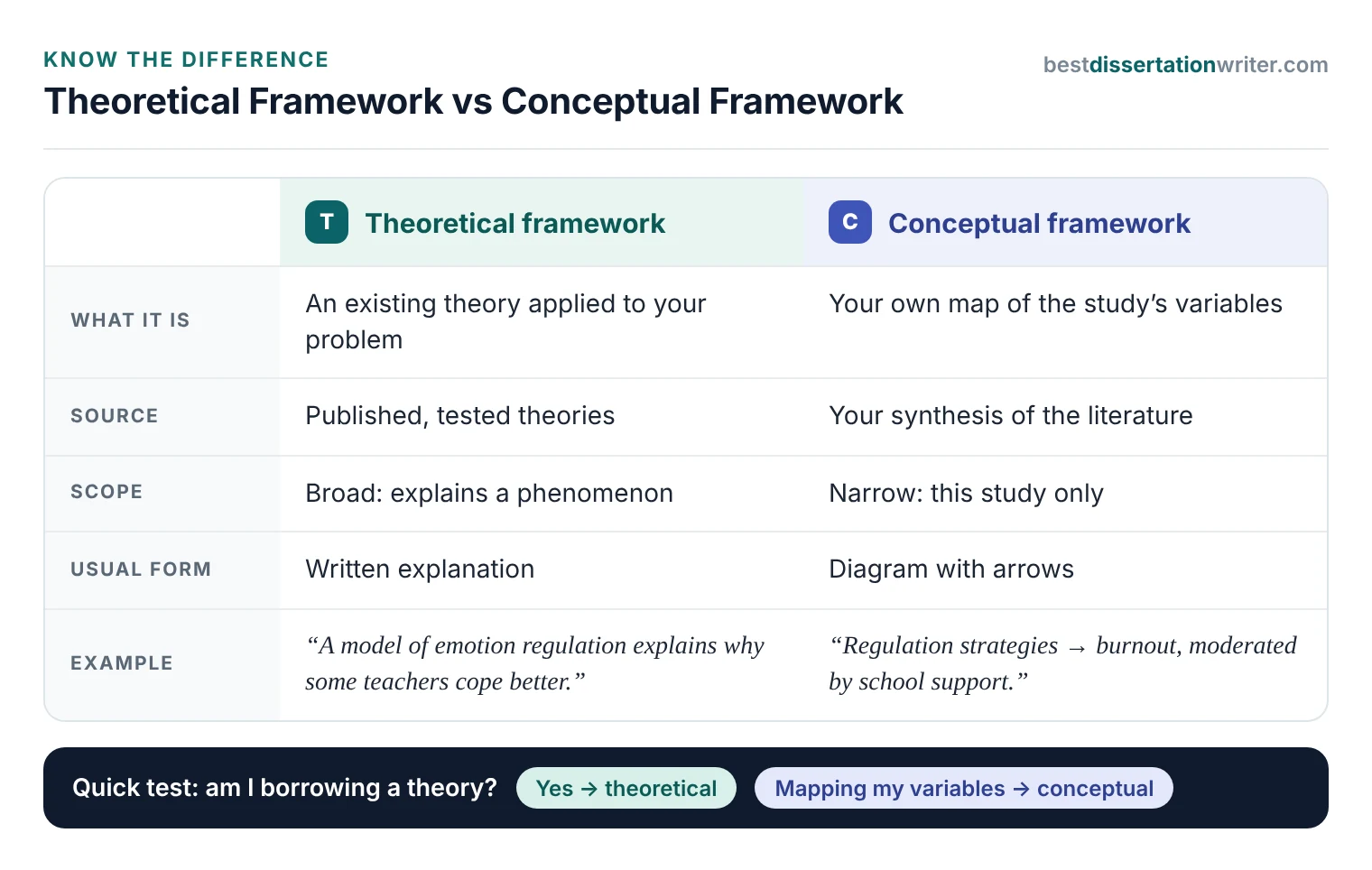
| Feature | Theoretical framework | Conceptual framework |
|---|---|---|
| Based on | One or more existing, tested theories | Your own synthesis of concepts from the literature review |
| Scope | Broad explanation of a phenomenon | Specific to your study’s variables |
| Form | Written explanation of the theory and its key concepts | Often a diagram or conceptual model with arrows |
| Main question it answers | Why do these things relate? | How do I expect these variables to relate here? |
What a conceptual model adds
A conceptual framework often appears as a conceptual model: a diagram that shows your independent, dependent and moderating variables. It turns theory into a map of your specific research.
- It names your variables: it lists the variables in your study and the direction of each expected relationship.
- It shows your logic: arrows make the expected relationships easy for reviewers to follow.
- It links to the theory: each arrow should be justified by the theory or prior studies.
How to Develop a Theoretical Framework in 5 Steps
You can develop a theoretical framework by moving from your research question to the theory, and back again. Follow these five steps to write a theoretical framework that fits your study.
- Start with your questionName the key concepts
- Search the literatureFind relevant theories
- Compare theoriesPick the best fit
- Define and connectConcepts and links
- Apply itMethods to discussion
- Step 1: Identify the key concepts in your research question. Underline the main ideas in your research problem and research question, such as “emotion regulation” and “teacher burnout”. These key concepts tell you which theories to look for.
- Search the literature for relevant theories. During your literature review, note which theoretical approaches other researchers used to study the same concepts. Look for theories that appear repeatedly in recent journal articles in your research area.
- Compare and select the theory that fits best. Judge each candidate by how well it explains your research problem, whether it has been tested with your population, and whether its concepts can be measured or observed in your research design.
- Define the concepts and explain the connections. Define each key concept as the theory uses it, cite the original theorists and explain how the theory predicts or explains the relationships in your study.
- Apply the framework across your study. Show how the theory guides your research questions and hypotheses, your data collection, your analysis of the research results and your discussion.
Developing the theoretical lens for your research question
When developing the theoretical lens, keep checking that the theory and your research question point the same way. A mismatch is the most common reason examiners ask for revisions.
- Fit the level: a theory about individual motivation suits a question about individual behavior, not one about national policy.
- Fit the method: if the theory’s concepts cannot be measured or observed, it will not guide your research methods.
- Combine carefully: two theories can work together in one research framework, but explain clearly what each contributes.
- Stay specific: one specific theoretical framework is more useful than a long tour of every theory you read.
How long should the framework section be in doctoral research?
Length depends on the type of document. Doctoral research usually needs more depth than a journal article or a master’s research paper.
- Journal article: often a few paragraphs within the introduction or literature review.
- Master’s thesis or dissertation: commonly a dedicated subsection of two to four pages.
- Doctoral research: a theoretical framework in dissertation research is sometimes a full chapter, especially when the study extends or tests a theory and adds new theoretical work.
Where the Framework Section Goes in a Research Paper
The framework section can sit in different places depending on your field and your program’s template. What matters is that readers meet the theory before they meet your methods.
Position your theoretical framework in a dissertation
In a thesis or dissertation, there are three common places for this section. Check your handbook, then choose the one that suits your study.
- Chapter 1, the introduction: a short overview of the framework after the problem statement and purpose, as shown in our dissertation introduction chapter guide.
- Chapter 2, the literature review: a full section explaining the theory, its development and how others have used it.
- A separate chapter: some social science research programs ask for a stand-alone theory chapter.
Theory to research: linking the framework to your research methodology
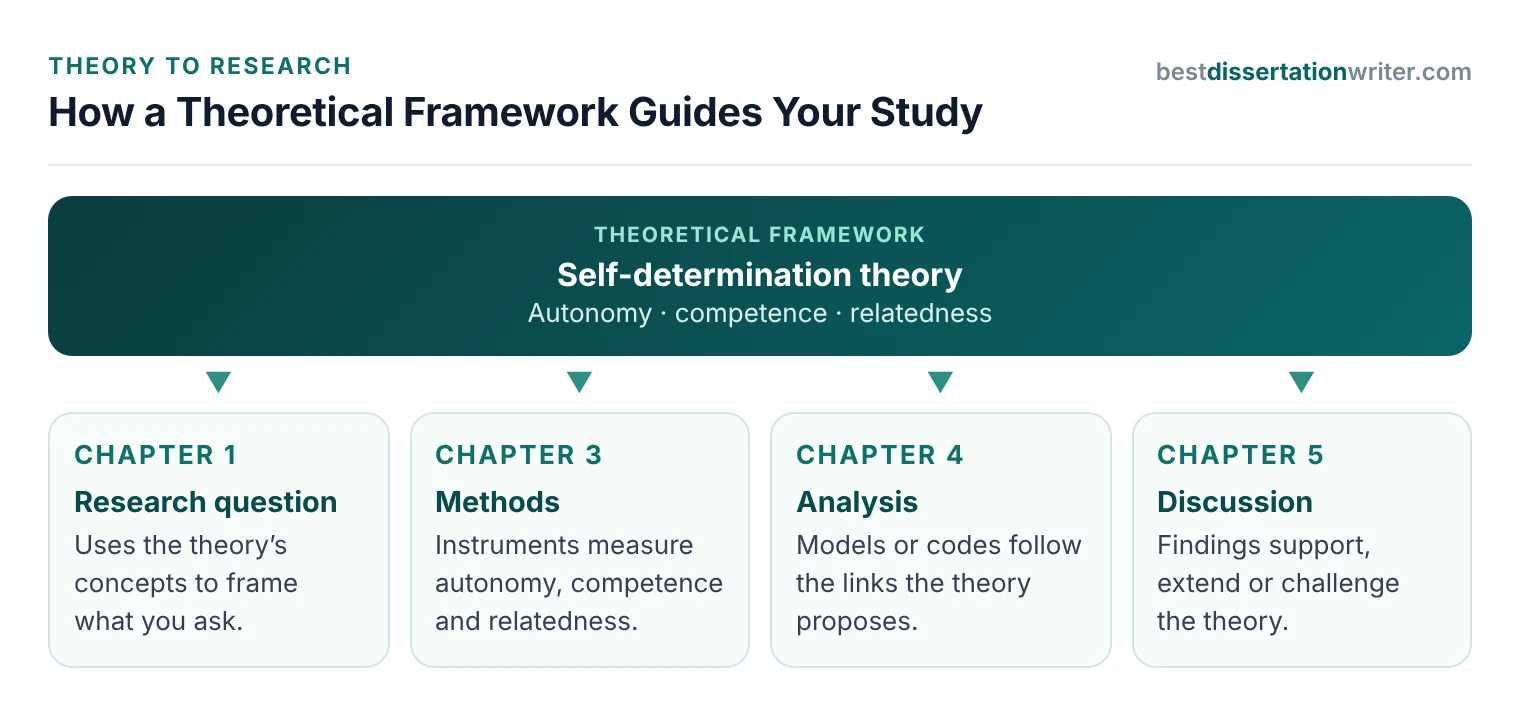
Moving from theory to research means showing how the framework shapes each choice in your research methodology. Integrating the theory this way gives your study consistent theoretical framing.
- Research questions: each question should use concepts named in the theory.
- Instruments: survey scales and interview guides should measure or explore the theory’s concepts; our Chapter 3 methodology example shows this in practice.
- Analysis: codes or statistical models should reflect the relationships the theory proposes.
- Discussion: explain whether your findings support, extend or challenge the theory.
Examples of Theoretical Frameworks in Social Science Research
These examples of theoretical frameworks are widely used in social science and practical research. Each one has guided many research studies, so you will find plenty of prior work to build on.
| Theory | Key theorists | Often used to study |
|---|---|---|
| Social cognitive theory | Albert Bandura | Learning, self-efficacy, health behavior |
| Self-determination theory | Edward Deci and Richard Ryan | Motivation in education and work |
| Theory of planned behavior | Icek Ajzen | Intentions, consumer and health choices |
| Attachment theory | John Bowlby | Relationships and child development |
| Transformational leadership theory | James MacGregor Burns; Bernard Bass | Leadership, teams and innovation |
| Technology acceptance model | Fred Davis | Adoption of new technology |
How these theories guide practical research
The same theory can guide research in very different fields. Here is how a theoretical framework for understanding behavior shapes three studies.
- Psychology: attachment theory can explain differences in relationship satisfaction among young adult couples.
- Management: transformational leadership theory guides research on team climate, such as studies of transformational leadership and psychological safety in project teams.
- Education: a model of emotion regulation can frame survey research on emotion regulation and teacher burnout.
Weak vs Strong Theoretical Framework and Conceptual Framework Examples
Seeing weak and strong versions side by side is the quickest way to improve your draft. Each pair below shows a common mistake and how to fix it.
Theoretical framework: naming vs applying
Weak
“This study uses self-determination theory. The theory has been used in many studies about motivation.”
Names the theory but never explains its concepts or why it fits this study.
Strong
“This study draws on self-determination theory (Deci and Ryan), which proposes that motivation depends on three needs: autonomy, competence and relatedness. Because remote work changes all three, the theory offers a lens for explaining why flexibility may influence employee retention.”
Defines the key concepts, cites the theorists and links them to the research problem.
Conceptual framework: vague vs mapped
Weak
“Many factors affect burnout, and this study looks at them.”
No variables, no direction and no link to theory.
Strong
“The conceptual framework proposes that emotion regulation strategies (independent variable) predict burnout (dependent variable) among early-career teachers, and that school support moderates this relationship.”
Names each variable, its role and the expected relationship.
Fit with the research question
Weak
“Maslow’s hierarchy of needs explains why consumers trust AI-generated marketing.”
The theory does not address trust or technology, so the fit is weak.
Strong
“The technology acceptance model, extended with a trust construct, frames how perceived usefulness and trust shape purchase intention across generations.”
The theory’s concepts match the variables in the research question.
Full theoretical framework examples
Open each example to see a complete section you can model.
Quantitative example: remote work and retention
This study is grounded in self-determination theory, which holds that people are most motivated when three basic needs are met: autonomy, competence and relatedness. Remote work flexibility can increase autonomy, while also reducing day-to-day contact with colleagues.
The theory therefore suggests two competing effects on retention, which this study tests with survey data from small and midsize technology firms. See a full study on remote work flexibility and employee retention.
Qualitative example: community health workers
This study uses social cognitive theory as a theoretical lens to explore how community health workers support chronic disease self-management. The theory’s concept of self-efficacy guided the interview questions about how patients gain confidence in managing their condition.
During analysis, codes were compared with the theory’s concepts, while remaining open to themes the theory did not predict. The same approach works for many qualitative studies of health care roles.
Template to write a theoretical framework
Copy this template, then expand each part with evidence from your literature review.
Template
This study is grounded in [theory name], developed by [theorist(s)], which explains [what the theory explains]. Its key concepts are [concept 1], [concept 2] and [concept 3]. This theory fits the present study because [link to the research problem]. It guides the research questions, the choice of [instrument or method] and the interpretation of the findings.
Common mistakes to avoid
- Listing theories without choosing: a tour of six theories confuses readers; pick the one or two that guide your research.
- Using the theory only once: a framework that disappears after Chapter 2 does not guide the research at all.
- Confusing the two frameworks: keep the theory explanation and the variable map clearly separate.
- Treating it as an add-on: integrating a theoretical framework from the start is far easier than adding one after data collection.
- Citing summaries only: cite the original theorists as well as recent studies that applied the theory.
Academic writing about theory can be hard to get right on the first draft. If you need support, our writers can help with your framework and the rest of your thesis or dissertation; you can also review our guides on how to write a research paper and how to write a dissertation.
Theoretical Framework FAQs
What is a theoretical framework in simple terms?
A theoretical framework is the existing theory you use to explain your research problem. Think of it as a lens: it tells you which ideas matter, how they should relate and how to make sense of your results.
For example, a study on teacher burnout might use a model of emotion regulation to explain why some teachers cope better than others. The framework names the theory, defines its key concepts and shows how they connect to your research question, so readers understand the reasoning behind your whole study.
What is the difference between a theoretical framework and a conceptual framework?
A theoretical framework is based on an established theory that other scholars have developed and tested. A conceptual framework is your own map of the specific variables in your study and how you expect them to relate, often shown as a diagram.
The theory explains why the relationships should exist, while the conceptual framework shows which relationships you will examine. Many dissertations include both, with the conceptual framework built on the theory. Keeping them separate makes your reasoning easier for examiners and reviewers to follow and assess.
Does every research paper need a theoretical framework?
Most theses and dissertations need one, and many journals expect one in social science research. Some research papers, such as descriptive studies or practical research reports, may rely on a looser set of concepts instead of a single theory.
Qualitative studies that build theory from data may present the framework differently, but they still explain the ideas that guided the work. If you are unsure, check your program’s handbook or ask your supervisor. Including a clear framework rarely hurts and usually makes your study more convincing and coherent.
How do I choose the right theory for my study?
Start with the key concepts in your research question, then look for theories that explain those concepts in your literature review. Shortlist theories that appear repeatedly in recent studies on your topic.
Choose the one that best explains your research problem, has been used with similar populations and has concepts you can measure or observe. Avoid picking a theory only because it is famous. Your supervisor can confirm the fit, and reading two or three studies that used the theory will show you how to apply it in your own work.
Can I use more than one theory in my framework?
Yes, many studies combine two theories when one alone cannot explain the research problem. For example, a study might pair a motivation theory with a leadership theory to explain team performance. The key is to explain what each theory contributes and how they fit together, rather than listing them side by side.
Avoid using too many theories, which makes the framework hard to apply consistently. Two well-integrated theories are usually the practical limit for a thesis or dissertation, and one is often enough for a journal article.
Best Dissertation Writers
Need help writing your dissertation introduction?
Our expert writers can help you draft your background, problem statement, purpose and research questions to your brief.