

How to Write the Scope and Delimitations of Your Study
 By Dr. Robertson Prime, Research Fellow
Updated October 17, 2026
18 min read
About 3,700 words
By Dr. Robertson Prime, Research Fellow
Updated October 17, 2026
18 min read
About 3,700 words
Every research paper or thesis needs clear edges. The scope and delimitation section gives your study those edges: it tells your committee what the study covers and which parts of the topic you deliberately set aside.
- It prevents scope creep: your study’s scope and delimitations make your research manageable and keep your research question answerable.
- It makes findings easier to defend: readers know exactly who and what the conclusions apply to.
- It keeps you relevant: clear boundaries make your study more relevant to the problem it addresses.
This guide explains what scope and delimitations in research mean, shows you how to write the scope and delimitations step by step, and compares weak and strong examples. You will also find copyable templates, full examples for different research designs, and a clear explanation of delimitations vs limitations.
On this page
Key takeaways
- The scope describes what your study covers: topic, population, setting, time frame, variables and research design.
- Delimitations are conscious decisions about what you leave out, each with a short reason.
- Limitations are different: they are weaknesses you could not control.
- Tie every boundary back to your research question and research problem.
What Is Scope and Delimitation in Academic Research?
In academic research, the scope and delimitation section sets the boundaries of the study before any data is collected. It answers two linked questions:
- Scope: what will this research study examine?
- Delimitations: what will it deliberately not examine, and why?
- Where it appears: most universities expect it in Chapter 1 of a dissertation, in a research proposal, and often in the introduction of a research paper.
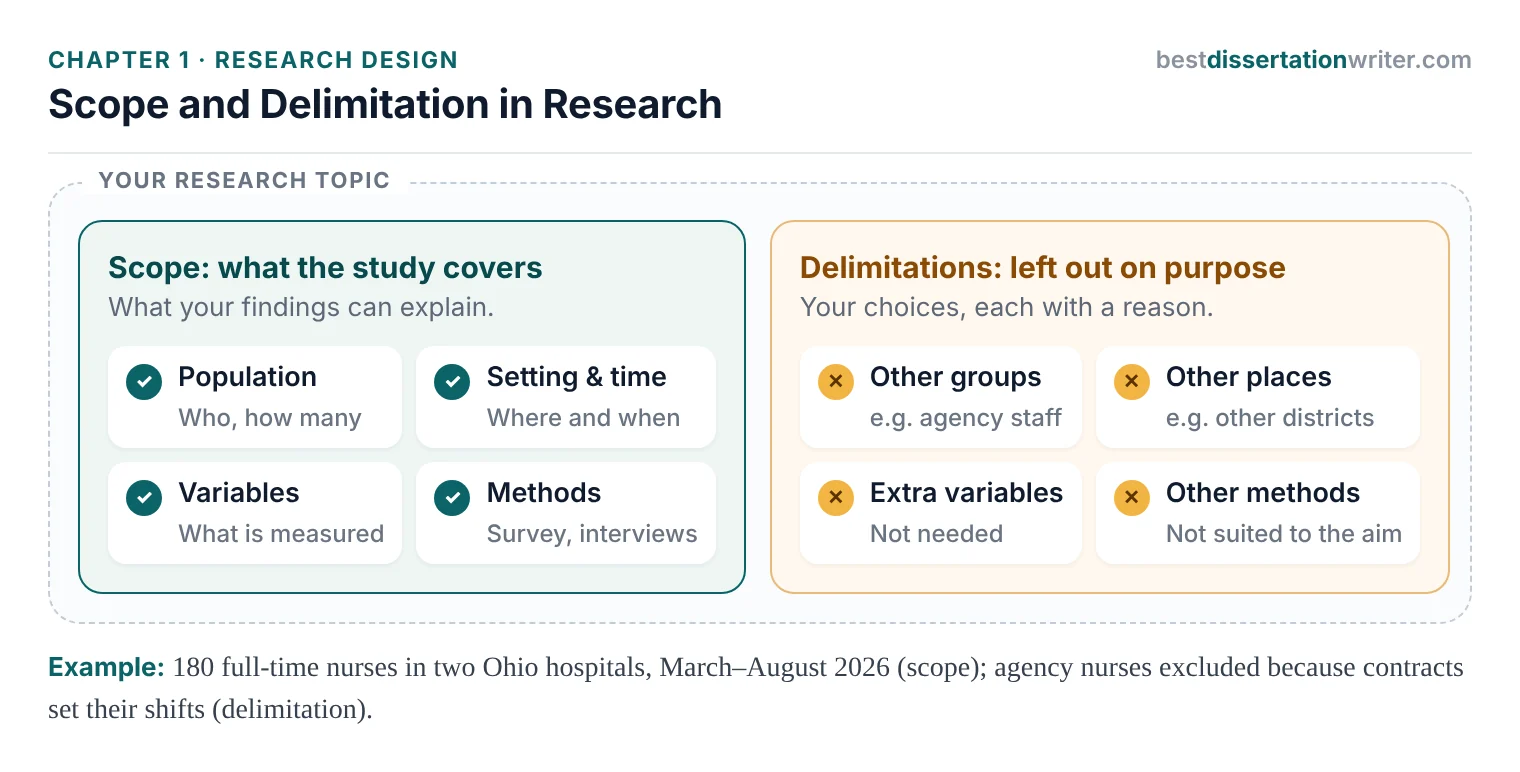
Scope of a study: what the study covers
The scope of a study describes the coverage of your research, that is, the aspects of the research you will investigate in depth. Think of the scope in terms of who, what, where, when and how:
- Who: the study and the population you will work with, and the sample size.
- What: the research topic and the key variables or concepts.
- Where: the setting, such as schools, hospitals, firms or a region.
- When: the study duration or data collection window.
- How: the research design and the research tools and analysis techniques you will use.
Defining the scope early saves time later, because every other part of your research, from the literature review to the analysis plan, depends on it.
Delimitations: the boundaries of your research
Delimitations are the boundaries of your research that you set on purpose. Put simply, delimitations are the sections of a wider topic that you decide not to study.
- What they are: delimitations are factors and variables you could have included but chose to exclude so the study stays focused and feasible.
- Who controls them: delimitations are within your control as the researcher; delimitations are deliberate.
- What to name: anything omitted from the research scope, such as other populations, places, periods, variables or methods.
- What makes them strong: carefully thought-out delimitations carry a reason, such as time, access, relevance to the research question, or the characteristics of the research design. Narrow, reasoned choices make the study easier to defend.
Why the Scope and Delimitation Section Matters in a Research Paper
The scope and delimitation section is a short section of a research paper, but it shapes everything that follows.
- Focus: a clearly defined scope turns a broad research topic into focused research you can actually finish.
- Credibility: it shows your committee that you understand your research area well enough to choose what matters most.
- Honest reach: readers judge a given piece of research partly by how clearly it states its boundaries; the boundaries of your study tell them how far your conclusions can travel.
- Validity: well-chosen boundaries contribute to research validity, because a fixed population, setting and variables keep data collection and analysis consistent.
- Alignment: a clear scope helps ensure that the research answers the question it set out to answer, so your conclusions align with your research evidence rather than stretching beyond it.
How scope connects to your research question
Your research question decides your boundaries, not the other way round.
- Scope: every element of the scope should help you answer your research question.
- Delimitations: every delimitation should remove something that would distract from it. If a boundary does not trace back to your research question, rethink it.
- Research problem: your scope should match the boundaries of the research problem you describe in the problem statement.
- Purpose: your delimitations should follow the purpose of the study, so Chapter 1 reads as one connected argument.
Where delimitations and limitations go in your dissertation
The two sections sit in different places, so readers can see which boundaries you chose and which you met along the way:
- Scope and delimitations: usually in the introduction chapter, after the research questions, the significance of the study and the theoretical framework.
- Limitations: usually later, in the methodology or discussion chapter, once you know what affected the study.
- Your template wins: the table below shows a typical placement; always follow your university’s template if it differs.
| Section | What it covers | Typical place |
|---|---|---|
| Scope | What the study covers: population, setting, time frame, variables, design | Chapter 1 (introduction) or research proposal |
| Delimitations | What you deliberately exclude, and why | Chapter 1, straight after the scope |
| Limitations | Weaknesses outside your control that affect the results | Methodology or discussion chapter |
How to Write the Scope of Your Research in 5 Steps
Settle the scope of the study before the delimitations, because the delimitations of the study describe what sits outside it. The five steps below build one scope statement piece by piece, using a running example on nurse burnout.
- Start from your research question. Put your main research question at the top of the page. Every element of the scope of your study must help answer it. Example: “How does shift length relate to burnout among registered nurses?”
- Name the population and sample. Say who or what will be included in the study and roughly how many participants, cases or documents. Example: 180 full-time registered nurses.
- Fix the setting and time frame. State where the study takes place and the study duration, such as one academic year or a six-month data collection window. Example: two public hospitals in Ohio, March to August 2026.
- List the variables or concepts. Name the key variables (quantitative) or the phenomena the study will explore (qualitative). Example: shift length and burnout scores.
- State the research design. Summarize your research design or methodology, data collection methods, and research tools and analysis techniques in one sentence. Example: a quantitative correlational survey analyzed with regression.
- Test it: could a stranger tell exactly what the study will cover? If not, define scope more precisely.
- Keep it short: one focused paragraph is enough for the description of the research; the methodology chapter gives the detail.
Template: scope statement
This [qualitative/quantitative/mixed-methods] study examines [main concept or relationship] among [population and sample size] in [setting] during [time frame]. The study focuses on [key variables or themes], using [data collection method] and [analysis technique].
How to Write Delimitations in a Research Paper
Once the scope is set, the second half of the scope and delimitation section begins: the delimitations of your study explain what sits outside it and show that every exclusion was a reasoned choice. Follow these steps to write clear delimitations of a study.
- List what you are leaving out. Note the populations, settings, time periods, variables, theories and methods you considered but will not use. Example: agency nurses, private hospitals, nurse managers and interview data.
- Give a reason for each one. Explain why each exclusion makes the study more focused or feasible, for example relevance, access or time. Example: agency nurses work shifts set by outside contracts.
- Link each reason to the research question. Show that the exclusion keeps the study aligned with what you set out to answer. Example: contract-set shifts would blur the link between shift length and burnout.
- Write in a confident tone. Delimitations are conscious decisions, not apologies. Avoid phrases such as “unfortunately” or “due to my weakness”. Example: “The study is delimited to…” rather than “The study could not include…”.
- Keep it short. One or two paragraphs, or a short list, is enough in most dissertations. Example: three delimitations, one sentence each.
When you define the scope and delimitations together, each part checks the other. Use these quick checks:
- Nothing unexplained: anything that is not part of your research scope should appear either nowhere or as a named delimitation.
- Mine your background section: the aspects of a research topic you mentioned in your background of the study but do not plan to investigate are candidate delimitations.
- Reasons, not gaps: strong delimitations of a research study read as reasoned choices, each with its explanation.
Template: write the scope and delimitations in one paragraph
Template: delimitations
This study is delimited to [population] in [setting]. [Excluded group or variable] were not included because [reason linked to the research question]. The study also excludes [method, theory or time period] because [reason]. These delimitations were set to keep the study focused on [core aim].
Weak vs Strong Scope and Delimitations in Research
Comparing a weak and a strong version is the fastest way to improve your own scope and delimitation paragraph. In each pair below:
- Weak: the kind of statement committees send back, with the problem noted underneath.
- Strong: a version you can adapt, with what makes it work. Notice that every strong version names specifics and gives a reason.
All examples are illustrative, not taken from real studies.
Scope statement
Weak
“This study looks at nurses and burnout.”
The research scope is too broad: no population size, setting, time frame or design.
Strong
“This quantitative study examines the relationship between shift length and burnout scores among 180 registered nurses in two public hospitals in Ohio between March and August 2026.”
Names the population, setting, time frame, variables and design.
Population delimitation
Weak
“Some people were not included in the study.”
Vague: readers cannot tell who was excluded or why.
Strong
“Agency and travel nurses were excluded because their shift patterns are set by external contracts, which would confound the effect of shift length.”
Specific exclusion with a reason tied to the research question.
Method delimitation
Weak
“Interviews were not done due to lack of time.”
Sounds like an apology and reads as a limitation.
Strong
“The study is delimited to survey data because the research question concerns patterns across a large sample rather than individual experiences.”
Frames the choice as a deliberate design decision.
Time and setting delimitation
Weak
“The study covers schools.”
No location or period, so the findings have no clear boundary.
Strong
“The study focused on six public middle schools in one Texas district during the 2025–26 school year; private and charter schools were excluded because they follow different curriculum rules.”
Clear setting, period and justified exclusion.
Examples of Delimitations and Scope Statements by Research Type
These full examples show how the scope and delimitations section reads in finished form across quantitative, qualitative research and mixed-methods designs. Open the one closest to your own research design and replace the details with your own study.
Quantitative example: social media use and academic performance
Scope. This correlational study examines the relationship between daily social media use and grade point average among 300 undergraduate students aged 18–22 at one public university in California during the spring 2026 semester. Data will be collected through an online survey and analyzed using multiple regression.
Delimitations. The study is delimited to full-time undergraduates; graduate and part-time students were excluded because their course loads differ. It focuses on time spent on social media and does not examine content type, as the research question concerns usage volume. Qualitative interviews were not included because the study aims to identify patterns across a large sample.
Qualitative example: teachers’ experiences of hybrid learning
Scope. This qualitative study will explore the lived experiences of 12 elementary school teachers who moved to hybrid teaching in one Florida school district. Semi-structured interviews will be conducted over eight weeks and analyzed using thematic analysis.
Delimitations. The study is delimited to classroom teachers; administrators, parents and students were excluded because the research question concerns teachers’ own experiences. Secondary schools were excluded because hybrid models there differ in structure. The study does not measure learning outcomes.
Mixed-methods research proposal example: community attitudes to solar energy
Scope. This proposed mixed-methods study will cover household attitudes toward rooftop solar adoption in one coastal county in North Carolina. A survey of 200 households will be followed by 15 interviews, and the study will cover the 2026–27 planning period.
Delimitations. The research project is delimited to rooftop solar; wind and community solar schemes were excluded because local incentives apply only to rooftop systems. Businesses were excluded to keep the focus on household decision-making. These delimitations were set to match the research proposal’s funding period and aims.
For more complete Chapter 1 samples, see our dissertation introduction examples, where you can read how the scope and delimitations sit alongside the other introduction sections.
Delimitations vs Limitations: The Difference Between Delimitations and Limitations
Confusing delimitations with limitations is one of the most common problems examiners flag. The difference is control:
- Delimitations: choices you make before the study starts.
- Limitations: weaknesses you discover or cannot avoid, such as a low response rate.
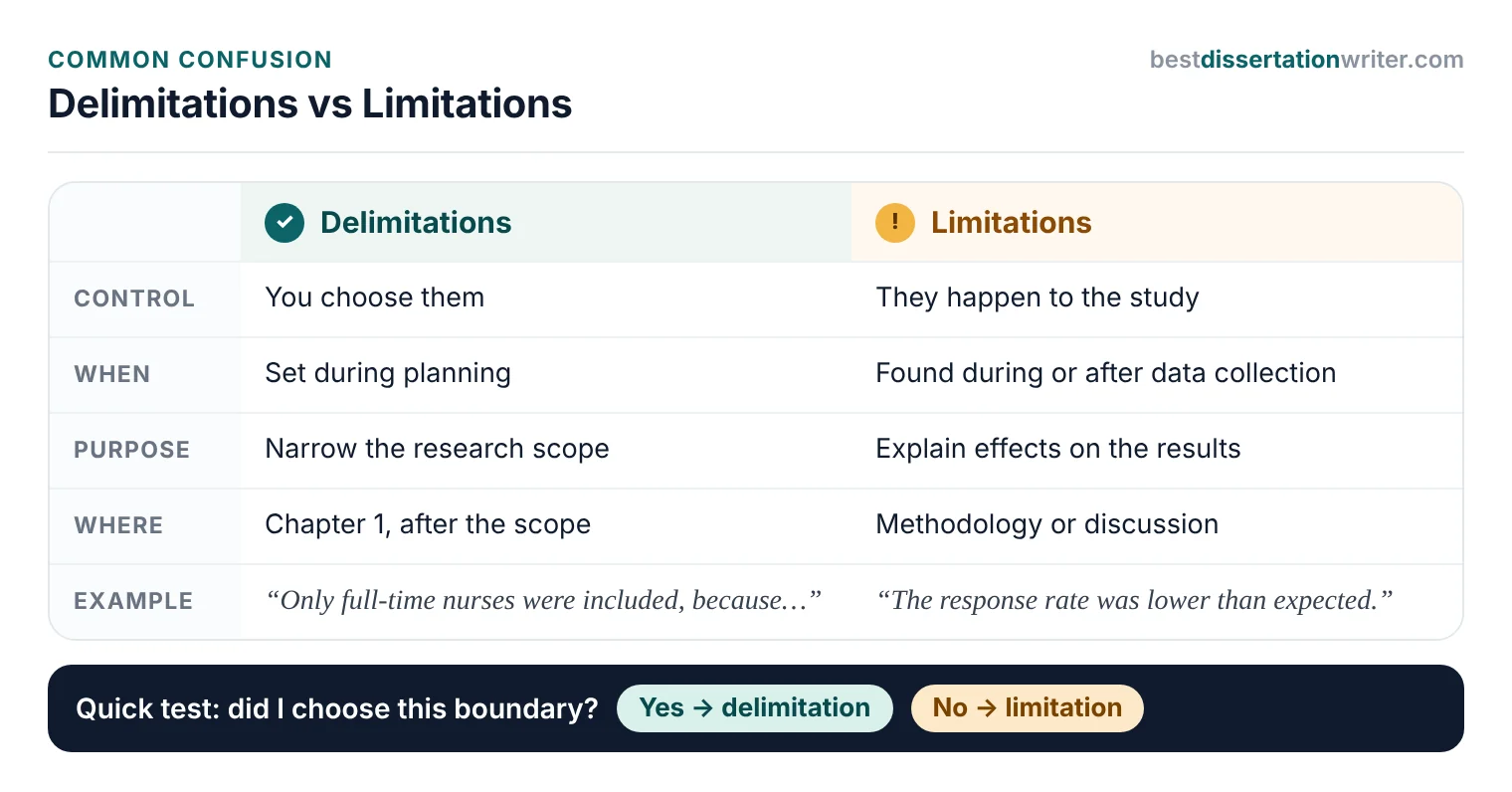
Not sure which label fits? Run each boundary in your draft through this quick sort:
| Boundary in your draft | Label | Why |
|---|---|---|
| “Only full-time nurses were included.” | Delimitation | Within the researcher’s control: you chose the population. |
| “The response rate was lower than expected.” | Limitation | Outside the researcher’s control: it happened during data collection. |
| “Data came from one hospital to match the research question.” | Delimitation | A planned setting choice, though it may also limit how far findings generalize. |
| “Participants may have under-reported burnout.” | Limitation | Self-report bias affects the results; you cannot fully control it. |
| “Interviews were not used.” | Delimitation | A design decision, as long as you give a reason linked to the research question. |
Delimitations and limitations still work together, and the scope and delimitations also shape which limitations you will report:
- One can create the other: studying one hospital, for instance, may limit how far the findings generalize.
- Report both, in their places: mention the delimitation in Chapter 1 and the resulting limitation later. Our guide to limitations of the study shows how to write that part.
Common Mistakes in the Scope or Delimitations Section
Most weak scope and delimitation sections fail for the same few reasons. Check your draft against this list before you submit it.
Signs your research scope is too broad
Setting an overly broad scope is the most frequent mistake. Watch for these signs of a scope too broad to finish in your timeline:
- No named population or setting: the study could apply to anyone, anywhere.
- No time frame: there is no clear start or end to data collection.
- Too many variables: several unrelated variables, or a topic that could fill a whole career.
- Hard design choices: a broad scope makes it hard to choose a sample and a research design.
The fix is to narrow one element at a time: the population, then the setting, then the variables, narrowing the study to make it feasible. A study focused this way has clear boundaries of a research project that a committee can approve.
Other mistakes to avoid
- Listing exclusions without reasons. Each delimitation needs a short justification, or it looks arbitrary.
- Mixing up the terms. Keep delimitations (choices) separate from limitations (constraints).
- Writing apologetically. Present boundaries as decisions that strengthen the study.
- Losing the link to the research question. Bring every boundary back to your research question.
- Burying the section. Place it where your template expects it, usually in Chapter 1.
Tips for writing scope and delimitations clearly
- Plain, specific wording: write the scope and delimitations clearly with short sentences, specific numbers and verbs such as “includes”, “excludes” and “focuses on”.
- Same order in both parts: readers can then match each boundary to what the study covers.
- Supervisor test: ask your supervisor to read the section alongside your research question; if they can predict your methods from it, the section is doing its job.
Final Checklist to Define Your Research and Define What the Study Excludes
Use this scope and delimitation checklist to define your research boundaries before you submit your proposal or Chapter 1. It also helps you define what the study will not do, so examiners do not expect more than you promise.
- Complete scope: it names the population, setting, time frame, variables and research design.
- Justified delimitations: each one is specific and has a reason.
- Clear links: every boundary links back to the research question and research problem.
- Right labels: delimitations are written as decisions; limitations are kept for later.
- Right place: the section matches your dissertation introduction chapter structure and your university template.
For an overview of how every chapter fits together, see our guide on how to write a dissertation. University guides such as the IUP dissertation overview and Nova Southeastern University’s dissertation guide on limitations and delimitations are also useful to compare with your own program’s rules.
Frequently Asked Questions About Scope and Delimitations
What is the scope and delimitation of a study?
The scope describes what a research study covers: the topic, the population and sample, the setting, the time frame, the key variables or concepts, and the research design. The delimitations are the boundaries you choose to set inside that topic, such as groups, places, periods, variables or methods you deliberately leave out, each with a short reason. Read together, the two tell your committee exactly what your findings can explain and where they stop, which makes the study easier to approve, defend and replicate.
How long should the scope and delimitations section be?
In most dissertations the section runs to one to three paragraphs, or roughly 200–400 words. A research paper or journal article may need only three to five sentences in the introduction or methods. Coverage matters more than length: name the population, setting, time frame, variables and design, then list each delimitation with its reason. If your university template sets a length or heading, follow it. When the section grows past a page, move detailed sampling or instrument information into the methodology chapter instead.
What are examples of delimitations?
Common delimitations limit the study to one population, such as full-time registered nurses; one location, such as a single school district; or one time period, such as the 2025–26 school year. Others narrow the variables, for example measuring time spent on social media but not content type, or fix the method, such as a survey rather than interviews. Follow each delimitation with a one-line reason linked to the research question, so readers see a deliberate design choice rather than a gap or weakness.
Is a small sample size a delimitation or a limitation?
It is usually a limitation, because a small sample often results from limited access, low response rates or time constraints rather than a free choice. The exception is a deliberately small, in-depth sample in a qualitative design, such as 12 interviews chosen for depth. In that case, describe the sample size and the reason for it in the scope, then note any effect on generalizability in the limitations section. Labeling it clearly in each place shows examiners you understand the difference between the two.
Where do scope and delimitations go in a dissertation?
They usually appear in Chapter 1, after the research questions, the purpose of the study and the significance of the study. Many programs place them just before the limitations and the definition of terms. Some universities ask for them in the research proposal or the methodology chapter instead, and a research paper often covers them briefly in the introduction or methods section. Always check your department’s dissertation template or handbook first, because the required heading and position vary between institutions and programs.
A clear scope and delimitation section takes a little time to write, but it saves weeks later by keeping your study focused. Draft the scope first, add a reason for every delimitation, and keep the whole section tied to your research question.
Best Dissertation Writers
Need help writing your dissertation introduction?
Our expert writers can help you draft your background, problem statement, purpose and research questions to your brief.