

The Impact of Neighborhood Social Cohesion on Adolescent Civic Engagement in Urban Communities
 By Dr. Robertson Prime, Research Fellow
Updated October 24, 2026
18 min read
About 3,600 words
By Dr. Robertson Prime, Research Fellow
Updated October 24, 2026
18 min read
About 3,600 words
This dissertation introduction example examines how neighborhood social cohesion relates to adolescent civic engagement in urban communities. It is a complete Chapter 1 for a quantitative, multilevel study of adolescents nested within neighborhoods.
Every reference in the chapter has been checked against its published source. The breakdown near the end shows how a multilevel design is explained to readers who may not be statisticians.
On this page
What this example shows
- Two levels of cohesion: the study separates neighborhood-level cohesion from each adolescent’s own perception.
- Nested data handled: the chapter explains why adolescents in the same neighborhood are not independent.
- A cross-level moderator: concentrated disadvantage may change how strongly cohesion matters.
- A new outcome: cohesion is well studied for problem behavior, so civic engagement is the gap.
Background of the Study: Neighborhood Social Cohesion and Youth
Introduction
Adolescent civic engagement, encompassing behaviors such as community volunteering, participation in local organizations, and involvement in collective problem-solving, is widely regarded as a developmentally significant precursor to adult civic and political participation, yet rates of adolescent civic engagement vary substantially across urban neighborhoods in ways that individual-level demographic and family factors alone do not fully explain (Flanagan & Levine, 2010; Wray-Lake & Abrams, 2020).
A substantial body of neighborhood-effects research has identified social cohesion, the degree of mutual trust, shared values, and willingness to intervene for the common good among neighborhood residents, as a significant predictor of a range of adolescent outcomes, yet its specific relationship to adolescent civic engagement, as distinct from related outcomes such as delinquency or academic achievement, has received comparatively less direct empirical attention within urban contexts (Sampson, 2012; Odgers & Adler, 2018).
This chapter introduces the background, problem, purpose, and design of a quantitative, multilevel study examining the impact of neighborhood social cohesion on adolescent civic engagement in urban communities, situating the inquiry within collective efficacy theory and civic development theory and identifying the empirical gap the proposed study is intended to address.
Background of the Study
Neighborhood social cohesion, most influentially theorized within Sampson’s collective efficacy framework, refers to the combination of mutual trust and shared values among neighborhood residents together with their shared willingness to intervene on behalf of the common good, a construct originally developed to explain neighborhood-level variation in violent crime but subsequently applied to a wide range of youth developmental outcomes (Sampson, 2012).
Collective efficacy theory proposes that socially cohesive neighborhoods generate stronger informal social control and more extensive intergenerational closure, in which adults beyond a youth’s immediate family monitor, support, and hold local adolescents accountable, mechanisms theorized to shape not only youths’ avoidance of problem behavior but also their orientation toward constructive community participation (Sampson et al., 1997).
Civic engagement during adolescence has been separately theorized within developmental psychology as an outcome shaped by youths’ sense of belonging, perceived efficacy, and opportunities for meaningful participation within their immediate community context, with foundational work by Youniss and colleagues arguing that adolescents develop civic identity substantially through participation in real community institutions and relationships rather than through abstract civic instruction alone (Flanagan & Levine, 2010; Youniss et al., 1997).
This developmental literature has documented that adolescents who perceive their neighborhoods as supportive, trustworthy, and responsive report greater civic identity development and are more likely to engage in sustained community participation, suggesting a plausible theoretical link between neighborhood social cohesion and adolescent civic engagement specifically (Wray-Lake & Abrams, 2020).
Empirical neighborhood-effects research has more extensively documented the relationship between neighborhood social cohesion and outcomes such as adolescent delinquency, internalizing symptoms, and academic achievement than civic engagement specifically, with several large multilevel studies establishing that neighborhood-level collective efficacy predicts reduced adolescent problem behavior even after controlling for individual and family-level risk factors (Odgers & Adler, 2018; Browning et al., 2017).
A smaller, more recent body of research has begun to extend this neighborhood-effects framework specifically to civic and prosocial outcomes, finding preliminary evidence that neighborhood cohesion is associated with greater adolescent volunteering and community organization participation, though this research has generally relied on relatively small samples, single-city designs, or cross-sectional data insufficiently able to account for the nested, multilevel structure of neighborhood and individual-level influences on civic outcomes (Ballard & Syme, 2016; Duke et al., 2009).
Urban communities present a particularly important, and understudied, context for this inquiry, given that urban neighborhoods exhibit substantially greater variation in social cohesion than suburban or rural areas, and given ongoing concern regarding civic disengagement among urban adolescents facing concentrated disadvantage, residential instability, and reduced access to civic-engagement-supporting institutions such as community centers and youth organizations (Sampson, 2012; Theokas & Lerner, 2006).
This concentration of both cohesion variation and civic engagement disparity within urban contexts specifically underscores the need for multilevel research directly testing the neighborhood social cohesion–adolescent civic engagement relationship within this population, a gap the present study is designed to address.
Problem Statement and Purpose of the Study
Statement of the Problem
While neighborhood social cohesion has been well established as a predictor of adolescent problem behavior and several other developmental outcomes, its specific relationship to adolescent civic engagement within urban communities remains insufficiently tested using multilevel designs capable of properly accounting for the nested structure of neighborhood and individual-level influence, leaving unclear the degree to which neighborhood-level cohesion, as distinct from individual or family-level factors, meaningfully predicts adolescent civic participation (Odgers & Adler, 2018; Duke et al., 2009).
Existing research linking neighborhood cohesion to civic-relevant outcomes has generally relied on small, single-city, or cross-sectional designs, limiting confidence in the generalizability and robustness of the relationship across the varied urban neighborhood contexts in which adolescent civic disengagement is of greatest policy concern (Ballard & Syme, 2016; Theokas & Lerner, 2006).
This gap is problematic because municipal youth development programs, school-based civic education initiatives, and community organizing efforts continue to be designed and funded without sufficiently rigorous evidence regarding the degree to which neighborhood-level social cohesion itself constitutes a meaningful lever for promoting adolescent civic engagement, as distinct from individual-level interventions targeting youths’ civic knowledge or attitudes directly (Wray-Lake & Abrams, 2020).
Without stronger multilevel empirical evidence, policymakers and youth development practitioners risk underinvesting in neighborhood-level social cohesion-building strategies that this research suggests may carry meaningful, and currently underleveraged, civic developmental benefit (Browning et al., 2017).
Purpose of the Study
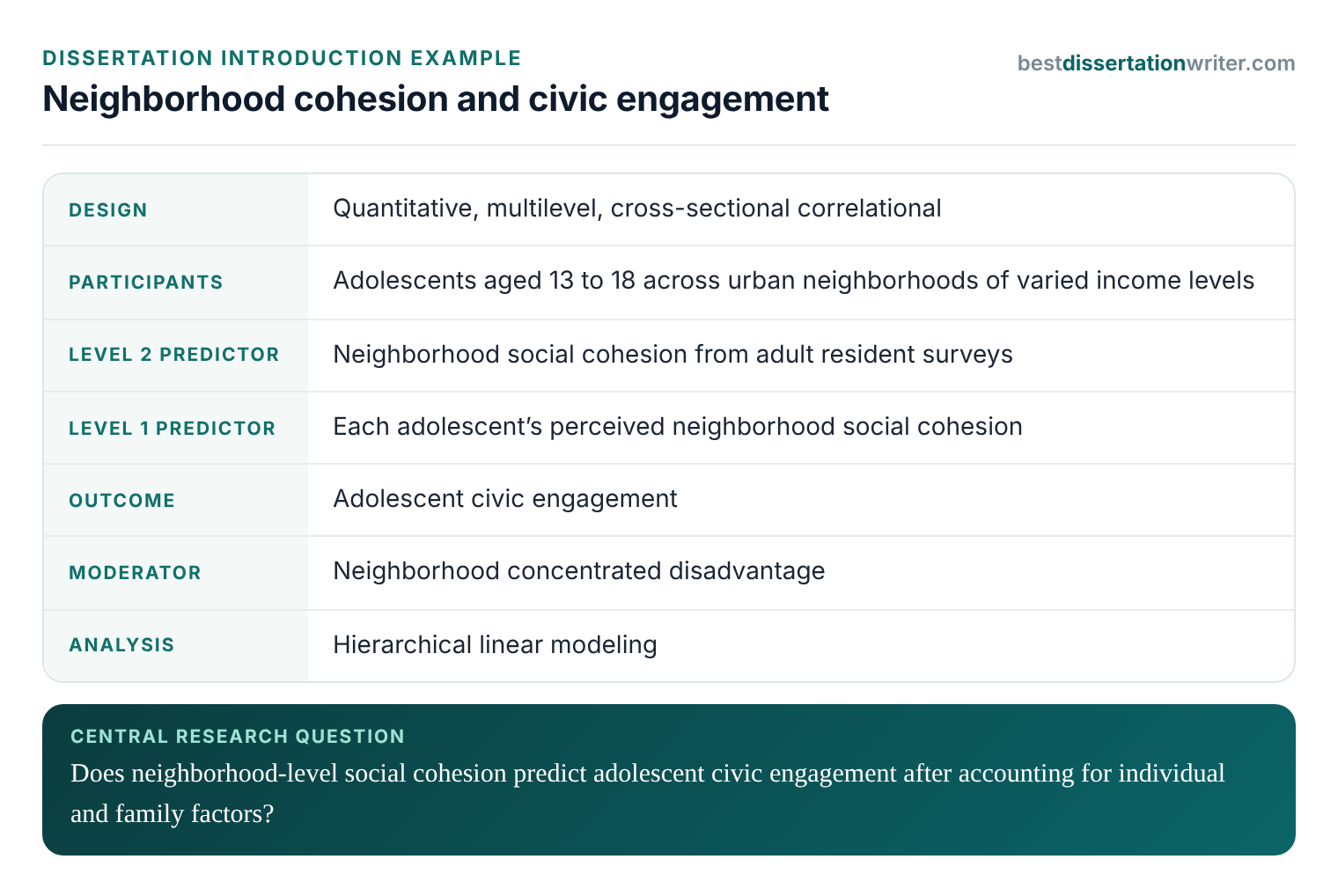
The purpose of this quantitative, multilevel correlational study is to examine the impact of neighborhood social cohesion on adolescent civic engagement within urban communities, while accounting for the nested structure of adolescents within neighborhoods and controlling for relevant individual- and family-level covariates.
Adolescents residing across multiple urban neighborhoods will complete validated self-report measures of perceived neighborhood social cohesion and civic engagement behavior, with neighborhood-level social cohesion additionally assessed through aggregated resident survey data, allowing the relationship between neighborhood-level cohesion and individual-level civic engagement to be tested using multilevel modeling.
Research Questions and Hypotheses
RQ1. Does neighborhood-level social cohesion significantly predict adolescent civic engagement after accounting for individual- and family-level covariates?
H1. Neighborhood-level social cohesion will significantly and positively predict adolescent civic engagement, even after controlling for individual- and family-level covariates including socioeconomic status, parental civic modeling, and school civic opportunity.
RQ2. Does adolescents’ individually perceived neighborhood social cohesion significantly predict their civic engagement independent of aggregated, neighborhood-level cohesion?
H2. Adolescents’ individually perceived neighborhood social cohesion will significantly and positively predict civic engagement, contributing unique variance beyond aggregated neighborhood-level cohesion.
RQ3. Does the relationship between neighborhood social cohesion and adolescent civic engagement differ significantly by neighborhood concentrated disadvantage level?
H3. The positive relationship between neighborhood social cohesion and adolescent civic engagement will be significantly stronger in neighborhoods with higher concentrated disadvantage, where cohesion may compensate for reduced access to formal civic-engagement-supporting institutions.
Significance and Theoretical Framework
Significance of the Study
This study carries significance for developmental theory, urban youth policy, and community development practice.
Theoretically, the study extends collective efficacy theory and adolescent civic development theory by directly testing their integration within a multilevel design, clarifying whether the mechanisms collective efficacy theory proposes for explaining reduced problem behavior also extend to the promotion of constructive civic participation specifically (Sampson, 2012; Flanagan & Levine, 2010).
Practically, findings may directly inform municipal and community-based youth development strategy, providing evidence regarding whether neighborhood-level social cohesion-building initiatives, such as resident association support, block-level community organizing, and neighborhood public space investment, merit consideration as civic-engagement-promoting interventions alongside more traditional individual-level civic education programming (Wray-Lake & Abrams, 2020).
Given persistent concern regarding civic disengagement among urban adolescents facing concentrated disadvantage, evidence clarifying whether neighborhood cohesion offers a compensatory pathway to civic engagement in under-resourced neighborhoods carries significant relevance for equity-focused urban youth policy (Theokas & Lerner, 2006; Browning et al., 2017).
More broadly, this study contributes to the broader neighborhood-effects literature by extending its focus beyond risk and problem-behavior outcomes toward a constructive, civic developmental outcome of substantial democratic and community significance (Odgers & Adler, 2018).
Theoretical Framework
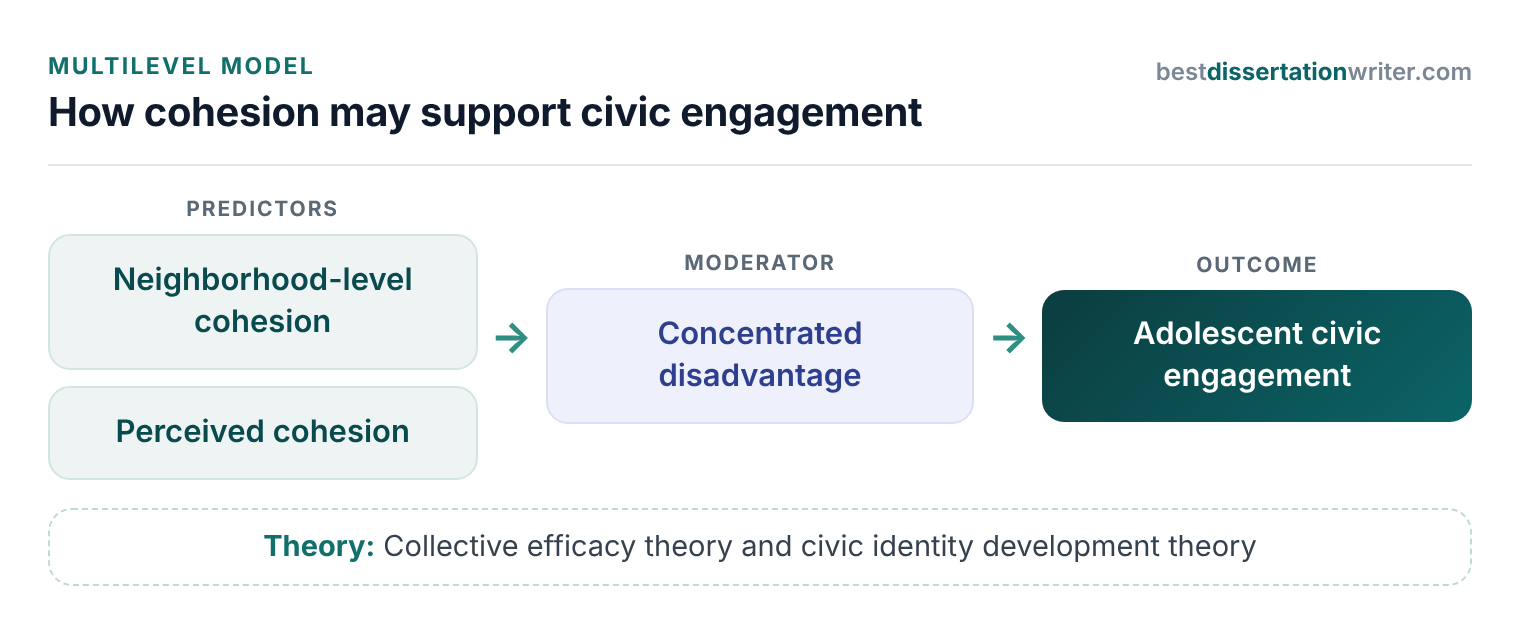
This study is grounded in Sampson’s collective efficacy theory, which proposes that neighborhoods characterized by mutual trust, shared values, and residents’ willingness to intervene for the common good generate stronger informal social control and intergenerational closure, mechanisms theorized to shape a wide range of adolescent developmental outcomes beyond the reduced problem behavior for which the theory was originally developed (Sampson, 2012; Sampson et al., 1997).
This framework provides the theoretical basis for hypothesizing that neighborhood social cohesion extends its influence to constructive civic participation, not merely the avoidance of problem behavior.
This neighborhood-level framework is paired with adolescent civic identity development theory, which proposes that civic identity and engagement develop substantially through adolescents’ participation in, and perceived belonging within, real community institutions and relationships, such that a supportive, trustworthy neighborhood context is theorized to provide the relational and institutional scaffolding necessary for civic identity formation (Youniss et al., 1997; Flanagan & Levine, 2010).
Integrating these two frameworks allows the study to test not only whether neighborhood cohesion predicts adolescent civic engagement in the aggregate, consistent with collective efficacy theory, but also whether this relationship operates differentially across neighborhood disadvantage contexts, consistent with civic identity theory’s emphasis on the compensatory role of relational community scaffolding where formal civic institutions are less available (Wray-Lake & Abrams, 2020).
Nature of the Study, Key Terms, Assumptions and Limitations
Nature of the Study
This study will employ a quantitative, multilevel correlational design, in which individual adolescent-level survey data are nested within neighborhood-level units, allowing the relationship between neighborhood social cohesion and adolescent civic engagement to be tested while properly accounting for the non-independence of adolescents residing within the same neighborhood (Creswell & Creswell, 2023).
Adolescents will be recruited from multiple urban neighborhoods varying in socioeconomic composition and will complete validated self-report measures of perceived neighborhood social cohesion, civic engagement behavior, and relevant individual- and family-level covariates, while neighborhood-level social cohesion will additionally be assessed through aggregated adult resident survey data collected within the same neighborhoods.
Neighborhoods will be selected using stratified sampling to ensure adequate representation across a range of concentrated disadvantage levels, operationalized using standard census-tract indicators including poverty rate, unemployment rate, and single-parent household proportion.
Data will be analyzed using hierarchical linear modeling, with adolescent civic engagement specified as the outcome variable, aggregated neighborhood-level social cohesion and individually perceived cohesion entered as predictors at their respective levels, and neighborhood concentrated disadvantage entered as a cross-level moderator to test whether the cohesion-engagement relationship varies significantly across disadvantage contexts.
Definitions of Key Terms
Neighborhood social cohesion: The degree of mutual trust, shared values, and sense of connectedness among residents of a shared neighborhood or geographic community (Sampson, 2012).
Collective efficacy: The combination of neighborhood social cohesion and residents’ shared willingness to intervene on behalf of the common good, theorized to generate informal social control within a neighborhood (Sampson et al., 1997).
Adolescent civic engagement: Adolescents’ participation in community-oriented behaviors including volunteering, community organization involvement, and collective local problem-solving activity (Flanagan & Levine, 2010).
Concentrated disadvantage: A neighborhood-level construct capturing the co-occurrence of poverty, unemployment, and family structure instability within a geographic area, typically measured using census-tract indicators (Odgers & Adler, 2018).
Intergenerational closure: The extent to which adults within a neighborhood know, monitor, and feel a sense of responsibility toward children and adolescents beyond their own immediate family (Sampson, 2012).
Multilevel modeling: A statistical analytic approach designed to appropriately model data with a nested structure, such as individuals nested within neighborhoods, by simultaneously estimating effects at multiple levels of analysis (Browning et al., 2017).
Assumptions
This study operates under several assumptions. It is assumed that adolescent participants can accurately self-report their own civic engagement behavior and their perceptions of neighborhood social cohesion, and that these self-reports are not substantially distorted by social desirability bias despite the socially valued status of civic participation.
It is assumed that aggregating adult resident survey responses to the neighborhood level provides a valid, independent measure of neighborhood-level social cohesion distinct from, though theoretically related to, adolescents’ own individually perceived cohesion.
It is further assumed that census-tract-level indicators of concentrated disadvantage adequately capture the structural disadvantage construct theorized to moderate the cohesion-engagement relationship, and that the validated instruments selected for measuring social cohesion and civic engagement possess adequate reliability and construct validity across the demographically diverse urban neighborhoods sampled.
Scope and Delimitations
The scope of this study is delimited to adolescents between the ages of thirteen and eighteen residing within urban neighborhoods, and does not examine younger children, emerging adults, or adolescents residing in suburban or rural communities, contexts in which the structural and relational dynamics of neighborhood cohesion may differ substantially.
The study is further delimited to civic engagement operationalized as volunteering, community organization participation, and collective local problem-solving behavior, and does not extend to formal political participation such as voting-adjacent activity, given that most participants will not yet be of voting age.
The study is delimited to a single, cross-sectional measurement occasion and does not examine the longitudinal developmental trajectory of adolescent civic engagement or the potential for neighborhood cohesion effects to accumulate or diminish over time.
Limitations
Several limitations should be acknowledged. The cross-sectional design precludes definitive causal inference regarding the direction of the relationship between neighborhood social cohesion and adolescent civic engagement, as it remains plausible that neighborhoods with more civically engaged adolescents subsequently develop stronger social cohesion, rather than cohesion driving engagement unidirectionally.
The reliance on self-report measures for both individual-level civic engagement and perceived cohesion introduces the possibility of shared method variance, potentially inflating observed individual-level associations relative to the neighborhood-level relationship captured through independent resident survey aggregation.
The stratified sampling of neighborhoods across disadvantage levels, while designed to ensure adequate variation, may not fully capture the diversity of urban neighborhood contexts nationally, potentially limiting generalizability of findings to urban areas with substantially different housing, immigration, or municipal governance characteristics than those sampled.
Finally, the study’s reliance on aggregated adult resident survey data to represent neighborhood-level social cohesion, while methodologically standard within collective efficacy research, may still imperfectly capture the specific dimensions of neighborhood cohesion most relevant to adolescents’ own civic developmental experience, which may differ in some respects from adult residents’ experience of the same neighborhood (Theokas & Lerner, 2006).
Summary
This chapter introduced the background, problem, purpose, and theoretical grounding of a proposed quantitative, multilevel study examining the impact of neighborhood social cohesion on adolescent civic engagement within urban communities.
While neighborhood social cohesion has been well established as a predictor of reduced adolescent problem behavior, its specific relationship to constructive adolescent civic engagement remains insufficiently tested using multilevel designs capable of properly modeling the nested structure of neighborhood and individual-level influence, particularly with respect to whether this relationship varies across neighborhoods differing in concentrated disadvantage.
Grounded in collective efficacy theory and adolescent civic identity development theory, this quantitative, multilevel correlational study aims to clarify whether, and under what neighborhood conditions, social cohesion meaningfully predicts adolescent civic engagement, with implications for urban youth development policy, community organizing practice, and developmental theory.
Chapter Two will present a comprehensive review of the existing literature on neighborhood effects, collective efficacy, and adolescent civic development, further situating this study within its scholarly context.
References
Ballard, P. J., & Syme, S. L. (2016). Engaging youth in communities: A framework for promoting adolescent and community health. Journal of Epidemiology and Community Health, 70(2), 202–206.
Browning, C. R., Calder, C. A., Soller, B., Jackson, A. L., & Dirlam, J. (2017). Ecological networks and neighborhood social organization. American Journal of Sociology, 122(6), 1939–1988.
Creswell, J. W., & Creswell, J. D. (2023). Research design: Qualitative, quantitative, and mixed methods approaches (6th ed.). SAGE Publications.
Duke, N. N., Skay, C. L., Pettingell, S. L., & Borowsky, I. W. (2009). From adolescent connections to social capital: Predictors of civic engagement in young adulthood. Journal of Adolescent Health, 44(2), 161–168.
Flanagan, C., & Levine, P. (2010). Civic engagement and the transition to adulthood. The Future of Children, 20(1), 159–179.
Odgers, C. L., & Adler, N. E. (2018). Challenges for low-income children in an era of increasing income inequality. Child Development Perspectives, 12(2), 128–133.
Sampson, R. J. (2012). Great American city: Chicago and the enduring neighborhood effect. University of Chicago Press.
Sampson, R. J., Raudenbush, S. W., & Earls, F. (1997). Neighborhoods and violent crime: A multilevel study of collective efficacy. Science, 277(5328), 918–924.
Theokas, C., & Lerner, R. M. (2006). Observed ecological assets in families, schools, and neighborhoods: Conceptualization, measurement, and relations with positive and negative developmental outcomes. Applied Developmental Science, 10(2), 61–74.
Wray-Lake, L., & Abrams, L. S. (2020). Pathways to civic engagement among urban youth of color. Monographs of the Society for Research in Child Development, 85(2), 7–154.
Youniss, J., McLellan, J. A., & Yates, M. (1997). What we know about engendering civic identity. American Behavioral Scientist, 40(5), 620–631.
Why This Neighborhood Social Cohesion Dissertation Introduction Example Works
Sociology and community research often involve data at more than one level. This neighborhood social cohesion example handles that complexity in four ways.
- Gap in the outcome: The chapter shows that cohesion is well linked to problem behavior and then argues that its link to civic engagement is under-tested.
- Levels kept separate: RQ1 and RQ2 distinguish shared neighborhood cohesion from each adolescent’s own perception, which multilevel modeling can test.
- A moderator with a reason: RQ3 asks whether cohesion matters more in disadvantaged neighborhoods, and the chapter explains why it might.
- Two complementary theories: Collective efficacy explains the neighborhood side, and civic identity development explains the adolescent side.
Hypothesis: weak vs. strong
Weak
“Cohesive neighborhoods will have more engaged teenagers.”
This ignores the nested data, controls and level of measurement the design depends on.
Strong
“Neighborhood-level social cohesion will significantly and positively predict adolescent civic engagement, even after controlling for individual- and family-level covariates.”
This names the level, the direction and the controls, so it matches a hierarchical linear model.
How to Adapt This Structure
If your data are nested, for example students within schools or patients within clinics, say so in the nature of the study and explain why it matters. Write separate research questions for each level you measure.
For section-by-section guidance, see how to write the background of the study, a testable hypothesis and the scope and delimitations. You can compare this chapter with the social media and body image example, browse all dissertation introduction examples, or return to the how to write a dissertation hub.
The University of Leeds Library also keeps a collection of dissertation examples by subject.
FAQs About This Neighborhood Social Cohesion Dissertation Introduction
Why does this study use multilevel modeling?
Adolescents who live in the same neighborhood share an environment, so their answers are not fully independent. Ordinary regression assumes independence and can produce misleading results with nested data.
Hierarchical linear modeling accounts for this nesting and lets the study test neighborhood-level and individual-level effects at the same time. It also allows the cross-level moderation in RQ3, where a neighborhood characteristic may change how strongly cohesion relates to civic engagement. Most statistics software packages, including R and SPSS, can fit these models once the data are structured by level.
What is the difference between neighborhood social cohesion and collective efficacy?
Neighborhood social cohesion refers to trust, shared values and close ties among residents. Collective efficacy, as described by Sampson and colleagues, combines that cohesion with residents’ willingness to act for the common good.
In this example, collective efficacy theory supplies the explanation, while neighborhood social cohesion is the measured predictor. Keeping the two distinct in your key terms helps readers see which concept you measure and which concept explains your expected results. Clear definitions also make your measures easier to justify in the methodology chapter.
How do I write hypotheses for a multilevel dissertation?
Write one hypothesis for each level and each cross-level question. State which level the predictor sits at, which controls are included and the expected direction of the effect.
This example does that in three steps. H1 tests neighborhood-level cohesion, H2 tests individual perceptions beyond the neighborhood average, and H3 predicts a stronger link in more disadvantaged neighborhoods, giving the results chapter a clear structure to follow. Clear hypotheses at each level also make it easier to report fixed and random effects later on.
Best Dissertation Writers
Want an introduction chapter like this for your topic?
Get a custom Chapter 1 written around your research problem, field and deadline.