Respectful Maternity Care and Experiences of Disrespect and Abuse in Childbirth: A Qualitative Evidence Synthesis
 By Dr. Robertson Prime, Research Fellow
Updated October 12, 2026
16 min read
About 3,100 words
By Dr. Robertson Prime, Research Fellow
Updated October 12, 2026
16 min read
About 3,100 words
In this review
Abstract
Background: Respectful maternity care means care that maintains women’s dignity, privacy and confidentiality, ensures freedom from harm and mistreatment, and enables informed choice and continuous support during labour and childbirth. Yet studies from many countries show that women are shouted at, ignored, physically abused or subjected to procedures without consent while giving birth.
Aim: This integrative review aimed to examine evidence on the nature and extent of mistreatment during childbirth, who is most affected, and which interventions promote respectful care, and to consider the implications for midwifery practice.
Methods: Evidence was identified through targeted searches of openly accessible bibliographic records, publisher websites and the reference lists of key reviews. Six sources published between 2015 and 2019 were included: a mixed-methods systematic review, two cross-sectional studies, a before-and-after intervention study, a systematic review of respectful care policies and a WHO guideline, appraised with CASP checklists and synthesised thematically.
Findings: Mistreatment was classified into seven domains, from physical and verbal abuse to health system constraints. In a four-country study, 41.6% of observed women experienced physical or verbal abuse, stigma or discrimination, and most episiotomies observed were performed without consent. In the United States, one in six women (17.3%) reported mistreatment, with higher rates among women of colour and hospital births. A multi-component intervention in Tanzania reduced the odds of disrespect and abuse by about two-thirds.
Conclusion: Midwives should treat consent, communication and dignity as core clinical standards, challenge mistreatment and support system-level change that makes respectful maternity care the norm for every woman.
Keywords: respectful maternity care, obstetric violence, women’s experiences
Introduction
This integrative review critically examines recent evidence on respectful maternity care and its implications for midwifery practice.
Giving birth is one of the most significant experiences in a woman’s life, and the way she is treated during labour can shape her physical recovery, her mental health, her relationship with her baby and her trust in health services for years to come. Over the past two decades, research from low-, middle- and high-income countries has documented women being shouted at, slapped, ignored, left alone, examined without permission and denied a companion during childbirth. Such accounts have led to growing international concern about the quality and humanity of maternity care, and to calls for respectful maternity care to be guaranteed for every woman.
Several terms are used to describe this problem, including disrespect and abuse, mistreatment during childbirth and obstetric violence, a term that emphasises the structural and gendered nature of harm. Each reflects a shift away from viewing birth only in terms of survival towards a focus on women’s experiences, rights and dignity. Respectful maternity care is the positive counterpart to these concepts: care that is organised for and provided to all women in a manner that maintains their dignity, privacy and confidentiality and supports informed choice.
Midwives are the professionals most present during labour and birth, so they are central both to the problem and to its solution. An integrative design was chosen because the evidence includes qualitative and quantitative studies, observational research, intervention studies and international guidance, which need to be brought together to give a complete picture.
Review question
What is known about the forms and extent of mistreatment during childbirth, who is most affected, and which interventions promote respectful maternity care?
Background to Respectful Maternity Care
Concern about how women are treated during childbirth grew alongside global efforts to increase facility-based birth. Encouraging women to give birth in hospitals and health centres was intended to reduce maternal and newborn deaths, but researchers and advocates found that poor treatment in facilities discouraged some women from returning for later births. Mistreatment was therefore recognised not only as a violation of rights but also as a barrier to safe care.
Early work described categories of disrespect and abuse, but definitions varied widely between studies, making comparison difficult. A clear and shared definition was needed so that mistreatment could be measured consistently and so that improvement efforts could be evaluated. The systematic review by Bohren et al. (2015), discussed below, responded to this need by developing an evidence-based typology that has since informed research tools and international guidance.
In 2018, the World Health Organization (WHO) published recommendations on intrapartum care for a positive childbirth experience. The first of its 56 recommendations is respectful maternity care, followed by effective communication between maternity care providers and women in labour, and a companion of choice for all women throughout labour and childbirth (WHO, 2018). Placing these recommendations at the start of a clinical guideline signals that dignity and communication are part of the quality of care, not separate from it.
Mistreatment is not confined to low-income settings. Studies in high-income countries have described women feeling unheard, pressured into interventions or treated differently because of their ethnicity, age or social position. These experiences sit alongside wider inequalities in maternal outcomes and suggest that respectful maternity care is a universal concern for midwifery practice.
Search Strategy and Methods
Evidence for this example was identified through targeted searches of openly accessible bibliographic records, publisher websites and the reference lists of key reviews. Search terms combined keywords for the concept (“respectful maternity care”, “disrespect and abuse”, “mistreatment”, “obstetric violence”, “dignity”) with terms for the setting and population (“childbirth”, “labour”, “intrapartum”, “maternity”, “women”), joined with the Boolean operators AND and OR. A full integrative review for assessment would run the same strategy in CINAHL, MIDIRS, PubMed/MEDLINE and the Cochrane Library and report the number of records screened in a PRISMA flow diagram.
Sources were eligible if they described women’s experiences of mistreatment or respectful care during facility-based childbirth, measured its prevalence or associated factors, evaluated interventions to promote respectful maternity care, or provided international guidance. Qualitative, quantitative and mixed-methods studies, systematic reviews and guidelines were included in line with the integrative design. Opinion pieces and studies focusing only on antenatal or postnatal care were excluded.
Six sources on respectful maternity care published between 2015 and 2019 were included: a mixed-methods systematic review, two cross-sectional studies, a comparative before-and-after intervention study, a systematic review of respectful care policies and an international guideline (Table 1). The quality of each source was appraised using the Critical Appraisal Skills Programme (CASP) checklist appropriate to its design, and findings were synthesised thematically.
Key Findings on Respectful Maternity Care
Three themes were identified: the forms and extent of mistreatment during childbirth, inequity in who experiences mistreatment, and interventions that promote respectful maternity care. Table 1 summarises the included sources, and Figure 1 presents the proportions of women experiencing abuse and procedures without consent in a four-country study.
| Author, year | Design | Setting and sample | Key finding |
|---|---|---|---|
| Bohren et al. (2015) | Mixed-methods systematic review | 65 studies from 34 countries | Developed a typology of mistreatment in seven domains, from physical abuse to health system constraints. |
| Kujawski et al. (2017) | Comparative before-and-after study | 2,983 women; two hospitals, Tanga Region, Tanzania | Disrespect and abuse fell from 13.10% to 3.20% at the intervention hospital; odds reduced by 66%. |
| Downe et al. (2018) | Systematic review | 5 studies of respectful care policies; all in Africa | Multi-component policies may increase respectful care and reduce disrespect and abuse; key components unclear. |
| WHO (2018) | International guideline | Intrapartum care for healthy women and newborns | Respectful maternity care, effective communication and a companion of choice among 56 recommendations. |
| Bohren et al. (2019) | Cross-sectional study with labour observations and surveys | 2,016 women observed and 2,672 surveyed; Ghana, Guinea, Myanmar, Nigeria | 41.6% of observed women experienced physical or verbal abuse, stigma or discrimination; consent often absent. |
| Vedam et al. (2019) | Cross-sectional survey | 2,138 women; United States | 17.3% reported mistreatment; higher among women of colour and hospital births (28.1% vs 5.1% at home). |
Theme 1: Forms and Extent of Mistreatment During Childbirth
Bohren et al. (2015) conducted a mixed-methods systematic review of 65 studies from 34 countries to develop a typology of mistreatment during facility-based childbirth. They identified seven domains: physical abuse, sexual abuse, verbal abuse, stigma and discrimination, failure to meet professional standards of care, poor rapport between women and providers, and health system conditions and constraints. The typology shows that mistreatment occurs at the level of individual interactions but is also shaped by staffing, resources and the organisation of services.
The strength of this typology is that it was grounded in women’s experiences across many settings. However, most included studies were qualitative or used different measures, so the review could describe the forms of mistreatment but not how common they were. This gap led to the development of standardised tools to measure mistreatment through direct observation and community surveys.
Using these tools, Bohren et al. (2019) observed 2,016 women in labour in Ghana, Guinea and Nigeria and surveyed 2,672 women after birth in these countries and Myanmar. Overall, 41.6% of observed women and 35.4% of surveyed women experienced physical or verbal abuse, stigma or discrimination. Verbal abuse was most common, observed in 37.8% of women, and physical abuse was observed in 14.0%. Mistreatment was most likely from 30 minutes before birth until 15 minutes after, the period when women are most vulnerable.
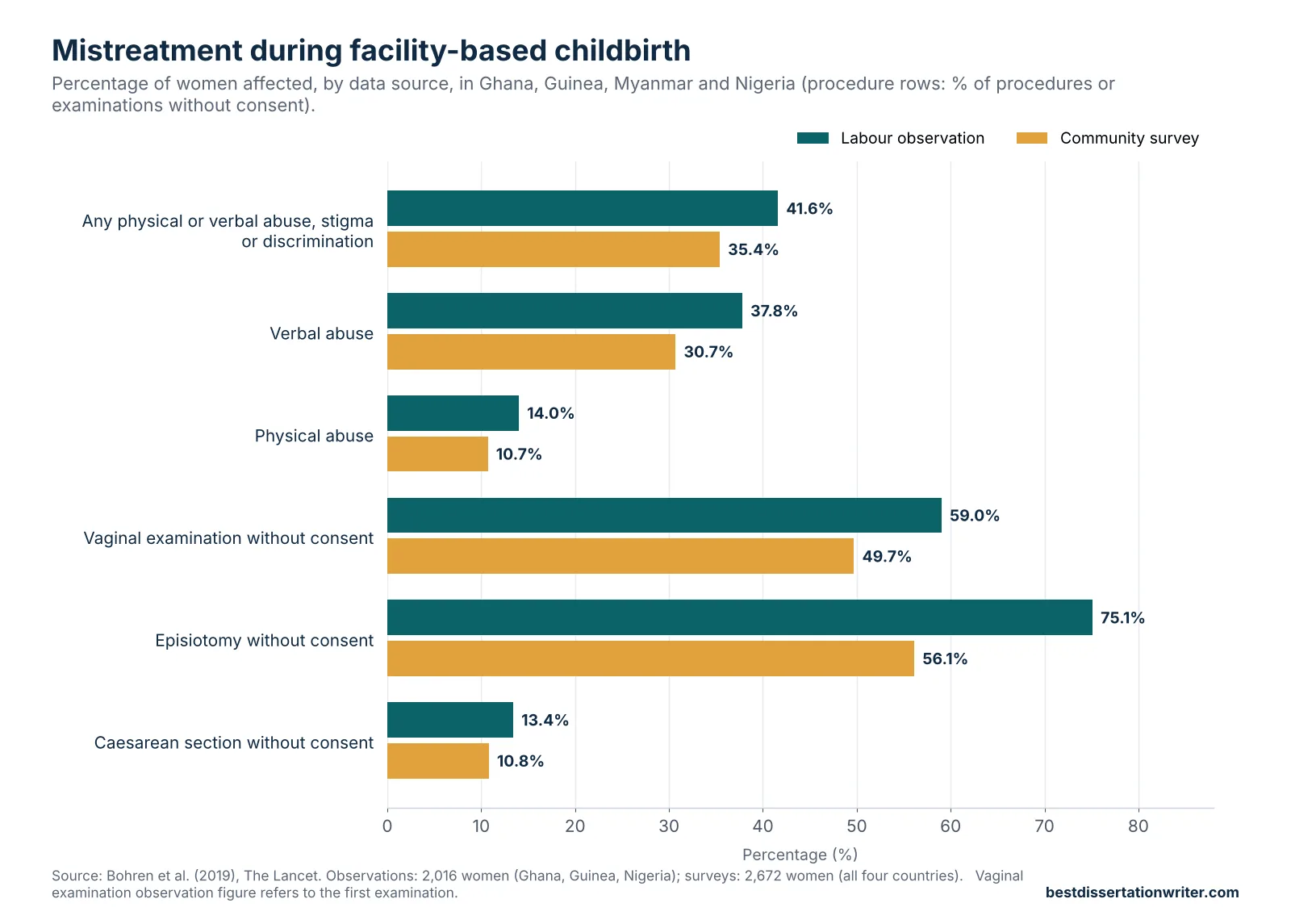
Consent was frequently absent. Among observed women, 59.0% had their first vaginal examination without consent, 75.1% of episiotomies and 13.4% of caesarean sections were performed without consent, and 5.0% of surveyed women or their babies were detained in the facility because they could not pay. The use of direct observation strengthens these findings, although the presence of observers may have changed behaviour, so the true figures could be higher. These results show how far care in these facilities fell short of respectful care.
Theme 2: Inequity and Women’s Experiences of Mistreatment
Mistreatment is not distributed equally. In the four-country study, younger women aged 15 to 19 years had nearly twice the odds of experiencing abuse, stigma or discrimination (odds ratio 1.9), and younger women with no education had the highest odds of verbal abuse (Bohren et al., 2019). These findings suggest that power imbalances based on age and social status shape how women are treated.
Similar patterns were found in a high-income setting. In the Giving Voice to Mothers study, 2,138 women in the United States completed a survey on their experiences of maternity care, and one in six (17.3%) reported at least one type of mistreatment, such as loss of autonomy, being shouted at or scolded, or being ignored or refused help (Vedam et al., 2019). Mistreatment was reported by 27.2% of women of colour with low socioeconomic status compared with 18.7% of white women with low socioeconomic status.
The place of birth and type of provider also mattered. Only 5.1% of women who gave birth at home reported mistreatment, compared with 28.1% of those who gave birth in hospital, and having a vaginal birth, a community birth or a midwife was associated with a lower likelihood of mistreatment (Vedam et al., 2019). The study was developed with community members, which strengthens its relevance, but it used an online survey and a non-random sample, so women who chose community birth may have been over-represented.
Theme 3: Interventions to Promote Respectful Maternity Care
Evidence on how to reduce mistreatment is more limited. Kujawski et al. (2017) evaluated a community and health system intervention in Tanga Region, Tanzania, which combined a client service charter, shared with communities and displayed in facilities, with a facility-based quality improvement process that introduced changes such as a private admission room and curtains for examinations and births. Self-reported disrespect and abuse fell from 13.10% to 3.20% at the intervention hospital, compared with a fall from 21.27% to 15.76% at the comparison hospital, and the intervention was associated with a 66% reduction in the odds of disrespect and abuse.
A systematic review by Downe et al. (2018) identified five studies of respectful care policies, all conducted in Africa. Moderate-certainty evidence from one cluster trial suggested that multi-component interventions increased women’s reports of respectful care and reduced disrespect and abuse, but there was no clear effect on satisfaction, and evidence for other outcomes was low in certainty. The authors concluded that the most effective components and the sustainability of effects remained unclear.
Together with the WHO (2018) recommendations, this evidence suggests that respectful maternity care can be improved, but that change requires action at several levels at once: clear standards and accountability, staff training and support, adequate staffing and resources, and mechanisms for women and communities to raise concerns. Single-component interventions, such as one-off training, are unlikely to be enough on their own.
Discussion
This review shows that mistreatment during childbirth is common and takes many forms, from verbal abuse to procedures without consent. It falls disproportionately on younger, poorer and minoritised women, and it can be reduced through multi-component interventions. The evidence comes from diverse settings and designs, and the consistency of findings across them strengthens the case that respectful maternity care should be treated as a core component of quality.
A key tension lies in how mistreatment is explained. Individual midwives and doctors carry out the actions that women experience as abusive, yet many of the drivers identified by Bohren et al. (2015) are structural, including overcrowding, understaffing, lack of privacy and hierarchical cultures. Framing the problem as obstetric violence highlights these structural and gendered dimensions, while focusing only on individual behaviour risks blaming staff who are themselves working under severe pressure. Effective responses need to address both.
Measurement also matters. Observation and survey data in the four-country study gave different estimates, and women may not label experiences as mistreatment if poor treatment is normalised. Conversely, high-income studies relying on online surveys may over-represent women with strong views. Using women’s experiences as the starting point for measurement, as the typology does, is important, but standard tools are needed to compare settings and track change over time.
The relevance of these findings to well-resourced maternity services should not be underestimated. Although discussions of obstetric violence often focus on overt abuse, the Giving Voice to Mothers findings show that loss of autonomy, being ignored and being scolded are also reported in a high-income system. In such settings, mistreatment may be less visible than physical abuse but still harmful, for example when women feel pressured into interventions or are not listened to when they raise concerns. Respectful maternity care therefore requires attention to everyday communication, shared decision-making and consent, not only to the prevention of overt abuse. Midwives working in any system can apply respectful maternity care principles from the first contact onwards.
The evidence on intervention is the weakest part of the literature. Only a small number of studies, mostly from East Africa, have tested interventions, and few have measured long-term effects or clinical outcomes. It is not yet known which components are essential, how interventions should be adapted for high-income health systems, or how respectful care can be sustained when staffing and funding are under pressure.
This review has limitations. It relied on openly accessible, English-language sources and did not involve independent double screening, and the number of included sources was small. Most evidence came from a limited number of countries, and studies from the United Kingdom were not included. Future research should test interventions in a wider range of settings, including high-income maternity services, and should measure respectful care alongside clinical outcomes, staff wellbeing and long-term maternal mental health.
Implications of Respectful Maternity Care Evidence for Practice
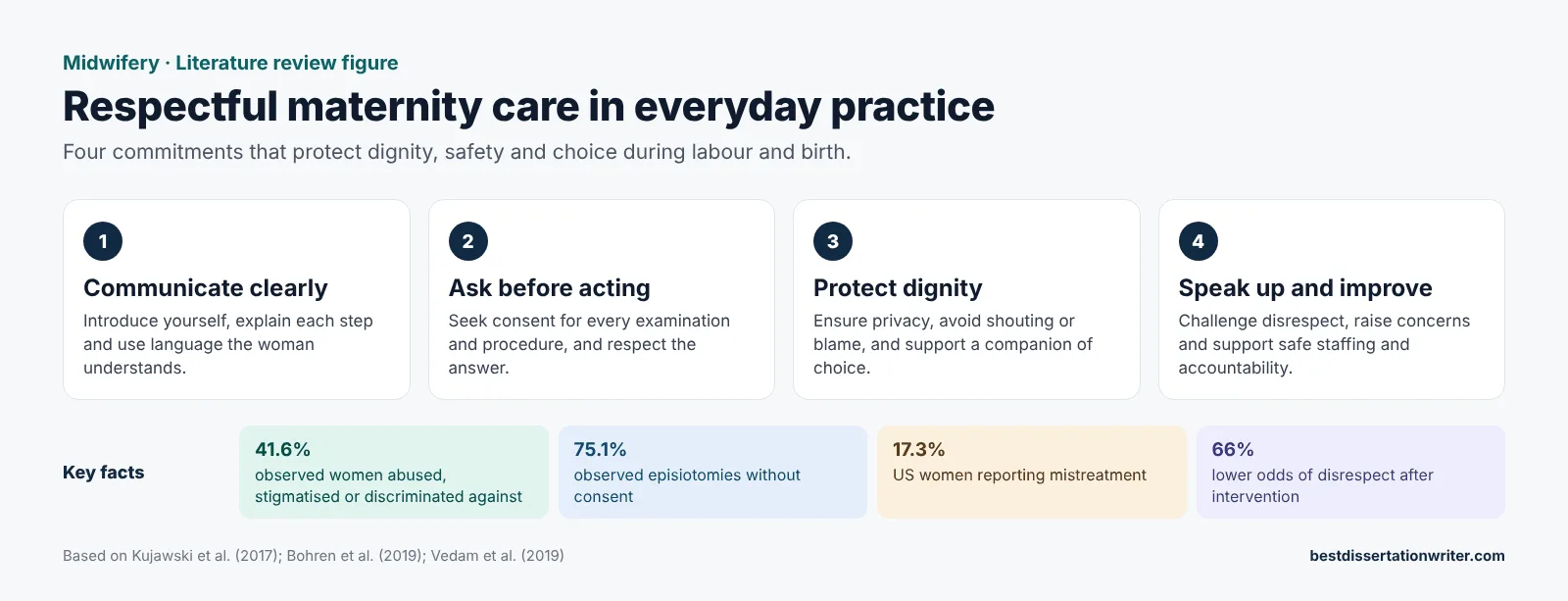
Midwives can promote respectful maternity care by introducing themselves, explaining what they are doing and why, asking for consent before every examination and procedure, protecting privacy and supporting a companion of choice. They should listen to women’s concerns, respect their decisions and take particular care with younger women, women from minority ethnic groups and women facing social disadvantage, who are at greater risk of mistreatment. Respectful care also supports women to make informed choices about where and how to give birth, including planned home birth.
Midwives also have a professional duty to challenge disrespectful practice and to raise concerns through appropriate routes. Managers should ensure safe staffing, supervision and a culture in which respectful behaviour is expected and recognised. Models such as continuity of carer can build trusting relationships, and respectful, trauma-informed care is particularly important for women with fear of childbirth. Addressing mistreatment is also part of wider efforts to reduce maternal mortality, since women who are mistreated may avoid seeking care in the future.
Conclusion
This integrative review examined evidence on mistreatment during childbirth and on respectful maternity care. Mistreatment takes seven broad forms, affects a large proportion of women in some settings and one in six women in a high-income country survey, falls most heavily on disadvantaged women and can be reduced by multi-component interventions.
For midwives, the message is that dignity, communication and consent are core clinical standards, not optional extras. Embedding respectful maternity care in everyday practice, and supporting the system changes that make it possible, is essential to improving women’s experiences of childbirth.
References
Bohren, M. A., Mehrtash, H., Fawole, B., Maung, T. M., Balde, M. D., Maya, E., Thwin, S. S., Aderoba, A. K., Vogel, J. P., Irinyenikan, T. A., Adeyanju, A. O., Mon, N. O., Adu-Bonsaffoh, K., Landoulsi, S., Guure, C., Adanu, R., Diallo, B. A., Gülmezoglu, A. M., Soumah, A.-M., Sall, A. O., & Tunçalp, Ö. (2019). How women are treated during facility-based childbirth in four countries: A cross-sectional study with labour observations and community-based surveys. The Lancet, 394(10210), 1750–1763. https://doi.org/10.1016/S0140-6736(19)31992-0
Bohren, M. A., Vogel, J. P., Hunter, E. C., Lutsiv, O., Makh, S. K., Souza, J. P., Aguiar, C., Saraiva Coneglian, F., Diniz, A. L. A., Tunçalp, Ö., Javadi, D., Oladapo, O. T., Khosla, R., Hindin, M. J., & Gülmezoglu, A. M. (2015). The mistreatment of women during childbirth in health facilities globally: A mixed-methods systematic review. PLOS Medicine, 12(6), e1001847. https://doi.org/10.1371/journal.pmed.1001847
Downe, S., Lawrie, T. A., Finlayson, K., & Oladapo, O. T. (2018). Effectiveness of respectful care policies for women using routine intrapartum services: A systematic review. Reproductive Health, 15, 23. https://doi.org/10.1186/s12978-018-0466-y
Kujawski, S. A., Freedman, L. P., Ramsey, K., Mbaruku, G., Mbuyita, S., Moyo, W., & Kruk, M. E. (2017). Community and health system intervention to reduce disrespect and abuse during childbirth in Tanga Region, Tanzania: A comparative before-and-after study. PLOS Medicine, 14(7), e1002341. https://doi.org/10.1371/journal.pmed.1002341
Vedam, S., Stoll, K., Taiwo, T. K., Rubashkin, N., Cheyney, M., Strauss, N., McLemore, M., Cadena, M., Nethery, E., Rushton, E., Schummers, L., Declercq, E., & the GVtM-US Steering Council. (2019). The Giving Voice to Mothers study: Inequity and mistreatment during pregnancy and childbirth in the United States. Reproductive Health, 16, 77. https://doi.org/10.1186/s12978-019-0729-2
World Health Organization. (2018). WHO recommendations: Intrapartum care for a positive childbirth experience. World Health Organization. https://www.who.int/publications/i/item/9789241550215
Cite this example
Best Dissertation Writers (2026) Respectful Maternity Care and Experiences of Disrespect and Abuse in Childbirth: A Qualitative Evidence Synthesis. Available at: https://bestdissertationwriter.com/respectful-maternity-care-review-review/
Best Dissertation Writers
Get expert help with your nursing literature review
Share your topic and deadline with Best Dissertation Writers and get support tailored to your module brief.