Health Inequalities and Maternal Mortality Among Ethnic Minority Women: A Narrative Review
 By Dr. Robertson Prime, Research Fellow
Updated October 12, 2026
16 min read
About 3,200 words
By Dr. Robertson Prime, Research Fellow
Updated October 12, 2026
16 min read
About 3,200 words
In this review
Abstract
Background: Maternal mortality remains a key measure of the quality and fairness of maternity care, and in high-income countries such as the United Kingdom and the United States the risk of dying is not shared equally between ethnic groups. Globally, about 260,000 women died during or after pregnancy and childbirth in 2023, most from preventable causes.
Aim: This narrative review aimed to examine the evidence on ethnic inequalities in maternal death and severe illness, the factors that explain them and what they mean for midwifery practice.
Methods: Evidence was identified through targeted searches of openly accessible bibliographic records, publisher websites and the reference lists of key reviews. Six sources published between 2009 and 2026 were included: a national surveillance data brief, a global fact sheet, two national cohort studies, a national surveillance report and a qualitative evidence synthesis, appraised with CASP checklists and synthesised narratively.
Findings: In the UK in 2022–24, the maternal death rate was 12.80 per 100,000 maternities, and Black women in England had 2.72 times the risk of White women; women in the most deprived areas had almost twice the risk of those in the least deprived. In the United States, Black women had 3.2 times the pregnancy-related death rate of White women, and the gap persisted among college graduates. Ethnic differences extend to severe maternal morbidity, stillbirth and fetal growth restriction, and ethnic minority women describe discrimination, poor communication and not being listened to.
Conclusion: Reducing maternal mortality among ethnic minority women requires midwives to listen to and act on women’s concerns, provide culturally safe, continuous care and challenge discrimination within maternity systems.
Keywords: maternal mortality, ethnic inequalities, maternal health
Introduction
This narrative review critically examines recent evidence on maternal mortality and its implications for midwifery practice.
The death of a woman during pregnancy, childbirth or the year that follows is a tragedy for her family and a sign that something in the system of care has failed. Most such deaths are preventable. Although the United Kingdom has one of the lowest maternal death rates in the world, national surveillance has shown for many years that the risk is not shared equally. Black and some Asian women, and women living in deprived areas, are more likely to die than White women and women in affluent areas.
These ethnic inequalities have become a priority for maternity services, professional bodies and campaigners. Explanations range from differences in pre-existing illness and social disadvantage to structural racism, poor communication and unequal access to good care. Each explanation points to different solutions, so understanding the evidence matters for midwives, who are often the professionals with the most contact with women and the first to notice when something is wrong. Maternal mortality is therefore a question of quality, safety and equity as much as of clinical risk.
A narrative review was chosen because the evidence includes national surveillance data, cohort studies and qualitative research that cannot be pooled statistically. A narrative approach allows these different kinds of evidence to be brought together and interpreted critically, with attention to the strengths and limitations of each.
Review question
What does recent evidence show about ethnic inequalities in maternal mortality and severe maternal illness, what factors help to explain them, and what are the implications for midwifery practice?
Background to Maternal Mortality
A maternal death is usually defined as the death of a woman during pregnancy or within 42 days of its end from a cause related to or aggravated by the pregnancy or its management. Direct deaths result from obstetric complications such as haemorrhage, thrombosis or pre-eclampsia, while indirect deaths result from pre-existing or new conditions, such as heart disease, epilepsy or mental illness, that are made worse by pregnancy. Late deaths occur between six weeks and one year after the end of pregnancy.
Globally, maternal mortality remains a major public health problem. The World Health Organization (2025) estimates that about 260,000 women died during or after pregnancy and childbirth in 2023. Around 70% of these deaths occurred in sub-Saharan Africa, and the maternal mortality ratio was 346 per 100,000 live births in low-income countries compared with 10 in high-income countries. The Sustainable Development Goals aim to reduce the global ratio to below 70 per 100,000 live births by 2030.
In high-income countries, deaths are rare, so national surveillance systems combine several years of data to calculate reliable rates. In the UK, MBRRACE-UK carries out a confidential enquiry into every maternal death and publishes rates by age, ethnicity and deprivation. These enquiries combine numbers with detailed case reviews to identify lessons for care. In the United States, the Centers for Disease Control and Prevention monitor pregnancy-related deaths through a national surveillance system.
Ethnicity itself is not a cause of death. It is a marker for a complex mix of biological, social and structural factors, including higher rates of some medical conditions, socioeconomic disadvantage, migration status, language barriers, experiences of racism and the quality of care received. Disentangling these factors is difficult, and the way researchers group women into broad ethnic categories can hide important differences within groups. These points need to be kept in mind when interpreting the evidence on maternal health inequalities.
Search Strategy and Methods
Evidence for this example was identified through targeted searches of openly accessible bibliographic records, publisher websites and the reference lists of key reviews. Search terms combined keywords for the outcome (“maternal mortality”, “maternal death”, “severe maternal morbidity”, “stillbirth”) with terms for the population and exposure (“ethnic*”, “Black”, “Asian”, “minority”, “race”, “inequalit*”, “deprivation”), joined with the Boolean operators AND and OR. A full narrative review for assessment would run the same strategy in CINAHL, PubMed/MEDLINE, the Cochrane Library and Embase and report the number of records screened in a PRISMA flow diagram. MIDIRS would also be searched for midwifery-specific literature.
Sources were eligible if they reported maternal mortality, severe maternal morbidity or adverse pregnancy outcomes by ethnic group, or explored ethnic minority women’s experiences of maternity care, in national or international populations. National surveillance reports, large cohort studies, systematic and qualitative evidence syntheses and international statistics were prioritised. Single-site studies, opinion pieces and sources reporting only clinical management without data on ethnicity were excluded.
Six sources published between 2009 and 2026 were included: a UK national surveillance data brief, a global fact sheet from the World Health Organization, two national cohort studies from England, a United States surveillance report and a qualitative evidence synthesis (Table 1). The quality of each source was appraised using the Critical Appraisal Skills Programme (CASP) checklist appropriate to its design, and findings were synthesised narratively and grouped into themes. Surveillance reports on maternal mortality were judged on the completeness of case ascertainment and the clarity of their definitions.
Key Findings on Maternal Mortality
Three themes were identified: the persistent ethnic gap in maternal mortality in the UK and the United States, the wider pattern of ethnic inequalities in severe illness and adverse pregnancy outcomes, and women’s experiences of maternity care, including discrimination and not being heard. Table 1 summarises the included sources, and Figure 1 presents the relative risk of maternal death by ethnic group, deprivation and age in the most recent UK surveillance data.
| Author, year | Design | Setting and sample | Key finding |
|---|---|---|---|
| Knight et al. (2009) | National cohort study (UKOSS) | 686 cases of severe maternal morbidity in an estimated 775,186 UK maternities | Ethnic minority women had higher risk (RR 1.58); Black Caribbean RR 2.45; excess persisted after adjustment (OR 1.50). |
| Petersen et al. (2019) | National surveillance report | 6,765 pregnancy-related deaths, United States, 2007–2016 | Black women 40.8 vs White women 12.7 deaths per 100,000 births; gap persisted at all education levels. |
| Jardine et al. (2021) | National cohort study | 1,155,981 singleton births, 132 NHS hospitals in England | Stillbirth 0.7% in Black vs 0.3% in White women; 11.7% of stillbirths attributable to ethnic inequality. |
| MacLellan et al. (2022) | Qualitative evidence synthesis | 24 qualitative studies of ethnic minority women using UK maternity services | Discrimination and communication failures common; woman-centred care often the exception. |
| World Health Organization (2025) | International fact sheet | Global estimates of maternal deaths, 2023 | About 260,000 maternal deaths; around 70% in sub-Saharan Africa; ratio 346 vs 10 per 100,000 in low- vs high-income countries. |
| Felker and Knight (2026) | National surveillance data brief (MBRRACE-UK) | 252 maternal deaths among 1,969,321 UK maternities, 2022–24 | Rate 12.80 per 100,000; Black women RR 2.72 vs White women; most deprived areas RR 1.94. |
Theme 1: The Persistent Ethnic Gap in Maternal Mortality
The most recent UK surveillance data show that 252 women died from direct and indirect causes during or within 42 days of the end of pregnancy in 2022–24, among 1,969,321 maternities, a rate of 12.80 per 100,000 maternities (Felker and Knight, 2026). This rate was 20% higher than in 2009–11. Thrombosis and thromboembolism remained the leading cause of death during pregnancy and up to six weeks afterwards, followed by cardiac disease and psychiatric causes, while maternal suicide was the leading cause of late deaths.
In England, Black women had 2.72 times the risk of maternal death of White women (95% CI 1.80 to 4.00). The higher rates among Asian women (relative risk 1.27) and women of mixed ethnicity (1.39) were not statistically significant, partly because the numbers were small. Women in the most deprived fifth of areas had almost twice the risk of those in the least deprived (relative risk 1.94), and women aged 40 or over had 2.89 times the risk of women aged 25 to 29 (Felker and Knight, 2026).
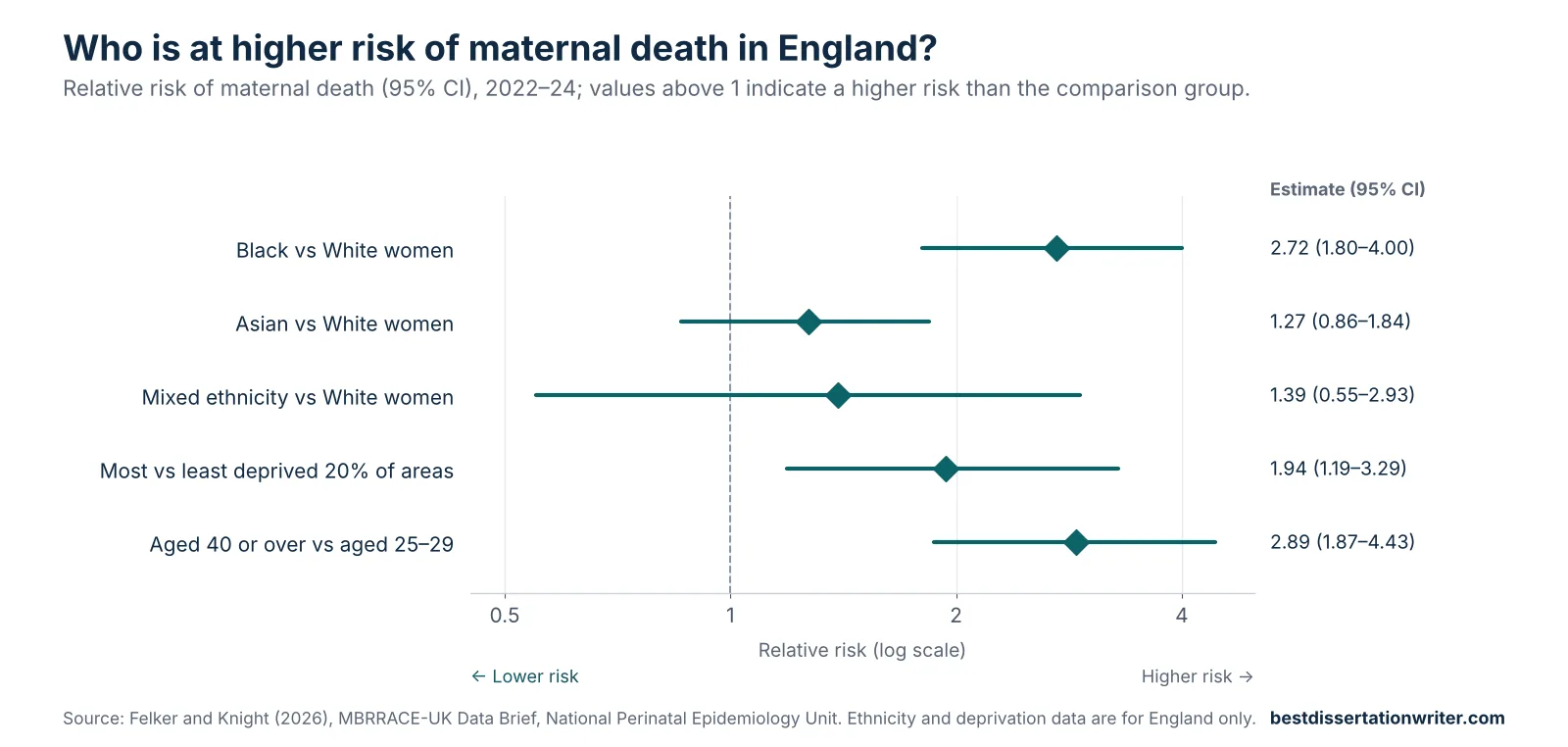
The size of these differences is striking, but the data also have limitations. Because maternal mortality is rare, confidence intervals are wide, and year-to-year changes in the estimated gap should be interpreted with caution. The data brief reports rates rather than adjusted estimates, so it cannot show how much of the ethnic gap is explained by age, deprivation or pre-existing conditions. The confidential enquiries, which review each death in depth, are needed to understand the circumstances behind the numbers.
Similar patterns are seen in the United States. Petersen et al. (2019) analysed 6,765 pregnancy-related deaths between 2007 and 2016. The overall pregnancy-related mortality ratio was 16.7 per 100,000 births, but it was 40.8 for Black women and 12.7 for White women, a ratio of about 3.2, and 29.7 for American Indian and Alaska Native women. Importantly, the gap persisted at every level of education: Black women with a college degree or higher had a mortality ratio 5.2 times that of White women with the same education.
This last finding challenges the assumption that ethnic inequalities in maternal death are simply a result of poverty or low education. Although socioeconomic disadvantage is clearly important, the persistence of the gap among highly educated women suggests that other factors, including the quality of care received and the effects of racism, also play a part. The surveillance data cannot identify these mechanisms directly, but they point clearly towards the need to examine how care is delivered.
Theme 2: Ethnic Inequalities Beyond Maternal Mortality
Maternal mortality is only the most extreme outcome, and severe illness provides a larger and more sensitive picture of inequality. In a national cohort study using the UK Obstetric Surveillance System, Knight et al. (2009) identified 686 cases of severe maternal morbidity among an estimated 775,186 maternities. The risk was 126 per 100,000 maternities for women from ethnic minority groups and 80 per 100,000 for White women, a risk ratio of 1.58. Black African and Black Caribbean women had risk ratios of 2.35 and 2.45 respectively.
Crucially, the increased risk among ethnic minority women remained after adjustment for age, socioeconomic and smoking status, body mass index and parity (odds ratio 1.50). This suggests that the inequality cannot be explained by these measured risk factors alone. The study’s national coverage and prospective case identification are strengths, but it focused on a specific set of severe conditions and was conducted more than fifteen years ago, so it may not reflect current patterns of care.
More recent evidence shows that ethnic inequalities extend to babies. Jardine et al. (2021) analysed 1,155,981 singleton births in 132 NHS hospitals in England. Stillbirth occurred in 0.7% of births to Black women compared with 0.3% of births to White women, and fetal growth restriction affected 3.5% of babies born to South Asian women compared with 1.4% of babies born to White women. About 11.7% of stillbirths and 16.9% of cases of fetal growth restriction were attributable to ethnic inequality.
Jardine et al. (2021) also found that socioeconomic and ethnic inequalities overlapped but did not simply duplicate each other: after adjustment for deprivation, smoking and body mass index, 13.0% of stillbirths were still attributable to ethnic inequality. The study’s large national dataset is a major strength, but routinely collected data may misclassify ethnicity and lack detail on factors such as migration history or language. Together, these studies show that maternal health inequalities form a continuum, from poorer pregnancy outcomes through severe illness to death.
Theme 3: Women’s Experiences of Care and Discrimination
Mortality statistics alone cannot explain why ethnic minority women experience higher maternal mortality and worse outcomes. MacLellan et al. (2022) synthesised 24 qualitative studies of Black, Asian and minority ethnic women’s experiences of maternity services in the UK. They identified discriminatory practices and communication failures, with many women reporting mistreatment, stereotyping and not being listened to. Woman-centred midwifery care was valued highly, but the authors concluded that for ethnic minority women such care was often the exception rather than the rule.
The authors suggested that this mistreatment may contribute to the poorer outcomes reported by national surveillance, for example when symptoms are dismissed, concerns are not escalated or interpreters are not provided. The synthesis was rigorous, using CASP appraisal and thematic synthesis, but qualitative studies cannot measure how far these experiences affect clinical outcomes. Nevertheless, its findings suggest that the experience of care should be examined alongside clinical risk factors when explaining the ethnic gap.
These experiences matter in their own right. Feeling dismissed or disrespected during pregnancy can reduce trust in services, discourage women from seeking help and leave lasting distress. For midwives, the evidence highlights the importance of listening, believing women, using professional interpreters and recognising how assumptions based on ethnicity or culture can lead to missed diagnoses. Improving maternal health for ethnic minority women depends as much on the quality of relationships as on clinical protocols.
Discussion
This review shows that ethnic inequalities in maternal mortality are large, persistent and found in more than one high-income country. In the UK, Black women had nearly three times the risk of White women in 2022–24, and in the United States the ratio was about 3.2 over a decade. The same pattern appears in severe maternal morbidity, stillbirth and fetal growth restriction, suggesting a shared set of underlying causes rather than chance variation.
The evidence also shows that the gap in maternal mortality is not fully explained by measured risk factors. Adjusted analyses in the UK cohort and the persistence of disparities among highly educated women in the United States both point beyond individual characteristics. Qualitative evidence on discrimination, stereotyping and poor communication offers one plausible explanation, although the causal pathway from experience of care to death is difficult to prove. Structural racism, social disadvantage and pre-existing illness are likely to interact rather than act separately.
There is a tension between the precision of surveillance data and their ability to explain. National data briefs provide accurate counts and rates, but because deaths are rare, confidence intervals are wide, and apparent changes from one period to the next may be due to chance. Broad categories such as Black or Asian also combine women with very different histories and needs. Detailed confidential enquiries, linked datasets and qualitative research are needed alongside rates to understand what drives the gap in maternal mortality.
The global context adds another dimension. Most maternal deaths occur in low-income countries, where weak health systems, lack of skilled birth attendance and poverty dominate. Some women who give birth in the UK have migrated from these settings and may carry the effects of earlier disadvantage, including untreated conditions and experiences of trauma. Midwives therefore need to understand both the global and local dimensions of maternal mortality.
This review has limitations. It relied on openly accessible, English-language sources, used a targeted rather than exhaustive search and did not involve independent double screening. Most evidence came from the UK and the United States, and findings may not apply to other countries. Several sources were descriptive rather than explanatory. Future research should evaluate interventions designed to reduce ethnic inequalities, such as continuity of care, interpreter services and anti-racism training, and should involve women from ethnic minority groups in designing and conducting studies.
Implications of Maternal Mortality Evidence for Practice
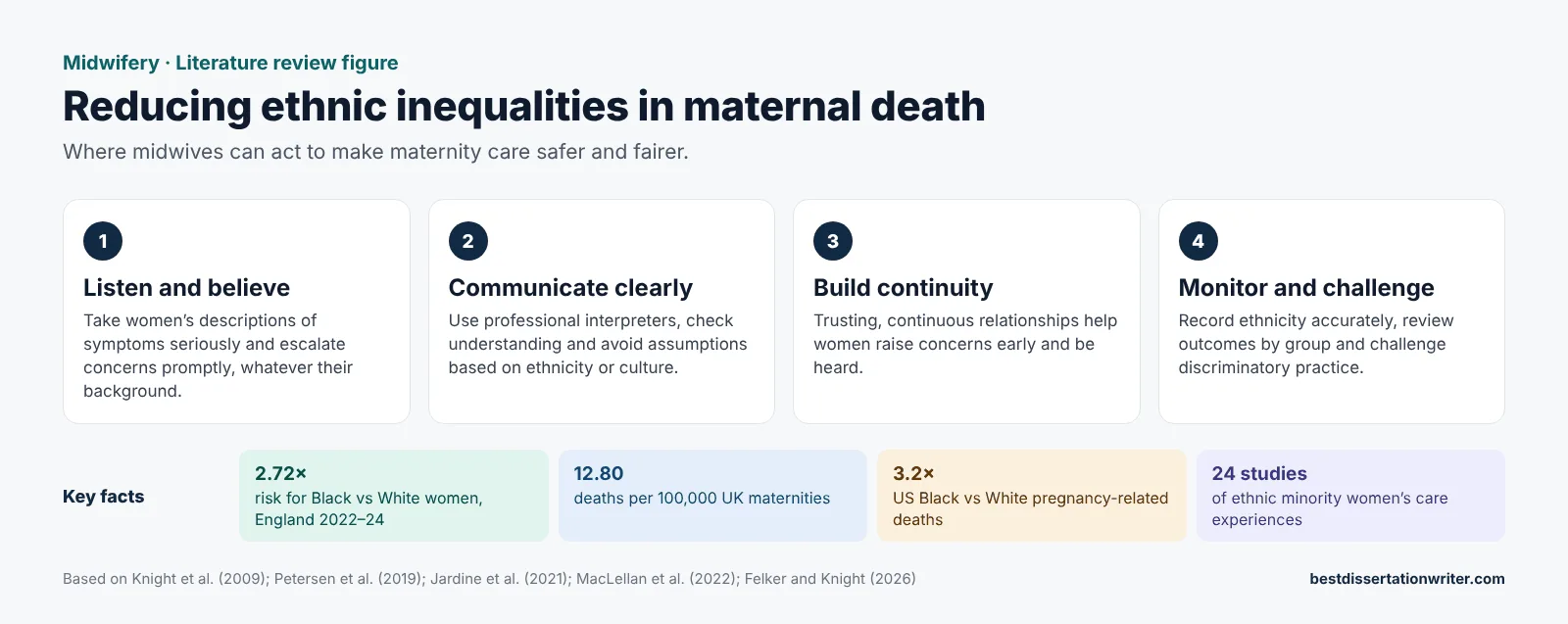
For midwives, the evidence calls for active listening and a low threshold for escalating concerns raised by women from ethnic minority groups. Midwives should take women’s descriptions of symptoms seriously, use professional interpreters rather than family members, avoid assumptions based on ethnicity or culture and document concerns clearly. Training on cultural safety and unconscious bias should be linked to clinical scenarios such as recognising sepsis, thromboembolism and cardiac disease in women from all backgrounds. Recording ethnicity accurately also allows services to monitor their own outcomes and identify inequalities.
Service-level approaches are also important. Models such as continuity of carer allow women to build trusting relationships, and the principles of respectful maternity care address the discrimination described by women. Midwives should also be aware that differences in caesarean section rates and other interventions may reflect inequalities in care, and that accessible antenatal education, offered in appropriate languages and formats, can help women recognise warning signs and seek help early. Together, these approaches help to place equity in maternal health at the centre of everyday midwifery practice.
Conclusion
This narrative review examined evidence on ethnic inequalities in maternal mortality. Black women in the UK and the United States face around three times the risk of dying as White women, and similar inequalities are seen in severe maternal morbidity, stillbirth and fetal growth restriction. The gap is not fully explained by measured risk factors, and ethnic minority women frequently report discrimination and not being heard.
Midwives are well placed to make a difference by listening to women, acting promptly on their concerns, providing culturally safe and continuous care and challenging discrimination where they see it. Reducing maternal mortality among ethnic minority women will require action at every level, from individual consultations to national policy, but the relationship between a woman and her midwife remains central to safer and fairer care.
References
Felker, A., & Knight, M. (2026). MBRRACE-UK data brief: Maternal mortality 2022–24. National Perinatal Epidemiology Unit, University of Oxford. https://doi.org/10.5287/ora-rdkmpynqg
Jardine, J., Walker, K., Gurol-Urganci, I., Webster, K., Muller, P., Hawdon, J., Khalil, A., Harris, T., van der Meulen, J., & National Maternity and Perinatal Audit Project Team. (2021). Adverse pregnancy outcomes attributable to socioeconomic and ethnic inequalities in England: A national cohort study. The Lancet, 398(10314), 1905–1912. https://doi.org/10.1016/S0140-6736(21)01595-6
Knight, M., Kurinczuk, J. J., Spark, P., & Brocklehurst, P. (2009). Inequalities in maternal health: National cohort study of ethnic variation in severe maternal morbidities. BMJ, 338, b542. https://doi.org/10.1136/bmj.b542
MacLellan, J., Collins, S., Myatt, M., Pope, C., Knighton, W., & Rai, T. (2022). Black, Asian and minority ethnic women’s experiences of maternity services in the UK: A qualitative evidence synthesis. Journal of Advanced Nursing, 78(7), 2175–2190. https://doi.org/10.1111/jan.15233
Petersen, E. E., Davis, N. L., Goodman, D., Cox, S., Syverson, C., Seed, K., Shapiro-Mendoza, C., Callaghan, W. M., & Barfield, W. (2019). Racial/ethnic disparities in pregnancy-related deaths — United States, 2007–2016. Morbidity and Mortality Weekly Report, 68(35), 762–765. https://doi.org/10.15585/mmwr.mm6835a3
World Health Organization. (2025, April 7). Maternal mortality [Fact sheet]. https://www.who.int/news-room/fact-sheets/detail/maternal-mortality
Cite this example
Best Dissertation Writers (2026) Health Inequalities and Maternal Mortality Among Ethnic Minority Women: A Narrative Review. Available at: https://bestdissertationwriter.com/maternal-mortality-literature-review/
Best Dissertation Writers
Get expert help with your nursing literature review
Share your topic and deadline with Best Dissertation Writers and get support tailored to your module brief.