Maternal and Neonatal Outcomes of Planned Home Birth Compared With Hospital Birth: A Systematic Review
 By Dr. Robertson Prime, Research Fellow
Updated October 12, 2026
15 min read
About 3,000 words
In this review
Abstract
Background: Planned home birth is an option for healthy pregnant women in several high-income countries, but its safety compared with hospital birth remains debated. Decisions about place of birth involve balancing the small risks of adverse outcomes against the benefits of fewer interventions and greater autonomy.
Aim: This systematic review aimed to compare maternal and neonatal outcomes of planned home birth with planned hospital birth among low-risk women, and to consider the implications for midwifery practice.
Methods: Evidence was identified through targeted searches of openly accessible bibliographic records, publisher websites and the reference lists of key reviews. Six sources published between 2011 and 2023 were included: two national cohort studies, two systematic reviews with meta-analysis, a Cochrane review and a national guideline, appraised with CASP checklists and synthesised narratively.
Findings: In meta-analyses of around 500,000 intended home births, perinatal or neonatal mortality did not differ from intended hospital birth in well-integrated settings, and a Dutch cohort of over 740,000 low-risk births found similar results. In England, adverse perinatal outcomes were more common for first-time mothers planning home birth (9.3 compared with 5.3 per 1,000), and 45% were transferred to hospital. Home birth was associated with much lower odds of caesarean section, epidural, episiotomy and severe perineal tears.
Conclusion: Midwives should give low-risk women balanced, parity-specific information about place of birth and work within well-integrated systems that support safe, timely transfer when needed.
Keywords: planned home birth, place of birth, low-risk women
Introduction
This systematic review critically examines recent evidence on planned home birth and its implications for midwifery practice.
Where a woman gives birth is one of the most important decisions she makes during pregnancy. For most of history, birth took place at home, but during the twentieth century hospital birth became the norm in most high-income countries. Today, home birth remains an established option in countries such as the Netherlands and the United Kingdom, while in other settings it is rare or poorly integrated into the health system. Debate continues about whether planned home birth is as safe as hospital birth for women with straightforward pregnancies.
Supporters argue that home birth offers a familiar, calm environment, continuity with a known midwife, fewer unnecessary interventions and greater control for women. Critics are concerned that serious complications can arise suddenly and that delay in reaching specialist care could harm the baby or mother. These positions are often strongly held, which makes balanced, evidence-based information all the more important for low-risk women weighing their options. Understanding what the research actually shows about planned home birth is therefore essential for every midwife, whether or not she attends births at home.
Midwives are the main providers of home birth care and the main source of information about place of birth during pregnancy. A systematic design was chosen to identify and appraise the strongest available evidence, including large cohort studies, meta-analyses and Cochrane evidence, in a transparent way.
Review question
How do maternal and neonatal outcomes of planned home birth compare with planned hospital birth for low-risk women, and what are the implications for midwifery practice?
Background to Planned Home Birth
Planned home birth refers to a birth that a woman intends, at the onset of labour, to have at home with a midwife in attendance. Comparing outcomes by intended rather than actual place of birth is essential, because women who transfer to hospital during labour often do so because of complications. Counting them as hospital births would make home birth appear safer than it is and make hospital birth appear less safe.
The safety of planned home birth depends on more than the setting itself. Important factors include the selection of women who are at low risk of complications, the training and experience of attending midwives, access to emergency equipment, clear criteria for transfer and the distance and time to an obstetric unit. Health systems in which home birth is well integrated, with regulated midwives and established transfer pathways, differ greatly from settings where home birth occurs outside the formal system.
Randomised trials of place of birth are difficult because many women hold strong preferences and are unwilling to be allocated at random. A Cochrane review found only one small trial, with 11 participants, and concluded that randomised evidence on whether planned hospital birth reduces maternal or perinatal mortality for low-risk women is uncertain (Olsen & Clausen, 2023). Most evidence on planned home birth therefore comes from large observational cohort studies, which are vulnerable to confounding but can include very large numbers of births.
Search Strategy and Methods
Evidence for this example was identified through targeted searches of openly accessible bibliographic records, publisher websites and the reference lists of key reviews. Search terms combined keywords for the exposure (“planned home birth”, “home birth”, “place of birth”, “birth setting”) with terms for population and outcomes (“low risk”, “perinatal mortality”, “neonatal outcome*”, “maternal outcome*”, “intervention*”, “transfer”), joined with the Boolean operators AND and OR. A full systematic review for assessment would run the same strategy in CINAHL, MIDIRS, PubMed/MEDLINE and the Cochrane Library and report the number of records screened in a PRISMA flow diagram.
Sources were eligible if they compared outcomes for low-risk women intending to give birth at home with those intending to give birth in hospital, analysed by intended place of birth, and reported perinatal, neonatal or maternal outcomes or intervention rates. Systematic reviews, Cochrane reviews, large national cohort studies and national guidelines were prioritised. Studies of unplanned or unattended home births and of women with high-risk pregnancies were excluded.
Six sources on planned home birth published between 2011 and 2023 were included: two national cohort studies, two systematic reviews with meta-analysis, one Cochrane review and one national guideline (Table 1). The quality of each source was appraised using the Critical Appraisal Skills Programme (CASP) checklist appropriate to its design, and findings were synthesised narratively and grouped into themes.
Key Findings on Planned Home Birth
Three themes were identified: perinatal and neonatal outcomes, maternal outcomes and birth interventions, and the influence of parity, transfer and system integration. Table 1 summarises the included sources, and Figure 1 presents the pooled odds of birth interventions and maternal complications for women intending to give birth at home.
| Author, year | Design | Setting and sample | Key finding |
|---|---|---|---|
| Birthplace in England Collaborative Group (2011) | National prospective cohort study | 64,538 low-risk women; England | Nulliparous home births: adverse outcomes 9.3 vs 5.3 per 1,000 (aOR 1.75); no difference for multiparous women; far fewer interventions. |
| de Jonge et al. (2015) | National cohort study | 743,070 low-risk women in midwife-led care; Netherlands | Intrapartum and neonatal death similar for planned home and hospital births in nulliparous and parous women. |
| Hutton et al. (2019) | Systematic review and meta-analysis | 14 studies; about 500,000 intended home births | No difference in perinatal or neonatal mortality in well-integrated settings (OR 1.07 nulliparous, 1.08 multiparous). |
| Reitsma et al. (2020) | Systematic review and meta-analysis | 16 studies; about 500,000 intended home births | Lower odds of caesarean section (OR 0.58), epidural, episiotomy, severe tears and infection with intended home birth. |
| NICE (2023) | National clinical guideline | Healthy women with uncomplicated pregnancies; England | Support any choice of birth setting; home particularly suitable for multiparous women; small added risk for nulliparous. |
| Olsen & Clausen (2023) | Cochrane systematic review | 1 RCT with 11 participants | Randomised evidence on whether planned hospital birth reduces mortality for low-risk women is uncertain. |
Theme 1: Perinatal and Neonatal Outcomes of Planned Home Birth
The Birthplace in England national prospective cohort study followed 64,538 low-risk women (Birthplace in England Collaborative Group, 2011). Adverse perinatal outcomes, including stillbirth during labour, early neonatal death, neonatal encephalopathy and birth injuries, were uncommon overall at 4.3 per 1,000 births. For nulliparous women, however, adverse outcomes were more common in planned home births than in planned obstetric unit births (9.3 compared with 5.3 per 1,000; adjusted odds ratio 1.75). For multiparous women there was no significant difference (adjusted odds ratio 0.72).
In the Netherlands, where home birth is fully integrated into the maternity system, de Jonge et al. (2015) analysed national data on 743,070 low-risk women in midwife-led care at the onset of labour. Intrapartum and neonatal death up to 28 days was similar for planned home and hospital births among nulliparous women (1.02 compared with 1.09 per 1,000) and parous women (0.59 compared with 0.58 per 1,000). Among parous women, neonatal intensive care admission was lower after planned home birth. The very large sample is a strength, but registry data may contain errors in recorded place and timing of death.
Hutton et al. (2019) pooled 14 studies including around 500,000 intended home births. In well-integrated settings, the odds of perinatal or neonatal mortality did not differ between intended home and hospital birth for nulliparous women (odds ratio 1.07) or multiparous women (1.08). In less integrated settings, the estimates were higher (3.17 and 1.58) but very imprecise, with confidence intervals that included no difference. Together these studies suggest that serious adverse outcomes are rare and that any additional risk is concentrated among first-time mothers.
Theme 2: Maternal Outcomes and Birth Interventions
The clearest benefit of planned home birth is a reduction in medical intervention. In a companion meta-analysis of 16 studies, Reitsma et al. (2020) found that low-risk women intending to give birth at home in well-integrated settings had lower odds of caesarean section (odds ratio 0.58), operative vaginal birth (0.42), epidural analgesia (0.30), episiotomy (0.45), third- or fourth-degree tears (0.57), oxytocin augmentation (0.37) and maternal infection (0.23). Pooled data also suggested less postpartum haemorrhage, although two studies that could not be pooled found no difference. No maternal deaths were reported.
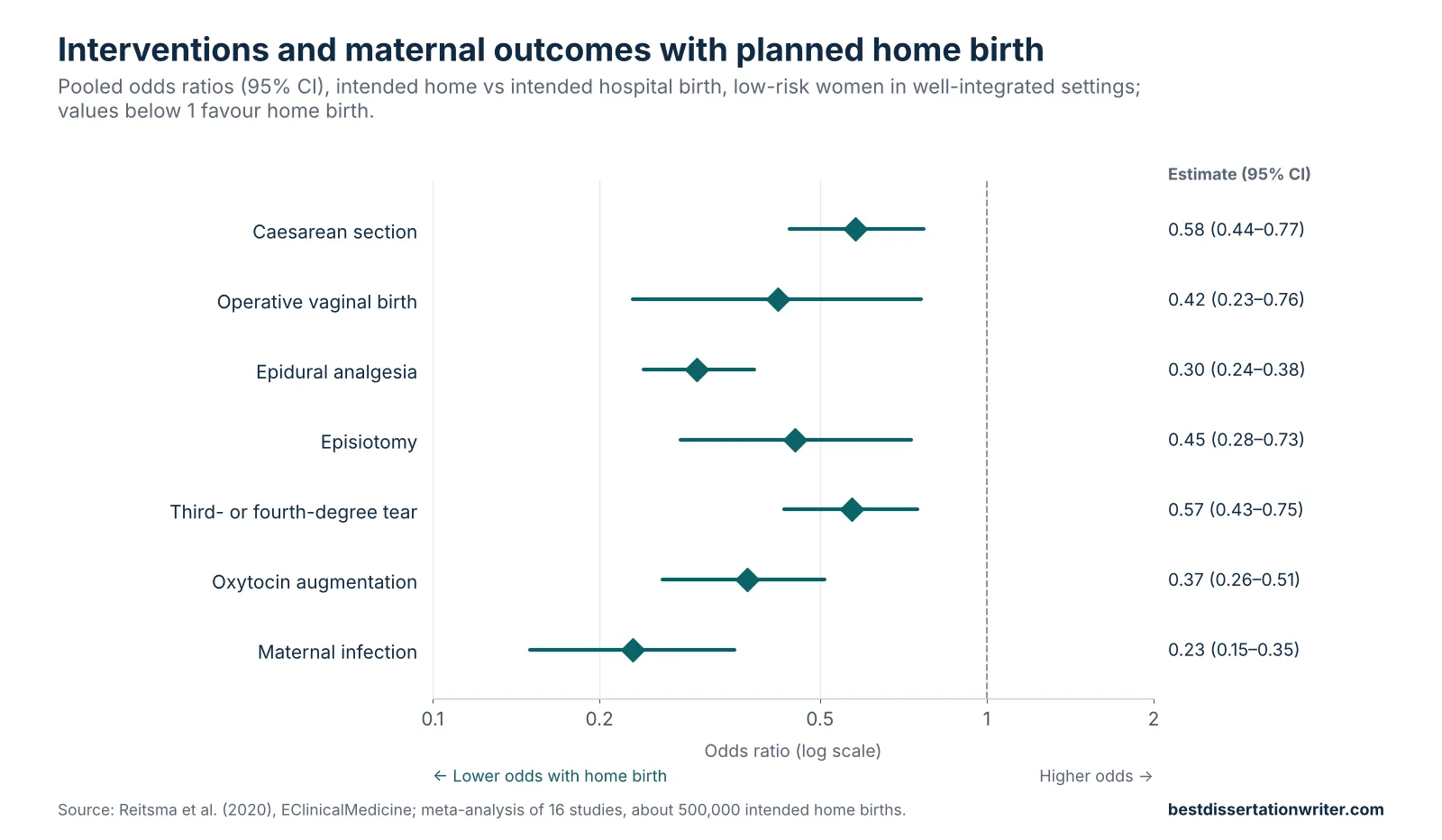
The Birthplace study found a similar pattern. Intrapartum caesarean section occurred in 2.8% of planned home births compared with 11.1% of planned obstetric unit births, and around 88% of women planning home birth had a normal birth compared with about 58% of those planning birth in an obstetric unit (Birthplace in England Collaborative Group, 2011). These differences remained after adjustment for maternal characteristics.
These findings must be interpreted with caution. Women who choose home birth may differ from those who choose hospital in ways that are not fully captured by adjustment, such as their motivation for a physiological birth, their attitudes to pain relief and their support at home. Some of the reduction in intervention may therefore reflect who chooses home birth rather than the setting alone. Nevertheless, the consistency of findings across countries and study designs suggests that the setting and model of care play an important part.
Theme 3: Parity, Transfer and System Integration
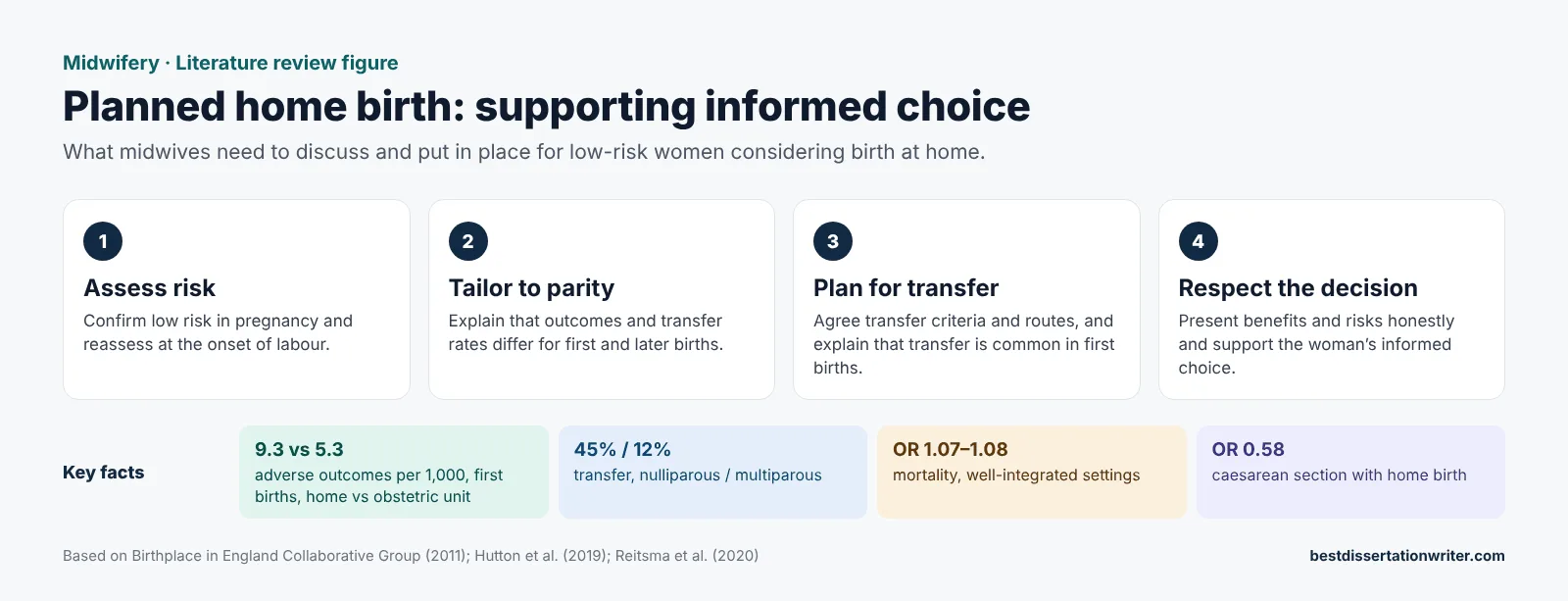
Transfer to hospital is an expected part of home birth care. In the Birthplace study, 45% of nulliparous women and 12% of multiparous women who planned home birth were transferred to an obstetric unit during labour or immediately after birth (Birthplace in England Collaborative Group, 2011). Women need to understand before labour that transfer is common, particularly in a first birth, and why it may be recommended.
National guidance reflects these parity differences. The National Institute for Health and Care Excellence (NICE, 2023) advises that all low-risk women can choose any birth setting and that their choice should be supported. Multiparous women should be told that planning birth at home or in a midwifery-led unit is particularly suitable for them because intervention rates are lower and outcomes for the baby are no different from an obstetric unit. Nulliparous women should be told that planned home birth carries a small increase in the risk of an adverse outcome for the baby.
System integration emerges as a key modifier of safety. The reassuring findings from the Netherlands, England and the well-integrated settings in the meta-analyses come from systems with regulated midwives, clear risk assessment and established transfer arrangements (de Jonge et al., 2015; Hutton et al., 2019). These results cannot simply be applied to places where home birth is attended by unregulated providers or where hospital transfer is slow or unwelcoming.
Discussion
This review found that, for low-risk women in well-integrated maternity systems, planned home birth is associated with similar rates of perinatal and neonatal mortality to planned hospital birth and with substantially fewer interventions and maternal complications. The main exception is that first-time mothers planning a home birth in England had a small but significant increase in adverse perinatal outcomes and a high transfer rate. These findings are broadly consistent across large cohorts and meta-analyses.
There is, however, a tension between the English and Dutch findings for nulliparous women. The Birthplace study used a composite outcome that included neonatal encephalopathy and birth injuries, while the Dutch study focused on mortality and neonatal intensive care admission. Differences in outcome definitions, transfer distances and how home birth is organised may explain why planned home birth appeared to carry additional risk for first births in one setting but not in the other.
The absence of randomised evidence is a central limitation. The Cochrane review found only one small feasibility trial (Olsen & Clausen, 2023), and all other evidence is observational. Confounding by unmeasured factors, such as women’s health behaviours and preferences, cannot be excluded. However, observational studies that analyse outcomes by intended place of birth and adjust for key risk factors provide the best available evidence and allow very rare outcomes to be studied.
Women’s autonomy is also central to this debate. Place of birth is not only a clinical question but a personal decision about values, priorities and the kind of experience a woman wants. Low-risk women may reasonably weigh a small absolute increase in risk to the baby differently from health professionals, especially when it is accompanied by large reductions in intervention for themselves. The role of the midwife is to present the evidence honestly and support the woman’s informed decision, whatever the choice of place of birth.
The evidence also has implications for the midwifery workforce. Home birth requires midwives who are confident in managing normal labour without immediate medical support, recognising early signs of complications and making timely decisions about transfer. Where home births are rare, midwives may have few opportunities to maintain these skills, and services may struggle to staff home birth teams alongside busy hospital units. The reassuring outcomes reported in well-integrated systems depend on these conditions being in place, so expanding access to planned home birth without investing in staffing, training and transfer arrangements could undermine its safety. Regular skills drills and audit of transfers can help services monitor and maintain quality.
This review has limitations. It relied on openly accessible, English-language sources and did not involve independent double screening, and most included evidence came from a small number of high-income countries with established midwifery services. Few studies reported women’s experiences, long-term outcomes or the views of partners. Future research should examine outcomes in different health systems, standardise outcome definitions and explore how decision-making about planned home birth can best be supported.
Implications of Planned Home Birth Evidence for Practice
Midwives should discuss place of birth with all low-risk women during pregnancy, giving clear and balanced information that is specific to parity. Multiparous women can be told that home birth is a suitable option with fewer interventions and similar outcomes for the baby, while nulliparous women need to know about the small increase in risk to the baby and the likelihood of transfer. Information should be updated as pregnancy progresses, and risk assessment should be repeated at the onset of labour.
Services need robust systems for safe home birth, including appropriately trained and staffed midwifery teams, emergency equipment, clear transfer guidelines and good communication with obstetric units. Lower intervention rates may contribute to reducing caesarean section rates and to safe, sustainable maternity care, but safety systems remain essential for preventing maternal mortality. Models of continuity of carer can support women planning home birth, and midwives should discuss non-pharmacological and other options for pain relief in labour so that expectations are realistic.
Conclusion
This systematic review compared outcomes of planned home birth with planned hospital birth for low-risk women. In well-integrated systems, perinatal mortality is similar, interventions and maternal complications are substantially lower, and the additional risk to the baby is concentrated in first births, where transfer is also common.
For midwives, the evidence supports offering planned home birth as a genuine choice for low-risk women, with honest, parity-specific information and strong systems for transfer. Supporting informed choice about place of birth is central to safe, woman-centred midwifery practice.
References
Birthplace in England Collaborative Group. (2011). Perinatal and maternal outcomes by planned place of birth for healthy women with low risk pregnancies: The Birthplace in England national prospective cohort study. BMJ, 343, d7400. https://doi.org/10.1136/bmj.d7400
de Jonge, A., Geerts, C. C., van der Goes, B. Y., Mol, B. W., Buitendijk, S. E., & Nijhuis, J. G. (2015). Perinatal mortality and morbidity up to 28 days after birth among 743 070 low-risk planned home and hospital births: A cohort study based on three merged national perinatal databases. BJOG: An International Journal of Obstetrics and Gynaecology, 122(5), 720–728. https://doi.org/10.1111/1471-0528.13084
Hutton, E. K., Reitsma, A., Simioni, J., Brunton, G., & Kaufman, K. (2019). Perinatal or neonatal mortality among women who intend at the onset of labour to give birth at home compared to women of low obstetrical risk who intend to give birth in hospital: A systematic review and meta-analyses. EClinicalMedicine, 14, 59–70. https://doi.org/10.1016/j.eclinm.2019.07.005
National Institute for Health and Care Excellence. (2023). Intrapartum care (NICE Guideline NG235). https://www.nice.org.uk/guidance/ng235
Olsen, O., & Clausen, J. A. (2023). Planned hospital birth compared with planned home birth for pregnant women at low risk of complications. Cochrane Database of Systematic Reviews, (3), CD000352. https://doi.org/10.1002/14651858.CD000352.pub3
Reitsma, A., Simioni, J., Brunton, G., Kaufman, K., & Hutton, E. K. (2020). Maternal outcomes and birth interventions among women who begin labour intending to give birth at home compared to women of low obstetrical risk who intend to give birth in hospital: A systematic review and meta-analyses. EClinicalMedicine, 21, 100319. https://doi.org/10.1016/j.eclinm.2020.100319
Cite this example
Best Dissertation Writers (2026) Maternal and Neonatal Outcomes of Planned Home Birth Compared With Hospital Birth: A Systematic Review. Available at: https://bestdissertationwriter.com/planned-home-birth-literature-review/
Best Dissertation Writers
Get expert help with your nursing literature review
Share your topic and deadline with Best Dissertation Writers and get support tailored to your module brief.