Continuity of Carer Models in Midwifery and Their Impact on Maternal and Neonatal Outcomes: A Systematic Review
 By Dr. Robertson Prime, Research Fellow
Updated October 12, 2026
16 min read
About 3,100 words
In this review
Abstract
Background: Continuity of carer means that a woman is cared for by the same midwife, or a small team of midwives, through pregnancy, birth and the early postnatal period. Midwife-led continuity models are widely promoted, yet their effects on birth outcomes and their sustainability for the workforce remain debated.
Aim: This systematic review aimed to examine the impact of midwife continuity of care models on maternal and neonatal outcomes and what this means for midwifery practice.
Methods: Evidence was identified through targeted searches of openly accessible bibliographic records, publisher websites and the reference lists of key reviews. Seven sources published between 2012 and 2024 were included: a Cochrane review, three randomised trials, a qualitative meta-synthesis, a workforce survey and a national policy letter, appraised with CASP checklists and synthesised thematically.
Findings: A Cochrane review of 17 trials with 18,533 women found that continuity models increased spontaneous vaginal birth (risk ratio 1.05) and reduced caesarean section (0.91), instrumental birth (0.89), regional analgesia (0.85) and episiotomy (0.83), with no clear difference in preterm birth or neonatal death. In the COSMOS trial, caseload midwifery lowered the caesarean rate from 24.9% to 19.4%. Women valued the relationship, trust and empowerment that continuity brings, and midwives providing it reported lower burnout, although a UK pilot trial for women at risk of preterm birth found no difference in its primary outcome.
Conclusion: Continuity of carer offers modest but consistent benefits with no evidence of harm, provided that it is staffed safely. Midwives and managers should protect the relationship at its core and build models that midwives can sustain.
Keywords: continuity of carer, midwife-led, caseload midwifery, birth outcomes
Introduction
This systematic review critically examines recent evidence on continuity of carer and its implications for midwifery practice.
Many women meet a different midwife at almost every antenatal appointment, are cared for in labour by someone they have never met and are visited at home after the birth by yet another professional. Fragmented care of this kind can mean that women repeat their history many times, that concerns are lost between handovers and that nobody holds the whole picture of a pregnancy. Continuity of carer aims to change this by giving each woman a known midwife, or a small team of midwives, across pregnancy, labour, birth and the early postnatal weeks.
Midwives sit at the centre of this model. In caseload midwifery, a named midwife carries responsibility for a set number of women and is on call for their births, supported by a partner or small group practice. Team models share care among a slightly larger group. Both approaches ask midwives to work flexibly and autonomously, and both depend on organisational support that many services have found difficult to provide. These models therefore raise questions not only about birth outcomes but also about workforce wellbeing, cost and equity.
A systematic approach was chosen so that a Cochrane review, randomised trials, qualitative synthesis and workforce evidence could be identified, appraised and compared transparently. This matters because national policy on continuity of carer has shifted in recent years, and midwives need a clear understanding of what the evidence does and does not show.
Review question
What is the impact of midwife continuity of carer models on maternal and neonatal outcomes, how do women and midwives experience these models, and what are the implications for midwifery practice?
Background to Continuity of Carer
Continuity in maternity care can be relational, meaning an ongoing relationship with a known professional, or informational and management continuity, meaning that records and plans follow the woman between professionals. Midwife-led continuity models focus on relational continuity. In these models, the midwife is the lead professional for women with straightforward pregnancies and coordinates referral to obstetricians and other specialists when complications arise, so that the relationship is maintained even when care becomes shared.
Several organisational forms exist. Caseload midwifery allocates each midwife a personal caseload, typically working in partnership with one or two colleagues who cover days off and leave. Team midwifery involves a larger group sharing care for a defined population, which offers more predictable working patterns but means that a woman may not have met the midwife who attends her birth. Models also differ in whether they serve only women at low obstetric risk or women of any risk, and in whether births take place in hospital, midwifery units or at home.
The case for continuity of carer rests on several proposed mechanisms. A trusting relationship may help women feel safe in labour, reducing stress and the need for pharmacological pain relief. A known midwife may recognise changes in a woman’s physical or emotional wellbeing earlier, and may be better placed to support informed decision-making. Critics, however, point out that these mechanisms are difficult to measure, that trial populations may not reflect women with complex needs and that on-call working can be demanding for midwives.
In England, midwifery continuity became a national ambition, with services expected to place most women on continuity pathways. In September 2022, however, NHS England removed the national target and the date by which services had to deliver midwifery continuity of carer, advising trusts that could not meet safe staffing levels to suspend provision (NHS England, 2022). This change makes it timely to revisit the underlying evidence.
Search Strategy and Methods
Evidence for this example was identified through targeted searches of openly accessible bibliographic records, publisher websites and the reference lists of key reviews. Search terms combined keywords for the model of care (“continuity of carer”, “continuity of care”, “caseload midwifery”, “midwife-led”, “team midwifery”) with terms for outcomes and experience (“birth outcomes”, “caesarean”, “preterm”, “experience”, “burnout”), joined with the Boolean operators AND and OR. A full systematic review for assessment would run the same strategy in CINAHL, MIDIRS, PubMed/MEDLINE and the Cochrane Library and report the number of records screened in a PRISMA flow diagram.
Sources were eligible if they evaluated midwife continuity of carer models against other models of maternity care, explored women’s or midwives’ experiences of continuity of carer, or set out national policy on its implementation. Randomised trials and systematic reviews were prioritised for outcome questions, while qualitative and survey evidence was included to address experience and workforce questions. Studies of continuity provided mainly by doctors, or of general practitioner care alone, were excluded.
Seven sources published between 2012 and 2024 were included: one Cochrane systematic review, three randomised controlled trials, one qualitative systematic review with meta-synthesis, one cross-sectional workforce survey and one national policy letter (Table 1). The quality of each source was appraised using the Critical Appraisal Skills Programme (CASP) checklist appropriate to its design, and findings were synthesised narratively and grouped into themes. Particular attention was paid to the certainty ratings reported in the Cochrane review.
Key Findings on Continuity of Carer
Three themes were identified: the effects of continuity of carer on maternal and neonatal birth outcomes, women’s experiences and the value of the relationship, and the sustainability of continuity models for midwives and services. Table 1 summarises the included sources, and Figure 1 presents the pooled risk ratios from the most recent Cochrane review for selected outcomes.
| Author, year | Design | Setting and sample | Key finding |
|---|---|---|---|
| McLachlan et al. (2012) | Randomised controlled trial (COSMOS) | 2,314 low-risk women; tertiary hospital, Melbourne, Australia | Caseload midwifery reduced caesarean birth (19.4% vs 24.9%; RR 0.78) and neonatal unit admission. |
| Tracy et al. (2013) | Randomised controlled trial (M@NGO) | 1,748 women of any risk; Australia | No significant difference in caesarean section (21% vs 23%); care cost AUS$566.74 less per woman. |
| Fenwick et al. (2018) | Cross-sectional survey | 862 Australian midwives (214 in continuity models) | Continuity midwives had lower burnout, anxiety and depression and higher autonomy. |
| Perriman et al. (2018) | Qualitative systematic review and meta-synthesis | 13 studies, 2006–2016; mainly Australia, UK and New Zealand | The woman–midwife relationship delivered personalised care, trust and empowerment. |
| Fernandez Turienzo et al. (2020) | Pilot randomised controlled trial (POPPIE) | 334 women at increased risk of preterm birth; UK | No difference in primary composite outcome (83.3% vs 84.7%); more skin-to-skin and breastfeeding. |
| NHS England (2022) | National policy letter | Maternity services in England | Removed the national target; trusts unable to staff safely should suspend provision. |
| Sandall et al. (2024) | Cochrane systematic review | 17 trials, 18,533 women | More spontaneous vaginal births (RR 1.05) and fewer caesareans (RR 0.91); no clear neonatal differences. |
Theme 1: Continuity of Carer and Birth Outcomes
The most comprehensive evidence comes from the Cochrane review by Sandall et al. (2024), which included 17 trials involving 18,533 women. Compared with other models of care, midwife continuity of care models increased spontaneous vaginal birth (risk ratio [RR] 1.05, 95% confidence interval [CI] 1.03 to 1.07) and reduced caesarean section (RR 0.91, 0.84 to 0.99), both with moderate certainty. They also reduced instrumental vaginal birth (RR 0.89, 0.83 to 0.96) and episiotomy (RR 0.83, 0.77 to 0.91), and may reduce regional analgesia (RR 0.85, 0.79 to 0.92), although the certainty for regional analgesia was very low.
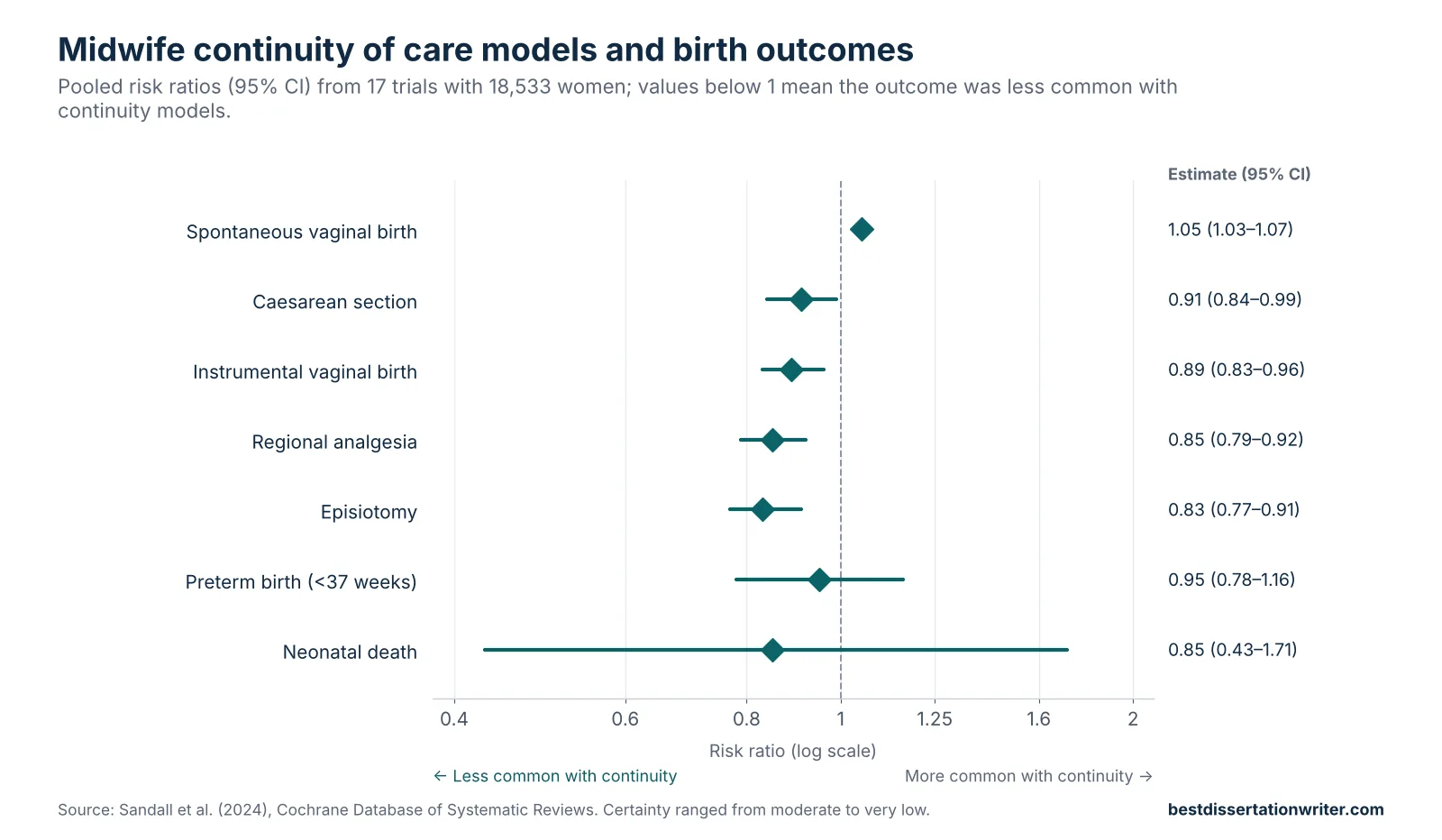
For neonatal outcomes, the review found little or no difference in preterm birth before 37 weeks (RR 0.95, 0.78 to 1.16) and was very uncertain about effects on neonatal death (RR 0.85, 0.43 to 1.71) and fetal loss at or after 24 weeks. Postpartum haemorrhage was not clearly reduced (RR 0.92, 0.82 to 1.03). Women in continuity models were far more likely to be attended in labour by a known midwife (RR 9.13), which confirms that the intervention changed care as intended. Importantly, no outcome showed clear harm.
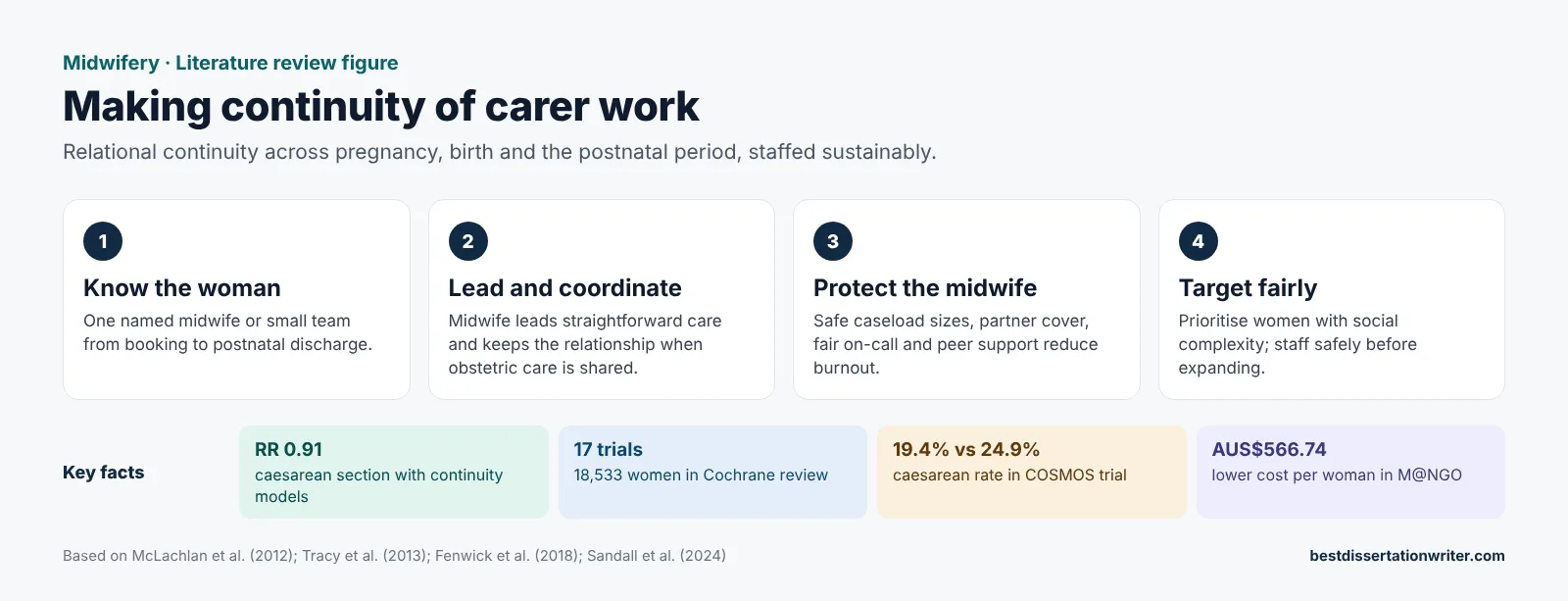
Individual trials illustrate the range of effects. In the COSMOS trial in Melbourne, McLachlan et al. (2012) randomised 2,314 women at low obstetric risk to caseload midwifery or standard care. Caseload midwifery reduced caesarean birth from 24.9% to 19.4% (RR 0.78, 0.67 to 0.91) and increased spontaneous vaginal birth from 55.7% to 63.0%. Epidural use, episiotomy and infant admission to special or neonatal intensive care (4.0% versus 6.4%) were also lower, and no infant outcome favoured standard care.
The M@NGO trial tested caseload midwifery for women of any risk. Tracy et al. (2013) randomised 1,748 women in Australia and found no significant difference in caesarean section (21% versus 23%), instrumental birth or epidural use, although elective caesarean sections were less common (8% versus 11%). Neonatal outcomes did not differ. These more modest results suggest that the size of benefit may depend on the population, the setting and the comparison care, and that headline effects from a single trial should not be generalised uncritically.
Theme 2: Women’s Experiences and the Value of the Relationship
Clinical outcomes are only part of the picture. Perriman et al. (2018) synthesised 13 qualitative studies published between 2006 and 2016, mainly from Australia, the United Kingdom and New Zealand. The overarching concept was the relationship between the woman and her midwife, which the authors described as the vehicle through which personalised care, trust and empowerment were achieved. Women valued being known, not having to repeat their story and feeling that their midwife was available and on their side.
The Cochrane review similarly reported that continuity models generally gave women more positive experiences, although these data were described narratively because of differences in measurement (Sandall et al., 2024). The qualitative evidence helps to explain the quantitative findings: a trusted relationship may reduce fear in labour and support physiological birth. However, most qualitative studies came from high-income countries and from women who had chosen or been offered continuity, so their experiences may not represent women who are less able to access such models.
Continuity may also matter for women at higher social or clinical risk. In the POPPIE pilot trial, Fernandez Turienzo et al. (2020) randomised 334 women at increased risk of preterm birth in the United Kingdom, 32% of whom were from Black, Asian and minority ethnic groups. There was no significant difference in the primary composite outcome of appropriate and timely interventions for preterm labour and birth (83.3% versus 84.7%; RR 0.98, 0.90 to 1.08). Infants in the continuity group were, however, more likely to have skin-to-skin contact and to breastfeed immediately after birth and at discharge.
Theme 3: Sustainability for Midwives and Services
A frequent concern is that continuity of carer, particularly on-call caseload work, leads to exhaustion. The survey evidence does not support this assumption when models are well organised. Fenwick et al. (2018) compared 214 Australian midwives providing continuity of midwifery care with 648 who did not. Midwives working in continuity models had significantly lower scores on all three burnout subscales, lower anxiety and depression scores and higher autonomy and empowerment, with no difference in time off or work-life balance. Because the study was cross-sectional, midwives who thrive in continuity roles may self-select into them.
Cost is a second consideration for services. In the M@NGO trial, caseload midwifery cost AUS$566.74 less per woman than standard care (Tracy et al., 2013), and the Cochrane review noted cost savings in the antenatal and intrapartum periods (Sandall et al., 2024). Nevertheless, implementation depends on enough midwives to staff caseloads safely. In England, NHS England (2022) removed the national continuity of carer target and advised trusts unable to meet safe staffing levels to suspend provision and redeploy midwives, illustrating how workforce shortages can override evidence of benefit.
Discussion
This review suggests that continuity of carer improves several maternal birth outcomes, including more spontaneous vaginal births and fewer caesarean sections, instrumental births and episiotomies, without evidence of harm. The effects are modest in relative terms, but because these outcomes are common, small relative changes can affect many women. The Cochrane evidence is the strongest available, drawing on 17 trials, and the consistent direction of effect across trials strengthens confidence in the findings.
The neonatal picture is less certain. Earlier interest in continuity of carer as a way to reduce preterm birth is not clearly supported by the most recent pooled estimate, and the POPPIE pilot trial found no difference in its primary outcome. Neonatal deaths and fetal losses are rare, so even large meta-analyses produce wide confidence intervals. Claims that continuity models save babies’ lives should therefore be made cautiously, although improvements in skin-to-skin contact and breastfeeding are encouraging.
A recurring tension lies between evidence and implementation. The trials were conducted in settings with the resources and commitment to set up continuity models carefully, whereas national roll-out took place amid staff shortages. The decision by NHS England (2022) to remove the target reflects this gap. The lower burnout reported by Fenwick et al. (2018) suggests that continuity work can be sustainable, but only when caseload sizes, on-call arrangements and team support are designed well.
Equity is another important consideration. Women from disadvantaged and minority ethnic groups experience worse maternity outcomes, and continuity of carer has been promoted as one way to address this. The POPPIE trial shows that it is feasible to deliver continuity to women with complex needs, but larger trials are required to establish whether targeted continuity reduces inequalities in birth outcomes. Services should ensure that continuity is not offered mainly to women who are already advantaged.
The evidence base has limitations. Most trials were conducted in Australia and the United Kingdom, many included only women at low risk and blinding was impossible. Outcomes such as experience and cost were inconsistently measured. This review relied on openly accessible, English-language sources and did not involve independent double screening, so relevant studies may have been missed. Future research should evaluate continuity models for women with social and medical complexity, measure midwives’ wellbeing over time and report costs alongside outcomes.
Implications of Continuity of Carer Evidence for Practice
For midwives, the evidence supports building trusting relationships with women across pregnancy, birth and the postnatal period wherever the service model allows. Even where full caseload midwifery is not available, midwives can promote relational continuity by limiting the number of professionals each woman meets, using shared records well and handing over care carefully. Managers should design caseloads, on-call arrangements and peer support to protect midwives’ wellbeing, and should prioritise continuity for women who are likely to benefit most, such as those with social complexity.
A known midwife is well placed to recognise early warning signs and to support women through complications such as postpartum haemorrhage, and to notice and respond to perinatal anxiety and depression. Continuity also supports breastfeeding initiation and the dignity and trust that underpin respectful maternity care.
Conclusion
This systematic review examined the impact of continuity of carer models on maternal and neonatal outcomes. Midwife continuity models increase spontaneous vaginal birth and reduce caesarean section, instrumental birth, episiotomy and regional analgesia, with no evidence of harm, while effects on preterm birth and neonatal death remain uncertain. Women value the relationship at the heart of these models, and midwives working in well-organised continuity teams report lower burnout.
The main challenge is not whether continuity of carer works but how to deliver it safely and fairly with the available workforce. Midwives and managers should protect relational continuity, staff caseloads sustainably and focus provision where it can make the greatest difference to women and babies.
References
Fenwick, J., Sidebotham, M., Gamble, J., & Creedy, D. K. (2018). The emotional and professional wellbeing of Australian midwives: A comparison between those providing continuity of midwifery care and those not providing continuity. Women and Birth, 31(1), 38–43. https://doi.org/10.1016/j.wombi.2017.06.013
Fernandez Turienzo, C., Bick, D., Briley, A. L., Bollard, M., Coxon, K., Cross, P., Silverio, S. A., Singh, C., Seed, P. T., Tribe, R. M., Shennan, A. H., Sandall, J., & POPPIE Pilot Collaborative Group. (2020). Midwifery continuity of care versus standard maternity care for women at increased risk of preterm birth: A hybrid implementation-effectiveness, randomised controlled pilot trial in the UK. PLoS Medicine, 17(10), e1003350. https://doi.org/10.1371/journal.pmed.1003350
McLachlan, H. L., Forster, D. A., Davey, M.-A., Farrell, T., Gold, L., Biro, M. A., Albers, L., Flood, M., Oats, J., & Waldenström, U. (2012). Effects of continuity of care by a primary midwife (caseload midwifery) on caesarean section rates in women of low obstetric risk: The COSMOS randomised controlled trial. BJOG: An International Journal of Obstetrics and Gynaecology, 119(12), 1483–1492. https://doi.org/10.1111/j.1471-0528.2012.03446.x
NHS England. (2022, September 21). Midwifery continuity of carer [Letter, publication reference PR2011]. https://www.england.nhs.uk/wp-content/uploads/2022/09/B2011-Midwifery-Continuity-of-Carer-letter-210922.pdf
Perriman, N., Davis, D. L., & Ferguson, S. (2018). What women value in the midwifery continuity of care model: A systematic review with meta-synthesis. Midwifery, 62, 220–229. https://doi.org/10.1016/j.midw.2018.04.011
Sandall, J., Fernandez Turienzo, C., Devane, D., Soltani, H., Gillespie, P., Gates, S., Jones, L. V., Shennan, A. H., & Rayment-Jones, H. (2024). Midwife continuity of care models versus other models of care for childbearing women. Cochrane Database of Systematic Reviews, (4), CD004667. https://doi.org/10.1002/14651858.CD004667.pub6
Tracy, S. K., Hartz, D. L., Tracy, M. B., Allen, J., Forti, A., Hall, B., White, J., Lainchbury, A., Stapleton, H., Beckmann, M., Bisits, A., Homer, C., Foureur, M., Welsh, A., & Kildea, S. (2013). Caseload midwifery care versus standard maternity care for women of any risk: M@NGO, a randomised controlled trial. The Lancet, 382(9906), 1723–1732. https://doi.org/10.1016/S0140-6736(13)61406-3
Cite this example
Best Dissertation Writers (2026) Continuity of Carer Models in Midwifery and Their Impact on Maternal and Neonatal Outcomes: A Systematic Review. Available at: https://bestdissertationwriter.com/continuity-of-carer-literature-review/
Best Dissertation Writers
Get expert help with your nursing literature review
Share your topic and deadline with Best Dissertation Writers and get support tailored to your module brief.