Dysphagia and the Risk of Aspiration in People with Learning Disabilities: A Narrative Review
 By Dr. Robertson Prime, Research Fellow
Updated October 12, 2026
17 min read
About 3,400 words
In this review
Abstract
Background: Dysphagia, or difficulty with eating, drinking and swallowing, is common among people with learning disabilities and is closely linked to choking, malnutrition, dehydration and aspiration pneumonia. A national mortality review in England found that pneumonia and aspiration pneumonia were the conditions most often recorded on the death certificates of people with learning disabilities.
Aim: This narrative review aimed to examine how common swallowing difficulties are in people with learning disabilities, how they relate to aspiration and death, and what evidence supports their management.
Methods: A narrative review was conducted using targeted searches of openly accessible bibliographic records, publisher websites and the reference lists of key reviews. Seven sources published between 2009 and 2020 were included: two systematic reviews, a descriptive clinical study, a population survey, a prospective cohort study, an international framework development study and a national mortality review report, each appraised with CASP tools and synthesised thematically.
Findings: Swallowing difficulties were consistently more common in people with more severe learning disabilities, cerebral palsy and motor impairments, and about 15% of adults known to specialist services needed mealtime support. In the national mortality review, dysphagia was recorded in 38% of reviewed deaths and aspiration pneumonia appeared on 16% of death certificates, rising to 24% among people with severe or profound and multiple learning disabilities. Standardised texture descriptors now exist, but a systematic review found only four eligible intervention studies, all observational.
Conclusion: Learning disability nurses should treat swallowing risk as a core part of nursing assessment, ensure that mealtime guidelines are followed consistently and act early on signs of chest infection.
Keywords: dysphagia, aspiration pneumonia, swallowing, nursing assessment
Introduction
This narrative review critically examines recent evidence on dysphagia and its implications for learning disability nursing practice.
Eating and drinking are among the most ordinary parts of daily life, yet for many people with learning disabilities they carry real risk. Difficulties with chewing, controlling food and fluid in the mouth or triggering a safe swallow can lead to coughing and choking at mealtimes, poor nutrition and dehydration. When food, drink or saliva enter the airway instead of the oesophagus, the person may develop aspiration pneumonia, a serious chest infection that can be fatal. Because some people cannot easily describe these problems, the signs may be missed or mistaken for behaviour.
Dysphagia is therefore a clinical issue and a question of everyday care. Most of the support a person receives at mealtimes is provided by family carers, support workers and nurses rather than by specialists. Learning disability nurses are often the professionals who notice changes, make referrals to speech and language therapy, interpret recommendations for support staff and monitor whether guidelines are followed. Their nursing assessment of eating, drinking, weight, hydration and chest health sits at the centre of safe practice.
A narrative review was chosen because the evidence on dysphagia is diverse, including prevalence studies, mortality reports, cohort data and systematic reviews of interventions. A narrative approach allows these sources to be interpreted together and their strengths and gaps to be discussed openly, rather than forcing a pooled estimate from studies that measure very different things.
Review question
How common is dysphagia among people with learning disabilities, how is it related to aspiration pneumonia and death, and what evidence supports its management?
Background to Dysphagia
Swallowing is usually described in phases: an oral preparatory phase in which food is chewed and formed into a bolus, an oral phase in which the bolus is moved to the back of the mouth, a pharyngeal phase in which the airway closes and the swallow is triggered, and an oesophageal phase. Difficulties can occur at any stage. In people with learning disabilities, problems are often linked to neurological conditions such as cerebral palsy, to poor posture and muscle tone, to dental problems, to medication side effects and to rapid or unsafe eating behaviours.
Dysphagia is not a diagnosis in itself but a sign of an underlying difficulty, and its effects extend well beyond mealtimes. Repeated aspiration can cause recurrent chest infections and lung damage, while slow or effortful eating can reduce intake and lead to weight loss, constipation and dehydration. Mealtimes may become stressful for the person and those supporting them, and texture-modified diets can reduce choice and enjoyment. For some people, eating difficulties progress to the point where tube feeding is considered.
Assessment is usually led by speech and language therapists, who may use bedside clinical examination and, where appropriate, instrumental tests such as videofluoroscopy. However, much of the information on which assessment depends comes from carers and nurses who observe the person every day. Recognising coughing or choking during meals, wet or gurgly voice after drinking, prolonged mealtimes, food refusal, weight loss and repeated chest infections allows early referral and timely changes to support.
In England, the Learning Disabilities Mortality Review programme, known as LeDeR, has examined the deaths of people with learning disabilities since 2016. Its reports have drawn attention to respiratory causes of death and to the support people receive with eating and drinking. These findings have made dysphagia and swallowing safety a priority for health and social care services and have increased expectations that nurses can recognise and respond to risk.
Search Strategy and Methods
Evidence for this example was identified through targeted searches of openly accessible bibliographic records, publisher websites and the reference lists of key reviews. Search terms combined keywords for the condition (“dysphagia”, “swallowing”, “feeding difficulties”, “mealtime support”, “aspiration pneumonia”) with terms for the population (“learning disabilit*”, “intellectual disabilit*”), joined with the Boolean operators AND and OR. A full narrative review for assessment would run the same strategy in CINAHL, PubMed/MEDLINE, PsycINFO, the Cochrane Library and Embase and report the number of records screened in a PRISMA flow diagram.
Sources were eligible if they reported on the prevalence, consequences or management of eating, drinking and swallowing difficulties in children or adults with learning disabilities, or if they set out standards widely used in the management of dysphagia. Systematic reviews, population-based studies and national reports were prioritised. Single case reports, studies of people with acquired brain injury without learning disabilities and opinion pieces were excluded.
Seven sources on dysphagia published between 2009 and 2020 were included: two systematic reviews, one descriptive clinical study, one population survey of mealtime support needs, one prospective cohort study, one international framework development study and one national mortality review report (Table 1). The quality of each source was appraised using the Critical Appraisal Skills Programme (CASP) checklist appropriate to its design, and findings were synthesised narratively and grouped into themes.
Key Findings on Dysphagia
Three themes were identified: the prevalence and risk profile of dysphagia, the link between swallowing difficulties, aspiration pneumonia and death, and the evidence for mealtime support and swallowing interventions. Table 1 summarises the included sources, and Figure 1 presents the proportion of deaths in which aspiration pneumonia was recorded on the death certificate in the national mortality review.
| Author, year | Design | Setting and sample | Key finding |
|---|---|---|---|
| Chadwick and Jolliffe (2009) | Descriptive clinical study | 101 community-living adults referred for eating and drinking assessment | 99 had dysphagia on clinical or videofluoroscopic assessment; linked to cerebral palsy, physical disability and cognitive impairment. |
| Ball et al. (2012) | Population survey of support needs | Adults known to specialist services in Cambridgeshire; 69 studied in detail | About 15% needed mealtime support; 82% had difficulty getting food into the body safely. |
| Cichero et al. (2017) | International framework development (surveys and systematic review) | 2,050 and 3,190 survey responses from 33 and 57 countries | IDDSI framework of eight levels (0–7) for texture-modified foods and thickened drinks. |
| Robertson et al. (2017) | Systematic review | 20 studies, 1990–2016; people with learning disabilities | Swallowing problems more likely with severe learning disability, cerebral palsy and motor impairment. |
| Perez et al. (2017) | Prospective cohort study | 142 adults with mealtime support needs; East of England | Prior chest infection, epilepsy and reported swallowing difficulty predicted later respiratory infection. |
| Heslop et al. (2019) | National mortality review report | Deaths of people with learning disabilities reviewed in England in 2018 | Dysphagia in 38% of hand-coded reviews; aspiration pneumonia on 16% of death certificates. |
| Manduchi et al. (2020) | Systematic review | 4 retrospective studies of adults with learning disabilities | Only enteral feeding studied; nutrition improved but adverse events common; high risk of bias. |
Theme 1: Prevalence and Risk Profile of Dysphagia
Chadwick and Jolliffe (2009) reviewed the records of 101 community-living adults with learning disabilities who had been referred for eating and drinking assessment. Clinical and videofluoroscopic assessments classified 99 of them as having swallowing difficulties, and the authors reported a tentative prevalence estimate of 8.15%. Difficulties were associated with cerebral palsy, greater physical disability and more severe cognitive impairment. Because the sample was drawn from referrals, it describes those already recognised as at risk and is likely to miss people whose difficulties had not been noticed.
Robertson et al. (2017) brought together the international evidence in a systematic review of 20 studies published between 1990 and July 2016. Across the studies, swallowing problems were more likely in people with more severe learning disabilities, in those with co-occurring cerebral palsy and in those with motor impairments. The reviewers did not produce a single pooled figure because the studies differed widely in sampling and assessment methods, and they concluded that representative samples and adequate assessment were needed before precise prevalence estimates could be given.
Ball et al. (2012) approached the issue from the perspective of support needs. In a study of adults known to specialist learning disability services in Cambridgeshire, around 15% of the 2,230 adults on the service register needed mealtime support, equivalent to 56 per 100,000 of the general population. Among the 69 adults studied in detail, 82% had difficulty getting food into the body safely, 45% showed risky eating and drinking behaviours and 43% ate slowly or refused food. Additional disability or illness contributed in 65% of cases, and psychological or behavioural issues in 52%.
Taken together, these studies show that swallowing problems are concentrated among people with more severe and complex disabilities but are not confined to them. Risky behaviours such as eating very quickly or overfilling the mouth can affect people with milder learning disabilities, who may be less likely to be referred. Prevalence figures therefore depend heavily on how cases are found and defined, which is an important limitation for service planning.
Theme 2: Aspiration Pneumonia and Mortality
The strongest evidence of harm comes from mortality data. In the LeDeR annual report for 2018, Heslop et al. (2019) found that dysphagia was recorded among the most common long-term conditions, present in 38% of the 590 deaths that were reviewed and hand-coded in that year. Pneumonia was the condition most often listed in Part I of the medical certificate of cause of death, in 25% of deaths, and aspiration pneumonia was the second most common, in 16%. Aspiration pneumonia was recorded more often in men than women and in adults than children.
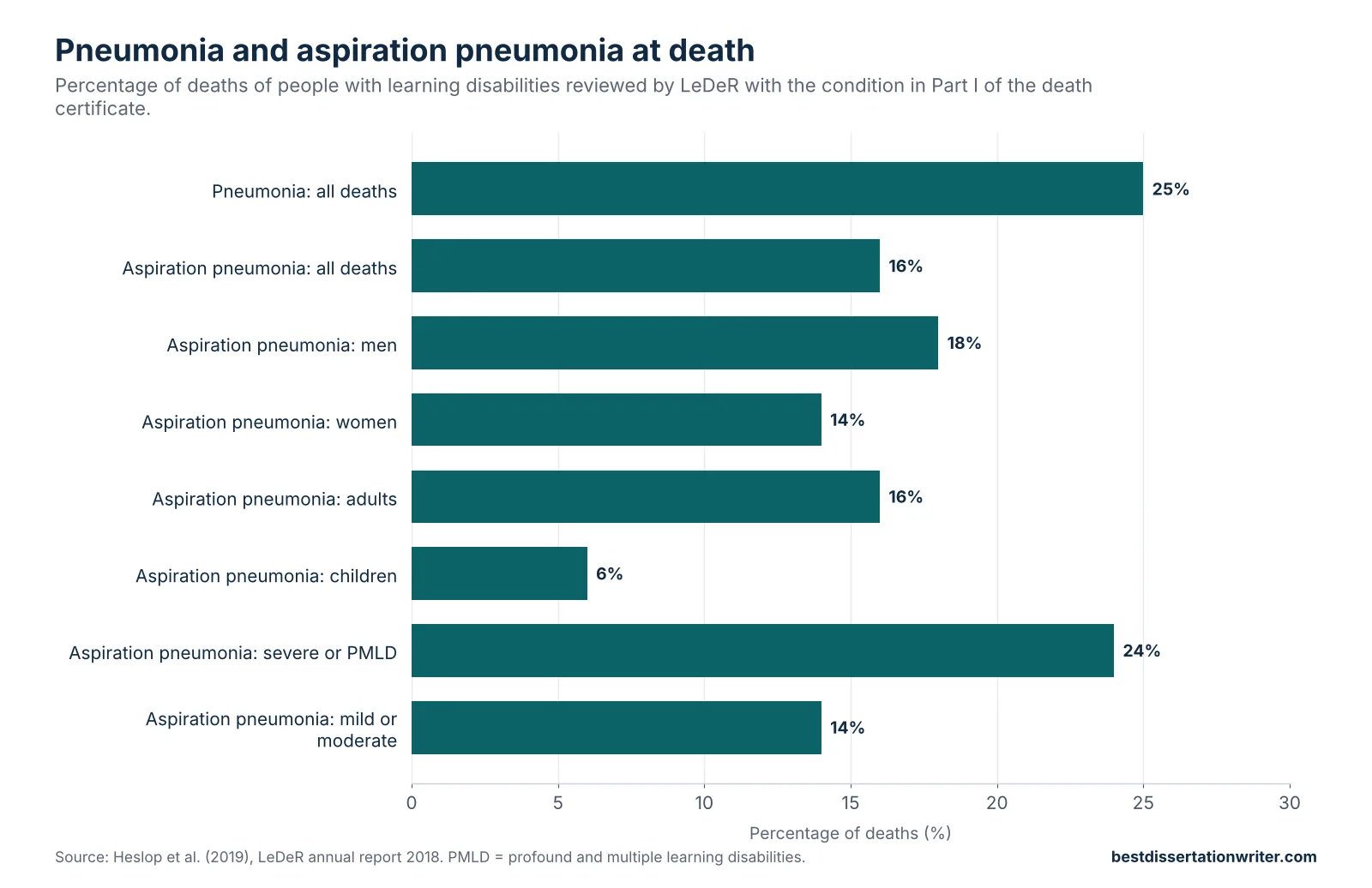
The gradient by severity is striking. Aspiration pneumonia was recorded in 24% of deaths of people with severe or profound and multiple learning disabilities, compared with 14% of those with mild or moderate learning disabilities. The report also noted that 37% of people who died of aspiration pneumonia did so between October and December, compared with 31% of those who died of other causes. Death certificate data have limits, because certification practice varies and Part I lists contributing conditions rather than a single cause, but the pattern is consistent with the prevalence evidence in Theme 1.
Perez et al. (2017) followed 142 adults with learning disabilities and mealtime support needs in the East of England, interviewing caregivers at baseline and again after 12 months. In exploratory prognostic models, respiratory infection in the second year was most likely among people who had a respiratory infection in the first year, who had epilepsy or whose caregivers reported swallowing difficulty. Emergency hospital admission for eating, drinking and swallowing problems was more likely with greater mealtime support needs, epilepsy and full support, meaning being fed mainly or entirely by a caregiver or by tube.
These findings offer practical warning signs that nurses can use. A previous chest infection, epilepsy and dependence on others for eating and drinking all marked higher risk. However, the authors stressed that their models were exploratory and needed validation in other samples, and they relied on caregiver report rather than clinical records. The cohort also included only people already identified as needing mealtime support.
Theme 3: Mealtime Support and Swallowing Interventions
Texture modification of food and thickening of drinks are among the most common responses to swallowing difficulty, but terminology has historically varied between countries and services. Cichero et al. (2017) described the development of the International Dysphagia Diet Standardisation Initiative (IDDSI) framework. An initial survey received 2,050 responses from 33 countries and found 54 different names for food texture levels and 27 names for liquid thickness levels. After a systematic review and a second survey of 3,190 respondents from 57 countries, the committee produced a continuum of eight levels, numbered 0 to 7, each with a label, colour code, definition and simple testing method.
A shared language matters for people with learning disabilities, who may move between home, day services, respite care and hospital, each with different staff. Clear, testable descriptors make it easier for carers and nurses to prepare the right texture and to check that recommendations are followed. However, the framework standardises descriptions rather than proving that any particular texture improves outcomes, and texture modification can reduce the pleasure and dignity of eating.
Evidence on the effectiveness of interventions is scarce. In a systematic review of interventions for feeding and swallowing disorders in adults with learning disabilities, Manduchi et al. (2020) searched seven databases with no language restrictions but found only four eligible studies. All four evaluated enteral tube feeding using retrospective observational designs. They reported improved nutritional status but also a high incidence of adverse events after tube feeding began, and risk of bias was high. No studies of diet modification, positioning, compensatory strategies or swallowing therapy in this population met the inclusion criteria.
This gap means that much everyday practice, including texture modification, positioning, pacing, supervision and adapted equipment, rests on clinical consensus and evidence from other populations. Manduchi et al. (2020) recommended that the risks and benefits of tube feeding are weighed for each individual and that caregivers take part in decisions, a conclusion that links swallowing care directly to questions of consent and capacity.
Discussion
This review found consistent evidence that dysphagia is common among people with learning disabilities, that it clusters among people with severe and complex disabilities, and that aspiration pneumonia is a major contributor to death in this population. The descriptive, population and mortality sources point in the same direction even though they use different methods, which strengthens confidence in the overall picture. By contrast, the evidence on what works to reduce risk is very limited.
Several tensions emerge. Prevalence estimates for dysphagia depend on who is referred and assessed, so people with milder disabilities, those living with family and those with less obvious difficulties may be under-counted. The mortality data show the end point of harm but cannot show whether earlier recognition or better mealtime support would have changed outcomes. The cohort by Perez et al. (2017) begins to fill this gap by identifying predictors of infection and admission, but its models await validation.
A further tension concerns quality of life. Texture modification, thickened drinks and restrictions on foods may reduce risk, but they can also reduce enjoyment, choice and social participation at mealtimes. Tube feeding may improve nutrition but carries its own complications, as Manduchi et al. (2020) found. Decisions about dysphagia care therefore require a balance between safety and the person’s preferences, which in turn depends on assessing whether the person can make the decision and, if not, on a careful best interests process involving those who know them well.
The findings also highlight the importance of the wider workforce. Most mealtime support is delivered by family carers and support staff, and Ball et al. (2012) found that physical, psychological and behavioural factors often combined to create need. Guidelines are only effective if those providing daily support understand them, have the time to follow them and recognise when the person’s needs change. Learning disability nurses are well placed to bridge specialist recommendations and everyday practice, but this role is rarely evaluated.
This review has limitations. It relied on openly accessible, English-language sources, did not involve independent double screening and included a small number of sources, several of which were from the United Kingdom. The included prevalence studies used referral-based or service-based samples, and the mortality data came from a single national report. Future research should establish the population-based prevalence of dysphagia using consistent assessment, test mealtime support, positioning and texture modification in controlled studies, and evaluate nurse-led screening for swallowing risk and its effect on chest infections and hospital admissions.
Implications of Dysphagia Evidence for Practice
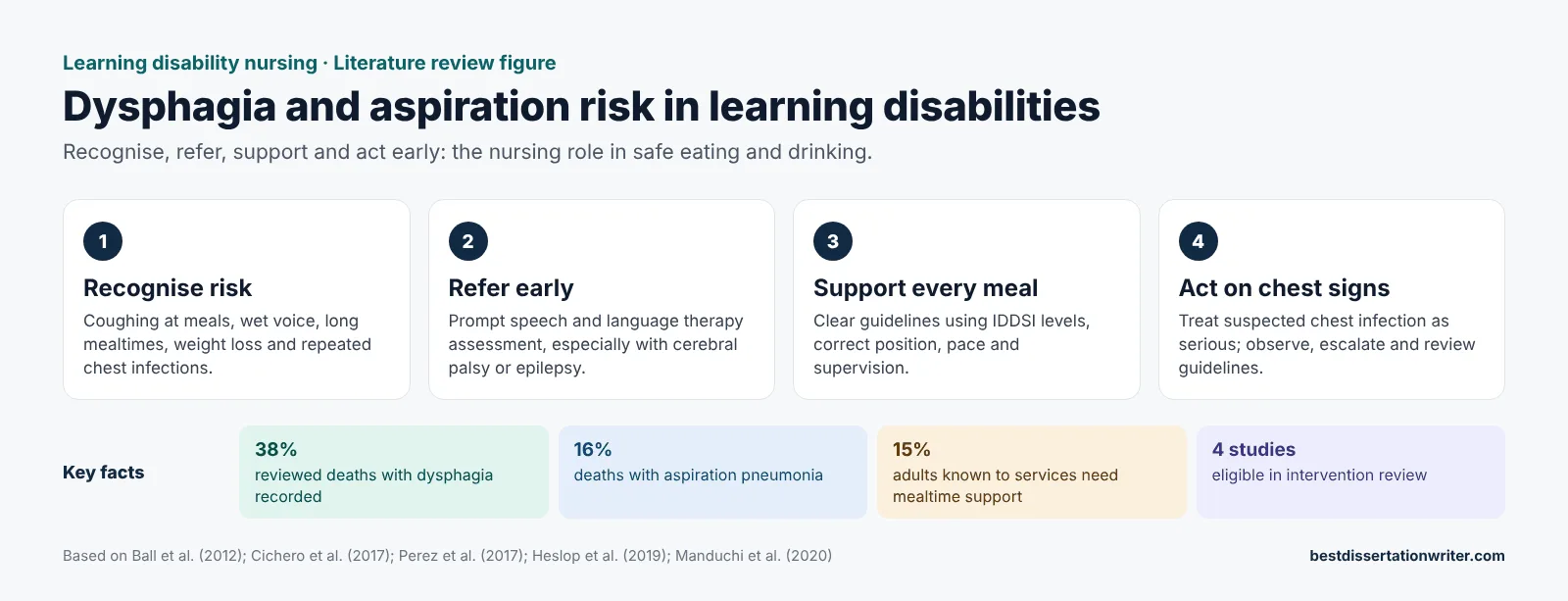
Learning disability nurses should include eating, drinking and swallowing in every nursing assessment, asking about coughing or choking at meals, changes in voice, prolonged mealtimes, weight loss and chest infections. People with severe or profound and multiple learning disabilities, cerebral palsy, epilepsy or full dependence on others for eating should be regarded as high risk and referred promptly to speech and language therapy. Supporting good nutritional screening and recording weight and fluid intake allows gradual deterioration to be detected.
Nurses should translate swallowing recommendations into clear, accessible mealtime guidelines using standard IDDSI descriptors, check that carers understand and follow them, and review them when health changes. A suspected chest infection in a person with known swallowing difficulty should be treated as potentially serious, with early observations and escalation informed by early warning scores. Decisions about texture modification or tube feeding should follow an assessment of mental capacity and involve the person and their family.
Swallowing risk should also be planned for at key points in the life course. When a young person moves into adult services for young people, mealtime guidelines, swallowing assessments and known risks need to be handed over in full, so that adult teams do not have to start again.
Conclusion
This narrative review examined evidence on dysphagia in people with learning disabilities. Swallowing difficulties are common, particularly among people with severe and complex disabilities, and aspiration pneumonia is one of the most frequently recorded conditions at death. Standardised descriptors support consistent mealtime care, but evidence on the effectiveness of interventions remains very limited.
Learning disability nurses can reduce risk by recognising swallowing problems early, ensuring prompt specialist assessment, supporting carers to follow mealtime guidelines consistently and acting quickly on signs of chest infection. Treating safe eating and drinking as a core part of dysphagia care, rather than a specialist task, is central to reducing avoidable harm.
References
Ball, S. L., Panter, S. G., Redley, M., Proctor, C.-A., Byrne, K., Clare, I. C. H., & Holland, A. J. (2012). The extent and nature of need for mealtime support among adults with intellectual disabilities. Journal of Intellectual Disability Research, 56(4), 382–401. https://doi.org/10.1111/j.1365-2788.2011.01488.x
Chadwick, D. D., & Jolliffe, J. (2009). A descriptive investigation of dysphagia in adults with intellectual disabilities. Journal of Intellectual Disability Research, 53(1), 29–43. https://doi.org/10.1111/j.1365-2788.2008.01115.x
Cichero, J. A. Y., Lam, P., Steele, C. M., Hanson, B., Chen, J., Dantas, R. O., Duivestein, J., Kayashita, J., Lecko, C., Murray, J., Pillay, M., Riquelme, L., & Stanschus, S. (2017). Development of international terminology and definitions for texture-modified foods and thickened fluids used in dysphagia management: The IDDSI framework. Dysphagia, 32(2), 293–314. https://doi.org/10.1007/s00455-016-9758-y
Heslop, P., Calkin, R., & Huxor, A. (2019). The Learning Disability Mortality Review (LeDeR) programme: Annual report 2018. University of Bristol Norah Fry Centre for Disability Studies; Healthcare Quality Improvement Partnership. https://www.hqip.org.uk/resource/the-learning-disabilities-mortality-review-annual-report-2018/
Manduchi, B., Fainman, G. M., & Walshe, M. (2020). Interventions for feeding and swallowing disorders in adults with intellectual disability: A systematic review of the evidence. Dysphagia, 35(2), 207–219. https://doi.org/10.1007/s00455-019-10038-5
Perez, C. M., Wagner, A. P., Ball, S. L., White, S. R., Clare, I. C. H., Holland, A. J., & Redley, M. (2017). Prognostic models for identifying adults with intellectual disabilities and mealtime support needs who are at greatest risk of respiratory infection and emergency hospitalisation. Journal of Intellectual Disability Research, 61(8), 737–754. https://doi.org/10.1111/jir.12376
Robertson, J., Chadwick, D., Baines, S., Emerson, E., & Hatton, C. (2017). Prevalence of dysphagia in people with intellectual disability: A systematic review. Intellectual and Developmental Disabilities, 55(6), 377–391. https://doi.org/10.1352/1934-9556-55.6.377
Cite this example
Best Dissertation Writers (2026) Dysphagia and the Risk of Aspiration in People with Learning Disabilities: A Narrative Review. Available at: https://bestdissertationwriter.com/dysphagia-literature-review/
Best Dissertation Writers
Get expert help with your nursing literature review
Share your topic and deadline with Best Dissertation Writers and get support tailored to your module brief.