Positive Behaviour Support in the Management of Challenging Behaviour in People with Learning Disabilities: A Systematic Review
 By Dr. Robertson Prime, Research Fellow
Updated October 12, 2026
15 min read
About 3,000 words
By Dr. Robertson Prime, Research Fellow
Updated October 12, 2026
15 min read
About 3,000 words
In this review
Abstract
Background: Positive behaviour support is the recommended framework in the United Kingdom for supporting people with learning disabilities whose behaviour challenges. Challenging behaviour affected 18.1% of adults with intellectual disability in a total population study, and it can lead to restrictive practices, placement breakdown and admission to hospital.
Aim: This systematic review aimed to examine the evidence on the effectiveness of positive behaviour support (PBS) in reducing challenging behaviour in people with learning disabilities and its implications for nursing practice.
Methods: Targeted searches of openly accessible bibliographic records, publisher websites and the reference lists of key reviews identified six sources published between 2013 and 2023: a consensus definition paper, two systematic reviews of staff training, a national guideline, a total population prevalence study and a cluster randomised controlled trial. Sources were appraised with CASP checklists and synthesised narratively.
Findings: Systematic reviews found that staff training improved staff knowledge, attributions and emotional responses and was associated with reduced challenging behaviour, but evidence for better quality of life was weak and few studies were methodologically strong. In a cluster trial of 246 adults in 23 community teams, staff training in PBS did not reduce challenging behaviour compared with usual care after 12 months (mean difference −2.14, 95% CI −8.79 to 4.51) or 36 months. Low fidelity and limited reach were major problems, and all available behaviour support plans were rated less than optimal.
Conclusion: The values and methods of PBS remain well supported, but training alone does not guarantee better outcomes. Nurses should focus on high-quality functional assessment, physical health checks and sustained, supervised implementation.
Keywords: positive behaviour support, challenging behaviour, behaviours that challenge
Introduction
This systematic review critically examines recent evidence on positive behaviour support and its implications for learning disability nursing practice.
Some people with learning disabilities show behaviours that challenge, such as aggression, self-injury, destruction of property or repetitive behaviours that put themselves or others at risk. These behaviours are usually understood as a way of communicating needs or coping with a difficult environment, rather than as a fixed part of the person. Nevertheless, they can lead to injuries, exclusion from services, use of restraint and sedating medication, breakdown of family placements and admission to specialist hospitals far from home.
Positive behaviour support (PBS) has become the main framework for responding to these behaviours in the United Kingdom. It combines person-centred values with functional assessment, which seeks to understand why a behaviour occurs, and with proactive strategies that improve the person’s quality of life and reduce the need for restrictive practices. Learning disability nurses contribute to assessment, write and review behaviour support plans, train and support care staff and monitor physical and mental health, so the effectiveness of PBS is central to their practice.
A systematic approach was chosen so that systematic reviews, a cluster randomised trial, national guidance and a population study could be identified and appraised transparently. Combining these designs allows the promise of positive behaviour support to be compared with what happens when it is delivered in routine services.
Review question
How effective is positive behaviour support, and in particular staff training in PBS, in reducing challenging behaviour in people with learning disabilities, and what are the implications for nursing?
Background to Positive Behaviour Support
Challenging behaviour is common. In a total population study of 265 adults with intellectual disability known to services in one area of the United Kingdom, Bowring et al. (2017) found an overall prevalence of 18.1%. Stereotyped behaviour affected 10.9%, aggressive or destructive behaviour 8.3% and self-injurious behaviour 7.5%. Communication problems and more severe intellectual disability were consistently associated with a higher risk, suggesting that interventions targeting communication and daytime activity are needed.
The National Institute for Health and Care Excellence (NICE, 2015) guideline on challenging behaviour and learning disabilities estimates that prevalence is around 5–15% in educational, health and social care services, rising to 30–40% in hospital settings. It recommends that initial assessment considers physical and mental health problems and the effects of medication, that functional assessment identifies what maintains the behaviour and that behaviour support plans include proactive strategies to improve quality of life as well as reactive strategies for behaviours that cannot be prevented.
Gore et al. (2013) set out an influential UK definition of positive behaviour support as a multi-component framework. It has ten core components grouped under three headings: values, theory and evidence base, and process. The framework draws on applied behaviour analysis but places it within a commitment to rights, inclusion and quality of life. It was intended to guide competence development, service delivery, training and research at a time of major policy change.
That policy change followed the abuse of people with learning disabilities uncovered at Winterbourne View hospital in 2011, which led to national programmes to reduce reliance on inpatient care and restrictive practices. Positive behaviour support was promoted as a key part of this response, and training staff in its methods became a common way of introducing it across services. Whether such training improves outcomes for people with learning disabilities is therefore a central question for policy and practice.
Search Strategy and Methods
Evidence for this example was identified through targeted searches of openly accessible bibliographic records, publisher websites and the reference lists of key reviews. Search terms combined keywords for the intervention (“positive behaviour support”, “positive behavioral support”, “PBS”, “functional assessment”, “staff training”) with terms for the population and outcome (“learning disabilit*”, “intellectual disabilit*”, “challenging behaviour”, “behaviours that challenge”), joined with the Boolean operators AND and OR. A full systematic review for assessment would run the same strategy in CINAHL, PubMed/MEDLINE, PsycINFO, the Cochrane Library and Embase and report the number of records screened in a PRISMA flow diagram.
Sources were eligible if they defined positive behaviour support, evaluated its effects or the effects of staff training on staff or service-user outcomes, provided national guidance, or estimated the prevalence of challenging behaviour in adults with learning or intellectual disabilities. Systematic reviews, randomised trials, guidelines and population-based studies published from 2010 onward were prioritised. Single case studies and studies of school-wide behaviour programmes for children without learning disabilities were excluded.
Six sources published between 2013 and 2023 were included: one consensus definition paper, two systematic reviews, one national guideline, one total population prevalence study and one cluster randomised controlled trial with economic and process evaluations (Table 1). The quality of each source was appraised using the Critical Appraisal Skills Programme (CASP) checklist appropriate to its design, and the findings on positive behaviour support were synthesised narratively into themes.
Key Findings on Positive Behaviour Support
Three themes were identified: the effects of staff training on staff and service users, the effectiveness of PBS training in routine community services, and the influence of implementation and fidelity on outcomes. Table 1 summarises the included sources, and Figure 1 presents the main outcome of the largest randomised trial of staff training in PBS.
| Author, year | Design | Setting and sample | Key finding |
|---|---|---|---|
| Gore et al. (2013) | Consensus definition paper | UK academics and practitioners; review of definitions and research | Defined PBS as a multi-component framework with ten core components: values, theory and evidence, and process. |
| MacDonald and McGill (2013) | Systematic review | 14 studies of PBS staff training outcomes | Training improved staff knowledge, attributions and emotions; reduced challenging behaviour; no evidence of better quality of life. |
| NICE (2015) | National clinical guideline (NG11) | People with learning disabilities whose behaviour challenges | Assess physical health and function; plans with proactive and reactive strategies; regular review; prevalence about 5–15%. |
| Bowring et al. (2017) | Total population prevalence study | 265 adults with intellectual disability known to services, UK | Challenging behaviour prevalence 18.1%; linked to communication problems and severity of disability. |
| Hassiotis et al. (2018) | Cluster randomised controlled trial with economic and process evaluation | 246 adults with challenging behaviour; 23 community services in England | No significant effect at 12 months (MD −2.14) or 36 months; low fidelity; plans rated less than optimal. |
| Konstantinidou et al. (2023) | Systematic review | 9 studies of PBS staff training and organisational behaviour management | Staff behaviour improved; only one study showed better quality of life; only two methodologically strong. |
Theme 1: Effects of Staff Training on Staff and Service Users
MacDonald and McGill (2013) carried out the first systematic review of the outcomes of staff training in positive behaviour support. They included 14 studies: six reported staff outcomes, four reported service-user outcomes and four reported both. Training was associated with improvements in staff knowledge, skills, confidence, attributions and emotional responses, and studies that measured service-user outcomes reported reductions in challenging behaviour. However, the one study that measured quality of life found no change.
A later systematic review by Konstantinidou et al. (2023) examined nine studies of staff training and organisational behaviour management. Training combined antecedent and consequence-based strategies, and five of the eight studies that described organisational systems used pyramidal training, in which trained staff pass on their skills to colleagues. Staff behaviour changed after training, but only one study showed a significant increase in service users’ quality of life, and only two studies were judged methodologically strong.
Together, these reviews suggest that training can change what staff know, believe and do, which is a necessary first step. However, most included studies were small, uncontrolled or used single-case designs, and few measured whether people with learning disabilities had better lives as a result. Improvements in staff attributions and confidence are valuable, but they are not the same as fewer behaviours that challenge or greater inclusion.
Theme 2: Positive Behaviour Support Training in Routine Services
The largest test of PBS training was a multicentre cluster randomised trial in 23 community intellectual disability services in England (Hassiotis et al., 2018). Services were randomised to manual-assisted, face-to-face training of therapists in PBS plus usual care, or to usual care alone. The trial recruited 246 adults with challenging behaviour, 109 in 11 intervention teams and 137 in 12 control teams.
The trial also monitored safety. Twenty-nine participants experienced 45 serious adverse events, 19 in the intervention arm and 26 in the control arm. Forty-six qualitative interviews were conducted as part of the process evaluation. The combination of clinical, economic and qualitative data makes this the most comprehensive evaluation of PBS training in adult community services to date, although it tested only one training model.
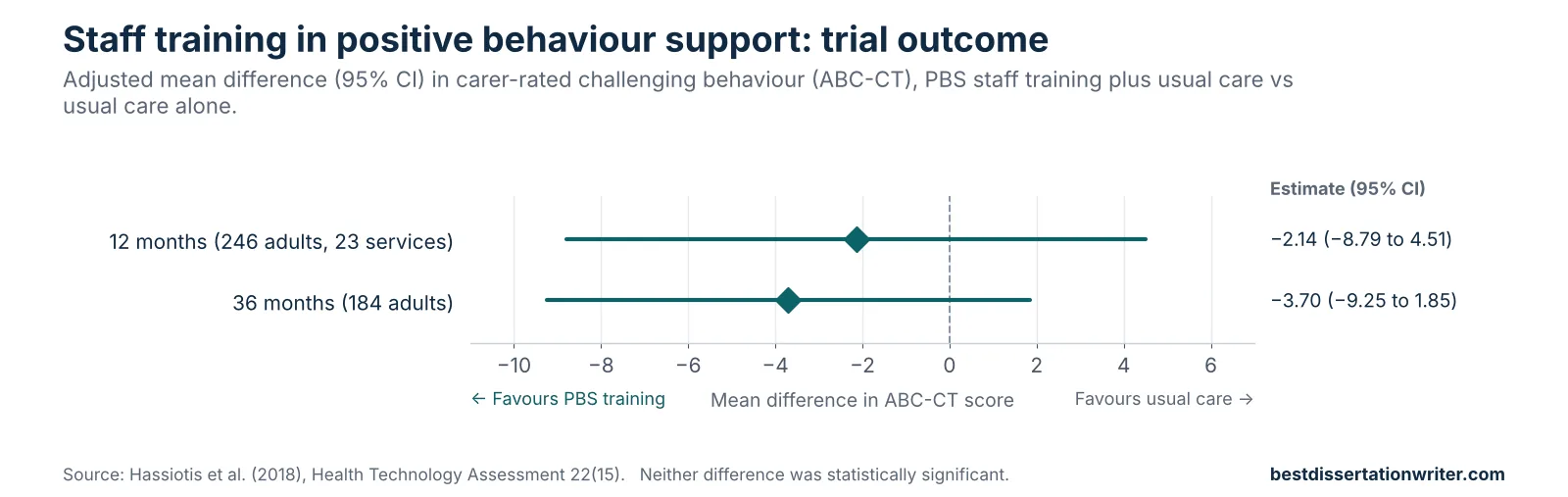
After 12 months, there was no significant difference in carer-reported challenging behaviour between groups (mean difference −2.14, 95% confidence interval −8.79 to 4.51), and no effects were found on any secondary outcome. At 36 months, in 184 participants, the difference was again not significant (−3.70, −9.25 to 1.85). Mean intervention cost was £1,201 per participant, and quality-adjusted life years initially favoured the intervention, with a 60% chance of cost-effectiveness, but this advantage was not maintained over the longer term.
The trial had important strengths, including randomisation of whole services, a single-blind design and follow-up to 36 months. Its findings challenge the assumption that introducing positive behaviour support through training is enough to improve outcomes in routine practice. Some participants and carers nevertheless reported benefits in qualitative interviews, including learning to manage difficult situations and good relationships with therapists, which suggests that the approach was valued even when outcome scores did not change.
Theme 3: Implementation, Fidelity and Guidance
The process evaluation of Hassiotis et al. (2018) helps to explain the null result. Treatment fidelity was low and the intervention reached relatively few people. Behaviour support plans were available for only 33 participants, and an independent assessment rated all of them as less than optimal. In other words, the trial tested PBS as it was actually delivered in busy community teams, rather than a high-quality version of the approach.
Konstantinidou et al. (2023) reached a similar conclusion from a different angle, arguing that implementation fidelity depends on both training and organisational systems. Pyramidal training and supervision structures can spread skills, but without monitoring and feedback, staff practice may drift. NICE (2015) likewise recommends that staff are trained to deliver proactive strategies and that behaviour support plans are reviewed fortnightly for the first two months and monthly thereafter.
The consensus definition by Gore et al. (2013) emphasises that positive behaviour support is a multi-component framework rather than a single technique. If services adopt the language of PBS without functional assessment, individualised plans, changes to the environment and ongoing review, outcomes are unlikely to improve. This distinction between the framework and its partial implementation runs through all of the included sources.
NICE (2015) places physical health at the start of the process. Annual health checks should include a review of any known or emerging behaviour that challenges and how it may be linked to physical health problems, and the guideline notes that environments in which pain and physical health needs go unrecognised increase the likelihood of such behaviour. A behaviour support plan built without this step risks treating the symptom of an untreated illness rather than its cause.

Discussion
This systematic review found a tension between the strong policy support for positive behaviour support and the limited evidence that staff training in it reduces challenging behaviour in routine services. Reviews of mostly small studies report improvements in staff knowledge and attitudes and reductions in behaviour (MacDonald and McGill, 2013; Konstantinidou et al., 2023), but the largest randomised trial found no significant clinical effect at 12 or 36 months (Hassiotis et al., 2018).
These findings can be reconciled. Small studies often involve motivated services, expert supervision and close monitoring, whereas the trial tested training as it was delivered at scale, with low fidelity and limited reach. The null result therefore says more about implementation than about the underlying principles of the approach. It does, however, warn against assuming that sending staff on training courses will by itself reduce restrictive practices or hospital admissions.
Quality of life remains the weakest area of the evidence. Positive behaviour support aims to improve quality of life, yet the one study that measured it in the earlier review found no change, and only one study in the later review showed a significant improvement. Because behaviours that challenge are linked to communication difficulties and severity of disability (Bowring et al., 2017), interventions that improve communication, daytime activity and physical health may be as important as behavioural strategies.
The evidence also has implications for restrictive practice and medication. NICE (2015) advises that antipsychotic medication should only be offered in combination with psychological or other interventions, and that reactive strategies, including restrictive interventions, should be a last resort used alongside proactive approaches. If PBS is implemented poorly, services may fall back on medication and restraint, so weak implementation carries risks beyond a lack of improvement in behaviour scores.
This review has limitations. It relied on openly accessible, English-language sources, did not involve independent double screening and included only six sources, most from the United Kingdom. The two systematic reviews included many small studies with weak designs, and the trial focused on one model of training. Future research should test well-implemented, supervised positive behaviour support with high fidelity, longer follow-up and outcomes that matter to people with learning disabilities, including quality of life, inclusion and use of restrictive practices.
Implications of Positive Behaviour Support Evidence for Practice
Learning disability nurses should ensure that every behaviour support plan is based on a thorough functional assessment that first rules out pain, illness, medication side effects and mental health problems. Plans should include proactive strategies that improve the person’s quality of life, clear reactive strategies, and regular review in line with NICE guidance. Nurses can support fidelity by modelling the approach, supervising staff, monitoring how plans are used in practice and involving the person and their family throughout.
Distress at mealtimes may reflect pain or fear linked to dysphagia, so swallowing should be assessed when behaviour changes around eating. Restrictive interventions and decisions about support must respect mental capacity law. PBS also shares principles with de-escalation techniques and trauma-informed care, which emphasise safety, choice and understanding the meaning of behaviour.
Conclusion
This systematic review examined the evidence on positive behaviour support for people with learning disabilities whose behaviour challenges. Staff training improves staff knowledge and attitudes and may reduce challenging behaviour in small studies, but the largest trial found no significant effect in routine community services, largely because fidelity and reach were low.
For learning disability nurses, the message is that positive behaviour support works only when it is delivered as a complete framework. High-quality functional assessment, attention to physical health, individualised plans, supervision and regular review are needed to turn the values of PBS into better lives for people with learning disabilities.
References
Bowring, D. L., Totsika, V., Hastings, R. P., Toogood, S., & Griffith, G. M. (2017). Challenging behaviours in adults with an intellectual disability: A total population study and exploration of risk indices. British Journal of Clinical Psychology, 56(1), 16–32. https://doi.org/10.1111/bjc.12118
Gore, N. J., McGill, P., Toogood, S., Allen, D., Hughes, J. C., Baker, P. A., Hastings, R. P., Noone, S. J., & Denne, L. D. (2013). Definition and scope for positive behavioural support. International Journal of Positive Behavioural Support, 3(2), 14–23.
Hassiotis, A., Poppe, M., Strydom, A., Vickerstaff, V., Hall, I., Crabtree, J., Omar, R., King, M., Hunter, R., Bosco, A., Biswas, A., Ratti, V., Blickwedel, J., Cooper, V., Howie, W., & Crawford, M. (2018). Positive behaviour support training for staff for treating challenging behaviour in people with intellectual disabilities: A cluster RCT. Health Technology Assessment, 22(15), 1–110. https://doi.org/10.3310/hta22150
Konstantinidou, I., Dillenburger, K., & Ramey, D. (2023). Positive behaviour support: A systematic literature review of the effect of staff training and organisational behaviour management. International Journal of Developmental Disabilities, 69(1), 29–44. https://doi.org/10.1080/20473869.2022.2123199
MacDonald, A., & McGill, P. (2013). Outcomes of staff training in positive behaviour support: A systematic review. Journal of Developmental and Physical Disabilities, 25(1), 17–33. https://doi.org/10.1007/s10882-012-9327-8
National Institute for Health and Care Excellence. (2015). Challenging behaviour and learning disabilities: Prevention and interventions for people with learning disabilities whose behaviour challenges (NICE guideline NG11). https://www.nice.org.uk/guidance/ng11
Cite this example
Best Dissertation Writers (2026) Positive Behaviour Support in the Management of Challenging Behaviour in People with Learning Disabilities: A Systematic Review. Available at: https://bestdissertationwriter.com/positive-behaviour-support-review/
Best Dissertation Writers
Get expert help with your nursing literature review
Share your topic and deadline with Best Dissertation Writers and get support tailored to your module brief.