Diagnostic Overshadowing in the Care of People with Learning Disabilities: An Integrative Review
 By Dr. Robertson Prime, Research Fellow
Updated October 12, 2026
17 min read
About 3,300 words
In this review
Abstract
Background: Diagnostic overshadowing, in which new symptoms are wrongly attributed to a person’s learning disability, is widely cited as one reason why illness is missed in this group. People with learning disabilities die younger than the general population, and many of their deaths are judged avoidable with good-quality healthcare.
Aim: This integrative review aimed to establish how strong the evidence for diagnostic overshadowing is, what its consequences are for people with learning disabilities, and which service factors allow it to occur.
Methods: Targeted searches of openly accessible bibliographic records, publisher websites and the reference lists of key reviews identified seven sources published between 2004 and 2025: an experimental vignette study, two systematic reviews, a population-based confidential inquiry, a primary care cohort study, a qualitative interview study and a national mortality review report. Each was appraised with the relevant CASP checklist and the findings were synthesised narratively.
Findings: Clinicians recognised psychiatric symptoms more often when a vignette described a man without a learning disability, but a 2024 systematic review of 25 studies found that about one third showed no overshadowing and rated the evidence as low quality. Mortality studies were more consistent: 37% of deaths in two English studies were amenable to good-quality healthcare, compared with 13% and 22.5% in comparison groups, and the national review judged 39% of deaths notified in 2023 avoidable against 21% in the general population. Qualitative and review evidence linked missed diagnosis to gaps in staff knowledge, poor use of health passports and carers not feeling listened to.
Conclusion: Experimental evidence for diagnostic overshadowing is weaker than often assumed, yet avoidable deaths remain common. Learning disability nurses can reduce the risk by recording each person’s baseline, listening to carers and promoting reasonable adjustments.
Keywords: diagnostic overshadowing, missed diagnosis, unmet health needs
Introduction
This integrative review critically examines recent evidence on diagnostic overshadowing and its implications for learning disability nursing practice.
People with learning disabilities experience more physical and mental health conditions than the general population, yet they often receive less effective healthcare. Many find it difficult to describe pain or other symptoms, rely on family members or paid carers to notice that something is wrong and may communicate distress through changes in behaviour rather than words. When a professional attributes such changes to the learning disability rather than investigating them, a treatable illness can be overlooked until it is advanced.
This tendency has become known as diagnostic overshadowing. The term was first used in psychiatric research to describe clinicians attributing symptoms of mental illness to a person’s intellectual impairment, but it is now used more broadly in the United Kingdom to describe any situation in which a new physical or mental health problem is missed because symptoms are put down to the disability. National mortality reviews have repeatedly linked such missed diagnosis to premature and avoidable deaths, making it a central concern for learning disability nurses.
An integrative review design was chosen because the evidence includes experimental vignette studies, systematic reviews, population-based mortality studies, national review reports and qualitative research. Bringing these different designs together allows the concept, its measurement and its real-world consequences to be considered side by side, which no single design could achieve. Understanding how diagnostic overshadowing arises is a first step towards preventing it.
Review question
How strong is the evidence that diagnostic overshadowing occurs, what are its consequences for people with learning disabilities, and which service factors allow it to happen?
Background to Diagnostic Overshadowing
A learning disability, termed intellectual disability in much of the international literature, involves a significantly reduced ability to understand new or complex information and to learn new skills, starting before adulthood and with a lasting effect on development. People with learning disabilities have higher rates of epilepsy, respiratory disease, gastrointestinal problems, sensory impairment and mental illness than the general population. Many of these conditions present atypically, and some people cannot report symptoms verbally at all.
Diagnostic overshadowing describes a cognitive bias in clinical reasoning. A clinician who already knows that a person has a learning disability may interpret new information through that lens, so that agitation, withdrawal, self-injury or loss of skills is seen as part of the person’s disability or personality rather than as a sign of pain, infection, constipation, depression or another treatable condition. The bias is not usually deliberate, but its effect can be the same as neglect: investigations are not ordered and treatment is delayed.
The concept is closely linked to wider health inequalities. Reasonable adjustments, such as longer appointments, accessible information and involving people who know the person well, are a legal duty under the Equality Act 2010 in Great Britain, and annual health checks aim to identify unmet health needs before they cause harm. When these safeguards are missing, the person’s carers and learning disability nurses often become the main protection against diagnostic overshadowing, because they know how the person usually behaves and can recognise when something has changed.
Search Strategy and Methods
Evidence for this example was identified through targeted searches of openly accessible bibliographic records, publisher websites and the reference lists of key reviews. Search terms combined keywords for the concept (“diagnostic overshadowing”, “missed diagnosis”, “delayed diagnosis”, “avoidable death”, “premature mortality”) with terms for the population (“learning disabilit*”, “intellectual disabilit*”), joined with the Boolean operators AND and OR. A full integrative review for assessment would run the same strategy in CINAHL, PubMed/MEDLINE, PsycINFO, the Cochrane Library and Embase and report the number of records screened in a PRISMA flow diagram.
Sources were eligible if they studied diagnostic overshadowing directly, or reported delayed diagnosis, avoidable deaths or failures in healthcare for adults with learning disabilities in ways relevant to the concept. Experimental, observational, qualitative and review designs were all eligible, together with national mortality review reports, in keeping with an integrative approach. Studies focused only on children, or on overshadowing in people with severe mental illness but without a learning disability, were excluded.
Seven sources published between 2004 and 2025 were included: one experimental vignette study, two systematic reviews, one population-based confidential inquiry, one primary care cohort study, one qualitative interview study and one national mortality review report (Table 1). Each source was appraised using the Critical Appraisal Skills Programme (CASP) checklist appropriate to its design, and findings were compared and synthesised narratively into themes in order to examine diagnostic overshadowing from several perspectives.
Key Findings on Diagnostic Overshadowing
Three themes were identified: the evidence for diagnostic overshadowing as a clinical bias, the consequences of missed diagnosis for premature and avoidable death, and the service and practice factors that allow overshadowing to occur. Table 1 summarises the included sources, and Figure 1 compares the proportion of deaths judged amenable to good-quality healthcare in people with learning disabilities and in comparison populations.
| Author, year | Design | Setting and sample | Key finding |
|---|---|---|---|
| Mason and Scior (2004) | Experimental vignette survey | UK psychiatrists and clinical psychologists; 223 responded (90 and 133) | Symptoms recognised more often when the vignette described a normal IQ, supporting diagnostic overshadowing. |
| Heslop et al. (2014) | Population-based confidential inquiry | 247 deaths of people with learning disabilities, south-west England, 2010–2012 | 37% of deaths amenable to good-quality healthcare vs 13% in the general population; men died 13 and women 20 years younger. |
| Iacono et al. (2014) | Systematic review | 16 studies of hospital experiences of people with intellectual disability | Seven themes, including fear of hospital, carers’ responsibilities and gaps in staff knowledge, skills and attitudes. |
| Hosking et al. (2016) | Primary care cohort study | 16,666 adults with intellectual disability and 113,562 matched controls; 343 English practices | Mortality hazard ratio 3.6; 37.0% of deaths amenable to healthcare vs 22.5% in controls. |
| Dell’Armo and Tassé (2024) | Systematic review | 25 studies of overshadowing of psychological disorders | About one third found no overshadowing; evidence graded low quality, mostly analogue designs. |
| Majid et al. (2025) | Qualitative interview study | 11 learning disability MDT professionals, including nurses; one West Midlands NHS trust | Overshadowing of physical illness, inadequate use of health passports and inadequate capacity assessments in mainstream services. |
| King’s College London (2025) | National mortality review report (LeDeR) | 3,556 deaths of people with a learning disability notified in England in 2023 | 39% of deaths avoidable vs 21% in the general population; delays in care in 37% of reviews. |
Theme 1: The Evidence for Diagnostic Overshadowing as a Clinical Bias
The most direct test of the concept in the United Kingdom was carried out by Mason and Scior (2004). UK psychiatrists and clinical psychologists were randomly sent one of two clinical vignettes describing identical problems, differing only in whether the man described had an IQ of 58 with impaired social functioning or an IQ of 108 with normal social functioning. Among the 223 respondents (133 psychologists and 90 psychiatrists), a range of psychiatric symptoms was recognised more often when the man was described as having a normal IQ, which the authors interpreted as evidence of diagnostic overshadowing. Psychiatrists appeared more prone to the error than psychologists in some circumstances.
The study was well designed for its purpose, because random allocation to vignettes isolated the effect of the learning disability label. However, the sample was a self-selected group of respondents, and vignettes cannot reproduce the information, time pressure and relationships of real consultations. Mason and Scior (2004) themselves acknowledged weaknesses in the analogue methods used in this field and called for alternative approaches, an important caveat for a concept that is now widely cited in policy and practice.
A systematic review by Dell’Armo and Tassé (2024) reinforced these concerns. Reviewing 25 studies of overshadowing of psychological disorders, including dissertations as well as peer-reviewed articles, they found that about one third reported no overshadowing effect. The overall evidence was graded as low quality, with common problems including outdated studies, analogue methods, small convenience samples and inadequate statistical analysis or reporting. The authors suggested that the bias may be less widespread than previously believed.
These findings do not mean that the problem is imaginary, but they show that the experimental evidence is narrower than its prominence suggests. Almost all controlled studies concern mental health diagnoses made by psychiatrists or psychologists, whereas UK concern now focuses mainly on physical illness in general hospitals and primary care. Evidence for the latter comes instead from mortality reviews and qualitative studies, which describe outcomes and experiences but cannot isolate a single cognitive bias.
Theme 2: Missed Diagnosis, Premature Death and Avoidable Mortality
The Confidential Inquiry into premature deaths of people with learning disabilities reviewed 247 deaths in five primary care trust areas of south-west England between 2010 and 2012 (Heslop et al., 2014). The median age at death was 65 years for men, 13 years younger than men in the general population, and 63 years for women, 20 years younger than women in the general population. Deaths from causes amenable to good-quality healthcare were much more common than in the general population, at 37% compared with 13%.
Heslop et al. (2014) also identified care and service factors that differed from a comparator group without learning disabilities, including problems with advance care planning, adherence to the Mental Capacity Act, inappropriate accommodation, failure to adjust care as needs changed and carers not feeling listened to. The inquiry concluded that much of the disparity arose from care and service provision rather than from the learning disability itself, which is consistent with the idea that missed diagnosis and delayed treatment are preventable.
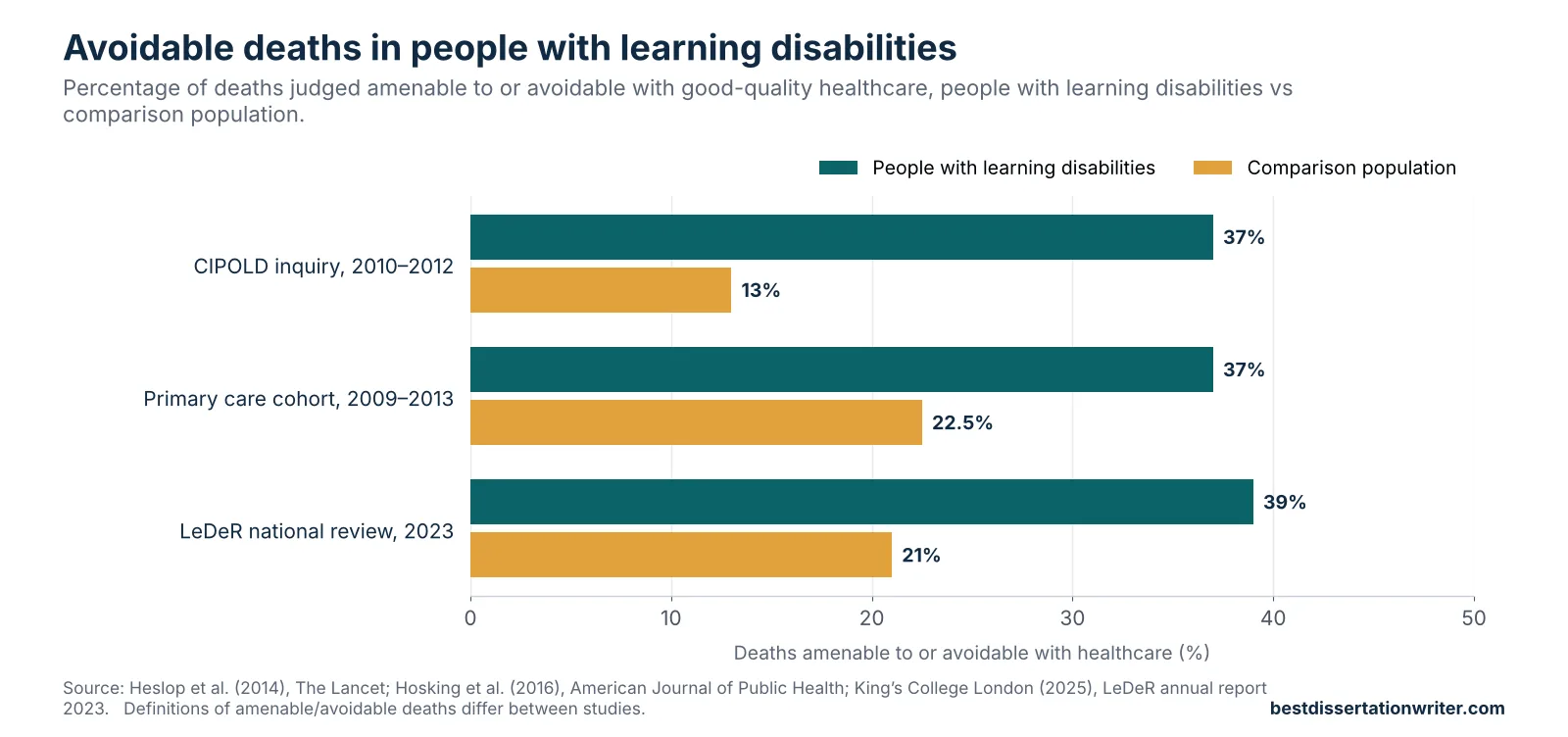
A primary care cohort study by Hosking et al. (2016) confirmed this pattern on a larger scale. Using records from 343 general practices in England between 2009 and 2013, it compared 16,666 adults with intellectual disability with 113,562 matched controls. Mortality was more than three times higher in the intellectual disability group (hazard ratio 3.6, 95% confidence interval 3.3 to 3.9), and remained raised after adjustment for comorbidity, smoking and deprivation (hazard ratio 3.1). Risk was greater still for people who also had Down syndrome or epilepsy.
Hosking et al. (2016) classified 37.0% of deaths in the intellectual disability group as amenable to healthcare intervention, compared with 22.5% in the general population. The study was large and used matched controls, but routinely recorded data cannot show why individual deaths occurred, and coding of learning disability in primary care is incomplete. It therefore shows the scale of potentially preventable mortality rather than the specific contribution of diagnostic overshadowing.
The national Learning from Lives and Deaths (LeDeR) programme continues this work. Its report on 3,556 deaths notified in 2023 found that the proportion judged avoidable had fallen from 46% in 2021 to 39%, which is still almost double the general population rate of 21% (King’s College London, 2025). Some delay in care or treatment was reported in 37% of reviews, and diagnosis and treatment guidelines were not met in 28%. People with severe or profound learning disabilities died younger and were more likely to die from treatable causes such as pneumonia or seizures.
Theme 3: Service and Practice Factors
A systematic review of 16 studies of hospital experiences by Iacono et al. (2014) helps explain how such delays arise. Its seven overarching themes included patients’ fear of hospital encounters, the responsibilities placed on carers, and problems with care delivery, including gaps in hospital staff knowledge, skills and attitudes. Although the review did not use the term overshadowing, it described a context in which staff unfamiliar with learning disabilities may misread behaviour and depend on carers to interpret symptoms, while carers may be expected to stay with the person but not be treated as partners.
Majid et al. (2025) interviewed 11 professionals from a learning disability psychiatry multidisciplinary team in one NHS trust in the West Midlands, including psychiatrists, nurses, occupational therapists and speech and language therapists. Participants described the team working to overcome systemic barriers, and identified overshadowing as one consequence of failures in mainstream services. Health passports were not used adequately, and capacity assessments were sometimes inadequate. The authors recommended a rapid review of health passport practice and greater awareness among mainstream staff of the harms of diagnostic overshadowing.
These two qualitative sources are small and context-specific, and both relied on professional or carer accounts rather than direct observation of clinical decisions. Nevertheless, they are consistent with the contributory factors identified by Heslop et al. (2014). Together, they suggest that overshadowing is less an isolated error of individual clinicians than a product of services that lack time, information about the person’s baseline and structured ways of listening to those who know the person best.
Discussion
This integrative review found a clear tension in the evidence on diagnostic overshadowing. Experimental studies of the bias itself are few, mostly old, focused on mental health diagnosis and of low quality, and about one third found no effect (Dell’Armo and Tassé, 2024). By contrast, population studies and national mortality reviews consistently show that people with learning disabilities die younger and that a large proportion of their deaths are amenable to better healthcare (Heslop et al., 2014; Hosking et al., 2016; King’s College London, 2025).
These two bodies of evidence answer different questions. Vignette studies ask whether a diagnostic label changes clinical judgement under controlled conditions, while mortality reviews ask whether care was good enough in real life. The fact that the first is uncertain does not weaken the second. However, it suggests that practitioners and policymakers should be careful when presenting diagnostic overshadowing as the established cause of avoidable deaths, because delays may also arise from communication difficulties, inaccessible services, poor coordination and missed reasonable adjustments.
The decline in avoidable deaths reported by LeDeR between 2021 and 2023 is encouraging, but it should be interpreted cautiously. The 2021 figures were affected by the COVID-19 pandemic, review methods have changed over time and the comparison with the general population uses a different data source. A rate almost double that of the general population still represents a large number of people whose unmet health needs were not addressed in time. The reviews do not report how many of these deaths involved diagnostic overshadowing, which is itself a gap in the evidence.
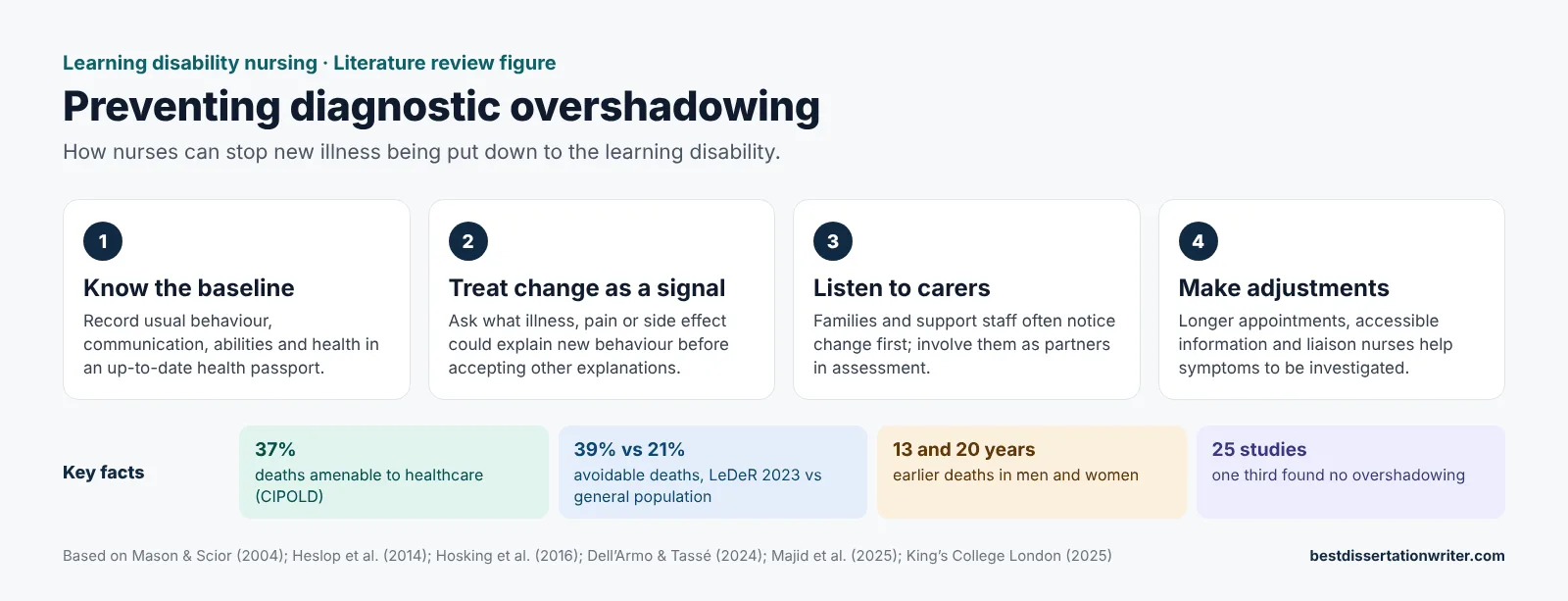
For learning disability nurses, the most consistent message across the sources is the importance of knowing the person. Carers not feeling listened to, health passports not being used and failures to adjust care as needs changed all point to information that existed but did not reach decision-makers. Nurses who document a person’s usual behaviour, communication and health baseline, and who advocate for investigation when this changes, address the mechanism of diagnostic overshadowing that all the included sources describe.
This review has limitations. It relied on openly accessible, English-language sources, did not involve independent double screening and included only seven sources, several of which were UK-based. Mortality studies used different definitions of avoidable or amenable deaths, so their figures cannot be directly compared. Future research should move beyond vignettes to study real clinical decisions, for example through record review or observation, and should evaluate whether interventions such as health passports, liaison nurses and staff training reduce delayed or missed diagnosis.
Implications of Diagnostic Overshadowing Evidence for Practice
Learning disability nurses should help each person to have an up-to-date health passport and a clear record of their usual behaviour, communication and abilities, so that change can be recognised quickly. When a person’s behaviour changes, nurses should ask what physical or mental health problem might explain it before accepting a behavioural explanation, and should support carers to describe changes to other professionals. Liaison nurses in general hospitals can promote reasonable adjustments, longer appointments and involvement of people who know the person well, while community nurses can use annual health checks to identify unmet health needs early.
Overshadowing is a particular risk in epilepsy management, where seizures, medication side effects and changes in alertness can be confused with the learning disability, and in positive behaviour support, where a functional assessment should always rule out pain and illness as causes of distress. Recognising pain depends on the same principles that guide the assessment of acute and chronic pain in other groups, and it is supported by the therapeutic communication skills that help nurses to understand people who communicate in different ways.
Conclusion
This integrative review examined the evidence on diagnostic overshadowing in the care of people with learning disabilities. Experimental support for the bias is weaker than often assumed, but population studies and national mortality reviews consistently show high levels of premature and avoidable death, with delays in care and failures to listen to carers as recurring contributory factors.
Whatever the precise mechanism, the practice message is clear. Learning disability nurses can reduce the risk of diagnostic overshadowing by knowing each person’s baseline, treating changes in behaviour as possible signs of illness, involving carers as partners and challenging services to make reasonable adjustments, so that unmet health needs are identified and treated in time.
References
Dell’Armo, K., & Tassé, M. J. (2024). Diagnostic overshadowing of psychological disorders in people with intellectual disability: A systematic review. American Journal on Intellectual and Developmental Disabilities, 129(2), 116–134. https://doi.org/10.1352/1944-7558-129.2.116
Heslop, P., Blair, P. S., Fleming, P., Hoghton, M., Marriott, A., & Russ, L. (2014). The Confidential Inquiry into premature deaths of people with intellectual disabilities in the UK: A population-based study. The Lancet, 383(9920), 889–895. https://doi.org/10.1016/S0140-6736(13)62026-7
Hosking, F. J., Carey, I. M., Shah, S. M., Harris, T., DeWilde, S., Beighton, C., & Cook, D. G. (2016). Mortality among adults with intellectual disability in England: Comparisons with the general population. American Journal of Public Health, 106(8), 1483–1490. https://doi.org/10.2105/AJPH.2016.303240
Iacono, T., Bigby, C., Unsworth, C., Douglas, J., & Fitzpatrick, P. (2014). A systematic review of hospital experiences of people with intellectual disability. BMC Health Services Research, 14, 505. https://doi.org/10.1186/s12913-014-0505-5
King’s College London. (2025). LeDeR annual report 2023: Learning from lives and deaths – people with a learning disability and autistic people. NHS England. https://www.kcl.ac.uk/ioppn/assets/pdfs/leder/leder-annual-report-2023.pdf
Majid, M., Rennick-Egglestone, S., Harris, B., Roy, A., & Crawford, H. (2025). Factors influencing physical healthcare quality for people with intellectual disabilities: Psychiatry multidisciplinary team perspective. BJPsych Open, 11(4), e137. https://doi.org/10.1192/bjo.2025.10051
Mason, J., & Scior, K. (2004). ‘Diagnostic overshadowing’ amongst clinicians working with people with intellectual disabilities in the UK. Journal of Applied Research in Intellectual Disabilities, 17(2), 85–90. https://doi.org/10.1111/j.1360-2322.2004.00184.x
Cite this example
Best Dissertation Writers (2026) Diagnostic Overshadowing in the Care of People with Learning Disabilities: An Integrative Review. Available at: https://bestdissertationwriter.com/diagnostic-overshadowing-review-review/
Best Dissertation Writers
Get expert help with your nursing literature review
Share your topic and deadline with Best Dissertation Writers and get support tailored to your module brief.