Barriers to Accessing Cancer Screening for People with Learning Disabilities: A Systematic Review
 By Dr. Robertson Prime, Research Fellow
Updated October 12, 2026
16 min read
About 3,100 words
By Dr. Robertson Prime, Research Fellow
Updated October 12, 2026
16 min read
About 3,100 words
In this review
Abstract
Background: Accessing cancer screening is harder for people with learning disabilities, who take part in national cervical, breast and bowel screening programmes less often than the general population. In England in 2015 to 2016, for example, 30% of eligible people with learning disabilities had cervical screening compared with 76% of other people.
Aim: This systematic review aimed to compare cancer screening uptake among people with learning disabilities with that of the general population, identify the barriers and facilitators that affect participation, and consider the implications for learning disability nursing.
Methods: Targeted searches of openly accessible bibliographic records, publisher websites and the reference lists of key reviews identified seven sources published between 2012 and 2024: one national cohort study, two literature reviews, one qualitative systematic review, two meta-analyses and one national guidance document. Sources were appraised with CASP checklists and synthesised narratively.
Findings: In a UK primary care cohort, adjusted rate ratios for screening were 0.54 for cervical smears and 0.76 for mammograms among people with learning disabilities. Meta-analysis found lower odds of colorectal screening for people with intellectual disabilities (odds ratio 0.65), with an even larger gap for faecal tests (0.58). Fear, concern about pain, the influence of family and paid carers, provider discomfort and inaccessible information were the main barriers. Reasonable adjustments such as easy-read invitations, practical help and joint work between community learning disability nurses and primary care are recommended, but controlled evaluations are lacking.
Conclusion: Improving accessing cancer screening requires proactive, individualised support that respects informed choice and the Mental Capacity Act, and learning disability nurses are well placed to coordinate it.
Keywords: accessing cancer screening, cancer screening uptake, reasonable adjustments
Introduction
This systematic review critically examines recent evidence on accessing cancer screening and its implications for learning disability nursing practice.
As people with learning disabilities live longer, more of them reach the ages at which national cancer screening programmes apply. Screening for cervical, breast and bowel cancer aims to find disease early, when treatment is more likely to succeed. Yet people with learning disabilities consistently take part in these programmes less often than other people, which may mean that some cancers are found later and are harder to treat.
The reasons for lower participation are complex. Invitations are often written in language that is hard to understand, procedures can be frightening or uncomfortable, and many people depend on family carers or paid staff to open letters, arrange appointments and attend with them. Health professionals may be unsure how to communicate, how to assess capacity or how to adapt a procedure. Difficulties with accessing cancer screening therefore arise from the interaction between individual needs, the attitudes of those around the person and the way services are organised.
Learning disability nurses work at the boundary between the person, their supporters and mainstream health services. They can prepare people for screening, advise primary care and screening staff on adjustments, and support best-interest decisions where a person lacks capacity. Understanding the evidence on accessing cancer screening is therefore directly relevant to their everyday practice and to wider efforts to reduce avoidable deaths.
A systematic review design was chosen so that cohort data, meta-analyses, qualitative syntheses and national guidance on accessing cancer screening could be identified, appraised and compared in a transparent and reproducible way.
Review question
How does cancer screening uptake among people with learning disabilities compare with that of the general population, what barriers and facilitators affect participation, and what are the implications for learning disability nursing?
Background to Accessing Cancer Screening
In England, the national programmes invite women aged 25 to 64 for cervical screening every three to five years, women aged 50 and over for breast screening every three years, and men and women aged 60 to 74 for bowel screening every two years (Public Health England, 2016). Each programme relies on a written invitation, an understanding of what the test involves and the ability to attend an appointment or complete a home test kit. Each of these steps can create difficulties in accessing cancer screening when a person has a learning disability.
Screening is not compulsory. Every adult is entitled to make an informed choice to accept or decline, and the Mental Capacity Act 2005 requires professionals to presume capacity unless it is established that the person cannot make the specific decision, after all practicable steps have been taken to support them. Where a person lacks capacity, any decision must be made in their best interests. Public Health England (2016) states that, as a rule, people with learning disabilities should continue to be invited, so that each invitation offers a fresh opportunity to decide rather than a blanket exclusion.
The Equality Act 2010 requires health services to make reasonable adjustments so that disabled people are not placed at a substantial disadvantage. In screening, reasonable adjustments might include easy-read letters, longer appointments, a visit to the clinic beforehand, a familiar supporter in the room or practical help with a bowel test kit. Whether such adjustments are routinely offered, and whether they improve uptake, is central to understanding accessing cancer screening in this population.
Cancer in people with learning disabilities can also be harder to detect without screening. In a review of colorectal cancer, Willis et al. (2018) reported that clinical presentation is often masked, particularly by challenging behaviours, so that diagnosis frequently comes late when tumours are advanced. Screening that does not depend on a person reporting symptoms is therefore especially valuable for people who communicate in non-verbal ways or whose distress may be misread.
Search Strategy and Methods
Evidence for this example was identified through targeted searches of openly accessible bibliographic records, publisher websites and the reference lists of key reviews. Search terms combined keywords for the population (“learning disab*”, “intellectual disab*”, “people with disabilities”) with terms for screening and access (“accessing cancer screening”, “cervical screening”, “mammography”, “bowel screening”, “colorectal screening”, “uptake”, “barriers”, “reasonable adjustments”), joined with the Boolean operators AND and OR. A full systematic review for assessment would run the same strategy in CINAHL, PubMed/MEDLINE, the Cochrane Library and Embase and report the number of records screened in a PRISMA flow diagram.
Sources were eligible if they reported cancer screening uptake, barriers or facilitators for adults with learning or intellectual disabilities, or for disabled people where results for intellectual disability were reported separately or were directly relevant, or if they provided national guidance on accessing cancer screening. Large cohort studies, systematic reviews, meta-analyses, qualitative syntheses and official guidance were prioritised. Single case reports, opinion pieces and studies of cancer treatment rather than screening were excluded.
Seven sources published between 2012 and 2024 were included: one national cohort study, one literature review of screening barriers, one narrative review of colorectal cancer, one qualitative systematic review with meta-aggregation, two systematic reviews with meta-analysis and one national guidance document (Table 1). The quality of each source was appraised using the Critical Appraisal Skills Programme (CASP) checklist appropriate to its design, and findings were synthesised narratively into themes.
Key Findings on Accessing Cancer Screening
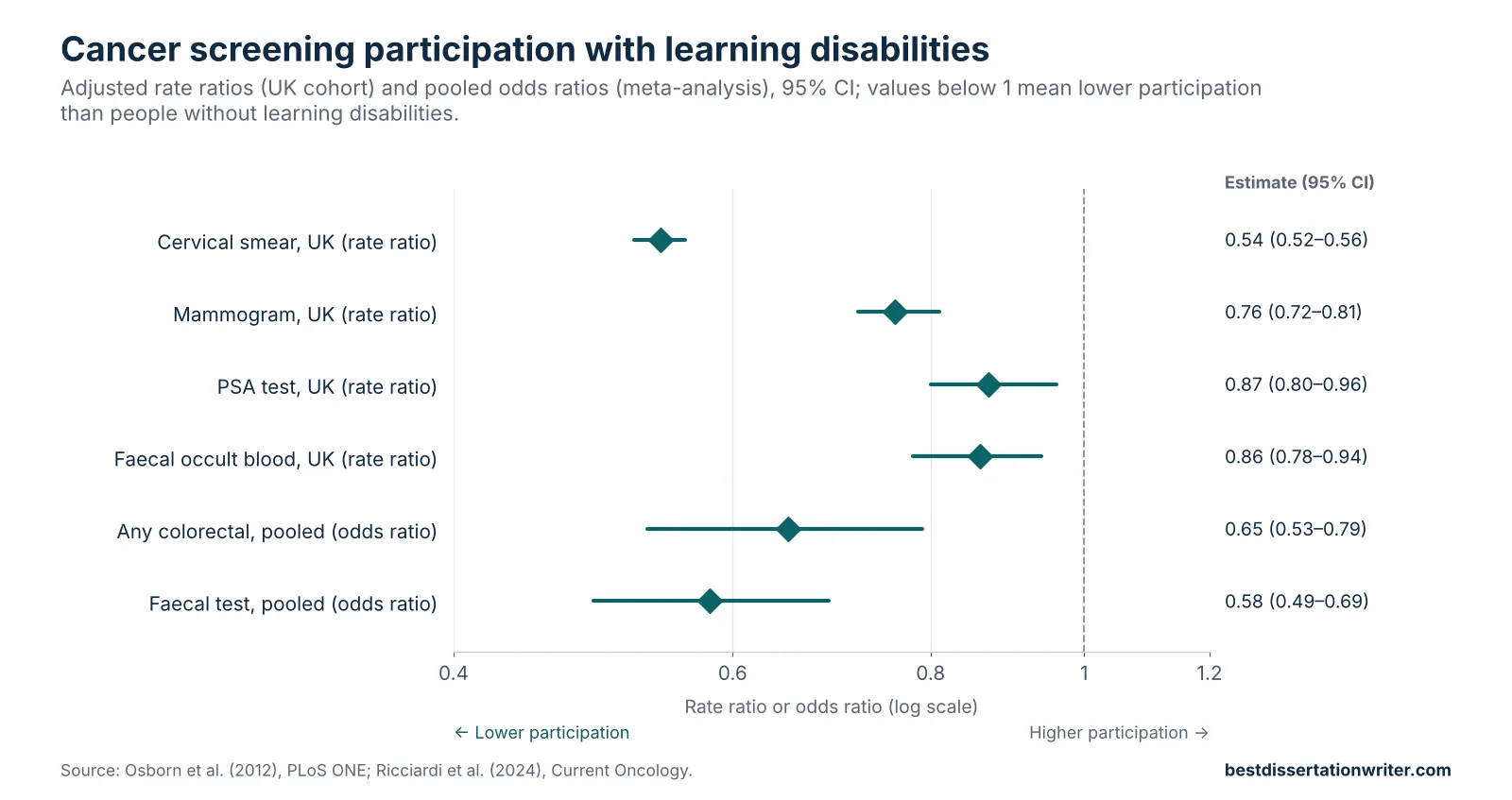
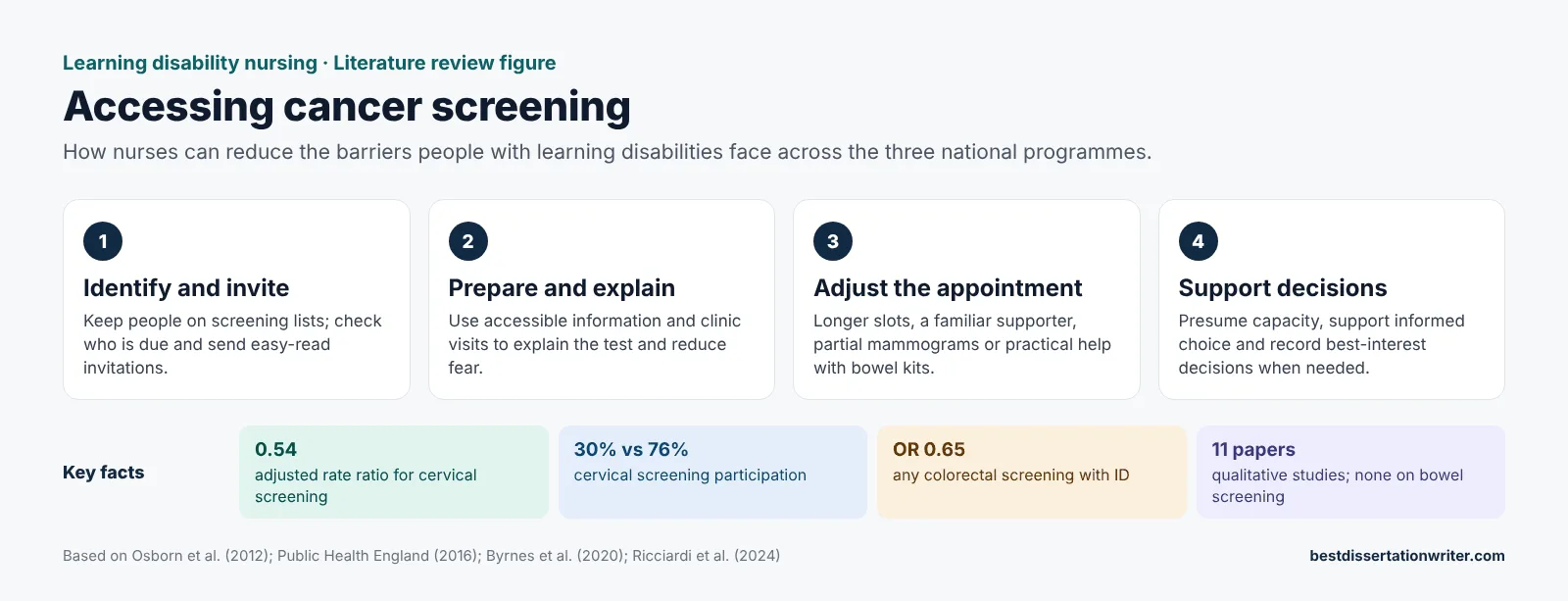
Three themes were identified: inequalities in cancer screening uptake across the national programmes; the barriers experienced by people with learning disabilities, their carers and professionals; and the reasonable adjustments and support that may improve accessing cancer screening. Table 1 summarises the included sources, and Figure 1 presents adjusted rate ratios and pooled odds ratios for screening participation among people with learning or intellectual disabilities compared with people without.
| Author, year | Design | Setting and sample | Key finding |
|---|---|---|---|
| Osborn et al. (2012) | Four matched cohort studies (primary care database) | UK primary care (THIN); people with and without learning disabilities in screening age ranges | Adjusted rate ratios: cervical 0.54, mammogram 0.76, PSA 0.87, faecal occult blood 0.86. |
| Merten et al. (2015) | Literature review | 35 peer-reviewed articles; people with a range of disabilities | Barriers: cost, access, provider discomfort and physical and cognitive limitations. |
| Public Health England (2016) | National guidance | NHS cervical, breast and bowel screening programmes, England | Participation 30% vs 76% (cervical), 51% vs 67% (breast), 75% vs 83% (bowel); lists reasonable adjustments. |
| Willis et al. (2018) | Narrative literature review | Colorectal cancer in people with intellectual disabilities; four databases, 1970–2017 | Screening used less; presentation often masked by challenging behaviours; late diagnosis common. |
| Byrnes et al. (2020) | Qualitative systematic review (meta-aggregation) | 11 UK papers; people with learning disabilities, family carers, paid carers | Fear, concern about pain and carer influence affect attendance; no studies of bowel screening. |
| Andiwijaya et al. (2022) | Systematic review and meta-analysis | 29 studies of women with disabilities, high-income settings | Lower odds of breast (OR 0.78) and cervical (OR 0.63) screening with disability. |
| Ricciardi et al. (2024) | Systematic review and meta-analysis | 20 studies of disabled people; mostly USA | Intellectual disability: OR 0.65 for any colorectal screening, 0.58 for faecal tests. |
Theme 1: Inequalities in Cancer Screening Uptake
The strongest UK evidence comes from four cohort studies within The Health Improvement Network primary care database. Osborn et al. (2012) matched people with a recorded learning disability to up to six people without one and found significantly lower uptake for all four tests. Adjusted incidence rate ratios were 0.54 for cervical smears among 6,254 eligible women, 0.76 for mammograms among 2,956 eligible women, 0.87 for prostate specific antigen tests among 3,520 eligible men and 0.86 for faecal occult blood tests among 6,566 eligible people.
Osborn et al. (2012) also found that the gap in cervical screening narrowed over time but remained 45% lower in 2008/9, while the gap in breast screening appeared to widen, reaching 35% lower in 2009. Differences were smaller in more socially deprived areas. Because the study relied on primary care records, screening recorded elsewhere may have been missed, and people with mild learning disabilities are often not identified in general practice, which could bias the estimates in either direction.
National figures cited by Public Health England (2016) from the NHS Digital learning disability dataset show the same pattern. In 2015 to 2016, participation was 30% for cervical screening among people with learning disabilities compared with 76% among people without an identified learning disability, 51% compared with 67% for breast screening, and 75% compared with 83% for bowel screening. The largest gap was therefore in cervical screening, an intimate procedure that many women find difficult and that requires the most preparation and support.
International meta-analyses suggest that these inequalities are not unique to the UK. Andiwijaya et al. (2022) pooled 29 studies, all from high-income settings, and found lower odds of breast screening (odds ratio 0.78) and cervical screening (0.63) among women with disabilities, although a separate pooled estimate for intellectual disability was not possible and about a third of studies were at high risk of bias. Ricciardi et al. (2024), in 20 studies mostly from the United States, found lower odds of any colorectal screening among people with intellectual disabilities (odds ratio 0.65), and especially of faecal tests (0.58).
Theme 2: Barriers to Accessing Cancer Screening
Merten et al. (2015) reviewed 35 peer-reviewed articles on barriers to breast, cervical, prostate and colorectal screening for people with a range of disabilities. People with more advanced disabilities were screened less often, and education, income, age, employment, screening history and level of disability all influenced uptake. The main barriers were cost, access, provider discomfort and physical and cognitive limitations. Although the review was not specific to learning disabilities, its finding that professionals feel uncomfortable is directly amenable to training.
Byrnes et al. (2020) synthesised qualitative research on the views of people with learning disabilities, family carers and paid care workers in the UK, identifying 11 eligible papers from 14,846 records. All concerned cervical or breast screening; none addressed bowel screening. Women with learning disabilities may not attend because of fear and concern about pain, and family carers and paid care workers strongly influenced whether women attended. Carers can therefore act either as gatekeepers who discourage screening or as enablers who make attendance possible.
Service organisation creates further barriers. Public Health England (2016) highlights time pressures in appointments, mobility needs, communication difficulties and the need for best-interest processes before a person is removed from a programme. Bowel screening by home test kit relies on a person understanding the instructions and collecting a sample, which many people cannot do without support. Willis et al. (2018) noted that risk factors such as overweight, obesity and low physical activity are more common among people with intellectual disabilities, so these barriers carry particular risk.
Theme 3: Reasonable Adjustments and Support
Public Health England (2016) set out reasonable adjustments for each programme. These include routine easy-read invitations and accessible information to support informed choice; practical help before and during appointments; advice on visual checks or partial mammography where full positioning is not possible; and guidance for staff on collecting bowel samples for people who cannot do so themselves. The guidance also recommends education for carers, care home staff, general practitioners and radiographers, and notes that joint work between community learning disability nurses and primary care staff can improve cervical cancer screening uptake.
The qualitative evidence supports this direction. Byrnes et al. (2020) identified practical mechanisms that helped women with learning disabilities attend, and Merten et al. (2015) recommended specialised provider training, community programmes and health promotion tailored to disabled people. However, none of the included sources reported controlled evaluations showing that reasonable adjustments increase cancer screening uptake, so their effectiveness remains largely assumed rather than demonstrated.
Ricciardi et al. (2024) found that, across disability groups, the gap was concentrated in faecal tests completed at home, with no significant difference for colonoscopy, and the lowest odds for people with intellectual disabilities were for faecal tests. This strengthens the case for practical help with home kits, such as reminders, visual instructions and carer guidance, alongside wider efforts to improve accessing cancer screening across all three programmes.
Discussion
This review shows a consistent pattern: people with learning disabilities are less likely than others to take part in cervical, breast and bowel cancer screening, with the largest gap in cervical screening. The finding is supported by a large UK cohort, national figures and international meta-analyses, which strengthens confidence that the inequality is real rather than an artefact of a single study or setting.
The barriers to accessing cancer screening operate at several levels. Individual factors include fear, pain and limited understanding; interpersonal factors include the attitudes of family carers and paid staff; and service factors include inaccessible invitations, short appointments and provider discomfort. This layering suggests that single interventions, such as an easy-read leaflet alone, are unlikely to be sufficient without changes in the support around the person and in how services are delivered.
There is a tension between increasing uptake and respecting informed choice. Higher participation is not automatically a good outcome if people are screened without understanding or consent, or if an intimate procedure causes significant distress. Public Health England (2016) links accessible information to informed choice and stresses the Mental Capacity Act process, including formal best-interest decisions. Measuring success only by cancer screening uptake may therefore miss the quality of decision-making and the experience of the person.
The evidence base has important gaps. Qualitative research has focused almost entirely on women and on cervical and breast screening, while bowel screening, which applies equally to men, has been neglected. The meta-analyses were limited by the small number of studies reporting intellectual disability separately, variable risk of bias and the predominance of high-income countries. Most importantly, there is little controlled evidence that reasonable adjustments improve accessing cancer screening, despite their widespread recommendation.
This review has limitations. This review relied on openly accessible, English-language sources, did not involve independent double screening and included a small number of sources, some of which addressed disability in general rather than learning disabilities specifically. The national participation figures were reported in guidance rather than peer-reviewed research. Future research should evaluate reasonable adjustments and nurse-led interventions using controlled designs, include men and bowel screening, measure informed choice as well as uptake, and involve people with learning disabilities in designing studies.
Implications of Accessing Cancer Screening Evidence for Practice
For learning disability nurses, the evidence supports a proactive, individualised approach. Nurses can identify people who are due for screening, provide easy-read information and desensitisation work in advance, and agree reasonable adjustments with the practice nurse, screening service or radiographer. They should support capacity assessment and best-interest decisions where needed, record the person’s preferences in their health action plan, and offer practical help with bowel test kits. Training family carers and paid staff to understand the value of screening and to support informed choice is equally important.
Lower screening participation is one reason why cancer contributes to avoidable mortality among people with learning disabilities. Staff working in supported living services are often the people who open invitations and arrange appointments, so their understanding of screening is crucial. Clear, patient and honest explanation, drawing on therapeutic communication skills, helps people to understand what screening involves and to make their own decisions.
Conclusion
This systematic review examined evidence on accessing cancer screening for people with learning disabilities. People with learning disabilities are consistently less likely to take part in cervical, breast and bowel screening, and the barriers include fear, pain, carer influence, inaccessible information and provider discomfort. Reasonable adjustments are widely recommended, but evidence of their effectiveness is limited.
Improving accessing cancer screening requires coordinated, person-centred support that respects informed choice. Learning disability nurses are well placed to lead this work by preparing people, advising mainstream services and educating carers, while further research should test which reasonable adjustments make the greatest difference.
References
Andiwijaya, F. R., Davey, C., Bessame, K., Ndong, A., & Kuper, H. (2022). Disability and participation in breast and cervical cancer screening: A systematic review and meta-analysis. International Journal of Environmental Research and Public Health, 19(15), 9465. https://doi.org/10.3390/ijerph19159465
Byrnes, K., Hamilton, S., McGeechan, G. J., O’Malley, C., Mankelow, J., & Giles, E. L. (2020). Attitudes and perceptions of people with a learning disability, family carers, and paid care workers towards cancer screening programmes in the United Kingdom: A qualitative systematic review and meta-aggregation. Psycho-Oncology, 29(3), 475–484. https://doi.org/10.1002/pon.5311
Merten, J. W., Pomeranz, J. L., King, J. L., Moorhouse, M., & Wynn, R. D. (2015). Barriers to cancer screening for people with disabilities: A literature review. Disability and Health Journal, 8(1), 9–16. https://doi.org/10.1016/j.dhjo.2014.06.004
Osborn, D. P. J., Horsfall, L., Hassiotis, A., Petersen, I., Walters, K., & Nazareth, I. (2012). Access to cancer screening in people with learning disabilities in the UK: Cohort study in the Health Improvement Network, a primary care research database. PLoS ONE, 7(8), e43841. https://doi.org/10.1371/journal.pone.0043841
Public Health England. (2016). Cancer screening: Making reasonable adjustments. GOV.UK. https://www.gov.uk/government/publications/cancer-screening-and-people-with-learning-disabilities/cancer-screening-making-reasonable-adjustments
Ricciardi, G. E., Cuciniello, R., De Ponti, E., Lunetti, C., Pennisi, F., Signorelli, C., & Renzi, C. (2024). Disability and participation in colorectal cancer screening: A systematic review and meta-analysis. Current Oncology, 31(11), 7023–7039. https://doi.org/10.3390/curroncol31110517
Willis, D., Samalin, E., & Satgé, D. (2018). Colorectal cancer in people with intellectual disabilities. Oncology, 95(6), 323–336. https://doi.org/10.1159/000492077
Cite this example
Best Dissertation Writers (2026) Barriers to Accessing Cancer Screening for People with Learning Disabilities: A Systematic Review. Available at: https://bestdissertationwriter.com/accessing-cancer-screening-review/
Best Dissertation Writers
Get expert help with your nursing literature review
Share your topic and deadline with Best Dissertation Writers and get support tailored to your module brief.