Mental Capacity, Consent, and Decision-Making for People with Learning Disabilities in Healthcare: An Integrative Review
 By Dr. Robertson Prime, Research Fellow
Updated October 12, 2026
16 min read
About 3,200 words
By Dr. Robertson Prime, Research Fellow
Updated October 12, 2026
16 min read
About 3,200 words
In this review
Abstract
Background: Questions of mental capacity arise whenever a person with learning disabilities is asked to consent to examination, treatment or care. In England and Wales the Mental Capacity Act 2005 requires professionals to presume capacity, to support people to make their own decisions and, where capacity is lacking, to act in the person’s best interests.
Aim: This integrative review aimed to examine how capacity, consent and decision-making for people with learning disabilities are understood and put into practice by health and social care professionals.
Methods: An integrative review was conducted using targeted searches of openly accessible bibliographic records, publisher websites and the reference lists of key reviews. Seven sources published between 2005 and 2021 were included: the Act itself, a parliamentary inquiry, a national guideline, an interview study of community learning disability teams, a literature review, a qualitative study and a national survey, appraised with CASP tools where appropriate and synthesised thematically.
Findings: The legal framework is strongly empowering, but a parliamentary committee concluded that its empowering ethos had not been delivered in practice. Studies of professionals identified 14 areas of weak knowledge in community learning disability teams, variable adherence to legal requirements in capacity assessment and particular difficulty with the ‘use or weigh’ element of the test. Supported decision-making was valued but rarely linked explicitly to assessment, and 38.6% of surveyed professionals named people with learning disabilities as the group most vulnerable to undue influence.
Conclusion: Learning disability nurses should prioritise supported decision-making, record capacity assessments clearly and use best interests processes that keep the person’s wishes at the centre.
Keywords: mental capacity, best interests, decision-making
Introduction
This integrative review critically examines recent evidence on mental capacity and its implications for learning disability nursing practice.
Every day, people with learning disabilities are asked to agree to blood tests, vaccinations, screening, medicines, hospital admission and changes to where they live. Some can make these decisions independently, some can make them with the right support and some cannot make a particular decision at a particular time. Getting this judgement right matters: treating a person as lacking mental capacity when they could decide removes their rights, while assuming understanding that is not there can leave them exposed to harm or to treatment they did not truly agree to.
Learning disability nurses are closely involved in these situations. They prepare people for procedures, explain information in accessible ways, assess whether a person can make a decision, contribute to best interests meetings and advocate for the person in acute and community services. National reviews of the deaths of people with learning disabilities have also raised concern that the law on mental capacity is not always applied correctly when serious treatment decisions are made, which makes this a patient safety issue as well as a matter of rights.
An integrative review design was chosen because the relevant evidence includes legislation, a parliamentary inquiry, national guidance, surveys, interview studies and literature reviews. Combining these sources allows the legal and policy expectations to be compared with the evidence on what actually happens in practice, which no single design could show.
Review question
How are mental capacity, consent and decision-making for people with learning disabilities understood and put into practice by health and social care professionals?
Background to Mental Capacity
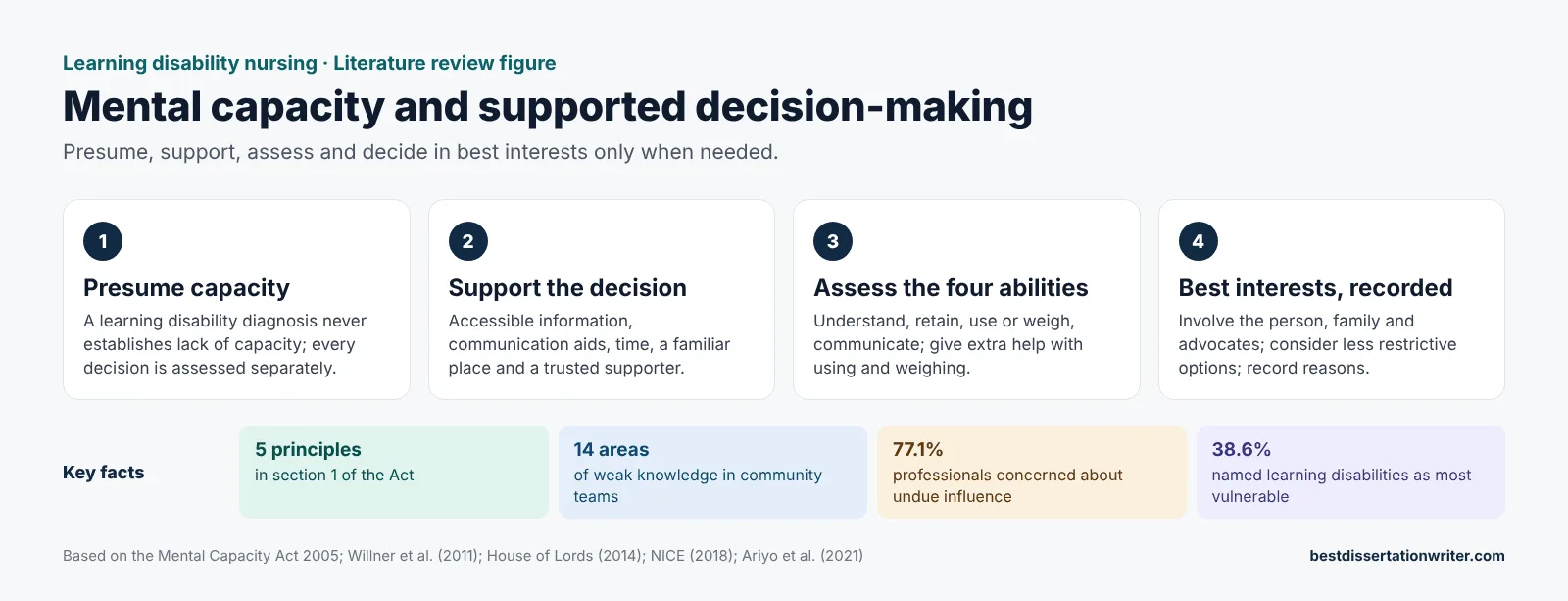
In England and Wales, decisions about capacity are governed by the Mental Capacity Act 2005 (MCA). Section 1 sets out five principles: a person must be assumed to have capacity unless it is established that they lack it; they are not to be treated as unable to decide unless all practicable steps to help them have been taken without success; they are not to be treated as unable to decide merely because they make an unwise decision; any act or decision made for a person who lacks capacity must be in their best interests; and regard must be had to whether the purpose can be achieved in a less restrictive way.
The Act defines capacity as decision-specific and time-specific. A person lacks capacity in relation to a matter if, because of an impairment of or disturbance in the functioning of the mind or brain, they are unable to make that decision at the time it needs to be made. The functional test asks whether the person can understand the relevant information, retain it, use or weigh it as part of the decision-making process and communicate their decision by any means. A diagnosis of learning disability alone therefore never establishes a lack of capacity.
Where a person lacks capacity for a specific decision, the decision maker must act in their best interests. This requires consideration of the person’s past and present wishes, feelings, beliefs and values, consultation with family, carers and others interested in their welfare, and involvement of the person as far as possible. For serious medical treatment or changes of accommodation where there is no one appropriate to consult, an Independent Mental Capacity Advocate must be instructed.
Internationally, the United Nations Convention on the Rights of Persons with Disabilities, particularly Article 12, has encouraged a shift from substitute decision-making towards supported decision-making. This approach emphasises giving people the information, time, communication aids and trusted support they need to make their own choices, and it challenges professionals to treat capacity assessment as a last step rather than a first response.
Search Strategy and Methods
Evidence for this example was identified through targeted searches of openly accessible bibliographic records, publisher websites and the reference lists of key reviews. Search terms combined keywords for the concept (“mental capacity”, “capacity assessment”, “consent”, “best interests”, “supported decision-making”) with terms for the population and setting (“learning disabilit*”, “intellectual disabilit*”, “health care”, “nurs*”), joined with the Boolean operators AND and OR. A full integrative review for assessment would run the same strategy in CINAHL, PubMed/MEDLINE, PsycINFO, the Cochrane Library and Embase and report the number of records screened in a PRISMA flow diagram.
Sources were eligible if they set out the legal or policy framework for mental capacity and consent in England and Wales, or if they reported empirical evidence on how professionals assess capacity, support decision-making or make best interests decisions for adults with learning disabilities or for mixed groups that included them. Studies of capacity to consent to research participation, studies of children under 16 and opinion pieces were excluded.
Seven sources on mental capacity published between 2005 and 2021 were included: the Act itself, a parliamentary post-legislative scrutiny report, a national guideline, an interview study, a literature review, a qualitative study and a national survey (Table 1). The quality of the empirical sources was appraised using the Critical Appraisal Skills Programme (CASP) checklist appropriate to their design, the policy sources were appraised for authority and currency, and findings were synthesised narratively and grouped into themes.
Key Findings on Mental Capacity
Three themes were identified: the gap between the empowering intent of the law and its implementation, the difficulties professionals face when assessing mental capacity, and the place of supported decision-making and best interests in protecting rights. Table 1 summarises the included sources, and Figure 1 shows which groups professionals considered most vulnerable to undue influence in capacity decisions.
| Author, year | Design | Setting and sample | Key finding |
|---|---|---|---|
| Mental Capacity Act 2005 | Primary legislation | England and Wales; people aged 16 and over | Five principles, including presumed capacity, practicable support, unwise decisions and best interests. |
| Willner et al. (2011) | Structured interview study | 40 professionals from 10 community learning disability teams; Wales | Health and social care staff performed similarly; 14 areas of weak knowledge identified. |
| House of Lords Select Committee (2014) | Post-legislative scrutiny report | Written and oral evidence on the Act | Empowering ethos not delivered; lack of awareness and understanding; cultures of paternalism and risk-aversion. |
| NICE (2018) | National guideline | People aged 16 and over who may lack mental capacity | All practicable support before assessment; accessible information; recorded assessment before best interests decisions. |
| Jayes et al. (2020) | Literature review | 20 studies, 2007–2018; England and Wales | Little detail on how abilities were tested; adherence to legal requirements varied. |
| Webb et al. (2020) | Qualitative interview study | 41 people with mental health problems and/or learning disabilities; Northern Ireland | Support rarely addressed the four components of the test; using and weighing hardest to support. |
| Ariyo et al. (2021) | National survey | 611 professionals, including 62 nurses; England and Wales | 77.1% concerned about undue influence; 38.6% named people with learning disabilities as most vulnerable. |
Theme 1: An Empowering Law, Unevenly Implemented
The MCA was designed to protect people who lack capacity while maximising the autonomy of those who have it. Its principles of presumed capacity, practicable support and respect for unwise decisions are directly relevant to people with learning disabilities, whose abilities have historically been underestimated. On paper, the framework places the person and their wishes at the heart of every decision made about them.
A House of Lords Select Committee (2014) examined how the Act had worked in practice. It concluded that implementation had not met the expectations the Act rightly raised, that it had suffered from a lack of awareness and a lack of understanding, and that its empowering ethos had not been delivered. The committee linked this to prevailing cultures of paternalism in health care and risk-aversion in social care, described the Deprivation of Liberty Safeguards as so poorly drafted and implemented that the only appropriate response was to start again, and recommended a single independent body to oversee implementation.
The committee drew on extensive written and oral evidence rather than systematic research, so its conclusions reflect the views of those who gave evidence. Nonetheless, its findings are consistent with the empirical studies in this review, and its criticism of paternalism is particularly relevant for people with learning disabilities, who may be assumed to lack capacity because of their diagnosis rather than because of a proper assessment.
NICE (2018) responded to these concerns with a guideline on decision-making and mental capacity for people aged 16 and over. It emphasises that practitioners must take all practicable steps to help a person decide before concluding that they cannot, recommends accessible, tailored information and communication aids, states that single screening tools such as the Mini-Mental State Examination should not be used as the basis for assessing capacity, and requires a proportionate written record of the support given and the reasons for any finding.
Theme 2: Assessing Mental Capacity in Practice
Willner et al. (2011) interviewed 40 professionals from 10 community learning disability teams, two social workers and two health professionals from each team, using three case scenarios and ten true or false statements. Most had received training in the Act, and health and social services staff performed similarly. However, the study identified 14 areas in which knowledge or understanding was weak, including the identification of capacity issues, risk assessment and the less restrictive alternative. Participants generally recognised the limits of their own knowledge, and most said the interview had made them aware of further training needs.
The study is small and was conducted in one region of Wales shortly after the Act came into force, so knowledge may have changed since. It also measured knowledge in hypothetical scenarios rather than observed practice. Even so, its finding that trained professionals still held important misunderstandings suggests that training alone does not guarantee confident application of capacity law.
Jayes et al. (2020) reviewed 20 studies published between 2007 and 2018 on how health and social care professionals in England and Wales assess mental capacity. The studies, of varying quality, covered many professions, user groups and settings. Four themes emerged: preparation for assessment, assessment processes, supported decision-making and interventions to improve practice. Studies often gave little detail about how information was provided to people or how their decision-making abilities were tested, and practice varied in how closely it followed legal requirements.
Ariyo et al. (2021) surveyed 611 professionals in England and Wales, of whom 62 (10.1%) were nurses and half were social workers. More than half (53%) carried out over 25 capacity assessments a year, and 77.1% were at least moderately concerned about undue influence on the people they assessed. Respondents described using and weighing information as the most problematic part of the functional test and communication support as the most frequently discussed difficulty.
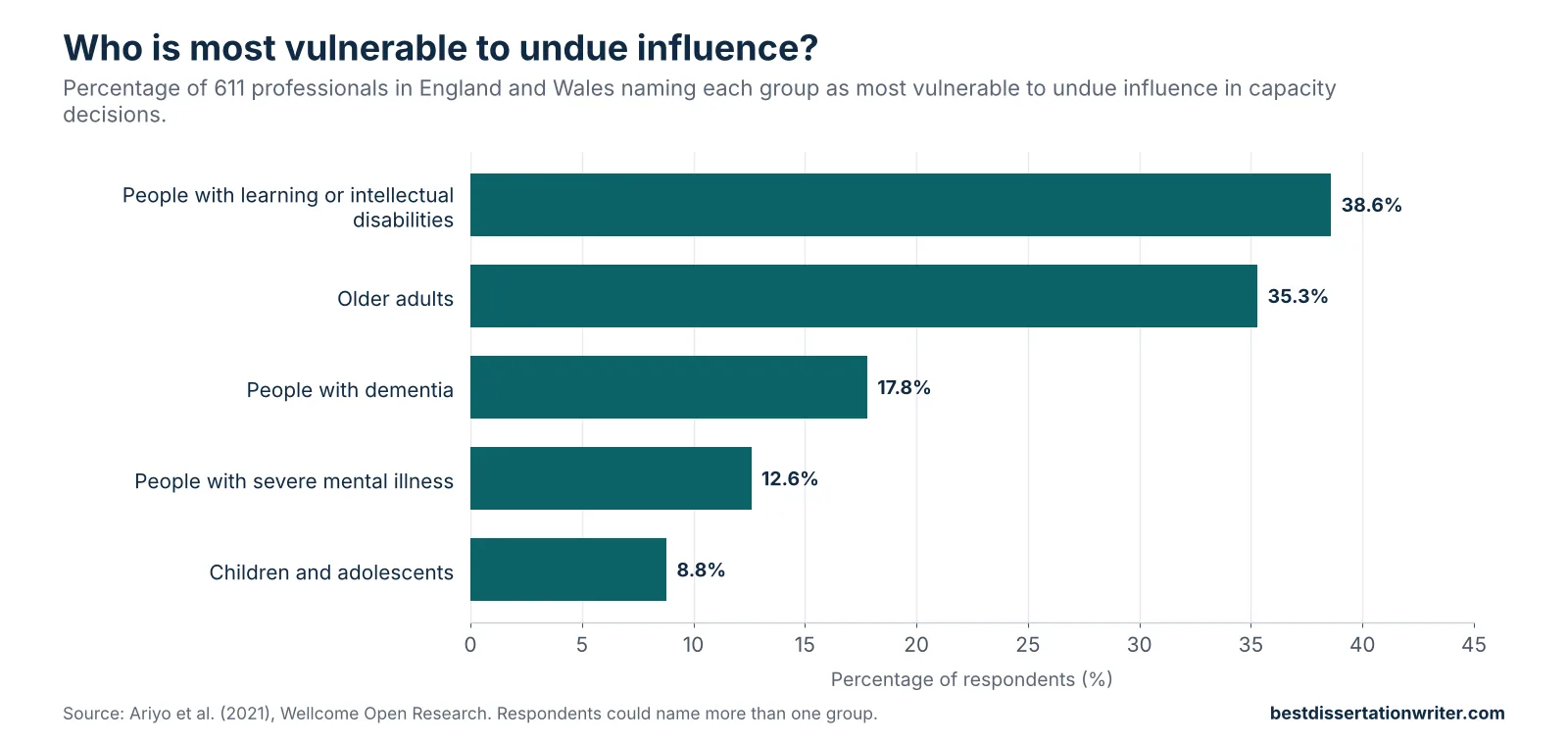
When asked which groups were most vulnerable to undue influence, the largest share of respondents (38.6%) named people with learning or intellectual disabilities, ahead of older adults (35.3%) and people with dementia (17.8%). This perception matters because undue influence from family members, carers or professionals can distort both the person’s decision and the assessor’s judgement of it. The survey relied on a self-selected sample, which may over-represent professionals with a particular interest in capacity, and it did not report findings separately for learning disability services.
Theme 3: Supported Decision-Making and Best Interests
Webb et al. (2020) interviewed 41 people with mental health problems and/or learning disabilities in Northern Ireland about how they made decisions and the support they received. Participants rarely described their decision-making in terms of the four components of the functional test, and the support they received seldom addressed those components explicitly. Support with using and weighing information was identified as a particular challenge. The authors argued that considering support for each part of the test could make supported decision-making more comprehensive.
This finding links the two sides of the law. The Act requires practicable steps to help a person decide before capacity is judged, but if support is not organised around the abilities the test examines, people may be found to lack capacity for reasons that better support could have overcome. The overlap with the survey by Ariyo et al. (2021), in which using and weighing was also the most problematic element, strengthens this conclusion.
Where capacity is lacking, the guideline from NICE (2018) requires a recorded capacity assessment before a best interests decision, except in emergencies, agreement about who the decision maker is, active efforts to seek the person’s wishes, feelings, values and beliefs, consultation with family, carers and advocates, and documentation of the reasons where the decision differs from the person’s expressed wishes. These expectations place considerable responsibility on nurses who coordinate care and record decisions.
Discussion
This review found a consistent gap between the empowering intent of the law on mental capacity and its application in practice. The Act and national guidance set out clear expectations: presume capacity, support decisions, assess carefully, record reasons and keep the person at the centre of best interests decisions. Yet the parliamentary inquiry, the interview study, the literature review and the survey all describe weak knowledge, variable practice and uncertainty about key elements of the test.
A central tension lies between protection and autonomy. The committee’s observation of paternalism in health care is especially relevant to people with learning disabilities, who may be steered towards decisions that others consider safe. At the same time, concern about undue influence was widespread, and people with learning disabilities were seen as particularly vulnerable to it. Nurses must therefore protect people from pressure while avoiding the opposite error of overriding their choices.
The evidence also suggests that the functional test of mental capacity is applied inconsistently. Using and weighing information was identified as difficult in two independent sources, and the review by Jayes et al. (2020) found little detail on how professionals tested decision-making abilities. Without clear methods, judgements about mental capacity may rely on the assessor’s intuition, which is open to bias and difficult to challenge.
Supported decision-making offers a way forward, but the evidence on how to deliver it is thin. Webb et al. (2020) show that support is rarely organised around the abilities the law assesses, and the guideline from NICE (2018) is based largely on expert consensus rather than trials. For learning disability nurses, this means that skills in accessible communication, easy-read information and building trusting relationships are central to lawful practice, not simply good manners.
This review has limitations. It relied on openly accessible, English-language sources, did not involve independent double screening and included only seven sources, several of which were policy documents or studies that mixed people with learning disabilities with other groups. Most evidence came from England, Wales and Northern Ireland, so it may not transfer to other legal systems. Future research should observe real assessments of mental capacity with people with learning disabilities, test structured supported decision-making interventions and evaluate whether better practice improves outcomes and experiences of care.
Implications of Mental Capacity Evidence for Practice
Learning disability nurses should begin every consent conversation by presuming capacity and asking what support the person needs to decide. This includes accessible information, communication aids, extra time, a familiar environment and a trusted supporter, drawing on therapeutic communication skills. Support should be planned around each part of the functional test, especially helping the person to use and weigh information, and assessments should be decision-specific, clearly recorded and revisited when circumstances change.
Where a person lacks capacity, nurses should ensure that best interests decisions involve the person, their family and advocates, consider less restrictive options and record the reasons for the decision. These skills are needed in many areas of care, from decisions about accessing cancer screening and hospital discharge planning to the move from children’s to adult services for young people, when the Act begins to apply at 16 and responsibility for decisions shifts from parents to the young person.
Conclusion
This integrative review examined evidence on mental capacity, consent and decision-making for people with learning disabilities. The law is strongly empowering, but its implementation has been uneven, professionals report gaps in knowledge and particular difficulty with using and weighing information, and supported decision-making is rarely linked to the abilities that capacity assessment examines.
Learning disability nurses are well placed to close this gap by putting supported decision-making first, assessing mental capacity carefully and transparently, and ensuring that best interests decisions reflect the person’s own wishes, values and relationships. Doing so protects both the rights and the safety of people with learning disabilities.
References
Ariyo, K., McWilliams, A., David, A. S., & Owen, G. S. (2021). Experiences of assessing mental capacity in England and Wales: A large-scale survey of professionals. Wellcome Open Research, 6, 144. https://doi.org/10.12688/wellcomeopenres.16823.1
House of Lords Select Committee on the Mental Capacity Act 2005. (2014). Mental Capacity Act 2005: Post-legislative scrutiny (HL Paper 139). The Stationery Office. https://publications.parliament.uk/pa/ld201314/ldselect/ldmentalcap/139/13902.htm
Jayes, M., Palmer, R., Enderby, P., & Sutton, A. (2020). How do health and social care professionals in England and Wales assess mental capacity? A literature review. Disability and Rehabilitation, 42(19), 2797–2808. https://doi.org/10.1080/09638288.2019.1572793
Mental Capacity Act 2005, c. 9. https://www.legislation.gov.uk/ukpga/2005/9/contents
National Institute for Health and Care Excellence. (2018). Decision-making and mental capacity (NICE guideline NG108). https://www.nice.org.uk/guidance/ng108
Webb, P., Davidson, G., Edge, R., Falls, D., Keenan, F., Kelly, B., McLaughlin, A., Montgomery, L., Mulvenna, C., Norris, B., Owens, A., & Shea Irvine, R. (2020). Key components of supporting and assessing decision making ability. International Journal of Law and Psychiatry, 72, 101613. https://doi.org/10.1016/j.ijlp.2020.101613
Willner, P., Jenkins, R., Rees, P., Griffiths, V. J., & John, E. (2011). Knowledge of mental capacity issues in community teams for adults with learning disabilities. Journal of Applied Research in Intellectual Disabilities, 24(2), 159–171. https://doi.org/10.1111/j.1468-3148.2010.00573.x
Cite this example
Best Dissertation Writers (2026) Mental Capacity, Consent, and Decision-Making for People with Learning Disabilities in Healthcare: An Integrative Review. Available at: https://bestdissertationwriter.com/mental-capacity-literature-review/
Best Dissertation Writers
Get expert help with your nursing literature review
Share your topic and deadline with Best Dissertation Writers and get support tailored to your module brief.