Communication Strategies and Augmentative Aids Used by Nurses with People with Learning Disabilities: A Scoping Review
 By Dr. Robertson Prime, Research Fellow
Updated October 12, 2026
15 min read
About 3,000 words
By Dr. Robertson Prime, Research Fellow
Updated October 12, 2026
15 min read
About 3,000 words
In this review
Abstract
Background: Nurses depend on effective communication strategies to assess pain, explain care and obtain consent, yet many people with learning disabilities have difficulty understanding or using spoken language. When communication breaks down, symptoms are missed, distress rises and people are excluded from decisions about their own care.
Aim: This scoping review aimed to map the evidence on communication strategies and augmentative aids that nurses can use with people with learning disabilities, including signing systems such as Makaton.
Methods: Targeted searches of openly accessible bibliographic records, publisher websites and the reference lists of key reviews identified seven sources published between 2013 and 2023: three systematic or mixed-methods reviews, a national cross-sectional study, an intervention study, a documentary review of hospital passports and a professional standards document. Sources were appraised with CASP checklists where appropriate and charted thematically.
Findings: In a national study of 601 adults aged 40 and over with intellectual disability, 57.9% had communication difficulties and 23.5% had severe difficulties, and more than half found it hard to communicate with professionals. Reviews found that augmentative and alternative communication and interaction-focused interventions produced some improvements, but all ten controlled studies in one review were rated low quality. Key word signing improved when support staff were trained, and partner knowledge, attitudes and clear roles shaped the use of aids, while hospital passports varied widely in content and format.
Conclusion: Communication is a shared responsibility of the nurse and the person. Nurses should use communication passports, signing and visual supports consistently, involve carers and seek speech and language therapy input, while recognising that the evidence base remains limited.
Keywords: communication strategies, augmentative and alternative communication, Makaton
Introduction
This scoping review critically examines recent evidence on communication strategies and its implications for learning disability nursing practice.
Communication is at the heart of nursing. Nurses need to find out how a person feels, explain what is happening, check understanding and seek consent many times a day. For people with learning disabilities, these everyday exchanges can be difficult. Some people have little or no speech, some understand far less than their spoken language suggests, and many find unfamiliar people, noise and medical words confusing. When communication strategies are not adapted, pain and illness may be overlooked and people may be excluded from decisions about their own care.
A wide range of approaches has been developed to bridge this gap. They include simplifying spoken language, using objects, photographs and symbols, augmentative and alternative communication such as communication boards and speech-generating devices, and signing systems such as Makaton, which combines signs and symbols with speech. Communication passports and hospital passports record how a person communicates so that staff who do not know them can adapt their approach. Nurses in every field meet people who rely on these strategies, not only learning disability nurses.
A scoping review design was chosen because the evidence is broad and diverse, spanning prevalence studies, intervention trials, qualitative syntheses, documentary analyses and professional standards. The aim is to map what is known and where the gaps lie rather than to estimate a single pooled effect of communication strategies.
Review question
What evidence exists on the communication strategies and augmentative aids that nurses and other staff use with people with learning disabilities, and what does it suggest for nursing practice?
Background to Communication Strategies
Communication difficulties are among the defining features of learning disability. They can affect understanding (receptive communication), expression (expressive communication), or both, and they are often accompanied by hearing or visual impairment, autism or physical disability. Many people communicate through a combination of speech, gesture, facial expression, behaviour and vocalisation, and those closest to them may be the only people who can interpret these signals reliably. Assumptions that a person understands because they nod or repeat words are a frequent source of error, and communication strategies need to be built around how the individual actually communicates rather than how staff expect them to.
Augmentative and alternative communication describes any method that supplements or replaces speech. Unaided approaches use the body, for example signing and gesture; aided approaches use external tools ranging from low-tech picture boards to high-tech speech-generating devices and tablet applications. Makaton and other forms of key word signing are widely used in the United Kingdom: the speaker signs the key words in a sentence while speaking, which slows the pace of speech and adds a visual cue. Choosing appropriate communication strategies usually involves assessment by a speech and language therapist.
Professional and legal frameworks reinforce the importance of accessible communication. Under the Equality Act 2010, adapting how information is given is a reasonable adjustment. In response to the abuse uncovered at Winterbourne View, the Royal College of Speech and Language Therapists (RCSLT, 2013) published five good communication standards for hospital and residential settings, setting out what people with learning disabilities and autistic people should be able to expect from services.
Search Strategy and Methods
Evidence for this example was identified through targeted searches of openly accessible bibliographic records, publisher websites and the reference lists of key reviews. Search terms combined keywords for the population (“learning disabilit*”, “intellectual disabilit*”) with terms for the communication approaches (“communication strategies”, “augmentative and alternative communication”, “AAC”, “Makaton”, “key word signing”, “hospital passport”, “communication passport”) and for staff (“nurs*”, “support staff”, “communication partner*”), joined with the Boolean operators AND and OR. A full scoping review for assessment would run the same strategy in CINAHL, PubMed/MEDLINE, PsycINFO, the Cochrane Library and Embase and report the number of records screened in a PRISMA flow diagram.
Sources were eligible if they reported on communication strategies, augmentative aids or communication documents used with adolescents or adults with learning disabilities, or on the communication needs that these approaches address. Reviews, empirical studies and national professional standards were included, consistent with the broad scope of a scoping review. Studies limited to young children, or to acquired communication disorders without learning disability, were excluded unless they formed part of a broader synthesis.
Seven sources published between 2013 and 2023 were included: one professional standards document, one metasynthesis, one intervention study of key word signing, one documentary review of hospital passports, one national cross-sectional study, one systematic review of speech and language therapy and one mixed-methods systematic review of communication partners’ experiences (Table 1). The quality of empirical sources was appraised using the Critical Appraisal Skills Programme (CASP) checklist appropriate to their design, and findings on communication strategies were charted and grouped into themes.
Key Findings on Communication Strategies
Three themes were identified: the scale of communication needs; the evidence for augmentative and alternative communication and signing interventions; and the role of communication partners, passports and hospital systems in making communication strategies work. Table 1 summarises the included sources, and Figure 1 shows the prevalence of communication difficulties in a national sample of older adults with intellectual disability.
| Author, year | Design | Setting and sample | Key finding |
|---|---|---|---|
| RCSLT (2013) | Professional standards | Hospital and residential settings for people with learning disability and/or autism; UK | Five good communication standards, including a detailed description of how to communicate with each person and competent staff. |
| Hemsley and Balandin (2014) | Metasynthesis | Hospital studies of patients with severe communication disabilities, including intellectual disability | Six strategies identified (time, tools, carers, staff competence, policies, access to information); none tested in hospital. |
| Meuris et al. (2015) | Pre–post intervention study | 15 adults with intellectual disability and 15 support staff; key word signing programme | Sign use by staff and adults increased significantly after 12 months; adults expressed more communicative functions. |
| Northway et al. (2017) | Documentary review (qualitative content analysis) | 60 hospital passports in use in the UK | Wide variation in terminology, length and format; some omitted allergies, risk assessment and reasonable adjustments. |
| Smith et al. (2020) | National cross-sectional study | 601 adults aged 40 and over with intellectual disability; Ireland | 57.9% had communication difficulties, 23.5% severe; more than half found communicating with professionals difficult. |
| Wood and Standen (2021) | Systematic review | 10 controlled studies of speech and language therapy for adults with intellectual disabilities | AAC, speech and interaction interventions showed some improvements; all studies low quality. |
| Hanley et al. (2023) | Mixed-methods systematic review | 8 studies of communication partners of adults with severe or profound intellectual disability | Partner knowledge, attitudes, time and clear roles shaped AAC use; trained instruction improved signing. |
Theme 1: The Scale of Needs Addressed by Communication Strategies
Smith et al. (2020) examined communication in 601 adults aged 40 and over with intellectual disability who took part in a national longitudinal study in Ireland. Overall, 57.9% had communication difficulties and 23.5% had severe difficulties, and only 75.1% communicated verbally. More than half found it difficult to communicate with professionals and unfamiliar people. Difficulties were associated with level of intellectual disability, low social participation, behaviours that challenge and a diagnosis of Down syndrome.
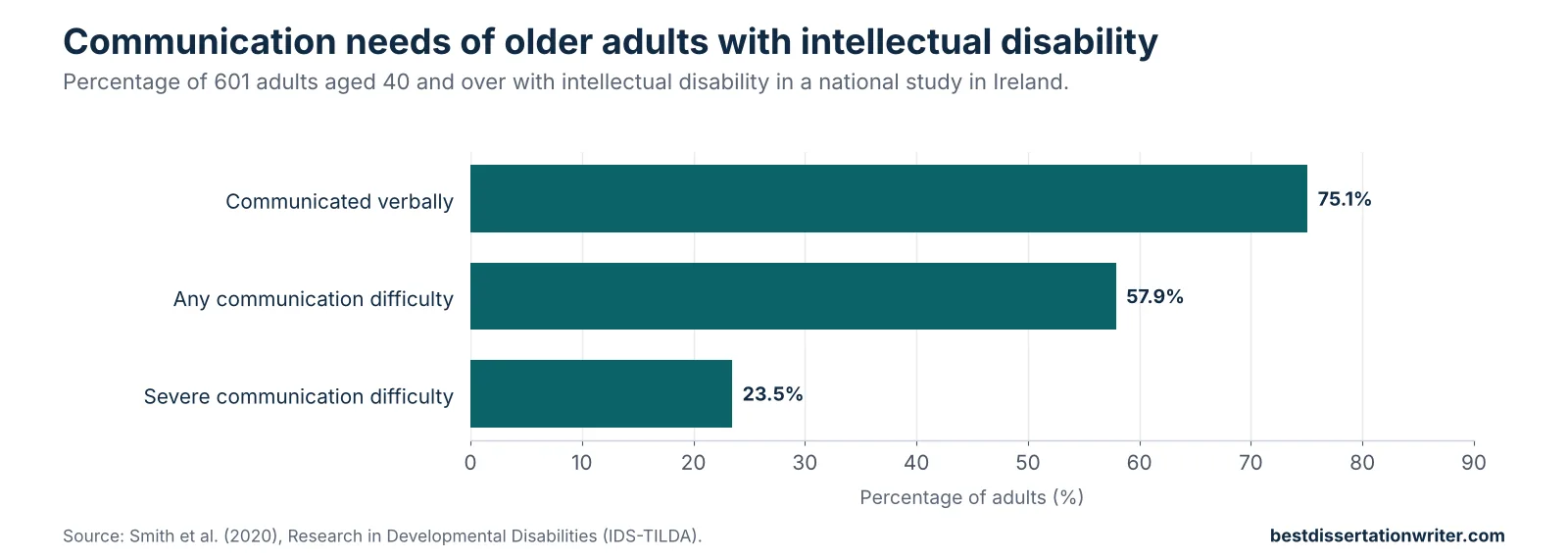
These figures matter for nursing because health professionals are, by definition, unfamiliar communication partners for most patients. The finding that communication with professionals was especially difficult suggests that nurses cannot rely on a person’s communication with family as a guide to how well they will understand clinical information. The study sample was older and drawn from one country, so prevalence in younger adults or other settings may differ. Nevertheless, the results show that adapted communication strategies are needed by a majority, not a minority, of people with learning disabilities.
Theme 2: Augmentative and Alternative Communication and Signing
Wood and Standen (2021) systematically reviewed controlled studies of speech and language therapy for adults with intellectual disabilities. Ten studies met the inclusion criteria; most targeted the person directly to improve speech, increase the use of augmentative and alternative communication or develop interaction skills, and one addressed work with carers. These interventions were associated with some improvements in communication, but all ten studies were rated low quality, and the authors concluded that the evidence was weak and preliminary.
Signing provides an example of both the promise and the limits of the evidence. Meuris et al. (2015) evaluated a key word signing programme in which eight support workers received eight hours of training and then taught two signs a week to colleagues, who used them in daily interactions. After 12 months, sign production increased significantly among both the 15 adults with intellectual disability and their 15 support staff, and the adults expressed more communicative functions. The study had no control group and a small sample, but it shows that signing, like other communication strategies, depends on staff using signs consistently in everyday interactions.
Makaton is the most widely known signing system in the United Kingdom, yet controlled research on Makaton itself is scarce, and much of the evidence for key word signing comes from small studies in other countries. Hanley et al. (2023) found that support staff identified and produced more signed words after training from a speech and language therapist or an official programme than after training from a colleague. This suggests that the source and quality of training are as important as the choice of system when introducing communication strategies such as Makaton.
Theme 3: Communication Partners, Passports and Hospital Systems
Hanley et al. (2023) synthesised eight studies of communication partners’ experiences of using augmentative and alternative communication with adults with severe or profound intellectual disability. Greater knowledge of the aids and positive attitudes were associated with greater use, whereas familiarity with the person could paradoxically hinder use, because partners assumed they already knew what the person meant. Lack of time, limited opportunities and uncertainty about who was responsible for supporting communication were further barriers, while attention to the person’s own preferences helped.
In hospital, Hemsley and Balandin (2014) synthesised research on patient–provider communication for people with severe communication disabilities, including people with intellectual disability, cerebral palsy and autism. They identified six strategies: services and policies that support communication, adequate time, access to communication tools such as call systems and aids, access to written health information, effective collaboration with carers, and training to build staff communicative competence. However, none of these communication strategies had been trialled or validated in hospital settings.
Hospital passports are intended to carry essential information about a person, including how they communicate, between settings. Northway et al. (2017) reviewed 60 hospital passports in use across the United Kingdom and found wide variation in terminology, length and format. Most included communication and support needs, but some omitted allergies, risk assessment and the need for reasonable adjustments. The authors argued that this variation may limit the usefulness of passports, because staff may not find key information quickly, and they called for greater standardisation. These findings echo the RCSLT (2013) standard that every person should have a detailed, agreed description of how best to communicate with them.
Discussion
This scoping review shows that communication difficulties affect most adults with learning disabilities and are particularly marked in encounters with professionals. A range of communication strategies, including augmentative and alternative communication, key word signing and communication passports, is widely recommended and valued, but the research evidence for their effectiveness is limited, mostly small-scale and of low methodological quality.
A consistent message across the sources is that communication is a shared activity. The intervention studies and the synthesis by Hanley et al. (2023) show that aids and signs are only effective when communication partners know how to use them, believe in them and have time to do so. This shifts the focus from fixing the person’s communication to changing the behaviour, skills and environment of staff, which aligns with the RCSLT (2013) standards and with the social model of disability. For nurses, it means that adapting their own communication is part of the job rather than a specialist add-on.
There is a tension between the strong professional consensus supporting these approaches and the weak experimental evidence. Wood and Standen (2021) rated every included study as low quality, and Hemsley and Balandin (2014) found no hospital-based trials of the strategies they identified. This does not mean that communication strategies are ineffective; rather, they are complex, individualised and hard to evaluate with conventional trials. Outcomes such as being understood, taking part in decisions and having pain recognised may matter more to people than standardised language scores.
Documentation is a further weak point. The variation in hospital passports found by Northway et al. (2017) means that even well-designed communication strategies may not be known to the nurse at the bedside. Passports, Makaton signs and picture supports only help if staff read and use them, which links communication directly to wider systems for flagging reasonable adjustments in hospital records.
This review has limitations. This review relied on openly accessible, English-language sources, included a small number of sources and did not involve independent double screening. Few studies focused specifically on nurses, and much of the evidence came from support staff in residential settings. Future research should evaluate nurse-delivered communication strategies in hospital and primary care, test standardised communication passports and involve people with learning disabilities in defining what successful communication means to them.
Implications of Communication Strategies Evidence for Practice
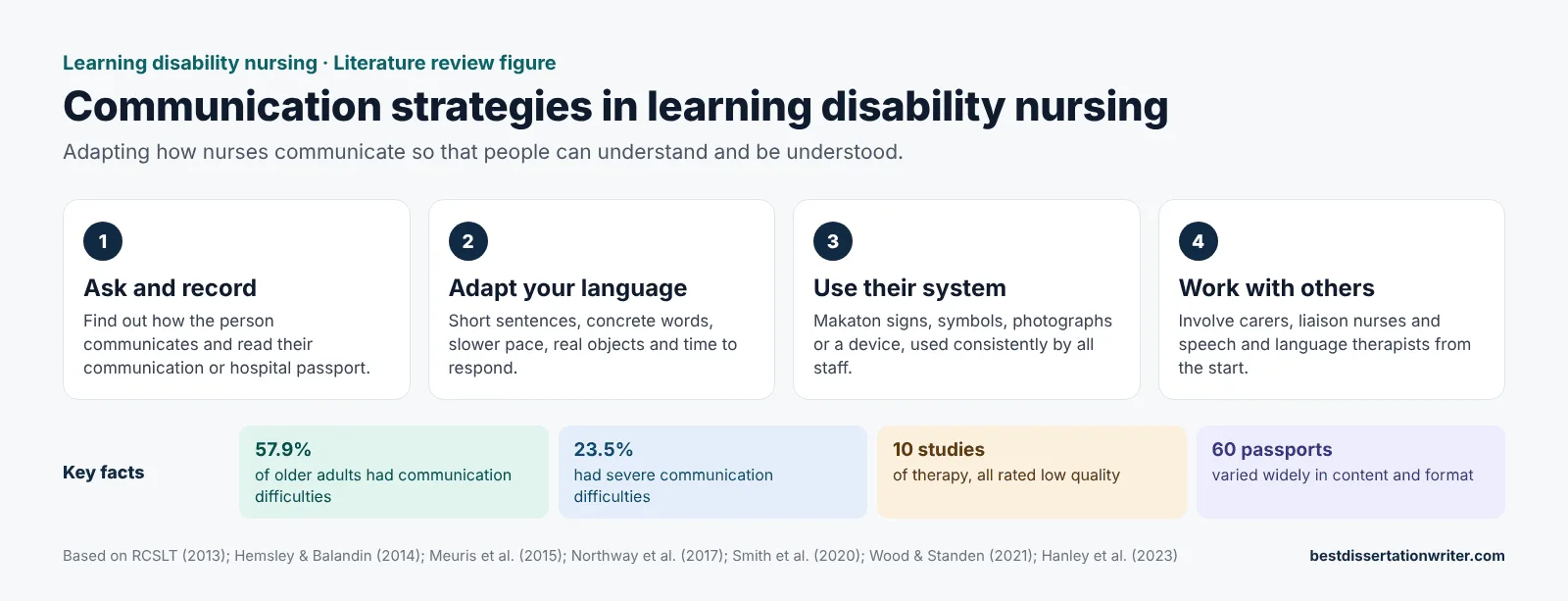
Nurses should ask early how each person communicates, read and update communication or hospital passports, and use the person’s own system, whether speech, Makaton signs, symbols or a device. Speaking slowly, using short sentences and concrete words, showing equipment, allowing time for responses and checking understanding are simple adjustments that benefit most patients. Carers and learning disability liaison nurses can help to interpret behaviour and should be involved from admission, and their knowledge should be recorded so that it is not lost at handover or transfer between wards.
Recognising that changes in behaviour may signal pain helps to prevent diagnostic overshadowing and supports the use of structured pain assessment tools, while clear explanation of medicines and seizure plans underpins safe epilepsy management. These approaches build on the therapeutic communication skills expected of every nurse. At service level, wards and community teams should ensure access to basic Makaton training, speech and language therapy advice and a small stock of picture and symbol resources, and managers should check through audit that passports are read and used rather than simply filed in the notes.
Conclusion
This scoping review found that communication difficulties are common among people with learning disabilities and that communication strategies such as augmentative and alternative communication, key word signing and communication passports are widely recommended, but supported by limited and mostly low-quality evidence. Their success depends heavily on the knowledge, attitudes and consistency of communication partners.
For nurses, effective communication strategies are a professional responsibility and a reasonable adjustment, not an optional extra. Learning how each person communicates, adapting one’s own language, using signs and visual supports, and working with carers and speech and language therapists can make care safer and help people with learning disabilities to take part in decisions about their health.
References
Hanley, E., Martin, A. M., Dalton, C., & Lehane, E. (2023). Communication partners’ experiences of communicating with adults with severe/profound intellectual disability through augmentative and alternative communication: A mixed methods systematic review. Journal of Intellectual Disabilities, 27(4), 1107–1134. https://doi.org/10.1177/17446295221115914
Hemsley, B., & Balandin, S. (2014). A metasynthesis of patient-provider communication in hospital for patients with severe communication disabilities: Informing new translational research. Augmentative and Alternative Communication, 30(4), 329–343. https://doi.org/10.3109/07434618.2014.955614
Meuris, K., Maes, B., & Zink, I. (2015). Teaching adults with intellectual disability manual signs through their support staff: A key word signing program. American Journal of Speech-Language Pathology, 24(3), 545–560. https://doi.org/10.1044/2015_AJSLP-14-0062
Northway, R., Rees, S., Davies, M., & Williams, S. (2017). Hospital passports, patient safety and person-centred care: A review of documents currently used for people with intellectual disabilities in the UK. Journal of Clinical Nursing, 26(23–24), 5160–5168. https://doi.org/10.1111/jocn.14065
Royal College of Speech and Language Therapists. (2013). Five good communication standards: Reasonable adjustments to communication for individuals with learning disability and/or autism in specialist hospital and residential settings. RCSLT. https://www.rcslt.org/-/media/Project/RCSLT/good-comm-standards.pdf
Smith, M., Manduchi, B., Burke, É., Carroll, R., McCallion, P., & McCarron, M. (2020). Communication difficulties in adults with intellectual disability: Results from a national cross-sectional study. Research in Developmental Disabilities, 97, 103557. https://doi.org/10.1016/j.ridd.2019.103557
Wood, S., & Standen, P. J. (2021). Is speech and language therapy effective at improving the communication of adults with intellectual disabilities? A systematic review. International Journal of Language & Communication Disorders, 56(2), 435–450.
Cite this example
Best Dissertation Writers (2026) Communication Strategies and Augmentative Aids Used by Nurses with People with Learning Disabilities: A Scoping Review. Available at: https://bestdissertationwriter.com/communication-strategies-review-review/
Best Dissertation Writers
Get expert help with your nursing literature review
Share your topic and deadline with Best Dissertation Writers and get support tailored to your module brief.