
Transition From Children’s to Adult Services for Young People with Learning Disabilities: A Scoping Review
 By Dr. Robertson Prime, Research Fellow
Updated October 12, 2026
16 min read
About 3,200 words
In this review
Abstract
Background: The move from children’s to adult services for young people with learning disabilities often coincides with leaving school, changes in family roles and the loss of long-standing professional relationships. Many of these young people have complex health needs, so poor continuity of care at this point can have lasting consequences.
Aim: This scoping review aimed to map evidence on the health needs, experiences and planning of the transition from children’s to adult health services for young people with learning disabilities.
Methods: A scoping review was conducted using targeted searches of openly accessible bibliographic records, publisher websites and the reference lists of key reviews. Seven sources published between 2014 and 2022 were included: a national regulatory review, a national guideline, two systematic reviews, a whole-population census study, a qualitative study and a pilot evaluation of nurse education, appraised with CASP tools where appropriate and synthesised thematically.
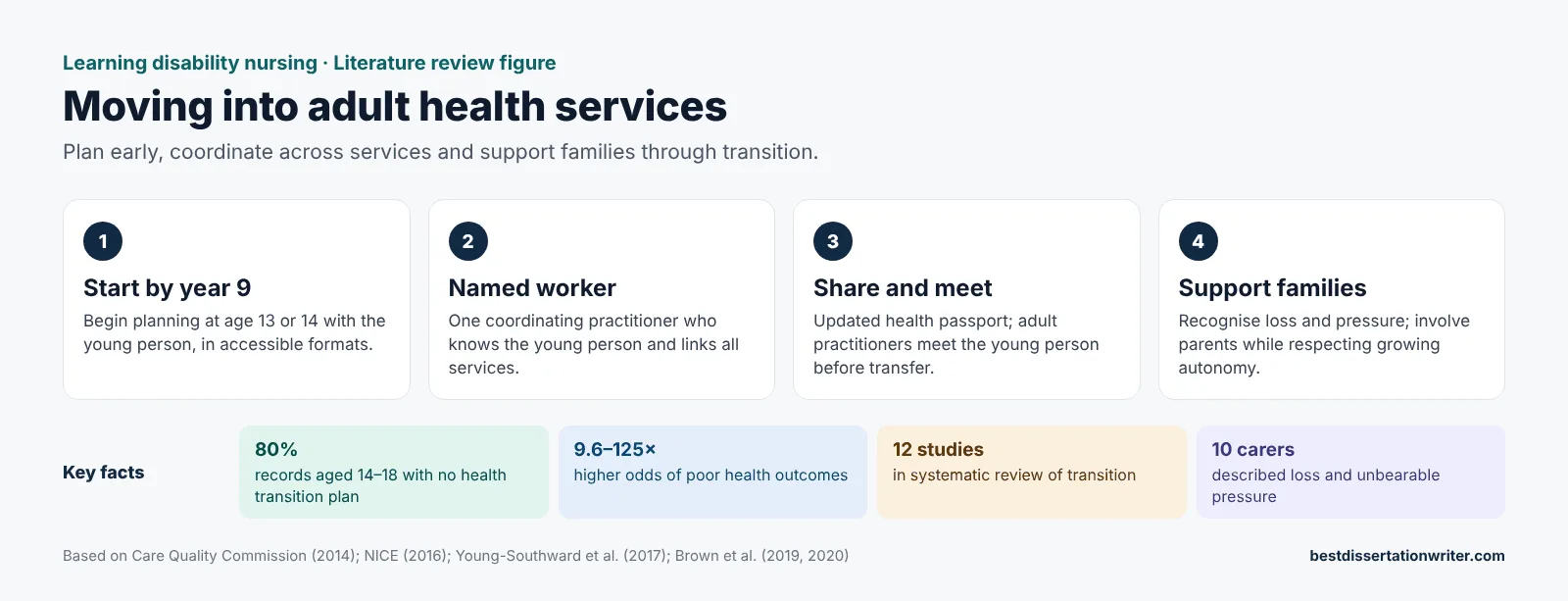
Findings: In a whole-country census, young people aged 13 to 24 with intellectual disabilities had between 9.6 and 125.0 times the odds of poor health outcomes compared with their peers. A national review found that 80% of tracked case records for 14 to 18-year-olds had no transition plan covering health needs, and systematic and qualitative evidence described fragmented care, parents acting as advocates and a sense of loss. National guidance recommends planning from age 13 or 14, a named worker and meeting adult practitioners before transfer, and nurses were seen as central to easing transition.
Conclusion: Learning disability nurses can improve adult services for young people by starting transition planning early, coordinating care across services and supporting families throughout the move.
Keywords: adult services for young people, continuity of care, transition planning
Introduction
This scoping review critically examines recent evidence on adult services for young people and its implications for learning disability nursing practice.
For young people with learning disabilities, the years between 14 and 25 bring many changes at once. They may leave school or college, move away from paediatric teams who have known them since birth, lose access to services such as children’s community nursing or short breaks, and begin to receive care from adult teams who know little about them. At the same time, decisions about their health increasingly rest with them rather than their parents, and families must learn to navigate an unfamiliar system.
These changes matter because many young people with learning disabilities have epilepsy, physical disabilities, sensory impairments, mental health conditions or other long-term needs. When continuity of care breaks down, appointments can be missed, medicines and equipment can be interrupted and important knowledge about the person can be lost. Learning disability nurses work across children’s and adult services and are often the professionals who coordinate transition planning, share information and support families, which places them at the centre of how adult services for young people are experienced.
A scoping review was chosen because the evidence is broad and varied, including national reviews, guidance, population data, systematic reviews and qualitative research. A scoping approach allows the range of evidence on adult services for young people to be mapped and gaps identified, complementing the separate review in this series on general paediatric to adult transition for young people with chronic conditions.
Review question
What is known about the health needs, experiences and planning of the move from children’s to adult health services for young people with learning disabilities?
Background to Adult Services for Young People
Transition is usually described as a purposeful, planned process that addresses the medical, psychosocial, educational and vocational needs of young people as they move from child-centred to adult-oriented services. It differs from transfer, which is the single event of moving from one service to another. For young people with learning disabilities, transition spans health, social care and education, and each system may use different age thresholds and eligibility criteria.
Children’s services for young people with complex needs are often built around a stable multidisciplinary team, a paediatrician who coordinates care and education settings that provide therapy and nursing support. Adult services for young people are commonly organised by specialty, with separate teams for epilepsy, respiratory care, mental health and social care. Families who have been closely involved in decisions may find that adult teams expect the young person to lead, and that the help available to carers is less clear.
In England, the move into adult services also coincides with legal changes. The Mental Capacity Act 2005 applies from age 16, so decisions that parents previously made may require an assessment of the young person’s capacity and, where capacity is lacking, a best interests process. Education, health and care plans can continue into early adulthood, but health and social care services may change at different ages, which can leave gaps.
Concerns about the quality of adult services for young people with learning disabilities have grown as more young people with complex needs survive into adulthood. National mortality reviews have also highlighted the importance of coordinated, well-planned care for people with learning disabilities throughout life, making transition a priority for policy and nursing practice.
Search Strategy and Methods
Evidence for this example was identified through targeted searches of openly accessible bibliographic records, publisher websites and the reference lists of key reviews. Search terms combined keywords for the process (“transition”, “transfer”, “adult services”, “transition planning”, “continuity of care”) with terms for the population (“learning disabilit*”, “intellectual disabilit*”, “young people”, “adolescen*”), joined with the Boolean operators AND and OR. A full scoping review for assessment would run the same strategy in CINAHL, PubMed/MEDLINE, PsycINFO, the Cochrane Library and Embase and report the number of records screened in a PRISMA flow diagram.
Sources were eligible if they examined the move from children’s services to adult services for young people with learning disabilities, or for young people with complex needs where those with learning disabilities formed a substantial group, or if they set national standards for transition planning. Systematic reviews, population studies, national reports and qualitative studies were included in keeping with a scoping approach. Studies focused only on specific chronic conditions without learning disabilities were excluded, as these are covered elsewhere.
Seven sources on adult services for young people published between 2014 and 2022 were included: a national regulatory review, a national guideline, two systematic reviews, a whole-population census study, a qualitative interview study and a pilot evaluation of an online learning resource for nurses (Table 1). The quality of the empirical sources was appraised using the Critical Appraisal Skills Programme (CASP) checklist appropriate to their design, and findings were charted and synthesised narratively into themes.
Key Findings on Adult Services for Young People
Three themes were identified: the health needs of young people with learning disabilities at the point of transition, the fragmented experience of moving into adult services for young people and their families, and the planning and coordination that guidance recommends. Table 1 summarises the included sources, and Figure 1 presents the odds of poor health outcomes among young people with intellectual disabilities in a whole-country census.
| Author, year | Design | Setting and sample | Key finding |
|---|---|---|---|
| Care Quality Commission (2014) | National regulatory review | Young people aged 14–25 with complex health needs; 199 records tracked; England | 80% of records for 14–18-year-olds had no transition plan covering health needs. |
| NICE (2016) | National guideline | Young people using health or social care services | Plan from year 9 at the latest; named worker; meet adult practitioners before transfer; flexible timing. |
| Young-Southward, Philo and Cooper (2017) | Systematic review | 17 studies of young people with intellectual disabilities | Mixed evidence; obesity and sexual health issues during transition; major research gap. |
| Young-Southward, Rydzewska et al. (2017) | Whole-population census study | 815,889 people aged 13–24, including 5,556 with intellectual disabilities; Scotland | Odds of poor health outcomes 9.6 to 125.0 times higher with intellectual disabilities. |
| Brown et al. (2019) | Systematic review | 12 studies, 2007–2017; young people with intellectual disabilities and carers | Fragmented transition, parents as advocates and adult services unprepared for complex needs. |
| Brown et al. (2020) | Qualitative interview study | 10 family carers of young adults with intellectual disabilities; Scotland | Transition marked by loss, overwhelming processes and pressure; nurses key to easing it. |
| Brown et al. (2022) | Pilot evaluation | 12 registered nurses from 2 Scottish NHS boards | Online learning resource on transition judged acceptable and accessible. |
Theme 1: Health Needs at the Point of Transition
Young-Southward, Rydzewska et al. (2017) analysed data from Scotland’s 2011 census for all 815,889 young people aged 13 to 24, of whom 5,556 had intellectual disabilities. After adjustment for age and gender, young people with intellectual disabilities had between 9.6 and 125.0 times the odds of poor outcomes across seven health measures. The odds were highest for limitation of day-to-day activities and physical disability, but were also around twelve times higher for mental health conditions and hearing impairment.
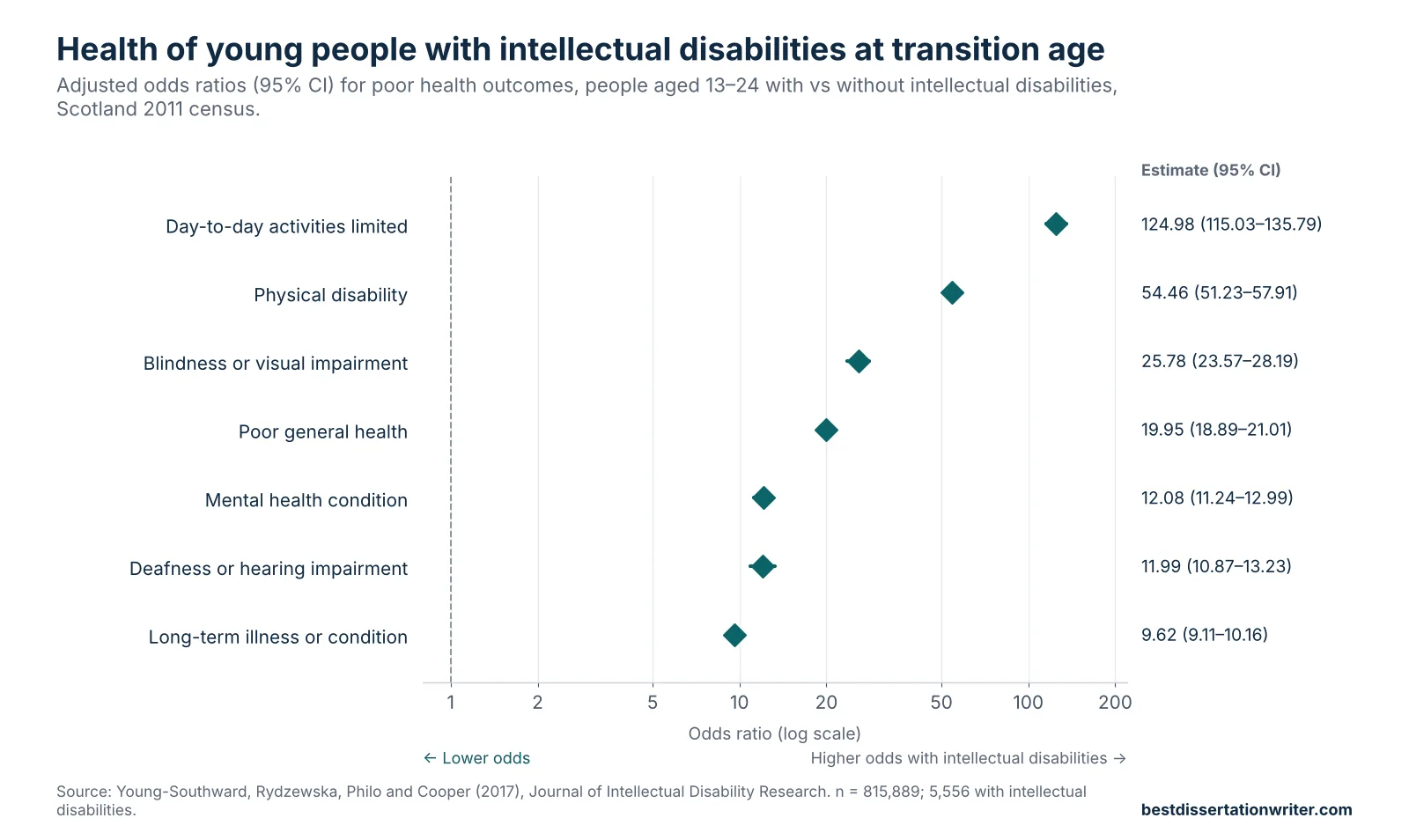
Within the group with intellectual disabilities, those aged 19 to 24 were more likely than those aged 13 to 18 to have a mental health condition, although other health outcomes did not differ by age. The study is cross-sectional and uses census responses rather than clinical records, so it may miss some young people and cannot show cause and effect. However, its whole-population coverage makes it the largest study of its kind, and its authors concluded that the move into adult services for young people with intellectual disabilities must be carefully planned to manage existing conditions and minimise emerging ones.
A systematic review by Young-Southward, Philo and Cooper (2017) sought evidence on how transition affects health and well-being in this population. From 15,985 records, 17 studies met the inclusion criteria. Findings were mixed but suggested health and well-being issues during transition, including obesity and sexual health concerns. The review was prospectively registered and followed recognised reporting guidelines, but the small and heterogeneous evidence base led the authors to identify transition and health as a clear gap in research.
Theme 2: Moving into Adult Services for Young People
The Care Quality Commission (2014) reviewed the move from children’s to adult services for young people aged 14 to 25 with complex health needs, a group that included many young people with learning disabilities. The review visited 19 areas, inspected 23 registered services, tracked the records of 199 young people and spoke to 58 young people and 124 family members. Of the 103 case records for 14 to 18-year-olds, 80% had no transition plan that covered their health needs, and only two of 18 areas believed that all young people with complex health needs had a specific health transition plan.
The review also found that lead professionals were often missing before transfer, that health passports were seen only very rarely and that only eight of 19 clinical commissioning groups were confident that each young person had a lead professional. Families described the move with the words that gave the report its title: from the pond, you are picked up and put in the sea. The report did not separate findings for young people with learning disabilities, but its recommendations on transition plans, lead professionals and support for parents are directly relevant.
Brown et al. (2019) systematically reviewed research on transitions from child to adult health care for young people with intellectual disabilities. Of 637 records, 12 studies from 2007 to 2017 were included, most from the United States and the United Kingdom, and eight were rated high quality using CASP tools. Four themes emerged: becoming an adult, a fragmented transition process and care, parents as advocates in emotional turmoil, and making transitions happen. Young people and carers often had negative experiences, and adult services were frequently unprepared for complex, multifaceted needs.
Brown et al. (2020) then interviewed ten family carers in Scotland whose young adults with intellectual disabilities and complex needs were going through or had recently completed transition. Carers described the process as emotionally intense, with five themes: a deep sense of loss, an overwhelming process, parents making transitions happen, a shock to the adult health care system and unbearable pressure. Nurses were often seen as key to easing these difficulties. The small, self-selected sample limits transferability, but the findings closely mirror those of the systematic review.
Theme 3: Transition Planning and the Nursing Role
NICE (2016) published guidance on transition from children’s to adults’ services for young people using health or social care services. It recommends that planning for adulthood starts from school year 9, at age 13 or 14, at the latest; that support is developmentally appropriate, taking account of cognitive ability and communication needs; that the young person is helped to identify a named worker; that a practitioner from adult services meets the young person before transfer; and that transfer is not based on a rigid age threshold. It also states that involving the general practitioner is critical for young people who do not meet criteria for specialist adult services.
These recommendations address many of the problems described in the empirical studies, particularly the lack of plans, the absence of a coordinating professional and the abrupt loss of familiar staff. However, the guideline applies to all young people using health or social care services and is largely based on consensus and qualitative evidence, so it offers few specific recommendations for those with learning disabilities and complex health needs.
Recognising the importance of nurses, Brown et al. (2022) developed and piloted an online learning resource for registered nurses on transition for young adults with intellectual disabilities. Twelve nurses from two Scottish NHS boards completed the evaluation questionnaire and three took part in follow-up interviews. Participants found the online format and most of the content acceptable and accessible across different areas of practice. The pilot was very small and measured acceptability rather than changes in practice or outcomes for young people.
Discussion
This review found that young people with learning disabilities enter adult services for young people with far greater health needs than their peers, yet the transition process is often unplanned, fragmented and emotionally difficult for families. Population data, national inspection findings, systematic reviews and qualitative research point in the same direction, which strengthens the overall conclusion even though each source has limitations.
A key tension lies between the needs of young people and the structure of services. Children’s services often provide coordinated, family-centred care, whereas adult services are organised by specialty and expect young people to lead their own care. Where adult services for young people with complex needs and communication difficulties are unprepared, this shift can lead to lost information and interrupted treatment. Guidance on named workers and joint appointments seeks to bridge this gap, but the evidence suggests that these practices were far from universal.
The role of families is also complex. Parents often acted as the main coordinators and advocates, yet they described feeling excluded or overwhelmed when their child moved into adult services for young people. At the same time, the young person’s legal right to make their own decisions from 16 means that professionals must balance family involvement with respect for the young person’s autonomy and, where needed, careful capacity assessment.
Nurses appear repeatedly in the evidence as the professionals who ease transition, but there is little research on what nurse-led transition support involves or what difference it makes. The pilot by Brown et al. (2022) is a promising step towards preparing the workforce, yet no included study evaluated outcomes such as continuity of care, hospital admissions or quality of life after transfer.
This review has limitations. It relied on openly accessible, English-language sources, did not involve independent double screening and included a small number of sources, most from the United Kingdom. Two sources concerned young people with complex needs more broadly rather than learning disabilities specifically. Future research should follow young people with learning disabilities through transition, evaluate named worker and nurse-led coordination models, and measure health outcomes, continuity of care and the experiences of young people themselves rather than relying mainly on parents’ views.
Implications of Adult Services for Young People Evidence for Practice
Learning disability nurses should begin transition planning by age 13 or 14, using accessible approaches that involve the young person and their family, and should agree a named worker who coordinates care across services. Health action plans and hospital passports should be updated and shared so that adult teams receive full information about epilepsy, swallowing, communication and behaviour. Nurses should arrange for adult practitioners to meet the young person before transfer and ensure that the general practitioner is involved, especially where no specialist adult team is available.
Transition planning should also anticipate future health needs. Young adults with learning disabilities should be supported into routine preventive care, including accessing cancer screening when they become eligible, because gaps in care at this age can contribute to later avoidable mortality. Nurses can draw on the wider evidence on paediatric to adult healthcare and the principles of family-centred care, while recognising that adult services must also respect the young person’s growing autonomy.
Conclusion
This scoping review mapped evidence on adult services for young people with learning disabilities. Young people at transition have much higher odds of poor health than their peers, yet many lack transition plans, coordinating professionals and continuity of care, and families describe the move as a time of loss and pressure. National guidance sets out clear expectations, but evidence on how to meet them is limited.
Learning disability nurses can make a decisive difference by planning early, coordinating care, sharing information and supporting both young people and families. Strengthening adult services for young people in this way is essential if the health gains of childhood are to be protected in adult life.
References
Brown, M., Higgins, A., & MacArthur, J. (2020). Transition from child to adult health services: A qualitative study of the views and experiences of families of young adults with intellectual disabilities. Journal of Clinical Nursing, 29(1–2), 195–207. https://doi.org/10.1111/jocn.15077
Brown, M., Macarthur, J., Higgins, A., & Chouliara, Z. (2019). Transitions from child to adult health care for young people with intellectual disabilities: A systematic review. Journal of Advanced Nursing, 75(11), 2418–2434. https://doi.org/10.1111/jan.13985
Brown, M., MacArthur, J., Truesdale, M., & Higgins, A. (2022). The transition from child to adult health services for young adults with intellectual disabilities: An evaluation of a pilot of an online learning resource for Registered Nurses. Nurse Education in Practice, 64, 103424. https://doi.org/10.1016/j.nepr.2022.103424
Care Quality Commission. (2014). From the pond into the sea: Children’s transition to adult health services. Care Quality Commission. https://www.cqc.org.uk/sites/default/files/CQC_Transition%20Report.pdf
National Institute for Health and Care Excellence. (2016). Transition from children’s to adults’ services for young people using health or social care services (NICE guideline NG43). https://www.nice.org.uk/guidance/ng43
Young-Southward, G., Philo, C., & Cooper, S.-A. (2017). What effect does transition have on health and well-being in young people with intellectual disabilities? A systematic review. Journal of Applied Research in Intellectual Disabilities, 30(5), 805–823. https://doi.org/10.1111/jar.12286
Young-Southward, G., Rydzewska, E., Philo, C., & Cooper, S.-A. (2017). Physical and mental health of young people with and without intellectual disabilities: Cross-sectional analysis of a whole country population. Journal of Intellectual Disability Research, 61(10), 984–993. https://doi.org/10.1111/jir.12422
Cite this example
Best Dissertation Writers (2026) Transition From Children’s to Adult Services for Young People with Learning Disabilities: A Scoping Review. Available at: https://bestdissertationwriter.com/adult-services-for-young-people-review/
Best Dissertation Writers
Get expert help with your nursing literature review
Share your topic and deadline with Best Dissertation Writers and get support tailored to your module brief.