Premature and Avoidable Mortality in People with Learning Disabilities: A Narrative Review
 By Dr. Robertson Prime, Research Fellow
Updated October 12, 2026
16 min read
About 3,300 words
In this review
Abstract
Background: Avoidable mortality is far higher among people with learning disabilities than in the general population, and they die many years earlier. In England in 2024, the median age at death of adults with a learning disability was 62.8 years compared with 81.8 years in the general population.
Aim: This narrative review aimed to examine the scale of premature and avoidable mortality among people with learning disabilities, the main causes of death and the factors that make these deaths avoidable, and to consider the implications for learning disability nursing.
Methods: Targeted searches of openly accessible bibliographic records, publisher websites and the reference lists of key reviews identified six sources published between 2014 and 2026: a confidential inquiry, three population cohort studies, a systematic review and a national mortality review report. Sources were appraised with CASP checklists and synthesised narratively.
Findings: Cohort studies in England and Scotland found all-cause mortality around three times higher than in the general population, with a life expectancy gap of almost 20 years. In the national mortality review, 39.0% of deaths in 2024 were avoidable compared with 21.1% in the general population, a gap driven mainly by treatable causes such as pneumonia and epilepsy. Respiratory and circulatory diseases were the leading causes of death, while problems with care planning, delays in treatment and failure to follow the Mental Capacity Act contributed to many deaths.
Conclusion: Much avoidable mortality reflects how care is organised and delivered, so nurses can reduce it through early recognition of deterioration, proactive management of respiratory and epilepsy risk and close work with carers.
Keywords: avoidable mortality, premature mortality, avoidable death, causes of death
Introduction
This narrative review critically examines recent evidence on avoidable mortality and its implications for learning disability nursing practice.
People with learning disabilities die much younger than the rest of the population. For many years this was regarded as an unfortunate but unavoidable consequence of the conditions associated with learning disability. Over the past decade, however, confidential inquiries, national cohort studies and a national mortality review programme have shown that a large share of these deaths could have been prevented by public health measures or treated successfully by timely, good-quality healthcare.
The concept of avoidable mortality is central to this shift. It divides deaths before old age into those from causes that are preventable, such as many cancers and injuries, and those from causes that are treatable, such as pneumonia, epilepsy and many cardiovascular conditions. Measuring avoidable deaths in this way allows the contribution of health and care services to be separated, at least in part, from the effects of genetic conditions and complex disability.
Nurses are present at almost every point where an avoidable death might be prevented: in primary care, community learning disability teams, acute hospitals, supported living and residential services. Understanding the scale of avoidable mortality, the main causes of death and the factors that make deaths avoidable is therefore essential for learning disability nurses and for every nurse who cares for people with learning disabilities in mainstream services.
A narrative review design was chosen because the evidence combines a confidential inquiry, population cohorts, a systematic review and national mortality review data, which use different methods and definitions and are best interpreted together rather than pooled statistically.
Review question
What does recent evidence show about the scale of premature mortality and avoidable mortality among people with learning disabilities, which causes of death predominate, and what factors make these deaths avoidable?
Background to Avoidable Mortality
In England, the Office for National Statistics classifies deaths as avoidable when they are from causes considered preventable, treatable or both, given current medical knowledge. Preventable deaths could largely be avoided through public health and primary prevention, while treatable deaths could largely be avoided through timely and effective healthcare. These definitions were designed for the general population and allow comparisons between groups, although they may not fully capture the complex health needs of people with severe or profound learning disabilities.
Concern about avoidable mortality in this population led to a national inquiry. The Confidential Inquiry into premature deaths of people with learning disabilities was commissioned by the Department of Health for England to identify contributory factors to avoidable and premature deaths (Heslop et al., 2014). Its findings led to the Learning from Lives and Deaths programme, known as LeDeR, which now reviews the deaths of people with a learning disability and autistic people across England and reports annually.
Several features of learning disability make deaths harder to prevent. Many people have multiple long-term conditions, including epilepsy, dysphagia and congenital heart disease, and may communicate pain or illness in non-verbal ways. Symptoms can be attributed to the learning disability rather than investigated, and people often depend on family carers or paid staff to notice changes and seek help. These factors mean that avoidable mortality depends heavily on the knowledge, attitudes and coordination of those around the person.
Identification is a further challenge. People with learning disabilities can only be counted in mortality statistics if they are recorded as having a learning disability in health records. Glover et al. (2017) noted that general practitioners identify only around 0.5% of the population as having a learning disability, which means that people with mild learning disabilities are likely to be under-represented in studies of premature mortality.
Search Strategy and Methods
Evidence for this example was identified through targeted searches of openly accessible bibliographic records, publisher websites and the reference lists of key reviews. Search terms combined keywords for the population (“learning disab*”, “intellectual disab*”) with terms for the outcome (“avoidable mortality”, “premature mortality”, “avoidable death”, “amenable mortality”, “causes of death”, “life expectancy”), joined with the Boolean operators AND and OR. A full narrative review for assessment would run the same strategy in CINAHL, PubMed/MEDLINE, PsycINFO and the Cochrane Library and report the number of records screened in a PRISMA flow diagram.
Sources were eligible if they reported mortality rates, age at death, causes of death or the proportion of deaths classed as avoidable, amenable, preventable or treatable among adults with learning or intellectual disabilities, using population-based or national data. Systematic reviews, cohort studies, confidential inquiries and national mortality review reports were prioritised. Studies limited to children, single case reviews and studies of specific syndromes only were excluded, so that the review focused on avoidable mortality across the adult population.
Six sources published between 2014 and 2026 were included: one population-based confidential inquiry, three population cohort studies from England and Scotland, one systematic review of early death and causes of death, and one national mortality review report (Table 1). The quality of each source was appraised using the Critical Appraisal Skills Programme (CASP) checklist appropriate to its design, and findings were synthesised narratively and grouped into themes relevant to avoidable mortality.
Key Findings on Avoidable Mortality
Three themes were identified: the scale of premature mortality among people with learning disabilities; the proportion of deaths that are avoidable and the balance between treatable and preventable causes; and the causes of death and care problems behind these figures. Table 1 summarises the included sources, and Figure 1 compares the proportions of avoidable, treatable and preventable deaths among people with learning disabilities and the general population in England and Scotland.
| Author, year | Design | Setting and sample | Key finding |
|---|---|---|---|
| Heslop et al. (2014) | Population-based confidential inquiry | 247 deaths of people with learning disabilities aged 4+; five areas of south-west England, 2010–2012 | Median age at death 13 (men) and 20 (women) years lower; 37% of deaths avoidable vs 13% in general population. |
| Hosking et al. (2016) | Matched cohort study (primary care records) | 16,666 adults with intellectual disability and 113,562 controls; 343 English practices, 2009–2013 | Adjusted mortality hazard ratio 3.1; 37.0% of deaths amenable to healthcare vs 22.5%. |
| Glover et al. (2017) | Cohort study (linked primary care and death records) | England, 2010–2014; about 5% of the population | Standardised mortality ratio 3.18; life expectancy 19.7 years lower; excess of amenable deaths. |
| O’Leary et al. (2018) | Systematic review | 27 studies from high-income countries | Death about 20 years earlier; respiratory and circulatory diseases main causes; some deaths avoidable. |
| Rydzewska et al. (2025) | Record linkage national cohort study | 14,477 adults with intellectual disabilities and 506,207 controls; Scotland, 2011–2019 | SMR 3.1; median age at death 65 vs 80; avoidable deaths 31.7% vs 18.2%. |
| Yu et al. (2026) | National mortality review report (LeDeR) | 11,687 reviewed deaths of adults with a learning disability; England, 2021–2024 | Median age at death 62.8 vs 81.8 years; 39.0% of deaths avoidable in 2024 vs 21.1%. |
Theme 1: The Scale of Premature Mortality
The Confidential Inquiry reviewed 247 deaths of people with learning disabilities aged four years and over in five primary care trust areas of south-west England between 2010 and 2012 (Heslop et al., 2014). The median age at death was 64 years. Men died at a median of 65 years, 13 years younger than men in the general population, and women at a median of 63 years, 20 years younger than women in the general population. Almost a quarter (22%) died before the age of 50.
National cohort studies confirm the size of this gap. Using records from 343 general practices, Hosking et al. (2016) compared 16,666 adults with intellectual disability with 113,562 matched controls and found mortality more than three times higher, with a hazard ratio of 3.1 after adjustment for comorbidity, smoking and deprivation. Glover et al. (2017), using linked primary care and death registration data for 2010 to 2014, reported a standardised mortality ratio of 3.18 and a life expectancy at birth 19.7 years lower than for people without learning disabilities.
Evidence from Scotland is consistent. Rydzewska et al. (2025) linked the 2011 Census to death records for 14,477 adults aged 25 and over with intellectual disabilities and 506,207 adults without, following them for 8.5 years. Nearly a quarter (23.7%) of people with intellectual disabilities died compared with 13.8% of controls, with a median age at death of 65 compared with 80 years and a standardised mortality ratio of 3.1. Relative risk was highest in younger age groups, in women and, unexpectedly, in the most affluent areas.
The most recent national data show only limited change. The LeDeR report for 2024 found that the median age at death of adults with a learning disability was 62.8 years, compared with 81.8 years in the general population, a gap of 19 years (Yu et al., 2026). In a systematic review of 27 studies, O’Leary et al. (2018) concluded that people with intellectual disabilities die about 20 years earlier than the general population, that mortality has improved over recent decades but the inequality persists, and that people with more severe disabilities or additional conditions have the shortest lives.
Theme 2: Avoidable Mortality and Treatable Causes
Every major source found that a larger share of deaths was avoidable among people with learning disabilities. The Confidential Inquiry classed 37% of deaths as avoidable through good-quality healthcare, compared with 13% in the general population of England and Wales (Heslop et al., 2014). Hosking et al. (2016) similarly found that 37.0% of deaths among adults with intellectual disability were amenable to healthcare intervention compared with 22.5% in the general population, with a hazard ratio for amenable mortality of 5.9.
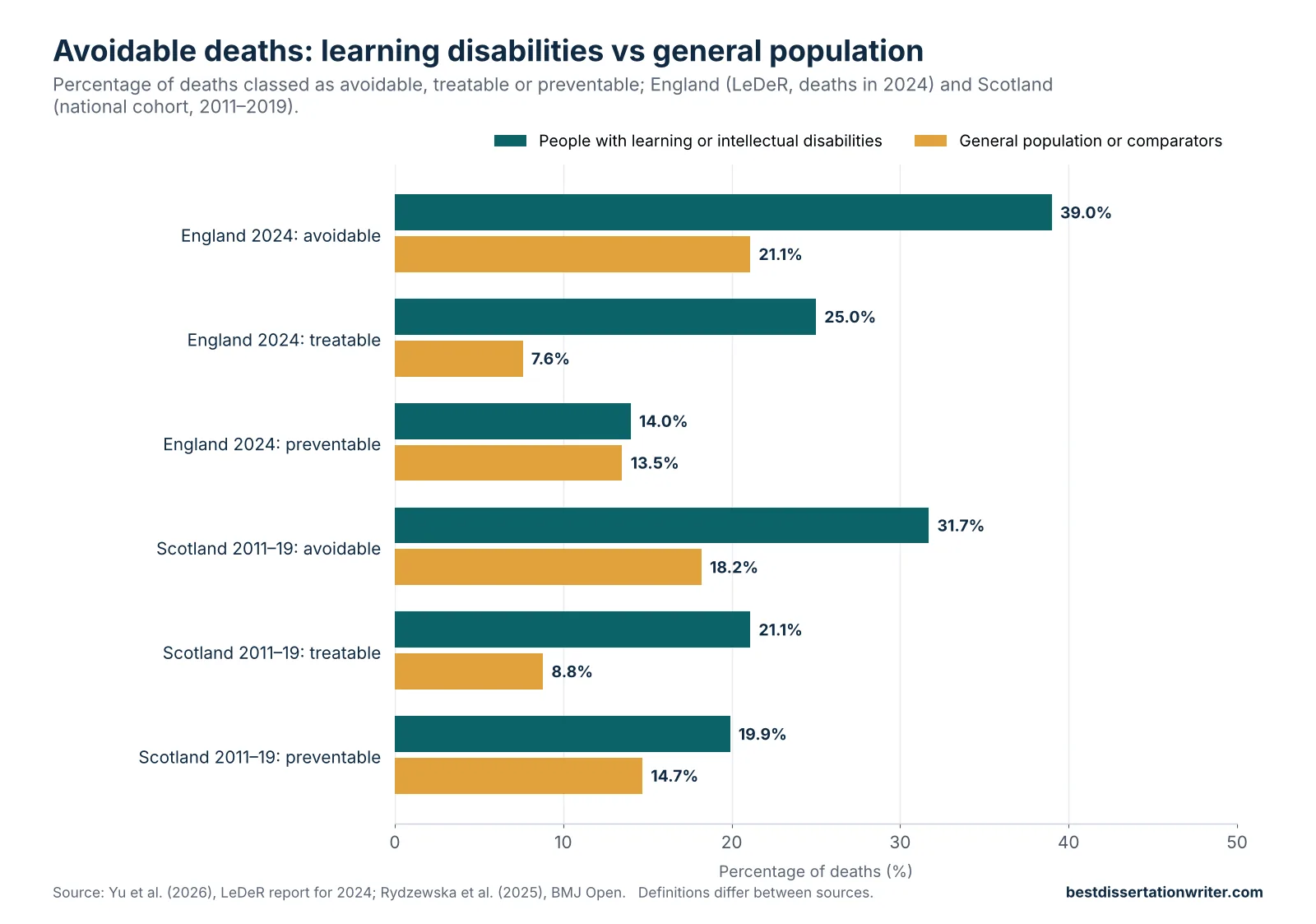
The LeDeR report for 2024 found that 39.0% of reviewed deaths of adults with a learning disability were avoidable, compared with 21.1% in the general population (Yu et al., 2026). The proportion has fallen each year, from 46.3% in 2021 to 43.4% in 2022, 41.4% in 2023 and 39.0% in 2024, although the early years were inflated by COVID-19, which was the most commonly recorded underlying cause of death in 2021. Even so, the rate of avoidable death remains almost double that of the general population.
Separating treatable from preventable deaths shows where the gap lies. In 2024, 25.0% of deaths of adults with a learning disability were from treatable causes compared with 7.6% in the general population, whereas preventable causes accounted for 14.0% and 13.5% respectively (Yu et al., 2026). Rydzewska et al. (2025) found the same pattern in Scotland: 31.7% of deaths were avoidable compared with 18.2% among controls, with treatable deaths at 21.1% compared with 8.8%. The excess in avoidable mortality is therefore largely about the timeliness and quality of healthcare rather than lifestyle alone.
Glover et al. (2017) reached a similar conclusion, finding that a higher proportion of deaths among people with learning disabilities were from causes amenable to good medical care and a lower proportion from preventable causes. This matters for nursing, because treatable deaths, which make up most of the excess in avoidable mortality, depend on recognising illness early, escalating concerns and delivering effective treatment, all of which are core nursing responsibilities in hospital and community settings.
Theme 3: Causes of Death Behind Avoidable Mortality
The leading causes of death differ from those in the general population. O’Leary et al. (2018) found that respiratory and circulatory diseases were the main causes, that congenital heart disease was more common and ischaemic heart disease less common, and that cancer was less common and had a different profile. Glover et al. (2017) identified circulatory, respiratory and neoplastic diseases as the three most common causes, with epilepsy, aspiration pneumonitis and colorectal cancer accounting for 3.9%, 3.6% and 2.4% of deaths respectively.
In the LeDeR report for 2024, the most common causes of death by disease group were respiratory diseases (16.6%), circulatory diseases (16.2%), cancers (15.5%), diseases of the nervous system (13.5%) and congenital conditions (13.3%) (Yu et al., 2026). Cancers accounted for 27.1% of deaths in the general population. Among avoidable deaths, pneumonia, ischaemic heart disease and epilepsy together accounted for 32.8%. The report also noted that Down syndrome was recorded as the underlying cause in 10.0% of deaths, a practice that may obscure the avoidable condition that actually led to death.
Problems in care contributed to many deaths. In the Confidential Inquiry, premature deaths were more often associated with problems in advance care planning, adherence to the Mental Capacity Act, inappropriate accommodation, adjusting care as needs changed and carers not feeling listened to (Heslop et al., 2014). The LeDeR report for 2024 found delays in care or treatment in 39.8% of reviews, diagnosis and treatment guidelines not met in 25.8%, and the Mental Capacity Act correctly followed in only 66.6% (Yu et al., 2026). Avoidable mortality is therefore shaped by systems as well as by individual clinical decisions.
Discussion
The evidence reviewed here is remarkably consistent. Across a confidential inquiry, three population cohorts and a national mortality review, people with learning disabilities die around 15 to 20 years earlier than the general population, have mortality rates around three times higher and experience a markedly higher proportion of avoidable deaths. Although avoidable mortality has fallen since 2021, the gap with the general population remains large, and progress over the decade since the Confidential Inquiry has been slow.
The finding that the excess lies mainly in treatable rather than preventable deaths is important. It suggests that lifestyle and public health measures, while valuable, will not close the gap in avoidable mortality on their own. Respiratory infections, epilepsy and cardiovascular conditions are all amenable to timely recognition and effective treatment, yet they continue to cause many deaths. This directs attention to how quickly deterioration is noticed, whether concerns raised by carers are acted upon and whether reasonable adjustments are made when people need hospital care.
There are tensions in how avoidable mortality is measured. The definitions used by the Office for National Statistics were designed for the general population and may classify as avoidable some deaths that reflect complex, life-limiting conditions, or may miss avoidable elements in deaths attributed to congenital conditions. The recording of Down syndrome as an underlying cause, highlighted by Yu et al. (2026), illustrates how certification practices can hide the treatable illness that caused death and limit learning from it.
Differences between sources also need careful interpretation. The Confidential Inquiry covered one region, the English cohorts relied on people being identified in general practice, and LeDeR depends on deaths being notified and reviewed. The Scottish cohort, which used Census data, may have captured people with milder learning disabilities. The surprising finding of higher relative risk in more affluent areas (Rydzewska et al., 2025) may reflect lower mortality among the general population in those areas rather than worse care, and needs further investigation before it is used to target efforts to reduce avoidable mortality.
This review has limitations. This review relied on openly accessible, English-language sources, did not involve independent double screening and included a small number of sources, most of them from the United Kingdom. Definitions of avoidable and amenable mortality differed between sources, and the LeDeR data describe reviewed deaths rather than a complete population. Future research should evaluate interventions to reduce avoidable death, such as pneumonia and epilepsy pathways, and examine why women and younger adults appear to be at particular relative risk.
Implications of Avoidable Mortality Evidence for Practice
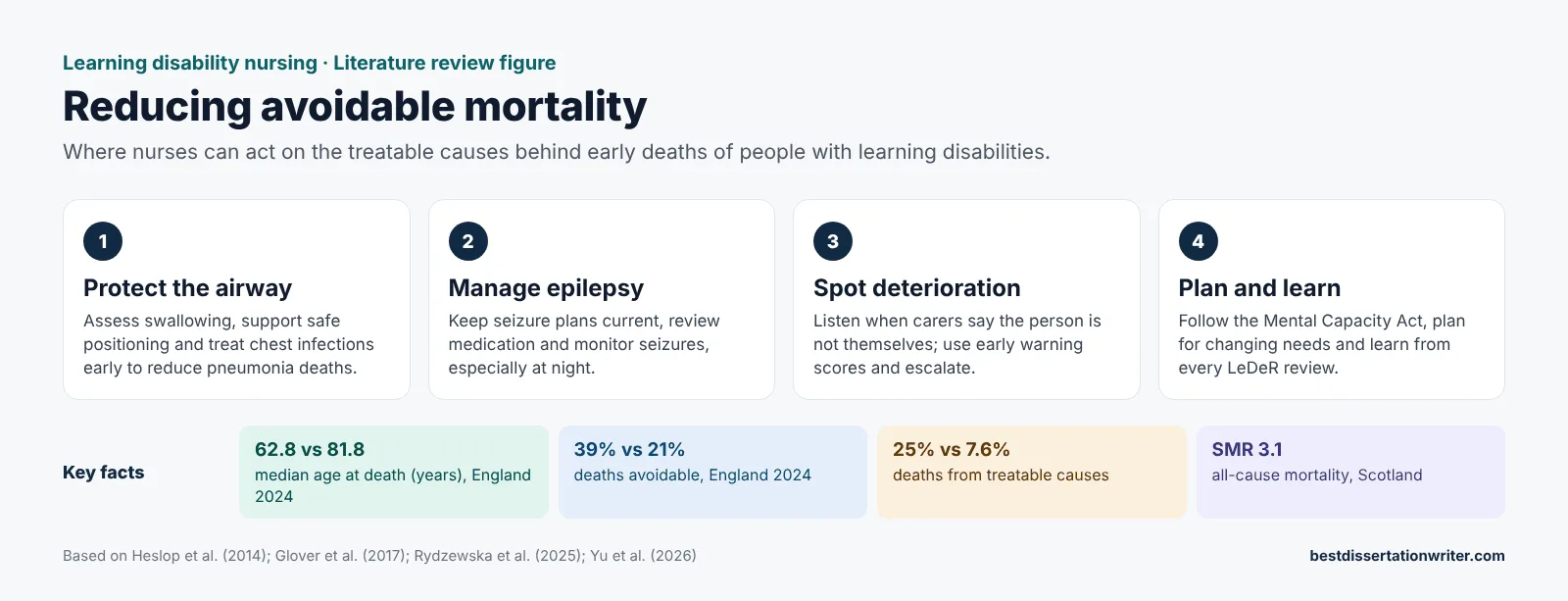
For nurses, the evidence points to a small number of conditions where action can save lives. Respiratory risk should be managed proactively through dysphagia assessment, safe positioning and early treatment of chest infections, and epilepsy care should include up-to-date management plans and seizure monitoring. Nurses should listen to family carers and paid staff who report that a person is ‘not themselves’, use early warning scores alongside knowledge of the person’s usual presentation, and escalate concerns without delay. Applying the Mental Capacity Act correctly and planning ahead for changing needs are equally essential.
Many people with learning disabilities live in supported living services, where staff are often the first to notice illness, so training in recognising deterioration is vital. Communication approaches for non-verbal patients, such as hospital passports and pain assessment tools adapted to the individual, help ensure that symptoms are recognised rather than attributed to the learning disability itself.
Conclusion
This narrative review examined the evidence on avoidable mortality among people with learning disabilities. People with learning disabilities die around 20 years earlier than the general population, and almost two in five deaths are avoidable, a gap driven mainly by treatable causes such as pneumonia, epilepsy and cardiovascular disease, alongside problems with care planning, delays and inconsistent use of the Mental Capacity Act.
Reducing avoidable mortality requires earlier recognition of illness, proactive management of known risks, accurate recording of causes of death and genuine partnership with carers. Nurses in every setting can contribute by making reasonable adjustments routine, escalating concerns promptly and learning from each death through the LeDeR programme.
References
Glover, G., Williams, R., Heslop, P., Oyinlola, J., & Grey, J. (2017). Mortality in people with intellectual disabilities in England. Journal of Intellectual Disability Research, 61(1), 62–74. https://doi.org/10.1111/jir.12314
Heslop, P., Blair, P. S., Fleming, P., Hoghton, M., Marriott, A., & Russ, L. (2014). The Confidential Inquiry into premature deaths of people with intellectual disabilities in the UK: A population-based study. The Lancet, 383(9920), 889–895. https://doi.org/10.1016/S0140-6736(13)62026-7
Hosking, F. J., Carey, I. M., Shah, S. M., Harris, T., DeWilde, S., Beighton, C., & Cook, D. G. (2016). Mortality among adults with intellectual disability in England: Comparisons with the general population. American Journal of Public Health, 106(8), 1483–1490. https://doi.org/10.2105/AJPH.2016.303240
O’Leary, L., Cooper, S.-A., & Hughes-McCormack, L. (2018). Early death and causes of death of people with intellectual disabilities: A systematic review. Journal of Applied Research in Intellectual Disabilities, 31(3), 325–342. https://doi.org/10.1111/jar.12417
Rydzewska, E., Nijhof, D., Hughes, L., Melville, C., Fleming, M., Mackay, D., Sosenko, F., Ward, L., Dunn, K., Truesdale, M., Cairns, D., Pell, J. P., Wyper, G. M. A., Jani, B. D., Barlow, F., Henderson, A., Callander, R., & Cooper, S.-A. (2025). Rates, causes and predictors of all-cause and avoidable mortality in 514 878 adults with and without intellectual disabilities in Scotland: A record linkage national cohort study. BMJ Open, 15(2), e089962. https://doi.org/10.1136/bmjopen-2024-089962
Yu, M. K. L., Ditzel, N., Bokor, L., Sheehan, R., Magill, N., Ding, J., Keagan-Bull, R., Chauhan, U., Tuffrey-Wijne, I., & Strydom, A. (2026). Learning from Lives and Deaths – People with a learning disability and autistic people (LeDeR): Report for 2024. King’s College London. https://www.kcl.ac.uk/ioppn/leder/leder2024/leder-2024-report.pdf
Cite this example
Best Dissertation Writers (2026) Premature and Avoidable Mortality in People with Learning Disabilities: A Narrative Review. Available at: https://bestdissertationwriter.com/avoidable-mortality-literature-review/
Best Dissertation Writers
Get expert help with your nursing literature review
Share your topic and deadline with Best Dissertation Writers and get support tailored to your module brief.