
The Role of School Nurses in Child Health Promotion and Wellbeing: A Systematic Review
 By Dr. Robertson Prime, Research Fellow
Updated October 28, 2026
14 min read
About 2,900 words
In this review
Abstract
Background: Schools reach almost every child, which makes them an important setting for health promotion. School nurses are the health professionals most closely associated with this setting, yet the strength of the evidence for their work, and how far it improves health and education outcomes, is not always clear to commissioners, head teachers or nurses themselves.
Aim: This systematic review aimed to examine what is known about the role and effectiveness of school nurses in promoting child health and wellbeing.
Methods: Evidence was identified through targeted searches of openly accessible bibliographic records, publisher websites and reference lists. Five sources published between 2014 and 2024 were included: three reviews of school nursing, a Cochrane review of the health promoting school framework and a World Health Organization fact sheet. The research sources were appraised using CASP checklists and synthesised narratively.
Findings: An integrative review of 65 studies found that most school nurse interventions concerned care coordination, with motivational interviewing and counselling the most common, and that 17 studies linked school nurse interventions to better student outcomes, although about 80% of studies were descriptive. An overview of 16 systematic reviews suggested a key role for school nurses in asthma and diabetes care, with less certain evidence for obesity, but most reviews were of very low quality. A Cochrane review of 67 cluster-randomised trials found small improvements in some health outcomes from whole-school approaches.
Conclusion: School nurses contribute to child health in many ways, but the evidence is limited by weak study designs. Higher-quality evaluations, particularly of mental health and of children from disadvantaged backgrounds, are needed.
Keywords: school nurses, school nursing, child health promotion, health education
Introduction
This systematic review critically examines recent evidence on school nurses and its implications for public health nursing practice.
Children spend a large part of their waking lives at school, and what happens there shapes their health, their learning and their later opportunities. Schools can reach children from every background, including those who seldom see a doctor or nurse elsewhere. For this reason health policy has long treated schools as a setting for prevention, early identification of problems and support for children with long-term conditions.
The World Health Organization (WHO) reports that more than 1.5 million adolescents and young adults aged 10 to 24 years died in 2021, about 4,500 every day, and that half of all mental health disorders in adulthood begin by the age of 18, although most cases go undetected and untreated. These figures show why the years of schooling matter for public health, and why the people who work in schools need the skills to notice problems early and to respond.
Among those who work in schools, school nurses have a distinctive position. They combine clinical skills with knowledge of public health, they can build trusting relationships with children and families over several years, and they link education with health and social care services. Even so, school nurses are often few in number, may cover several schools and may have to justify their role to people who control budgets. A systematic review was chosen because the question concerns the effectiveness of an intervention and several syntheses are available.
Review question
What does the research show about the role and effectiveness of school nurses in promoting child health and wellbeing, and how reliable is that evidence?
Background to School Nurses and Child Health Promotion
School nursing covers a wide range of activities. These include screening and surveillance, immunisation, care for children with asthma, diabetes and other long-term conditions, emotional and mental health support, sexual health advice, safeguarding and advice on healthy eating and physical activity. The United States National Association of School Nurses has described this work through a framework for twenty-first century school nursing practice, in which care coordination, leadership, quality improvement, community and public health, and the use of standards of practice are linked together.
Child health promotion is the process of helping children and young people to improve control over, and to improve, their health. In schools it can take the form of lessons, whole-school policies, individual support and partnerships with families and local services. Health education is a central part of this work, because it helps children to understand risks and to build the skills they need to make healthy choices.
The WHO health promoting school framework brings these ideas together. It encourages schools to look beyond the curriculum and to consider the school environment, policies, partnerships with the community and access to health services. School nursing can be seen as one contribution to this wider approach, and the evidence on the framework is therefore relevant to how school nurses should work.
Evaluating the work of school nurses is not straightforward. Outcomes such as attendance, attainment or wellbeing depend on many factors, children are taught in groups, and the benefit of preventive work may only appear years later. As later sections show, much research is descriptive, and few studies have compared outcomes with and without a school nurse.
Staffing varies widely. In some areas a school nurse is based in one school and knows every child, while in others a single nurse leads a team that serves many schools, delegating routine tasks to assistants and concentrating on children with the greatest needs. These arrangements affect what can be delivered and how it can be evaluated, and they help to explain why studies describe such different activities under the same title.
Search Strategy and Methods
Evidence for this example was identified through targeted searches of openly accessible bibliographic records, publisher websites and the reference lists of key reviews. Search terms combined keywords for the provider and setting (“school nurse”, “school nursing”, “school health services”) with terms for outcomes (“child health promotion”, “wellbeing”, “attendance”, “asthma”), joined with the Boolean operators AND and OR. A full systematic review for assessment would run the same strategy in CINAHL, PubMed/MEDLINE, ERIC and Web of Science and report the records screened in a PRISMA flow diagram.
Sources were eligible if they were systematic, integrative or overview reviews of the effectiveness or role of school nurses, or reviews of school-based health promotion, or if they provided authoritative data on the health of young people. Reviews of single clinical conditions, studies of university or pre-school settings and opinion pieces were excluded.
Five sources published between 2014 and 2024 were included (Table 1). The quality of each research source was considered using the Critical Appraisal Skills Programme (CASP) checklists, and findings were synthesised narratively.
Key Findings on School Nurses
Three themes were identified: what school nurses do, what evidence links their work to outcomes, and what can be learned from whole-school approaches to health. Table 1 summarises the included sources, and Figure 1 compares the size of the evidence in the main reviews.
| Author, year | Design | Setting and sample | Key finding |
|---|---|---|---|
| Best et al. (2018) | Integrative review | 65 studies | Most interventions were care coordination; 17 studies linked school nursing to better outcomes; about 80% descriptive. |
| Langford et al. (2014) | Cochrane systematic review | 67 cluster-randomised trials; 1,443 schools or districts | Small positive effects on BMI, activity, fitness, diet, tobacco and bullying; low to moderate certainty. |
| Lineberry & Ickes (2015) | Systematic review | Literature 1937–2013 | Immunisation, attendance and screening promising; results mixed. |
| Pawils et al. (2023) | Overview of reviews | 16 systematic reviews; 1,494 records screened | Key role in asthma and diabetes; obesity less certain; most reviews very low quality. |
| World Health Organization (2024) | Fact sheet | Global data | 4,500 adolescent and young adult deaths a day; half of adult mental disorders begin by 18. |
Theme 1: What School Nurses Do
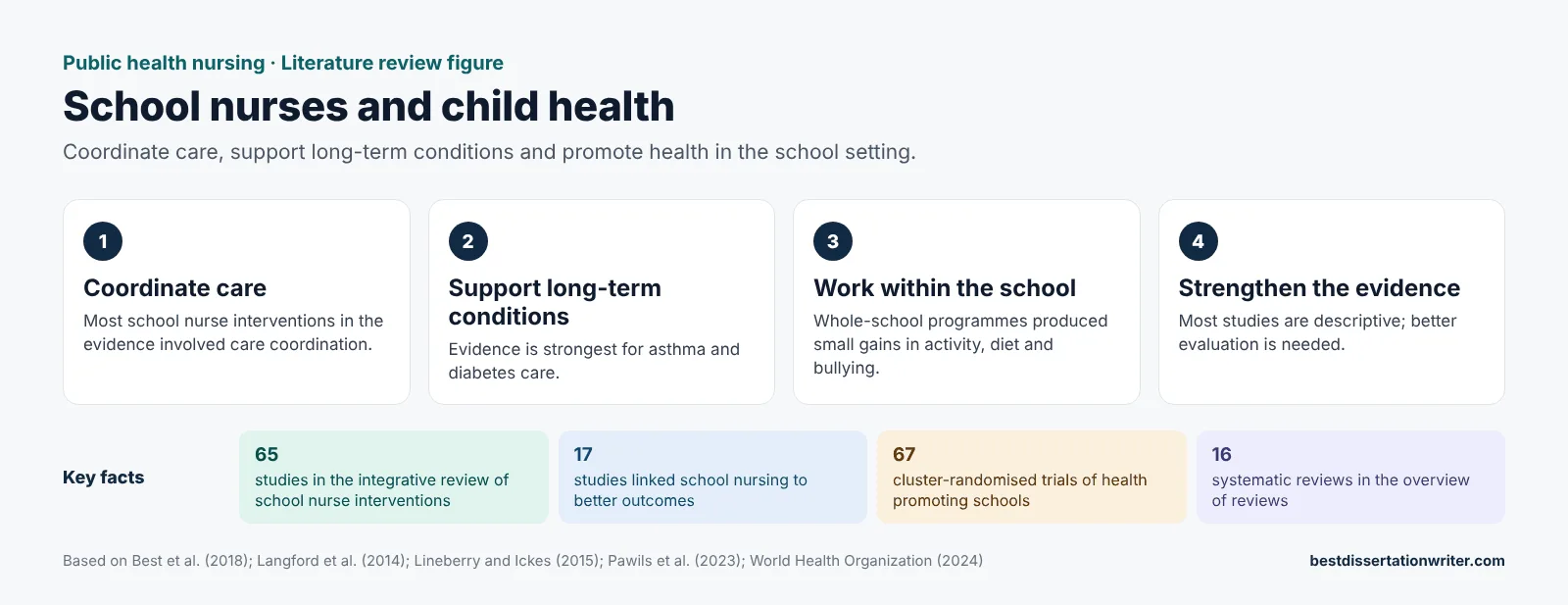
Best et al. (2018) carried out an integrative review of research on school nurses to identify the types of interventions, the health and education outcomes measured, and how interventions related to student outcomes. Sixty-five studies met the inclusion criteria. The authors categorised the interventions using the National Association of School Nurses framework, and found that most fell under the care coordination principle. Motivational interviewing and counselling were the most common interventions.
This finding shows that nurses in schools are not simply providers of first aid or screening. A large part of their work involves coordinating care between the child, the family, the school and health services, and talking with children in ways that support changes in behaviour. These are skills of health education and counselling as much as of clinical practice.
Lineberry and Ickes (2015) reviewed research on nurses in American elementary schools, drawing on literature from 1937 to 2013. They found that studies of immunisation compliance, attendance, body mass index screening, vision screening and follow-up looked promising, but results were mixed and further evidence was needed. The long period covered also shows how long school nursing has been studied without a strong body of high-quality trials.
Together, these two reviews present a picture of a profession whose activity is broad, which is a strength in a setting where children’s needs are varied, but which makes evaluation harder. When one service covers screening, immunisation, counselling, long-term conditions and safeguarding, no single outcome can capture its value, and studies tend to focus on whichever element is easiest to measure.
Theme 2: Evidence Linking School Nursing to Outcomes
In the integrative review by Best et al. (2018), 17 of the 65 studies linked school nurse interventions to improved student outcomes. However, most studies, about 80%, were descriptive. Descriptive studies can show what nurses do and what children report, but they cannot show whether the improvement would have happened without the nurse. The authors called for more rigorous research on the effects of school nurse work on student health and education.
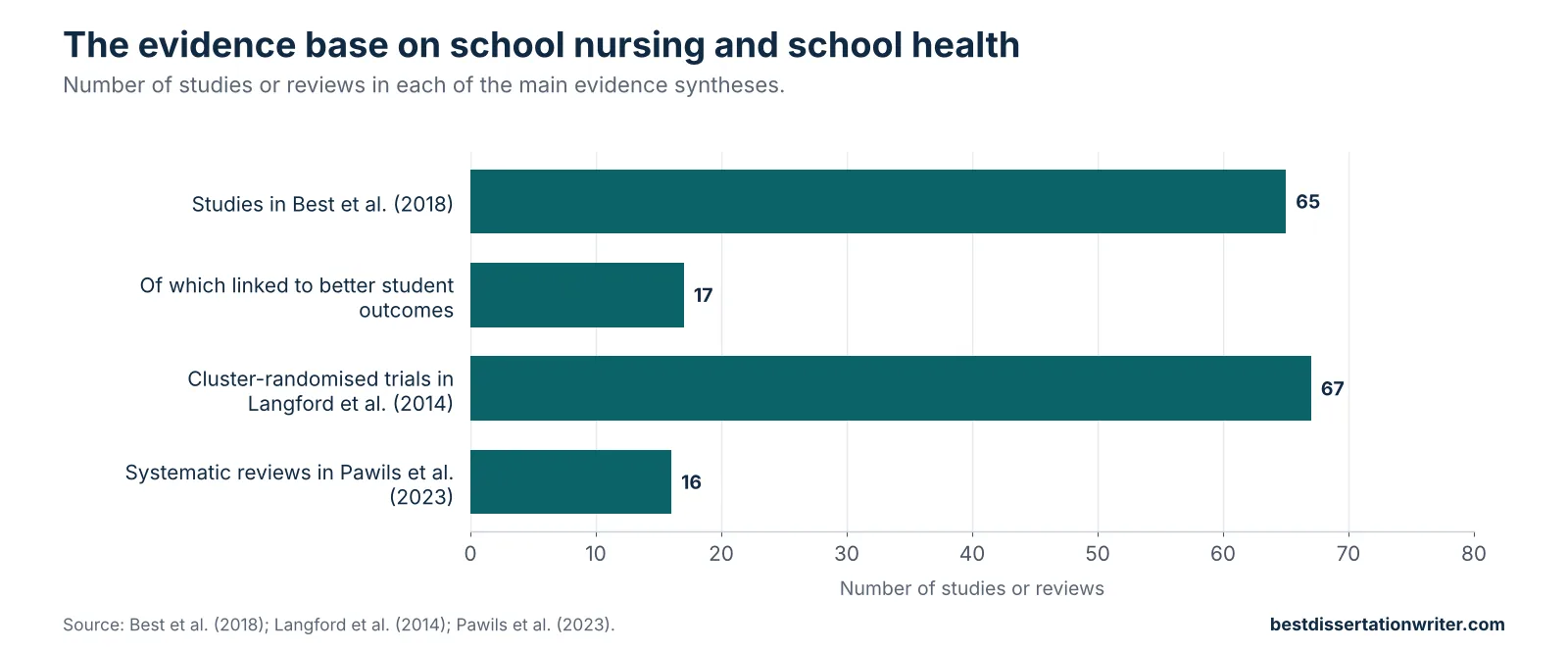
Pawils et al. (2023) conducted an overview of reviews on the effectiveness of school nurses in promoting the health of children and adolescents. From 1,494 records, they evaluated 16 systematic reviews using the AMSTAR-2 tool and then assessed the primary studies in those reviews using the GRADE approach. Their findings suggested that nurses in schools play a key role in improving health for children with asthma and diabetes, while evidence on obesity was less certain. Most of the reviews were of very low quality.
The authors noted that earlier research often had weak methods, and they recommended further research, especially on mental health and on children from low-socioeconomic backgrounds, together with better quality standards for school nursing research. The overview therefore supports the claim that school nursing makes a contribution to child health, particularly for long-term conditions, but it also shows that the quality of evidence does not match the importance of the role.
It is also notable that the strongest conclusions concern children with defined long-term conditions, where outcomes such as symptom control or missed school days are easy to define and to count. In contrast, evidence on prevention in the general school population, where benefits are diffuse and long term, is thinner. This pattern is common in public health and does not mean that prevention is ineffective, only that it is harder to demonstrate.
Theme 3: Lessons from Whole-School Health Promotion
Langford et al. (2014) reviewed the effectiveness of the WHO health promoting school framework in a Cochrane review of 67 cluster-randomised trials, covering 1,443 schools or districts (1,345 schools and 98 districts). The review found positive effects on body mass index, physical activity, physical fitness, fruit and vegetable intake, cigarette use and being bullied. There was little evidence for standardised body mass index, and no evidence of an effect on fat intake, alcohol use, drug use, mental health, violence or bullying others, although few studies examined these outcomes.
There were insufficient data to assess sexual health, hand-washing, cycle-helmet use, eating disorders, sun protection, oral health and academic outcomes. Overall certainty was low to moderate, with limitations including reliance on self-reported data, high attrition and little long-term follow-up. The authors noted that effects were generally small, but could matter at the population level.
This review does not evaluate nurses in schools specifically. Its relevance is that it shows what school-based programmes can achieve and where evidence is lacking, so it provides a benchmark for judging what a nurse working within such a programme might contribute.
Discussion
This systematic review suggests that school nurses carry out a wide range of valuable work, with the strongest evidence for care of children with asthma and diabetes, but that the research base is weak. Many studies are descriptive, many reviews are of low quality, and few trials have been designed to test the effect of a school nurse. The conclusion is not that school nurses are ineffective, but that their effect has not been measured as well as it should be.
The distinction between description and evaluation is important. A report that children seen by a school nurse had better attendance does not show that the nurse caused the improvement, because children who see nurses may differ from those who do not. Stronger designs, such as comparisons between schools with different levels of provision, and the use of validated outcome measures, are needed. Qualitative research can add information on how children and families experience the service.
The Cochrane review shows that whole-school approaches can produce small improvements in physical activity, diet, tobacco use and bullying, which suggests that school nurses may be most effective when they work within a coordinated school programme rather than alone. It also shows gaps, in mental health, sexual health and academic outcomes, that are areas in which school nurses are often asked to work.
Mental health deserves particular attention. Half of adult mental disorders begin by the age of 18, children spend much of their time in school, and a nurse who is known and trusted can notice changes early and help children to find support. Yet mental health is one of the areas in which the reviews found the least evidence, so services that expand this work should build evaluation into their plans from the start.
Equity should be considered. Children from disadvantaged backgrounds have higher rates of many health problems and may benefit most from a trusted professional in school, yet they are poorly represented in research. The overview of reviews called for more work with this group, and this should be a priority for researchers and commissioners.
There are limitations. This review relied on openly accessible, English-language sources, and did not involve formal systematic screening. The included reviews differ in their definitions of school nursing and in the settings they cover, and most evidence is from high-income countries, so findings may not apply everywhere.
Implications of School Nursing Evidence for Practice
For practice, the evidence supports the view that school nurses should focus on care coordination, support for children with long-term conditions, and health education and counselling, and should work with teachers, families and local services. School nurses can also contribute to wider programmes, including those described in the reviews of sexual health screening and the social determinants of health, and to the prevention work discussed in the review of obesity prevention programmes. Guidance on school health is available from the WHO health promoting schools page.
Training is another consideration. Counselling and motivational interviewing were common interventions, so nurses in schools need preparation in these skills, as well as in the management of long-term conditions and in safeguarding. Supervision and links with colleagues in community and mental health services help to keep practice consistent and to support nurses who often work alone.
Services should collect consistent data on activity and outcomes, so that the contribution of school nursing can be shown over time. Commissioners should avoid judging the value of the role by the weak evidence alone, while supporting better evaluation.
Conclusion
This systematic review examined evidence on the role and effectiveness of school nurses. School nurses coordinate care, counsel children and support those with long-term conditions, and there is some evidence of benefit, but the research base is limited and of variable quality.
The priority for the profession is better evidence. By designing and publishing stronger evaluations, especially of mental health work and of services for disadvantaged children, school nurses can demonstrate the value of their contribution to child health and wellbeing.
References
Best, N. C., Oppewal, S., & Travers, D. (2018). Exploring school nurse interventions and health and education outcomes: An integrative review. Journal of School Nursing, 34(1), 14–27. https://doi.org/10.1177/1059840517745359
Langford, R., Bonell, C. P., Jones, H. E., Pouliou, T., Murphy, S. M., Waters, E., Komro, K. A., Gibbs, L. F., Magnus, D., & Campbell, R. (2014). The WHO Health Promoting School framework for improving the health and well-being of students and their academic achievement. Cochrane Database of Systematic Reviews, (4), CD008958. https://doi.org/10.1002/14651858.CD008958.pub2
Lineberry, M. J., & Ickes, M. J. (2015). The role and impact of nurses in American elementary schools: A systematic review of the research. Journal of School Nursing, 31(1), 22–33. https://doi.org/10.1177/1059840514540940
Pawils, S., Heumann, S., Schneider, S. A., Metzner, F., & Mays, D. (2023). The current state of international research on the effectiveness of school nurses in promoting the health of children and adolescents: An overview of reviews. PLoS ONE, 18(2), e0275724. https://doi.org/10.1371/journal.pone.0275724
World Health Organization. (2024, November 26). Adolescent and young adult health [Fact sheet]. https://www.who.int/news-room/fact-sheets/detail/adolescents-health-risks-and-solutions
Cite this example
Best Dissertation Writers (2026) The Role of School Nurses in Child Health Promotion and Wellbeing: A Systematic Review. Available at: https://bestdissertationwriter.com/school-nurses-literature-review/
Best Dissertation Writers
Get expert help with your nursing literature review
Share your topic and deadline with Best Dissertation Writers and get support tailored to your module brief.