
Community Mental Health Promotion Led by Nurses: A Scoping Review
 By Dr. Robertson Prime, Research Fellow
Updated October 28, 2026
14 min read
About 2,800 words
In this review
Abstract
Background: Community mental health promotion aims to protect and improve mental wellbeing across whole populations, not only to treat illness once it has developed. The World Health Organization estimates that about 1.2 billion people, nearly 1 in 7, were living with a mental disorder in 2023, and many receive no formal care. Nurses working in schools, primary care and community services are well placed to promote mental wellbeing.
Aim: This scoping review aimed to map evidence on community-based approaches to mental health promotion and on the contribution of nurses.
Methods: Evidence was identified through targeted searches of openly accessible bibliographic records, publisher websites and the reference lists of key reviews. Five sources published between 2017 and 2026 were included: a global fact sheet, a systematic review of social prescribing, two meta-analyses and a systematic review of interventions led by mental health nurses. Findings were charted and summarised descriptively.
Findings: A review of 15 UK evaluations of social prescribing found that all were at high risk of bias, so success and value for money could not be judged. A meta-analysis of 18 trials with 5,936 participants found that Mental Health First Aid training improved knowledge (d = 0.72) and confidence in helping (d = 0.58), with smaller effects on stigma. A meta-analysis of 118 school-based trials found small effects on depression (g = 0.21) and anxiety (g = 0.18). Evidence on the effectiveness of nurse-led prevention and promotion remained limited.
Conclusion: Community approaches can improve mental health literacy and give small preventive benefits, but much of the evidence is limited. Nurses should promote wellbeing, build mental health literacy and connect people with community support, while contributing to better evaluation.
Keywords: community mental health promotion, mental health promotion, mental wellbeing
Introduction
This scoping review critically examines recent evidence on community mental health promotion and its implications for public health nursing practice.
Mental health is more than the absence of illness. It includes the ability to cope with the normal stresses of life, to work productively, to form and keep relationships and to contribute to a community. The World Health Organization (WHO) estimates that in 2023 about 1.2 billion people worldwide, nearly 1 in 7, were living with a mental disorder, including 470 million with an anxiety disorder and 322 million with depression. Only about one third of people with depression receive formal mental health care.
Treatment services alone cannot meet this need. Community mental health promotion tries to build protective factors such as social connection, a sense of control, meaningful activity and knowledge about mental health, and to reduce risks such as isolation, debt and discrimination. It works through schools, workplaces, neighbourhoods and primary care, and it includes both universal approaches aimed at everyone and targeted approaches for people at higher risk.
Nurses contribute across the whole range of community mental health promotion. School nurses and health visitors see children and families early, practice and community nurses meet people with long-term conditions and social problems, and mental health nurses lead prevention and promotion programmes. A scoping review approach was chosen because the evidence spans many designs and settings.
Review question
What does the evidence show about social prescribing, mental health literacy training and school-based prevention, and what is known about the contribution of nurses?
Background to Community Mental Health Promotion
The idea of mental health promotion rests on the observation that mental wellbeing is shaped by the conditions in which people live. Housing, income, employment, relationships, discrimination and experiences in childhood all influence mental health. For this reason, promotion is a shared responsibility of health, education, housing and social services, and nurses often act as a bridge between these services and the people they serve.
Several kinds of intervention fall under community mental health promotion. Social prescribing connects people to community groups, activities and support, often through a link worker. Mental health literacy programmes teach people to recognise problems, to respond helpfully and to reduce stigma. School-based programmes teach emotional and coping skills to children and young people, and community projects try to strengthen neighbourhood networks and tackle isolation.
Stigma is a persistent barrier. People may avoid seeking help because they fear judgement, and communities may misunderstand mental illness. Programmes that improve understanding and encourage supportive responses can make it easier for people to talk and to seek help earlier. Nurses, who are trusted and often seen in everyday settings, can reinforce these messages in conversations with individuals and families. Neutral, respectful language also helps people to feel heard rather than judged.
Evaluating community mental health promotion is difficult. Benefits may appear slowly, outcomes such as wellbeing are harder to measure than clinical symptoms, and community programmes are often small and tailored to local needs. These difficulties help to explain why evidence for many promotion programmes is less developed than evidence for clinical treatments, a point that runs through the findings of this review.
The settings in which nurses promote mental health are varied. A school nurse may run a drop-in session on worries and sleep, a health visitor may help a new mother to talk about how she is feeling, a practice nurse may ask about loneliness during a long-term condition review and a community nurse may help someone to join a local group. Each of these conversations is an opportunity to protect wellbeing before a problem becomes severe, and none requires a specialist qualification, although confidence and training help.
Search Strategy and Methods
Evidence for this example was identified through targeted searches of openly accessible bibliographic records, publisher websites and the reference lists of key reviews. Search terms combined keywords for the topic (“mental health promotion”, “mental wellbeing”, “prevention”, “social prescribing”, “mental health literacy”) with terms for the setting and provider (“community”, “school”, “primary care”, “nurse”), joined with the Boolean operators AND and OR. A full scoping review of community mental health promotion for assessment would follow the JBI scoping review method, run the same strategy in CINAHL, PubMed/MEDLINE, the Cochrane Library and Web of Science and report the number of records screened in a PRISMA-ScR flow diagram.
Sources were eligible if they examined approaches to community mental health promotion in community, school or primary care settings, or the prevention of mental health problems, or provided authoritative data on the scale of need. Systematic reviews and meta-analyses were prioritised. Studies of treatment for established mental illness were excluded.
Five sources published between 2017 and 2026 were included: a systematic review of social prescribing, a meta-analysis of Mental Health First Aid training, a meta-analysis of school-based prevention programmes, a systematic review of interventions led by mental health nurses and the WHO fact sheet that provides global context (Table 1). Consistent with scoping review methods, findings were charted and summarised descriptively rather than formally appraised.
Key Findings on Community Mental Health Promotion
Three themes in community mental health promotion were identified: social prescribing and community connection, mental health literacy, and prevention in schools and by mental health nurses. Table 1 summarises the included sources, and Figure 1 shows the effects of Mental Health First Aid training reported by a meta-analysis.
| Author, year | Design | Setting and sample | Key finding |
|---|---|---|---|
| Bickerdike et al. (2017) | Systematic review | 15 UK evaluations of social prescribing | All at high risk of bias; success and value for money could not be judged. |
| Morgan et al. (2018) | Systematic review and meta-analysis | 18 trials; 5,936 adults | Knowledge d = 0.72 and confidence d = 0.58 after training; stigma d = 0.14. |
| Werner-Seidler et al. (2021) | Systematic review and meta-analysis | 118 trials; 45,924 young people | Small effects on depression (g = 0.21) and anxiety (g = 0.18). |
| Santonja-Ayuso & Carmona-Simarro (2026) | Systematic review | Interventions led by mental health nurses | Evidence on effectiveness of nurse-led prevention and promotion remains limited. |
| World Health Organization (2026) | Fact sheet (global data, 2023) | Worldwide estimates | About 1.2 billion people (1 in 7) living with a mental disorder. |
Theme 1: Community Mental Health Promotion Through Social Prescribing
Bickerdike et al. (2017) reviewed the evidence on social prescribing, in which primary care patients are referred to a link worker or facilitator who connects them with community support. They searched nine databases for United Kingdom studies from 2000 to January 2016 and included 15 evaluations. Most were small and poorly designed and reported, and all were judged to be at high risk of bias. Common problems included a lack of comparison groups, short follow-up, use of non-standardised measures and missing data.
Despite these weaknesses, most evaluations reached positive conclusions. The authors judged that the evidence did not give enough detail to decide whether social prescribing succeeds or offers value for money, and called for comparative evaluations that consider when, by whom, for whom and at what cost it works. The review illustrates a recurring theme in community mental health promotion: enthusiasm and local reports of benefit often run ahead of rigorous evidence.
Theme 2: Building Mental Health Literacy
Morgan et al. (2018) carried out a meta-analysis of Mental Health First Aid training, a widely used form of community mental health promotion, which teaches members of the public how to recognise and respond to mental health problems. The review included 18 trials with 5,936 adult participants. Immediately after training, knowledge improved considerably (Cohen’s d = 0.72), and so did confidence in helping others (d = 0.58), while stigma fell only slightly (d = 0.14). Effects remained up to six months later, although they became smaller (knowledge d = 0.54; confidence d = 0.46; stigma d = 0.14).
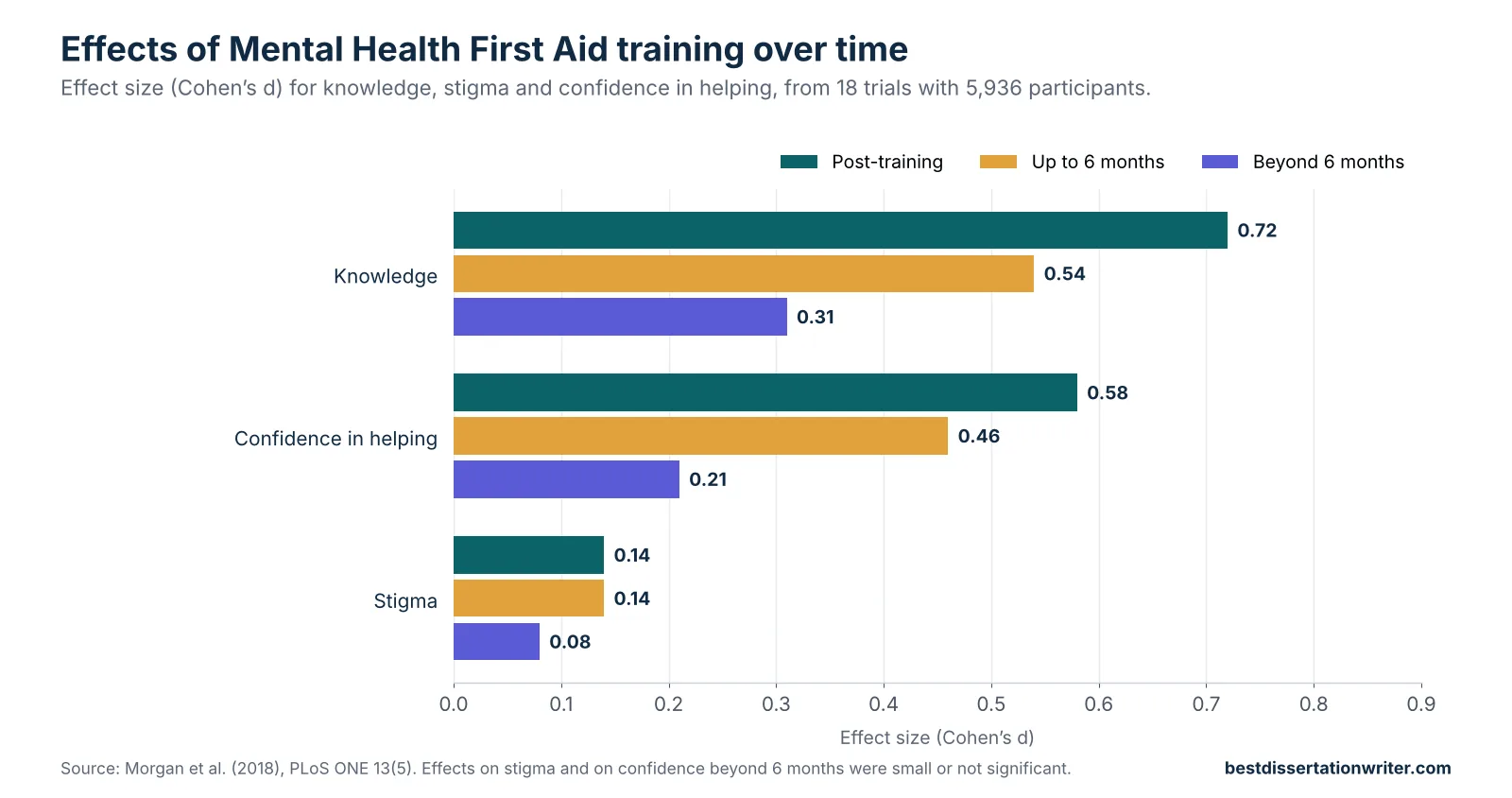
Beyond six months, effects on knowledge (d = 0.31) and confidence (d = 0.21) were smaller still, and the effect on stigma was 0.08, so longer-term benefits were less clear. Helping behaviour showed a small effect of 0.23 at follow-up. The authors concluded that the review supports the effectiveness of the training in improving mental health literacy and appropriate support up to six months after training, although the evidence on actual helping behaviour was less strong.
Theme 3: Prevention in Schools and by Mental Health Nurses
Werner-Seidler et al. (2021) updated a meta-analysis of school-based programmes that teach psychological skills to prevent depression and anxiety. Searching three databases to October 2020, they included 130 articles representing 118 unique randomised trials and 45,924 participants. After the programmes, the effects were small for depression (g = 0.21) and for anxiety (g = 0.18). Programmes aimed at young people with risk factors or symptoms were more effective for depression than universal programmes, and there was some evidence that external providers did better than school staff.
The authors judged the overall quality of the studies to be moderate and concluded that school programmes have small effects on symptoms, and that refinement and sustainable delivery beyond the trial period are needed if they are to affect whole populations. Santonja-Ayuso and Carmona-Simarro (2026) reviewed prevention and promotion interventions led by mental health nurses and assessed the methodological quality of studies from the preceding five years. They noted that although mental health nurses are the largest professional group in mental health care, the evidence on how effective their interventions are remains limited.
Discussion
This scoping review shows that community mental health promotion rests on plausible ideas but on evidence of variable strength. Training in mental health literacy improved knowledge and confidence, school-based programmes produced small preventive effects, and social prescribing was popular but poorly evaluated. The evidence on what nurses themselves contribute was limited, even though nurses deliver much of this work.
Small effects can still be valuable in community mental health promotion. A reduction of about 0.2 standard deviations in depression symptoms across a school population is modest for each young person, but programmes can reach many people cheaply and may prevent some problems from becoming serious. The challenge is to deliver programmes in ways that are sustainable and that target those who need them most, since targeted programmes performed better than universal ones for depression.
The finding that knowledge improved more than stigma or behaviour is worth noting. Knowing about mental health is necessary, but it does not automatically change attitudes or the way people act. Nurses can reinforce training with everyday practice, for example by showing how to start a supportive conversation, encouraging people to ask directly about how someone is feeling and treating mental health with the same seriousness as physical health. Programmes that combine teaching with practice in real conversations may therefore be more likely to change behaviour, although the included studies could not show this directly.
Social prescribing may suit nurses well as a form of community mental health promotion, because they often identify people whose problems are social rather than clinical. The weak evidence base should not discourage it, but it argues for careful evaluation. Nurses can help by recording what happens to people who are referred, by working with link workers and community groups and by listening to what people say about the support they receive. Evidence on loneliness and depression in later life also suggests that connection to others is a key element.
Equity and access need attention. People who are most at risk of poor mental health, including those living in poverty, those who are isolated and those from minority groups, are often the least likely to attend groups or to find services. Promotion that relies on people coming forward may therefore widen gaps. Nurses who work in the community can go to people, build trust over time and tailor approaches to local cultures and languages, which may help programmes to reach those who would otherwise be missed.
Measurement is a further challenge. Wellbeing can be assessed with validated questionnaires, but community projects often rely on attendance figures or personal stories. Simple, consistent measures used before and after a programme would allow teams to learn more from their work and would help to address the weak evidence found in the review of social prescribing. Nurses are used to recording information routinely and can help to make evaluation part of everyday practice.
Several limitations should be noted. The five sources vary in design, setting and quality, many of the included studies were at risk of bias and most outcomes were measured soon after the intervention. This review relied on openly accessible, English-language sources and did not involve formal systematic screening. Future research should test nurse-led promotion programmes, follow participants for longer and measure outcomes that matter to communities as well as symptom scores.
Implications of Community Mental Health Promotion Evidence for Practice
For nurses, the evidence supports building mental health literacy in everyday conversations, talking openly about mental health to reduce stigma, supporting programmes that develop coping skills in children and young people, and linking people to community support while recording the results. The work connects closely with health literacy campaigns and with services that support young people, such as those described in teenage pregnancy prevention. Further information about mental health is available from the WHO mental disorders fact sheet.
In practice, a nurse can begin by asking an open question about how a person is coping, listening without hurrying and responding with warmth. If the person is struggling, the nurse can explain what support exists locally, offer to help with a first contact and agree when to check back. Where there is risk of harm, usual safeguarding and urgent referral pathways apply. These simple steps put promotion into everyday care.
Managers and commissioners should invest in training, protect time for nurses to carry out promotion work, support partnerships with schools and voluntary organisations, and build evaluation into new programmes so that learning is shared. Programmes should be offered in ways that reach people who are less likely to seek help.
Conclusion
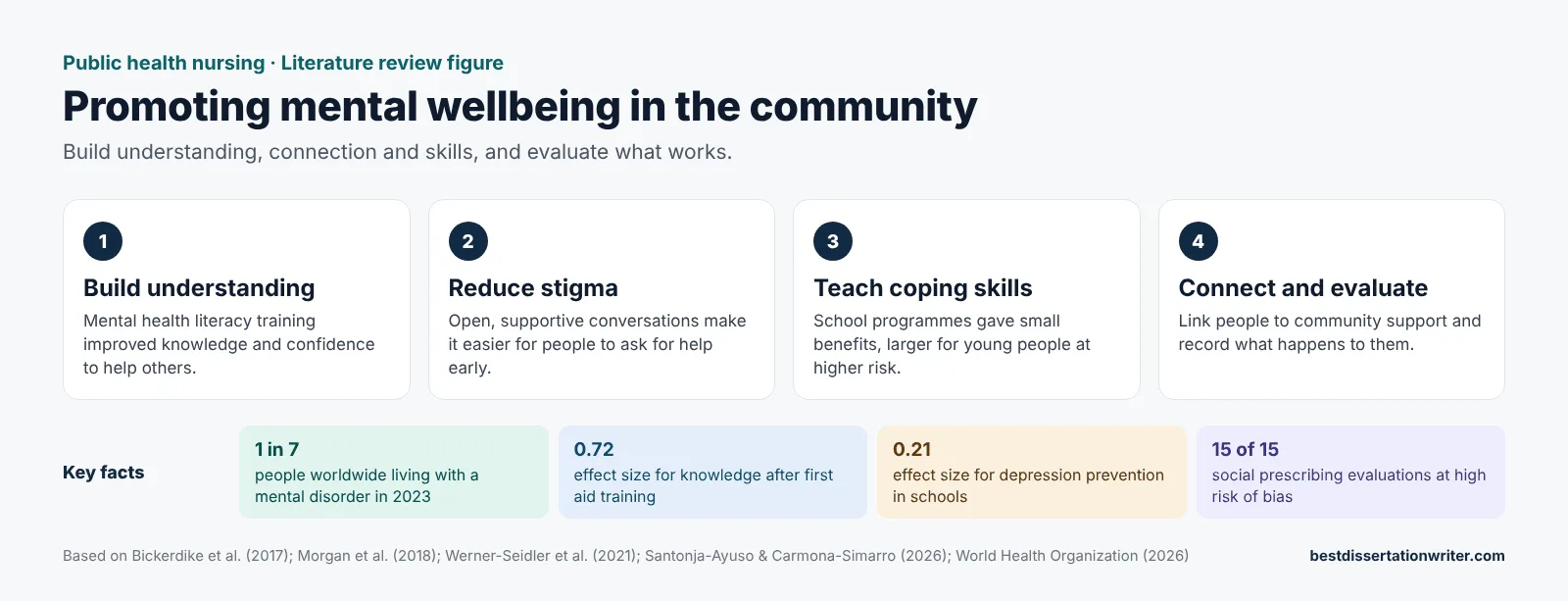
This scoping review mapped evidence on community mental health promotion. Mental health literacy training improved knowledge and confidence, school programmes had small effects on depression and anxiety, social prescribing lacked rigorous evaluation, and evidence on nurse-led approaches remained limited.
Community mental health promotion is an investment in the wellbeing of whole populations. By promoting understanding, reducing stigma, connecting people with support and helping to evaluate what works, nurses can contribute to communities in which mental wellbeing is protected as well as treated.
References
Bickerdike, L., Booth, A., Wilson, P. M., Farley, K., & Wright, K. (2017). Social prescribing: Less rhetoric and more reality. A systematic review of the evidence. BMJ Open, 7(4), e013384. https://doi.org/10.1136/bmjopen-2016-013384
Morgan, A. J., Ross, A., & Reavley, N. J. (2018). Systematic review and meta-analysis of Mental Health First Aid training: Effects on knowledge, stigma, and helping behaviour. PLoS ONE, 13(5), e0197102. https://doi.org/10.1371/journal.pone.0197102
Santonja-Ayuso, L., & Carmona-Simarro, J. V. (2026). Prevention and mental health promotion interventions led by mental health nurses: A systematic review. Archives of Psychiatric Nursing, 60, 152056. https://doi.org/10.1016/j.apnu.2026.152056
Werner-Seidler, A., Spanos, S., Calear, A. L., Perry, Y., Torok, M., O’Dea, B., Christensen, H., & Newby, J. M. (2021). School-based depression and anxiety prevention programs: An updated systematic review and meta-analysis. Clinical Psychology Review, 89, 102079. https://doi.org/10.1016/j.cpr.2021.102079
World Health Organization. (2026, September 11). Mental disorders [Fact sheet]. https://www.who.int/news-room/fact-sheets/detail/mental-disorders
Cite this example
Best Dissertation Writers (2026) Community Mental Health Promotion Led by Nurses: A Scoping Review. Available at: https://bestdissertationwriter.com/community-mental-health-promotion/
Best Dissertation Writers
Get expert help with your nursing literature review
Share your topic and deadline with Best Dissertation Writers and get support tailored to your module brief.