
Nurse-Delivered Sexual Health Screening and Education Programmes: A Scoping Review
 By Dr. Robertson Prime, Research Fellow
Updated October 28, 2026
14 min read
About 2,800 words
In this review
Abstract
Background: Sexual health screening finds infections that often cause no symptoms, so that they can be treated before they cause harm or spread. Nurses deliver much of this work in sexual health clinics, general practice, schools and community settings, but the evidence on how best to offer screening and education has not been mapped for nursing practice.
Aim: This scoping review aimed to map the evidence on the scale of sexually transmitted infections (STIs), approaches to increasing STI testing, and the role of nurses in sexual health screening and education.
Methods: Evidence was identified through targeted searches of openly accessible bibliographic records, publisher websites and official statistics. Five sources published between 2011 and 2026 were included: two reviews of interventions, a scoping review of school nurses, a World Health Organization fact sheet and a national surveillance report. Data were charted and summarised descriptively.
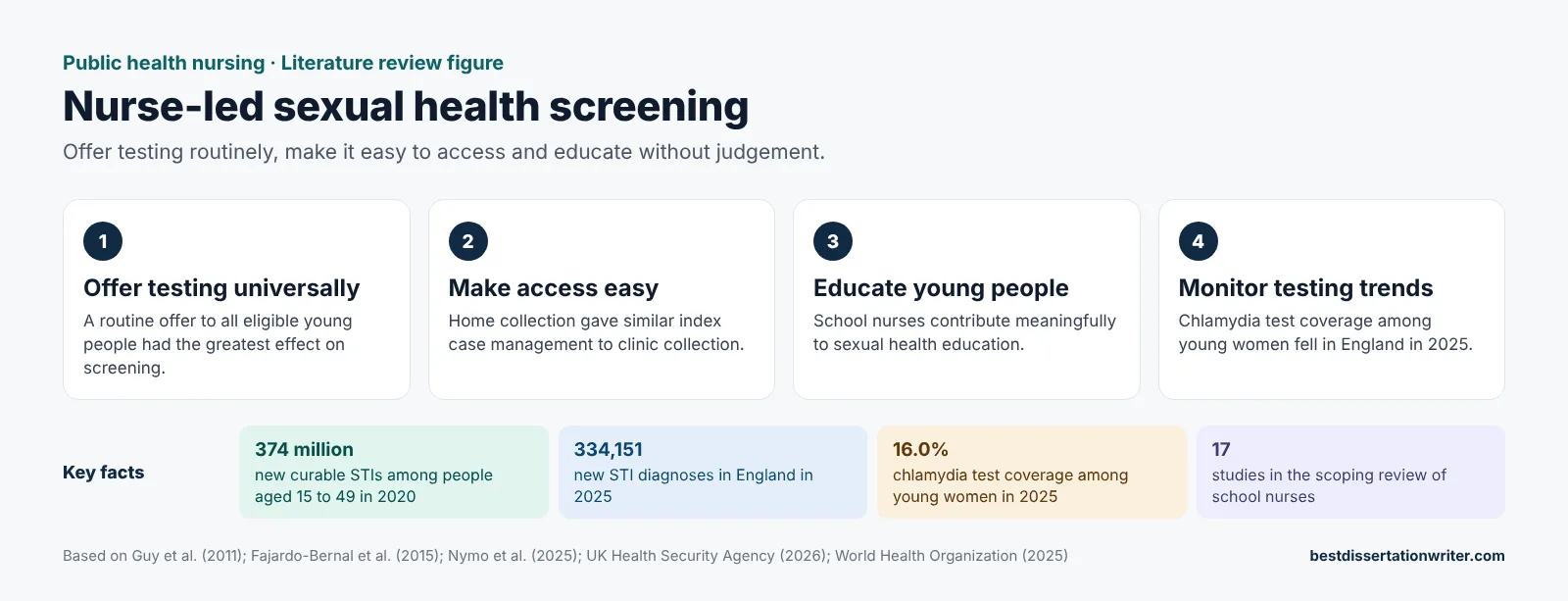
Findings: The WHO estimated about 374 million new infections with four curable STIs among people aged 15 to 49 in 2020. In England, 334,151 new STI diagnoses were reported in 2025, and chlamydia test coverage among young women fell from 17.7% to 16.0%. A systematic review of 16 intervention strategies found that offering a chlamydia test to all young people had the greatest effect on screening in primary care. A Cochrane review found that home collection of specimens gave similar index case management to clinic collection. A scoping review of 17 studies found that school nurses contribute meaningfully to sexual health education.
Conclusion: Universal offers of testing, accessible testing options and nurse-led education are all supported by the evidence mapped, although the research base is varied. Nurses should make sexual health screening a routine, non-judgemental offer.
Keywords: sexual health screening, STI, STI testing
Introduction
This scoping review critically examines recent evidence on sexual health screening and its implications for public health nursing practice.
Sexually transmitted infections (STIs) are among the most common infections in the world, and most of them cause no symptoms. The World Health Organization (WHO) reports that more than 1 million curable STIs are acquired every day among people aged 15 to 49 years, and estimates that in 2020 there were about 374 million new infections with one of four curable STIs: chlamydia (129 million), gonorrhoea (82 million), syphilis (7.1 million) and trichomoniasis (156 million). Because infections often go unnoticed, sexual health screening is the main way to find and treat them.
Untreated infections can have serious consequences. The WHO notes that syphilis in pregnancy affected about 1.1 million women in 2022, resulting in over 390,000 adverse birth outcomes, and that human papillomavirus infection is associated with over 311,000 cervical cancer deaths each year. Drug resistance in gonorrhoea is described as a major threat. These facts show that the value of sexual health screening lies in early treatment, prevention of onward transmission and protection of fertility and pregnancy.
Nurses provide sexual health screening and education in clinics, general practice, pharmacies, schools, prisons and outreach services. They take sexual histories, collect samples, give results, offer treatment under protocols, trace partners and give advice on contraception and prevention. Their work draws on communication skills as well as clinical knowledge, because people may feel embarrassed or fear judgement. A scoping review was chosen because the evidence is varied in design and the aim was to map it, rather than to pool effects.
Review question
What does the evidence show about the scale of STIs, approaches that increase STI testing, and the contribution of nurses to sexual health screening and education?
Background to Sexual Health Screening
Screening for STIs may be offered to everyone in a defined group, to people with risk factors, or to people who attend a service for another reason. The WHO recommends screening of asymptomatic STIs in selected priority populations and settings. In England, the National Chlamydia Screening Programme has, since June 2021, aimed primarily to reduce the health harm of untreated chlamydia, and opportunistic screening focuses on sexually active young women and others with a womb or ovaries.
A distinction is made between screening, which looks for infection in people without symptoms, and diagnostic testing, which investigates symptoms or a known contact. In practice the two overlap, and the same test may serve both purposes. The term STI testing is used in this review to include both, while sexual health screening refers to the offer of tests to people without symptoms.
Prevention is the other half of sexual health work. The WHO states that correctly and consistently used condoms are among the most effective protections against STIs, including HIV, although they do not protect against infections that cause extra-genital ulcers such as syphilis and genital herpes, and that safe, effective vaccines exist for hepatitis B and human papillomavirus. Sexual health education, delivered in schools and clinics, aims to give young people the knowledge and skills to protect themselves and to seek testing.
Access to services can be uneven. People may avoid screening because of stigma, concerns about confidentiality, cost, travel or inconvenient opening hours. Services therefore try to bring testing closer to people, through opportunistic offers in general practice, online ordering of home sampling kits and outreach, and nurses are involved in each of these.
Search Strategy and Methods
Evidence for this example was identified through targeted searches of openly accessible bibliographic records, publisher websites and official statistics. Search terms combined keywords for the topic (“sexual health screening”, “STI testing”, “chlamydia screening”, “sexually transmitted infections”) with terms for the provider and intervention (“nurse”, “school nurse”, “primary care”, “home sampling”, “sexual health education”), joined with the Boolean operators AND and OR. A full scoping review for assessment would follow the PRISMA extension for scoping reviews and search CINAHL, PubMed/MEDLINE, PsycINFO and Embase, and report the number of records screened.
Sources were included if they gave authoritative data on the scale of STIs, evaluated interventions to increase testing, or examined the role of nurses in sexual health education. Studies of treatment of established HIV infection and of clinical management of individual infections were excluded.
Five sources published between 2011 and 2026 were included (Table 1). In line with scoping review methods, no formal quality appraisal was undertaken. Data were charted and summarised descriptively under themes.
The search was deliberately broad because sexual health screening is studied by epidemiologists, primary care researchers, nurses and educators, and each group uses different terms and designs. The review therefore treats the included sources as complementary pieces of a map, rather than as competing estimates of one effect.
Key Findings on Sexual Health Screening
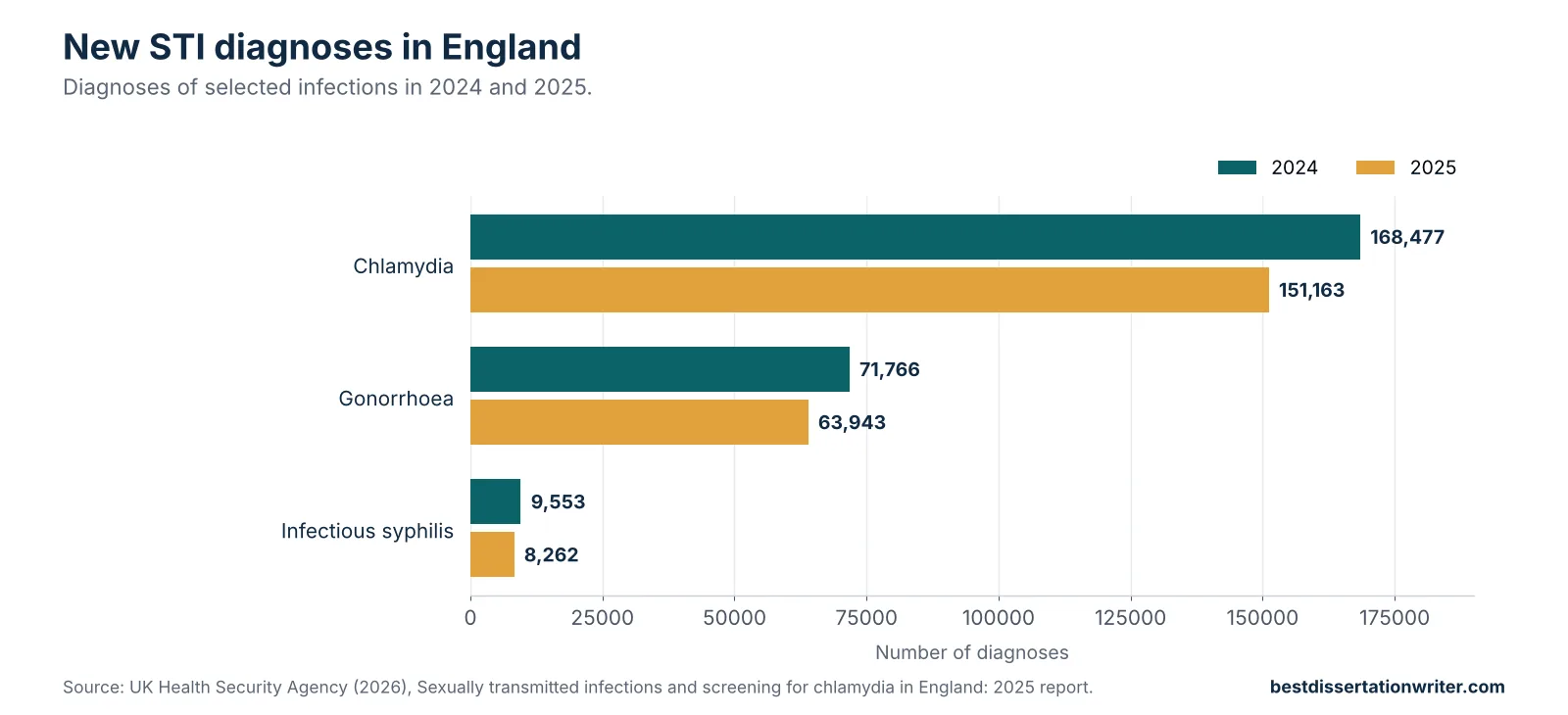
Three themes were identified: the scale of STIs and trends in testing, approaches that increase STI testing, and the role of nurses in education. Table 1 summarises the included sources, and Figure 1 shows the change in diagnoses in England between 2024 and 2025.
| Author, year | Design | Setting and sample | Key finding |
|---|---|---|---|
| Fajardo-Bernal et al. (2015) | Cochrane systematic review | 10 randomised trials; 10,479 participants | Home and clinic specimen collection gave similar index case management; fewer positives with home collection. |
| Guy et al. (2011) | Systematic review | 16 intervention strategies (11 trials, 5 observational) | Universal offers of chlamydia testing had the greatest effect on screening in primary care. |
| Nymo et al. (2025) | Scoping review | 17 studies from 406 unique articles | School nurses contribute meaningfully to sexual health education. |
| UK Health Security Agency (2026) | National surveillance report | England, 2025 | 334,151 new STI diagnoses (down 8.3%); chlamydia test coverage in young women fell to 16.0%. |
| World Health Organization (2025) | Fact sheet | Global estimates | About 374 million new curable STIs a year (2020); screening recommended in priority groups. |
Theme 1: The Scale of STIs and Trends in Testing
The UK Health Security Agency (2026) reported that in England in 2025 there were 334,151 new STI diagnoses, a fall of 8.3% from 364,261 in 2024. Diagnoses of chlamydia fell by 10.3% to 151,163, gonorrhoea by 10.9% to 63,943 and infectious syphilis by 13.5% to 8,262. The report presents these as changes in diagnoses, which depend on testing as well as on infection, and so falls should not be read simply as reduced infection.
Testing among young people fell as well. In 2025, 547,308 chlamydia tests were carried out among young women aged 15 to 24 years, a decrease of 9.4% from 2024. Test coverage among young women fell from 17.7% to 16.0%, and test positivity was 8.4%, down from 8.8%. The chlamydia detection rate fell 13.6% from 1,561 to 1,348 per 100,000 population, against an expectation that local authorities work toward at least 3,250 per 100,000. This suggests that the fall in diagnoses was partly due to less testing, which is a concern for sexual health screening.
For nursing practice the practical lesson is that sexual health screening should be monitored as a service, not only delivered as a series of consultations. Coverage, positivity and detection rate together describe whether the right people are being reached, and a fall in any of them is a prompt to review how tests are offered. Nurses who lead services are well placed to carry out this kind of review.
Theme 2: Approaches That Increase STI Testing
Guy et al. (2011) systematically reviewed interventions to increase chlamydia screening in primary care, identifying 16 intervention strategies, of which 11 were randomised controlled trials and 5 were observational studies. Ten targeted females only, five targeted both sexes and one targeted males only. Among 15 interventions for females, six produced significant increases in screening, including a multifaceted quality improvement programme that gave patients a urine jar at registration (44% compared with 16% in the control clinic), linking screening to routine cervical smears (6.9% compared with 4.5%), computer alerts for doctors, education workshops for staff, internet-based education and free sexual health consultations.
Two of six interventions for males produced significant increases, namely the same quality improvement programme (45% compared with 15%) and a practice in which doctors offered a test to all young male patients before their consultation (29% compared with 4%). The authors concluded that interventions that promoted offering a chlamydia test universally to young people had the greatest impact on screening in primary care. For nurses, the implication is that a routine offer to every eligible person is more effective than waiting for patients to ask.
Fajardo-Bernal et al. (2015) compared home-based and clinic-based specimen collection in a Cochrane review of 10 randomised controlled trials with 10,479 participants. Index case management, meaning that a person was tested, diagnosed and treated, was similar: 5.8% in the home-based group and 6.5% in the clinic-based group (risk ratio 0.88; 95% confidence interval 0.60 to 1.29), with moderate-certainty evidence. The proportion tested varied so widely that results could not be pooled, ranging from 30% to 96% with home collection and from 6% to 97% in clinics. Positive tests were fewer with home collection (11.6% compared with 18.5%; risk ratio 0.72). No trial evaluated harms, and the authors recommended that future trials measure biological outcomes.
Taken together, these two reviews suggest that the way a test is offered matters as much as the test itself. A universal offer places the decision in the normal flow of the consultation, which reduces the embarrassment of asking, while flexible collection methods remove practical barriers. Both approaches fit comfortably within the scope of nursing practice, and neither requires specialist equipment.
Theme 3: The Role of Nurses in Sexual Health Education
Nymo et al. (2025) carried out a scoping review of the role of school nurses in promoting positive sexual health education. They screened 406 unique articles and included 17 studies, most from the United States and England. The review reported that school nurses contribute meaningfully to sexual education programmes, that young people prefer external, qualified educators such as school nurses to deliver sexual education, and that broader representation, especially from Nordic countries, would enrich understanding. The authors called for more research to strengthen sexual health promotion among young people.
This finding is relevant to screening because education creates the conditions in which young people understand why testing matters, know where to obtain it and feel able to ask. The role of school-based nursing is considered further in the review of school nurses, and the prevention of unintended pregnancy is covered in a related review of teenage pregnancy.
Discussion
This scoping review mapped evidence on sexual health screening and shows a field in which the need is large, the effective approaches are reasonably clear and the trend in testing is a concern. The most consistent message is that making testing a routine and universal offer is more effective than relying on individual requests, and that making testing easy, for example through home collection, can keep uptake high.
Sexual health screening also raises ethical questions that nurses must handle with care. Consent, confidentiality and the sensitive handling of results are essential, particularly for young people, and an offer of testing must never feel like an accusation. Training in communication helps nurses to raise the subject naturally and to respond calmly when people disclose difficult experiences, including coercion or abuse, which require safeguarding.
The home collection evidence illustrates the complexity of interpretation. Home collection produced similar index case management, but fewer positive results, which may mean that it reached people at lower risk, or that fewer people with infection completed testing. A higher number of tests is therefore not the same as a better outcome, and services need to monitor who is tested as well as how many.
Taken as a whole, the evidence suggests that sexual health screening works best as a combination of universal offers, flexible access and education, supported by data that show who is and is not reached. No single element is sufficient, and services that rely on one approach alone risk missing the people who most need care.
The fall in testing in England deserves attention. Diagnoses of every major STI fell in 2025, as did tests among young women. While some of this may reflect behaviour change, it is not possible to separate this from reduced access, and the report notes detection rates well below the level that local authorities are expected to reach. Nurses and commissioners should monitor this closely.
Equity is central. Stigma and concerns about confidentiality may make some people reluctant to attend, and the burden of untreated infection falls most heavily on those who find services hardest to reach. Nurses can reduce barriers by offering care that is confidential, non-judgemental and culturally sensitive, and by working with schools, community groups and outreach services.
This review has limitations. As a scoping review it did not appraise study quality or pool results, and the included studies differ widely in design. The primary care review was published in 2011 and the home collection review in 2015, so some of the underlying trials are dated and may not reflect current services. This review relied on openly accessible, English-language sources, and did not involve a formal systematic search of all databases.
Implications of Sexual Health Screening Evidence for Practice
For practice, the evidence supports routine offers of testing to eligible young people, easy access through options such as home sampling, confidential and respectful consultations, and education that links testing with prevention. Sexual health work also connects with the wider determinants of health discussed in the review of social determinants of health, and with other public health priorities, such as the programmes in the review of obesity prevention programmes. Information is available from the WHO STI fact sheet.
Services should record who is offered and who accepts STI testing, review trends in coverage and positivity, and make sure that results are communicated promptly and that partner notification is supported. Training in sexual history taking and in communication should be available for all nurses who may be asked about sexual health.
Conclusion
This scoping review mapped the evidence on sexual health screening and the role of nurses. The need is substantial, universal offers of testing and accessible options increase uptake, and nurses contribute to education, although the evidence is varied and in places dated.
Nurses are well placed to make sexual health screening an ordinary part of care. By offering tests routinely, supporting access in a range of settings and educating young people without judgement, they can help to detect infections early and to reduce harm.
References
Fajardo-Bernal, L., Aponte-Gonzalez, J., Vigil, P., Angel-Müller, E., Rincon, C., Gaitán, H. G., & Low, N. (2015). Home-based versus clinic-based specimen collection in the management of Chlamydia trachomatis and Neisseria gonorrhoeae infections. Cochrane Database of Systematic Reviews, (9), CD011317. https://doi.org/10.1002/14651858.CD011317.pub2
Guy, R., Ali, H., Liu, B., Poznanski, S., Ward, J., Donovan, B., Kaldor, J., & Hocking, J. (2011). Efficacy of interventions to increase the uptake of chlamydia screening in primary care: A systematic review. BMC Infectious Diseases, 11, 211. https://doi.org/10.1186/1471-2334-11-211
Nymo, B., Eriksen, S. B., & Øygarden, A.-M. U. (2025). The role of school nurses in promoting positive sexual health education: A scoping review. The Journal of School Nursing, 42(1), 6–18. https://doi.org/10.1177/10598405251337769
UK Health Security Agency. (2026, June 2). Sexually transmitted infections and screening for chlamydia in England: 2025 report. GOV.UK. https://www.gov.uk/government/statistics/sexually-transmitted-infections-stis-annual-data-tables/sexually-transmitted-infections-and-screening-for-chlamydia-in-england-2025-report
World Health Organization. (2025, September 10). Sexually transmitted infections (STIs) [Fact sheet]. https://www.who.int/news-room/fact-sheets/detail/sexually-transmitted-infections-(stis)
Cite this example
Best Dissertation Writers (2026) Nurse-Delivered Sexual Health Screening and Education Programmes: A Scoping Review. Available at: https://bestdissertationwriter.com/sexual-health-screening-review-review/
Best Dissertation Writers
Get expert help with your nursing literature review
Share your topic and deadline with Best Dissertation Writers and get support tailored to your module brief.