Nursing Roles in Communicable Disease Outbreak Management and Control: A Scoping Review
 By Dr. Robertson Prime, Research Fellow
Updated October 28, 2026
14 min read
About 2,800 words
In this review
Abstract
Background: A communicable disease outbreak can place enormous demands on health services, and nurses are often among the first to recognise, respond to and control it. Nurses prevent infection at the bedside, support contact tracing, care for affected patients and communicate with the public, yet the evidence for these roles is scattered across many sources.
Aim: This scoping review aimed to map evidence on the infection control measures, workforce protection and contact tracing that underpin the nursing response to infectious disease outbreaks.
Methods: Evidence was identified through targeted searches of openly accessible bibliographic records, publisher websites and the reference lists of key reviews. Five sources published between 2000 and 2023 were included: a hospital-wide intervention study, a cohort study, a narrative synthesis, a systematic review and a Cochrane review. Findings were charted and summarised descriptively.
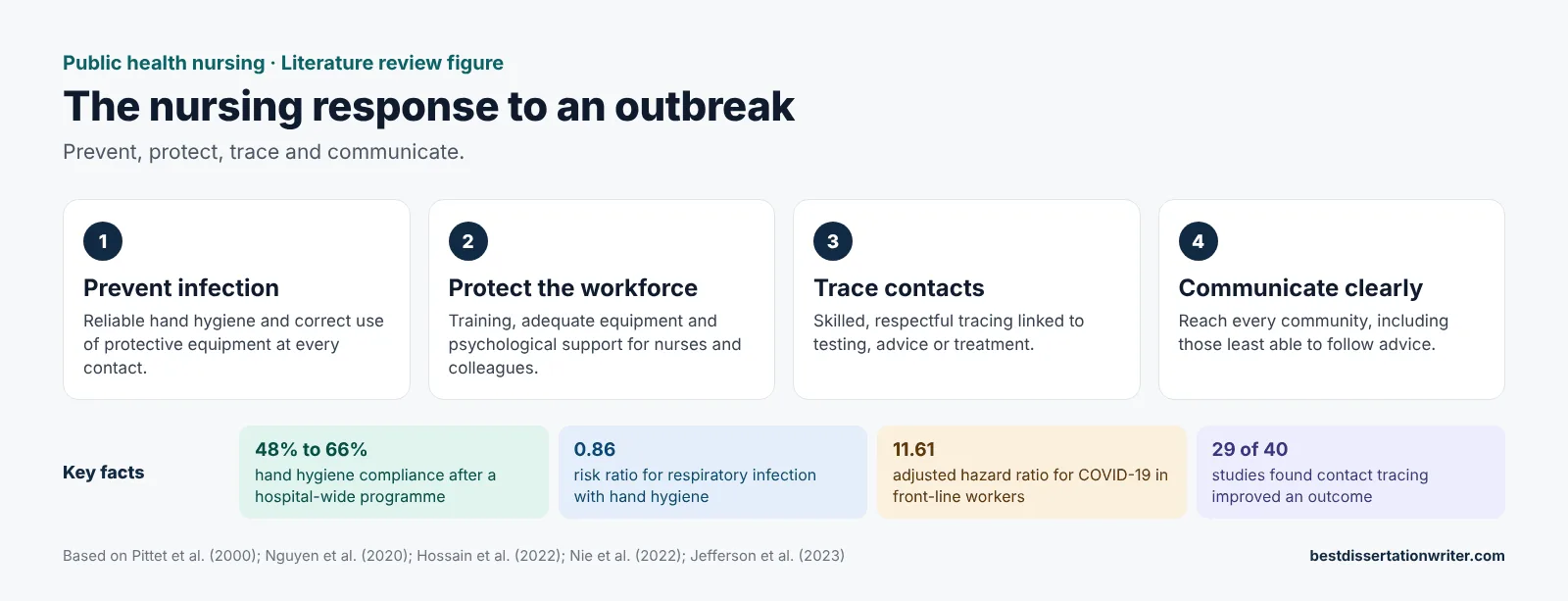
Findings: A hospital-wide programme raised hand hygiene compliance from 48% to 66% and reduced MRSA transmission from 2.16 to 0.93 episodes per 10,000 patient-days. A Cochrane review found that hand hygiene reduced acute respiratory infections (risk ratio 0.86), while evidence on masks was uncertain. Front-line health-care workers had a higher risk of COVID-19 than the community (adjusted hazard ratio 11.61). Most nurses were willing to respond to epidemics but did not feel adequately prepared. Provider-initiated contact tracing was associated with improvement in at least one outcome in 29 of 40 studies.
Conclusion: Hand hygiene, adequate protective equipment, preparedness training and contact tracing are the foundations of the nursing response to a communicable disease outbreak, although the quality of the evidence varies.
Keywords: communicable disease outbreak, outbreak management, contact tracing
Introduction
This scoping review critically examines recent evidence on communicable disease outbreak and its implications for public health nursing practice.
A communicable disease outbreak is a rise in cases of an infectious illness above what would normally be expected in a community, a hospital or a care setting. Outbreaks range from a cluster of norovirus on a single ward to global pandemics, and they can spread quickly through families, schools, workplaces and health services. Responding requires rapid recognition, effective infection prevention, tracing of contacts, care for people who are ill and clear communication with the public.
Nurses are central to every stage of communicable disease outbreak response. In hospitals they carry out hand hygiene, isolation and the use of protective equipment. In the community, school nurses, health visitors, occupational health nurses and public health nurses recognise unusual patterns of illness, advise families, support vaccination and take part in contact tracing. During large outbreaks, nurses also work in testing sites, vaccination centres and enhanced care areas, often at personal risk.
A scoping review approach was chosen because the aim was to map a broad and varied body of evidence, from hospital-based studies to modelling of community responses, rather than to answer a single effectiveness question about one intervention.
Review question
What does the evidence show about infection control measures used in a communicable disease outbreak, how are nurses and other health-care workers affected and how prepared are they, and how effective is contact tracing?
Background to Communicable Disease Outbreak
Management of a communicable disease outbreak follows a set of well-established steps. These include recognising and confirming that an outbreak is under way, describing who is affected, putting control measures in place, communicating with those at risk and reviewing what happened afterwards. Control measures may include isolating cases, tracing and advising contacts, vaccination where available, cleaning and environmental measures and restrictions on movement or visiting.
Infection prevention and control is the bedside foundation of communicable disease outbreak control. Hand hygiene, the correct use of masks, gloves and gowns, safe handling of equipment and the separation of infectious patients all reduce the chance that infection spreads within a health-care setting. Because nurses have the most direct and prolonged contact with patients, their practice has a large influence on whether an outbreak is contained.
Contact tracing aims to find people who have been exposed to an infectious person so that they can be tested, advised or treated before passing the infection on. It has long been used for diseases such as tuberculosis and sexually transmitted infections, and it was used on a very large scale during the COVID-19 pandemic. Nurses were often involved in training, supervising and delivering these services.
The health and wellbeing of nurses is part of outbreak management. Health-care workers can be infected at work, may carry infection to patients and families, and may experience fear, exhaustion and moral distress. A workforce that is protected, trained and supported is more able to sustain an effective response over many weeks or months.
Surveillance and early recognition are also part of the nursing role. A school nurse who notices several children absent with similar symptoms, a practice nurse who sees an unusual cluster of cases or a care home nurse who reports a sudden rise in diarrhoea and vomiting may be the first to alert public health teams. Prompt reporting allows control measures to begin sooner, which can limit the number of people affected. Good records and clear local reporting routes make this possible.
Search Strategy and Methods
Evidence for this example was identified through targeted searches of openly accessible bibliographic records, publisher websites and the reference lists of key reviews. Search terms combined keywords for the problem (“outbreak”, “epidemic”, “pandemic”, “infectious disease”, “communicable disease”) with terms for the response (“nurses”, “infection control”, “hand hygiene”, “personal protective equipment”, “contact tracing”, “preparedness”), joined with the Boolean operators AND and OR. A full scoping review of communicable disease outbreak responses for assessment would follow the JBI scoping review method, run the same strategy in CINAHL, PubMed/MEDLINE, the Cochrane Library and Web of Science and report the number of records screened in a PRISMA-ScR flow diagram.
Sources were eligible if they examined interventions or evidence relevant to the nursing response to a communicable disease outbreak, including infection prevention, risks to health-care workers, preparedness and contact tracing. Intervention studies, cohort studies and systematic reviews were included. Opinion pieces and papers about a single organism or a single outbreak without wider relevance were excluded.
Five sources on communicable disease outbreak response published between 2000 and 2023 were included: a hospital-wide intervention study, a prospective cohort study, a narrative synthesis, a systematic review and a Cochrane review (Table 1). Consistent with scoping review methods, findings were charted and summarised descriptively rather than formally appraised.
Key Findings on Communicable Disease Outbreak
Three themes were identified: infection prevention through hand hygiene and protective equipment, the protection and preparedness of nurses and other health-care workers, and contact tracing as a tool for outbreak management. Table 1 summarises the included sources, and Figure 1 shows the effects of hand hygiene and masks reported by the Cochrane review.
| Author, year | Design | Setting and sample | Key finding |
|---|---|---|---|
| Pittet et al. (2000) | Hospital-wide intervention study | Swiss teaching hospital; >20,000 hand hygiene opportunities | Compliance 48% to 66%; MRSA transmission 2.16 to 0.93 per 10,000 patient-days. |
| Nguyen et al. (2020) | Prospective cohort study | 99,795 front-line workers; 2,035,395 community members | Adjusted hazard ratio for COVID-19 11.61 in front-line workers (3.40 after testing adjustment). |
| Hossain et al. (2022) | Systematic review | 47 studies; >2 million index patients | 29 of 40 studies found provider-initiated tracing improved at least one outcome. |
| Nie et al. (2022) | Narrative synthesis | 15 studies of nurses | Most nurses willing to respond but not adequately prepared. |
| Jefferson et al. (2023) | Cochrane systematic review | 78 randomised trials | Hand hygiene reduced acute respiratory infection (RR 0.86); mask evidence uncertain. |
Theme 1: Infection Prevention in a Communicable Disease Outbreak
Pittet et al. (2000) described a hospital-wide programme in a Swiss teaching hospital that promoted bedside alcohol-based hand rub. Seven surveys of more than 20,000 hand hygiene opportunities between 1994 and 1997 showed compliance rising from 48% to 66%. Nurses and nursing assistants improved significantly, whereas doctors remained poorly compliant. Over the same period, the prevalence of hospital-acquired infection fell from 16.9% to 9.9%, and transmission of meticillin-resistant Staphylococcus aureus (MRSA) fell from 2.16 to 0.93 episodes per 10,000 patient-days. The study was not randomised, so the programme cannot be proved to have caused all of these changes.
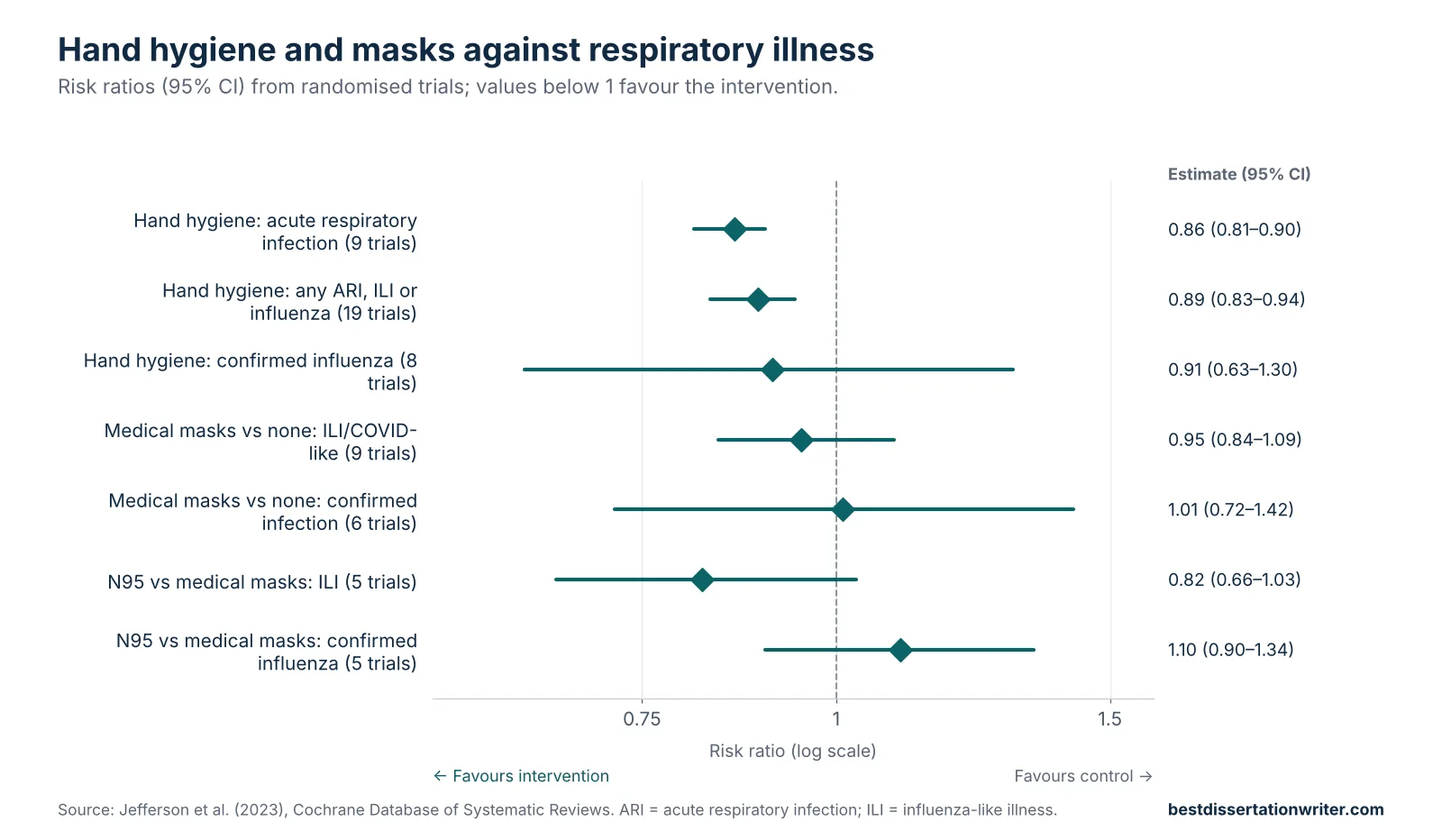
Jefferson et al. (2023) updated a Cochrane review of physical interventions to reduce the spread of respiratory viruses, including 78 randomised trials. Hand hygiene reduced acute respiratory infections by 14% (risk ratio 0.86; 95% confidence interval 0.81 to 0.90; 9 trials, 52,105 participants) with moderate-certainty evidence, although effects on influenza-like illness and laboratory-confirmed influenza analysed separately were not clear. Medical masks compared with no masks made little or no difference to influenza-like illness or laboratory-confirmed infection (risk ratio 0.95 and 1.01) in moderate-certainty evidence.
In health-care settings, N95 or P2 respirators compared with medical masks showed no clear difference in laboratory-confirmed influenza (risk ratio 1.10; 95% CI 0.90 to 1.34), and evidence for other outcomes was of low or very low certainty. No randomised trials were found for gowns, gloves or face shields. The authors noted that harms were poorly measured and that adherence to interventions was often low, which is a reminder that the way equipment is used matters as much as the equipment itself.
Theme 2: Protecting and Preparing Nurses for a Communicable Disease Outbreak
Nguyen et al. (2020) analysed self-reported data from 2,035,395 members of the community and 99,795 front-line health-care workers in the United Kingdom and United States who used a COVID-19 symptom app between March and April 2020. There were 5,545 positive test reports over 34,435,272 person-days. Front-line health-care workers had a markedly higher risk of a positive test (adjusted hazard ratio 11.61; 95% CI 10.93 to 12.33). The ratio fell to 3.40 (95% CI 3.37 to 3.43) after adjustment for the greater likelihood that these workers would be tested.
Even the lower figure indicates a substantially higher risk, and the authors reported that the adequacy of personal protective equipment, the clinical setting and ethnic background were also important. They concluded that health-care systems should ensure adequate protective equipment and develop additional protective strategies, especially for Black, Asian and minority ethnic workers. The data were self-reported and drawn from app users, so the findings may not be representative of all health-care workers.
Nie et al. (2022) undertook a narrative synthesis of 15 studies of nurses’ preparedness for infectious disease outbreaks. Four themes emerged: knowledge and skills, psychological preparation, external resources, and attitude and intention. Most nurses were willing to respond to epidemics, but most did not believe that they were adequately prepared. The authors recommended ongoing training, protective equipment, safer working conditions, psychological support, resilience-building and faster sharing of scientific information.
Theme 3: Contact Tracing in Communicable Disease Outbreak Management
Hossain et al. (2022) searched PubMed, Embase and the Cochrane Library up to November 2021 and identified 9,050 unique citations, of which 47 studies met their criteria: 6 on COVID-19, 20 on tuberculosis, 8 on HIV, 12 on curable sexually transmitted infections and 1 on measles. The studies included more than 2 million index patients. Twenty-nine (61.7%) were observational, including all of the COVID-19 studies, and 18 (38.3%) were randomised controlled trials.
Of the 40 studies that evaluated provider-initiated contact tracing, 29 (72.5%) found that it was associated with improvement in at least one outcome, including 4 of the 6 COVID-19 studies. Risk of bias was low in 23 studies, moderate in 22 and high in 2. The authors concluded that provider-initiated contact tracing can be an effective public health tool, but that varied approaches, limited quantitative evidence and a lack of detail about the most important tracing parameters limited the conclusions that could be drawn.
Discussion
This scoping review shows that the foundations of the nursing response to a communicable disease outbreak are well supported. Hand hygiene programmes improved compliance and coincided with fewer infections, the Cochrane review supported hand hygiene for reducing respiratory illness, and provider-initiated contact tracing was associated with improvement in a majority of studies that evaluated it. At the same time, the evidence for some measures, such as masks, was uncertain, and no trials were found for others.
Uncertain evidence does not mean that measures should be abandoned. In many cases the absence of trials reflects the difficulty of carrying out randomised studies of protective equipment in real outbreaks, and nurses should follow national infection prevention guidance, which draws on a wider body of evidence, including laboratory and observational studies. The review does, however, highlight the importance of research that is designed before the next communicable disease outbreak begins.
The findings on health-care worker risk show that protecting nurses is a core part of protecting patients. Higher infection rates among front-line staff, the importance of adequate equipment, and the finding that most nurses did not feel prepared point to the need for training, fit testing, safe staffing and psychological support. These are matters for employers and systems as well as for individual nurses.
Contact tracing worked best where it was carried out by trained providers and linked to testing or treatment. Nurses bring communication skills, trust and an understanding of local communities that are well suited to this work, particularly for conversations about sensitive matters such as sexual contacts or housing. Quality is likely to depend on training and supervision, but the review did not identify trials of nurse-led tracing specifically.
Communication is a thread running through all of the themes. Staff need clear and consistent guidance on what to do, patients and families need honest explanations of why restrictions are in place, and contacts need to trust the person who calls them. Nurses are often the most visible and trusted members of the health-care team, and the way they explain and reassure can affect whether people follow advice. Training in communication, and not only in technical procedures, is therefore valuable.
Equity is central. Nguyen et al. (2020) found particular concerns for Black, Asian and minority ethnic workers, and the same pressures can affect patients and communities with less secure housing, work or access to services. Communicable disease outbreak management should therefore consider who is most exposed and least able to follow advice, and ensure that communication is clear, accessible and trusted.
Several limitations should be noted. The five sources came from different settings and used different designs, from a single-hospital programme to a large app-based cohort, so they cannot be combined directly. Many of the studies were observational and some measured outcomes by self-report. This review relied on openly accessible, English-language sources and did not involve formal systematic screening. Future research should evaluate nurse-led outbreak roles, preparedness training and the wellbeing of staff after outbreaks.
Implications of Communicable Disease Outbreak Evidence for Practice
For nurses, the evidence supports consistent hand hygiene, correct use of protective equipment, early recognition and reporting of unusual illness, participation in preparedness training and skilled, respectful contact tracing. Nurses can also build relationships with groups at higher risk, such as people experiencing homelessness, and bring the same public health approach used in areas such as alcohol harm reduction and vaccination uptake. Up-to-date national guidance is available from the UK Health Security Agency.
Managers should ensure that protective equipment is available and that staff are trained and fit tested, that staffing allows safe infection control, that preparedness exercises are regular and that support is provided for the wellbeing of staff during and after an outbreak. Services should also plan for contact tracing capacity and for communication that reaches all groups.
Conclusion
This scoping review mapped evidence on the nursing response to a communicable disease outbreak. Hand hygiene programmes, protective equipment, preparedness and contact tracing all have a role, although the strength of evidence varies and some questions remain unanswered. Front-line staff carry a high risk, and most nurses did not feel well prepared.
When a communicable disease outbreak occurs, nurses are present from the first suspicion to the final review. By keeping infection prevention practice reliable, protecting themselves and their colleagues, tracing contacts with skill and communicating clearly with the public, nurses can help to limit the harm that outbreaks cause.
References
Hossain, A. D., Jarolimova, J., Elnaiem, A., Huang, C. X., Richterman, A., & Ivers, L. C. (2022). Effectiveness of contact tracing in the control of infectious diseases: A systematic review. The Lancet Public Health, 7(3), e259–e273. https://doi.org/10.1016/S2468-2667(22)00001-9
Jefferson, T., Dooley, L., Ferroni, E., Al-Ansary, L. A., van Driel, M. L., Bawazeer, G. A., Jones, M. A., Hoffmann, T. C., Clark, J., Beller, E. M., Glasziou, P. P., & Conly, J. M. (2023). Physical interventions to interrupt or reduce the spread of respiratory viruses. Cochrane Database of Systematic Reviews, (1), CD006207. https://doi.org/10.1002/14651858.CD006207.pub6
Nguyen, L. H., Drew, D. A., Graham, M. S., Joshi, A. D., Guo, C.-G., Ma, W., Mehta, R. S., Warner, E. T., Sikavi, D. R., Lo, C.-H., Kwon, S., Song, M., Mucci, L. A., Stampfer, M. J., Willett, W. C., Eliassen, A. H., Hart, J. E., Chavarro, J. E., Rich-Edwards, J. W., … Chan, A. T. (2020). Risk of COVID-19 among front-line health-care workers and the general community: A prospective cohort study. The Lancet Public Health, 5(9), e475–e483. https://doi.org/10.1016/S2468-2667(20)30164-X
Nie, A., Su, X., Dong, M., & Guan, W. (2022). Are nurses prepared to respond to next infectious disease outbreak: A narrative synthesis. Nursing Open, 9(2), 908–919. https://doi.org/10.1002/nop2.1170
Pittet, D., Hugonnet, S., Harbarth, S., Mourouga, P., Sauvan, V., Touveneau, S., & Perneger, T. V. (2000). Effectiveness of a hospital-wide programme to improve compliance with hand hygiene. The Lancet, 356(9238), 1307–1312. https://doi.org/10.1016/S0140-6736(00)02814-2
Cite this example
Best Dissertation Writers (2026) Nursing Roles in Communicable Disease Outbreak Management and Control: A Scoping Review. Available at: https://bestdissertationwriter.com/communicable-disease-outbreak-review/
Best Dissertation Writers
Get expert help with your nursing literature review
Share your topic and deadline with Best Dissertation Writers and get support tailored to your module brief.