Alcohol Harm Reduction and Brief Interventions Delivered by Nurses: A Systematic Review
 By Dr. Robertson Prime, Research Fellow
Updated October 28, 2026
14 min read
About 2,800 words
In this review
Abstract
Background: Alcohol harm reduction is a central public health aim, because alcohol contributes to about 2.6 million deaths each year worldwide and to a wide range of injuries, illnesses and social problems. Nurses in primary care, hospitals and community services see large numbers of people who drink at hazardous levels and are well placed to offer short, structured advice.
Aim: This systematic review aimed to examine the evidence on the effectiveness of brief alcohol interventions and the contribution of nurses to delivering them.
Methods: Evidence was identified through targeted searches of openly accessible bibliographic records, publisher websites and the reference lists of key reviews. Five sources published between 2006 and 2024 were included: a narrative review of the nursing role, two Cochrane reviews, a meta-regression of randomised trials and a global fact sheet. The research sources were appraised using CASP checklists and synthesised narratively.
Findings: A Cochrane review of 69 trials found that brief interventions in primary care reduced alcohol consumption by about 20 grams per week at one year, with moderate-certainty evidence. A meta-regression of 52 trials found that nurse-delivered interventions had the largest effect on the quantity of alcohol consumed (d = -0.23). In general hospital wards, brief interventions reduced consumption at six months and were associated with fewer deaths at one year (risk ratio 0.60). Longer counselling added little to brief advice.
Conclusion: Brief interventions give a small but worthwhile reduction in drinking, and nurses appear to be effective providers. Nurses should ask about alcohol routinely, offer brief advice and refer people with dependence for specialist support.
Keywords: alcohol harm reduction, brief intervention, alcohol brief interventions
Introduction
This systematic review critically examines recent evidence on alcohol harm reduction and its implications for public health nursing practice.
Alcohol harm reduction matters because alcohol is a leading cause of preventable illness and death. The World Health Organization (WHO) estimates that around 2.6 million deaths were attributable to alcohol in 2019, including 1.6 million from noncommunicable diseases, 700,000 from injuries and 300,000 from communicable diseases. An estimated 400 million people aged 15 and over, or 7% of that age group, lived with an alcohol use disorder. Many more drink at levels that increase their risk of harm without being dependent.
Most people who drink hazardously do not seek help for their drinking and will never see an alcohol specialist. They do, however, come into contact with health services for other reasons, whether for a check-up, an injury, a long-term condition or a hospital admission. These contacts offer an opportunity to ask about alcohol and to give brief advice. This approach is the basis of alcohol harm reduction in routine health care, and nurses are often the professionals who see people most frequently.
A systematic review design was chosen because the question concerns the effectiveness of interventions and because several good-quality syntheses already exist.
Review question
How effective are brief interventions for alcohol harm reduction, does it matter who delivers them or where, and what does the evidence suggest for the nursing role?
Background to Alcohol Harm Reduction
Alcohol harm reduction covers a spectrum of approaches, from population measures such as pricing and licensing to individual support for people who drink heavily. In health services, the most widely studied approach is screening followed by a brief intervention. Screening uses a short questionnaire to identify people who drink above recommended levels. A brief intervention then offers structured advice, feedback and encouragement to cut down, usually in a few minutes and sometimes over several short sessions.
Brief interventions vary in content. Some are simple advice about safe limits, others use motivational techniques that help a person to weigh up the pros and cons of change, and some include a leaflet or follow-up call. They are intended for people at increased risk, not for people with severe dependence, who need specialist assessment and treatment and may require medical support to withdraw safely.
The settings in which alcohol harm reduction work is delivered also vary. Most early research was done in primary care, but interventions have also been tested in hospital wards, emergency departments, workplaces and community venues. The professional delivering the intervention may be a doctor, a nurse, a counsellor or a lay worker, and the question of who is most effective is relevant to service planning.
Nurses already carry out many of the tasks involved, including taking histories, giving health advice and following up patients. Asking about alcohol in a way that is non-judgemental, and responding helpfully to the answer, requires skill and confidence. Stigma can make people reluctant to discuss drinking, so the manner in which the question is asked can be as important as the question itself.
Harm from alcohol extends beyond the person who drinks. Families may experience violence, financial hardship and emotional distress, children may be neglected, and communities bear the costs of accidents, crime and lost productivity. Because the harms are so wide, even small reductions in drinking among many people can matter. At the same time, people may feel ashamed or defensive when alcohol is raised, so health professionals need to approach the subject with respect and curiosity rather than blame.
Search Strategy and Methods
Evidence for this example was identified through targeted searches of openly accessible bibliographic records, publisher websites and the reference lists of key reviews. Search terms combined keywords for the problem (“alcohol harm reduction”, “hazardous drinking”, “harmful drinking”, “heavy drinkers”) with terms for the intervention and provider (“brief intervention”, “brief advice”, “screening”, “nurse”, “primary care”, “hospital”), joined with the Boolean operators AND and OR. A full systematic review of alcohol harm reduction for assessment would run the same strategy in CINAHL, PubMed/MEDLINE, the Cochrane Library and Web of Science and report the number of records screened in a PRISMA flow diagram.
Sources were eligible if they evaluated brief interventions for alcohol harm reduction among hazardous or harmful drinkers, or described the nursing role in delivering them, or provided authoritative data on the scale of alcohol harm. Systematic reviews and meta-analyses were prioritised. Studies of treatment for severe alcohol dependence were excluded.
Five sources published between 2006 and 2024 were included: a systematic review of the nursing role, two Cochrane reviews, a systematic review with meta-regression and the WHO fact sheet that provides global context (Table 1). The quality of each research source was considered using the Critical Appraisal Skills Programme (CASP) checklists, and findings were synthesised narratively.
Key Findings on Alcohol Harm Reduction
Three themes were identified: the effectiveness of brief interventions for alcohol harm reduction in primary care, the contribution of nurses as providers, and the evidence from hospital wards. Table 1 summarises the included sources, and Figure 1 shows the effects on weekly alcohol consumption reported by the Cochrane review of primary care.
| Author, year | Design | Setting and sample | Key finding |
|---|---|---|---|
| Hyman (2006) | Systematic review | Literature on brief intervention and the nursing role | Brief intervention supported in primary care; nurse role poorly defined; no meta-analyses of nurse delivery. |
| McQueen et al. (2011) | Cochrane systematic review | 14 trials; 4,041 hospital patients | Lower consumption at 6 and 9 months; deaths fewer at 1 year (RR 0.60). |
| Platt et al. (2016) | Systematic review and meta-regression | 52 trials; 29,891 participants | Overall effect 0.15 SD; nurse-delivered effect d = -0.23 on quantity. |
| Kaner et al. (2018) | Cochrane systematic review | 69 trials; 33,642 participants | About 20 g less alcohol per week at 1 year; longer counselling added little. |
| World Health Organization (2024) | Fact sheet (global data, 2019) | Worldwide estimates | About 2.6 million alcohol-attributable deaths; 400 million with alcohol use disorders. |
Theme 1: Alcohol Harm Reduction Through Brief Interventions in Primary Care
Kaner et al. (2018) updated a Cochrane review of brief alcohol interventions in primary care populations. It included 69 trials with 33,642 participants, of which 34 studies with 15,197 participants contributed to the main analysis. At one year, people who received a brief intervention drank about 20 grams less alcohol per week than people who received minimal or no intervention (95% confidence interval 12 to 28 grams less), with moderate-certainty evidence. Binge drinking episodes fell by 0.08 per week and drinking days by 0.13 per week.
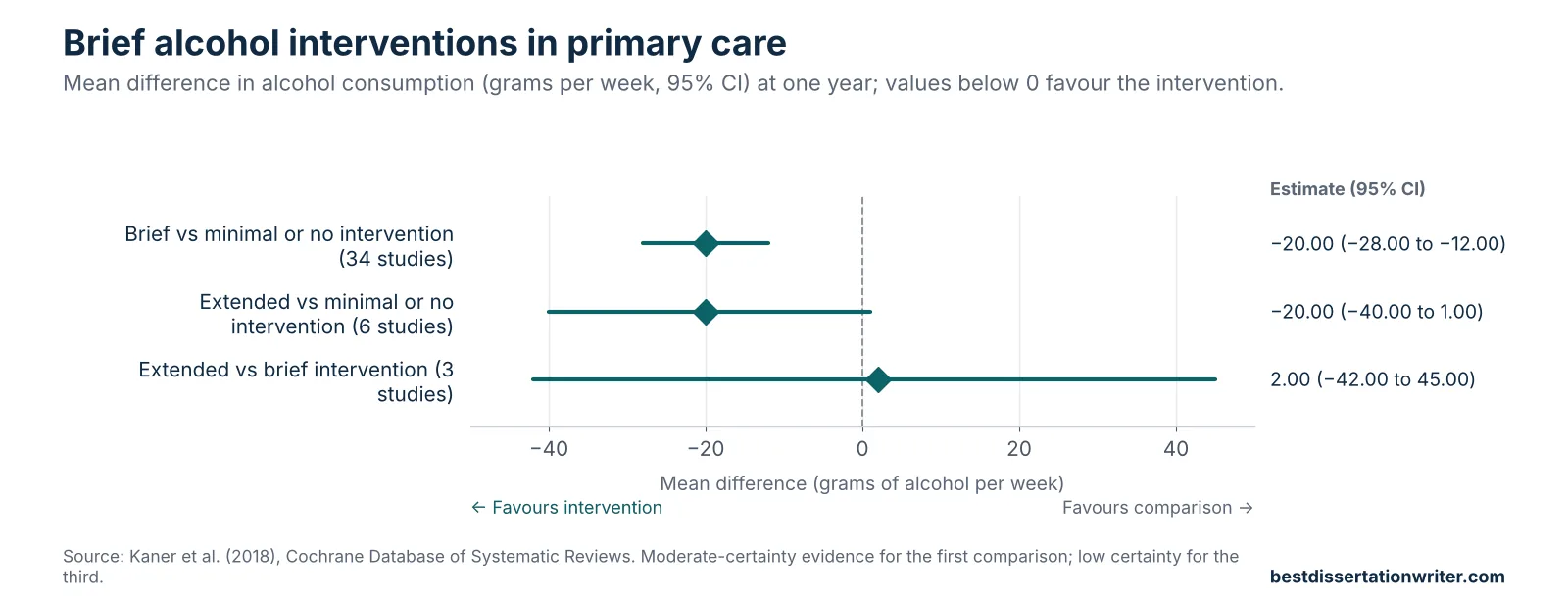
Results varied considerably between studies, with substantial heterogeneity (I² = 73%). Longer, extended counselling probably added little to a brief intervention (a difference of 2 grams per week, with a very wide confidence interval from -42 to 45; low-certainty evidence). Only five studies reported adverse effects, and the quality of that evidence was very low. One study found that a brief intervention increased binge drinking among women. The authors concluded that brief interventions reduce consumption in hazardous and harmful drinkers and that future research should identify the most effective components.
Theme 2: Nurses as Providers of Alcohol Harm Reduction
Hyman (2006) reviewed the literature on brief interventions and the role of the nurse. Six systematic reviews and meta-analyses supported brief intervention in primary care, but most trials had focused on doctors. Three randomised controlled trials highlighted the role of staff or clinic nurses, and there were no meta-analyses of nurse-delivered interventions. The author described the nurse’s role as poorly defined and a major gap in both nursing and alcohol research, while arguing that, because screening and health promotion are central to nursing, nurses should consider using brief intervention in daily practice.
Platt et al. (2016) later examined whether setting, provider and content affected the results of brief interventions. They included 52 randomised trials with 29,891 participants. Overall, brief interventions reduced the quantity of alcohol consumed by 0.15 standard deviations. Setting and content did not significantly change effectiveness, but the provider mattered in some analyses. Nurse-delivered interventions had the largest effect on quantity (d = -0.23; 95% CI -0.33 to -0.13), although they had no effect on frequency of drinking.
Brief advice was the most effective content for reducing the quantity consumed (d = -0.20; 95% CI -0.30 to -0.09). The authors concluded that brief interventions have a small but significant effect on drinking, that nurses appear to be effective deliverers, and that, because differences between types of content were not clear, services can choose the tool that best fits their needs. These findings address the gap identified a decade earlier by Hyman.
Theme 3: Alcohol Harm Reduction on Hospital Wards
McQueen et al. (2011) reviewed brief interventions for heavy drinkers admitted to general hospital wards. The review included 14 randomised and controlled trials with 4,041 participants, mainly male adults and adolescents aged 16 and over, mostly in the United Kingdom and United States. Interventions consisted of up to three sessions and were compared with no intervention or usual care.
Brief interventions reduced alcohol consumption at six months and nine months, although the reduction was not maintained at one year. At one year, self-reported consumption was lower in the intervention groups (standardised mean difference -0.26; 95% CI -0.50 to -0.03). Deaths were fewer in the intervention groups at six months (risk ratio 0.42; 95% CI 0.19 to 0.94) and at one year (risk ratio 0.60; 95% CI 0.40 to 0.91). The authors concluded that brief interventions are beneficial for heavy drinkers in hospital but that the best content and amount of treatment remain uncertain, and that the participants were mainly men.
Discussion
This review shows that alcohol harm reduction through brief interventions is supported by good evidence, although the effects are modest. In primary care, a brief intervention was associated with about 20 grams less alcohol per week at one year. In hospital, brief interventions reduced consumption in the short term and were associated with fewer deaths. Nurses appeared to be effective providers, and longer counselling added little.
A reduction of 20 grams per week is small for any individual, since one UK unit of alcohol is 8 grams. Across a population, however, many small reductions among large numbers of hazardous drinkers can prevent substantial harm. Brief interventions are also cheap, quick and acceptable, which makes them suitable for wide use in alcohol harm reduction. They are not a substitute for treatment for people who are dependent.
The evidence on nurses is encouraging but should be read with care. The larger effect on quantity for nurse-delivered interventions may reflect differences in the trials as well as in the nurses, since studies differ in populations and methods. It does, however, address the concern raised by Hyman (2006) that evidence for the nursing role was thin, and it suggests that nurses can deliver this work at least as well as other professionals.
A hospital admission may be an especially useful moment for a conversation. People who are unwell or injured may be more willing to think about their drinking, and ward nurses have time and continuity that other professionals lack. The results from hospital wards suggest that even a short intervention can make a difference in the following months, although the benefits on consumption faded by one year, which suggests that follow-up or repeated advice may be needed to sustain change.
Implementation is the main challenge for alcohol harm reduction in routine nursing. Asking about alcohol and giving advice are easy to leave out when time is short, and some staff feel unsure or worry about causing offence. Training, simple screening tools, clear pathways for referral and encouragement from managers help to embed the work. The evidence on how to deliver brief interventions to best effect, particularly the components that matter most, is still developing.
Stigma and equity deserve attention. People who drink heavily may already have experienced judgemental attitudes from services, and some groups, including women, young people and those facing poverty or insecure housing, may be missed by routine screening. Nurses can help by using neutral language, explaining why they are asking and offering support at a pace that suits the person. Making alcohol part of every assessment, rather than raising it only when a problem seems obvious, may also reduce stigma.
Limitations apply. Heterogeneity was high in the primary care review, most hospital participants were men, adverse effects were rarely reported and many trials relied on self-reported drinking. This review relied on openly accessible, English-language sources and did not involve formal systematic screening. Future research should test nurse-delivered interventions in groups that have been under-represented, including women, older people and people facing social disadvantage.
Implications of Alcohol Harm Reduction Evidence for Practice
For nurses, the evidence supports routine questions about alcohol, a brief intervention for those drinking at hazardous levels, and referral for people who may be dependent. People experiencing homelessness face particularly high risks and may need tailored support, while conversations about drinking can fit naturally alongside advice on smoking cessation and community mental health promotion. National guidance on alcohol and health is available from the WHO alcohol fact sheet.
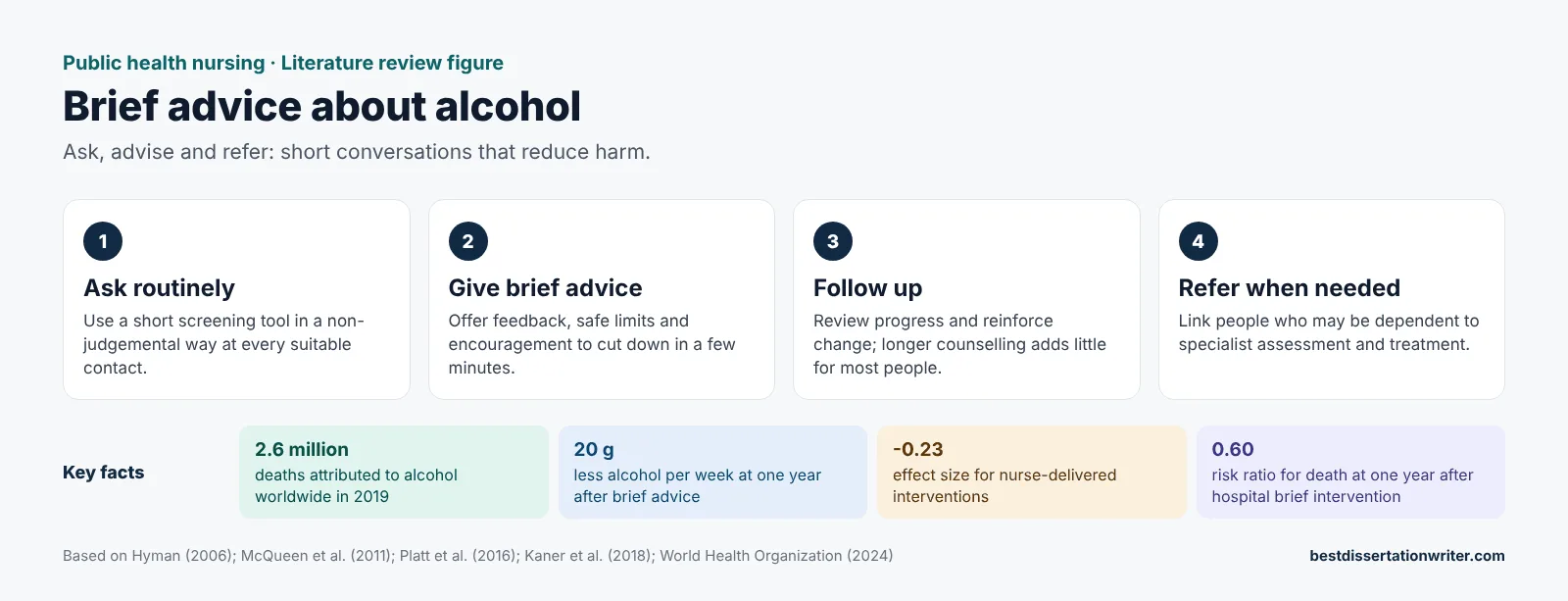
In practice, a brief intervention can be delivered in a few steps. The nurse asks permission to talk about alcohol, uses a validated screening questionnaire, gives feedback on what the answers suggest about risk, explains safer limits and invites the person to consider whether they would like to cut down. A realistic goal is agreed, and follow-up is arranged where possible. Throughout, the nurse listens and respects the person’s own views about change.
Managers and commissioners should provide training in screening and brief advice, make short screening tools part of routine assessment, set up clear referral pathways to specialist services and monitor how often alcohol is discussed. Giving staff the time and confidence to raise the subject is as important as providing the materials.
Conclusion
This systematic review examined evidence on alcohol harm reduction through brief interventions and the role of nurses. Brief interventions reduce drinking by a modest amount in primary care and hospital settings, nurses appear to be effective providers, and longer counselling adds little.
Alcohol harm reduction depends on many people asking the right question at the right moment. By asking routinely, giving brief advice without judgement and linking people to specialist help when it is needed, nurses can make a real contribution to reducing the harm that alcohol causes.
References
Hyman, Z. (2006). Brief interventions for high-risk drinkers. Journal of Clinical Nursing, 15(11), 1383–1396. https://doi.org/10.1111/j.1365-2702.2006.01458.x
Kaner, E. F. S., Beyer, F. R., Muirhead, C., Campbell, F., Pienaar, E. D., Bertholet, N., Daeppen, J. B., Saunders, J. B., & Burnand, B. (2018). Effectiveness of brief alcohol interventions in primary care populations. Cochrane Database of Systematic Reviews, (2), CD004148. https://doi.org/10.1002/14651858.CD004148.pub4
McQueen, J., Howe, T. E., Allan, L., Mains, D., & Hardy, V. (2011). Brief interventions for heavy alcohol users admitted to general hospital wards. Cochrane Database of Systematic Reviews, (8), CD005191. https://doi.org/10.1002/14651858.CD005191.pub3
Platt, L., Melendez-Torres, G. J., O’Donnell, A., Bradley, J., Newbury-Birch, D., Kaner, E., & Ashton, C. (2016). How effective are brief interventions in reducing alcohol consumption: Do the setting, practitioner group and content matter? Findings from a systematic review and metaregression analysis. BMJ Open, 6(8), e011473. https://doi.org/10.1136/bmjopen-2016-011473
World Health Organization. (2024, June 28). Alcohol [Fact sheet]. https://www.who.int/news-room/fact-sheets/detail/alcohol
Cite this example
Best Dissertation Writers (2026) Alcohol Harm Reduction and Brief Interventions Delivered by Nurses: A Systematic Review. Available at: https://bestdissertationwriter.com/alcohol-harm-reduction-review-review/
Best Dissertation Writers
Get expert help with your nursing literature review
Share your topic and deadline with Best Dissertation Writers and get support tailored to your module brief.