Safeguarding Vulnerable Adults in the Home: The Role of Community Nurses: An Integrative Review
 By Dr. Robertson Prime, Research Fellow
Updated October 12, 2026
14 min read
About 2,800 words
By Dr. Robertson Prime, Research Fellow
Updated October 12, 2026
14 min read
About 2,800 words
In this review
Abstract
Background: Safeguarding vulnerable adults is a core responsibility for community nurses, who often see people alone in their own homes, where abuse and neglect can remain hidden. Older people, people with disabilities and those who depend on others for care are at particular risk.
Aim: This integrative review aimed to examine the evidence on abuse and neglect of adults at risk in the community and the role of community nurses in safeguarding.
Methods: Evidence was identified through targeted searches of openly accessible bibliographic records, publisher websites and the reference lists of key reviews. Five sources published between 2007 and 2025 were included: a national prevalence study, a systematic review and meta-analysis, an ethnographic study, a national analysis of Safeguarding Adult Reviews and national safeguarding statistics, synthesised thematically.
Findings: Around one in six older adults worldwide experienced abuse in the past year, most commonly psychological abuse (11.6%). In England, the person’s own home was the most common location of risk (51.9%) and neglect the most common type (40.8%). Self-neglect featured in 60% of Safeguarding Adult Reviews, and shortcomings in attention to mental capacity (58%) and professional curiosity (44%) were common. Dignified district nursing care was identified as protective.
Conclusion: Community nurses should combine dignified everyday care with professional curiosity, attention to mental capacity and timely multi-agency referral.
Keywords: safeguarding vulnerable adults, safeguarding adults, community nurse, home visits
Introduction
This integrative review critically examines recent evidence on safeguarding vulnerable adults and its implications for community nursing practice.
Abuse and neglect of adults can take many forms: physical, psychological, sexual and financial abuse, neglect by others, self-neglect, domestic abuse, discriminatory abuse and modern slavery. People who depend on others for care, who have cognitive impairment or who are socially isolated are particularly vulnerable, and much of this harm happens in private, in people’s own homes, away from the view of professionals.
Community nurses are among the few professionals who regularly enter those homes. During home visits, a district nurse or community nurse may notice unexplained injuries, a person who seems frightened of a family member, unpaid bills, a lack of food or heating, or a person whose own self-care has broken down. These observations place nurses in a unique position to recognise harm, but also present difficult judgements about when and how to act.
An integrative approach was chosen because the evidence includes prevalence studies, a meta-analysis, qualitative research, national reviews and official statistics, which together describe the scale of harm, its patterns and the lessons for practice.
Safeguarding vulnerable adults also raises questions of language and rights. Current guidance in England prefers the term adults at risk, recognising that vulnerability arises from circumstances as well as from personal characteristics. Whatever the term, the aim is to enable people to live safely, free from abuse and neglect, while respecting their right to make their own choices.
Review question
What does the evidence show about abuse and neglect of adults at risk in the community, and what is the role of community nurses in safeguarding?
Background to Safeguarding Vulnerable Adults
In England, the Care Act 2014 placed safeguarding vulnerable adults on a statutory footing. Local authorities must make enquiries, known as Section 42 enquiries, when they have reasonable cause to suspect that an adult with care and support needs is experiencing, or at risk of, abuse or neglect and cannot protect themselves. Safeguarding Adults Boards bring together local agencies and must commission Safeguarding Adult Reviews when an adult dies or is seriously harmed and there is concern that agencies could have worked together more effectively.
The Act also recognised self-neglect as a safeguarding concern. Self-neglect covers a wide range of situations, from neglecting personal hygiene and health to hoarding, and it raises difficult questions about autonomy and capacity. Under the Mental Capacity Act 2005, adults are presumed to have capacity, and people with capacity have the right to make unwise decisions, yet capacity may be impaired or may fluctuate, and decisions about specific matters need careful assessment.
Making Safeguarding Personal is a key principle in English adult safeguarding. It emphasises working with people to understand the outcomes they want, rather than imposing processes on them. For community nurses, this means involving the person in decisions wherever possible, respecting their views and balancing protection with autonomy.
All nurses share responsibility for safeguarding vulnerable adults and have a duty to recognise and report concerns, and organisations provide training, policies and named safeguarding leads. However, recognising abuse in the home is rarely straightforward. Signs may be subtle, carers may be under severe strain, and people may be reluctant to disclose abuse by someone they love or depend on.
Carer strain is an important context for safeguarding vulnerable adults at home. Many family carers provide care with little support, and exhaustion, frustration or lack of knowledge can contribute to neglect or harm without any intent to abuse. Recognising and supporting struggling carers is therefore part of prevention, and community nurses can often identify strain before it leads to harm during routine home visits.
Search Strategy and Methods
Evidence for this example was identified through targeted searches of openly accessible bibliographic records, publisher websites and the reference lists of key reviews. Search terms combined keywords for the concept (“adult safeguarding”, “elder abuse”, “abuse”, “neglect”, “self-neglect”) with terms for the setting and profession (“community nursing”, “district nursing”, “home”, “older people”, “Safeguarding Adult Review”), joined with the Boolean operators AND and OR. A full integrative review for assessment would run the same strategy in CINAHL, PubMed/MEDLINE, the Cochrane Library and Social Care Online and report the number of records screened in a PRISMA flow diagram.
Sources were eligible if they examined the prevalence or patterns of abuse and neglect of adults in community settings, or the role of nurses and agencies in safeguarding vulnerable adults, using any design. National data and reviews from England were included because they reflect the legal and service context in which community nurses work. Studies limited to children or to hospital settings were excluded.
Five sources published between 2007 and 2025 were included: a national prevalence study, a systematic review and meta-analysis, an ethnographic study, a national analysis of Safeguarding Adult Reviews and national safeguarding statistics (Table 1). The quality of each source was considered using the Critical Appraisal Skills Programme (CASP) checklists where appropriate, and findings were synthesised thematically in line with integrative review methods.
Key Findings on Safeguarding Vulnerable Adults
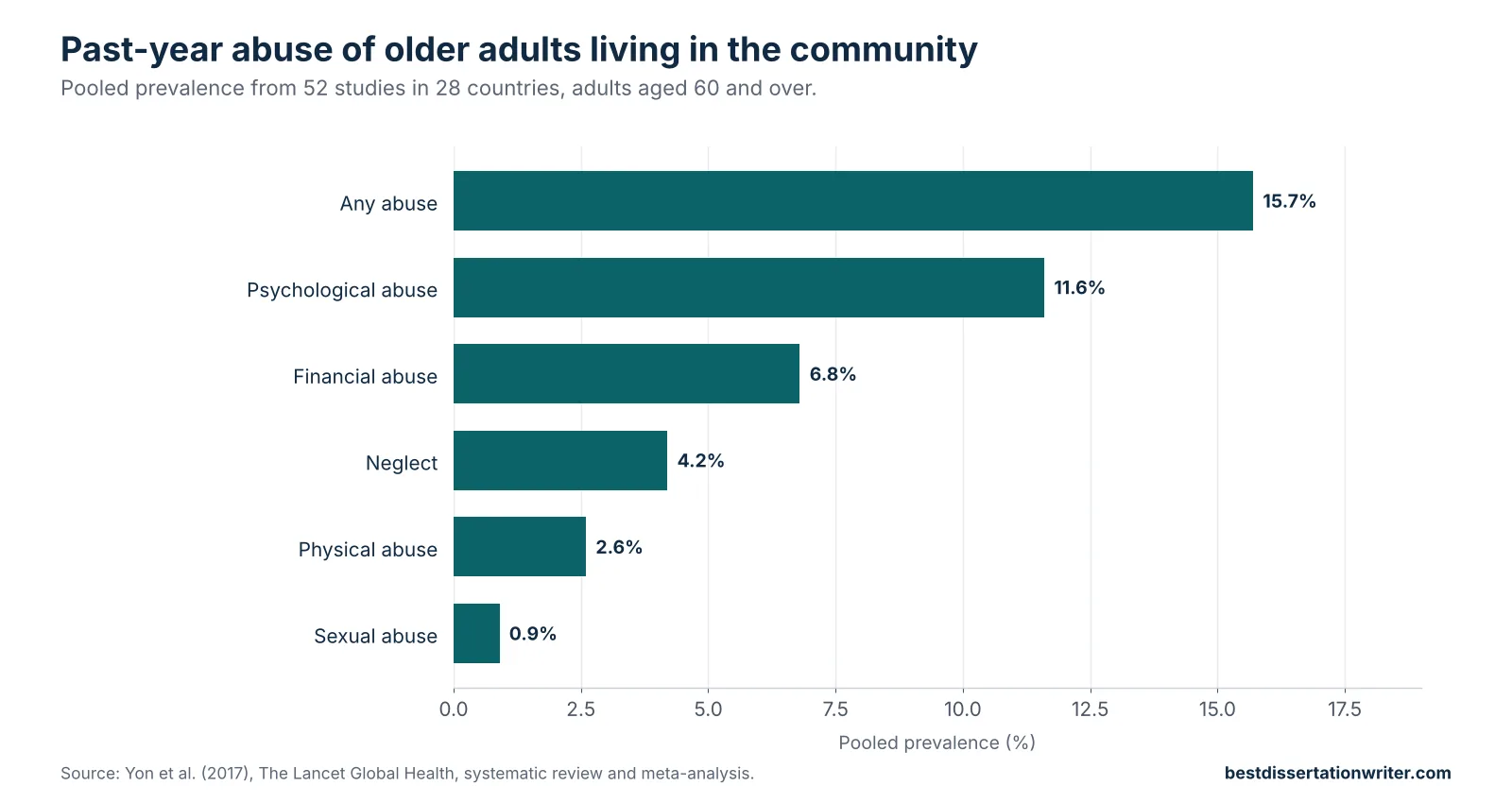
Three themes were identified: the scale and nature of abuse and neglect in the community, the lessons from Safeguarding Adult Reviews, and the community nurse’s role in safeguarding vulnerable adults through dignified care and action. Table 1 summarises the included sources, and Figure 1 shows the prevalence of different types of abuse among older adults.
| Author, year | Design | Setting and sample | Key finding |
|---|---|---|---|
| Manthorpe et al. (2007) | National prevalence study (summary) | Community-dwelling people aged 66+, UK | 2.6% reported mistreatment in the past year (4.0% including neighbours and acquaintances). |
| Yon et al. (2017) | Systematic review and meta-analysis | 52 studies, 28 countries, adults aged 60+ | Past-year abuse prevalence 15.7%; psychological 11.6%, financial 6.8%, neglect 4.2%. |
| Stevens et al. (2022) | Ethnographic study | 62 care episodes; 11 nursing staff and 11 older patients, England | Dignified district nursing care protective against abuse and neglect; time and space central. |
| Local Government Association (2024) | National analysis of Safeguarding Adult Reviews | 652 reviews, 861 individuals, England, 2019–2023 | Self-neglect in 60%; shortcomings in mental capacity (58%) and professional curiosity (44%). |
| DHSC (2025) | National safeguarding statistics | All Section 42 enquiries, England, 2024–25 | 185,270 enquiries; neglect most common risk (40.8%); own home most common location (51.9%). |
Theme 1: The Scale and Nature of Abuse in the Community
A systematic review and meta-analysis of 52 studies from 28 countries estimated the past-year prevalence of abuse among adults aged 60 and over living in the community (Yon et al., 2017). The pooled prevalence was 15.7%, or about one in six older people. Psychological abuse was most common (11.6%), followed by financial abuse (6.8%), neglect (4.2%), physical abuse (2.6%) and sexual abuse (0.9%). The authors described elder abuse as a neglected global public health priority.
Earlier UK evidence suggested lower but still substantial rates. The first national prevalence study in the UK found that 2.6% of people aged 66 and over living in the community reported mistreatment by family members, friends or care workers in the past year, rising to 4.0% when neighbours and acquaintances were included (Manthorpe et al., 2007). Loneliness, depression and poor quality of life were associated with mistreatment, and the authors emphasised that nurses have a key role in helping older people to report abuse.
Official statistics show the scale of safeguarding activity in England. In 2024 to 2025, there were an estimated 640,240 safeguarding concerns and 185,270 Section 42 enquiries (Department of Health and Social Care, 2025). Neglect and acts of omission were the most common type of risk, accounting for 40.8% of risks in concluded enquiries, and the person’s own home was the most common location of risk, at 51.9%. These figures confirm that the home, where community nurses work, is the main setting for safeguarding vulnerable adults.
Taken together, these sources suggest that a community nurse visiting older or disabled people at home will regularly encounter people at risk, even if abuse is rarely disclosed directly. The most common forms, psychological and financial abuse and neglect, are also the least visible, which means that safeguarding vulnerable adults depends on attentive observation and careful conversation rather than on obvious physical signs.
Theme 2: Lessons From Safeguarding Adult Reviews
The second national analysis of Safeguarding Adult Reviews examined 652 reviews completed in England between 2019 and 2023, covering 861 individuals, most of whom had died (Local Government Association, 2024). Self-neglect featured in 60% of reviews, an increase from 45% in the first analysis, and neglect or omission by others in 46%. Domestic abuse, physical abuse and financial abuse were also common.
In-depth analysis of 229 reviews found that 99% identified some shortcomings in practice. Shortcomings in risk assessment and management were found in 82%, in recognition of abuse or neglect in 56%, in attention to mental capacity in 58% and in professional curiosity in 44%. The analysis also highlighted weaknesses in communication, case coordination and multi-agency risk management. Because reviews are commissioned when things go wrong, they do not represent typical practice, but they show recurring patterns that every community nurse should recognise.
The growing prominence of self-neglect is particularly important for community nursing. Many people who self-neglect are known to community nurses because of wounds, continence problems or long-term conditions, and nurses may be among the few professionals who see the conditions in which they live. Engaging with people who decline help requires patience, relationship-building and persistence over time, rather than a single assessment.
Theme 3: Dignified Care and the Community Nurse’s Role
An ethnographic study in England observed 62 episodes of district nursing care and interviewed 11 nursing staff and 11 older patients to explore dignity and its relationship with safeguarding (Stevens et al., 2022). The study found that abuse and neglect were less likely when clinicians maintained patients’ dignity, and that time and space were central to how dignity was experienced. Where dignity was absent, there was more room for abuse and neglect to occur.
Nurses described not being given dedicated time to attend to dignity, so it could be sidelined despite being central to care. The authors argued that district nurses play both a proactive safeguarding role, by delivering dignified care, and a reactive role, by acting on suspected abuse or neglect. They also noted that the home must be managed as both a clinical setting and a dignified environment. The small sample limits generalisation, but the study offers rare insight into everyday district nursing practice.
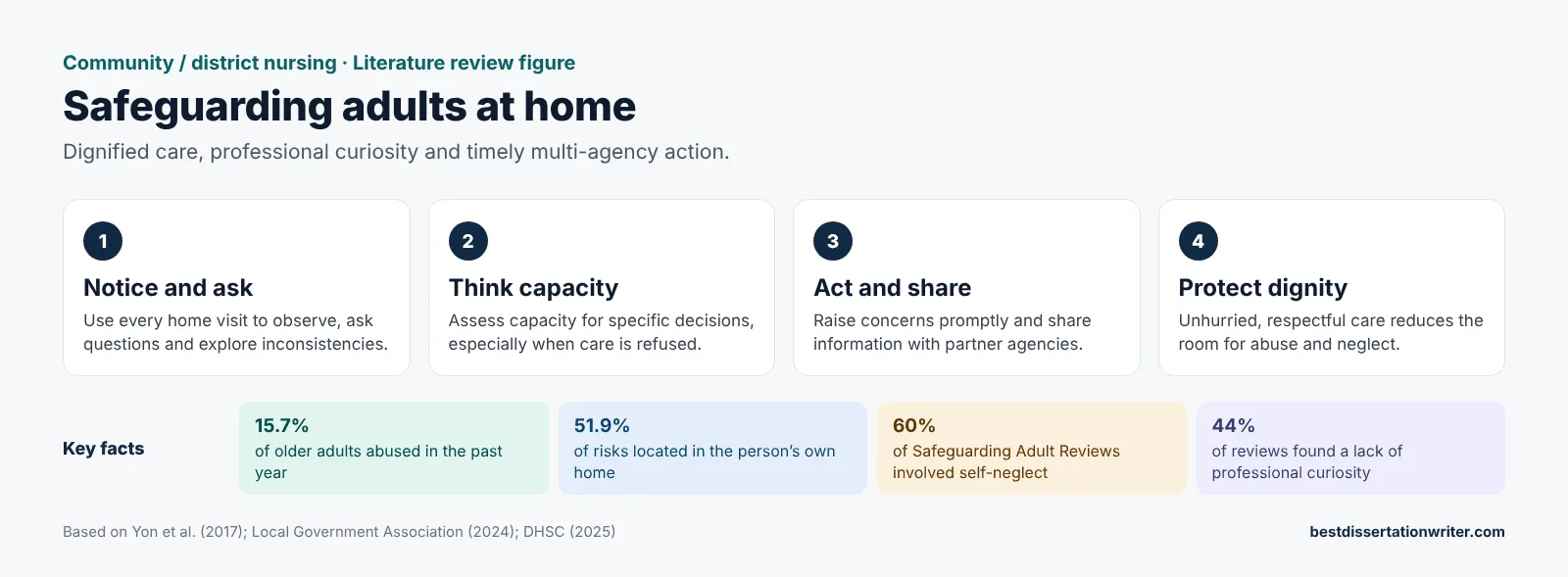
Across the three themes, a consistent message emerges: safeguarding vulnerable adults in the community depends less on rare dramatic interventions than on the quality of everyday practice. Local safeguarding adults procedures provide the framework, but it is attentive, respectful and curious care during routine visits that makes recognition possible.
Discussion
This review found that abuse and neglect of adults in the community are common, that the home is the most frequent setting for safeguarding concerns and that self-neglect has become the most frequent feature of Safeguarding Adult Reviews. Neglect, whether by others or by the person themselves, dominates the picture, which is highly relevant to community nursing, where nurses see the conditions in which people live and the care they receive.
The lessons from reviews point to the skills community nurses need. Professional curiosity, meaning the willingness to look beyond the obvious, ask questions and explore inconsistencies, was often missing. Attention to mental capacity was frequently inadequate, particularly in cases of self-neglect, where people’s refusal of help was sometimes accepted without assessing whether they could understand and weigh the risks. Nurses need confidence to question, assess and escalate concerns.
At the same time, the evidence emphasises that safeguarding is not only about detecting harm. Dignified, unhurried care can itself reduce the risk of abuse and neglect, both by modelling respect and by creating opportunities for disclosure. As community nursing teams come under pressure and visits become shorter and more task-focused, these opportunities may be lost, which raises concerns about the safety of people who rely on home care.
Multi-agency working is essential to safeguarding vulnerable adults. Community nurses rarely hold the whole picture, and many Safeguarding Adult Reviews identified failures to share information and coordinate care. Nurses should know how to raise concerns with the local authority, involve their safeguarding leads and contribute to multi-agency meetings, while keeping the person’s own wishes at the centre in line with Making Safeguarding Personal.
This review has limitations. Prevalence estimates vary with definitions and methods, the UK prevalence study is dated, and Safeguarding Adult Reviews focus on the most serious cases. Few studies have examined community nursing practice directly. This review relied on openly accessible, English-language sources and did not involve independent double screening. Future research should evaluate how community nurses recognise and respond to abuse and self-neglect during home visits.
Supervision and support for nurses are also important. Safeguarding vulnerable adults can be emotionally demanding, involving uncertainty, conflict with families and distress about people who refuse help. Access to safeguarding leads, reflective supervision and training in mental capacity and self-neglect can help nurses to make confident, defensible decisions and to sustain their practice.
Implications of Safeguarding Vulnerable Adults Evidence for Practice
Community nurses should use every home visit to observe and ask, showing professional curiosity about signs of neglect, self-neglect and abuse. Where people decline care, nurses should consider mental capacity for the specific decision and seek advice when capacity is uncertain. People with chronic conditions such as venous leg ulcers may be at risk of self-neglect, and housebound patients may have few other contacts.
Concerns should be raised promptly through local safeguarding adults procedures, and nurses should involve the person in decisions wherever possible. Particular care is needed during end-of-life care at home, when people are highly dependent and families are under strain. Protecting time for dignified care is itself a safeguarding measure.
Conclusion
This integrative review examined the evidence on abuse and neglect of adults at risk in the community and the role of community nurses in safeguarding. Abuse is common, the home is the main setting for concerns, and self-neglect and neglect by others dominate serious case reviews. Shortcomings in professional curiosity, mental capacity assessment and multi-agency working recur.
Community nurses are uniquely placed to contribute to safeguarding vulnerable adults. Safeguarding vulnerable adults requires dignified care, curiosity, sound knowledge of mental capacity and strong links with partner agencies, supported by time, training and supervision.
Organisations should ensure that local safeguarding adults training for community teams covers self-neglect, mental capacity and professional curiosity, reflecting the recurring lessons from national reviews.
References
Department of Health and Social Care. (2025). Safeguarding adults, England, 2024 to 2025: Statistical commentary. GOV.UK. https://www.gov.uk/government/statistics/safeguarding-adults-england-2024-to-2025/safeguarding-adults-england-2024-to-2025-statistical-commentary
Local Government Association. (2024). Second national analysis of Safeguarding Adult Reviews: April 2019 – March 2023. Local Government Association. https://www.local.gov.uk/our-support/partners-care-and-health/safeguarding-resources/analysis-safeguarding-adult-reviews-0
Manthorpe, J., Biggs, S., McCreadie, C., Tinker, A., Hills, A., O’Keefe, M., Doyle, M., Constantine, R., Scholes, S., & Erens, B. (2007). The U.K. national study of abuse and neglect among older people. Nursing Older People, 19(8), 24–26. https://doi.org/10.7748/nop2007.10.19.8.24.c6268
Stevens, E., Price, L., & Walker, L. (2022). “Just because people are old, just because they’re ill…” dignity matters in district nursing. Journal of Adult Protection, 24(1), 3–14. https://doi.org/10.1108/JAP-07-2021-0024
Yon, Y., Mikton, C. R., Gassoumis, Z. D., & Wilber, K. H. (2017). Elder abuse prevalence in community settings: A systematic review and meta-analysis. The Lancet Global Health, 5(2), e147–e156. https://doi.org/10.1016/S2214-109X(17)30006-2
Cite this example
Best Dissertation Writers (2026) Safeguarding Vulnerable Adults in the Home: The Role of Community Nurses: An Integrative Review. Available at: https://bestdissertationwriter.com/safeguarding-vulnerable-adults-review/
Best Dissertation Writers
Get expert help with your nursing literature review
Share your topic and deadline with Best Dissertation Writers and get support tailored to your module brief.