Pressure Ulcer Prevention for Patients in Home Care Settings: A Systematic Review
 By Dr. Robertson Prime, Research Fellow
Updated October 12, 2026
14 min read
About 2,900 words
In this review
Abstract
Background: Pressure ulcer prevention is a daily priority in community nursing, because many people at highest risk are frail, immobile and cared for at home. Pressure ulcers cause pain, infection and distress and have a significant impact on quality of life.
Aim: This systematic review aimed to examine the evidence on pressure ulcer prevention for patients cared for at home and in community settings.
Methods: Evidence was identified through targeted searches of openly accessible bibliographic records, publisher websites and the reference lists of key reviews. Five sources published between 2009 and 2021 were included: a systematic review of quality of life, a community prevalence study, two Cochrane reviews and a randomised controlled trial, synthesised narratively.
Findings: Pressure ulcers had a significant impact on physical, social and psychological wellbeing across 31 studies. In two community settings, prevalence was 0.40 to 0.77 per 1,000 adults. There was no clear evidence that structured risk assessment tools reduce pressure ulcers compared with clinical judgement. Alternating pressure mattresses did not significantly reduce pressure ulcers at final follow-up (hazard ratio 0.76) but showed a small benefit during treatment and were cost-effective.
Conclusion: Community nurses should combine clinical judgement with risk assessment, target equipment to individual needs and preferences, and support patients and carers to carry out prevention at home.
Keywords: pressure ulcer prevention, pressure injury prevention, community nursing
Introduction
This systematic review critically examines recent evidence on pressure ulcer prevention and its implications for community nursing practice.
Pressure ulcers, also called pressure injuries, are areas of damage to the skin and underlying tissue caused by sustained pressure, often combined with shear. They develop most often over bony areas such as the sacrum and heels in people who are immobile, malnourished, incontinent or acutely unwell. Pressure ulcers are painful, can become infected and may take months to heal, and they are widely regarded as largely preventable harms.
Much of the attention on pressure ulcers has focused on hospitals, yet many people at risk live at home. Frail older people, people receiving end-of-life care and people with spinal cord injury or neurological conditions may spend long periods in a bed or chair at home, supported by family carers and paid care workers. Community nurses are responsible for assessing their risk, arranging equipment and advising on repositioning, skin care and nutrition, often with limited time and resources.
A systematic review approach was chosen to bring together the highest-quality evidence on the burden of pressure ulcers, risk assessment and support surfaces, and to judge how far this evidence applies to home care.
Pressure ulcer prevention in the community also has a financial dimension. Treating established ulcers requires frequent dressings, nurse visits and sometimes hospital admission, so prevention can save nursing time as well as reduce suffering. However, prevention itself requires investment in equipment, training and time, and it competes with many other demands on community nursing teams.
Review question
What does the evidence show about pressure ulcer prevention for patients cared for at home and in community settings, and what are the implications for practice?
Background to Pressure Ulcer Prevention
International guidance describes pressure ulcer prevention as a bundle of interventions: assessing risk, inspecting the skin, managing moisture and incontinence, optimising nutrition and hydration, repositioning and using pressure-redistributing support surfaces such as mattresses and cushions. Some international guidelines now use the term pressure injury, and pressure injury prevention is the same set of activities under a different name. The SSKIN bundle, widely used in the UK, summarises these elements for staff and carers.
Risk assessment is usually carried out using structured tools such as the Waterlow, Braden or Ramstadius scales, combined with clinical judgement. These tools score factors such as mobility, continence, nutrition and skin condition. They are intended to identify people at risk so that preventive interventions can be targeted, but whether using a tool improves outcomes compared with clinical judgement alone has long been debated.
Support surfaces are a major part of prevention and of the costs involved. High-specification foam mattresses are the standard for people at risk, while alternating pressure air mattresses, which inflate and deflate cells to redistribute pressure, are often used for those at higher risk. In the community, equipment must be ordered, delivered and set up in people’s homes, which can delay provision and create practical problems with space, noise and comfort.
Pressure ulcer prevention at home also depends on people who are not health professionals. Family carers and care workers may carry out repositioning, continence care and skin inspection, so community nursing teams need to teach and support them. Understanding the evidence helps nurses to prioritise the interventions most likely to work in home settings.
Nutrition, hydration and continence are also central to pressure injury prevention. Malnourished skin breaks down more easily and heals more slowly, and moisture from incontinence increases the risk of damage. Community nurses therefore need to consider pressure ulcer prevention as part of a holistic assessment that includes diet, fluids, continence and mobility, rather than as a matter of equipment alone.
Search Strategy and Methods
Evidence for this example was identified through targeted searches of openly accessible bibliographic records, publisher websites and the reference lists of key reviews. Search terms combined keywords for the condition (“pressure ulcer”, “pressure injury”, “bedsore”, “decubitus”) with terms for prevention and setting (“prevention”, “risk assessment”, “support surface”, “mattress”, “community”, “home care”, “district nursing”), joined with the Boolean operators AND and OR. A full systematic review for assessment would run the same strategy in CINAHL, PubMed/MEDLINE, the Cochrane Library and Social Care Online and report the number of records screened in a PRISMA flow diagram.
Sources were eligible if they examined the impact, prevalence or prevention of pressure ulcers in adults, with relevance to community or home care. Systematic reviews and randomised controlled trials were prioritised, and a community prevalence study was included because it shows the scale of the problem on community nursing caseloads. Studies limited to treatment of existing ulcers were excluded.
Five sources published between 2009 and 2021 were included: a systematic review of quality of life, a cross-sectional prevalence study, two Cochrane systematic reviews and a multicentre randomised controlled trial (Table 1). The quality of each source was considered using the Critical Appraisal Skills Programme (CASP) checklists, drawing on the certainty ratings reported by each review, and findings were synthesised narratively.
Key Findings on Pressure Ulcer Prevention
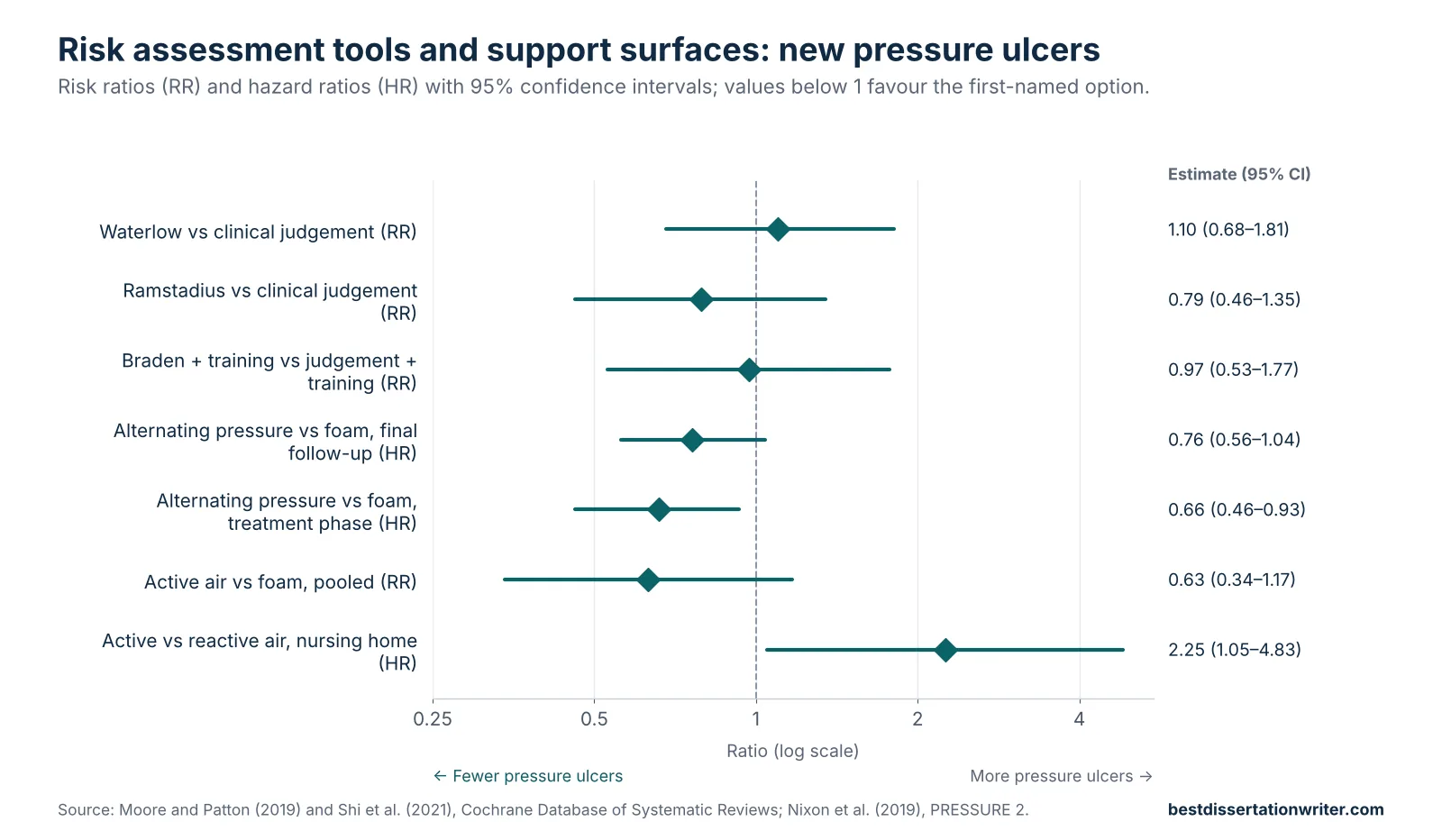
Three themes were identified: the burden of pressure ulcers in the community, the role of risk assessment, and the effectiveness of support surfaces for pressure ulcer prevention. Table 1 summarises the included sources, and Figure 1 shows the effects of risk assessment tools and support surfaces on new pressure ulcers.
| Author, year | Design | Setting and sample | Key finding |
|---|---|---|---|
| Gorecki et al. (2009) | Systematic review and metasynthesis | 31 studies, 2,463 participants, acute, community and long-term care | Pressure ulcers and their treatment had a significant impact on physical, social and psychological quality of life. |
| Stevenson et al. (2013) | Cross-sectional prevalence study | Community nursing caseloads, two sites, North of England | Prevalence 0.77 per 1,000 adults (site 1) and 0.40 per 1,000 (site 2); methods affect estimates. |
| Moore and Patton (2019) | Cochrane systematic review | 2 trials, 1,487 participants, acute hospitals | No clear evidence that Braden, Waterlow or Ramstadius tools reduce pressure ulcers compared with clinical judgement. |
| Nixon et al. (2019) | Multicentre randomised controlled trial (PRESSURE 2) | 2,029 high-risk adults, 42 UK hospital and community in-patient facilities | Alternating pressure vs foam: HR 0.76 (not significant) at follow-up; small benefit during treatment; cost-effective. |
| Shi et al. (2021) | Cochrane systematic review | 32 studies, 9,058 participants, mostly acute care | Active air surfaces may reduce ulcers vs foam (RR 0.63, low certainty) and are probably more cost-effective. |
Theme 1: The Burden of Pressure Ulcers in the Community
A systematic review of 31 studies with 2,463 participants aged 17 to 96, in acute, community and long-term care settings, examined the impact of pressure ulcers on health-related quality of life (Gorecki et al., 2009). The synthesis identified 11 themes, including physical, social and psychological impact, symptoms such as pain and exudate, and the effects on general health. Patients described the burden of interventions, the impact on others and a need for knowledge, and the authors concluded that pressure ulcers have a significant impact on quality of life.
A cross-sectional study in two community settings in the North of England estimated the prevalence of pressure ulcers among adults on community nursing caseloads (Stevenson et al., 2013). At the site that assessed all patients on the caseload, prevalence was 0.77 per 1,000 adults, or 0.38 per 1,000 when nursing home patients were excluded. At the second site, which assessed only patients already known to have an ulcer, prevalence was 0.40 per 1,000. The authors noted that differences in methods affect prevalence estimates.
Together, these studies show that pressure ulcers are a significant problem in the community, affecting a substantial number of people on community nursing caseloads and having a marked impact on their lives. They also underline the importance of consistent measurement, since prevention cannot be planned or evaluated without reliable data on how often ulcers occur.
Theme 2: Risk Assessment and Clinical Judgement
A Cochrane review examined whether structured risk assessment tools reduce pressure ulcers (Moore and Patton, 2019). Only two randomised trials with 1,487 participants were found, both in acute hospitals. Neither the Braden scale, with or without training, nor the Waterlow or Ramstadius tools clearly reduced the incidence of pressure ulcers compared with clinical judgement. The certainty of evidence was low to very low, and the authors could not be certain whether using a risk assessment tool makes any difference.
This finding does not mean that risk assessment is unimportant. Rather, it suggests that the value of assessment lies in what happens next: whether risk leads to timely skin inspection, equipment, repositioning, nutrition and continence care. A tool may help to structure assessment and communication, particularly for less experienced staff, but it should support rather than replace clinical judgement. The absence of community trials also limits how far these findings apply to home care.
Theme 3: Support Surfaces and Equipment
The PRESSURE 2 trial randomised 2,029 high-risk adults in 42 hospital and community in-patient facilities in the UK to alternating pressure mattresses or high-specification foam (Nixon et al., 2019). Overall, 7.9% developed a new pressure ulcer. At final follow-up, the difference between groups was not statistically significant (hazard ratio 0.76, 95% CI 0.56 to 1.04), but during the treatment phase alternating pressure mattresses showed a small benefit (hazard ratio 0.66). They were also cost-effective, and the authors recommended more targeted use guided by patient preference, comfort and risk factors.
A Cochrane review of 32 studies with 9,058 participants examined alternating pressure, or active, air surfaces (Shi et al., 2021). Compared with foam, active air surfaces may reduce new pressure ulcers (risk ratio 0.63), although the confidence interval included no effect and the certainty was low. In one nursing home study, active air surfaces may have increased risk compared with reactive air surfaces. Active air surfaces were probably more cost-effective than foam, but evidence on comfort and adverse events was insufficient.
These findings suggest that both high-specification foam and alternating pressure mattresses can be appropriate, and that equipment should be chosen according to individual risk, comfort and preferences. In the home, factors such as noise, movement, ease of transfer and the person’s wish to share a bed may affect whether equipment is used as intended, which makes shared decision-making essential.
Taken together, the evidence on support surfaces suggests that equipment is necessary but not sufficient for pressure ulcer prevention. Even with the best mattress, people at high risk need regular repositioning, skin inspection and attention to nutrition and continence. In home care, these activities depend on the person, their family and care workers as much as on nurses, which makes communication and education essential parts of pressure injury prevention.
The way pressure ulcer prevention is organised may matter as much as the choice of tool or mattress. Clear responsibilities, reliable equipment services, regular review of people at risk and good communication with carers are likely to determine whether evidence-based care is delivered consistently in the home.
Discussion
This review found that pressure ulcers place a heavy burden on patients and affect a substantial number of people in community settings, yet the evidence for specific preventive interventions is less certain than often assumed. Structured risk assessment tools have not been shown to reduce pressure ulcers compared with clinical judgement, and the advantages of alternating pressure mattresses over high-specification foam are small. Much of this evidence comes from hospitals, with little from people’s homes.
These uncertainties have practical implications. If no single tool or mattress is clearly superior, the quality of pressure ulcer prevention depends on how well nurses combine assessment, equipment and everyday care, and how consistently that care is delivered. In the community, where nurses may visit only once a day or less, prevention depends heavily on patients, family carers and care workers, which makes education and support central to effective practice.
Person-centred pressure ulcer prevention is also important. The quality of life review showed that interventions themselves can be burdensome, for example when repositioning disturbs sleep or equipment restricts independence. Some people at the end of life may choose comfort over frequent repositioning. Nurses need to discuss risks and options openly, document decisions and respect informed choices while continuing to minimise harm.
Equipment provision is a further challenge for pressure ulcer prevention. Delays in delivering mattresses, lack of space and difficulties with electricity or noise can all undermine prevention at home. Community nursing teams need responsive equipment services and clear criteria for when alternating pressure mattresses are needed, informed by evidence on cost-effectiveness and patient preference.
This review has limitations. It included a small number of sources, few of which were conducted in home settings, and the trials of risk assessment were limited to hospitals. The prevalence study is now dated and covered only two areas. This review relied on openly accessible, English-language sources and did not involve independent double screening. Future research should evaluate prevention strategies delivered in people’s homes, including carer education and equipment pathways.
There are also opportunities to strengthen pressure ulcer prevention through data. Recording all new pressure ulcers on community nursing caseloads, including the circumstances in which they developed, allows teams to learn from harm, identify gaps in equipment or training and monitor the effect of changes. Consistent methods for measuring prevalence and incidence, as highlighted by the community prevalence study, are essential for meaningful comparisons over time.
Implications of Pressure Ulcer Prevention Evidence for Practice
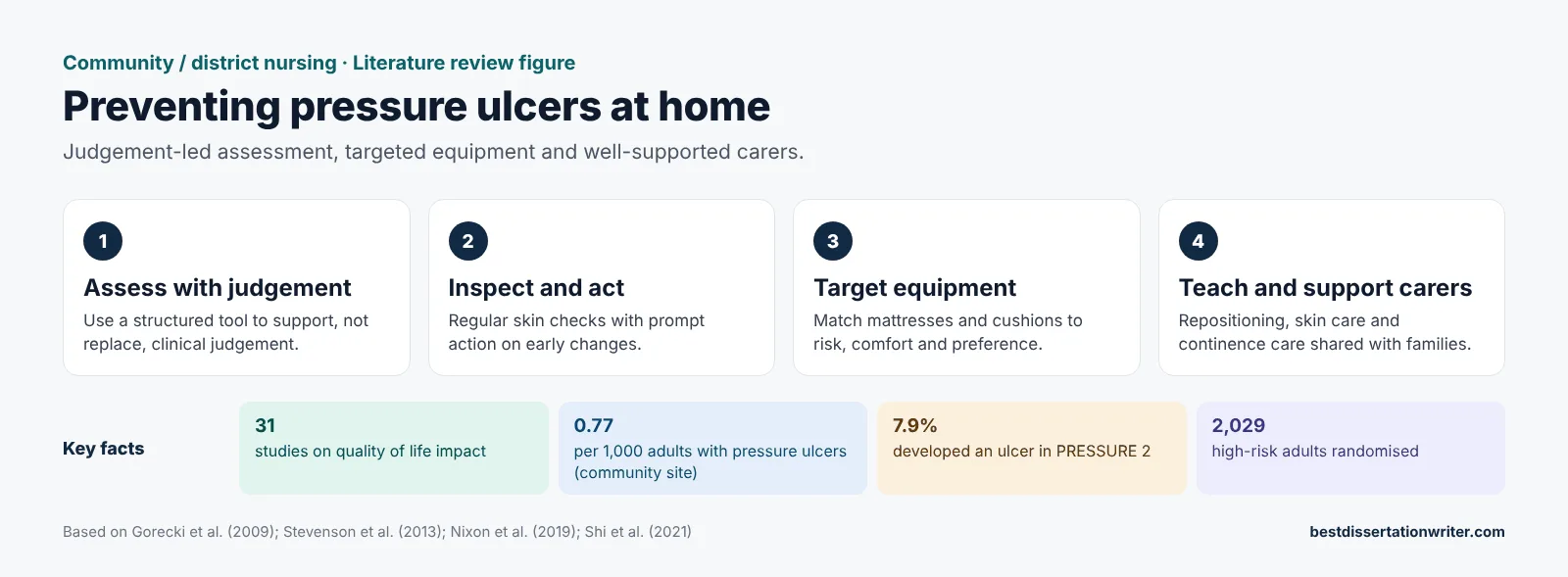
Community nurses should assess pressure ulcer risk using clinical judgement supported by a structured tool, inspect the skin regularly and act promptly on findings. Equipment should be matched to individual risk, comfort and preference, with alternating pressure mattresses targeted at people at higher risk. Teaching patients and carers about repositioning, skin inspection and continence care is essential, and nurses should recognise the impact on caregiver burden. Lessons from hospital-acquired pressure ulcers can inform community practice.
Advice should be given in clear, accessible language, supported by attention to health literacy, and nurses should recognise that people who are isolated may have no one to help with repositioning, linking prevention with efforts to address social isolation and loneliness.
Conclusion
This systematic review examined the evidence on pressure ulcer prevention for patients cared for at home and in community settings. Pressure ulcers have a significant impact on quality of life and are common on community nursing caseloads. Risk assessment tools have not been shown to outperform clinical judgement, and alternating pressure mattresses offer only a small benefit over high-specification foam, although they are cost-effective.
Effective pressure injury prevention at home depends on skilled assessment, timely and appropriate equipment, and well-supported patients and carers. Community nursing teams need the time, training and equipment services to deliver this consistently, and research in home settings is urgently needed.
References
Gorecki, C., Brown, J. M., Nelson, E. A., Briggs, M., Schoonhoven, L., Dealey, C., Defloor, T., & Nixon, J. (2009). Impact of pressure ulcers on quality of life in older patients: A systematic review. Journal of the American Geriatrics Society, 57(7), 1175–1183. https://doi.org/10.1111/j.1532-5415.2009.02307.x
Moore, Z. E. H., & Patton, D. (2019). Risk assessment tools for the prevention of pressure ulcers. Cochrane Database of Systematic Reviews, (1), CD006471. https://doi.org/10.1002/14651858.CD006471.pub4
Nixon, J., Smith, I. L., Brown, S., McGinnis, E., Vargas-Palacios, A., Nelson, E. A., Coleman, S., Collier, H., Fernandez, C., Gilberts, R., Henderson, V., Muir, D., Stubbs, N., Walker, K., Wilson, L., & Hulme, C. (2019). Pressure Relieving Support Surfaces for Pressure Ulcer Prevention (PRESSURE 2): Clinical and health economic results of a randomised controlled trial. EClinicalMedicine, 14, 42–52. https://doi.org/10.1016/j.eclinm.2019.07.018
Shi, C., Dumville, J. C., Cullum, N., Rhodes, S., Jammali-Blasi, A., & McInnes, E. (2021). Alternating pressure (active) air surfaces for preventing pressure ulcers. Cochrane Database of Systematic Reviews, (5), CD013620. https://doi.org/10.1002/14651858.CD013620.pub2
Stevenson, R., Collinson, M., Henderson, V., Wilson, L., Dealey, C., McGinnis, E., Briggs, M., Nelson, E. A., Stubbs, N., Coleman, S., & Nixon, J. (2013). The prevalence of pressure ulcers in community settings: An observational study. International Journal of Nursing Studies, 50(11), 1550–1557. https://doi.org/10.1016/j.ijnurstu.2013.04.001
Cite this example
Best Dissertation Writers (2026) Pressure Ulcer Prevention for Patients in Home Care Settings: A Systematic Review. Available at: https://bestdissertationwriter.com/pressure-ulcer-prevention-review-review/
Best Dissertation Writers
Get expert help with your nursing literature review
Share your topic and deadline with Best Dissertation Writers and get support tailored to your module brief.