De-Escalation Techniques and the Reduction of Restrictive Practices in Inpatient Mental Health Settings: A Systematic Review
 By Dr. Robertson Prime, Research Fellow
Updated October 12, 2026
15 min read
About 3,000 words
In this review
Abstract
Background: De-escalation techniques, which use communication, self-control and changes to the environment to reduce aggression without force, are a core mental health nursing skill and the first-line response to potential violence. Restrictive interventions such as restraint, seclusion and rapid tranquillisation can cause physical and psychological harm and damage trust, and reducing their use is a policy priority.
Aim: This systematic review aimed to examine the effectiveness of de-escalation and related ward-based approaches in reducing aggression and restrictive interventions in inpatient mental health settings, and what influences whether de-escalation succeeds.
Methods: Evidence was identified through targeted searches of openly accessible bibliographic records, publisher websites and the reference lists of key reviews. Seven sources published between 2015 and 2018 were included: a national guideline, a Cochrane review, a systematic review of training, a concept analysis, a cluster randomised controlled trial, a controlled before-and-after study and a qualitative interview study, appraised with CASP checklists and synthesised narratively.
Findings: A Cochrane review found no randomised trials of de-escalation for psychosis-induced aggression, and training studies showed gains in staff knowledge and confidence rather than in clinical safety outcomes. The ward-level Safewards model reduced conflict events by 15% and containment events by 26.4% in a cluster randomised trial, and seclusion fell by 36% at 12-month follow-up in an Australian evaluation. Staff interviews showed that technique choice was shaped by moral judgements, local custom, time pressure and anxiety, and that non-physical control techniques were linked to increased aggression and restrictive interventions.
Conclusion: Nurses should recognise agitation early, approach people calmly with one lead communicator and avoid provocative commands, while managers embed whole-ward approaches such as Safewards and ensure safe staffing and debriefing.
Keywords: de-escalation techniques, restrictive practice, psychiatric inpatient
Introduction
This systematic review critically examines recent evidence on de-escalation techniques and its implications for mental health nursing practice.
Violence and aggression are a recurring part of life on many acute mental health wards. Service users may be frightened, distressed, detained against their will or experiencing psychosis, and staff may be stretched across busy shifts. When tension rises, the response chosen by nurses can either calm the situation or escalate it towards physical restraint, seclusion or rapid tranquillisation. These restrictive interventions can cause physical and psychological harm, damage trust and are experienced by many service users as traumatic and humiliating.
Mental health nurses are usually the first professionals to respond when a person becomes agitated. De-escalation techniques, which use communication, self-control and changes to the environment to reduce aggression without force, are therefore a core nursing skill. National guidance and mandatory training programmes treat them as the first-line response to potential violence, and reducing reliance on restraint and seclusion has become a policy priority in the United Kingdom and internationally.
A systematic approach was chosen so that guidelines, Cochrane and other systematic reviews, trials and qualitative research could be identified and appraised together. Because de-escalation is difficult to study experimentally, the review also considers why the evidence base remains limited despite the strong professional consensus behind de-escalation techniques.
Review question
What does the evidence show about the effectiveness of de-escalation techniques and related ward-based approaches in reducing aggression and restrictive interventions in inpatient mental health settings, and what influences whether de-escalation succeeds?
Background to De-Escalation Techniques
De-escalation has been described in many ways, including talk-down, defusing, verbal intervention and conflict resolution. Hallett and Dickens (2017) analysed 79 publications and proposed that de-escalation is best understood as an umbrella term for interwoven, staff-delivered components that aim to reduce aggression or agitation, improve staff-patient relationships and minimise coercion. They identified five attributes: communication, self-regulation, assessment, actions and safety maintenance. This definition highlights that de-escalation techniques are not a single skill but a set of related behaviours.
Restrictive interventions include physical restraint, seclusion, rapid tranquillisation and enhanced observation. Each carries risks, ranging from injury and, rarely, death during restraint to psychological trauma and the erosion of the therapeutic relationship. In the United Kingdom, the NICE guideline on violence and aggression states that restrictive interventions should be used only when de-escalation and other preventive strategies have failed and there is potential for harm, and that de-escalation should continue throughout any intervention (National Institute for Health and Care Excellence [NICE], 2015).
Aggression on wards rarely arises from the individual alone. Ward rules, refusal of requests, bad news, crowding, boredom and staff attitudes can all act as flashpoints. Models such as Safewards therefore view conflict and containment as products of the interaction between service users, staff and the ward environment. From this perspective, de-escalation techniques are one part of a broader set of approaches to reducing restrictive practice, alongside preventive measures that stop tension building in the first place.
Search Strategy and Methods
Evidence for this example was identified through targeted searches of openly accessible bibliographic records, publisher websites and the reference lists of key reviews. Search terms combined keywords for the intervention (“de-escalation techniques”, “de-escalation”, “talk-down”, “Safewards”, “conflict and containment”) with terms for setting and outcome (“psychiatric inpatient”, “mental health ward”, “aggression”, “violence”, “restraint”, “seclusion”, “restrictive practice”), joined with the Boolean operators AND and OR. A full systematic review for assessment would run the same strategy in CINAHL, PubMed/MEDLINE, the Cochrane Library and Embase and report the number of records screened in a PRISMA flow diagram.
Sources were eligible if they were guidelines, systematic reviews, concept analyses, trials or qualitative studies examining de-escalation techniques, de-escalation training or ward-based models intended to reduce conflict and restrictive interventions for adults in mental health settings. Sources were required to be published in English from 2010 onward. Studies limited to emergency departments, children or learning disability services, and opinion articles without empirical data, were excluded.
Seven sources on de-escalation techniques published between 2015 and 2018 were included: one national guideline, one Cochrane review, one systematic review of training, one concept analysis, one cluster randomised controlled trial, one controlled before-and-after study and one qualitative interview study (Table 1). The quality of each source was appraised using the relevant Critical Appraisal Skills Programme (CASP) checklist, and findings were synthesised narratively and grouped into themes.
Key Findings on De-Escalation Techniques
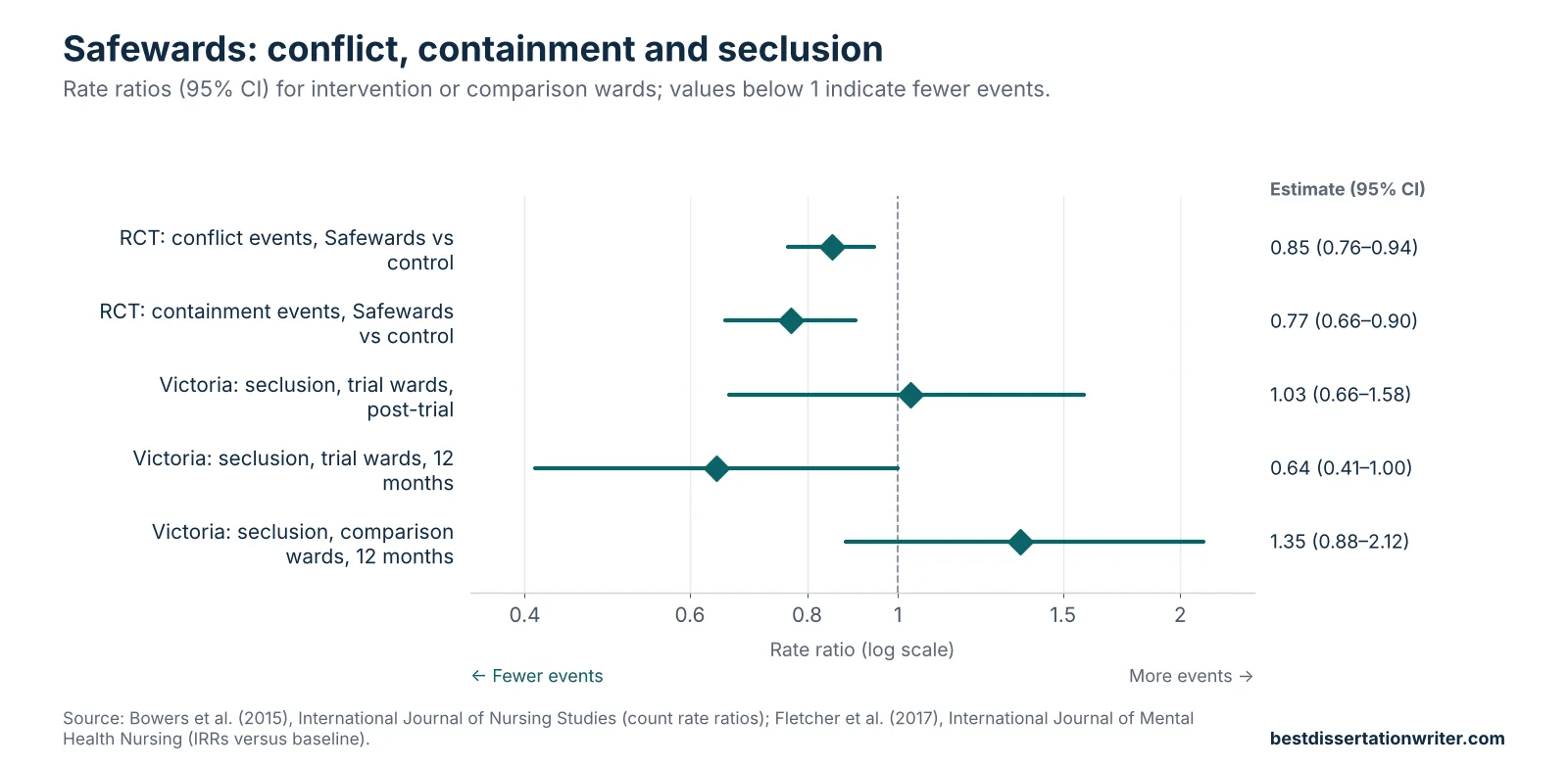
Three themes were identified: the limited trial evidence for de-escalation techniques, ward-level approaches that reduce conflict and containment, and staff perspectives on why de-escalation succeeds or fails. Table 1 summarises the included sources, and Figure 1 presents rate ratios for conflict, containment and seclusion from two evaluations of the Safewards model.
| Author, year | Design | Setting and sample | Key finding |
|---|---|---|---|
| Bowers et al. (2015) | Pragmatic cluster randomised controlled trial | 31 acute psychiatric wards in 15 hospitals, England | Safewards reduced conflict events by 15% and containment events by 26.4% versus control. |
| NICE (2015) | National clinical guideline | Mental health, health and community settings, UK | De-escalation first; restrictive interventions only when de-escalation and other strategies have failed. |
| Price et al. (2015) | Systematic review | 38 studies of de-escalation training for mental health staff | Training improved knowledge, confidence and simulated performance; effects on assaults and containment unclear. |
| Du et al. (2017) | Cochrane systematic review | Randomised trials of de-escalation for psychosis-induced aggression or agitation | 345 citations screened; no eligible trials, so effectiveness could not be assessed. |
| Fletcher et al. (2017) | Controlled before-and-after study | 13 Safewards wards and 31 comparison wards, Victoria, Australia | Seclusion fell by 36% in trial wards at 12-month follow-up; no significant change in comparison wards. |
| Hallett and Dickens (2017) | Concept analysis | 79 publications on de-escalation in healthcare settings | Five attributes: communication, self-regulation, assessment, actions and safety maintenance; theories lack empirical support. |
| Price et al. (2018) | Qualitative interview study | 20 ward staff, five inpatient wards in three NHS trusts | 14 techniques on a support–control continuum; non-physical control linked to escalation. |
Theme 1: Limited Trial Evidence for De-Escalation Techniques
The most striking finding is how little experimental evidence exists. A Cochrane review sought randomised trials of de-escalation for people with psychosis-induced aggression or agitation (Du et al., 2017). From 345 citations, only one study was considered for full-text inspection, and it was excluded because it was not randomised. No trials met the inclusion criteria, so the review could not draw any conclusions about effectiveness and called for well-designed randomised studies.
Evidence on training in de-escalation techniques is more plentiful but still weak. Price et al. (2015) searched 20 databases and identified 38 studies of de-escalation training for mental health staff. Training most clearly improved staff knowledge of de-escalation, confidence in managing aggression and de-escalation performance, although performance gains were demonstrated only in artificial training scenarios. No firm conclusions could be drawn about effects on assaults, injuries, containment or organisational outcomes, because studies were of low quality and their results conflicted.
This gap matters because mandatory training is a substantial investment for services. Improvements in knowledge and confidence are necessary but not sufficient: what matters to service users is whether they are less likely to be restrained or secluded. Hallett and Dickens (2017) argued that the absence of a clear conceptual definition has contributed to the weak evidence base, since studies have tested different packages under the same name and measured different outcomes, making comparison and synthesis difficult.
Theme 2: Ward-Level Approaches to Reducing Restrictive Practice
The strongest trial evidence comes from Safewards, a model of ten interventions that includes clear mutual expectations, soft words when making requests, talk-down methods, positive words at handover, bad news mitigation and calm-down methods. In a pragmatic cluster randomised trial on 31 acute wards in 15 hospitals, Bowers et al. (2015) found that Safewards reduced conflict events by 15% (95% CI 5.6–23.7%) and containment events by 26.4% (95% CI 9.9–34.3%) compared with a physical health control intervention.
The trial has important limitations. Shift reports were missing for more than half of shifts in the outcome period, fidelity to the interventions on experimental wards was modest when checked by researchers, and many staff discussed the interventions across trial arms. The authors’ sensitivity analyses suggested that the direction of effect was robust to missing data, but the follow-up was short and the trial was conducted only in England, so the size of the effect should be interpreted cautiously.
Safewards is not a direct test of de-escalation techniques, but several of its ten interventions, including talk-down and calm-down methods, draw on the same principles. Its results therefore suggest that de-escalation may work best when embedded in a whole-ward approach rather than taught as isolated skills. By changing routine interactions, such as how requests are refused or how bad news is shared, the model aims to prevent tension from building before de-escalation in a crisis is needed.
Fletcher et al. (2017) evaluated Safewards in 13 wards in Victoria, Australia, against 31 comparison wards using mandatory seclusion data. Seclusion did not change immediately after the 12-week trial but had fallen by 36% at 12-month follow-up (incidence rate ratio 0.64, 95% CI 0.41–1.00), while comparison wards showed no significant change. Fidelity increased over the follow-up period, suggesting that ward-level change takes time to embed. The non-randomised design means that other local initiatives may have contributed.
Theme 3: Staff Perspectives on De-Escalation in Practice
Qualitative research helps to explain why de-escalation sometimes fails. Price et al. (2018) interviewed 20 ward-based staff from five psychiatric inpatient wards in three NHS trusts. Staff described 14 techniques arranged along a continuum from support to control. Supportive techniques included listening and empathy, whereas non-physical control techniques, such as instructing patients to move to low-stimulus areas, were seen by staff as part of de-escalation yet were linked to increased aggression and restrictive interventions.
The choice of technique was not driven consistently by risk. Instead, staff decisions were influenced by moral judgements about the function of aggression, trial and error, local custom, knowledge of the patient, time pressure and staff anxiety. This suggests that training focused on individual skills may not be enough if ward cultures normalise controlling responses. It also supports the Safewards view that the behaviour of staff and the ward environment shape whether conflict escalates.
These findings also show how ward culture can override training. Staff working on psychiatric inpatient units under pressure may fall back on familiar controlling responses even when they have been taught de-escalation techniques, particularly if those responses are seen as quick and effective in the short term. Price et al. (2018) proposed that their support-control continuum could identify specific staff behaviours to target in future interventions, which offers a more precise basis for training than general instruction to stay calm.
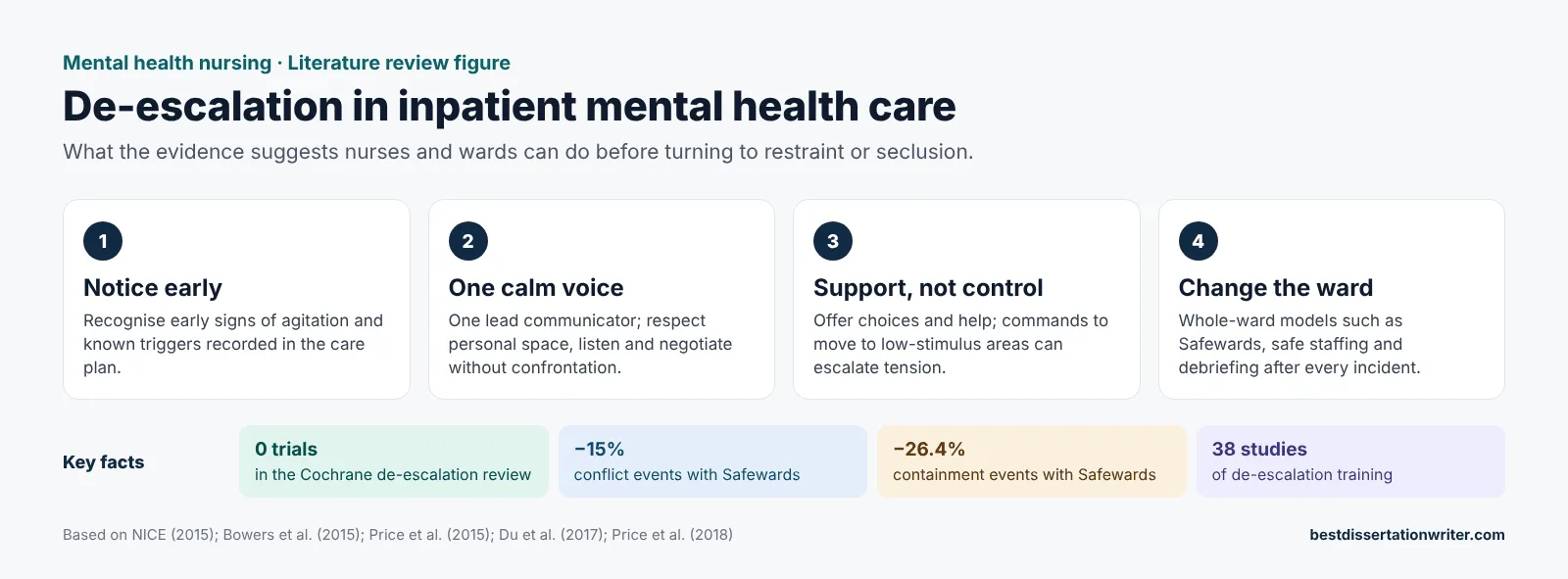
Taken together with the NICE recommendations, these findings indicate that effective de-escalation techniques depend on early recognition of agitation, a calm and respectful approach, one lead communicator, avoidance of provocative responses and knowledge of the individual. These elements reflect long-standing clinical consensus, but the qualitative evidence shows that they are not always applied, particularly when wards are understaffed or staff feel unsafe.
Discussion
This review found a striking contrast between the strong professional endorsement of de-escalation techniques and the limited evidence of their effectiveness. No randomised trials of de-escalation for psychosis-related aggression were found by the Cochrane review, and training studies show improvements in knowledge and confidence rather than in clinical safety outcomes. By contrast, ward-level models such as Safewards have produced moderate reductions in conflict, containment and seclusion in a cluster trial and a controlled evaluation.
One explanation is that de-escalation is difficult to isolate. It is delivered in the moment, varies from one interaction to the next and is shaped by the relationship between staff and the service user. Randomising individual incidents is impractical and arguably unethical, so evaluations of de-escalation techniques often rely on before-and-after designs, simulated scenarios or self-report. Ward-level packages are easier to evaluate, but it is then unclear which components produce the benefit.
A second tension concerns what counts as de-escalation. Price et al. (2018) showed that staff may regard instructing a patient to go to their room as de-escalation, even though service users may experience it as controlling. Hallett and Dickens (2017) define de-escalation partly by its aim of minimising coercion, which would exclude such techniques. Clearer definitions, as well as attention to how service users experience de-escalation techniques, are needed if training is to change practice rather than relabel existing habits.
Organisational factors are also important. NICE (2015) links the safe use of restrictive interventions to adequate staffing, trained staff and debriefing after incidents, and the Safewards trials showed that fidelity, and therefore impact, depended on sustained implementation. Reducing restrictive practice is therefore not only a matter of individual nursing skill but of leadership, ward culture and resources, which may explain the variation in outcomes between wards and services.
This review has limitations. It included a small number of sources, most from the United Kingdom and Australia, and only one randomised trial. This review relied on openly accessible, English-language sources and did not involve independent double screening. Future research should agree a shared definition of de-escalation techniques, measure outcomes that matter to service users, such as restraint, seclusion, injury and perceived safety, and test training and ward-level interventions in rigorous trials with longer follow-up.
Implications of De-Escalation Techniques Evidence for Practice
For mental health nurses, the evidence supports recognising early signs of agitation, approaching people calmly, using one lead communicator, listening to concerns, offering choices and avoiding commands that may provoke conflict. Nurses should reflect on whether responses that feel like de-escalation, such as directing someone to a low-stimulus area, may be experienced as control. Restraint, seclusion and rapid tranquillisation should be used only as a last resort, with efforts to calm the person continuing throughout and debriefing afterwards.
Ward managers can support these skills by implementing whole-ward approaches such as Safewards, monitoring fidelity and incident data over time and ensuring safe staffing on every psychiatric inpatient ward. Trust built through the therapeutic relationship makes calming conversations more likely to succeed, and an understanding of past trauma promoted by trauma-informed care helps nurses avoid re-traumatising people. Distress and agitation may also signal suicidal crisis, so de-escalation should be linked to compassionate suicide risk assessment, and nurses caring for adults with depression should recognise that agitation can accompany severe low mood.
Conclusion
This systematic review found that de-escalation techniques are universally recommended as the first response to aggression, yet there are no randomised trials of de-escalation itself and training evidence is largely limited to staff knowledge and confidence. Ward-level approaches such as Safewards offer the strongest evidence, with moderate reductions in conflict, containment and seclusion.
For mental health nursing, the priority is to combine skilled, respectful de-escalation techniques with ward cultures and resources that make calm, relational responses the norm. Investing in clear definitions, implementation support and rigorous evaluation will help services reduce restraint and seclusion and make inpatient care safer for service users and staff alike.
References
Bowers, L., James, K., Quirk, A., Simpson, A., Stewart, D., & Hodsoll, J. (2015). Reducing conflict and containment rates on acute psychiatric wards: The Safewards cluster randomised controlled trial. International Journal of Nursing Studies, 52(9), 1412–1422. https://doi.org/10.1016/j.ijnurstu.2015.05.001
Du, M., Wang, X., Yin, S., Shu, W., Hao, R., Zhao, S., Rao, H., Yeung, W.-L., Jayaram, M. B., & Xia, J. (2017). De-escalation techniques for psychosis-induced aggression or agitation. Cochrane Database of Systematic Reviews, (4), CD009922. https://doi.org/10.1002/14651858.CD009922.pub2
Fletcher, J., Spittal, M., Brophy, L., Tibble, H., Kinner, S., Elsom, S., & Hamilton, B. (2017). Outcomes of the Victorian Safewards trial in 13 wards: Impact on seclusion rates and fidelity measurement. International Journal of Mental Health Nursing, 26(5), 461–471. https://doi.org/10.1111/inm.12380
Hallett, N., & Dickens, G. L. (2017). De-escalation of aggressive behaviour in healthcare settings: Concept analysis. International Journal of Nursing Studies, 75, 10–20. https://doi.org/10.1016/j.ijnurstu.2017.07.003
National Institute for Health and Care Excellence. (2015). Violence and aggression: Short-term management in mental health, health and community settings (NICE Guideline NG10). https://www.nice.org.uk/guidance/ng10
Price, O., Baker, J., Bee, P., & Lovell, K. (2015). Learning and performance outcomes of mental health staff training in de-escalation techniques for the management of violence and aggression. British Journal of Psychiatry, 206(6), 447–455. https://doi.org/10.1192/bjp.bp.114.144576
Price, O., Baker, J., Bee, P., & Lovell, K. (2018). The support-control continuum: An investigation of staff perspectives on factors influencing the success or failure of de-escalation techniques for the management of violence and aggression in mental health settings. International Journal of Nursing Studies, 77, 197–206. https://doi.org/10.1016/j.ijnurstu.2017.10.002
Cite this example
Best Dissertation Writers (2026) De-Escalation Techniques and the Reduction of Restrictive Practices in Inpatient Mental Health Settings: A Systematic Review. Available at: https://bestdissertationwriter.com/de-escalation-techniques-review-review/
Best Dissertation Writers
Get expert help with your nursing literature review
Share your topic and deadline with Best Dissertation Writers and get support tailored to your module brief.