

The Therapeutic Relationship Between Mental Health Nurses and Service Users and Its Influence on Recovery Outcomes: A Systematic Review
 By Dr. Robertson Prime, Research Fellow
Updated October 12, 2026
15 min read
About 3,100 words
By Dr. Robertson Prime, Research Fellow
Updated October 12, 2026
15 min read
About 3,100 words
In this review
Abstract
Background: People who use mental health services often describe the therapeutic relationship with staff as the part of care that matters most. Mental health nurses spend more time with service users than any other professional group, yet paperwork, observation duties, bed pressures and staffing shortages can crowd out time for meaningful contact.
Aim: This systematic review aimed to examine what the evidence shows about the relationship between mental health nurses and service users, how it is linked to outcomes associated with recovery, and what helps nurses to build it.
Methods: Evidence was identified through targeted searches of openly accessible bibliographic records, publisher websites and the reference lists of key reviews. Six sources published between 2011 and 2021 were included: two meta-analyses, two systematic reviews, a narrative review and a literature review of measurement, appraised with CASP checklists and synthesised narratively.
Findings: A meta-analysis of 295 psychotherapy studies found a consistent correlation between the therapeutic alliance and outcome (r = 0.278), although the data were correlational. In psychosis, the alliance was most clearly associated with engagement with treatment, links with symptoms depended on who rated the relationship, and associations with functioning were not significant. Nursing-specific evidence was thin: one review identified only eight eligible papers on interventions to improve the nurse-patient alliance, and nurses and patients valued the relationship similarly but differed over time, negative perceptions and the insecurity of the ward setting.
Conclusion: Mental health nurses and ward managers should treat time spent talking and listening as core clinical work, protect one-to-one contact and include service users’ views of relationship quality in routine quality monitoring.
Keywords: therapeutic relationship, therapeutic alliance, nurse-patient relationship
Introduction
This systematic review critically examines recent evidence on therapeutic relationship and its implications for mental health nursing practice.
People who use mental health services often describe the quality of their relationships with staff as the part of care that matters most. Admission to hospital, contact with a community team or a crisis can leave people feeling frightened, misunderstood and powerless. Whether they come to trust the professionals around them, and whether a genuine therapeutic relationship develops, can shape how they engage with treatment, how they feel about themselves and whether they return to services when they need help again.
Mental health nurses spend more time with service users than any other professional group, particularly on inpatient wards. The therapeutic relationship has therefore long been described as the foundation of mental health nursing, from the interpersonal theory of Peplau to current models of recovery-oriented care. Yet nurses report that paperwork, observation duties, bed pressures and staffing shortages can crowd out time for meaningful contact, and service users sometimes describe wards where staff seem distant or preoccupied.
A systematic approach was chosen so that meta-analyses of the therapeutic alliance, reviews of severe mental illness and reviews specific to nursing could be identified, appraised and compared. Because much of the quantitative evidence comes from psychotherapy rather than nursing, the review also considers how far those findings can be transferred to everyday mental health nursing.
Review question
What does the evidence show about the therapeutic relationship between mental health nurses and service users, how is it linked to outcomes associated with recovery, and what helps nurses to build it?
Background to Therapeutic Relationship
The terms therapeutic relationship, therapeutic alliance, working alliance and nurse-patient relationship are often used interchangeably. In psychotherapy research, the alliance is usually defined as agreement on the goals of care, agreement on the tasks needed to reach them and an emotional bond of trust between the person and the professional. Nursing descriptions place more emphasis on presence, listening, compassion and the everyday interactions through which trust develops, such as sharing a meal, helping with a phone call or sitting with someone who is distressed.
Recovery in mental health is understood both clinically, as reduced symptoms, fewer relapses and better functioning, and personally, as living a satisfying and hopeful life with or without continuing symptoms. A good working relationship with staff could plausibly support both. It may help people to stay engaged with services and treatment, to feel safe enough to talk about difficult experiences and to rebuild a sense of agency. Equally, coercive or dismissive encounters may damage trust and discourage people from seeking help.
Building a therapeutic relationship can be particularly challenging in acute inpatient care. Many people are admitted under mental health legislation, wards may be noisy and unsettled, and nurses hold power over leave, observation and medication. Conflict, restraint or seclusion can strain relationships that nurses are trying to build. Understanding the evidence on the nurse-patient relationship is therefore important not only for individual practice but also for the design of ward environments, staffing and training.
Search Strategy and Methods
Evidence for this example was identified through targeted searches of openly accessible bibliographic records, publisher websites and the reference lists of key reviews. Search terms combined keywords for the relationship (“therapeutic relationship”, “therapeutic alliance”, “working alliance”, “nurse-patient relationship”, “engagement”) with terms for setting and outcome (“mental health nursing”, “psychiatric”, “psychosis”, “outcome”, “recovery”), joined with the Boolean operators AND and OR. A full systematic review for assessment would run the same strategy in CINAHL, PubMed/MEDLINE, the Cochrane Library and Embase and report the number of records screened in a PRISMA flow diagram.
Sources were eligible if they were systematic, narrative or meta-analytic reviews examining the therapeutic relationship or alliance between professionals and adults using mental health services, its association with outcomes, or interventions to strengthen it, with priority given to reviews involving mental health nurses or people with severe mental illness. Single primary studies, opinion pieces and reviews limited to children or to physical health settings were excluded.
Six sources on the therapeutic relationship published between 2011 and 2021 were included: two meta-analyses, two systematic reviews, one narrative review and one literature review of measurement (Table 1). The quality of each source was appraised using the Critical Appraisal Skills Programme (CASP) checklist for systematic reviews, adapted for the narrative and measurement reviews, and findings were synthesised narratively and grouped into themes.
Key Findings on Therapeutic Relationship
Three themes were identified: the association between the therapeutic alliance and outcomes, the therapeutic relationship in severe mental illness and psychosis, and the nursing evidence on building and measuring relationships with service users. Table 1 summarises the included sources, and Figure 1 presents pooled correlations between alliance and outcome from two meta-analyses.
| Author, year | Design | Setting and sample | Key finding |
|---|---|---|---|
| Priebe et al. (2011) | Systematic review (vote counting) | 9 prospective studies; patients with psychosis in psychiatric treatment programmes | More positive relationship predicted better hospitalisation, symptom and functioning outcomes more often than chance; effects small. |
| McAndrew et al. (2014) | Literature review of measurement | Acute mental health inpatient wards | Therapeutic engagement is not yet recognised as a fundamental metric of mental health nursing quality. |
| Moreno-Poyato et al. (2016) | Narrative review | Nurses and patients in psychiatric inpatient units | Both groups value the therapeutic relationship similarly; time, negative perceptions and insecure settings divide them. |
| Flückiger et al. (2018) | Meta-analysis | 295 independent studies, more than 30,000 adult psychotherapy patients | Alliance–outcome correlation r = 0.278 (95% CI 0.256–0.299); similar for internet-based therapy. |
| Hartley et al. (2020) | Systematic review | 8 studies of interventions to improve the nurse-patient alliance in mental health care | Diverse interventions; only half showed significant effects; most studies methodologically weak. |
| Browne et al. (2021) | Meta-analysis | 14 studies, 2,968 participants with schizophrenia or early psychosis | Alliance associated with engagement (r = 0.20–0.25); staff-rated alliance linked to symptom improvement. |
Theme 1: The Therapeutic Alliance and Outcomes
The largest body of evidence comes from psychotherapy. In a meta-analysis of 295 independent studies covering more than 30,000 patients, published between 1978 and 2017, Flückiger et al. (2018) found a correlation between alliance and outcome of r = 0.278 (95% CI 0.256 to 0.299), equivalent to a standardised difference of about 0.58. Only 2% of effect sizes were negative. A similar association was found in 23 samples of internet-based therapy (r = 0.275), suggesting that the link is not limited to face-to-face contact.
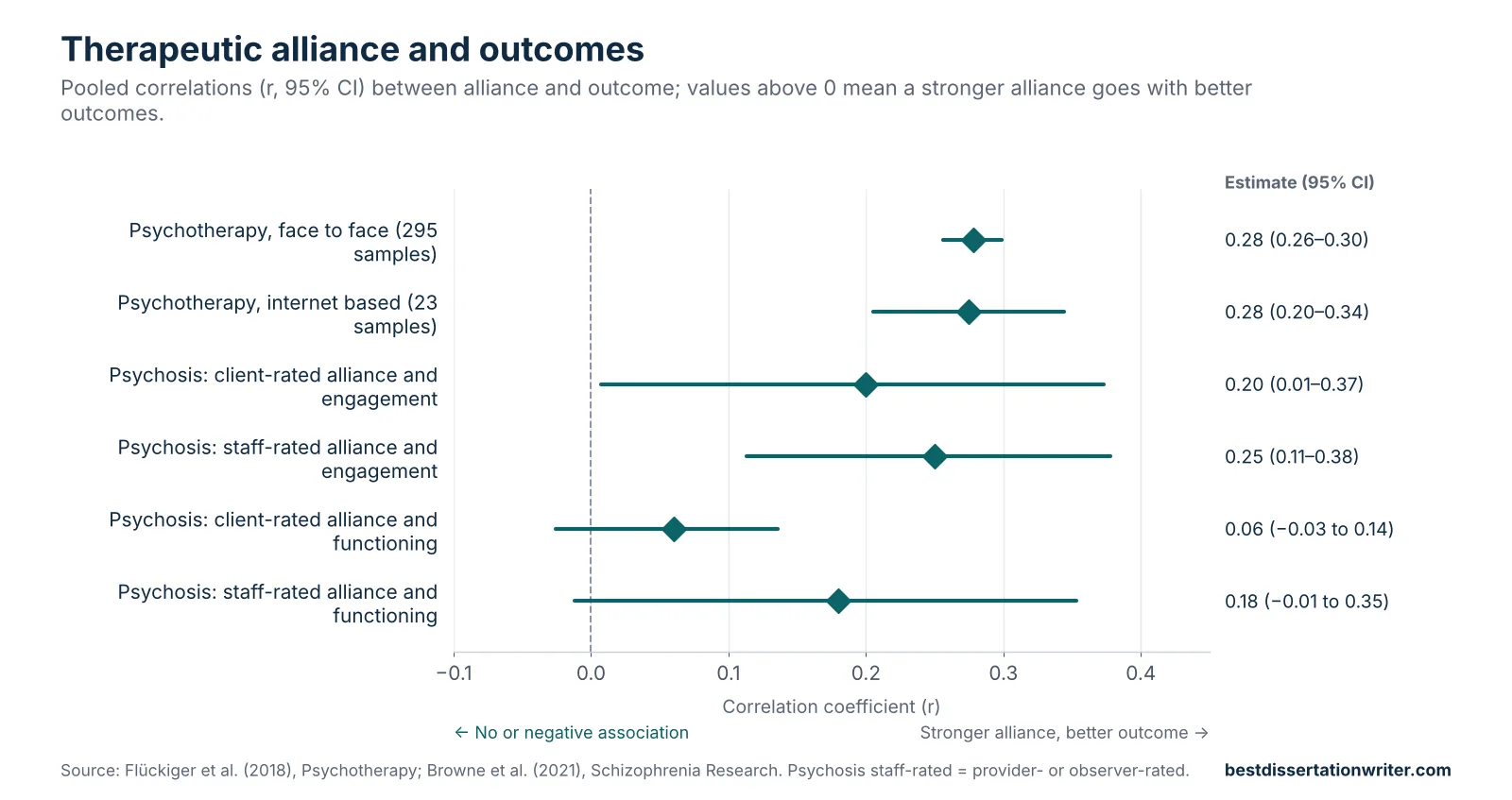
The strength of this finding lies in its consistency across therapy types, countries and raters. Adjusted correlations were broadly similar whether the alliance was rated by clients (0.25), therapists (0.22) or observers (0.22), and across cognitive behavioural, psychodynamic and humanistic therapies. Alliance measured late in treatment showed a stronger association (0.30) than alliance measured early (0.22), which raises the possibility that improvement strengthens the relationship as well as the reverse. Heterogeneity was substantial (I² = 70.8%), so the pooled figure conceals considerable variation.
These data are correlational, so they cannot show that a good alliance causes better outcomes. People who are less unwell or more motivated may form relationships more easily and also recover more quickly. In addition, the studies concerned structured psychological therapy, which differs from the informal, shift-based and often crowded context of nursing care. The meta-analysis nonetheless establishes the therapeutic alliance as one of the most consistently replicated correlates of outcome in mental health care.
Theme 2: The Therapeutic Relationship in Severe Mental Illness
People with psychosis are among those most often cared for by mental health nurses. Priebe et al. (2011) systematically reviewed nine prospective studies testing whether the therapeutic relationship predicted hospitalisation, symptoms and functioning in psychiatric treatment programmes for psychosis. Because methods varied, they used vote counting rather than meta-analysis. For each outcome, more studies found that a more positive relationship predicted better outcomes than would be expected by chance, but effect sizes were small and methods weak, so the authors judged the evidence that the relationship predicts outcomes to be suggestive rather than conclusive.
A more recent meta-analysis of 14 studies with 2,968 participants receiving individual psychosocial treatment for schizophrenia or early psychosis supported and refined these conclusions (Browne et al., 2021). Both client-rated (r = 0.20) and provider- or observer-rated (r = 0.25) alliance were associated with better treatment engagement. Alliance rated by others was associated with improvements in positive and negative symptoms, but alliance rated by clients was not, and associations with functioning were not statistically significant.
The psychosis evidence suggests that engagement with care may be the outcome most clearly linked to the quality of the alliance. This matters for recovery because disengagement from services is associated with relapse and readmission. However, both reviews included few studies, some with small samples, and none focused specifically on nursing. The difference between client-rated and staff-rated findings is a reminder that professionals and service users may judge the same relationship differently.
Theme 3: Building and Measuring the Therapeutic Relationship in Mental Health Nursing
Nursing-specific evidence is much thinner. Hartley et al. (2020) systematically searched Embase, PsycINFO, MEDLINE and CINAHL for interventions designed to improve the nurse-patient therapeutic alliance in mental health settings and identified only eight eligible papers. The interventions drew on diverse theories and methods, only half reported statistically significant improvements, and most were methodologically weak. The authors concluded that the evidence base for supporting nurses to build and maintain good therapeutic relationships was poor and called for a renewed research agenda.
Measurement is part of the problem. McAndrew et al. (2014) reviewed literature on measuring therapeutic engagement on acute inpatient wards and argued that, despite five decades of emphasis on relational care, therapeutic engagement has not been recognised as a fundamental metric of mental health nursing quality. They noted that nurses spend a disproportionate amount of time on activities other than listening and talking with service users. What is not measured is easily overlooked when wards are busy and performance is judged on other indicators.
Moreno-Poyato et al. (2016) reviewed the perspectives of nurses and patients on psychiatric inpatient units and found that both groups attach similar significance to the therapeutic relationship. Differences arose in relation to the time available, negative perceptions held on both sides and the insecurity of the ward setting. This suggests that barriers are often organisational and cultural rather than a matter of nurses failing to value relationships, which has implications for how improvement efforts are designed.
Discussion
Taken together, the sources show a consistent, moderate association between the therapeutic alliance and outcomes in psychological therapy, a smaller and less consistent association in the treatment of psychosis, and a striking shortage of nursing-specific research. The therapeutic relationship appears most clearly linked to engagement with care, which is an important step towards recovery, while links with symptoms and functioning are weaker and depend on who rates the relationship.
A major tension concerns transferability. The strongest data come from structured, one-to-one psychotherapy with consenting clients, whereas nurses often build relationships with people who are detained, acutely unwell or ambivalent about care. Nurses also work in teams across shifts, so a service user may have relationships with many nurses rather than one therapist. Applying psychotherapy effect sizes directly to nursing risks overstating what is known, even though the underlying principles of trust, collaboration and empathy are clearly shared.
Causality is a second concern. Most studies measured the alliance and outcomes at the same time or over short periods, and the stronger association for alliance measured late in therapy suggests that improvement and relationship may reinforce each other. Few studies have tested whether deliberately strengthening the therapeutic relationship improves outcomes, and the interventions reviewed by Hartley et al. (2020) were too varied and weak to answer this question for nursing.
The perspectives of service users on the therapeutic relationship also deserve greater weight. The psychosis meta-analysis found that client-rated and staff-rated relationships predicted different outcomes, and the nursing reviews highlight that time, mutual negative perceptions and unsafe environments shape the relationship. Measures developed with service users, such as those discussed by McAndrew et al. (2014), may capture aspects of the nurse-patient relationship that standard alliance scales miss, including dignity, respect and feeling listened to.
Power and coercion form a further tension that the included reviews only partly address. On acute wards, nurses may be asked to enforce detention, administer medication without consent or carry out restraint, and service users may find it hard to trust someone who also controls their liberty. Moreno-Poyato et al. (2016) identified insecurity of the setting as one factor dividing nurse and patient perspectives, and the psychosis studies took place mainly in voluntary psychosocial treatment. How alliances survive coercive episodes, and how they can be repaired afterwards, is therefore an important gap in the evidence for inpatient nursing.
This review has limitations. It included a small number of reviews, several of which pooled studies from outside nursing, and two of the nursing sources were narrative rather than systematic. This review relied on openly accessible, English-language sources, did not involve independent double screening and could not examine the primary studies in detail. Future research should develop and validate service user-informed measures of the therapeutic relationship in nursing, test relationship-focused interventions in well-designed trials and measure personal recovery as well as clinical outcomes.
Implications of Therapeutic Relationship Evidence for Practice
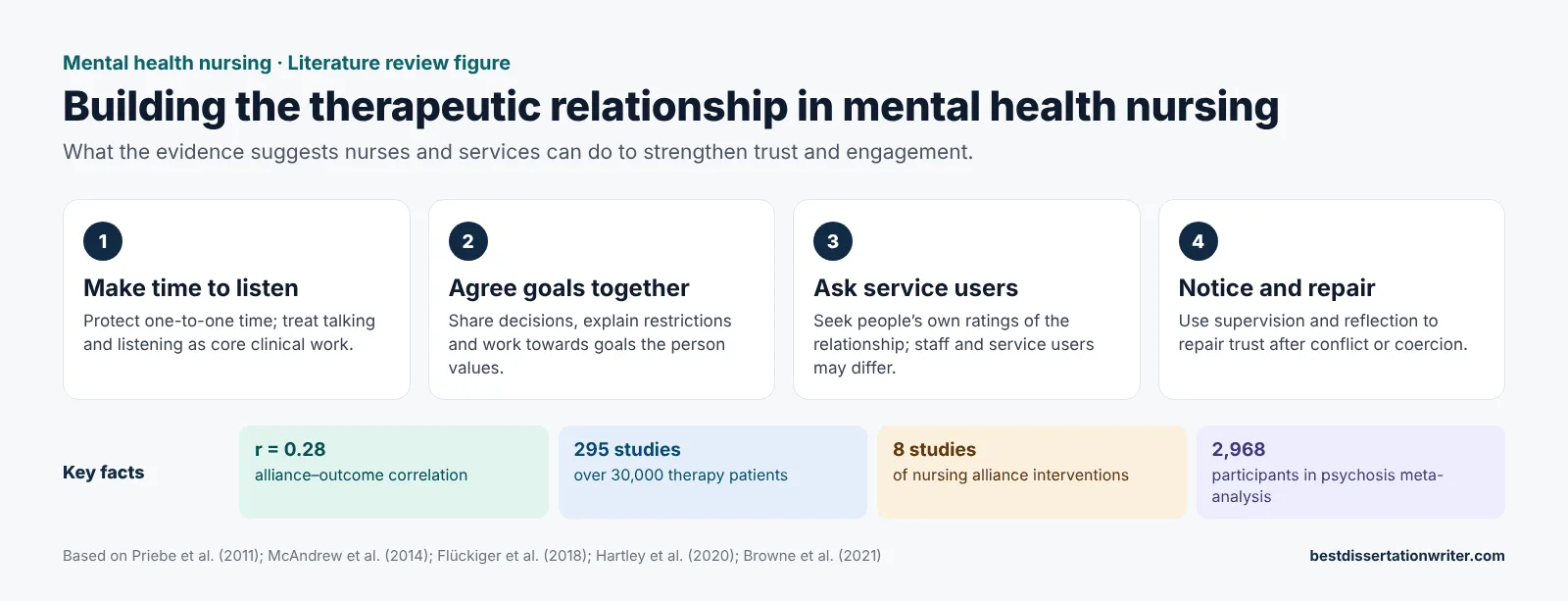
For mental health nurses, the evidence supports treating time spent talking and listening as core clinical work rather than an optional extra. Nurses can build trust by agreeing goals with service users, explaining decisions, keeping promises, using consistent named nurses and asking people how they experience their care. Ward managers can protect time for one-to-one contact, reduce unnecessary administrative duties and include relationship quality, as reported by service users, in routine quality monitoring. Supervision and reflective practice can help nurses to notice and repair ruptures after difficult events.
Education and organisational support matter as much as individual skill. Pre-registration and post-registration programmes can teach the principles that underpin the alliance, including agreeing goals, collaborating on tasks and maintaining a bond of trust, and can give nurses opportunities to practise difficult conversations. Because Hartley et al. (2020) found that most interventions were weak and inconsistent, services introducing new relationship-focused programmes should evaluate them carefully, ideally alongside service users, rather than assuming that training alone will change everyday ward practice.
Relationships also shape other areas of practice. Trust makes de-escalation techniques more likely to succeed when people become distressed or angry, and open, honest conversations underpin compassionate suicide risk assessment. Engagement is particularly important when supporting people with schizophrenia, and an understanding of past trauma, as promoted by trauma-informed care, can help nurses avoid repeating harmful experiences of power and control.
Conclusion
This systematic review found consistent evidence that a stronger therapeutic alliance is associated with better outcomes in psychological therapy, more modest evidence linking the therapeutic relationship with engagement and some symptom outcomes in psychosis, and very limited research on how mental health nurses can best build and maintain relationships with service users.
The therapeutic relationship remains central to mental health nursing, but it needs to be valued, measured and studied as rigorously as other aspects of care. Protecting time for meaningful contact, listening to service users’ views of their relationships with staff and investing in high-quality nursing research offer practical ways to strengthen a relationship that many people regard as the heart of their recovery.
References
Browne, J., Wright, A. C., Berry, K., Mueser, K. T., Cather, C., Penn, D. L., & Kurtz, M. M. (2021). The alliance-outcome relationship in individual psychosocial treatment for schizophrenia and early psychosis: A meta-analysis. Schizophrenia Research, 231, 154–163. https://doi.org/10.1016/j.schres.2021.04.002
Flückiger, C., Del Re, A. C., Wampold, B. E., & Horvath, A. O. (2018). The alliance in adult psychotherapy: A meta-analytic synthesis. Psychotherapy, 55(4), 316–340. https://doi.org/10.1037/pst0000172
Hartley, S., Raphael, J., Lovell, K., & Berry, K. (2020). Effective nurse–patient relationships in mental health care: A systematic review of interventions to improve the therapeutic alliance. International Journal of Nursing Studies, 102, 103490. https://doi.org/10.1016/j.ijnurstu.2019.103490
McAndrew, S., Chambers, M., Nolan, F., Thomas, B., & Watts, P. (2014). Measuring the evidence: Reviewing the literature of the measurement of therapeutic engagement in acute mental health inpatient wards. International Journal of Mental Health Nursing, 23(3), 212–220. https://doi.org/10.1111/inm.12044
Moreno-Poyato, A. R., Montesó-Curto, P., Delgado-Hito, P., Suárez-Pérez, R., Aceña-Domínguez, R., Carreras-Salvador, R., Leyva-Moral, J. M., Lluch-Canut, T., & Roldán-Merino, J. F. (2016). The therapeutic relationship in inpatient psychiatric care: A narrative review of the perspective of nurses and patients. Archives of Psychiatric Nursing, 30(6), 782–787. https://doi.org/10.1016/j.apnu.2016.03.001
Priebe, S., Richardson, M., Cooney, M., Adedeji, O., & McCabe, R. (2011). Does the therapeutic relationship predict outcomes of psychiatric treatment in patients with psychosis? A systematic review. Psychotherapy and Psychosomatics, 80(2), 70–77. https://doi.org/10.1159/000320976
Cite this example
Best Dissertation Writers (2026) The Therapeutic Relationship Between Mental Health Nurses and Service Users and Its Influence on Recovery Outcomes: A Systematic Review. Available at: https://bestdissertationwriter.com/therapeutic-relationship-review-review/
Best Dissertation Writers
Get expert help with your nursing literature review
Share your topic and deadline with Best Dissertation Writers and get support tailored to your module brief.