
Nursing Responses to Self-Harm in Inpatient and Community Settings: A Systematic Review of Qualitative Evidence
 By Dr. Robertson Prime, Research Fellow
Updated October 12, 2026
15 min read
About 3,000 words
In this review
Abstract
Background: Self-harm, meaning intentional self-poisoning or self-injury, is among the most common reasons for emergency presentation to hospital, and a hospital presentation is the strongest known predictor of later suicide. Nurses are usually the professionals with the most contact with people who hurt themselves, yet service users have long reported feeling judged or dismissed.
Aim: This systematic review aimed to examine what recent evidence shows about nursing attitudes and responses to people who hurt themselves in inpatient and community settings, and which approaches support therapeutic engagement and reduce repetition.
Methods: Evidence was identified through targeted searches of openly accessible bibliographic records, publisher websites and the reference lists of key reviews. Seven sources published between 2009 and 2022 were included: two systematic reviews of attitudes and experiences, one literature review and one meta-analysis focused on nurses, one meta-analysis of repetition, one Cochrane review and one national guideline, appraised with CASP checklists (or AGREE II domains for guidance) and synthesised narratively.
Findings: Service users frequently described poor communication and a perceived lack of staff knowledge, and a meta-analysis estimated that 16.3% of people repeated within one year of a hospital presentation. Negative nursing attitudes were common, particularly in general hospital and emergency settings, but active training, reflective education, supervision and peer support improved attitudes. A Cochrane review of 76 trials found that CBT-based psychotherapy, mentalisation-based therapy and group emotion-regulation psychotherapy were associated with reduced repetition, although certainty was often low, and national guidance advises against using risk assessment tools to predict suicide or repetition.
Conclusion: Nurses should respond to every presentation with compassion, replace risk prediction with a timely psychosocial assessment and actively support referral to CBT-informed psychological help. Organisations should provide reflective training, clinical supervision and peer support to sustain therapeutic engagement.
Keywords: self-harm, nursing attitudes, therapeutic engagement
Introduction
This systematic review critically examines recent evidence on self-harm and its implications for mental health nursing practice.
Self-harm, meaning intentional self-poisoning or self-injury, is among the most common reasons for emergency presentation to hospital, and a hospital presentation is the strongest known predictor of later suicide. People who hurt themselves often arrive at emergency departments, medical wards and community mental health teams at moments of acute distress, shame and exhaustion. What happens in those first encounters, including how they are spoken to, whether they are assessed and whether follow-up is arranged, can shape whether they return for help in future or avoid services altogether.
Nurses are usually the professionals with the most contact with people who self-harm. They triage, treat wounds and overdoses, carry out observations on inpatient wards, and provide ongoing support in the community. Yet service users have long reported feeling judged or dismissed, and staff often describe frustration, helplessness and a lack of training. Nursing attitudes therefore matter, because they influence the quality of care, the person’s willingness to engage and, potentially, the risk of repetition.
A systematic approach was chosen so that systematic reviews of qualitative and quantitative studies, a Cochrane review of interventions and current national guidance could be identified, appraised and synthesised in a transparent and reproducible way.
Review question
What does recent evidence show about nursing attitudes and responses to people who self-harm in inpatient and community settings, and which approaches support therapeutic engagement and reduce repetition?
Background to Self-Harm
In the United Kingdom, self-harm is defined broadly as intentional self-poisoning or self-injury, irrespective of the apparent purpose of the act. This definition deliberately avoids separating ‘suicide attempts’ from non-suicidal self-injury, because motives are often mixed, change over time and are difficult to judge from the outside. It includes cutting, burning, overdoses of prescribed or over-the-counter medicines and other forms of self-injury, and it applies to people of all ages.
The consequences of an episode can be serious. A meta-analysis of 177 papers found that around one in six people who presented to hospital after self-harming repeated the behaviour within a year, and that about one in 25 died by suicide within five years (Carroll et al., 2014). Repetition rates had not fallen in studies published after 2000 compared with earlier decades, suggesting that services had not improved outcomes over that period.
National guidance in England has recently changed. The NICE guideline on self-harm (NG225), published in 2022, replaced earlier guidance from 2004 and 2011 (National Institute for Health and Care Excellence [NICE], 2022). It advises against using risk assessment tools and scales to predict future suicide or repetition and instead emphasises a timely psychosocial assessment, compassionate treatment and training that explores staff attitudes, values, beliefs and biases. These changes place the quality of the relationship, rather than a risk score, at the centre of care.
Information for the public from charities such as Mind and from the Royal College of Psychiatrists offers information and support for people who self-injure and for their families and carers. Research with service users, reviewed below, suggests that negative or dismissive responses from health professionals can deepen distress and discourage future help-seeking. This makes the attitudes and behaviour of nurses a legitimate focus for review alongside the effectiveness of specific treatments.
Search Strategy and Methods
Evidence for this example was identified through targeted searches of openly accessible bibliographic records, publisher websites and the reference lists of key reviews. Search terms combined keywords for the population and problem (“self-harm”, “self-injury”, “self-poisoning”, “overdose”) with terms for staff and care (“nurs*”, “attitude*”, “stigma”, “therapeutic relationship”, “service user experience”, “psychosocial intervention”, “repetition”), joined with the Boolean operators AND and OR. A full systematic review for assessment would run the same strategy in CINAHL, PubMed/MEDLINE, the Cochrane Library and Embase and report the number of records screened in a PRISMA flow diagram.
Sources were eligible if they were systematic reviews, meta-analyses or national guidelines addressing staff attitudes to self-harm, service users’ experiences of clinical services, the risk of repetition after a hospital presentation, or psychosocial interventions to reduce repetition in adults. Both qualitative and quantitative evidence was included, because the review question concerns experiences as well as outcomes. Single primary studies, opinion pieces and sources focused only on children and young people were excluded.
Seven sources published between 2009 and 2022 were included: two systematic reviews of attitudes and experiences, one literature review and one meta-analysis focused on nurses, one meta-analysis of repetition, one Cochrane review and one national guideline (Table 1). The quality of each source was appraised using the Critical Appraisal Skills Programme (CASP) checklist for systematic reviews or the AGREE II domains for guidance, and findings were synthesised narratively.
Key Findings on Self-Harm
Three themes were identified: service users’ experiences of clinical care, the attitudes of nurses and other staff and how these can be changed, and the evidence on psychosocial interventions to reduce repetition. Table 1 summarises the included sources, and Figure 1 presents pooled effects of the psychosocial interventions that showed the clearest reductions in repeat self-injury.
| Author, year | Design | Setting and sample | Key finding |
|---|---|---|---|
| Taylor et al. (2009) | Systematic review (qualitative and quantitative) | 31 studies of service users’ views of clinical services | Poor communication and perceived lack of staff knowledge were common; assessment and after-care needed to improve. |
| Saunders et al. (2012) | Systematic review | 74 studies of clinical staff attitudes and knowledge | General hospital staff often negative, especially to repeat presentations; active training consistently improved attitudes. |
| Carroll et al. (2014) | Systematic review and meta-analysis | 177 papers on hospital-presenting self-harm | 16.3% repeated within one year; 1.6% suicide at 12 months and 3.9% at five years. |
| Karman et al. (2015) | Literature review | 15 articles on nurses in general and mental health settings | Negative nursing attitudes common; reflective, interactive education and supervision improve attitudes. |
| Rayner et al. (2019) | Meta-analysis | 5 studies of emergency department nurses | Limited empathy and a negative stance; education and supervision recommended. |
| Witt et al. (2021) | Cochrane systematic review | 76 trials, 21,414 adults | CBT-based therapy, mentalisation-based therapy and group emotion regulation reduced repetition; certainty often low. |
| NICE (2022) | National guideline (NG225) | Health and social care settings in England | No risk tools to predict repetition or suicide; early psychosocial assessment; CBT-informed intervention. |
Theme 1: Service User Experiences and Therapeutic Engagement
Taylor et al. (2009) systematically reviewed 31 qualitative and quantitative studies of how people who self-harm view clinical services. Despite differences between countries and health systems, experiences were strikingly similar. Participants frequently described poor communication with staff and a perceived lack of staff knowledge about self-injury, and many felt that psychosocial assessment and access to after-care needed to improve. The authors suggested that better staff knowledge, communication and after-care might increase satisfaction and adherence to treatment.
These findings matter for therapeutic engagement, because people who feel misunderstood at their first presentation may be less likely to attend follow-up appointments or to seek help during the next crisis. A strength of the review was its inclusion of the service user voice across many settings. However, most included studies used convenience samples, and people with the most negative experiences may have been more or less likely to take part, so the findings describe common themes rather than precise proportions.
The repetition data reported by Carroll et al. (2014) add urgency to this theme. Their meta-analysis estimated that 16.3% of people repeated self-harming within one year of a hospital presentation and that 1.6% died by suicide within 12 months, rising to 3.9% within five years. Estimates were higher when repetition was measured by self-report (21.9%) than by hospital records (13.7%), showing that many repeat episodes never reach hospital. Each presentation is therefore an important opportunity for therapeutic engagement.
Theme 2: Nursing Attitudes Towards Self-Harm and How They Change
Saunders et al. (2012) reviewed 74 studies of clinical staff attitudes and knowledge. General hospital staff, particularly doctors, often held negative attitudes, especially towards people who repeatedly self-harmed, and these patients were viewed more negatively than most other patient groups. Psychiatric staff were generally more positive than general hospital staff, and within general hospitals doctors were more negative than nurses. Importantly, active training led to consistent improvements in attitudes and knowledge across all staff groups.
Focusing specifically on nurses, Karman et al. (2015) identified 15 articles and found that negative nursing attitudes were common. The influence of age, gender and years of experience was unclear, but setting and qualification level appeared to matter, with mental health nurses tending to be more positive than general nurses. Education with reflective and interactive components improved attitudes, and peer and supervisory support appeared particularly important for mental health nurses.
Rayner et al. (2019) pooled five studies of emergency department nurses that used the Self-Harm Antipathy Scale or the Attitudes Towards Deliberate Self-Harm Questionnaire. The meta-analysis showed limited empathy and a generally negative stance towards patients who had self-harmed. The authors recommended education and clinical supervision and suggested that the same scales could be used to measure change after training. The small number of studies limits the precision of these findings, but they echo the earlier reviews.
Taken together, these reviews suggest that nursing attitudes are not fixed traits but are shaped by setting, training, workload and support. Negative attitudes often appear to arise from feelings of powerlessness and a lack of skills rather than from a lack of compassion. This interpretation is important, because it implies that education, supervision and adequate time can make a difference, whereas simply instructing staff to be more caring is unlikely to change practice.
Theme 3: Psychosocial Interventions and Repetition
The Cochrane review by Witt et al. (2021) included 76 trials with 21,414 adult participants and examined a wide range of psychosocial interventions. Cognitive behavioural therapy (CBT)-based psychotherapy was associated with fewer people repeating self-injury by the end of treatment (odds ratio 0.35, 95% confidence interval 0.12 to 1.02; four trials, 238 participants), although the confidence interval was wide and the certainty of evidence low. Some evidence of benefit was also reported at later follow-up.
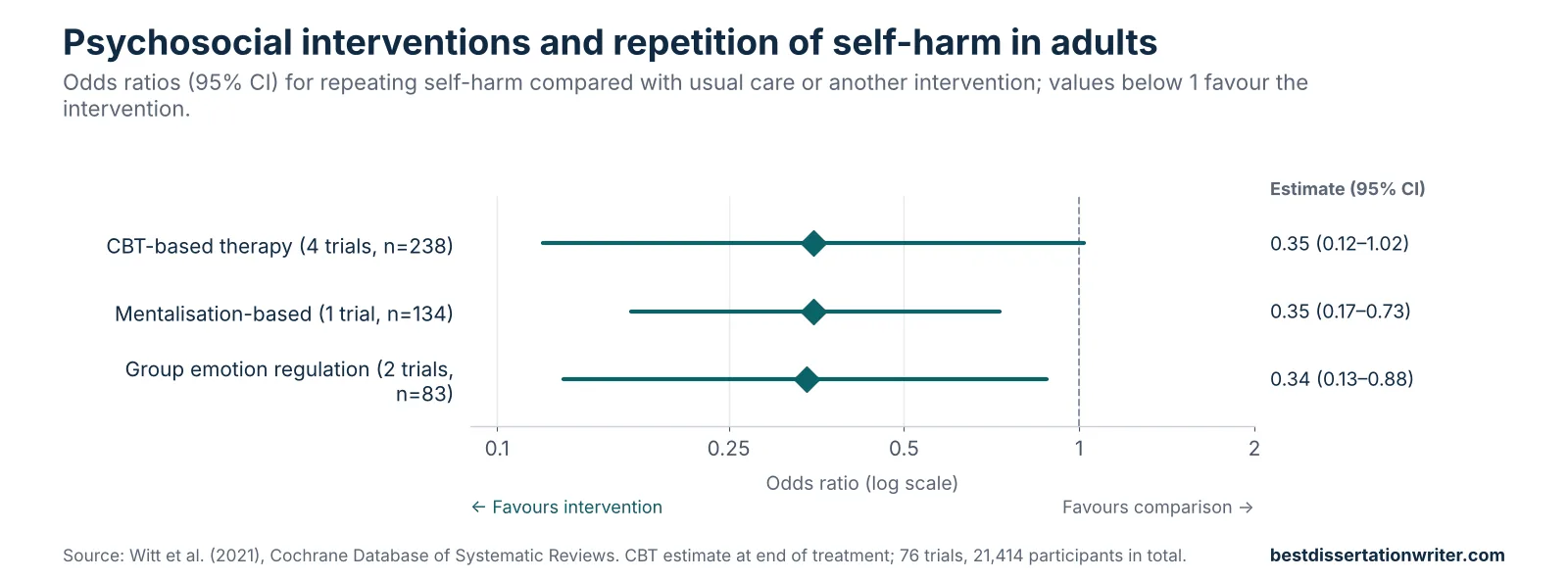
Mentalisation-based therapy, tested in a single trial with 134 participants, reduced repetition (odds ratio 0.35, 0.17 to 0.73), and group-based emotion-regulation psychotherapy, tested in two small trials with 83 participants, also showed benefit (0.34, 0.13 to 0.88). In contrast, the review found no clear evidence of a difference for case management, remote contact interventions such as postcards or telephone calls, or dialectical behaviour therapy for repetition, with 66.0% of participants repeating after dialectical behaviour therapy compared with 68.2% after usual care or an alternative therapy.
The NICE (2022) guideline reflects this evidence by recommending a structured, person-centred, CBT-informed psychological intervention for adults, typically lasting between four and ten sessions. It also recommends that a psychosocial assessment should take place as early as possible and should not be delayed until medical treatment is complete. For nurses, these recommendations shift attention from predicting risk towards understanding the person’s needs and ensuring that they are connected to effective, timely psychological help.
Discussion
This review found a consistent picture across more than a decade of self-harm research. People who self-harm often experience care as dismissive or poorly informed, many staff, including nurses, hold negative attitudes, and repetition is common. At the same time, attitudes improve with training and support, and several structured psychological therapies appear to reduce repetition. The evidence therefore points to both the problem and its partial solutions, and nurses are central to both.
A key tension lies between the emotional demands of the work and the expectation of compassionate care. Reviews by Karman et al. (2015) and Rayner et al. (2019) suggest that negative attitudes are linked to frustration and powerlessness, particularly when people present repeatedly. Repeated self-harm is, however, a marker of higher risk rather than of manipulation, and the evidence on repetition suggests that people who return to hospital are exactly those who most need a skilled and consistent response. Reframing repetition as a sign of unmet need, and giving nurses the skills to respond, may help to reduce this frustration and protect therapeutic engagement.
The shift away from risk prediction tools is significant for nursing practice. Risk scales are attractive because they appear objective and are quick to complete, but NICE (2022) concluded that they should not be used to predict suicide or repetition. Without a score, nurses must rely on conversation, observation and clinical judgement, which demands confidence and good communication skills. This change makes training in assessment and therapeutic engagement more, not less, important.
There is also a gap between the evidence for psychological therapies and their availability. Interventions such as mentalisation-based therapy and group emotion-regulation therapy require specialist training and are not available everywhere. Nurses working in emergency departments or on wards who care for people after self-harm cannot usually deliver these therapies themselves, but they can support motivation to attend, provide brief psychologically informed care and ensure that referrals are made. The effects of nursing attitudes on uptake of these therapies have rarely been studied directly.
The evidence base has limitations. Many attitude studies were cross-sectional surveys using different scales, the reviews included few studies from low- and middle-income countries, and some focused on general hospital rather than mental health settings. The intervention trials were often small, and certainty was frequently low. This review relied on openly accessible, English-language sources and did not involve independent double screening. Future research should test whether training for nurses changes behaviour and patient outcomes, not just attitude scores, and should include the views of people with lived experience.
Implications of Self-Harm Evidence for Practice
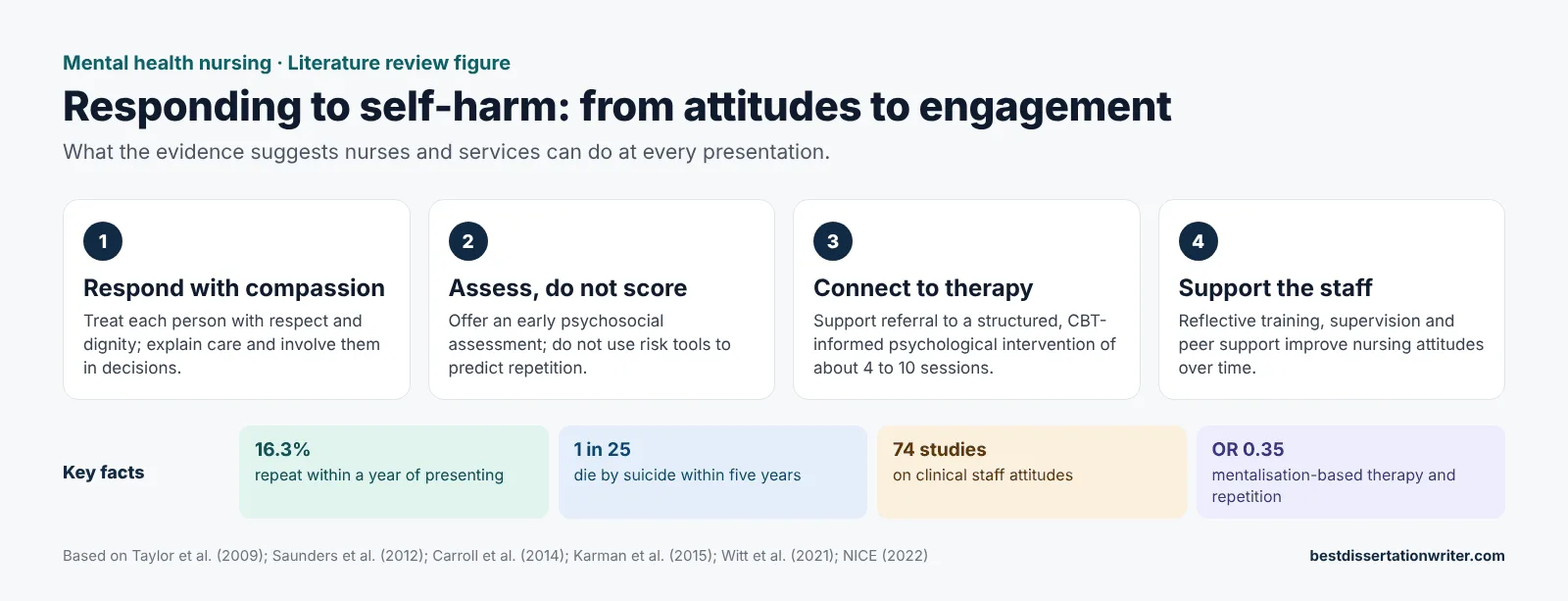
For mental health nurses, the evidence supports responding to every presentation with respect, dignity and compassion, explaining what will happen and involving the person in decisions about their care. Nurses should avoid using risk scores to predict outcomes and should instead carry out or arrange a timely psychosocial assessment, focusing on the person’s needs, safety and strengths. Wound care and physical treatment should be delivered without judgement, and referral to CBT-informed psychological help should be discussed and actively supported.
Organisations should provide regular training that includes reflection, contact with people with lived experience and opportunities to explore staff attitudes, together with clinical supervision and peer support. Recognising and addressing mental illness stigma among staff, attending to dual diagnosis where substance misuse is involved, and combining good suicide risk assessment practice with a strong therapeutic relationship can all strengthen therapeutic engagement and continuity of care.
Conclusion
This systematic review examined evidence on nursing responses to self-harm in inpatient and community settings. People who self-harm frequently report poor communication and dismissive care, and negative nursing attitudes remain common, particularly in general and emergency settings. Repetition is frequent, and around one in 25 people presenting to hospital die by suicide within five years.
Encouragingly, training, supervision and support can improve attitudes, and structured psychological therapies can reduce repeat self-harm. Mental health nurses can make a difference by treating each encounter as an opportunity for therapeutic engagement, replacing risk prediction with compassionate assessment and ensuring that people are connected to effective help.
References
Carroll, R., Metcalfe, C., & Gunnell, D. (2014). Hospital presenting self-harm and risk of fatal and non-fatal repetition: Systematic review and meta-analysis. PLOS ONE, 9(2), e89944. https://doi.org/10.1371/journal.pone.0089944
Karman, P., Kool, N., Poslawsky, I. E., & van Meijel, B. (2015). Nurses’ attitudes towards self-harm: A literature review. Journal of Psychiatric and Mental Health Nursing, 22(1), 65–75. https://doi.org/10.1111/jpm.12171
National Institute for Health and Care Excellence. (2022). Self-harm: Assessment, management and preventing recurrence (NICE guideline NG225). NICE. https://www.nice.org.uk/guidance/ng225
Rayner, G., Blackburn, J., Edward, K., Stephenson, J., & Ousey, K. (2019). Emergency department nurse’s attitudes towards patients who self-harm: A meta-analysis. International Journal of Mental Health Nursing, 28(1), 40–53. https://doi.org/10.1111/inm.12550
Saunders, K. E. A., Hawton, K., Fortune, S., & Farrell, S. (2012). Attitudes and knowledge of clinical staff regarding people who self-harm: A systematic review. Journal of Affective Disorders, 139(3), 205–216. https://doi.org/10.1016/j.jad.2011.08.024
Taylor, T. L., Hawton, K., Fortune, S., & Kapur, N. (2009). Attitudes towards clinical services among people who self-harm: Systematic review. British Journal of Psychiatry, 194(2), 104–110. https://doi.org/10.1192/bjp.bp.107.046425
Witt, K. G., Hetrick, S. E., Rajaram, G., Hazell, P., Taylor Salisbury, T. L., Townsend, E., & Hawton, K. (2021). Psychosocial interventions for self-harm in adults. Cochrane Database of Systematic Reviews, (4), CD013668. https://doi.org/10.1002/14651858.CD013668.pub2
Cite this example
Best Dissertation Writers (2026) Nursing Responses to Self-Harm in Inpatient and Community Settings: A Systematic Review of Qualitative Evidence. Available at: https://bestdissertationwriter.com/self-harm-literature-review/
Best Dissertation Writers
Get expert help with your nursing literature review
Share your topic and deadline with Best Dissertation Writers and get support tailored to your module brief.