Nursing Care of Patients Presenting with Alcohol- and Drug-Related Emergencies: A Scoping Review
 By Dr. Robertson Prime, Research Fellow
Updated November 2, 2026
15 min read
About 3,000 words
In this review
Abstract
Background: Emergency departments are often the first place where people with harmful alcohol and drug use come into contact with health services. Drug-related emergencies include intoxication, overdose and withdrawal, and they are demanding for emergency nurses because they combine acute risk, complex needs and, for some patients, experiences of stigma.
Aim: This scoping review aimed to map the evidence on nursing care of patients presenting with alcohol- and drug-related emergencies, including brief interventions, treatment initiation and nurses’ attitudes, and to identify gaps in the literature.
Methods: Evidence was identified through targeted searches of openly accessible bibliographic records, publisher websites and repositories. Five sources published between 2015 and 2024 were included: a realist review, a systematic review of brief interventions in young people, a review of nurse-led screening and brief intervention, a scoping review of buprenorphine initiation and a survey of emergency nurses. Sources were charted and summarised descriptively.
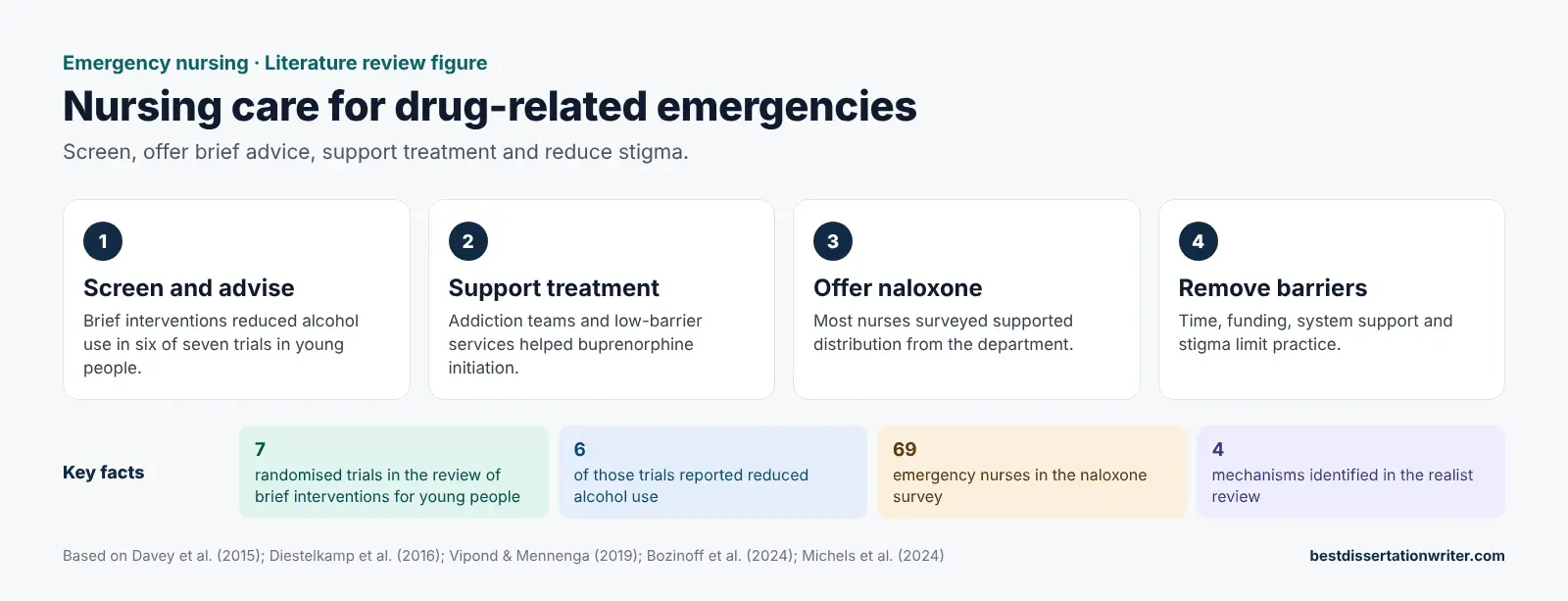
Findings: A review of seven randomised trials and other studies of brief interventions for young people found that six trials reported reduced alcohol use, although designs were heterogeneous. A realist review identified four mechanisms and four contexts that shape how brief interventions work in emergency departments. A review of nurse-implemented screening and brief intervention reported that risky drinking declined and that nurses delivered it effectively, with buy-in and funding as challenges. A scoping review of buprenorphine initiation found that multidisciplinary addiction teams and low-barrier services helped, whereas stigma and a more dangerous drug supply were obstacles. In a survey of 69 emergency nurses, most supported naloxone distribution but cited limited time, system support and cost as barriers.
Conclusion: Nurses are well placed to deliver brief interventions and to support treatment for patients with drug-related emergencies, but the evidence is uneven, mostly concerns alcohol and opioids, and rarely includes patients’ views. Education, time and system support are needed.
Keywords: drug-related emergencies, substance use, brief intervention
Introduction
This scoping review critically examines recent evidence on drug-related emergencies and its implications for emergency nursing practice.
Emergency departments see people at some of the most vulnerable moments of their lives. For patients who use alcohol or other drugs in harmful ways, an attendance may follow an injury, an overdose, a collapse or a period of acute withdrawal, and it may be the only time that they come into contact with a health professional. Drug-related emergencies therefore present both a clinical challenge and an opportunity to offer support.
Emergency nurses assess and monitor these patients, manage risk, give emergency treatment and communicate with patients who may be distressed, drowsy or unwilling to engage. They also work in a setting where time is short, where patients may be seen as responsible for their own condition and where stigma can affect the quality of care. The nurse’s attitude and approach can therefore influence whether a patient feels able to accept help.
The literature on this topic covers many different kinds of intervention, from brief advice about alcohol to starting treatment for opioid dependence in the department and supplying naloxone. Because these studies differ in design and aim, a scoping review was chosen.
Review question
What is known about nursing care of patients presenting with alcohol- and drug-related emergencies, and where are the gaps in the evidence?
Background to Drug-Related Emergencies
Drug-related emergencies range from acute intoxication, which may need only observation and supportive care, to life-threatening overdose and severe withdrawal. Alcohol is the substance most often discussed in the emergency nursing literature, but opioids, stimulants and other drugs also lead to attendance. The needs of each group differ, and so do the interventions that nurses can offer.
Two broad approaches appear in the literature. The first is opportunistic: using an emergency attendance to screen for harmful use, offer brief advice and refer patients for further help. The second is treatment based: starting medicines such as buprenorphine for opioid use disorder, or giving naloxone to take home, so that patients are protected from another overdose. Both depend heavily on the knowledge, attitudes and time of emergency nurses.
Drug-related emergencies also overlap with other problems seen in the department. Patients may be in a mental health crisis, may have been injured in violence or may be at risk of harm at home. These links are discussed in the reviews of domestic violence and mental health crisis. Recognising them early helps nurses to plan care that addresses the whole person and not only the immediate toxic effects.
The emergency nurse’s role in drug-related emergencies has several parts. The first is safe assessment and monitoring, including airway, breathing, level of consciousness and signs of withdrawal. The second is communication, which means explaining what is happening and listening without judgement. The third is linking the patient to further help before discharge. Each part of this role is affected by the pace of the department, so planning for drug-related emergencies needs to consider workload as well as clinical skill.
Search Strategy and Methods
Evidence for this example was identified through targeted searches of openly accessible bibliographic records, publisher websites and repositories. Search terms combined keywords for the problem (“alcohol”, “drug overdose”, “opioid use disorder”, “intoxication”) with terms for the setting and provider (“emergency department”, “emergency nurses”, “brief intervention”, “SBIRT”, “naloxone”, “buprenorphine”), joined with the Boolean operators AND and OR. A full scoping review for assessment would run the same strategy in CINAHL, PubMed/MEDLINE, PsycINFO and Embase and report the records screened in a PRISMA-ScR flow diagram.
Sources were eligible if they reviewed or reported evidence on emergency department care for people with alcohol- or drug-related problems and had relevance to nursing. Studies that concerned only doctors, inpatient treatment or non-emergency settings were excluded.
Five sources published between 2015 and 2024 were included (Table 1). In line with scoping review methods, the sources were charted and summarised descriptively, without a formal appraisal of quality or a pooled estimate of effect.
Because this is a scoping review, the aim is to describe the range of evidence about drug-related emergencies, not to rank interventions. Each source is therefore presented in terms of what it examined, how it was designed and what it reported, and gaps are noted as findings in their own right. Where sources used different terms, such as alcohol misuse, risky drinking and opioid use disorder, the original wording is kept.
Key Findings on Drug-Related Emergencies
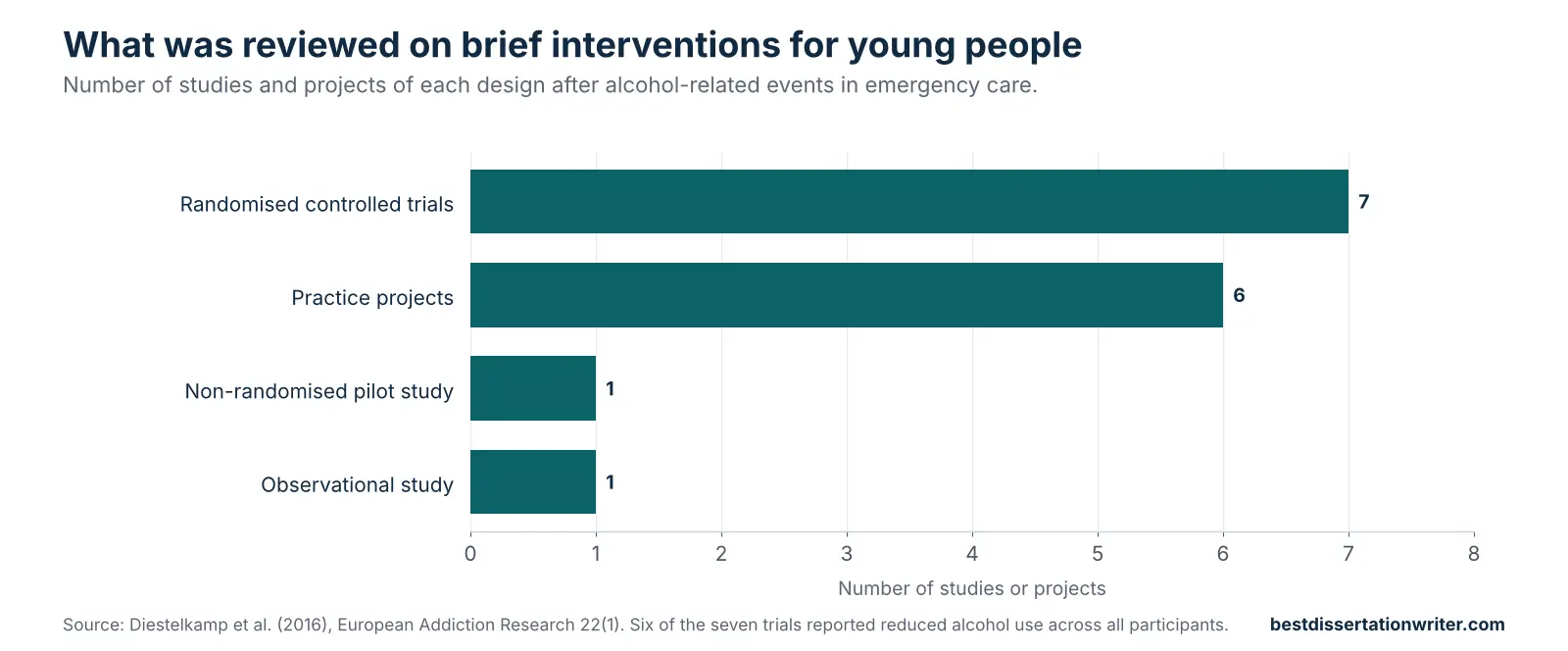
Three themes were identified: brief interventions for alcohol, nurse-led screening and treatment, and the attitudes and barriers experienced by emergency nurses. Table 1 summarises the included sources, and Figure 1 shows the designs of the studies included in the review of brief interventions for young people.
| Author, year | Design | Setting and sample | Key finding |
|---|---|---|---|
| Bozinoff et al. (2024) | Scoping review | ED buprenorphine initiation; United States and Canada | Addiction teams and low-barrier services helped; stigma and drug supply were obstacles. |
| Davey et al. (2015) | Realist review | Brief interventions for alcohol misuse in EDs | Four mechanisms and four contexts identified; not yet tested empirically. |
| Diestelkamp et al. (2016) | Systematic review | 7 trials and other studies; ages 12–25 | Six trials reported reduced alcohol use; designs heterogeneous. |
| Michels et al. (2024) | Cross-sectional survey | 69 emergency nurses (93% response) | Most supported naloxone distribution; time, support and cost were barriers. |
| Vipond & Mennenga (2019) | Review of the literature | Nurse-implemented SBIRT | Risky drinking declined; buy-in and funding were challenges. |
Theme 1: Brief Interventions for Alcohol-Related Presentations
Diestelkamp et al. (2016) reviewed brief in-person interventions for adolescents and young adults aged 12 to 25 who attended emergency care after alcohol-related events. Searching for controlled trials and supplementing them with grey literature, they identified seven randomised controlled trials, six practice projects, one non-randomised pilot study and one observational study. Six of the trials reported reduced alcohol use across all participants, and four reported effects on consumption, risky behaviour or referral to treatment.
The authors cautioned that the heterogeneous designs and results limit conclusions about effectiveness. Participation and referral rates varied widely, and acceptance and implementation were rarely assessed. They also observed that the number of practice projects in Europe suggests that practitioners see a need to address this group, even though evidence of effectiveness is incomplete. For nurses, this means that offering brief advice to a young person after an alcohol-related attendance is reasonable but that the specific approach to use remains uncertain.
Davey et al. (2015) approached the question differently, through a realist review of brief interventions for alcohol misuse delivered in emergency departments. Rather than asking whether the interventions work, the authors asked how, for whom and under what circumstances. They identified four mechanisms through which brief interventions may act: engagement with and retention of the intervention materials, resolving ambivalence, increased awareness of the consequences of drinking, and increased self-efficacy or empowerment to change.
Four contexts appeared to shape these mechanisms: the patient’s emotional state, whether an injury was attributed to alcohol, the severity of alcohol use and the patient’s stage of change. The authors noted that these configurations have not been tested empirically and called for quantitative research. A limitation is that the paper’s own figures were inconsistent: the abstract reports 36 included studies, whereas the results report a different number, so the exact size of the evidence base should not be relied upon.
Theme 2: Nurse-Led Screening and Treatment
Vipond and Mennenga (2019) reviewed the literature on screening, brief intervention and referral to treatment (SBIRT) by emergency nurses. They set out to assess the effectiveness and feasibility of nurse-implemented SBIRT. After nurses implemented it, risky drinking behaviours declined, and nurses implemented the approach effectively. Challenges included gaining nurse buy-in and securing limited funding.
The authors concluded that the emergency department is a key setting for SBIRT, because it may help to reduce alcohol-related injuries and readmissions, and that nurses are central to implementation because of their close relationships with patients. As the abstract does not give the number of included studies, the strength of this evidence cannot be judged from the source alone, and the conclusion should be read as supportive rather than definitive.
Bozinoff et al. (2024) carried out a scoping review of the facilitators of and barriers to starting buprenorphine in the emergency department, using the Consolidated Framework for Implementation Research. Starting buprenorphine in the department is widely viewed as an evidence-based response to the opioid overdose crisis, but it has been adopted only to a limited extent. Across the United States and Canada, there has been substantial implementation effort.
Helpful factors included multidisciplinary addiction teams and on-site, low-barrier services informed by harm reduction, which ease patients’ transitions to continuing care. Obstacles included failure to address structural stigma, the complexity of patients’ lives and a more dangerous drug supply. The authors noted that the literature largely omits the views of service users, health administrators and learners. They called for better coordination of implementation and for equitable, inclusive pathways for starting opioid agonist therapy.
Theme 3: Nurses’ Attitudes and Barriers
Michels et al. (2024) surveyed emergency nurses at a large academic medical centre in the United States about their attitudes to patients with opioid use disorder and to naloxone distribution. The response rate was 93% (69 of 74 nurses). Most supported distributing naloxone from the department, but they cited limited time, lack of system support and cost as barriers. Most were comfortable caring for patients with opioid use disorder, although many felt only a little or somewhat comfortable with overdose education and naloxone distribution.
Nurses with fewer than five years of experience reported more overdose education training in nursing school than those with six or more years, and no other differences were significant. The authors concluded that targeted education and action on systemic barriers are opportunities to improve these efforts. This single-centre survey is small, so its results cannot be generalised, but they match the barriers of time, support and funding reported in the reviews of nurse-led brief intervention and treatment initiation.
Taken together, the sources suggest that willingness among nurses is not the main obstacle. The nurses surveyed supported naloxone distribution, and reviews report that nurses can deliver brief interventions effectively. What limits practice are organisational factors: time, funding, system support, training and the stigma that surrounds substance use. These are matters that nurses cannot solve alone and that services and managers must address.
One strength of the nursing contribution is continuity of contact. Emergency nurses often spend more time with a patient than any other clinician during a visit, which gives them time to build a rapport and to notice what the patient says about their drinking or drug use. That contact is the basis of every approach to drug-related emergencies described in this review, and it is why nurse education is a recurring recommendation.
Discussion
This scoping review shows that nurses have a clear role in the care of patients with drug-related emergencies beyond immediate resuscitation and observation. Brief interventions for alcohol, treatment initiation for opioid use disorder and naloxone distribution all depend on nursing contact, and nurses’ relationships with patients are cited as a strength.
The evidence is uneven. The strongest controlled evidence concerns brief interventions for young people and alcohol, and even this is limited by heterogeneity. The sources on opioids and naloxone describe implementation, barriers and attitudes rather than patient outcomes. Evidence about stimulants, cannabis, new psychoactive substances and mixed drug use was not found in the sources reviewed, and the views of patients are largely missing.
There are further limitations. Four of the five sources are from North America or Europe, and the survey was carried out in one hospital. The realist review contained internal inconsistencies, and the SBIRT review did not report the number of studies in its abstract. The scoping approach does not appraise quality, so findings should be seen as a map of the evidence rather than a judgement on what works. This review relied on openly accessible, English-language sources.
The findings also point to the importance of the attitude of the nurse. The sources describe stigma as a structural barrier, and stigma may shape how patients experience emergency care. A respectful, non-judgemental approach, which treats a patient with a drug-related emergency as a person needing help, is likely to make brief interventions and referral more acceptable. The sources do not test this directly, so it remains a reasonable assumption rather than an established finding.
Implications of Drug-Related Emergencies Evidence for Practice
For practice, the evidence supports training emergency nurses in screening and brief intervention for alcohol, giving them time and protocols to offer brief advice and referral, supporting local pathways for treatment initiation and naloxone supply, and tackling stigma in the department. Information for patients and professionals is available from NHS and Drinkaware.
Managers should consider how emergency nurses are supported to take on these roles in drug-related emergencies. Time, funding and access to addiction teams were barriers in the sources, so services may need to plan staffing and referral routes alongside training. The department’s approach to patients who attend repeatedly with drug-related emergencies, and to patients who present with rapid assessment needs, is also relevant and is discussed in the review of rapid assessment and streaming.
Educational preparation is a practical starting point. Nurses who feel only slightly comfortable with overdose education are unlikely to offer it consistently, whatever their attitudes. Short, scenario-based training on drug-related emergencies, including how to talk about naloxone and how to respond to patients who are drowsy, distressed or reluctant, can be added to induction and updating for emergency staff. Services should also check that written guidance is clear and that nurses know whom to contact for addiction support.
Future research should measure patient outcomes for nurse-led interventions, test approaches for drugs other than alcohol and opioids, include the views of people who use drugs, and examine how best to train nurses and reduce stigma. Studies carried out in United Kingdom emergency departments would be particularly useful for local practice.
Evidence on drug-related emergencies is growing, but nurses and services need clearer data on what works for different substances and different groups of patients. Until that evidence is available, a sensible approach is to use the interventions with some support, evaluate them locally and listen to patients about what helps.
Conclusion
This scoping review found that emergency nurses can deliver brief interventions and contribute to treatment and harm reduction for people with drug-related emergencies, but that the evidence is uneven and dominated by alcohol and opioids.
Time, training, funding and stigma are the main barriers described. Addressing them would help nurses to use the emergency attendance as an opportunity to offer support and not only to treat the immediate crisis.
References
Bozinoff, N., Grennell, E., Soobiah, C., Farhan, Z., Rodak, T., Bucago, C., Kingston, K., Klaiman, M., Poynter, B., Shelton, D., Schoenfeld, E., & Kalocsai, C. (2024). Facilitators of and barriers to buprenorphine initiation in the emergency department: A scoping review. The Lancet Regional Health – Americas, 38, Article 100899. https://doi.org/10.1016/j.lana.2024.100899
Davey, C. J., Landy, M. S. H., Pecora, A., Quintero, D., & McShane, K. E. (2015). A realist review of brief interventions for alcohol misuse delivered in emergency departments. Systematic Reviews, 4, Article 45. https://doi.org/10.1186/s13643-015-0024-4
Diestelkamp, S., Drechsel, M., Baldus, C., Wartberg, L., Arnaud, N., & Thomasius, R. (2016). Brief in person interventions for adolescents and young adults following alcohol-related events in emergency care: A systematic review and European evidence synthesis. European Addiction Research, 22(1), 17–35. https://doi.org/10.1159/000435877
Michels, C., Schneider, T., Tetreault, K., Payne, J. M., Zubke, K., & Salisbury-Afshar, E. (2024). Attitudes, beliefs, barriers, and facilitators of emergency department nurses toward patients with opioid use disorder and naloxone distribution. Western Journal of Emergency Medicine, 25(4). https://doi.org/10.5811/westjem.18020
Vipond, J., & Mennenga, H. A. (2019). Screening, brief intervention, and referral to treatment by emergency nurses: A review of the literature. Journal of Emergency Nursing, 45(2), 178–184. https://doi.org/10.1016/j.jen.2018.10.004
Cite this example
Best Dissertation Writers (2026) Nursing Care of Patients Presenting with Alcohol- and Drug-Related Emergencies: A Scoping Review. Available at: https://bestdissertationwriter.com/drug-related-emergencies-review-review/
Best Dissertation Writers
Get expert help with your nursing literature review
Share your topic and deadline with Best Dissertation Writers and get support tailored to your module brief.