Nursing Care and Support in Perinatal Mental Health: A Scoping Review
 By Dr. Robertson Prime, Research Fellow
Updated October 12, 2026
16 min read
About 3,200 words
In this review
Abstract
Background: Perinatal mental health problems, including depression and anxiety in pregnancy and the first year after birth, affect not only the woman but also her bonding with the baby and the baby’s later development. Nurses, midwives and health visitors see women most often during this period, yet these problems are still often missed or attributed to the normal demands of new parenthood.
Aim: This scoping review aimed to map recent evidence on the burden of postnatal depression and antenatal anxiety, and on nursing-led approaches that can prevent or reduce them.
Methods: Evidence was identified through targeted searches of openly accessible bibliographic records, publisher websites and the reference lists of key reviews. Six sources published between 2009 and 2025 were included: two systematic reviews with meta-analysis of prevalence, one Cochrane review, one cluster randomised trial, one national clinical guideline and one national confidential enquiry report, appraised with CASP checklists and charted and synthesised narratively.
Findings: The pooled prevalence of perinatal depression was 11.9%, and self-reported anxiety symptoms rose to 24.6% in the third trimester, suggesting that antenatal anxiety is at least as common as depression. Maternal suicide was the leading cause of death between six weeks and one year after the end of pregnancy in the United Kingdom and Ireland, and national guidance recommends routine identification questions and prompt assessment. Psychosocial interventions reduced the risk of postnatal depression, with intensive home visits by public health nurses or midwives among the most promising approaches, and trained health visitors reduced depressive symptoms in a large cluster randomised trial.
Conclusion: Nurses should ask every woman about mood and anxiety throughout pregnancy and the first postnatal year, link identification to timely referral and offer psychologically informed support to women at risk.
Keywords: perinatal mental health, postnatal depression, antenatal anxiety
Introduction
This scoping review critically examines recent evidence on perinatal mental health and its implications for mental health nursing practice.
Pregnancy and the first year after birth are often imagined as a time of joy, yet for many women they bring depression, anxiety and, less commonly, severe mental illness. Problems in this period affect not only the woman herself but also her relationship with her partner, her bonding with the baby and the baby’s later emotional and cognitive development. Because women in the perinatal period are in frequent contact with maternity and health visiting services, there are repeated opportunities to notice when something is wrong, yet perinatal mental health problems are still often missed, minimised or attributed to the normal demands of new parenthood.
Nurses, midwives and health visitors are usually the professionals who see women most often. Mental health nurses work in specialist perinatal community teams and mother and baby units, while health visitors and practice nurses ask about mood at routine contacts. This places nursing at the centre of identification, support and referral, and it means that the evidence on how common these problems are, and on what helps, is directly relevant to everyday perinatal mental health practice.
A scoping review design was chosen because the topic spans prevalence studies, randomised trials, national guidance and confidential enquiries, which cannot be combined in a single meta-analysis. The aim was to map the main types of evidence, identify key themes and highlight gaps relevant to nurses working with women and families in the perinatal period.
Review question
What does recent evidence show about the burden of perinatal mental health problems, particularly postnatal depression and antenatal anxiety, and what nursing-led approaches can prevent or reduce them?
Background to Perinatal Mental Health
The perinatal period is usually defined as pregnancy and the first year after birth. Perinatal mental health problems include depression and anxiety disorders, which are the most common, together with obsessive-compulsive disorder, post-traumatic stress disorder after a traumatic birth, eating disorders, bipolar disorder and postpartum psychosis. Postnatal depression is the best-known condition, but depression frequently begins during pregnancy, and many women experience anxiety and depression together. Brief, common emotional changes in the first days after birth, often called the baby blues, are distinct from these conditions because they usually resolve without treatment.
Risk factors include a previous history of mental illness, lack of social support, relationship difficulties, domestic abuse, adverse life events, socioeconomic disadvantage and complications in pregnancy or birth. Some women, particularly those with bipolar disorder or a previous episode of postpartum psychosis, face a high risk of severe illness after birth and need careful planning before and during pregnancy. Stigma and fear that their baby may be taken away can stop women from disclosing symptoms, so the way professionals ask about mood matters.
In the United Kingdom, the NICE guideline on antenatal and postnatal mental health (CG192) sets out how mental health problems should be recognised, assessed and treated across pregnancy and the postnatal period (National Institute for Health and Care Excellence [NICE], 2014). It applies to midwives, health visitors and nurses in universal services as well as to specialist mental health teams, and it sets expectations for prompt assessment and access to psychological treatment.
Antenatal anxiety has received less attention than depression, although it is common and may persist after birth. Anxiety in pregnancy is often concerned with the health of the baby, labour and coping as a parent, and it can be hard to separate normal worry from a disorder. Including anxiety as well as depression in this review reflects the growing recognition that both conditions are central to perinatal mental health and require attention from nurses.
Search Strategy and Methods
Evidence for this example was identified through targeted searches of openly accessible bibliographic records, publisher websites and the reference lists of key reviews. Search terms combined keywords for the population and topic (“perinatal mental health”, “perinatal”, “antenatal”, “postnatal”, “postpartum”, “pregnan*”) with terms for conditions and interventions (“depression”, “anxiety”, “suicide”, “screening”, “psychosocial intervention”, “health visitor”, “listening visits”), joined with the Boolean operators AND and OR. A full scoping review for assessment would run the same strategy in CINAHL, PubMed/MEDLINE, PsycINFO, the Cochrane Library and Embase and report the number of records screened in a PRISMA flow diagram.
Sources were eligible if they addressed perinatal mental health in women during pregnancy or the first postnatal year and reported on prevalence, mortality, identification or interventions relevant to nursing, midwifery or health visiting. Consistent with a scoping approach to perinatal mental health evidence, systematic reviews, Cochrane reviews, large trials, national guidance and confidential enquiry reports were all eligible. Studies limited to fathers, to infant outcomes alone or to pharmacological treatment were excluded, as were opinion pieces without data.
Six sources published between 2009 and 2025 were included: two systematic reviews with meta-analysis of prevalence, one Cochrane review, one cluster randomised trial, one national clinical guideline and one national confidential enquiry report (Table 1). The quality of each source was appraised using the Critical Appraisal Skills Programme (CASP) checklist appropriate to its design. In keeping with scoping review methodology, findings were charted and synthesised narratively rather than pooled.
Key Findings on Perinatal Mental Health
Three themes were identified: the scale of perinatal mental health problems, including depression and anxiety; maternal suicide and the importance of identification; and nursing-led psychosocial interventions for prevention and early treatment. Table 1 summarises the included sources, and Figure 1 presents the pooled effects of psychosocial and psychological interventions for preventing postnatal depression.
| Author, year | Design | Setting and sample | Key finding |
|---|---|---|---|
| Morrell et al. (2009) | Cluster randomised controlled trial (PONDER) | 101 general practices, 4,084 postnatal women; England | Health visitor training reduced EPDS scores of 12 or more at six months (34% vs 46% in women screened positive). |
| Dennis and Dowswell (2013) | Cochrane systematic review | 28 RCTs; almost 17,000 women | Psychosocial interventions reduced postpartum depression (RR 0.78); nurse home visits RR 0.56. |
| NICE (2014; updated 2020) | National clinical guideline | Women in pregnancy and the first postnatal year; England | Ask depression identification questions and GAD-2; assess within two weeks and treat within one month. |
| Woody et al. (2017) | Systematic review and meta-regression | 96 studies, 1980–2015; worldwide | Pooled prevalence of perinatal depression 11.9%; higher in low- and middle-income countries. |
| Dennis et al. (2017) | Systematic review and meta-analysis | 102 studies, 221,974 women in 34 countries | Antenatal anxiety symptoms 18.2%–24.6% by trimester; postnatal anxiety symptoms 15.0%. |
| Felker et al. (2025) | National confidential enquiry (MBRRACE-UK) | Maternal deaths in the UK and Ireland, 2021–23 | Maternal suicide was the leading cause of death between six weeks and one year after pregnancy. |
Theme 1: The Scale of Perinatal Mental Health Problems
Woody et al. (2017) carried out a systematic review and meta-regression of 96 studies published between 1980 and 2015 that reported the prevalence or incidence of depression in pregnancy or after birth. The pooled prevalence of perinatal depression was 11.9%, meaning that more than one woman in ten was affected. Prevalence was higher in low- and middle-income countries than in high-income countries, both antenatally (19.2% compared with 9.2%) and postnatally (18.7% compared with 9.5%). Studies using symptom scales produced higher estimates than those using diagnostic interviews, a reminder that screening scores and diagnoses are not the same.
A strength of this review was its use of meta-regression to explore why estimates differ, but only three included studies came from low-income countries, and the period of pregnancy or the postnatal year did not itself predict prevalence. This finding challenges the common assumption that depression is mainly a postnatal problem and supports asking about mood throughout pregnancy as well as after birth.
Dennis et al. (2017) reviewed 102 studies involving 221,974 women from 34 countries to estimate the prevalence of antenatal anxiety and postnatal anxiety. Self-reported anxiety symptoms increased across pregnancy, from 18.2% in the first trimester to 19.1% in the second and 24.6% in the third. When clinical diagnostic interviews were used, 15.2% of pregnant women met criteria for any anxiety disorder. After birth, 15.0% of women reported anxiety symptoms and 9.9% had a diagnosed anxiety disorder in the first 24 weeks.
These figures suggest that antenatal anxiety may be at least as common as depression and that it deserves similar attention in perinatal mental health services. The review was large and included women from many countries, but differences in measures and thresholds make it difficult to compare rates directly. Even so, the finding that anxiety rises towards the end of pregnancy has clear implications for the timing of nursing contact.
Theme 2: Maternal Suicide and the Importance of Identification
The most serious consequence of untreated perinatal mental illness is maternal death. The MBRRACE-UK confidential enquiry into maternal deaths in the United Kingdom and Ireland reported that maternal suicide was the leading cause of death between six weeks and one year after the end of pregnancy in 2021–23 (Felker et al., 2025). Confidential enquiries review individual deaths in detail rather than testing interventions, so they cannot show what works, but they are designed to draw out lessons for improving care across maternity, primary care and mental health services.
National guidance responds to these concerns by making identification part of routine contact. NICE (2014) recommends that at a woman’s first contact with primary care, at her booking visit and in the early postnatal period, professionals consider asking two depression identification questions and the two-item Generalized Anxiety Disorder scale (GAD-2) as part of a general discussion about her mental health and wellbeing. Health visitors and others in regular contact should consider asking the same questions at later contacts and using the Edinburgh Postnatal Depression Scale or the Patient Health Questionnaire (PHQ-9) to monitor symptoms.
The guideline also sets expectations for prompt care: women referred with a known or suspected mental health problem should be assessed within two weeks of referral, and psychological interventions should be provided within one month of initial assessment (NICE, 2014). These standards are important because perinatal mental health problems can affect the mother–infant relationship at a sensitive stage, so delays have consequences for the baby as well as the woman. Identification is only useful, however, if services exist to which women can be referred.
Theme 3: Nursing-Led Interventions for Postnatal Depression
Dennis and Dowswell (2013) conducted a Cochrane review of 28 randomised trials, with almost 17,000 women contributing data, on psychosocial and psychological interventions for preventing postpartum depression. Overall, women who received an intervention were less likely to develop depression than those receiving standard care (risk ratio 0.78). Intensive postpartum home visits by public health nurses or midwives (risk ratio 0.56) and lay telephone peer support (risk ratio 0.54) were among the most promising approaches, and interventions targeting women at risk were also effective.
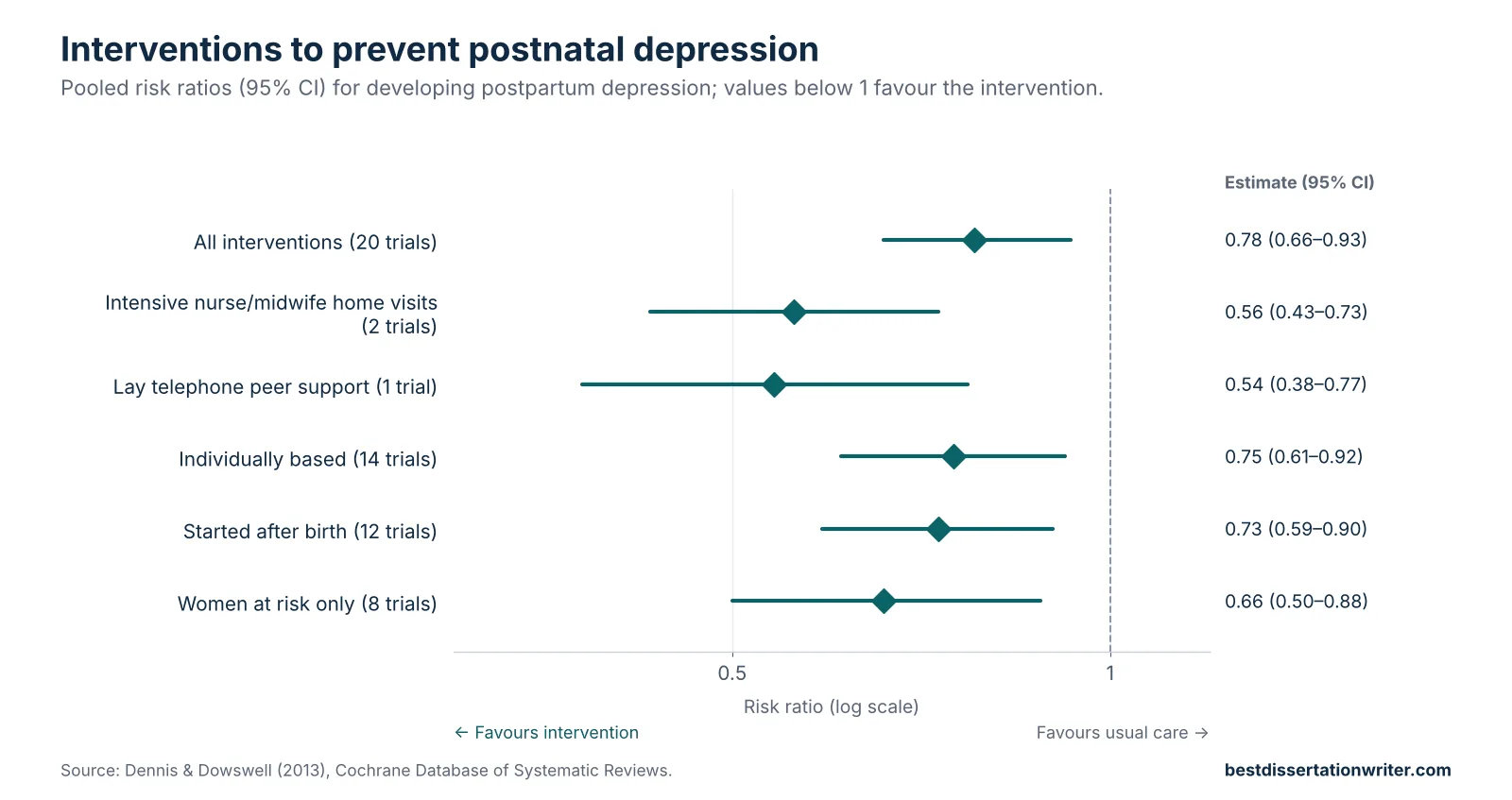
The review included only trials judged to be of acceptable quality, and the plain-language summary described their methodological quality as good to excellent. However, the interventions and outcome measures varied widely, some estimates came from only one or two trials, and most studies were conducted in high-income countries. The finding that interventions starting after birth and those directed at women at risk were effective is nonetheless useful for planning targeted nursing support.
Morrell et al. (2009) tested a nursing-led approach directly in the PONDER cluster randomised trial, which involved 101 general practices and 4,084 women in England. Health visitors were trained to identify depressive symptoms and to offer psychologically informed sessions based on cognitive behavioural or person-centred approaches. Among women who scored 12 or more on the Edinburgh Postnatal Depression Scale at six weeks, 34% of the intervention group compared with 46% of the control group still scored 12 or more at six months. The benefit was maintained at 12 months, and the two approaches were similarly effective.
The PONDER trial is a strong example of nursing research because it was large, pragmatic and embedded in routine health visiting. Its limitations include the fact that outcomes were measured by questionnaire rather than diagnostic interview and that losses to follow-up reduced the numbers analysed. It nonetheless shows that relatively brief training can enable health visitors to reduce postnatal depression.
Discussion
This scoping review shows that perinatal mental health problems are common, potentially fatal and, to a meaningful extent, preventable and treatable through nursing-led care. Around one woman in ten experiences perinatal depression, and anxiety symptoms are reported by around a fifth to a quarter of pregnant women in self-report studies. Against this background, the evidence that nurse-delivered home visits and health visitor training reduce postnatal depression is encouraging.
A tension runs through the evidence between identification and treatment. NICE (2014) encourages routine questions about depression and anxiety, but prevalence studies show that symptom scales produce higher rates than diagnostic interviews (Woody et al., 2017). Screening without adequate follow-up may therefore label many women without giving them access to help, while poorly resourced services may struggle with demand. Identification should always be linked to a clear pathway, including psychological therapy and specialist perinatal mental health teams for women with more severe illness.
The evidence on maternal suicide adds urgency. The MBRRACE-UK findings show that the period after six weeks postnatally, when contact with maternity services has usually ended, carries particular risk (Felker et al., 2025). This highlights the importance of health visitors, general practice nurses and community mental health nurses, who remain in contact with women later in the first year. It also supports continuity of care and good communication between maternity, primary care and mental health services.
There are also questions of equity. Woody et al. (2017) and Dennis et al. (2017) both found higher prevalence in low- and middle-income countries, and within high-income countries disadvantaged groups often face greater risk and poorer access to care. Interventions such as peer telephone support may offer a feasible way of extending support where professional resources are limited, although evidence for these approaches came from few trials.
This review has several limitations. This review relied on openly accessible, English-language sources, did not involve independent double screening and included a small number of sources, as is common in an illustrative scoping review of perinatal mental health. Much of the evidence on interventions is more than a decade old, and few studies evaluated treatments specifically for antenatal anxiety. Future research should test nursing interventions for anxiety in pregnancy, evaluate digital and peer support in diverse populations, and examine how well screening pathways translate into timely treatment and better outcomes for women and babies.
Implications of Perinatal Mental Health Evidence for Practice
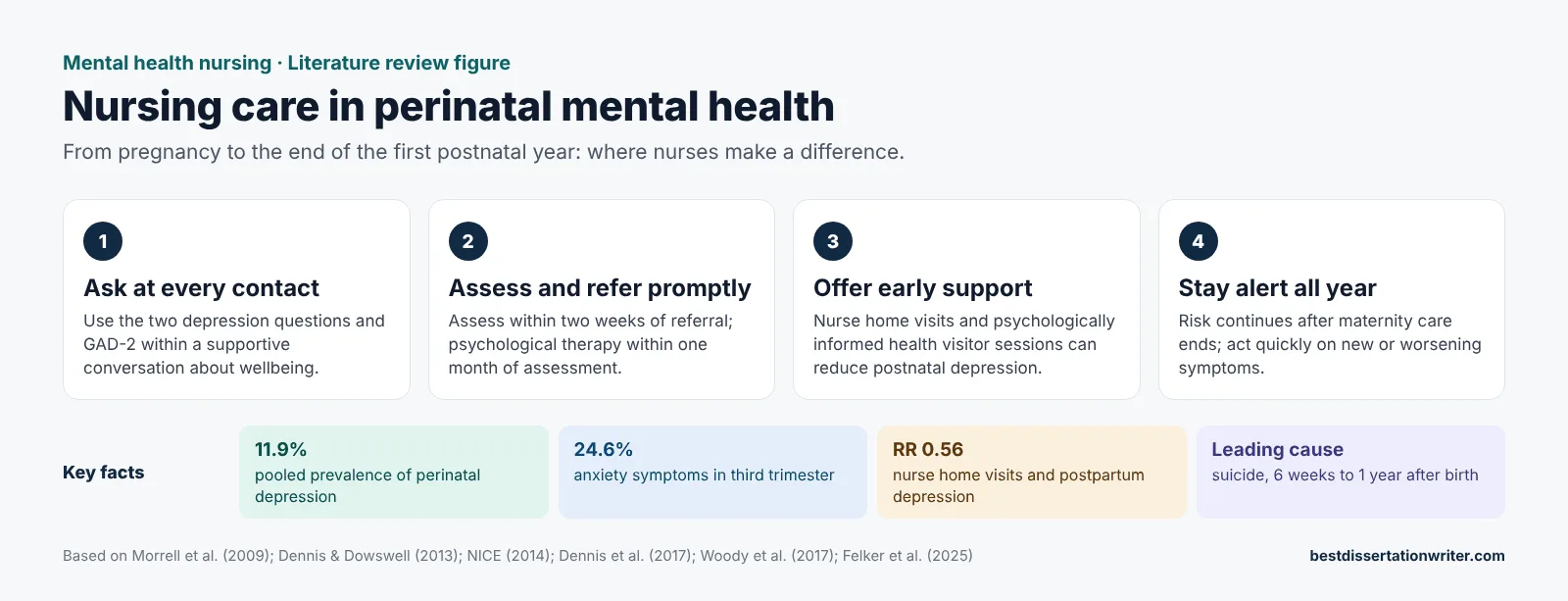
For nurses, the evidence supports asking every woman about her mood and anxiety in pregnancy and after birth, using the depression identification questions and the GAD-2 within a supportive conversation, and following positive responses with fuller assessment and timely referral. Health visitors and community nurses should recognise that risk extends throughout the first postnatal year, including after maternity care ends, and should respond promptly to new or rapidly worsening symptoms, thoughts of self-harm or signs of psychosis. Psychologically informed health visitor sessions and home visiting can be offered to women at risk of postnatal depression.
Supported self-help and online programmes may extend access to care, as discussed in the review of digital mental health interventions, and women with persistent low mood may benefit from the approaches described for adults with depression. Where women express suicidal thoughts, structured suicide risk assessment and safety planning are essential. Because this work is emotionally demanding, attention to burnout and staff wellbeing among perinatal nurses is also important for safe and compassionate care.
Conclusion
This scoping review examined evidence on perinatal mental health and its implications for nursing. Depression affects around one woman in ten during the perinatal period, anxiety is at least as common, and maternal suicide remains the leading cause of death in the later postnatal year in the United Kingdom and Ireland. Nurse-delivered home visits and health visitor training in psychological approaches can reduce postnatal depression.
Nurses in maternity, health visiting, primary care and mental health services are well placed to identify women who are struggling, offer evidence-based support and ensure timely referral. Making perinatal mental health a routine part of every contact, and linking identification to accessible treatment, offers a practical way to improve outcomes for women, babies and families.
References
Dennis, C.-L., & Dowswell, T. (2013). Psychosocial and psychological interventions for preventing postpartum depression. Cochrane Database of Systematic Reviews, (2), CD001134. https://doi.org/10.1002/14651858.CD001134.pub3
Dennis, C.-L., Falah-Hassani, K., & Shiri, R. (2017). Prevalence of antenatal and postnatal anxiety: Systematic review and meta-analysis. British Journal of Psychiatry, 210(5), 315–323. https://doi.org/10.1192/bjp.bp.116.187179
Felker, A., Patel, R., Kotnis, R., Kenyon, S., & Knight, M. (Eds.). (2025). Saving Lives, Improving Mothers’ Care compiled report: Lessons learned to inform maternity care from the UK and Ireland Confidential Enquiries into Maternal Deaths and Morbidity 2021–23. National Perinatal Epidemiology Unit, University of Oxford. https://doi.org/10.5287/ora-4javr692x
Morrell, C. J., Slade, P., Warner, R., Paley, G., Dixon, S., Walters, S. J., Brugha, T., Barkham, M., Parry, G. J., & Nicholl, J. (2009). Clinical effectiveness of health visitor training in psychologically informed approaches for depression in postnatal women: Pragmatic cluster randomised trial in primary care. BMJ, 338, a3045. https://doi.org/10.1136/bmj.a3045
National Institute for Health and Care Excellence. (2014). Antenatal and postnatal mental health: Clinical management and service guidance (Clinical guideline CG192; updated 2020). https://www.nice.org.uk/guidance/cg192
Woody, C. A., Ferrari, A. J., Siskind, D. J., Whiteford, H. A., & Harris, M. G. (2017). A systematic review and meta-regression of the prevalence and incidence of perinatal depression. Journal of Affective Disorders, 219, 86–92. https://doi.org/10.1016/j.jad.2017.05.003
Cite this example
Best Dissertation Writers (2026) Nursing Care and Support in Perinatal Mental Health: A Scoping Review. Available at: https://bestdissertationwriter.com/perinatal-mental-health-review-review/
Best Dissertation Writers
Get expert help with your nursing literature review
Share your topic and deadline with Best Dissertation Writers and get support tailored to your module brief.