Early Intervention Approaches for Young People with Emerging Mental Health Problems: A Systematic Review
 By Dr. Robertson Prime, Research Fellow
Updated October 12, 2026
15 min read
About 3,000 words
In this review
Abstract
Background: Early intervention aims to improve outcomes and reduce long-term disability by identifying and treating mental health problems at their first appearance. Adolescence and early adulthood are the years in which anxiety, eating disorders, substance misuse and psychosis most often first appear, and mental health nurses are central to specialist services for young people.
Aim: This systematic review aimed to examine when mental health problems typically begin, and how effective specialist services are for young people with emerging mental health problems, particularly first-episode psychosis.
Methods: Evidence was identified through targeted searches of openly accessible bibliographic records, publisher websites and the reference lists of key reviews. Five sources published between 2005 and 2023 were included: one nationally representative survey, one cluster randomised trial, two meta-analyses and one national implementation standard, appraised with CASP checklists and synthesised narratively.
Findings: A meta-analysis of 192 epidemiological studies found that 34.6% of people with any mental disorder had onset before age 14 and 62.5% before 25, highlighting the importance of adolescent mental health services. A meta-analysis of ten trials in early-phase psychosis found that specialist services reduced treatment discontinuation and hospitalisation and increased involvement in school or work, and a large community trial found greater benefit when the duration of untreated psychosis was shorter. In England, a national standard expects 60% of people with first-episode psychosis to start a NICE-recommended package of care within two weeks of referral.
Conclusion: Nurses should ensure prompt assessment, rapid engagement and family involvement for young people with emerging problems, and should work across the boundary between adolescent and adult services to provide continuity of care.
Keywords: early intervention, adolescent mental health, psychosis
Introduction
This systematic review critically examines recent evidence on early intervention and its implications for mental health nursing practice.
Most mental health problems begin early in life. Adolescence and early adulthood are periods of rapid brain development, changing relationships and growing independence, and they are also the years in which anxiety, eating disorders, substance misuse and psychosis most often first appear. When problems go unrecognised or untreated, young people can lose years of education, employment and social development, and the consequences may last into adult life.
The idea behind early intervention is that identifying and treating problems at their first appearance can improve outcomes and reduce long-term disability. This idea has shaped services for first-episode psychosis in many countries and, increasingly, youth mental health services more broadly. Mental health nurses are central to these services as care coordinators, therapists, prescribers and health educators, and nurses in schools, primary care and acute settings are often the first professionals to notice that a young person is struggling.
A systematic approach was chosen so that large epidemiological studies, meta-analyses of randomised trials and national standards could be identified and appraised together. Understanding both the timing of onset and the effects of early intervention matters for deciding where nursing resources should be directed.
Review question
When do mental health problems typically begin, and how effective are early intervention services for young people with emerging mental health problems, particularly first-episode psychosis?
Background to Early Intervention
Early intervention can mean different things. In its broadest sense it covers any approach that reduces the time between the onset of a problem and effective help, including prevention in schools, youth-friendly primary care and rapid access to specialist treatment. In psychosis, it usually refers to specialist early intervention in psychosis (EIP) teams, which offer people with a first episode a package of care that includes medication, psychological therapy, family work, physical health monitoring and support with education and employment.
A key concept is the duration of untreated psychosis, the time between the onset of psychotic symptoms and the start of adequate treatment. Longer periods of untreated illness have been associated with poorer outcomes, and specialist services aim both to shorten this period and to provide intensive, recovery-focused care during the first years of illness, often described as a critical period.
Interest in adolescent mental health has grown alongside this work. Many young people find adult services unwelcoming, and the transition from child and adolescent services at 18 is a well-known point at which people fall out of care. Youth-focused service models therefore try to make services accessible, non-stigmatising and continuous across the adolescent and early adult years.
For mental health nurses, these developments mean working across organisational boundaries, engaging young people who may be reluctant to seek help and working closely with families. They also raise questions about how far the specialist model developed for psychosis can be extended to other emerging mental health problems.
Search Strategy and Methods
Evidence for this example was identified through targeted searches of openly accessible bibliographic records, publisher websites and the reference lists of key reviews. Search terms combined keywords for the intervention (“early intervention”, “early intervention in psychosis”, “coordinated specialty care”, “first-episode psychosis”) with terms for population and outcomes (“young people”, “adolescent*”, “youth”, “age of onset”, “duration of untreated psychosis”, “relapse”, “hospitalisation”), joined with the Boolean operators AND and OR. A full systematic review for assessment would run the same strategy in CINAHL, PubMed/MEDLINE, the Cochrane Library and Embase and report the number of records screened in a PRISMA flow diagram.
Sources were eligible if they reported the age at onset of mental disorders in large samples, evaluated specialist services for young people or people with a first episode of psychosis, or set national standards for timely access to care. Meta-analyses, large randomised trials, nationally representative surveys and national guidance were prioritised. Studies of prevention programmes for the general population without a mental health outcome were excluded.
Five sources on early intervention published between 2005 and 2023 were included: one nationally representative survey, one cluster randomised trial, two meta-analyses and one national implementation standard (Table 1). The quality of each source was appraised using the Critical Appraisal Skills Programme (CASP) checklist appropriate to its design, and findings were synthesised narratively and grouped into themes.
Key Findings on Early Intervention
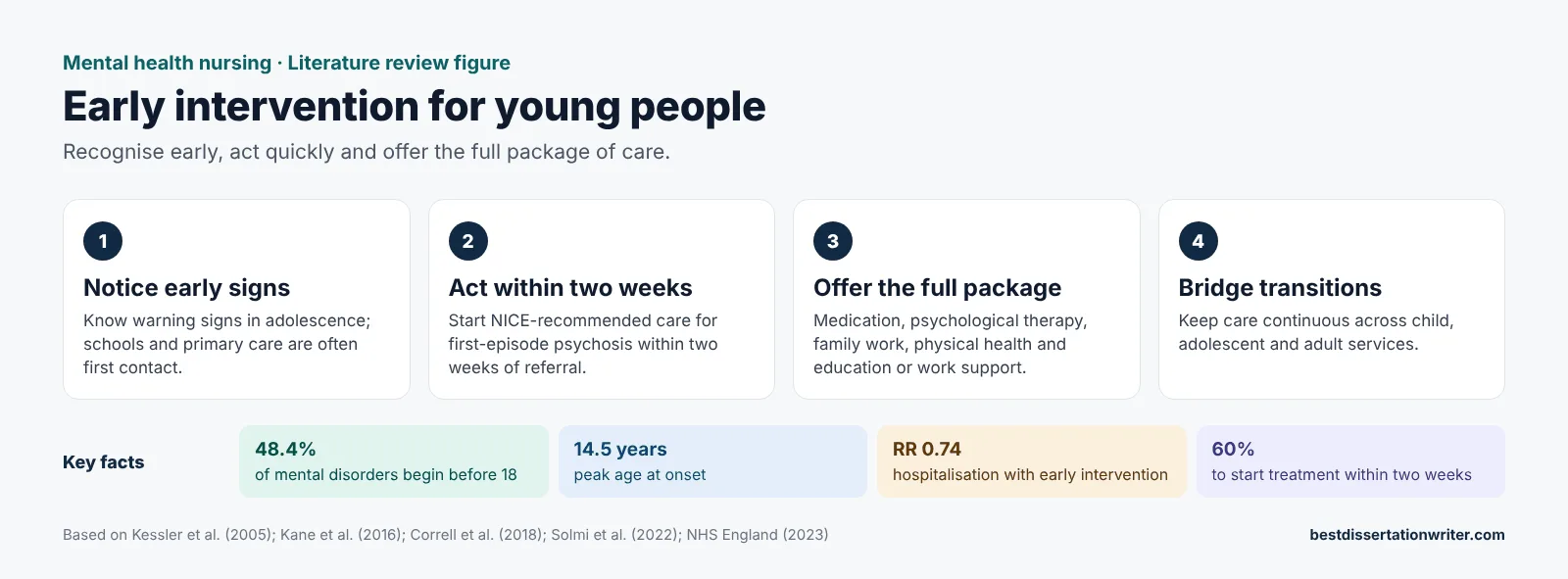
Three themes were identified: the early age at onset of mental disorders and its implications for services, the effectiveness of early intervention services for first-episode psychosis, and the importance of timely access within national standards. Table 1 summarises the included sources, and Figure 1 shows the proportion of people whose mental disorder began before the ages of 14, 18 and 25.
| Author, year | Design | Setting and sample | Key finding |
|---|---|---|---|
| Kessler et al. (2005) | Nationally representative survey | 9,282 adults; United States | Half of lifetime cases began by age 14 and three-quarters by 24; prevention and early treatment should focus on youth. |
| Kane et al. (2016) | Cluster randomised controlled trial (RAISE-ETP) | 404 people with first-episode psychosis; 34 US clinics | NAVIGATE improved retention, quality of life, symptoms and work or school involvement; greater benefit when untreated psychosis was shorter. |
| Correll et al. (2018) | Systematic review and meta-analysis | 10 RCTs, 2,176 people with early-phase psychosis | Early intervention services reduced discontinuation (RR 0.70) and hospitalisation (RR 0.74) and improved symptoms and functioning. |
| Solmi et al. (2022) | Meta-analysis of epidemiological studies | 192 studies, 708,561 people worldwide | 34.6% of disorders began before 14, 48.4% before 18 and 62.5% before 25; peak onset 14.5 years. |
| NHS England (2023) | National implementation guidance | People aged 14 to 65 with first-episode psychosis; England | 60% should start a NICE-recommended package of care within two weeks of referral. |
Theme 1: Age at Onset and the Case for Early Intervention
The case for early intervention rests on evidence that mental disorders start young. In a nationally representative survey of 9,282 adults in the United States, Kessler et al. (2005) estimated that half of all lifetime cases of mental disorder had started by age 14 and three-quarters by age 24. Median onset was 11 years for anxiety and impulse-control disorders, 20 years for substance use disorders and 30 years for mood disorders. The authors concluded that interventions aimed at prevention or early treatment need to focus on youth.
This survey relied on adults recalling when their problems began, sometimes decades earlier, which may be inaccurate. A larger meta-analysis by Solmi et al. (2022), which pooled 192 epidemiological studies with 708,561 people, offers a more international picture. It found that 34.6% of people with any mental disorder had onset before age 14, 48.4% before 18 and 62.5% before 25, with a peak age at onset of 14.5 years.
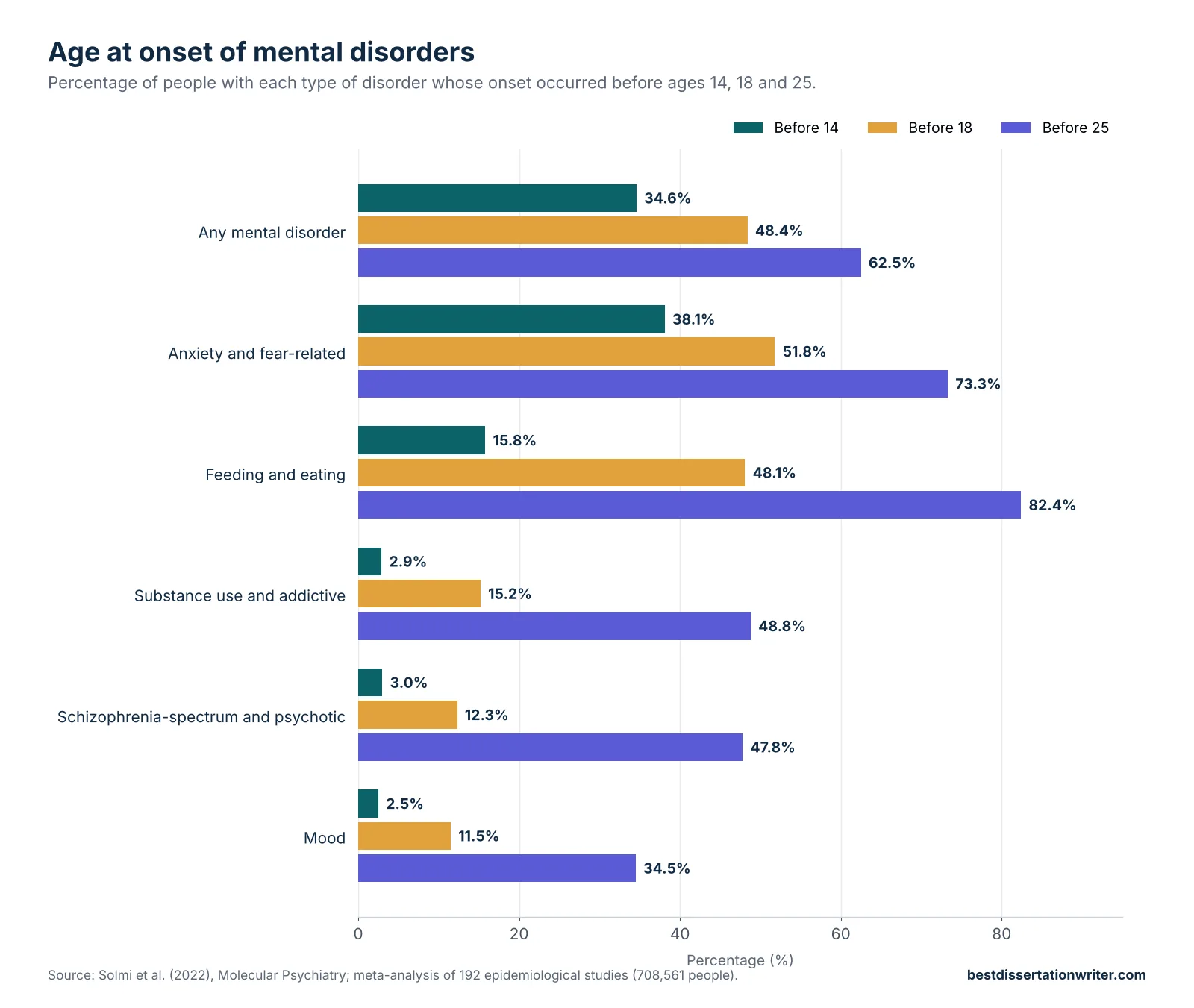
Onset patterns differed between disorders. Most neurodevelopmental conditions began in childhood, and more than half of anxiety and fear-related disorders began before 18, whereas only 12.3% of schizophrenia-spectrum and psychotic disorders and 11.5% of mood disorders had begun by that age (Solmi et al., 2022). The median age at onset for psychotic disorders was 25 years. This pattern supports help spanning adolescence and early adulthood rather than childhood alone, and it highlights why adolescent mental health services and EIP teams need to work together.
The difference between Kessler et al. (2005), who reported that half of disorders had started by 14, and Solmi et al. (2022), who found that about a third had, is a reminder that estimates depend on the population, the disorders included and the methods used. Both, however, place the peak period of onset in adolescence and early adulthood.
Theme 2: Early Intervention Services for First-Episode Psychosis
Correll et al. (2018) meta-analysed ten randomised trials involving 2,176 people with early-phase psychosis, with a mean age of 27.5 years, comparing specialist services with treatment as usual over an average of 16 months. Early intervention services reduced all-cause treatment discontinuation (risk ratio 0.70) and psychiatric hospitalisation (risk ratio 0.74), increased involvement in school or work (risk ratio 1.13) and produced small improvements in total, positive and negative symptoms, global functioning and quality of life. Specialist services were superior to usual care on every one of these outcomes.
The strengths of this review include its focus on randomised trials and its broad range of outcomes. However, the effect sizes were small to moderate, trials lasted no more than two years and services differed considerably between countries. Treatment as usual also varied, and the advantage of specialist care may be smaller in health systems where usual care is already good. The review could not show whether benefits persist after people leave specialist services.
The largest single trial in community settings, the RAISE Early Treatment Program, randomised 34 clinics in the United States to a coordinated specialty care programme called NAVIGATE or to usual community care (Kane et al., 2016). NAVIGATE combined personalised medication management, family education, individual resilience-focused therapy and supported employment and education. Over two years, the 223 people receiving NAVIGATE remained in treatment longer and improved more in quality of life and symptoms than the 181 in community care, and were more involved in work or school. Hospitalisation rates were low and did not differ between groups.
Importantly, the median duration of untreated psychosis was 74 weeks, and the benefits were greater for people who had been unwell for less than this time (Kane et al., 2016). This finding supports the central principle that treatment works best when it starts early. However, the trial randomised clinics rather than individuals, and the participants were selected from clinics willing to take part, which may limit generalisability.
Theme 3: Timely Access and National Standards
In England, these principles have been translated into a national access and waiting time standard. Current NHS England (2023) guidance states that 60% of people experiencing first-episode psychosis should start a NICE-recommended package of care within two weeks of referral. Both elements must be met: a maximum two-week wait and treatment that follows NICE guidance and quality standards. The standard applies to people aged 14 to 65 and includes provision for people at risk of psychosis.
The guidance argues that the sooner treatment starts, the better the outcome and the lower the overall cost of care, and it cites an estimated return of £15 for every £1 invested over ten years (NHS England, 2023). Such economic estimates depend on modelling assumptions and should be interpreted with caution. Nonetheless, the standard has made timely access and a full package of care, rather than simply assessment, a measurable expectation for services.
The inclusion of 14 to 17-year-olds means that EIP teams must work closely with child and adolescent services, schools and families. For nurses, meeting the two-week standard depends on prompt assessment, flexible engagement and a clear understanding of which interventions young people should be offered.
Discussion
This review suggests that early intervention is supported by two strands of evidence. Epidemiological studies show that most mental disorders begin in adolescence or early adulthood, and trials show that specialist EIP services reduce disengagement and hospitalisation and improve symptoms, functioning and involvement in work or education compared with usual care.
The evidence for early intervention is strongest for psychosis. The model of specialist teams, rapid access and a comprehensive package of care has been tested in multiple randomised trials and endorsed in national standards. By contrast, the epidemiological evidence shows that anxiety, eating disorders and other problems often begin earlier than psychosis, yet the included sources provide much less trial evidence on specialist services for these conditions. Extending the psychosis model to broader youth mental health is a reasonable aim, but it should be evaluated rather than assumed to work.
There is also a question about duration. Most trials lasted up to two years, and the benefits of specialist care may fade when people are discharged to standard services. The finding by Kane et al. (2016) that benefits were greater for people with a shorter duration of untreated psychosis suggests that how quickly services reach people may matter as much as what they provide. Reducing delays requires public awareness, confident primary care and school staff, and accessible referral routes.
The age-at-onset evidence also has practical implications for how adolescent mental health services are organised. Solmi et al. (2022) found that eating disorders peaked at 15.5 years and anxiety and fear-related disorders often began in childhood, whereas onset of mood and psychotic disorders peaked at 20.5 years. A single service boundary at 18 therefore falls in the middle of the period of greatest risk. Nurses working on either side of that boundary need shared assessment approaches, joint care planning and clear handover arrangements so that young people do not have to tell their story again or wait for a new service to accept them.
Early intervention also raises equity concerns. Young people from some ethnic minority groups, those in contact with the criminal justice system and those who are homeless may be less likely to reach services early. Adolescent mental health services that rely on young people or families to seek help may miss those at greatest risk. Mental health nurses working in outreach, schools and community settings are well placed to reduce these gaps.
The evidence base has limitations. The survey by Kessler et al. (2005) relied on recall and was conducted in one country, trials were mainly from high-income countries and few followed people beyond two years. This review relied on openly accessible, English-language sources and did not involve independent double screening or formal meta-analysis. Future research should evaluate specialist youth services for non-psychotic problems in young people, test the long-term effects of early intervention services and examine which components, including nursing roles, contribute most to outcomes.
Implications of Early Intervention Evidence for Practice
For mental health nurses, the evidence supports prompt assessment and rapid engagement of young people with emerging problems, particularly first-episode psychosis, so that a full package of NICE-recommended care starts within two weeks of referral. Nurses should involve families, monitor physical health, support education and employment, and offer psychological approaches such as cognitive behavioural therapy. Nurses in schools, primary care and acute settings should know local referral routes and recognise early warning signs.
Early intervention services increasingly include peer support workers and may use digital mental health interventions to engage young people who are reluctant to attend clinics. Because the peak years of onset overlap with the years in which many people become parents, joint working with services for perinatal mental health can help to support both parent and child.
Conclusion
This systematic review examined early intervention approaches for young people with emerging mental health problems. Most mental disorders begin by the mid-twenties, and specialist EIP services reduce disengagement and hospitalisation and improve symptoms, functioning and participation in work or education, with greater benefit when treatment starts sooner.
Mental health nurses are central to early intervention, from noticing the first signs of difficulty to coordinating comprehensive care. Ensuring timely access, family involvement and continuity across the adolescent and adult years offers a practical way to improve long-term outcomes for young people.
References
Correll, C. U., Galling, B., Pawar, A., Krivko, A., Bonetto, C., Ruggeri, M., Craig, T. J., Nordentoft, M., Srihari, V. H., Guloksuz, S., Hui, C. L. M., Chen, E. Y. H., Valencia, M., Juarez, F., Robinson, D. G., Schooler, N. R., Brunette, M. F., Mueser, K. T., Rosenheck, R. A., … Kane, J. M. (2018). Comparison of early intervention services vs treatment as usual for early-phase psychosis: A systematic review, meta-analysis, and meta-regression. JAMA Psychiatry, 75(6), 555–565. https://doi.org/10.1001/jamapsychiatry.2018.0623
Kane, J. M., Robinson, D. G., Schooler, N. R., Mueser, K. T., Penn, D. L., Rosenheck, R. A., Addington, J., Brunette, M. F., Correll, C. U., Estroff, S. E., Marcy, P., Robinson, J., Meyer-Kalos, P. S., Gottlieb, J. D., Glynn, S. M., Lynde, D. W., Pipes, R., Kurian, B. T., Miller, A. L., … Heinssen, R. K. (2016). Comprehensive versus usual community care for first-episode psychosis: 2-year outcomes from the NIMH RAISE Early Treatment Program. American Journal of Psychiatry, 173(4), 362–372. https://doi.org/10.1176/appi.ajp.2015.15050632
Kessler, R. C., Berglund, P., Demler, O., Jin, R., Merikangas, K. R., & Walters, E. E. (2005). Lifetime prevalence and age-of-onset distributions of DSM-IV disorders in the National Comorbidity Survey Replication. Archives of General Psychiatry, 62(6), 593–602. https://doi.org/10.1001/archpsyc.62.6.593
NHS England. (2023). Implementing the early intervention in psychosis access and waiting time standard (Version 3). https://www.england.nhs.uk/publication/implementing-the-early-intervention-in-psychosis-access-and-waiting-time-standard/
Solmi, M., Radua, J., Olivola, M., Croce, E., Soardo, L., Salazar de Pablo, G., Shin, J. I., Kirkbride, J. B., Jones, P., Kim, J. H., Kim, J. Y., Carvalho, A. F., Seeman, M. V., Correll, C. U., & Fusar-Poli, P. (2022). Age at onset of mental disorders worldwide: Large-scale meta-analysis of 192 epidemiological studies. Molecular Psychiatry, 27(1), 281–295. https://doi.org/10.1038/s41380-021-01161-7
Cite this example
Best Dissertation Writers (2026) Early Intervention Approaches for Young People with Emerging Mental Health Problems: A Systematic Review. Available at: https://bestdissertationwriter.com/early-intervention-literature-review/
Best Dissertation Writers
Get expert help with your nursing literature review
Share your topic and deadline with Best Dissertation Writers and get support tailored to your module brief.