The Effectiveness of Digital Mental Health Interventions Delivered or Supported by Nurses: A Systematic Review
 By Dr. Robertson Prime, Research Fellow
Updated October 12, 2026
14 min read
About 2,900 words
In this review
Abstract
Background: Digital mental health interventions, such as internet-delivered cognitive behavioural therapy and smartphone apps, have been promoted as a way of widening access to psychological help. Demand for help with depression and anxiety far exceeds the supply of trained therapists, and nurses are increasingly involved in recommending, guiding and monitoring digital tools.
Aim: This systematic review aimed to examine how effective digital interventions are for depression and anxiety, how well people engage with them, and what role human support, including support from nurses, plays in their success.
Methods: Evidence was identified through targeted searches of openly accessible bibliographic records, publisher websites and the reference lists of key reviews. Six sources published between 2017 and 2020 were included: four meta-analyses, one review of internet-delivered treatment that drew on recent meta-analyses, and one large analysis of real-world app usage data, appraised with CASP checklists and synthesised narratively.
Findings: Guided internet-based CBT produced effects equivalent to face-to-face therapy (Hedges’ g = 0.05), whereas self-guided programmes showed smaller effects. Smartphone apps produced small to moderate benefits for depression, anxiety and stress compared with control conditions, but showed no significant differences against active comparison interventions. Engagement was the major challenge: median app retention was only 3.3% at 30 days in real-world use, although human feedback and in-app mood monitoring were associated with lower dropout in trials.
Conclusion: Nurses can play a central role by guiding, monitoring and encouraging people using digital interventions, offering them as a choice alongside face-to-face care and ensuring clear procedures for monitoring risk.
Keywords: digital mental health interventions, online therapy, digital interventions
Introduction
This systematic review critically examines recent evidence on digital mental health interventions and its implications for mental health nursing practice.
Demand for psychological help for depression and anxiety far exceeds the supply of trained therapists in most health systems. Waiting lists are long, many people live far from services, and some find it hard to attend appointments because of work, caring responsibilities, stigma or anxiety itself. Internet-delivered therapy programmes and smartphone apps have been promoted as a way of widening access, offering structured support that people can use at home and at a time that suits them.
Nurses are increasingly involved in the delivery of digital mental health interventions. Mental health nurses may recommend apps, guide patients through online therapy programmes, review progress and messages, and blend digital tools with face-to-face contact. Primary care and practice nurses are often the first professionals asked about mental health apps. Yet the quality of digital interventions varies widely, and many people stop using them soon after starting, so nurses need a clear understanding of what the evidence shows.
A systematic approach was chosen so that meta-analyses of randomised controlled trials could be identified and appraised alongside evidence on engagement in real-world use, giving a balanced picture of both efficacy and uptake.
Review question
How effective are digital mental health interventions for depression and anxiety, how well do people engage with them, and what role does human support, including support from nurses, play in their success?
Background to Digital Mental Health Interventions
Digital mental health interventions include internet-delivered cognitive behavioural therapy (ICBT) programmes, smartphone apps, text-message support, computerised self-help and video-based therapy. Many are based on the same principles as face-to-face cognitive behavioural therapy, with modules on psychoeducation, behavioural activation, cognitive restructuring, exposure and relapse prevention. Some are entirely self-guided, while others include regular contact with a clinician or coach who reviews progress, answers questions and encourages continued use.
A key distinction is between guided and unguided programmes. In guided online therapy, a therapist or other trained professional supports the person, usually through brief written messages or telephone calls. Andersson et al. (2019) noted that this guidance typically takes around 10 minutes of clinician time per client per week, compared with a traditional 45-minute session, which is why guided programmes are seen as a way of increasing capacity.
Smartphone apps form a newer and less regulated part of the field. A very large number of mental health apps are available to download, but few have been tested in trials, and app stores give little indication of quality. Concerns about privacy, data security and misleading claims have led to calls for clearer evaluation standards. For nurses, the challenge is to distinguish evidence-based digital interventions from the many products without supporting evidence.
The COVID-19 pandemic accelerated the use of remote and digital care across mental health services, making questions about the effectiveness and acceptability of digital mental health interventions more pressing. Understanding which approaches work, for whom and with what level of human support is essential if digital care is to complement rather than replace therapeutic contact.
Search Strategy and Methods
Evidence for this example was identified through targeted searches of openly accessible bibliographic records, publisher websites and the reference lists of key reviews. Search terms combined keywords for the intervention (“digital mental health interventions”, “internet-delivered”, “online therapy”, “ICBT”, “smartphone app”, “mHealth”) with terms for conditions and outcomes (“depression”, “anxiety”, “effectiveness”, “engagement”, “adherence”, “dropout”), joined with the Boolean operators AND and OR. A full systematic review for assessment would run the same strategy in CINAHL, PubMed/MEDLINE, PsycINFO, the Cochrane Library and Embase and report the number of records screened in a PRISMA flow diagram.
Sources were eligible if they were systematic reviews or meta-analyses of randomised controlled trials of internet-delivered or smartphone-based psychological interventions for adults with depression, anxiety or related problems, or large studies of engagement with digital mental health interventions. Reviews of interventions for physical conditions only, single small trials and descriptive articles without data were excluded.
Six sources published between 2017 and 2020 were included: four meta-analyses, one review of internet-delivered treatment that drew on recent meta-analyses, and one large analysis of real-world app usage data (Table 1). The quality of each source was appraised using the Critical Appraisal Skills Programme (CASP) checklist appropriate to its design, and findings were synthesised narratively and grouped into themes.
Key Findings on Digital Mental Health Interventions
Three themes were identified: the effectiveness of internet-delivered therapy compared with face-to-face care; the effectiveness of smartphone-based digital mental health interventions; and engagement, dropout and the role of human support. Table 1 summarises the included sources, and Figure 1 presents the pooled effects of smartphone interventions on mental health outcomes.
| Author, year | Design | Setting and sample | Key finding |
|---|---|---|---|
| Firth et al. (2017) | Meta-analysis of RCTs | 18 RCTs, 22 apps, 3,414 participants with depressive symptoms | Apps reduced depressive symptoms (g = 0.38); smaller effect versus active controls (g = 0.22). |
| Carlbring et al. (2018) | Systematic review and meta-analysis | 20 studies, 1,418 participants; psychiatric and somatic disorders | Internet-based and face-to-face CBT produced equivalent effects (g = 0.05). |
| Andersson et al. (2019) | Review of internet-delivered treatments drawing on meta-analyses | Guided and self-guided ICBT for anxiety and depression | Guided ICBT matches face-to-face CBT; about 10 minutes of clinician time per client per week. |
| Baumel et al. (2019) | Analysis of objective real-world usage data | 93 mental health apps on Android devices | Median retention 3.9% at 15 days and 3.3% at 30 days. |
| Linardon et al. (2019) | Meta-analysis of RCTs | 66 RCTs of app-supported smartphone interventions | Apps improved depression (g = 0.28) and anxiety (g = 0.30) but were not superior to active treatments. |
| Torous et al. (2020) | Systematic review and meta-analysis | 18 RCTs, 3,336 participants; depression apps | Dropout 26.2% (47.8% adjusted); human feedback and mood monitoring linked to lower dropout. |
Theme 1: Internet-Delivered Therapy Compared With Face-to-Face Care
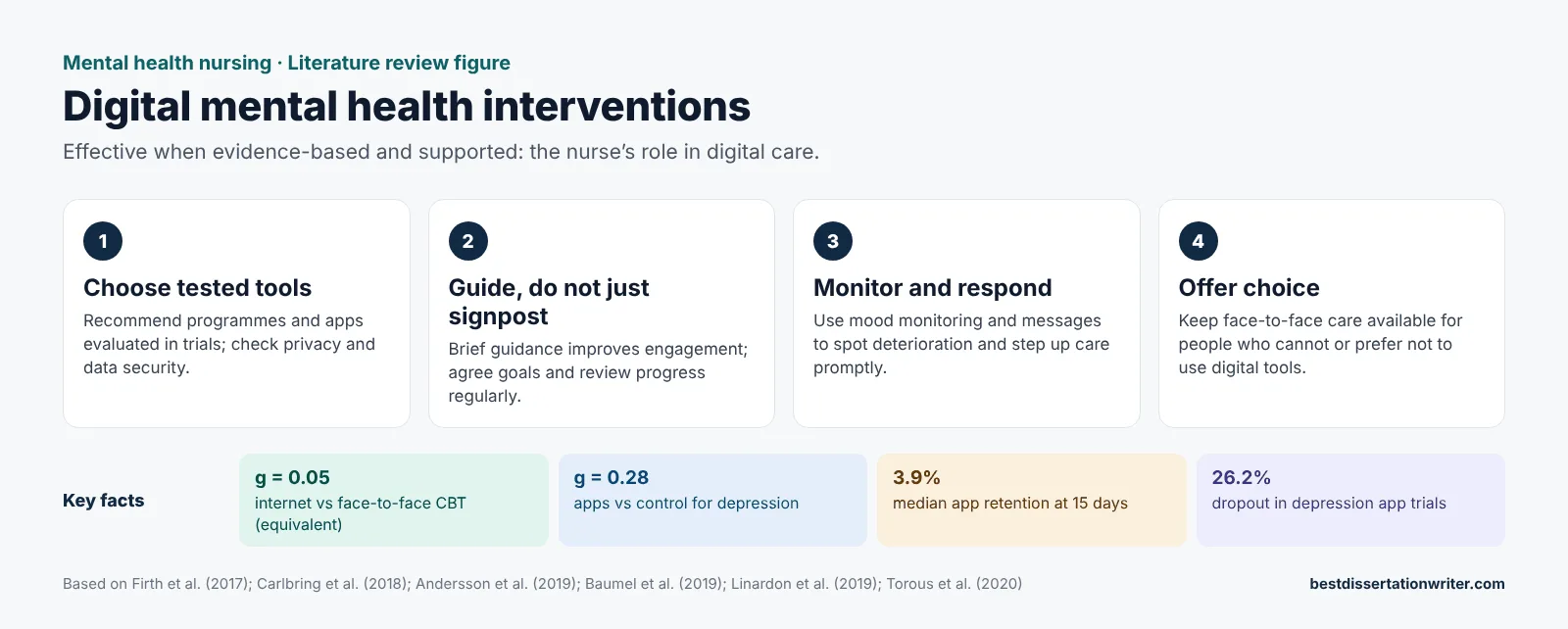
Carlbring et al. (2018) updated a systematic review and meta-analysis comparing internet-based and face-to-face cognitive behavioural therapy for psychiatric and somatic disorders. Twenty studies with 1,418 participants were included. The pooled effect size at the end of treatment was close to zero (Hedges’ g = 0.05, 95% CI −0.09 to 0.20), indicating that guided internet-based treatment and face-to-face therapy produced equivalent overall effects.
Andersson et al. (2019) reviewed two decades of research on internet-delivered psychological treatments. They concluded that guided ICBT is more effective than waiting-list controls for anxiety and depression and tends to match face-to-face CBT, with benefits that can be maintained over long-term follow-up. Self-guided ICBT for depression was also better than control conditions in a meta-analysis of 13 trials with 3,876 participants (g = 0.27), but this effect was smaller than those usually reported for guided programmes.
The strength of the Carlbring et al. (2018) review lies in its direct, head-to-head comparisons, which avoid the inflated effects that can arise when digital mental health interventions are compared only with waiting lists. However, the included trials were relatively small, with 1,418 participants across 20 studies, they covered a wide range of psychiatric and somatic conditions, and participants were often willing volunteers who had chosen an internet-based format. Equivalent average effects therefore do not mean that online therapy suits everyone, and people with complex needs, high risk or limited digital skills were rarely represented.
Andersson et al. (2019) also highlighted important caveats. A minority of patients deteriorate during treatment, although deterioration rates appeared similar to face-to-face therapy and lower than in control groups. Completion was a concern: in guided ICBT for depression, 65.1% of participants were classed as completers compared with 84.7% in face-to-face CBT. Most implementation had taken place in specialist clinics rather than in everyday services, which limits how far trial findings can be generalised.
Theme 2: Smartphone-Based Digital Mental Health Interventions
Firth et al. (2017) conducted a meta-analysis of 18 randomised controlled trials, involving 22 smartphone apps and 3,414 participants, examining effects on depressive symptoms. Apps reduced depressive symptoms significantly more than control conditions (g = 0.38). The effect was moderate when apps were compared with inactive controls (g = 0.56) but small when they were compared with active controls (g = 0.22), suggesting that part of the benefit may reflect attention and engagement rather than the specific content of the app.
Linardon et al. (2019) extended this work in a meta-analysis of 66 randomised trials of app-supported smartphone interventions. Apps outperformed control conditions for depressive symptoms (g = 0.28), generalised anxiety (g = 0.30), social anxiety (g = 0.58), stress (g = 0.35), quality of life (g = 0.35) and general psychiatric distress (g = 0.40). However, there were no significant differences when apps were compared with active comparison interventions, on any outcome.
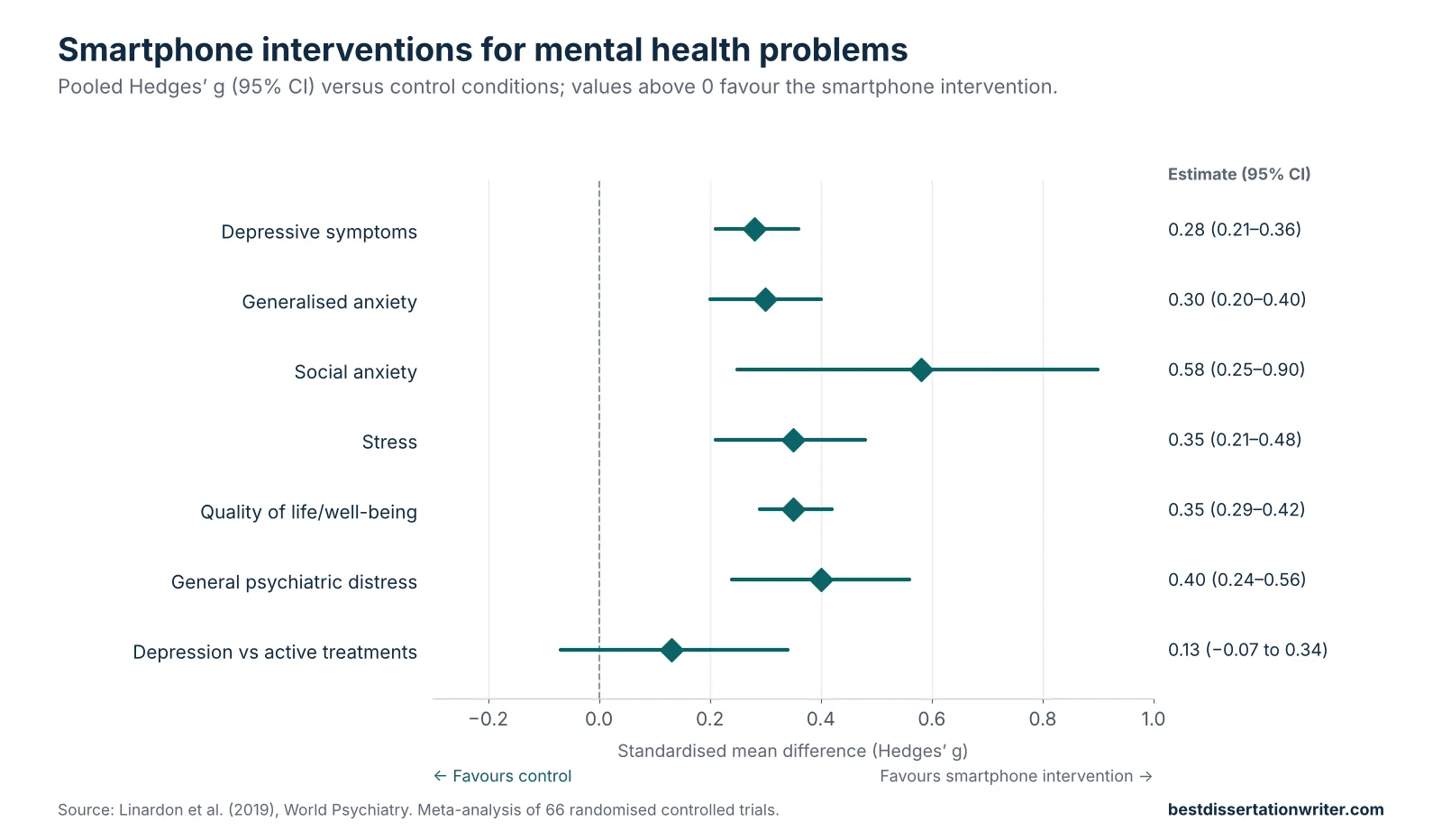
Effects for depression were smallest when apps were compared with attention or placebo control conditions (g = 0.12), which again suggests that expectation and attention contribute to apparent benefits (Linardon et al., 2019). Together, these reviews show that digital mental health interventions delivered by smartphone produce small to moderate benefits, but they are not a substitute for active treatment in people with more severe or complex needs.
Theme 3: Engagement, Dropout and Human Support
Trials may overestimate how much people use apps in everyday life. Baumel et al. (2019) analysed objective usage data from 93 mental health apps on Android devices. The median daily open rate was 4.0%, and median retention was only 3.9% at 15 days and 3.3% at 30 days after installation. Although usage data came from a commercial panel and could not show whether users benefited, the findings suggest that most people who download a mental health app stop using it within weeks.
Torous et al. (2020) examined dropout in 18 randomised trials of smartphone apps for depressive symptoms, involving 3,336 participants. The pooled dropout rate was 26.2%, rising to 47.8% after adjustment for publication bias. Importantly, studies that offered human feedback and in-app mood monitoring had lower dropout, while larger studies had higher dropout. This finding is directly relevant to nursing, because it suggests that brief human contact may help people stay engaged with digital interventions.
The evidence on guidance points in the same direction. Andersson et al. (2019) reported that therapist behaviour influenced outcomes in ICBT, with affirming messages linked to better results in depression. Novice clinicians were found to achieve outcomes similar to those of experienced therapists, which suggests that nurses with appropriate training could provide effective guidance for online therapy programmes.
Discussion
This systematic review suggests that digital mental health interventions can reduce symptoms of depression and anxiety. Guided internet-delivered CBT appears to produce effects equivalent to face-to-face therapy, and smartphone apps produce small to moderate benefits compared with inactive controls. These findings support the cautious use of evidence-based digital interventions as part of stepped mental health care.
However, the evidence contains important tensions. The effects of apps shrink considerably when compared with active or attention controls, and no review found apps to be superior to active treatments. Trial participants are often self-selected volunteers who are willing to use technology, and they may not reflect the people seen by mental health nurses in secondary care. Effect sizes from waiting-list comparisons can also be inflated, since people on waiting lists may expect little improvement.
Engagement is perhaps the biggest challenge. The striking contrast between trial dropout rates and the very low real-world retention reported by Baumel et al. (2019) shows that availability does not equal use. Digital mental health interventions are only effective if people use them, and the evidence that human feedback reduces dropout (Torous et al., 2020) suggests that a purely self-help model is unlikely to achieve the benefits seen in guided programmes.
These findings point to a supportive rather than replacement role for technology. Nurses can provide the guidance, monitoring and encouragement that sustain engagement, while digital tools offer structured content and flexibility. There are also equity concerns: people without smartphones, internet access, digital skills or privacy at home may be excluded, so digital options should be offered as a choice alongside face-to-face care rather than as the only route to help.
Safety and governance also require attention. Andersson et al. (2019) noted that a minority of patients deteriorate during internet-delivered treatment, and remote programmes may make it harder to notice rising risk if nobody is reviewing progress. Services that offer digital mental health interventions therefore need clear procedures for monitoring symptom scores, responding to disclosures of suicidal thoughts and escalating care. Clinical responsibility should be explicit, whether guidance is provided by nurses, psychological wellbeing practitioners or other staff.
This review relied on openly accessible, English-language sources, did not involve independent double screening and included a small number of sources. Few included studies evaluated interventions delivered or supported specifically by nurses, so conclusions about nursing roles are partly inferred from studies of other guides. Future research should test nurse-supported online therapy in routine mental health services, include people with more severe and complex needs, report long-term engagement and outcomes, and evaluate safety, privacy and cost-effectiveness.
Implications of Digital Mental Health Interventions Evidence for Practice
For mental health nurses, the evidence supports recommending digital interventions that have been tested in trials, ideally with guidance rather than as unsupported self-help. Nurses should discuss expectations, agree a plan for use, check progress regularly and respond to messages or mood monitoring data. Digital tools should be integrated within care plans and reviewed, and people who are not benefiting or whose risk increases should be offered face-to-face care promptly. Nurses also have a role in advising people on how to judge the quality and privacy of apps.
Services should also provide training so that nurses feel confident guiding online therapy, including how to write supportive, structured messages, how to monitor progress remotely and when to step up care. Protected time for this work, clear documentation standards and supervision will help to ensure that digital care is delivered safely and consistently rather than added on top of existing caseloads.
Guided internet-based programmes often draw on cognitive behavioural therapy and can extend care for adults with depression, but their success depends on a strong therapeutic relationship, even when contact is brief and remote. Supporting nurses to deliver digital care without increasing workload also has implications for burnout and staff wellbeing.
Conclusion
This systematic review examined the evidence on digital mental health interventions for depression and anxiety. Guided internet-delivered therapy can be as effective as face-to-face CBT, and smartphone apps produce small to moderate benefits, but apps have not been shown to outperform active treatments, and engagement in everyday use is low.
Human support appears central to the success of digital care. Mental health nurses are well placed to guide, monitor and encourage people using digital mental health interventions, combining the reach of technology with the therapeutic contact that keeps people engaged and safe.
References
Andersson, G., Titov, N., Dear, B. F., Rozental, A., & Carlbring, P. (2019). Internet-delivered psychological treatments: From innovation to implementation. World Psychiatry, 18(1), 20–28. https://doi.org/10.1002/wps.20610
Baumel, A., Muench, F., Edan, S., & Kane, J. M. (2019). Objective user engagement with mental health apps: Systematic search and panel-based usage analysis. Journal of Medical Internet Research, 21(9), e14567. https://doi.org/10.2196/14567
Carlbring, P., Andersson, G., Cuijpers, P., Riper, H., & Hedman-Lagerlöf, E. (2018). Internet-based vs. face-to-face cognitive behavior therapy for psychiatric and somatic disorders: An updated systematic review and meta-analysis. Cognitive Behaviour Therapy, 47(1), 1–18. https://doi.org/10.1080/16506073.2017.1401115
Firth, J., Torous, J., Nicholas, J., Carney, R., Pratap, A., Rosenbaum, S., & Sarris, J. (2017). The efficacy of smartphone-based mental health interventions for depressive symptoms: A meta-analysis of randomized controlled trials. World Psychiatry, 16(3), 287–298. https://doi.org/10.1002/wps.20472
Linardon, J., Cuijpers, P., Carlbring, P., Messer, M., & Fuller-Tyszkiewicz, M. (2019). The efficacy of app-supported smartphone interventions for mental health problems: A meta-analysis of randomized controlled trials. World Psychiatry, 18(3), 325–336. https://doi.org/10.1002/wps.20673
Torous, J., Lipschitz, J., Ng, M., & Firth, J. (2020). Dropout rates in clinical trials of smartphone apps for depressive symptoms: A systematic review and meta-analysis. Journal of Affective Disorders, 263, 413–419. https://doi.org/10.1016/j.jad.2019.11.167
Cite this example
Best Dissertation Writers (2026) The Effectiveness of Digital Mental Health Interventions Delivered or Supported by Nurses: A Systematic Review. Available at: https://bestdissertationwriter.com/digital-mental-health-interventions/
Best Dissertation Writers
Get expert help with your nursing literature review
Share your topic and deadline with Best Dissertation Writers and get support tailored to your module brief.