Implementing Trauma-Informed Care in Inpatient Mental Health Settings: A Scoping Review
 By Dr. Robertson Prime, Research Fellow
Updated October 12, 2026
15 min read
About 3,000 words
In this review
Abstract
Background: Trauma-informed care asks every part of a service to recognise the prevalence and effects of trauma, to respond in ways that promote safety, choice and trust, and to avoid retraumatisation. Many people admitted to inpatient mental health wards have experienced trauma, and detention, searches, locked doors and restraint can echo earlier harm.
Aim: This scoping review aimed to map what is known about implementing trauma-informed approaches in inpatient mental health settings, including their principles, the evidence on outcomes and the role of staff training and organisational change.
Methods: Evidence was identified through targeted searches of openly accessible bibliographic records, publisher websites and the reference lists of key reviews. Six sources published between 2011 and 2023 were included: a national framework, two reviews of trauma-informed approaches in inpatient and acute settings, a professional review article, an epidemiological meta-analysis and a pre–post evaluation, appraised with CASP checklists, charted and synthesised narratively.
Findings: A meta-analysis found that 57% of participants reported at least one adverse childhood experience, supporting universal trauma precautions built on relationships, calmer environments and collaboration with service users and families. Programmes such as the Six Core Strategies and the Sanctuary Model were associated with reductions in seclusion and restraint, although a scoping review of 31 studies judged the evidence to be limited because most used pre–post designs without comparison groups. Staff training was necessary but not sufficient, and programmes that reduced seclusion and restraint also relied on leadership support, data collection, debriefing and service user involvement.
Conclusion: Mental health nurses should apply universal trauma precautions, minimise coercion and advocate for sustained staff training, leadership support and attention to staff wellbeing.
Keywords: trauma-informed care, inpatient psychiatry, staff training
Introduction
This scoping review critically examines recent evidence on trauma-informed care and its implications for mental health nursing practice.
Many people admitted to inpatient mental health wards have experienced trauma, including childhood abuse, neglect, domestic violence and other adverse events. Admission itself can be frightening. People may be detained, searched, separated from family and exposed to locked doors, noise and, at times, restraint or seclusion. For someone with a history of trauma, these experiences can echo earlier harm and deepen distress rather than relieve it, while staff can also be affected by the stress of coercive incidents.
Trauma-informed care offers a different way of organising services. Rather than treating trauma only as a matter for specialist therapy, it asks every part of an organisation to recognise the prevalence and effects of trauma, to respond in ways that promote safety, choice and trust, and to avoid retraumatisation. Mental health nurses, who provide care around the clock and are most often involved in restrictive practices, are central to whether trauma-informed care becomes a reality on inpatient wards or remains an aspiration in policy documents.
A scoping review design was chosen because the evidence is broad and heterogeneous, ranging from conceptual frameworks and narrative reviews to pre–post evaluations and epidemiological meta-analyses. Scoping methods are suited to mapping such evidence, clarifying concepts and identifying gaps, rather than estimating a single pooled effect.
Review question
What is known about implementing trauma-informed care in inpatient mental health settings, including its principles, the evidence on outcomes and the role of staff training and organisational change?
Background to Trauma-Informed Care
The most widely used framework comes from the Substance Abuse and Mental Health Services Administration (SAMHSA, 2014). It describes trauma in terms of three elements: the event or events, the individual’s experience of them and their lasting effects. A trauma-informed approach is defined by four assumptions, often summarised as realise, recognise, respond and resist retraumatisation, and by six principles: safety; trustworthiness and transparency; peer support; collaboration and mutuality; empowerment, voice and choice; and attention to cultural, historical and gender issues.
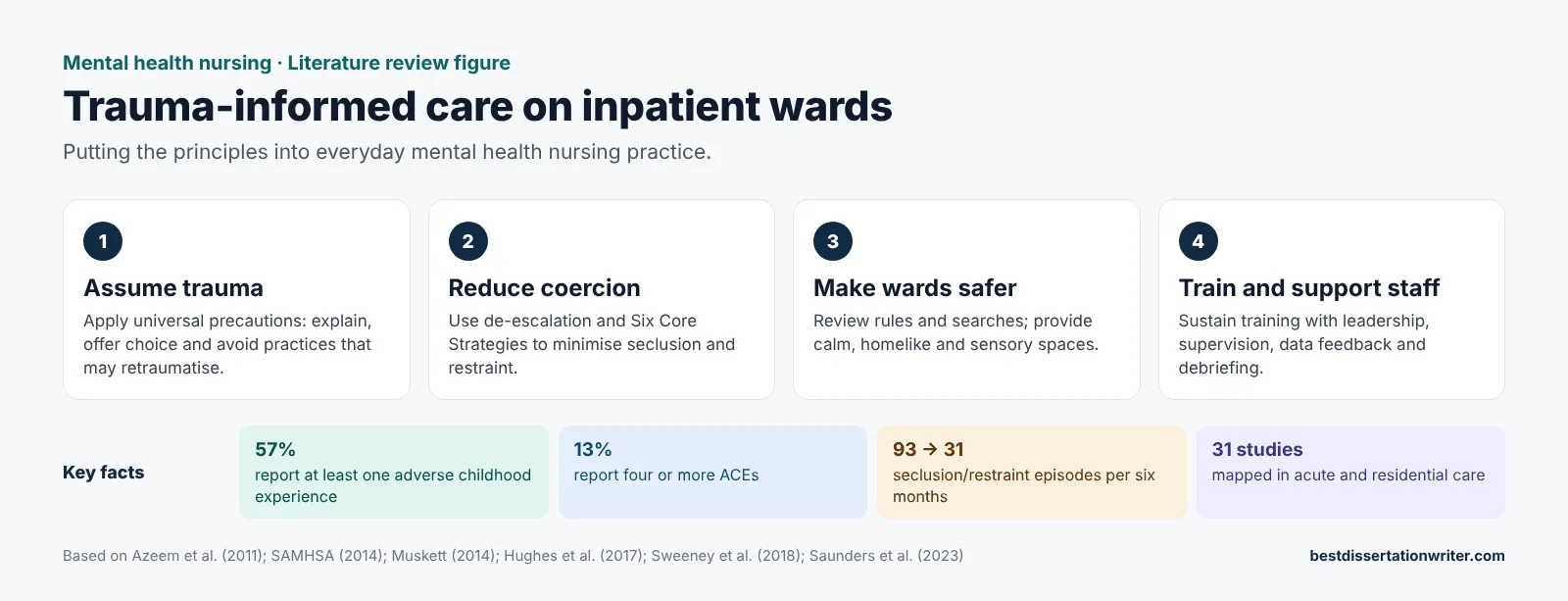
The rationale for trauma-informed approaches rests on the scale and consequences of adversity. In a systematic review and meta-analysis of 37 studies with 253,719 participants, Hughes et al. (2017) found that 57% of participants reported at least one adverse childhood experience and 13% reported four or more. People with four or more adverse experiences were at increased risk of every health outcome studied, with the strongest associations for problematic drug use and for interpersonal and self-directed violence. Associations with mental ill health were also strong.
Sweeney et al. (2018), writing as trauma survivors and service providers, describe trauma-informed care as a paradigm shift in which the central question changes from “What is wrong with you?” to “What happened to you?”. They argue that service users can be retraumatised by staff who are not trauma-informed, and that practices such as restraint and seclusion can also cause vicarious trauma for staff. Relationships built on understanding, respect and trust are presented as the foundation of the approach.
In inpatient psychiatry, trauma-informed care is closely linked to efforts to reduce restrictive practice. Muskett (2014) observed that policy in Australia had focused on reducing and, where possible, eliminating seclusion and restraint, but that many nurses regarded this goal as unrealistic. She asked whether the approach is only about ending coercion or whether it involves a wider set of everyday nursing practices.
Applying these principles in inpatient psychiatry is particularly challenging. Wards must manage risk, legal detention and acute distress, often with high bed occupancy, frequent use of temporary staff and limited space. Nurses may feel caught between the language of safety, choice and collaboration and the reality of locked doors, observation and occasional restraint. Understanding how services have tried to resolve this tension, and with what results, is therefore central to judging whether trauma-informed principles can change everyday ward practice.
Search Strategy and Methods
Evidence for this example was identified through targeted searches of openly accessible bibliographic records, publisher websites and the reference lists of key reviews. Search terms combined keywords for the approach (“trauma-informed care”, “trauma-informed approach”, “Six Core Strategies”, “Sanctuary Model”) with terms for the setting and outcomes (“inpatient”, “acute ward”, “psychiatric hospital”, “seclusion”, “restraint”, “staff training”, “adverse childhood experiences”), joined with the Boolean operators AND and OR. A full scoping review for assessment would run the same strategy in CINAHL, PubMed/MEDLINE, the Cochrane Library and Embase and report the number of records screened in a PRISMA flow diagram.
Sources were eligible if they defined or described trauma-informed care, evaluated its implementation in inpatient, acute, crisis or residential mental health settings, or provided evidence on the prevalence and impact of trauma relevant to the rationale for such approaches. Conceptual frameworks, reviews and empirical evaluations were all eligible, consistent with a scoping approach. Sources concerned only with trauma-focused psychotherapy for individuals, rather than with organisational approaches, were excluded.
Six sources on trauma-informed care published between 2011 and 2023 were included: a national framework, two reviews of trauma-informed approaches in inpatient and acute settings, a professional review article, an epidemiological meta-analysis and a pre–post evaluation from a psychiatric hospital (Table 1). The quality of each source was appraised using the Critical Appraisal Skills Programme (CASP) checklist appropriate to its design, and findings were charted and synthesised narratively into themes.
Key Findings on Trauma-Informed Care
Three themes were identified: the principles and practices that make up trauma-informed care on inpatient wards, the evidence on reducing seclusion and restraint, and the role of staff training, leadership and organisational change. Table 1 summarises the included sources, and Figure 1 shows changes in seclusion and restraint episodes after staff training in the Six Core Strategies at a child and adolescent psychiatric hospital.
| Author, year | Design | Setting and sample | Key finding |
|---|---|---|---|
| Azeem et al. (2011) | Retrospective pre–post evaluation | 458 young people; child and adolescent psychiatric hospital, USA | After Six Core Strategies training, episodes fell from 93 to 31 per six months; seclusions fell, restraints rose slightly. |
| Muskett (2014) | Literature review | 13 papers (2000–2011) on inpatient mental health settings | Trauma-informed care involves universal precautions, relationships, environment, training and screening, not only reducing coercion. |
| SAMHSA (2014) | National conceptual framework | Health and social care services, USA | Defines trauma (event, experience, effect), four Rs and six principles of a trauma-informed approach. |
| Hughes et al. (2017) | Systematic review and meta-analysis | 37 studies, 253,719 participants | 57% reported one or more ACEs and 13% four or more; four or more ACEs increased risk of all outcomes. |
| Sweeney et al. (2018) | Professional review article | Mental health services; co-written by trauma survivors | Shift from “What is wrong with you?” to “What happened to you?”; relationships and organisational change central. |
| Saunders et al. (2023) | Scoping review | 31 studies in acute, crisis, emergency and residential mental health care | Six Core Strategies and Sanctuary Model most common; restraint and seclusion reduced but evidence quality limited. |
Theme 1: Principles and Practices of Trauma-Informed Care on Inpatient Wards
Muskett (2014) reviewed literature published between 2000 and 2011 and included 13 papers on inpatient mental health settings. She found that the approach involves much more than reducing coercion. Service users described ward rules, searches, locked doors, mixed-sex environments and some ward round procedures as unsafe or disempowering. Associated practices included trust, respect, empathy and collaboration with service users and families, calmer and more homelike environments, sensory or time-out rooms, trauma screening on admission and routine feedback.
A key idea in Muskett’s review is that of universal trauma precautions. Because staff usually cannot know which service users are trauma survivors, all care should be delivered in ways that avoid harm and promote recovery. Muskett (2014) concluded that effective trauma-informed care largely comes down to good, basic mental health nursing built on the nurse–client relationship. A limitation acknowledged in the review was the small number of empirical studies, with many recommendations drawn from expert opinion and grey literature.
SAMHSA (2014) and Sweeney et al. (2018) reinforce this emphasis on relationships and organisational culture rather than on a single technique. Both present trauma-informed care as a whole-system approach in which policies, environments and staff behaviour all communicate safety and choice. This breadth is a strength, because it addresses the many ways in which admission can be distressing, but it also makes it difficult to define precisely and to evaluate in trials.
Theme 2: Trauma-Informed Care and the Reduction of Seclusion and Restraint
The most frequently reported outcome of trauma-informed approaches in inpatient psychiatry is a reduction in seclusion and restraint. Azeem et al. (2011) evaluated the Six Core Strategies, a trauma-informed restraint reduction programme, at a child and adolescent psychiatric hospital in the United States. Staff were trained in March 2005, and records of 458 young people admitted between July 2004 and March 2007 were reviewed. Overall, 79 young people (17.2%) experienced 278 seclusion or restraint episodes during the study period.
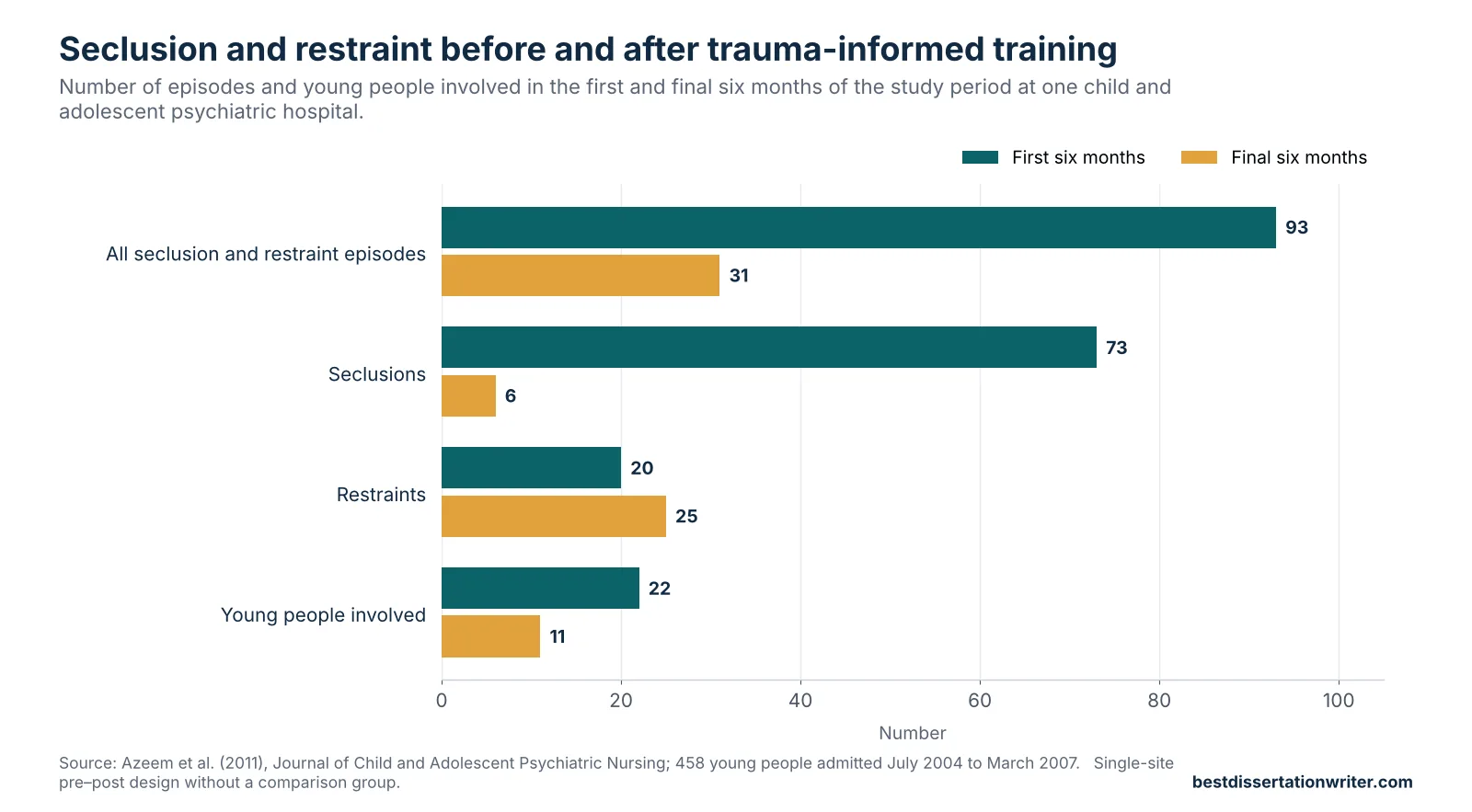
In the first six months of the study, there were 93 episodes involving 22 young people, of which 73 were seclusions and 20 were restraints. In the final six months there were 31 episodes involving 11 young people, of which six were seclusions and 25 were restraints. Seclusion fell sharply, but the number of restraints rose slightly. The study used a single-site pre–post design without a comparison group, so changes in staffing, case mix or policy over time cannot be ruled out as explanations.
Saunders et al. (2023) provide the broadest overview. Their scoping review of trauma-informed approaches in acute, crisis, emergency and residential mental health care identified 31 studies, most from the United States (23) and many from acute services (16). The Six Core Strategies (seven studies) and the Sanctuary Model (six studies) were the most commonly reported approaches. Reductions in restraint and seclusion were reported, but most studies used pre–post designs without comparison groups, and the authors judged the quality of evidence to be limited.
Theme 3: Staff Training, Leadership and Organisational Change
Staff training appears in almost every account of implementing trauma-informed approaches. Azeem et al. (2011) introduced the Six Core Strategies through staff training, and Muskett (2014) identified training on trauma, de-escalation, boundaries and strengths-based care, beginning at staff orientation, as part of building a trauma-informed culture. Muskett also noted that programmes which reduced seclusion and restraint combined staff training with leadership support, data collection, debriefing and service user involvement, rather than relying on training alone.
Saunders et al. (2023) reported that the Six Core Strategies were associated with improved staff attitudes and greater service user involvement, while the Sanctuary Model was associated with reductions in absconding and restraint. Sweeney et al. (2018) frame implementation as an organisational change process that requires leadership commitment, the involvement of trauma survivors and attention to staff wellbeing. They argue that the approach can improve staff working conditions, job satisfaction and stress as well as service user experience.
These findings suggest that staff training is necessary but not sufficient. One-off training sessions are unlikely to change ward culture if staffing is unstable, if leaders do not prioritise reduction of restrictive practice or if staff themselves feel unsafe. The evidence points towards sustained, multi-component programmes in which training is reinforced by supervision, data feedback, debriefing and co-production with people who use services.
Discussion
This scoping review found a strong rationale for trauma-informed care in inpatient settings, a broadly consistent set of principles and practices, and encouraging but low-quality evidence that it reduces seclusion and restraint. The prevalence data from Hughes et al. (2017) make a compelling case that trauma is common among people who use mental health services, and the conceptual work of SAMHSA (2014) and Sweeney et al. (2018) offers a shared language for change.
However, the outcome evidence for trauma-informed care is weak. Almost all evaluations used uncontrolled pre–post designs, often at single sites, and many were conducted in child and adolescent or residential services in the United States (Saunders et al., 2023). Reductions in seclusion and restraint are important, but they may reflect wider policy pressure or changes in leadership rather than the trauma-informed elements themselves. The rise in restraint seen by Azeem et al. (2011) as seclusion fell also raises the possibility that one restrictive practice may partly replace another.
A further tension concerns definition. Because trauma-informed care is described as a whole-system philosophy, services may claim to be trauma-informed while changing little in practice. Conversely, packaged models such as the Six Core Strategies are easier to evaluate but may narrow the concept to restraint reduction, which Muskett (2014) cautioned against. Clearer descriptions of the components delivered, and measures of service user experience, safety and trust, would help to distinguish meaningful change from rebranding.
The evidence also highlights staff as both agents and recipients of trauma-informed care. Nurses who are exposed to violence, coercive incidents and high workloads may find it difficult to offer the safety and choice that the approach requires. Sweeney et al. (2018) argue that attention to staff wellbeing and vicarious trauma is part of the approach, not an optional extra, and implementation plans should therefore include debriefing, supervision and support for the workforce.
This review has limitations. It relied on openly accessible, English-language sources, did not involve independent double screening and included a small number of sources, some of which were conceptual rather than empirical. Future research should use controlled designs across multiple adult acute wards, measure service user experience and staff outcomes alongside restrictive practice, examine cost and sustainability, and involve trauma survivors in designing and evaluating interventions.
Implications of Trauma-Informed Care Evidence for Practice
For mental health nurses in inpatient psychiatry, the evidence supports applying universal trauma precautions: explaining what is happening and why, offering choice wherever possible, reviewing ward rules and searches that may feel threatening, and creating calmer environments with access to sensory or quiet spaces. Services should provide sustained staff training in trauma and de-escalation, supported by leadership, supervision, data on restrictive practice and debriefing after incidents, and should involve people with lived experience in planning and reviewing care.
Trauma-informed nursing is closely connected to other areas of mental health practice. Skilled de-escalation techniques reduce the need for restraint, compassionate responses to self-harm avoid shaming people whose distress is linked to trauma, and challenging mental illness stigma among professionals supports the shift from asking what is wrong to asking what happened. Attention to burnout and staff wellbeing is also essential, because nurses who feel safe and supported are better able to provide safe care.
Conclusion
This scoping review found that trauma-informed care in inpatient mental health settings rests on a strong rationale and a clear set of principles, and that programmes such as the Six Core Strategies are associated with reductions in seclusion and restraint. The evidence, however, comes mainly from uncontrolled, single-site evaluations, so its effects cannot yet be stated with confidence.
Mental health nurses can lead the implementation of trauma-informed care by building trusting relationships, minimising coercion and advocating for sustained training, leadership support and attention to staff wellbeing. Rigorous evaluation is now needed to show which components make the greatest difference for people who use inpatient services.
References
Azeem, M. W., Aujla, A., Rammerth, M., Binsfeld, G., & Jones, R. B. (2011). Effectiveness of six core strategies based on trauma informed care in reducing seclusions and restraints at a child and adolescent psychiatric hospital. Journal of Child and Adolescent Psychiatric Nursing, 24(1), 11–15. https://doi.org/10.1111/j.1744-6171.2010.00262.x
Hughes, K., Bellis, M. A., Hardcastle, K. A., Sethi, D., Butchart, A., Mikton, C., Jones, L., & Dunne, M. P. (2017). The effect of multiple adverse childhood experiences on health: A systematic review and meta-analysis. The Lancet Public Health, 2(8), e356–e366. https://doi.org/10.1016/S2468-2667(17)30118-4
Muskett, C. (2014). Trauma-informed care in inpatient mental health settings: A review of the literature. International Journal of Mental Health Nursing, 23, 51–59. https://doi.org/10.1111/inm.12012
Saunders, K. R. K., McGuinness, E., Barnett, P., Foye, U., Sears, J., Carlisle, S., Allman, F., Tzouvara, V., Schlief, M., Vera San Juan, N., Stuart, R., Griffiths, J., Appleton, R., McCrone, P., Rowan Olive, R., Nyikavaranda, P., Jeynes, T., K, T., Mitchell, L., … Trevillion, K. (2023). A scoping review of trauma informed approaches in acute, crisis, emergency, and residential mental health care. BMC Psychiatry, 23, 567. https://doi.org/10.1186/s12888-023-05016-z
Substance Abuse and Mental Health Services Administration. (2014). SAMHSA’s concept of trauma and guidance for a trauma-informed approach (HHS Publication No. SMA 14-4884). Substance Abuse and Mental Health Services Administration.
Sweeney, A., Filson, B., Kennedy, A., Collinson, L., & Gillard, S. (2018). A paradigm shift: Relationships in trauma-informed mental health services. BJPsych Advances, 24(5), 319–333. https://doi.org/10.1192/bja.2018.29
Cite this example
Best Dissertation Writers (2026) Implementing Trauma-Informed Care in Inpatient Mental Health Settings: A Scoping Review. Available at: https://bestdissertationwriter.com/trauma-informed-care-literature-review/
Best Dissertation Writers
Get expert help with your nursing literature review
Share your topic and deadline with Best Dissertation Writers and get support tailored to your module brief.