Delays in Analgesia and Pain Management in the Emergency Department: A Systematic Review
 By Dr. Robertson Prime, Research Fellow
Updated November 2, 2026
15 min read
About 2,900 words
In this review
Abstract
Background: Pain is one of the commonest reasons for attending an emergency department, yet many patients wait a long time for pain relief. Delays in analgesia cause avoidable suffering, may worsen outcomes and reduce satisfaction, and emergency nurses are well placed to reduce them through early assessment and nurse-initiated treatment.
Aim: This systematic review aimed to examine the evidence on delays in analgesia in the emergency department, the effect of nurse-initiated analgesia and the evidence for effective options in specific groups, including children and older adults with hip fracture.
Methods: Evidence was identified through targeted searches of openly accessible bibliographic records, publisher websites and Cochrane evidence pages. Five sources published between 2014 and 2025 were included: two systematic reviews of nurse-initiated treatment, two Cochrane reviews and an observational study of time to analgesia. The sources were appraised using CASP checklists and synthesised narratively.
Findings: A systematic review of 12 articles found that nurse-initiated analgesia was associated with safe, timely and effective pain relief. A systematic review of five experimental studies found that patients received nurse-initiated medication about half an hour sooner, with no effect on adverse events. A Cochrane review of three trials with 313 children found that intranasal fentanyl reduced pain, although evidence was insufficient to compare it with morphine. A Cochrane review of 49 trials with 3,061 adults found that nerve blocks reduced pain on movement by about 2.5 points and reduced delirium. An observational study of 90 adults found a mean door-to-analgesia time of 40.6 minutes, with 45% receiving analgesia within 30 minutes.
Conclusion: Delays in analgesia remain common, and nurse-initiated analgesia and appropriate techniques such as intranasal fentanyl and nerve blocks can shorten them. Evidence is limited by small studies, so services should audit time to analgesia locally.
Keywords: delays in analgesia, oligoanalgesia, time to analgesia, emergency pain management
Introduction
This systematic review critically examines recent evidence on delays in analgesia and its implications for emergency nursing practice.
Most people who come to an emergency department are in pain. It may be the result of an injury, an acute illness or a long-term condition that has flared up. Relieving pain is one of the most basic things that nurses do, and the speed with which it is done matters to patients, who often describe the time spent waiting in pain as the worst part of their visit.
Despite this, delays in analgesia are well recognised. Patients may wait for assessment, for a prescription, for a doctor to be free or for a drug to be obtained and checked. Pain may not be recorded at triage, may be underestimated or may be treated with an inadequate dose. Some groups, such as older adults, children and people who cannot easily express their pain, may be at particular risk of delay.
Nurses have a central role. They are usually the first clinicians to see a patient and can assess pain, start simple measures such as splinting and positioning, and, in many departments, give analgesia under protocols or standing orders.
Review question
What does the evidence show about delays in analgesia in the emergency department, what is known about the effect of nurse-initiated analgesia and what is known about effective approaches for children and older adults?
Background to Delays in Analgesia
Pain is a symptom that cannot be measured directly. Assessment relies on patients’ reports, supported by observation, and scales such as numerical ratings are widely used. The need for assessment at triage is recognised, but the way pain is recorded varies, and the score recorded at triage does not always lead to action. Delays in analgesia can occur at many stages: before treatment is prescribed, between prescription and administration, and in the choice of a drug or route that takes time to work.
The consequences go beyond discomfort. Uncontrolled pain can raise heart rate and blood pressure, can make examination more difficult, and may contribute to distress and anxiety. In older adults with hip fracture, poorly controlled pain is linked with confusion. In children, unrelieved pain can be frightening and may make later procedures harder. Prompt pain relief is therefore part of safe, kind care, and not an optional extra.
Pain interacts with other emergency problems. Severe chest pain, for example, may be a sign of a myocardial infarction that can lead to cardiac arrest, so pain assessment must go together with a systematic clinical assessment such as the primary survey. Children’s pain is also an important element of paediatric emergencies, where the choice of drug and route must suit the child.
Delays in analgesia are not always the result of a single failure. In a busy department, each step may take only a few minutes, but the steps add up: waiting to be triaged, waiting to be seen, waiting for a prescription, waiting for a second nurse to check a controlled drug and waiting for the drug to take effect. Looking at the whole pathway, and not only at one step, is the best way to understand where delays in analgesia occur and where nurses can make a difference.
Search Strategy and Methods
Evidence for this example was identified through targeted searches of openly accessible bibliographic records, publisher websites and Cochrane evidence pages. Search terms combined keywords for the problem (“analgesia”, “pain management”, “oligoanalgesia”, “time to analgesia”) with terms for the intervention and setting (“nurse-initiated”, “emergency department”, “intranasal fentanyl”, “nerve block”, “triage”), joined with the Boolean operators AND and OR. A full systematic review for assessment would run the same strategy in CINAHL, PubMed/MEDLINE, Embase and the Cochrane Library and report the records screened in a PRISMA flow diagram.
Sources were eligible if they were systematic reviews, Cochrane reviews or studies of time to analgesia or the effectiveness of analgesic approaches for patients in the emergency department. Studies of chronic pain, postoperative pain and prehospital care alone were excluded.
Five sources published between 2014 and 2025 were included (Table 1). The quality of each source was considered using the Critical Appraisal Skills Programme (CASP) checklists, and findings were synthesised narratively under themes.
The findings on delays in analgesia are presented from the general to the specific. First, the evidence on how long patients wait is considered, then the evidence that nurse-initiated treatment shortens the wait and finally the evidence on particular drugs and techniques. Because the studies measure different things, such as door-to-analgesia time, pain scores and satisfaction, the results are described in each source’s own terms.
Key Findings on Delays in Analgesia
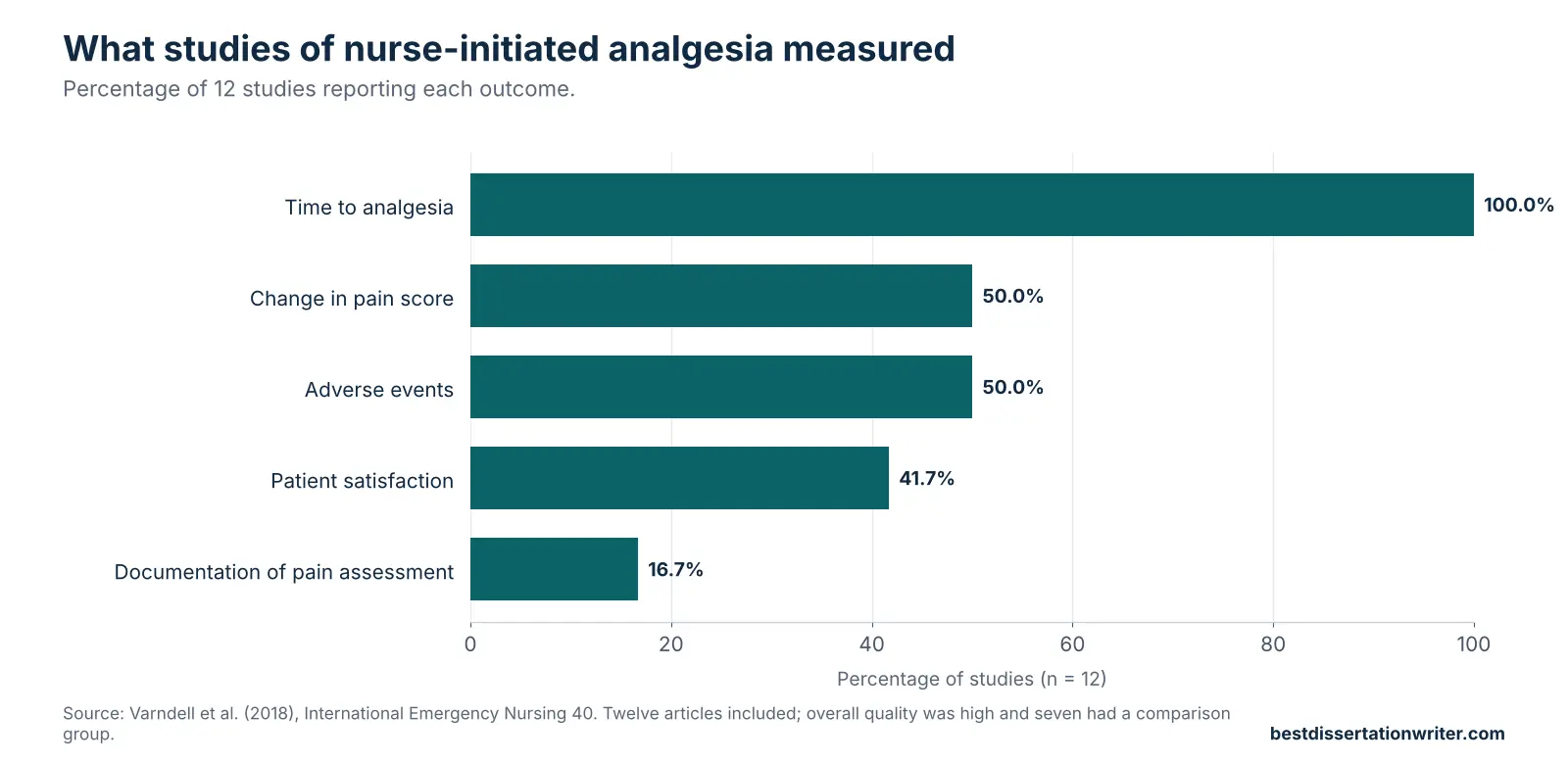
Three themes were identified: the extent of delays, the effect of nurse-initiated analgesia, and the evidence for specific analgesic approaches in children and older adults. Table 1 summarises the included sources, and Figure 1 shows the outcomes reported in a systematic review of nurse-initiated analgesia.
| Author, year | Design | Setting and sample | Key finding |
|---|---|---|---|
| Cabilan & Boyde (2017) | Systematic review | 5 experimental studies of nurse-initiated medications | Medication about half an hour sooner; no effect on adverse events. |
| Guay & Kopp (2020) | Cochrane review | 49 trials; 3,061 adults with hip fracture | Nerve blocks reduced pain on movement by about 2.5 points and reduced delirium. |
| Murphy et al. (2014) | Cochrane review | 3 trials; 313 children | Intranasal fentanyl reduced pain; evidence insufficient to compare with morphine. |
| Ohn et al. (2025) | Prospective observational study | 90 adults with musculoskeletal trauma | Mean door-to-analgesia time 40.6 minutes; 45% within 30 minutes. |
| Varndell et al. (2018) | Systematic review | 12 articles on nurse-initiated analgesia | Safe, timely and effective pain relief. |
Theme 1: The Extent of Delays
Ohn et al. (2025) carried out a prospective observational study of door-to-analgesia time in adults with musculoskeletal trauma at an urban tertiary emergency department. Over five months, they enrolled 90 adults and rated pain on a numerical scale at triage, before and after analgesia and at discharge. The mean door-to-analgesia time was 40.6 minutes, and 45% of patients received analgesia within 30 minutes.
Age over 45 years significantly predicted a door-to-analgesia time longer than 45 minutes, while the time did not differ significantly between triage categories. Analgesia reduced the mean pain score by 50%, but the delay was not significantly associated with patient satisfaction. The authors concluded that delays in analgesia remain a problem, especially in older patients, and that nurse-initiated analgesia, improved triage protocols and better use of resources may shorten the time.
This is a small, single-centre study in one country, and it measured a single type of injury, so the figures cannot be applied directly to other departments. The finding that more than half of the patients did not receive analgesia within 30 minutes is nonetheless consistent with the general concern about delays, and it provides a measure that services can use to audit their own practice. It also shows that older patients may wait longer, which should prompt nurses to be proactive in assessing their pain.
Theme 2: Nurse-Initiated Analgesia
Varndell et al. (2018) systematically reviewed the quality and impact of nurse-initiated analgesia for adults in the emergency department. They searched six sources from inception to December 2017, with no language restrictions, and included 12 articles that covered a range of analgesics and routes for mild to severe pain. Overall study quality was high, and seven studies had a comparison group.
All 12 studies reported time to analgesia. Six reported change in pain score, six reported adverse events, five reported patient satisfaction and two reported documentation of pain assessment. The authors concluded that nurse-initiated analgesia was associated with safe, timely and effective pain relief. This finding supports the use of protocols that allow nurses to give analgesia without waiting for a prescription.
Cabilan and Boyde (2017) systematically reviewed the impact of nurse-initiated medications in the emergency department. They included five experimental studies: one randomised controlled trial and four quasi-experimental studies, in paediatric and adult departments. The medications were salbutamol for respiratory conditions and analgesia for painful conditions. Patients received medication about half an hour sooner than those without nurse-initiated medication, and there was no effect on adverse events, doctor wait time or length of stay.
Nurse-initiated analgesia was associated with a higher likelihood of receiving analgesia, clinically relevant pain reduction and better patient satisfaction. The authors concluded that nurse-initiated medications are safe and beneficial but that randomised studies are needed to strengthen the evidence. Together with the review by Varndell et al., this provides consistent support for nurse-initiated analgesia, while noting that the evidence base consists mostly of small, non-randomised studies.
Theme 3: Evidence for Specific Approaches
Murphy et al. (2014) carried out a Cochrane review of intranasal fentanyl for acute pain in children, a route that avoids the delay and distress of establishing an intravenous line or giving an injection. They included three randomised or quasi-randomised trials with 313 children aged 3 to 15 years, all with acute pain from broken limb bones. Intranasal fentanyl produced a greater reduction in pain score at 10 minutes than intramuscular morphine, and no significant difference from intravenous morphine up to 20 minutes.
No serious adverse events were reported after intranasal fentanyl, although some studies reported a bad taste and vomiting. The authors judged the risk of bias to be low, but said that evidence was insufficient to compare intranasal fentanyl with intramuscular or intravenous morphine. They noted that the small number of studies, the absence of children under three and of children with non-injury pain, and the fact that all studies were conducted in Australia limit generalisability.
Guay and Kopp (2020) carried out a Cochrane review of peripheral nerve blocks for hip fractures in adults. They included 49 randomised controlled trials with 3,061 adults, of whom 1,553 received a block and 1,508 received no block or a sham block. Nerve blocks reduced pain on movement within 30 minutes by about 2.5 points on a 0 to 10 scale (high-certainty evidence) and reduced the risk of delirium (risk ratio 0.67, 95% confidence interval 0.50 to 0.90; high certainty).
Nerve blocks also probably reduce the risk of pneumonia (risk ratio 0.41, 0.19 to 0.89; moderate certainty). These findings are important for older adults, who are at high risk of both undertreated pain and delirium. They suggest that a block should be considered early for patients with hip fracture, if staff trained in the technique are available, and that nurses should ask whether such pathways exist in their department.
A practical lesson from the reviews of nurse-initiated treatment is that the benefit lies mainly in time. Patients received medication about half an hour sooner when nurses could start it, and pain relief was more likely. This matters because, even if the final level of pain control is similar, a shorter delay means less time in pain. Services that measure only whether pain is eventually relieved may therefore miss the problem of delays in analgesia.
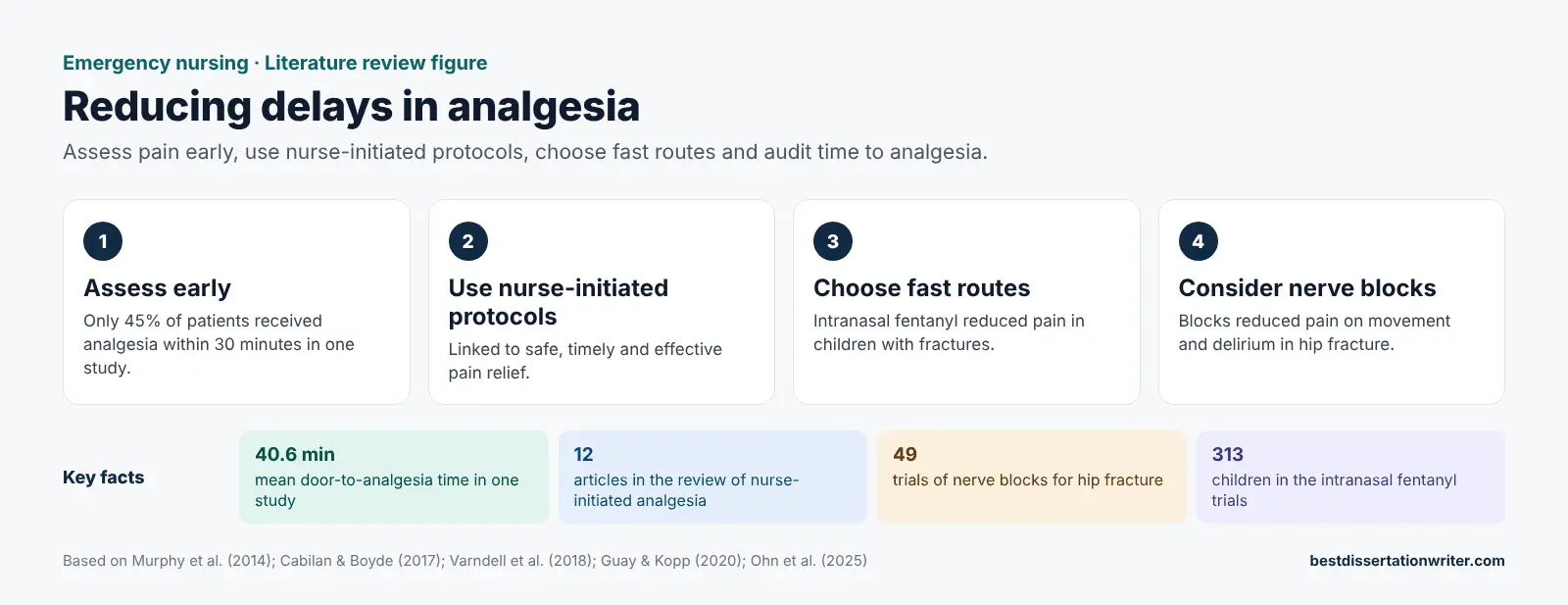
Taken together, these sources suggest that delays in analgesia can be reduced by a combination of approaches: assessing pain early, allowing nurses to give analgesia, choosing routes that are quick and well tolerated and using techniques such as nerve blocks for specific injuries. The evidence for each is of varying strength, and many of the studies are small, but the direction of effect is consistent.
Discussion
This systematic review suggests that delays in analgesia are common in emergency departments and that they can be reduced. Nurse-initiated analgesia was associated with timely and safe pain relief in two systematic reviews, and there is good evidence for specific approaches, such as intranasal fentanyl for children with limb fractures and nerve blocks for adults with hip fracture.
The sources vary in design and strength. The Cochrane reviews are rigorous but are based on small numbers of trials, particularly in children, and the review of nurse-initiated medications included only five experimental studies. The observational study is small and from a single centre. Patient-reported outcomes such as satisfaction were not always measured, and none of the sources examined the experiences of nurses who give analgesia.
There are other limitations. Much of the evidence comes from Australia, and practice in the United Kingdom, where nurse prescribing and patient group directions are available in many departments, may differ. The reviews may overlap in the studies they include. Newer evidence published after the search dates of the reviews, such as studies of other analgesics, would not be captured. This review relied on openly accessible, English-language sources.
A final point concerns equity. The study of time to analgesia found that older patients waited longer, and children, people with cognitive impairment and those with communication difficulties may be at risk of under-treatment. Nurses can help by using pain tools suited to the patient, by asking relatives and carers about signs of pain and by challenging assumptions that some patients do not need or will not tolerate analgesia.
Implications of Delays in Analgesia Evidence for Practice
For practice, the evidence supports recording pain at triage and acting on it, using protocols that allow nurses to give analgesia promptly, considering intranasal fentanyl for children with fractures and nerve blocks for adults with hip fracture where trained staff are available, and auditing the time to analgesia. Information is available from the National Institute for Health and Care Excellence and the Royal College of Emergency Medicine.
Managers should monitor door-to-analgesia time, provide training and authority for nurse-initiated analgesia and ensure that drugs and equipment are available. Delays in analgesia can also be reduced by good patient flow, so that patients are assessed and treated promptly.
Education is also relevant. Nurses who give analgesia under a protocol need to know the indications, contraindications, doses and observations required, and to feel confident in using them. Short, practical training, with audit of time to analgesia fed back to staff, can help to turn a protocol on paper into routine practice. Nurses should also be supported to document pain assessments clearly, since only two of the 12 studies of nurse-initiated treatment measured documentation, and what is not recorded is difficult to improve.
Future research should test nurse-initiated protocols in randomised designs, examine pain management in older adults, in children under three and in patients with non-injury pain, and measure patient experience. Studies in United Kingdom emergency departments would be especially useful.
The evidence reviewed here is encouraging, because the approaches that reduce delays in analgesia are mostly within the control of the emergency team. They do not depend on expensive equipment, but on assessment, protocols, training and attention to the patient’s experience of waiting.
Conclusion
This systematic review found that delays in analgesia remain a problem in emergency departments, that nurse-initiated analgesia is associated with faster and safe pain relief and that specific techniques can improve pain control in children and older adults.
Emergency nurses can reduce delays by assessing pain early, using protocols to treat it promptly and auditing their own practice.
References
Cabilan, C. J., & Boyde, M. (2017). A systematic review of the impact of nurse-initiated medications in the emergency department. Australasian Emergency Nursing Journal, 20(2), 53–62. https://doi.org/10.1016/j.aenj.2017.04.001
Guay, J., & Kopp, S. (2020). Peripheral nerve blocks for hip fractures in adults. Cochrane Database of Systematic Reviews, (11), Article CD001159. https://doi.org/10.1002/14651858.CD001159.pub3
Murphy, A., O’Sullivan, R., Wakai, A., Grant, T. S., Barrett, M. J., Cronin, J., McCoy, S. C., Hom, J., & Kandamany, N. (2014). Intranasal fentanyl for the management of acute pain in children. Cochrane Database of Systematic Reviews, (10), Article CD009942. https://doi.org/10.1002/14651858.CD009942.pub2
Ohn, M., Hein, Z. M., Elami, A. B. A., Jasim, A. D. N., Alatta, A. N., Ayman, M., Latt, S. S., & Ohn, K. (2025). Time to analgesia delivery in musculoskeletal trauma care: An observational study. Eurasian Journal of Medicine and Oncology, 9(4), 239–247. https://doi.org/10.36922/EJMO025220224
Varndell, W., Fry, M., & Elliott, D. (2018). Quality and impact of nurse-initiated analgesia in the emergency department: A systematic review. International Emergency Nursing, 40, 46–53. https://doi.org/10.1016/j.ienj.2018.05.003
Cite this example
Best Dissertation Writers (2026) Delays in Analgesia and Pain Management in the Emergency Department: A Systematic Review. Available at: https://bestdissertationwriter.com/delays-in-analgesia-literature-review/
Best Dissertation Writers
Get expert help with your nursing literature review
Share your topic and deadline with Best Dissertation Writers and get support tailored to your module brief.