Nurse-Led Rapid Assessment and Streaming Models in Emergency Care: A Systematic Review
 By Dr. Robertson Prime, Research Fellow
Updated November 2, 2026
16 min read
About 3,100 words
In this review
Abstract
Background: Crowding and long waits are major problems in emergency care. Rapid assessment and streaming are models in which patients are seen early by an experienced clinician and directed to the most suitable pathway, such as fast track or primary care, and nurses lead or contribute to many of them.
Aim: This systematic review aimed to examine the evidence on rapid assessment and streaming in emergency departments, including the effect on waiting times and length of stay, the role of nurses and other primary healthcare professionals and the quality of the evidence.
Methods: Evidence was identified through targeted searches of openly accessible bibliographic records, publisher websites and repositories. Five sources published between 2016 and 2023 were included: three systematic reviews (one with meta-analysis), a rapid realist review and a scoping review. The sources were appraised using CASP checklists and synthesised narratively.
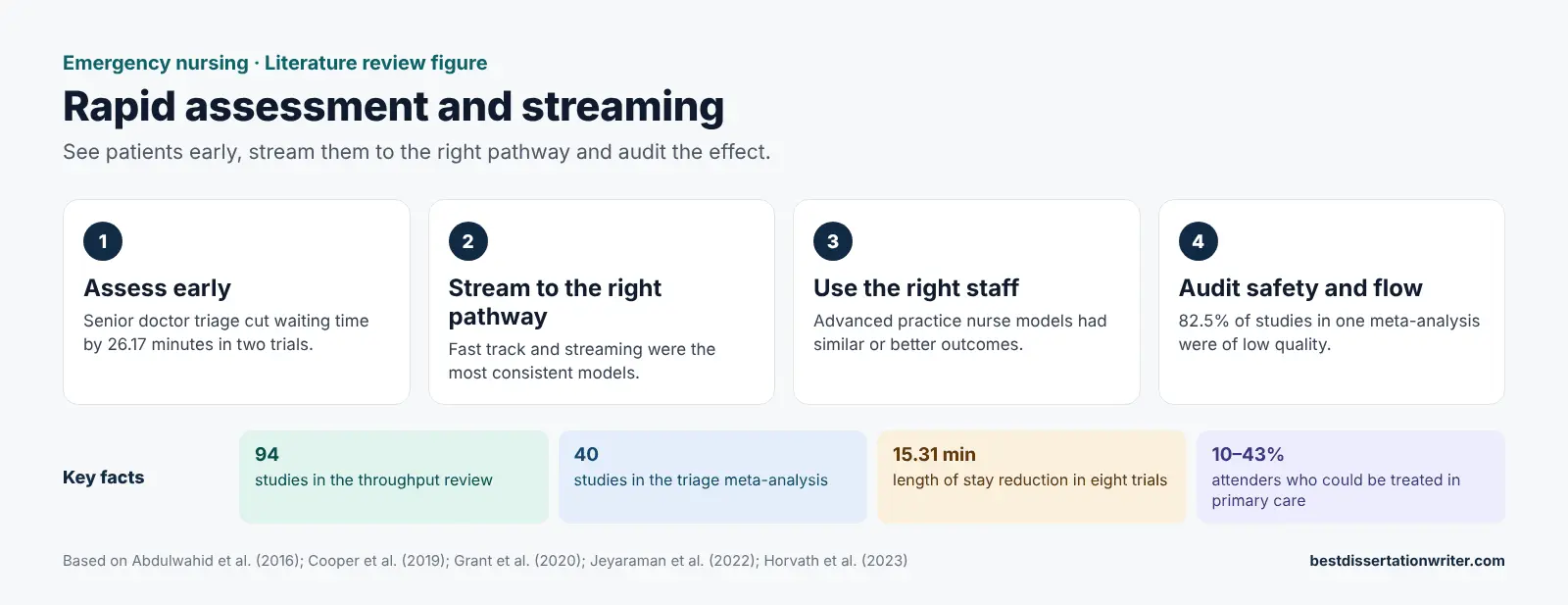
Findings: A systematic review of 94 studies found that 80 reported modest improvements in length of stay or left-without-being-seen rates, with the most consistent reductions for fast track and streaming. A meta-analysis of 40 comparative studies found that employing primary healthcare professionals at triage reduced length of stay by 15.31 minutes in eight randomised trials, although 82.5% of studies were of low quality. A meta-analysis of two trials found that senior doctor assessment at triage reduced waiting time by 26.17 minutes. A realist review of 96 articles estimated that 10% to 43% of attenders could be treated in primary care. A scoping review of 76 studies found that models with advanced practice nurses gave similar or better outcomes than other providers.
Conclusion: Rapid assessment and streaming are associated with shorter waits and stays, and fast track and streaming appear most consistent. The evidence is mostly observational, and services should audit their own models.
Keywords: rapid assessment and streaming, waiting times, streaming models
Introduction
This systematic review critically examines recent evidence on rapid assessment and streaming and its implications for emergency nursing practice.
Long waits are one of the most visible problems in emergency care. Patients who wait for hours may be in pain or anxious, may deteriorate, and may leave before they have been seen. For staff, crowded departments mean pressure, interruptions and moral distress. Many services have therefore tried to change the way patients are received, so that the first contact with a clinician happens sooner and leads to the right pathway.
Two ideas are central. Rapid assessment means that an experienced clinician sees the patient soon after arrival, often at the front door, and starts investigations and treatment without waiting for a bed or a full medical review. Streaming means directing patients to the pathway that suits them best, such as a fast track area for minor injuries, a primary care service alongside the department or a resuscitation area for the sickest. Together, rapid assessment and streaming aim to reduce delays and to match patients to the right skills.
Nurses are central to both. They usually carry out triage, and in many departments senior nurses and nurse practitioners lead rapid assessment, order tests, treat minor conditions and decide where patients should go. The effectiveness of these models, and the best way of staffing them, is therefore a question that directly concerns emergency nursing.
Review question
What does the evidence show about the effect of rapid assessment and streaming on waiting times and flow, what is known about the contribution of nurses and other professionals and how strong is the evidence?
Background to Rapid Assessment and Streaming in Emergency Nursing
Triage has long been the means by which departments decide who is seen first. The principles and tools of triage are discussed in the review of triage tools, but triage on its own sorts patients and does not by itself speed up care. Rapid assessment and streaming go further, by combining early clinical assessment with action, so that the patient’s journey begins at the front door.
There are several forms. Senior doctor assessment at triage places an experienced doctor in the triage area. Team triage uses a nurse, a doctor and sometimes other staff together. Fast track areas treat patients with minor injuries or illnesses separately from those with complex needs. Primary care streaming places general practitioners in or beside the department to treat patients who could be managed in primary care. Nurse practitioners and advanced practice nurses may work in any of these models.
Models of rapid assessment and streaming are related to other themes in emergency nursing. Time pressure can lead to stress and fatigue for staff, which is the subject of the review of compassion fatigue, and time-critical conditions such as stroke depend on rapid recognition, as discussed in the review of stroke recognition. A streaming model that sends a patient with such a condition to the wrong pathway can cause harm, so the design of the model and the skills of the person who decides are important.
Search Strategy and Methods
Evidence for this example was identified through targeted searches of openly accessible bibliographic records, publisher websites and repositories. Search terms combined keywords for the intervention (“rapid assessment”, “streaming”, “fast track”, “split flow”, “team triage”, “senior doctor triage”) with terms for the outcome and setting (“waiting times”, “length of stay”, “left without being seen”, “emergency department”, “nurse practitioner”), joined with the Boolean operators AND and OR. A full review for assessment would run the same strategy in CINAHL, PubMed/MEDLINE, Embase and the Cochrane Library and report how records were screened.
Sources were eligible if they were systematic, scoping or realist reviews of interventions in the emergency department that aimed to improve patient flow through early assessment or streaming. Single primary studies, opinion pieces and reviews of interventions in the inpatient wards or prehospital care were excluded.
Five sources published between 2016 and 2023 were included (Table 1). The quality of each source was considered using the Critical Appraisal Skills Programme (CASP) checklists, and findings were synthesised narratively under themes.
The findings are presented from the general to the specific. First the evidence on the overall effect of interventions is considered, then the evidence on who staffs the models, and finally the quality of the evidence and its limits. Because the sources use different outcome measures and designs, the results are described in each source’s own terms and are not combined statistically.
Key Findings on Rapid Assessment and Streaming
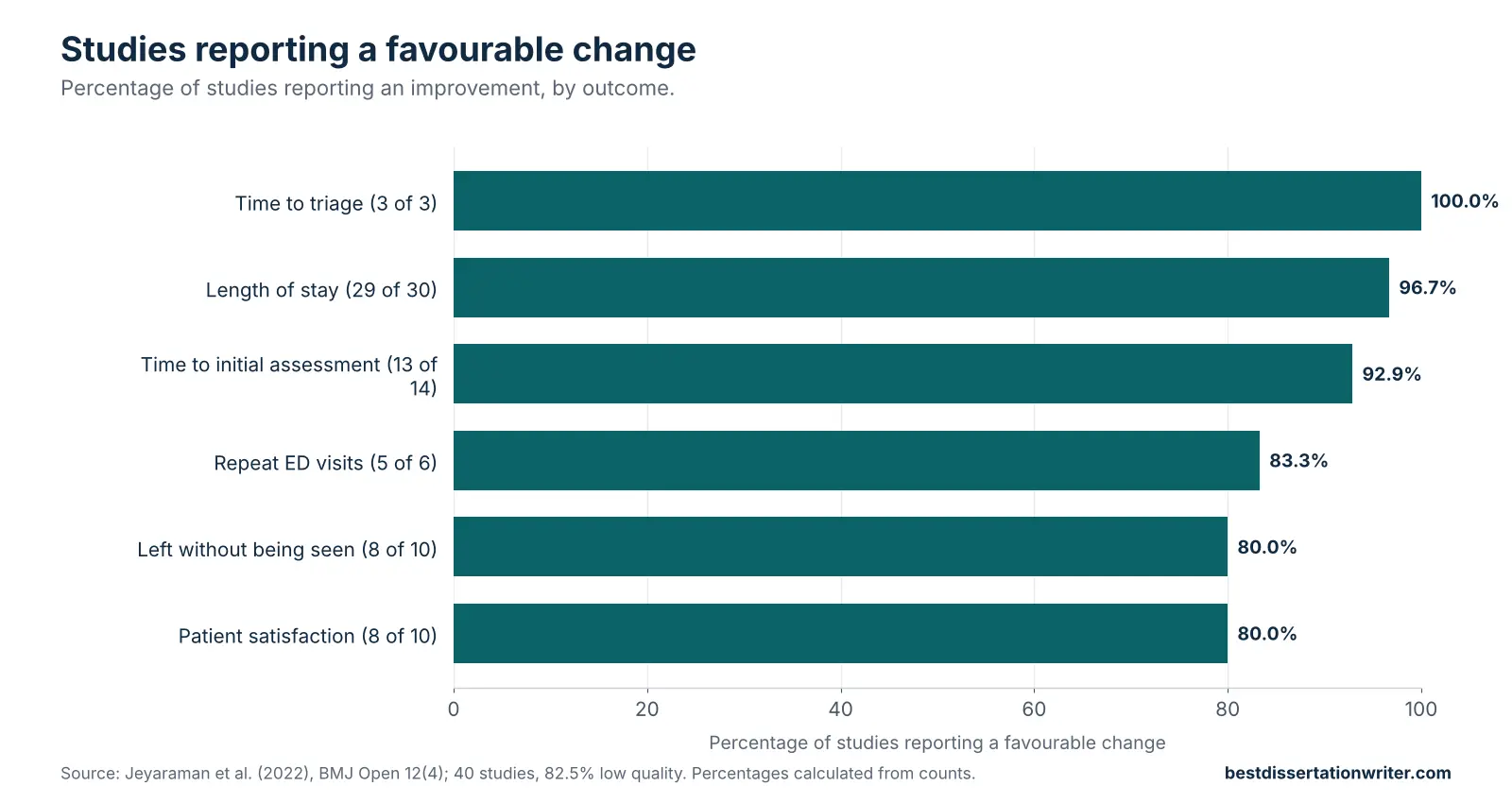
Three themes were identified: the effect on waiting times and length of stay, the contribution of different professionals, and the quality and limits of the evidence. Table 1 summarises the included sources, and Figure 1 shows the proportion of studies in one meta-analysis that reported a favourable change for each outcome.
| Author, year | Design | Setting and sample | Key finding |
|---|---|---|---|
| Abdulwahid et al. (2016) | Systematic review and meta-analysis | 25 studies of senior doctor assessment at triage | Waiting time reduced by 26.17 minutes in two trials; no change in adverse events. |
| Cooper et al. (2019) | Rapid realist review | 96 articles on general practitioners in or alongside emergency departments | 10% to 43% of attenders could be treated in primary care; caution advised. |
| Grant et al. (2020) | Systematic review | 94 studies of throughput interventions | 80 reported modest gains; fast track and streaming most consistent. |
| Horvath et al. (2023) | Scoping review | 76 studies of advanced practice nurse models | Similar or better outcomes than other providers. |
| Jeyaraman et al. (2022) | Systematic review and meta-analysis | 40 comparative studies of primary healthcare professionals at triage | Length of stay reduced by 15.31 minutes in eight trials; 82.5% of studies low quality. |
Theme 1: Effect on Waiting Times and Length of Stay
Grant et al. (2020) carried out a systematic review of throughput interventions to reduce emergency department crowding. Their abstract reports 94 included studies. Of these, 80 reported modest improvements in length of stay or in the proportion of patients who left without being seen, regardless of the type of intervention. The authors suggested that publication bias and a Hawthorne effect, in which staff perform differently because they are being observed, may contribute to this pattern.
The review found that fast track and streaming had the most consistent effects. Fourteen of 15 fast track studies showed significant reductions in length of stay, ranging from 12 to 114 minutes, and six of seven studies that measured left-without-being-seen rates showed significant reductions. Nine studies of patient streaming, sometimes called split flow, reported significant reductions in length of stay of 9 to 60 minutes. The authors concluded that fast track and streaming were the most consistent, and that moving physician contact to triage was effective and generally cost-neutral.
Abdulwahid et al. (2016) carried out a systematic review and meta-analysis of the impact of senior doctor assessment at triage. They identified 4,506 articles and included 25 studies, of which twelve were weak pre-post designs, nine were of moderate quality and four were strong. Pooled data from two Canadian randomised trials showed that senior doctor triage reduced waiting time by a weighted mean difference of 26.17 minutes (95% confidence interval 20.65 to 31.68) and length of stay for medium-acuity patients by 26.26 minutes (95% confidence interval 14.01 to 38.50).
The same trials showed a reduction in the risk of leaving without being seen (risk ratio 0.79, 95% confidence interval 0.66 to 0.94), and the review found no change in adverse events. It found no clear benefit for patient satisfaction or cost-effectiveness. The authors concluded that senior doctor triage can improve performance but called for cost-benefit analysis and more robust multicentre studies because of the risk of bias in the evidence.
Taken together, these sources point in the same direction. Seeing patients early, whether by a senior doctor, a team or a streaming system, is associated with shorter waits and stays. The size of the effect varies, from a few minutes to more than an hour, and the figures come from different models and health systems. They are best read as evidence that the direction of effect is favourable, and not as a guarantee of a particular result in a given department.
Theme 2: The Contribution of Different Professionals
Jeyaraman et al. (2022) carried out a systematic review and meta-analysis of the impact of employing primary healthcare professionals in emergency department triage on patient flow. They included 40 comparative studies (44 reports) drawn from 23,973 records, including 10 randomised trials and 13 pre-post studies. Eight randomised trials showed a significant decrease in length of stay (mean difference −15.31 minutes, 95% confidence interval −18.35 to −12.27), and 29 of 30 studies of length of stay reported a decrease.
Time to initial assessment, the primary outcome, did not change significantly in two randomised trials, although 13 of 14 studies overall reported a decrease. Eight of 10 studies reported fewer patients leaving without being seen, and eight of 10 reported higher patient satisfaction. There was no difference in the number of patients who left against medical advice. The review included studies of nurse practitioners, general practitioners and other professionals, and the evidence on general practitioner triage was limited to three studies.
Horvath et al. (2023) carried out a scoping review of models of care with advanced practice nurses in the emergency department. They identified 76 studies from 6,780 records. The models included fast track, generalised emergency care, minor injury, orthopaedics, paediatrics, geriatrics and triage, and most used nurse practitioners. Reported outcomes improved on measures such as length of stay, time to see a provider, left-without-being-seen rates, pain treatment, costs and resource use.
Compared with other providers, nurse practitioner models had similar or better patient and organisational outcomes. The scoping review did not mention streaming as a model, so its findings relate to advanced practice nurses in a range of roles and not to streaming itself. Grant et al. (2020) reported that nurse practitioner or physician assistant triage changed length of stay by between −106 and +19 minutes, which illustrates how much the effect depends on local circumstances.
Cooper et al. (2019) carried out a rapid realist review of the impact of general practitioners working in or alongside emergency departments. Ninety-six articles contributed to the development of theory. The review estimated that 10% to 43% of emergency department patients could be treated in primary care, and it described four general practitioner roles: traditional, extended, gatekeeper and emergency clinician. Traditional-style models might shorten process times for non-urgent patients, but there was little evidence that they freed emergency staff to care for the sickest patients.
The authors also warned that distinct primary care services offering more patient choice might generate provider-induced demand, and they urged caution in adopting the policy until more research is available, especially on economic evaluation and safety. For nurses, this is a reminder that streaming to primary care is not simply a matter of redirecting patients; it depends on context, on the model and on how the new service is staffed.
Theme 3: Quality and Limits of the Evidence
The quality of the evidence is a consistent concern. Jeyaraman et al. (2022) rated 82.5% of the included studies as low quality, mainly because of confounding, and seven randomised trials as moderate quality. Grant et al. (2020) noted that most studies were observational pre-post designs, and that of eight randomised trials, three had low risk of bias and five had some concerns. Abdulwahid et al. (2016) found that twelve of 25 studies had weak designs.
The reviews acknowledge other limits. Jeyaraman et al. noted that unpublished negative operational studies might be missing, that few studies addressed rural departments and that clinical outcomes such as delayed or missed diagnoses were not assessed. Grant et al. reported inconsistent numbers of included studies, with 94 in the abstract and 99 in the results, which suggests the need for care when quoting totals. Cooper et al. stressed that safety and cost had not been adequately studied.
These points are important for emergency nurses. A model that reduces length of stay may also change the case mix in other areas, the workload of staff or the experience of patients who are streamed away from the main department, and these effects may not be captured by flow measures alone. Where a service introduces rapid assessment and streaming, it should collect data on safety, staff experience and patient experience, as well as on waiting times.
Discussion
This systematic review suggests that rapid assessment and streaming are associated with shorter waits and stays, that fast track and streaming appear most consistent in their effects and that nurse practitioners and other primary healthcare professionals can deliver them with similar or better outcomes than other providers. The strongest evidence is for reductions of about 15 to 26 minutes from randomised trials.
The evidence base has important limits. Most studies are observational and low in quality, the interventions differ widely and the reviews overlap in the studies they include. Publication bias is likely, since services that improve are more likely to report. Evidence on safety, cost and the experience of patients and staff is sparse, and none of the reviews examined whether early assessment changes the detection of time-critical conditions.
Further limitations should be noted. Most of the studies come from Canada, the United States, Australia and the United Kingdom, and may not apply to other systems. The reviews of senior doctor triage and general practitioner models say less about nurse-led models than the topic implies. This review relied on openly accessible, English-language sources, and it did not include primary studies published after the reviews’ search dates.
Even so, the sources are consistent about what matters. Early assessment by an experienced clinician, clear criteria for streaming, adequate staffing and monitoring of safety are repeated across them. Emergency nurses are well placed to lead and evaluate these models, because they understand the flow of patients through the department and can see where delays occur.
Implications of Rapid Assessment and Streaming Evidence for Practice
For practice, the evidence supports early assessment by an experienced clinician, a fast track pathway for minor injuries and illnesses, clear and agreed streaming criteria and training for nurses who decide where patients should go. Services should audit waiting times, length of stay, left-without-being-seen rates and safety outcomes. Guidance is available from the Royal College of Emergency Medicine and the National Institute for Health and Care Excellence.
Managers should consider the staffing of rapid assessment and streaming models, make sure that nurses have the authority and training to order tests and start treatment and provide a route for review if a patient’s condition changes after streaming. They should also check that the primary care service to which patients are streamed has the capacity and the governance to receive them.
Future research should test nurse-led rapid assessment and streaming in randomised or well-controlled designs, include safety, cost and patient experience as outcomes, and examine how the models work in United Kingdom emergency departments and in rural settings. Studies of how staff decide who to stream, and of the effect on those who are not streamed, would also be valuable.
Conclusion
This systematic review found that rapid assessment and streaming are associated with shorter waits and stays in emergency departments, that fast track and streaming appear most consistent and that the evidence is mostly observational and of low quality.
Emergency nurses can contribute by leading early assessment, applying streaming criteria with care and auditing the effect of the models on safety and experience as well as on time.
References
Abdulwahid, M. A., Booth, A., Kuczawski, M., & Mason, S. M. (2016). The impact of senior doctor assessment at triage on emergency department performance measures: Systematic review and meta-analysis of comparative studies. Emergency Medicine Journal, 33(7), 504–513. https://doi.org/10.1136/emermed-2014-204388
Cooper, A., Davies, F., Edwards, M., Anderson, P., Carson-Stevens, A., Cooke, M. W., Donaldson, L., Dale, J., Evans, B. A., Hibbert, P. D., Hughes, T. C., Porter, A., Rainer, T., Siriwardena, A., Snooks, H., & Edwards, A. (2019). The impact of general practitioners working in or alongside emergency departments: A rapid realist review. BMJ Open, 9(4), Article e024501. https://doi.org/10.1136/bmjopen-2018-024501
Grant, K. L., Bayley, C. J., Premji, Z., Lang, E., & Innes, G. (2020). Throughput interventions to reduce emergency department crowding: A systematic review. Canadian Journal of Emergency Medicine, 22(6), 864–874. https://doi.org/10.1017/cem.2020.426
Horvath, S., Visekruna, S., Kilpatrick, K., McCallum, M., & Carter, N. (2023). Models of care with advanced practice nurses in the emergency department: A scoping review. International Journal of Nursing Studies, 148, Article 104608. https://doi.org/10.1016/j.ijnurstu.2023.104608
Jeyaraman, M. M., Alder, R. N., Copstein, L., Al-Yousif, N., Suss, R., Zarychanski, R., Doupe, M. B., Berthelot, S., Mireault, J., Tardif, P., Askin, N., Buchel, T., Rabbani, R., Beaudry, T., Hartwell, M., Shimmin, C., Edwards, J., Halas, G., Sevcik, W., Tricco, A. C., … Abou-Setta, A. M. (2022). Impact of employing primary healthcare professionals in emergency department triage on patient flow outcomes: A systematic review and meta-analysis. BMJ Open, 12(4), Article e052850. https://doi.org/10.1136/bmjopen-2021-052850
Cite this example
Best Dissertation Writers (2026) Nurse-Led Rapid Assessment and Streaming Models in Emergency Care: A Systematic Review. Available at: https://bestdissertationwriter.com/rapid-assessment-and-streaming-review/
Best Dissertation Writers
Get expert help with your nursing literature review
Share your topic and deadline with Best Dissertation Writers and get support tailored to your module brief.