
Stroke Recognition and Thrombolysis Timelines in Emergency Care: The Nursing Contribution: A Literature Review
 By Dr. Robertson Prime, Research Fellow
Updated November 2, 2026
16 min read
About 3,200 words
In this review
Abstract
Background: Stroke is a time-critical emergency in which each minute of delay to treatment means more brain tissue is lost. Emergency nurses are often the first clinicians to see a patient with suspected stroke, so accurate stroke recognition at triage, and rapid action afterwards, can determine whether a patient receives thrombolysis or thrombectomy.
Aim: This narrative review aimed to discuss the evidence on the benefit of early treatment for ischaemic stroke, the accuracy of stroke recognition tools used in prehospital and emergency settings and the strategies that shorten door-to-needle times, with attention to the nursing contribution.
Methods: Evidence was identified through targeted searches of openly accessible records and guidance. Five sources published between 2014 and 2020 were included: an individual patient data meta-analysis of thrombolysis, a systematic review of recognition instruments, a Cochrane review of prehospital stroke scales, a meta-analysis of strategies to reduce door-to-needle time and a national guideline. The relevance and quality of each source was considered critically, and findings were synthesised narratively.
Findings: A meta-analysis of 6,756 patients from nine trials found that alteplase improved the odds of a good outcome when given within 4.5 hours, with the greatest benefit within 3 hours. A systematic review of seven recognition instruments found that FAST and the Cincinnati scale generally had the highest sensitivity and that no instrument could be strongly recommended. A Cochrane review of 23 studies with 9,230 participants suggested the Cincinnati scale in the field and ROSIER in the emergency room. A meta-analysis of 96 studies found that all strategies shortened door-to-needle time, with combinations giving a 33.77% reduction.
Conclusion: Early, accurate stroke recognition is a prerequisite for treatment that improves outcomes. Nurses can contribute through validated tools, rapid imaging pathways and combined strategies to shorten door-to-needle time, although evidence on tools is limited by bias and heterogeneity.
Keywords: stroke recognition, thrombolysis, door-to-needle, FAST
Introduction
This narrative review critically examines recent evidence on stroke recognition and its implications for emergency nursing practice.
A stroke occurs when the blood supply to part of the brain is interrupted, most often by a blood clot, or when a blood vessel in the brain bleeds. Patients may present with sudden weakness of the face, arm or leg, difficulty speaking, loss of vision, dizziness or severe headache. Some symptoms resolve within minutes, which can lead to false reassurance, while others progress and cause lasting disability or death.
For the most common type, ischaemic stroke, treatment is time-dependent. Intravenous thrombolysis, which dissolves the clot, and mechanical thrombectomy, which removes it, are most effective when started early. Both depend on a chain of events: the patient or a bystander calls for help, paramedics or nurses recognise the problem, brain imaging is carried out, and the treatment decision is made. A delay at any point shortens the window in which treatment is possible.
Emergency nurses are central to this chain. They often triage patients who walk into the department or arrive with an ambulance crew, and they take the first history and observations. Accurate stroke recognition at this stage means that the patient is sent to the right place, the stroke team is alerted and the scan is requested without delay. Missed or delayed recognition is therefore a patient safety issue.
Review question
What does the evidence show about the benefit of early treatment, the accuracy of tools used to recognise stroke and the strategies that shorten the time to treatment, and what is the nursing contribution?
Background to Stroke Recognition in Emergency Nursing
Stroke recognition tools are brief checklists designed to identify the likely presence of a stroke from a few observations. The best known is the Face Arm Speech Test, usually called FAST, which asks whether the face has drooped, whether one arm drifts and whether speech is abnormal. Other tools include the Cincinnati Prehospital Stroke Scale, the Recognition of Stroke in the Emergency Room score, known as ROSIER, the Los Angeles Prehospital Stroke Screen and the Melbourne Ambulance Stroke Screen.
Tools differ in whether they are designed for ambulance crews or for the emergency department, in the symptoms they include and in the balance they strike between sensitivity, the ability to identify true strokes, and specificity, the ability to exclude patients who do not have a stroke. A highly sensitive tool will catch more strokes but may also flag patients with other conditions, such as hypoglycaemia, seizures or migraine, which are known as stroke mimics.
Stroke recognition sits within the wider assessment of an undifferentiated patient. The principles of prioritisation at the front door are discussed in the review of triage tools, and the models that bring senior assessment to the front of the department are discussed in the review of rapid assessment and streaming. In a major incident, stroke patients may compete for resources with others, as discussed in the review of major incident preparedness.
Stroke recognition in the emergency department is complicated by the variety of presentations. A patient with a clear facial droop and arm weakness is easy to identify, but a patient with dizziness, a visual disturbance or confusion may not trigger a tool designed around face, arm and speech. Accurate stroke recognition therefore requires both a tool and an understanding of its limits, and nurses who know when to look beyond the checklist are an important safeguard.
The time of onset is a second element of stroke recognition. Because treatment windows are defined from the moment symptoms began, or from when the patient was last known to be well, nurses should ask early and record the answer clearly. A history taken from a relative, carer or ambulance crew may be the only reliable source of the timing, particularly when the patient cannot speak, and a delay in obtaining it can cost valuable minutes.
Search Strategy and Methods
Evidence for this example was identified through targeted searches of openly accessible bibliographic records, publisher websites and guidance. Search terms combined keywords for the condition and task (“stroke recognition”, “stroke scale”, “FAST”, “ROSIER”, “prehospital”) with terms for treatment and setting (“thrombolysis”, “alteplase”, “door-to-needle”, “emergency department”, “nurse”), joined with the Boolean operators AND and OR. A full review for assessment would run the same strategy in CINAHL, PubMed/MEDLINE, Embase and the Cochrane Library and report how records were screened.
Sources were eligible if they were systematic reviews, meta-analyses or national guidelines that addressed the benefit of early treatment for acute ischaemic stroke, the accuracy of recognition instruments or the reduction of delay to treatment. Single primary studies, opinion pieces and reviews restricted to rehabilitation or secondary prevention were excluded.
Five sources published between 2014 and 2020 were included (Table 1). The relevance and quality of each source was considered critically, with attention to the design, the size and consistency of the evidence and the extent to which findings apply to emergency nursing, and findings were synthesised narratively under themes.
Key Findings on Stroke Recognition
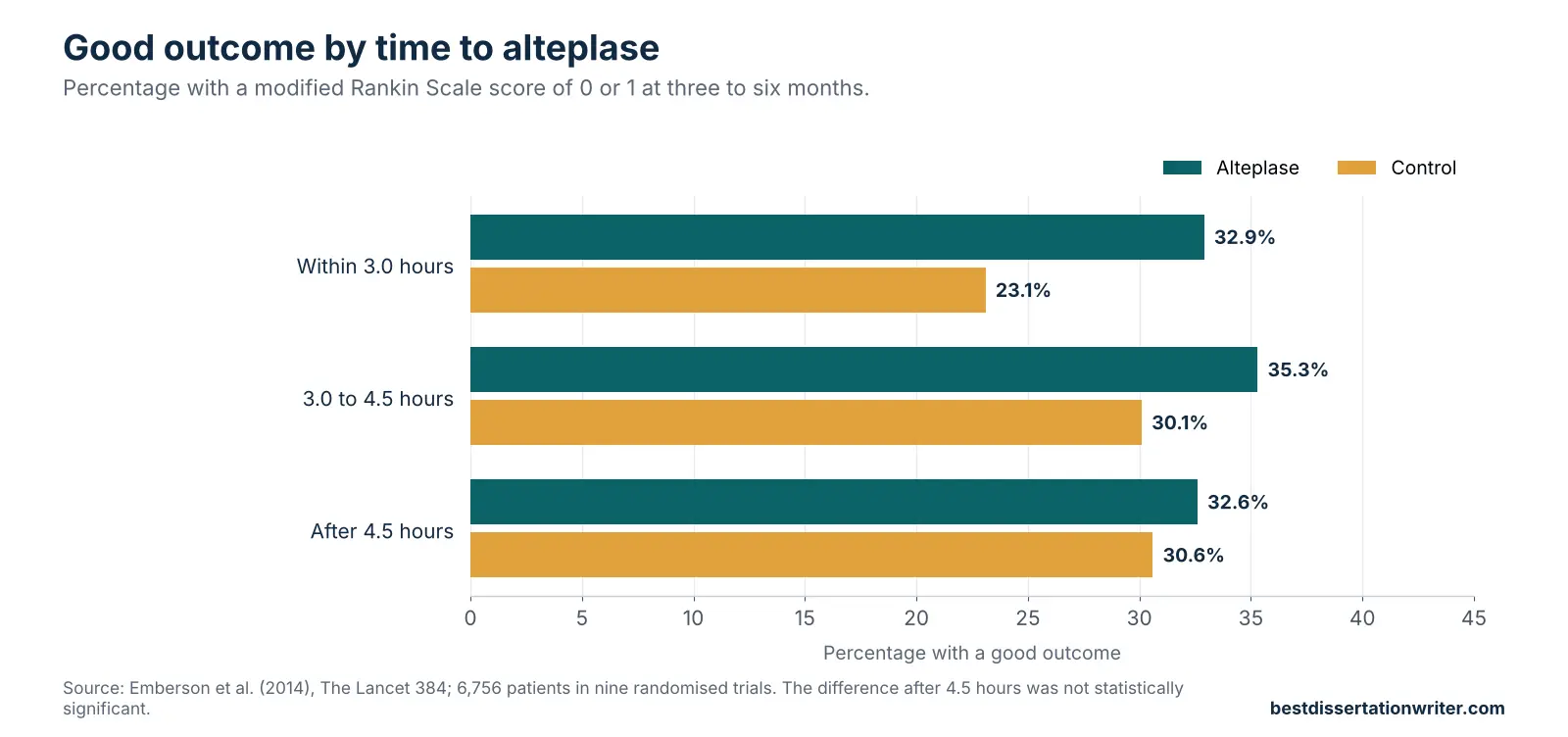
Three themes were identified: the benefit of early treatment, the accuracy of recognition tools, and strategies to shorten time to treatment. Table 1 summarises the included sources, and Figure 1 shows the proportion of patients with a good outcome in a meta-analysis of thrombolysis trials.
| Author, year | Design | Setting and sample | Key finding |
|---|---|---|---|
| Emberson et al. (2014) | Individual patient data meta-analysis | 6,756 patients; nine randomised trials | Alteplase improved good outcomes within 4.5 hours; greatest benefit within 3 hours. |
| National Institute for Health and Care Excellence (2019) | National guideline | Stroke and TIA in over 16s | FAST outside hospital; ROSIER in the emergency department; alteplase within 4.5 hours. |
| Rudd et al. (2016) | Systematic review | 18 papers and 3 abstracts; seven instruments | Cincinnati scale and FAST had highest sensitivity; no tool strongly recommended. |
| Siarkowski et al. (2020) | Systematic review and meta-analysis | 96 studies of door-to-needle strategies | Combined strategies reduced door-to-needle time by 33.77%. |
| Zhelev et al. (2019) | Cochrane review | 23 studies; 9,230 participants | Cincinnati scale preferred in the field; ROSIER in the emergency room; evidence provisional. |
Theme 1: The Benefit of Early Treatment
Emberson et al. (2014) carried out an individual patient data meta-analysis of nine randomised trials comparing intravenous alteplase with placebo or open control in 6,756 patients with acute ischaemic stroke. A good outcome was defined as a modified Rankin Scale score of 0 or 1 at three to six months, meaning little or no disability. The aim was to clarify the effect of treatment delay, age and stroke severity on the benefit of treatment.
When alteplase was started within 3.0 hours of onset, 32.9% of treated patients had a good outcome, compared with 23.1% of controls (odds ratio 1.75, 95% confidence interval 1.35 to 2.27). Between 3.0 and 4.5 hours the figures were 35.3% and 30.1% (odds ratio 1.26, 1.05 to 1.51). After 4.5 hours the difference, 32.6% compared with 30.6%, was not statistically significant (odds ratio 1.15, 0.95 to 1.40). The proportional benefit was similar across age groups and levels of severity.
The treatment carried a risk. Symptomatic intracranial haemorrhage occurred in 6.8% of treated patients and 1.3% of controls when measured by one definition, and fatal haemorrhage within seven days occurred in 2.7% and 0.4%. The authors judged that an average excess of about 2% in early death from haemorrhage was offset by a gain in disability-free survival of about 10% when treatment started within 3.0 hours and about 5% between 3.0 and 4.5 hours.
The authors concluded that alteplase improves the overall odds of a good outcome when given within 4.5 hours, regardless of age or severity, and that earlier treatment gives a larger proportional benefit. For emergency nurses, the implication is direct: the benefit declines with time, so every step that makes recognition and treatment faster increases the chance of a good outcome. The analysis is of trials conducted before 2014, and treatment options have since expanded to include thrombectomy.
Theme 2: The Accuracy of Recognition Tools
Rudd et al. (2016) carried out a systematic review of stroke recognition instruments in hospital and prehospital settings. They screened 5,622 references from Medline and Embase to August 2015 and included 18 papers and three conference abstracts that evaluated seven instruments: FAST, ROSIER, the Los Angeles Prehospital Stroke Screen, the Melbourne Ambulance Stroke Screen, the Ontario Prehospital Stroke Screening Tool, MedPACS and the Cincinnati Prehospital Stroke Scale.
Cohorts ranged from 50 to 1,225 people, and between 17.5% and 92% were subsequently diagnosed with stroke. The sensitivity and specificity of the same instrument varied by setting, and reporting of demographics, false-negative cases and service context was inconsistent. The Cincinnati scale and FAST generally had the highest sensitivity, whereas the Los Angeles screen had higher specificity but lower detection rates. The authors concluded that the data did not support a strong recommendation for one instrument over the others.
Zhelev et al. (2019) carried out a Cochrane review of prehospital stroke scales as screening tools for early identification of stroke and transient ischaemic attack. It included 23 studies with 9,230 participants and eight scales. Sensitivity of FAST ranged from 0.64 to 0.97 and specificity from 0.13 to 0.92 across five studies, and no pooled estimate was reported. ROSIER in the emergency room had a pooled sensitivity of 0.88 (95% confidence interval 0.84 to 0.91).
The Cochrane authors concluded that, in the field, the Cincinnati scale should be preferred because it had consistently high sensitivity in direct comparisons, and that in the emergency room ROSIER should be the test of choice. They stressed that the findings were provisional because of few studies per test, high risk of bias and large heterogeneity. The reviews therefore agree that no tool is perfect, and that the choice depends on the purpose and on the consequences of missing a stroke compared with over-triaging.
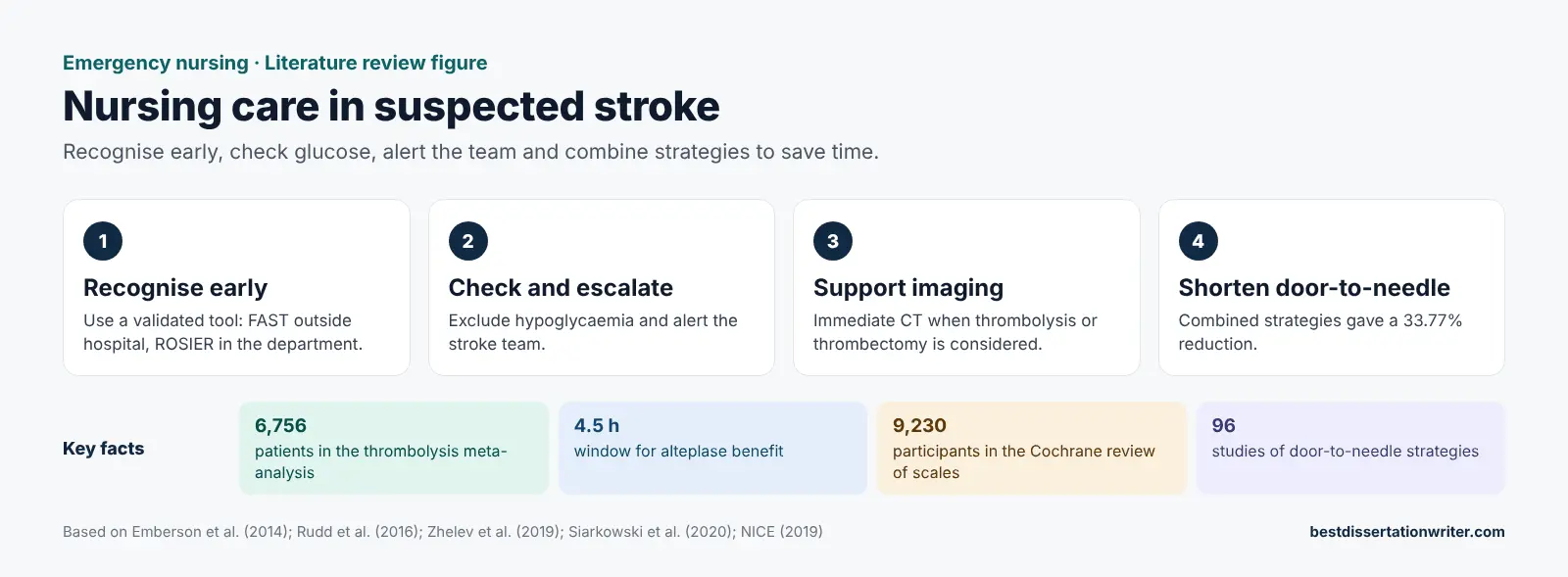
National guidance applies this evidence. The National Institute for Health and Care Excellence (2019) guideline on stroke and transient ischaemic attack recommends using a validated tool such as FAST outside hospital to screen people with sudden neurological symptoms, and a validated tool such as ROSIER in the emergency department. It also advises excluding hypoglycaemia, keeping blood glucose between 4 and 11 mmol/litre in acute stroke and performing immediate non-contrast CT when thrombolysis or thrombectomy is being considered.
Taken together, these sources suggest that nurses should use a validated tool rather than rely on impression, but that no tool replaces clinical judgement. A negative score does not exclude stroke, and posterior circulation strokes in particular may be missed by tools that focus on face, arm and speech. Nurses who understand the limits of the tool they use are better placed to escalate a patient whose presentation does not fit.
Theme 3: Strategies to Shorten Time to Treatment
Siarkowski et al. (2020) carried out a systematic review and meta-analysis of interventions to reduce door-to-needle time in acute ischaemic stroke. They included 96 studies: four randomised controlled trials, one review and 91 observational pre-post studies. Strategies were grouped under 13 headings adapted from the Target: Stroke programme, and quality was assessed using the National Institutes of Health tools.
All strategies reduced door-to-needle time. Combinations of interventions were the most effective, with a 33.77% reduction (standardised mean difference 1.857, 95% confidence interval 1.510 to 2.205), and they performed better than single strategies. The reduction was associated with how long a facility’s programme had been running. However, implementing more than two strategies at once did not give a significant additional benefit.
The strategies in such programmes often include prehospital notification, activation of the stroke team before the patient arrives, direct transfer to the scanner and a single call to alert all relevant staff. Nurses have a role in each: receiving the pre-alert, preparing the resuscitation area, taking bloods and glucose, establishing intravenous access and accompanying the patient to imaging. Their contribution is greatest where the pathway is agreed and rehearsed in advance.
The evidence on door-to-needle time is mostly observational, so the size of the effect should be treated with caution. Services that introduce several strategies at once may also differ in other ways, such as staffing, and programmes that are reported are more likely to have succeeded. Even so, the consistent direction of effect, from nearly 100 studies, supports the use of structured pathways and teamwork.
The nursing perspective adds a further consideration. Stroke recognition does not end when the tool has been applied: the patient has to be reassessed as symptoms evolve, the neurological observations repeated and any deterioration escalated. A nurse who documents the findings of the first stroke recognition assessment clearly gives the team a baseline against which change can be judged, and a patient whose symptoms improve should still be assessed urgently, because transient symptoms may be a warning sign.
Communication with the patient and family is also part of care. Patients with stroke may be frightened and unable to speak or understand, and relatives may need an explanation of the speed at which decisions have to be made. Clear, calm information about why the scan and treatment decision are urgent helps families to understand and support the process, and good stroke recognition by the first nurse sets the tone for the rest of the pathway.
Discussion
This narrative review suggests that the benefit of thrombolysis for ischaemic stroke depends on time, that validated tools help to recognise stroke but are imperfect and that combined strategies shorten door-to-needle time. National guidance recommends FAST outside hospital and ROSIER in the emergency department.
The evidence base has limits. The meta-analysis of thrombolysis includes trials from before 2014 and does not cover thrombectomy, which is now widely available. The reviews of recognition tools are limited by few studies per tool, high risk of bias and heterogeneity, and the Cochrane authors judged their conclusions provisional. The meta-analysis of strategies is based mainly on observational before-and-after studies.
Other limitations should be noted. None of the included sources focuses on the role of nurses, and none examines nurse-led recognition or nurse-initiated pathways directly, so the nursing contribution is inferred from the processes described. The sources do not examine stroke mimics in detail or the experience of patients and families. This review relied on openly accessible, English-language sources, and it did not include primary studies published after 2020.
Even so, the sources are consistent about what matters. Treatment is most effective when given early, recognition tools should be validated and used consistently, and structured, rehearsed pathways with several elements shorten the time to treatment. For emergency nurses, regular training in the chosen tool, audit of door-to-needle time and feedback to staff are practical ways of applying these findings.
Implications of Stroke Recognition Evidence for Practice
For practice, the evidence supports using a validated recognition tool at triage, checking blood glucose, alerting the stroke team and arranging immediate imaging when treatment is being considered, and recording the time of onset, or the time the patient was last known to be well. Guidance is available from the National Institute for Health and Care Excellence and the Royal College of Emergency Medicine.
Managers should make sure that the stroke pathway is clear, that pre-alerts are acted on and that door-to-needle time is audited and shared with staff. Training in stroke recognition, simulation of the pathway and feedback after cases may help to maintain performance, and audit of stroke recognition at triage can show where cases are being missed. Combining several strategies appears more effective than a single measure.
Future research should evaluate nurse-led stroke recognition and pathways, compare tools in emergency department populations that include mimics, examine the accuracy of tools for posterior circulation strokes and assess strategies for thrombectomy as well as thrombolysis. Studies in United Kingdom emergency departments would be particularly valuable.
Conclusion
This narrative review found that early treatment improves outcomes in ischaemic stroke, that recognition tools help but are imperfect and that combined strategies shorten the time to treatment.
Emergency nurses contribute through accurate stroke recognition, rapid escalation, support for imaging and treatment and participation in audit and improvement.
References
Emberson, J., Lees, K. R., Lyden, P., Blackwell, L., Albers, G., Bluhmki, E., Brott, T., Cohen, G., Davis, S., Donnan, G., Grotta, J., Howard, G., Kaste, M., Koga, M., von Kummer, R., Lansberg, M., Lindley, R. I., Murray, G., Olivot, J. M., … Hacke, W. (2014). Effect of treatment delay, age, and stroke severity on the effects of intravenous thrombolysis with alteplase for acute ischaemic stroke: A meta-analysis of individual patient data from randomised trials. The Lancet, 384(9958), 1929–1935. https://doi.org/10.1016/S0140-6736(14)60584-5
National Institute for Health and Care Excellence. (2019). Stroke and transient ischaemic attack in over 16s: Diagnosis and initial management (NICE guideline NG128). https://www.nice.org.uk/guidance/ng128
Rudd, M., Buck, D., Ford, G. A., & Price, C. I. (2016). A systematic review of stroke recognition instruments in hospital and prehospital settings. Emergency Medicine Journal, 33(11), 818–822. https://doi.org/10.1136/emermed-2015-205197
Siarkowski, M., Lin, K., Li, S. S., Al Sultan, A., Ganshorn, H., Kamal, N., Hill, M., & Lang, E. (2020). Meta-analysis of interventions to reduce door to needle times in acute ischaemic stroke patients. BMJ Open Quality, 9(3), Article e000915. https://doi.org/10.1136/bmjoq-2020-000915
Zhelev, Z., Walker, G., Henschke, N., Fridhandler, J., & Yip, S. (2019). Prehospital stroke scales as screening tools for early identification of stroke and transient ischemic attack. Cochrane Database of Systematic Reviews, (4), Article CD011427. https://doi.org/10.1002/14651858.CD011427.pub2
Cite this example
Best Dissertation Writers (2026) Stroke Recognition and Thrombolysis Timelines in Emergency Care: The Nursing Contribution: A Literature Review. Available at: https://bestdissertationwriter.com/stroke-recognition-literature-review/
Best Dissertation Writers
Get expert help with your nursing literature review
Share your topic and deadline with Best Dissertation Writers and get support tailored to your module brief.