Emergency Nurses’ Confidence and Competence in Managing Paediatric Emergencies: An Integrative Review
 By Dr. Robertson Prime, Research Fellow
Updated November 2, 2026
15 min read
About 3,000 words
In this review
Abstract
Background: Children make up a substantial share of emergency department attendances, yet seriously unwell or injured children are seen far less often than adults. Paediatric emergencies are therefore uncommon events for many emergency nurses, who must recognise deterioration, resuscitate and communicate with families despite limited exposure. Confidence and competence in this work are a recognised concern for emergency nursing.
Aim: This integrative review aimed to examine the evidence on emergency nurses’ confidence and competence in managing paediatric emergencies and on the education, policy and organisational factors that may influence them.
Methods: Evidence was identified through targeted searches of openly accessible bibliographic records, publisher websites and repositories. Five sources published between 2018 and 2025 were included: an integrative literature review, a simulation study, a mixed methods study and two cross-sectional surveys. The sources were appraised using CASP checklists and integrated narratively.
Findings: An integrative review of paediatric triage education found that simulation and standardised curricula were most often used in the highest-rated studies and that triage accuracy generally improved after education. A nurse-led, low-fidelity in situ simulation of paediatric sepsis involving 43 nurses raised the mean clinical performance score from 5.3 to 9.2. An Australian mixed methods study found that confidence was related to experience with children rather than to qualification. A survey of 538 paediatric emergency nurses in China reported a mean core competence score of 4.06 out of 5, with professional development scoring lowest. A national survey of United States emergency departments found that only 20.1% required nurse specialty certification, although departments with certification, competency and education policies had higher readiness scores.
Conclusion: Evidence suggests that confidence in paediatric emergencies depends on regular exposure, simulation, continuing education and supportive policies. Most sources were single studies, so firm conclusions about effectiveness cannot yet be drawn.
Keywords: paediatric emergencies, nurse confidence, paediatric resuscitation
Introduction
This integrative review critically examines recent evidence on paediatric emergencies and its implications for emergency nursing practice.
Children and young people attend emergency departments for a wide range of reasons, from minor injuries and fevers to asthma, sepsis, trauma and cardiac arrest. Most attendances are not life-threatening, but a small number of children arrive critically ill. Because these children are seen infrequently by any one nurse, the skills needed to manage paediatric emergencies can be difficult to develop and to keep up, especially in departments that treat mainly adults.
Children are not small adults. Their physiology, drug doses, equipment and communication needs differ with age and size, and they often compensate well until they suddenly deteriorate. The family is also part of the emergency, and parents may be frightened and need information and reassurance while the team works. Emergency nurses are usually the first clinicians to assess an unwell child, so their recognition of early warning signs and their confidence in acting on them are central to safety.
The topic has been examined in different ways: through training programmes, simulation, surveys of nurses’ self-assessed competence and national audits of department readiness. These sources do not use a single design, which is why an integrative review was chosen. It allows quantitative, mixed methods and review evidence to be considered together.
Review question
What does the evidence show about emergency nurses’ confidence and competence in managing paediatric emergencies, and which educational and organisational factors appear to influence them?
Background to Paediatric Emergencies in Emergency Nursing
Paediatric emergencies place particular demands on emergency nurses. Recognising a seriously ill child often relies on small changes in breathing, colour, behaviour or heart rate, and a nurse who sees few unwell children may find these cues harder to interpret. Calculations of drug doses and fluid volumes by weight add pressure, and equipment sized for children must be found quickly. Errors or delays in any of these steps can have serious consequences.
Departmental arrangements matter as well as individual skill. Some emergency departments have dedicated children’s areas and staff with paediatric qualifications, while others are general departments in which children are one of many patient groups. Staffing levels, access to training and the availability of paediatric guidance all differ. The sources reviewed here include studies from Australia, China and the United States, so the settings vary considerably, and findings should be applied to local practice with care.
Emergency nurses must also care for the child’s family and for children who may be at risk of harm. These issues are explored further in the reviews of drug-related emergencies and domestic violence, which show how emergency nurses meet safeguarding and substance-related concerns alongside acute care. The present review is narrower and asks how well prepared nurses feel and are for the acute care of children.
Time is a further pressure. Paediatric emergencies often unfold over minutes, and nurses must carry out several tasks at once: calling for help, giving oxygen, obtaining access, drawing up drugs and speaking to parents. In a busy department these tasks compete with the care of adults, so the nurse in charge must judge when to call for additional paediatric expertise. Preparation for paediatric emergencies is therefore about teamwork and systems as well as individual knowledge.
Search Strategy and Methods
Evidence for this example was identified through targeted searches of openly accessible bibliographic records, publisher websites and repositories. Search terms combined keywords for the population (“emergency nurses”, “paediatric”, “paediatric emergency”) with terms for the outcomes and interventions (“competence”, “confidence”, “education”, “simulation”, “triage”, “readiness”), joined with the Boolean operators AND and OR. A full integrative review for assessment would run the same strategy in CINAHL, PubMed/MEDLINE, Embase and the Cochrane Library and report the records screened in a PRISMA flow diagram.
Sources were eligible if they examined the confidence, competence, education or organisational preparedness of emergency nurses for the care of children, and used a review, simulation, survey or mixed methods design. Studies that focused only on doctors, paramedics or non-emergency settings were excluded.
Five sources published between 2018 and 2025 were included (Table 1). The quality of each source was considered using the Critical Appraisal Skills Programme (CASP) checklists, with attention to the sample, the measures used and the likely sources of bias, and findings were integrated narratively under themes.
The aim of an integrative review is to combine evidence from varied designs without pretending that they are the same. The sources here range from a review of educational studies to surveys of staff and departments, and each was considered on its own terms. Findings on paediatric emergencies were grouped where they addressed the same question, and differences in setting, sample and measurement are noted wherever they affect how far a result can be applied.
Key Findings on Paediatric Emergencies
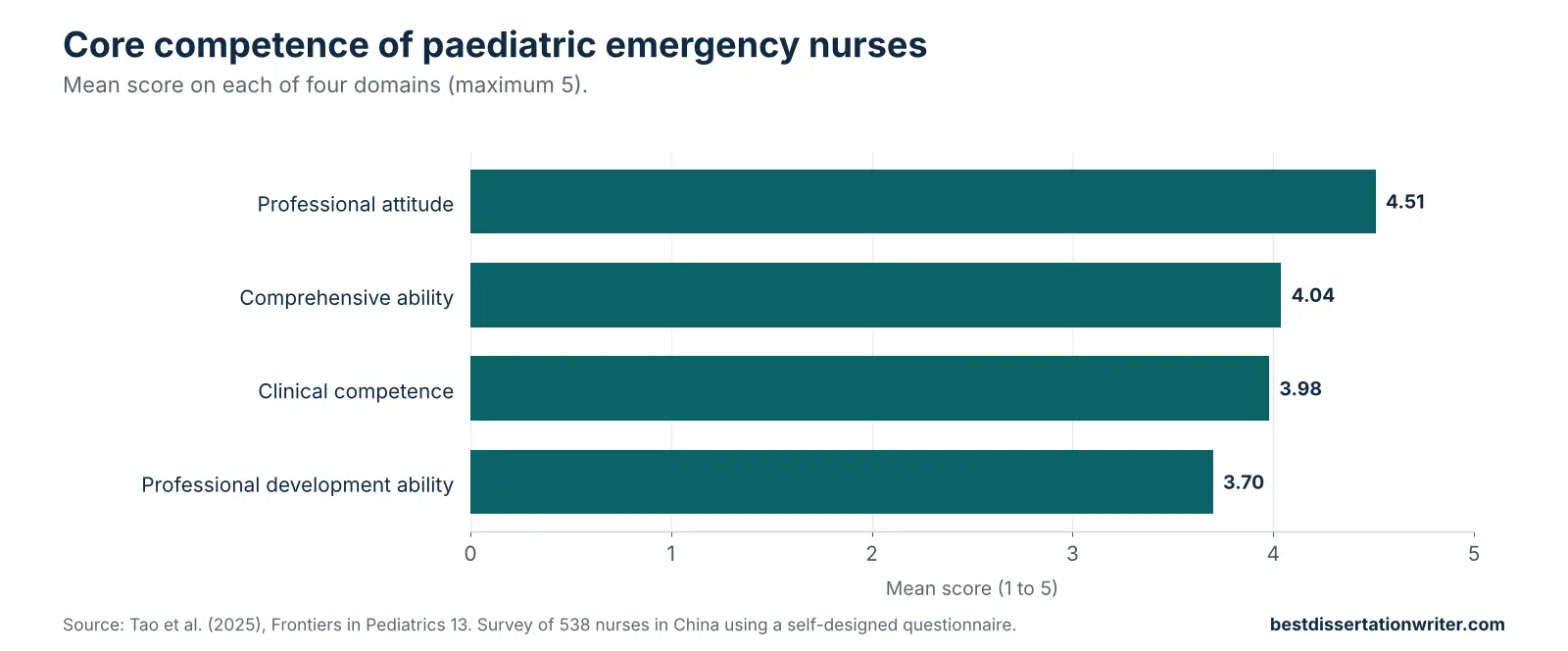
Three themes were identified: education and simulation, the factors that shape confidence and competence, and organisational readiness. Table 1 summarises the included sources, and Figure 1 shows the scores on four domains of core competence reported in a survey of paediatric emergency nurses.
| Author, year | Design | Setting and sample | Key finding |
|---|---|---|---|
| Hill et al. (2025) | Cross-sectional analysis | United States emergency departments; 2021 national assessment | Departments with competency, certification and education policies had higher readiness scores; 20.1% required certification. |
| Ilangakoon et al. (2020) | Mixed methods study | Australian emergency nurses; focus groups and survey | Confidence related to experience with children, not qualification. |
| Recznik & Simko (2018) | Integrative literature review | Studies of paediatric triage education | Simulation and standardised curricula most common in highest-rated studies; triage accuracy generally improved. |
| Saqe-Rockoff et al. (2019) | Simulation study | 43 nurses; 12 in situ simulations | Mean clinical performance score rose from 5.3 to 9.2; confidence rose. |
| Tao et al. (2025) | Cross-sectional survey | 538 paediatric emergency nurses in China | Mean core competence 4.06 of 5; professional development lowest. |
Theme 1: Education and Simulation
Recznik and Simko (2018) carried out an integrative literature review of paediatric triage education in the Journal of Emergency Nursing. Triage is the first assessment of a child in the department, so mistakes at this point can delay urgent care. The authors found that many educational methods had been used, that the highest-rated studies most often used simulation programmes or standardised curricula, and that triage accuracy generally improved after education.
They also found that outcomes varied widely and that studies compared teaching methods only indirectly, and they called for direct comparisons. The retention of skills was described as depending on the method and timing of training. For emergency nursing educators, this suggests that one-off sessions may not be enough, and that triage skills may need to be refreshed. A related review of triage tools considers the instruments that nurses use at this first stage.
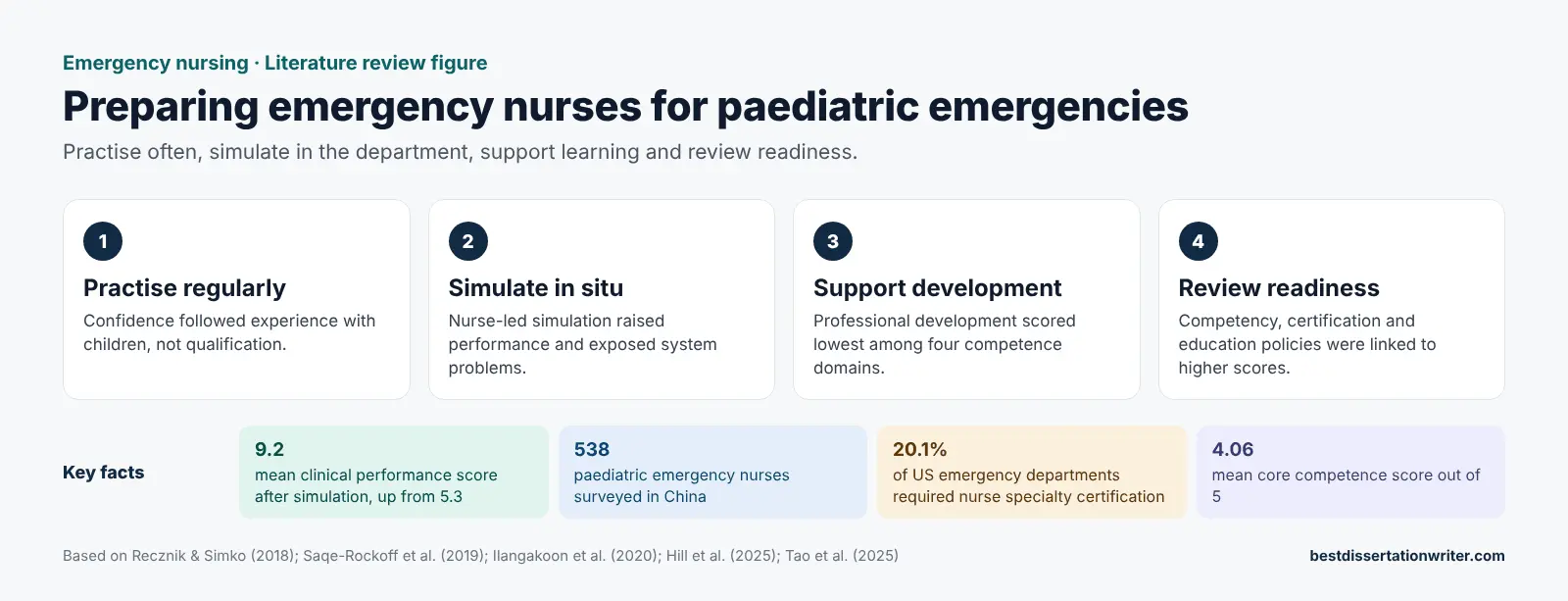
Saqe-Rockoff et al. (2019) described a nurse-led, low-fidelity in situ simulation of paediatric sepsis, run in the emergency department. Forty-three registered nurses took part in 12 simulations over three months. The mean clinical performance score rose from 5.3 to 9.2, a 74% improvement (P < 0.001), and nurses’ confidence also rose significantly. The simulations revealed system problems that were then addressed, including response times of respiratory therapists and the contents of the paediatric resuscitation cart.
These findings need cautious reading. The simulation study had no control group, was carried out in one department and used performance scores devised by the authors. It is an example of what a service can achieve rather than proof that simulation improves outcomes for children. Even so, it shows two practical strengths: the training took place in the working environment, where nurses use the equipment they would use in a real emergency, and it relied on low-cost methods led by nurses with little effect on staffing and budget.
Theme 2: Factors Shaping Confidence and Competence
Ilangakoon et al. (2020) used an exploratory sequential mixed methods design in Australia, with focus groups followed by a survey, to explore emergency nurses’ preparedness, confidence and competence in caring for deteriorating children. Confidence and competence did not correlate with the nurses’ level of qualification. More years of experience of caring for children increased confidence, and limited human resources reduced it. Nurses expressed interest in further education in this area.
The authors concluded that regular exposure to children was key to confidence and competence, whatever the nurse’s qualifications, and that interprofessional in situ simulation could help with staffing challenges and skill development. This finding challenges the idea that qualifications alone prepare nurses for paediatric emergencies. Where exposure is naturally low, as in general departments, other ways of keeping skills active, such as simulation and rotation to paediatric areas, may be needed.
Tao et al. (2025) surveyed paediatric emergency nurses in nine provinces and cities in China, with 538 valid responses (a response rate of 99.6%). The mean core competence score was 4.06 on a five-point scale, which the authors described as average. Professional attitude scored highest (4.51), followed by comprehensive ability (4.04) and clinical competence (3.98), while professional development ability scored lowest (3.70). Hospital level and management experience were significant predictors in the final model, but the model explained very little of the variation in scores (R² = 0.06).
The survey was large, but it has limitations. It used a convenience sample and a self-designed, self-reported questionnaire, tertiary hospitals made up 81.4% of respondents and the design was cross-sectional. The authors’ reports of which factors mattered were not entirely consistent between the abstract and the conclusions, and the small proportion of variance explained suggests that most influences on competence were not measured. Taken together with the Australian study, the survey suggests that nurses can feel strong in attitude but less secure in developing their skills further.
Theme 3: Organisational Readiness
Hill et al. (2025) analysed the 2021 National Pediatric Readiness Project assessment of United States emergency departments to examine whether nurse paediatric competency, certification and continuing education policies were linked to weighted readiness scores. Most departments (89%) required some form of nurse competency evaluation, 91.7% had hospital-specific competency evaluation policies and 98.3% had continuing education policies, but only 20.1% required nurse specialty certification.
Departments with each type of policy had higher median readiness scores: 71.3 for continuing education, 83.5 for specialty certification and 72.3 for hospital-specific competency evaluation, with statistically significant differences. The authors concluded that nurse competency, certification and continuing education matter for readiness and may help to reduce paediatric mortality. The study is a cross-sectional analysis of department-level data, so it cannot show that the policies caused the higher scores, and the mortality statement is a suggestion rather than a finding of the sub-analysis.
This source moves the discussion from the individual nurse to the system. A department with clear expectations for competence, a requirement for continuing education and a route to certification gives nurses a structure within which to develop confidence. Departments without these policies leave learning to chance. For paediatric emergencies, which are rare but high in consequence, this structure may be particularly important.
Taken as a whole, the sources point towards a practical model. Nurses who rarely see paediatric emergencies are more likely to feel confident when they have regular, realistic practice, when their department expects and records competence, and when managers support time for learning. This model is consistent across the sources, even though each used a different design, and it offers a starting point for services that wish to strengthen their approach to paediatric emergencies.
The findings also raise questions about equity. Departments that are small, rural or general are likely to have fewer chances for nurses to meet seriously ill children, and so may need more deliberate support than large specialist centres. The national survey of readiness in the United States, and the survey in China, which was dominated by large tertiary hospitals, both suggest that experience and resources are unevenly spread. Services caring for few children should not assume that paediatric emergencies will be managed well simply because a qualified nurse is on duty.
Discussion
This integrative review suggests that emergency nurses’ confidence and competence in paediatric emergencies are shaped by exposure to sick children, by training that mirrors real practice and by the policies of the department. The strongest message across the sources is that qualification alone does not guarantee confidence, and that regular practice, in the clinical area or in simulation, is what builds and maintains it.
The sources also differ in quality and in what they can show. The integrative review of triage education and the survey of departments give breadth, but the simulation study is a single-site project and the two surveys rely on self-report. None of the sources measured outcomes for children directly. They can therefore inform the design of education and policy but cannot show that any one approach improves the care or survival of children with paediatric emergencies.
A further limitation is the variety of settings. The studies were conducted in Australia, China and the United States, where emergency care is organised differently from the United Kingdom, and the surveys used different measures of competence. This review relied on openly accessible, English-language sources, and relevant studies in other languages or in subscription journals may have been missed. The newest sources are single studies, which have not yet been tested in other settings.
Even so, the findings fit together. Education that is repeated, practical and led by nurses appears acceptable and may improve performance. Confidence is related to how often nurses meet children, so departments with few paediatric attendances need deliberate strategies. System-level policies on competency and continuing education are linked to higher readiness. Each of these is within the reach of nurse educators and managers, even without major new resources.
Implications of Paediatric Emergencies Evidence for Practice
For practice, the evidence supports offering regular, hands-on paediatric resuscitation and triage training in the emergency department, using in situ simulation to test both skills and systems, supporting nurses to rotate into paediatric settings where possible, and recording paediatric competence and continuing education in a way that managers can review. Guidance for nurses and parents is available from the Royal College of Nursing and NHS.
Managers should also consider whether the department has the equipment, protocols and staffing to support nurses in an emergency involving a child. Training is more likely to build confidence when the cart, drug charts and escalation routes practised in simulation match those in daily use.
Future research should evaluate paediatric emergency education using controlled designs, measure patient and family outcomes as well as nurse confidence, follow nurses over time to see whether skills persist, and test the findings in United Kingdom emergency departments. Studies that compare simulation with other forms of training, and that include the experiences of children and parents, would add to the evidence.
Emergency nurses meet paediatric emergencies rarely but must act decisively when they occur. The evidence reviewed here suggests that practice, simulation and clear policies help to prepare them, and that departments should plan this preparation rather than leave it to individual nurses.
Conclusion
This integrative review found that confidence and competence in paediatric emergencies depend on exposure to children, on training that includes simulation and on organisational policies for competency and continuing education. The evidence comes mainly from single studies and self-reported measures, so conclusions are tentative.
Emergency nurses, educators and managers can use these findings to plan regular, practical preparation for the care of unwell children, and to evaluate whether it improves care.
References
Hill, L. M., Goodman, R., Gray, L., Moegling, M., Crady, R., Saucedo, J., & Hewes, H. A. (2025). Nurse pediatric competency, certification, and continuing education: Impact on EDs’ pediatric readiness. Journal of Emergency Nursing, 51(5), 904–912. https://doi.org/10.1016/j.jen.2025.03.007
Ilangakoon, C., Jones, T., Innes, K., & Morphet, J. (2020). Caring for deteriorating paediatric patients in the emergency department: A mixed method study. Australasian Emergency Care, 23(4), 252–258. https://doi.org/10.1016/j.auec.2020.07.006
Recznik, C. T., & Simko, L. M. (2018). Pediatric triage education: An integrative literature review. Journal of Emergency Nursing, 44(6), 605–613.e9. https://doi.org/10.1016/j.jen.2018.01.003
Saqe-Rockoff, A., Ciardiello, A. V., & Schubert, F. D. (2019). Low-fidelity, in-situ pediatric resuscitation simulation improves RN competence and self-efficacy. Journal of Emergency Nursing, 45(5), 538–544.e1. https://doi.org/10.1016/j.jen.2019.02.003
Tao, Y., Li, W., Zhang, L., Zhan, S., Wang, M., & Feng, M. (2025). A multicentre cross-sectional survey of the core competence of paediatric emergency nurses. Frontiers in Pediatrics, 13, Article 1635942. https://doi.org/10.3389/fped.2025.1635942
Cite this example
Best Dissertation Writers (2026) Emergency Nurses’ Confidence and Competence in Managing Paediatric Emergencies: An Integrative Review. Available at: https://bestdissertationwriter.com/paediatric-emergencies-review-review/
Best Dissertation Writers
Get expert help with your nursing literature review
Share your topic and deadline with Best Dissertation Writers and get support tailored to your module brief.