
Nurse-Led Smoking Cessation Interventions: A Systematic Review
 By Dr. Robertson Prime, Research Fellow
Updated October 28, 2026
14 min read
About 2,800 words
In this review
Abstract
Background: Smoking cessation is one of the most effective ways to improve health, yet tobacco still kills more than 7 million people every year. Nurses see people who smoke in every setting, from hospital wards to general practice and community clinics, and are well placed to offer advice, behavioural support and help to use medication.
Aim: This systematic review aimed to examine the evidence for nurse-led interventions, nicotine replacement, motivational interviewing and e-cigarettes in helping people to stop smoking.
Methods: Evidence was identified through targeted searches of openly accessible bibliographic records, publisher websites and the reference lists of key reviews. Five sources published between 2017 and 2026 were included: four Cochrane reviews and a WHO fact sheet. The research sources were appraised using CASP checklists and synthesised narratively.
Findings: Nursing interventions increased the likelihood of quitting (risk ratio 1.29; 44 studies, over 20,000 participants) with moderate-certainty evidence. Nicotine replacement therapy increased quitting by about half (risk ratio 1.55; 133 trials, 64,640 participants) with high-certainty evidence. Motivational interviewing showed no clear benefit over other support, with low-certainty evidence. Nicotine e-cigarettes were more effective than nicotine replacement (risk ratio 1.59) in high-certainty evidence, and serious adverse events were rare.
Conclusion: Nurses can modestly increase quitting through behavioural support, and combining this with effective medication gives the best chance of success. Nurses should ask about smoking at every contact, offer support and help people to choose treatment.
Keywords: smoking cessation, brief advice, tobacco
Introduction
This systematic review critically examines recent evidence on smoking cessation and its implications for public health nursing practice.
Tobacco is the leading preventable cause of death worldwide. The World Health Organization (WHO) reports that tobacco kills more than 7 million people each year, including more than 1.6 million non-smokers who die from exposure to secondhand smoke, and that there are 1.2 billion tobacco users, around 80% of whom live in low- and middle-income countries. Smoking causes lung cancer, heart disease, stroke and chronic respiratory disease, and stopping at any age reduces these risks.
Most people who smoke want to stop and many have tried, but stopping is difficult because of nicotine dependence, habit and the social and emotional roles that smoking plays. Success is more likely with support, and with medication to ease withdrawal. Services therefore aim to help each person to make repeated attempts with the best available help, rather than expecting a single effort to succeed.
Nurses are the largest part of the health workforce, and they meet people who smoke at nearly every kind of contact. In hospital they can start support when a person is admitted, in primary care they can follow up over time, and in community services they can reach groups who are less likely to attend specialist clinics. A systematic review design was chosen because the question concerns the effectiveness of interventions and several robust syntheses exist.
Smoking cessation is therefore a core activity for public health nursing. It is also an area in which the evidence base is unusually rich, because Cochrane reviews have been maintained for many years and updated as new trials appear. That makes it possible to compare the size and certainty of the benefit from different approaches, and to consider what each adds to routine nursing care.
Review question
How effective are nurse-delivered interventions, which treatments help people to quit, and what do the findings mean for smoking cessation work by nurses?
Background to Smoking Cessation
Smoking cessation support is usually described as having behavioural and pharmacological elements. Behavioural support includes brief advice, counselling, motivational interviewing and follow-up, and aims to help the person to prepare, to cope with cravings and to remain smoke free. Pharmacological support includes nicotine replacement therapy and prescription medicines, and aims to reduce withdrawal symptoms and cravings.
Brief advice is a short, structured conversation that takes a minute or two. The nurse asks about smoking, advises the person that stopping is the best thing they can do for their health, and offers help. This approach is designed to fit into any consultation, so that every contact becomes an opportunity to prompt a quit attempt.
Motivational interviewing is a style of counselling that helps people to explore their own reasons for change and to resolve mixed feelings. It is widely taught to nurses and other health professionals, and has been promoted as a way to help people who are not yet ready to quit. Whether it adds anything to other smoking cessation support is a question that has been studied in many trials.
Nicotine replacement therapy delivers nicotine in a form that does not involve smoking, through patches, gum, lozenges, inhalators or nasal spray, to reduce withdrawal. Electronic cigarettes deliver nicotine as vapour and have been used by many people trying to stop. Their regulation and safety have been debated, and the evidence continues to develop.
Policy has also shaped smoking cessation practice. The WHO Framework Convention on Tobacco Control, tobacco taxation, advertising restrictions and smoke-free laws all aim to reduce demand, and cessation services are the part of this approach that is delivered directly to individuals. Nurses therefore work within a wider system, and their contribution is strongest when it is joined up with these population measures.
Search Strategy and Methods
Evidence for this example was identified through targeted searches of openly accessible bibliographic records, publisher websites and the reference lists of key reviews. Search terms combined keywords for the problem (“smoking cessation”, “tobacco”, “quitting”, “nicotine dependence”) with terms for the intervention and provider (“nursing”, “brief advice”, “motivational interviewing”, “nicotine replacement”, “electronic cigarettes”), joined with the Boolean operators AND and OR. A full systematic review for assessment would run the same strategy in CINAHL, PubMed/MEDLINE, the Cochrane Library and Web of Science and report the number of records screened in a PRISMA flow diagram.
Sources were eligible if they evaluated interventions to help people stop smoking, or provided authoritative data on the scale of tobacco harm. Cochrane and other systematic reviews were prioritised. Studies of prevention of smoking uptake were excluded, as were studies of tobacco control policy.
Five sources published between 2017 and 2026 were included: four Cochrane reviews and the WHO fact sheet that provides global context (Table 1). The quality of each research source was considered using the Critical Appraisal Skills Programme (CASP) checklists, and findings were synthesised narratively.
Key Findings on Smoking Cessation
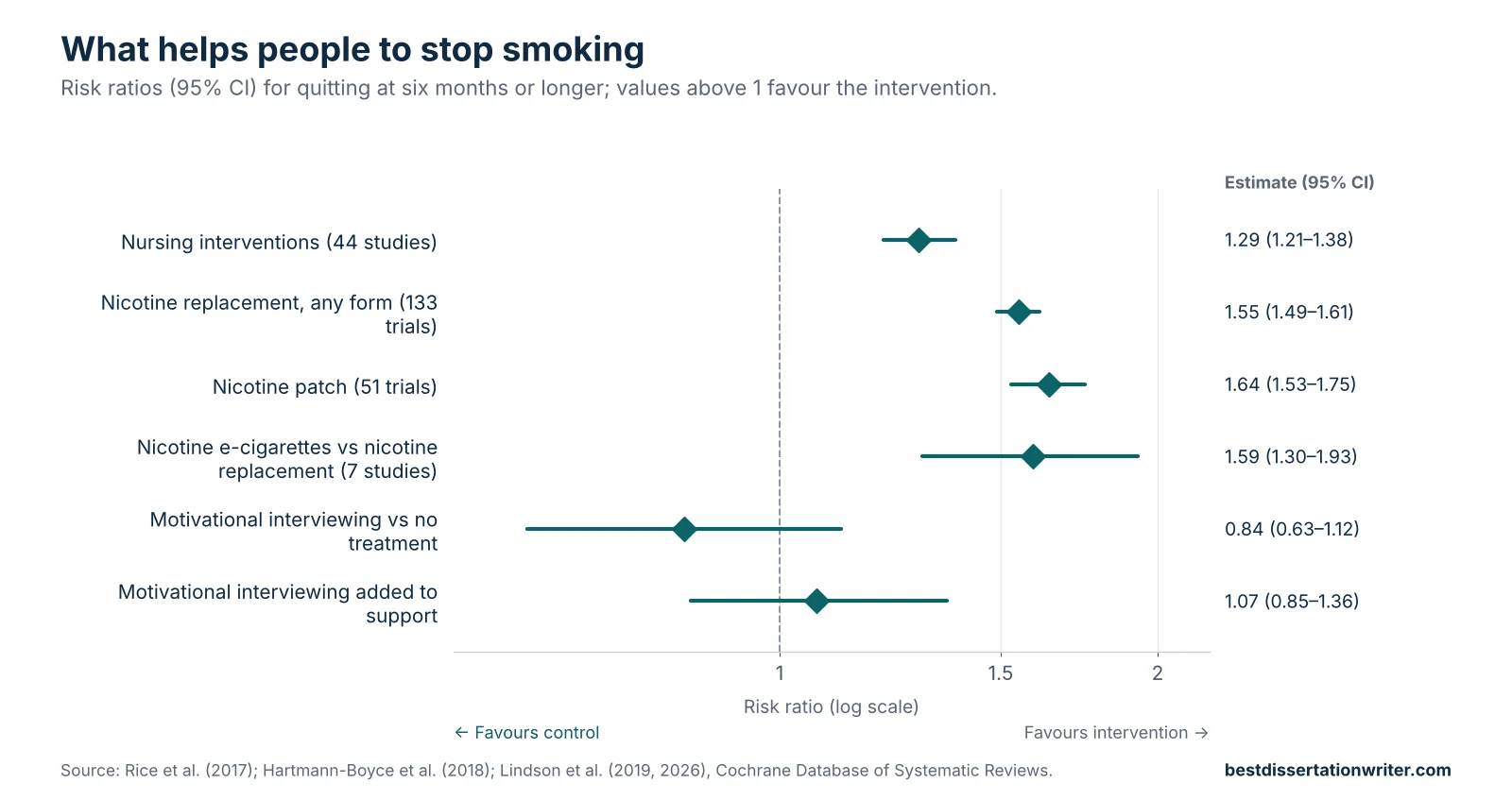
Three themes were identified: the effect of nursing interventions and counselling, the effectiveness of medication, and the place of e-cigarettes in the wider tobacco context. Table 1 summarises the included sources, and Figure 1 shows the effects on quitting reported by the Cochrane reviews.
| Author, year | Design | Setting and sample | Key finding |
|---|---|---|---|
| Rice et al. (2017) | Cochrane systematic review | 58 studies; 44 in main analysis, over 20,000 adults | Nursing interventions increased quitting (RR 1.29); moderate certainty. |
| Hartmann-Boyce et al. (2018) | Cochrane systematic review | 136 trials; 64,640 participants in main comparison | Nicotine replacement increased quitting (RR 1.55); high certainty. |
| Lindson et al. (2019) | Cochrane systematic review | 37 trials; over 15,000 people | Motivational interviewing: no clear benefit; low certainty. |
| Lindson et al. (2026) | Cochrane systematic review | E-cigarette trials; 2,544 in comparison with NRT | Nicotine e-cigarettes better than NRT (RR 1.59); serious events rare. |
| World Health Organization (2026) | Fact sheet (global data) | Worldwide estimates | >7 million deaths a year; 1.2 billion tobacco users. |
Theme 1: Nursing Interventions for Smoking Cessation
Rice et al. (2017) updated a Cochrane review of nursing interventions for smoking cessation. It included 58 studies, of which 44 comparing a nursing intervention with a control or usual care contributed to the main analysis, covering over 20,000 hospitalised adults and adults in the community. Nursing interventions increased the likelihood of quitting (risk ratio 1.29; 95% confidence interval 1.21 to 1.38), with moderate-certainty evidence. The effect did not change when the analysis was limited to studies at low risk of bias, and it did not differ by patient group or healthcare setting.
Eleven studies compared different nurse-delivered interventions. Adding components, more intense contact, follow-up or feedback aids did not change the effect, so there was insufficient evidence to say whether more intensive support is better than one-off support. The authors concluded that behavioural support from nurses can modestly increase the number of people achieving prolonged abstinence. The size of the effect is modest, but because nurses meet so many people who smoke, the benefit to a population could be considerable.
Lindson et al. (2019) reviewed motivational interviewing for smoking cessation in 37 randomised trials with more than 15,000 participants. Compared with no treatment, motivational interviewing showed no clear benefit (risk ratio 0.84; 95% CI 0.63 to 1.12), nor did it clearly add to existing support (1.07; 0.85 to 1.36) or outperform other cessation support (1.24; 0.91 to 1.69). All certainty ratings were low. Higher-intensity motivational interviewing appeared better than lower-intensity (1.23), but this did not hold when studies at high risk of bias were removed. The authors concluded that evidence was insufficient to say whether motivational interviewing helps.
These findings suggest that the nursing contribution to smoking cessation lies less in any particular technique than in consistent, repeated and respectful engagement. People are more likely to try to stop when they are asked, when the advice is clear and when help is easy to obtain. Nurses are able to provide each of these elements in the course of routine work, without the need for a separate appointment.
Theme 2: Medication and Smoking Cessation
Hartmann-Boyce et al. (2018) reviewed nicotine replacement therapy in 136 trials, 133 of which, with 64,640 participants, contributed to the main comparison with placebo or no nicotine replacement. Any form of nicotine replacement increased the chance of quitting (risk ratio 1.55; 95% CI 1.49 to 1.61), with high-certainty evidence. Results for individual products were similar: gum 1.49, patch 1.64, tablets and lozenges 1.52, inhalator 1.90 and nasal spray 2.02.
Side effects depended on the product and were mostly minor, such as skin irritation from patches and mouth irritation from gum or tablets. Chest pain or palpitations were uncommon (odds ratio 1.88; 15 trials), and serious adverse events were extremely rare. The authors concluded that all licensed forms increase the chance of quitting by roughly 50% to 60%, regardless of setting, and that the effect is largely independent of the intensity of additional support, although more support helps.
For public health nursing, the practical significance is that medication and behavioural support work together. Nicotine replacement can be combined, for example a patch with a short-acting product, and the Cochrane review reported that combination nicotine replacement was more effective than a single product. Nurses who understand the options can help people to choose a regimen they can sustain, and can reassure those who worry about using nicotine in a medicinal form.
Theme 3: E-Cigarettes and the Wider Tobacco Context
Lindson et al. (2026) updated a Cochrane review of electronic cigarettes for smoking cessation. Evidence from high-certainty comparisons showed that nicotine e-cigarettes increased quit rates compared with nicotine replacement therapy (risk ratio 1.59; 95% CI 1.30 to 1.93; 7 studies, 2,544 participants), equivalent to about four additional quitters per 100. Serious adverse events were rare across groups, and the authors found no evidence of serious short-term harm, but longer and larger trials are needed. Non-serious events such as throat or mouth irritation, headache and cough were more common with nicotine e-cigarettes than with behavioural or no support.
The findings apply to regulated nicotine products, and other products may have different harm profiles. The WHO fact sheet states that e-cigarettes are harmful and not safe and notes a growing body of evidence on their use by children and adolescents. These positions can be read together: in people who already smoke, regulated nicotine e-cigarettes may help some to stop, while for young people and non-smokers, starting to use them is not recommended.
Discussion
This systematic review shows that smoking cessation support works, but that the effect of any single intervention is modest. Nursing interventions raised quit rates by about 29%, nicotine replacement by about 55%, and nicotine e-cigarettes did better than nicotine replacement. Motivational interviewing as a technique had no clear advantage in the evidence reviewed. The most consistent message is that support should be offered to everyone who smokes, every time.
The finding that behavioural support from nurses works at all is important, given how many people nurses see. A modest effect on each person adds up across large numbers of contacts. The finding that medication has a larger effect suggests that nurses should help people to access and use it, including explaining how to use products correctly, since poor use is a common reason for failure.
Intensity is a puzzle. The nursing review found no clear benefit for more intensive support, and the nicotine replacement review found that effects were largely independent of the level of additional support, yet other evidence suggests that more support helps. For nurses, a practical interpretation is that a brief, consistent offer is worth making at every contact, and that longer support should be available for people who want it.
Equity matters. Smoking is more common among people with low incomes, mental health conditions and other disadvantages, and these groups bear a disproportionate share of tobacco-related harm. Services should therefore ensure that support is accessible, free of judgement and tailored to people’s circumstances. Nurses who work in community and mental health services have opportunities to reach people who may not attend dedicated clinics.
Several limitations should be noted. Some trials were old, effects were often measured by self-report or with differing follow-up, and certainty varied from low to high. The e-cigarette field is changing quickly, and long-term safety is not fully known. This review relied on openly accessible, English-language sources and did not involve formal systematic screening. Future research should test the best ways to deliver support through nurses in routine care, including for groups that are often excluded.
A further implication concerns training and confidence. Nurses who feel unsure about the evidence or about how to raise smoking cessation may avoid the topic, so training should cover brief advice, the safe use of medication and ways of responding to people who are not ready to stop. Recording smoking status in the clinical record, and prompting follow-up, helps to make smoking cessation part of routine care rather than an optional extra.
Implications of Smoking Cessation Evidence for Practice
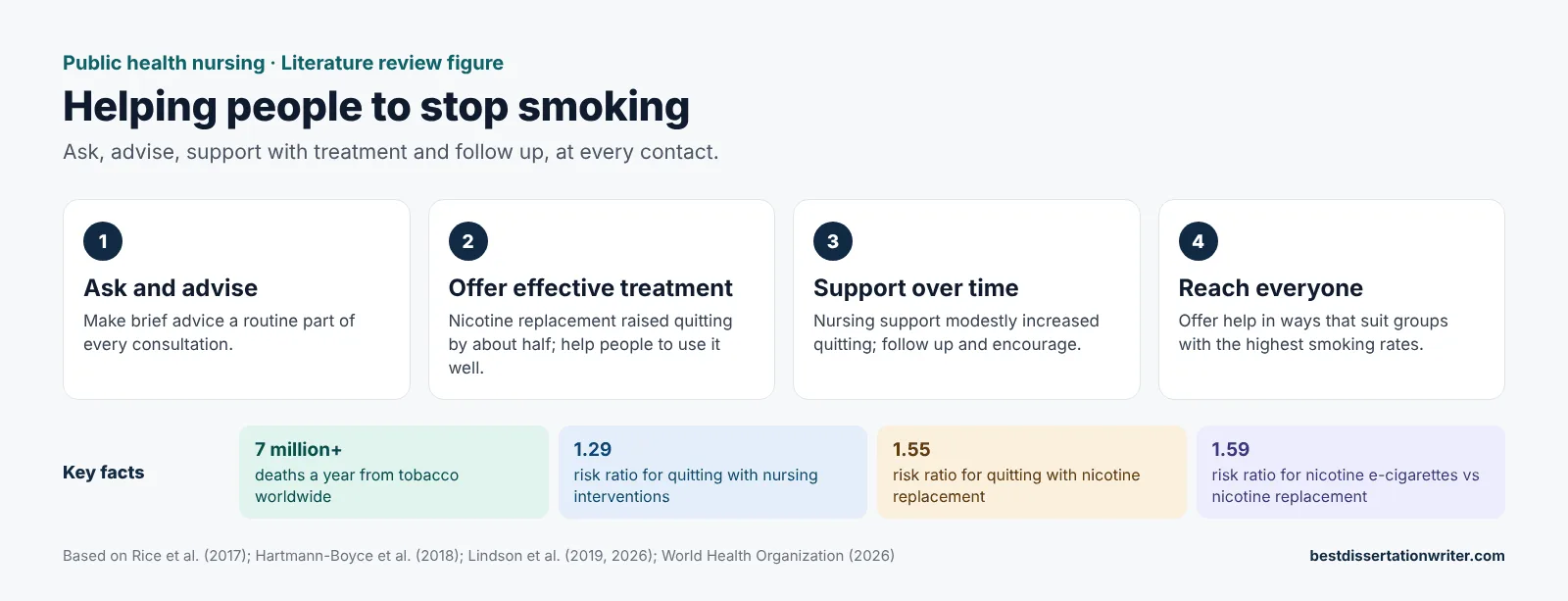
For nurses, the evidence supports asking about tobacco at every contact, offering brief advice and support, helping people to choose and use effective medication, arranging follow-up and referring to specialist services where needed. These conversations fit alongside school-based health work, as described in the review of school nurses, and sexual health discussions, as in sexual health screening. People who drink heavily may also benefit from combined advice, as in alcohol harm reduction. Information on tobacco is available from the WHO tobacco fact sheet.
Managers and commissioners should ensure that nurses are trained to deliver brief advice, that medication is easily available, that referral pathways to specialist services are clear and that hospital and community teams record smoking status and follow up. Support should be accessible to groups with the highest rates of smoking.
In summary, the evidence reviewed here supports a straightforward model of smoking cessation in nursing: ask, advise, offer effective treatment and follow up. Each element is supported by robust syntheses, and none requires more than a short conversation to begin. Their effects are modest individually but meaningful across the many people that nurses see.
Conclusion
This systematic review examined evidence on helping people to stop smoking. Nursing interventions modestly increased quitting, nicotine replacement and nicotine e-cigarettes were effective, and motivational interviewing showed no clear advantage. Certainty was moderate to high for the main findings.
Smoking cessation is among the most valuable things nurses can offer. By asking, advising, helping people to use effective treatments and following up with encouragement, nurses can help many people to stop smoking and to gain years of healthier life.
References
Hartmann-Boyce, J., Chepkin, S. C., Ye, W., Bullen, C., & Lancaster, T. (2018). Nicotine replacement therapy versus control for smoking cessation. Cochrane Database of Systematic Reviews, (5), CD000146. https://doi.org/10.1002/14651858.CD000146.pub5
Lindson, N., Livingstone-Banks, J., Butler, A. R., McRobbie, H., Bullen, C. R., Hajek, P., Wu, A. D., Begh, R., Theodoulou, A., Ma, C., Notley, C., Rigotti, N. A., Turner, T., Fanshawe, T., & Hartmann-Boyce, J. (2026). Electronic cigarettes for smoking cessation. Cochrane Database of Systematic Reviews, (8), CD010216. https://doi.org/10.1002/14651858.CD010216.pub11
Lindson, N., Thompson, T. P., Ferrey, A., Lambert, J. D., & Aveyard, P. (2019). Motivational interviewing for smoking cessation. Cochrane Database of Systematic Reviews, (7), CD006936. https://doi.org/10.1002/14651858.CD006936.pub4
Rice, V. H., Heath, L., Livingstone-Banks, J., & Hartmann-Boyce, J. (2017). Nursing interventions for smoking cessation. Cochrane Database of Systematic Reviews, (12), CD001188. https://doi.org/10.1002/14651858.CD001188.pub5
World Health Organization. (2026, June 26). Tobacco [Fact sheet]. https://www.who.int/news-room/fact-sheets/detail/tobacco
Cite this example
Best Dissertation Writers (2026) Nurse-Led Smoking Cessation Interventions: A Systematic Review. Available at: https://bestdissertationwriter.com/smoking-cessation-literature-review/
Best Dissertation Writers
Get expert help with your nursing literature review
Share your topic and deadline with Best Dissertation Writers and get support tailored to your module brief.