
Addressing Health Inequalities and the Social Determinants of Health Through Nursing Practice: A Narrative Review
 By Dr. Robertson Prime, Research Fellow
Updated October 28, 2026
15 min read
About 2,900 words
In this review
Abstract
Background: Differences in health between groups of people are largely explained by the social conditions in which they live, rather than by healthcare alone. Nurses work with people in their homes, schools, clinics and communities, and are widely expected to help address these social determinants of health, but what this means in practice is often unclear.
Aim: This narrative review aimed to examine what is known about the social determinants of health, the scale of health inequalities, and the contribution that nursing practice can make to health equity.
Methods: Evidence was identified through targeted searches of openly accessible bibliographic records, publisher websites and the reference lists of key reports. Five sources published between 2008 and 2023 were included: two World Health Organization publications, a national review of health inequalities in England, a report on the future of nursing and an integrative review of nurse screening. The relevance and quality of each source was considered critically, and findings were synthesised narratively.
Findings: The World Health Organization describes the social determinants of health as the conditions in which people are born, grow, live, work and age, and notes a life expectancy difference of 18 years between high- and low-income countries. In England, life expectancy stalled after 2010 and the gap between the least and most deprived areas reached 9.5 years for men and 7.7 years for women in 2016 to 2018. A US national report states that all nurses have a duty to address these determinants. An integrative review of 15 studies found that primary care nurses rarely use standardised screening tools and that organisational support and relationships are important.
Conclusion: Health inequalities are driven by social conditions that nurses cannot change alone, but nurses can identify need, build relationships, advocate and work with partners. Nurses need organisational support, education and better evidence to do so.
Keywords: social determinants of health, health inequalities, health equity
Introduction
This narrative review critically examines recent evidence on social determinants of health and its implications for public health nursing practice.
People who are poorer, less educated or more excluded tend to live shorter lives and to spend more of them in ill health. This pattern appears in every country and has been described as a social gradient, in which the lower the socioeconomic position, the worse the health. The World Health Organization (WHO) describes the social determinants of health as the conditions in which people are born, grow, live, work and age, and people’s access to power, money and resources. It states that research shows these social determinants can outweigh genetic influences or healthcare access in their effect on health.
The consequences are large. The WHO reports a difference of 18 years in life expectancy between high- and low-income countries, and an under-5 mortality rate that is more than eight times higher in Africa than in the European region. Within wealthy countries, differences also exist between areas, as the evidence from England below shows. These differences are avoidable, which is why they are described as inequities and why reducing them is a matter of fairness as well as of health.
Nurses meet the effects of these conditions every day. They see the child with asthma who lives in damp housing, the older adult who cannot afford to heat the home, and the parent who skips appointments because of insecure work. Because nurses are numerous, trusted and present in many settings, professional bodies have argued that they should help to address social causes of ill health. A narrative review design was chosen because the topic spans policy, epidemiology and nursing research, and a critical synthesis was more suitable than a pooled estimate.
Review question
What do key sources say about the social determinants of health and health inequalities, and what can nursing practice contribute?
Background to the Social Determinants of Health
The idea that social conditions shape health is long established, but it was brought to the centre of global policy by the Commission on Social Determinants of Health, set up by the WHO in 2005. Its 2008 final report, titled Closing the gap in a generation, argued that avoidable inequities arise from the circumstances in which people are born, live, work and age, together with the way health systems respond to illness, and that health equity is achievable within a generation.
The WHO defines health equity as the absence of unfair and avoidable or remediable differences in health among population groups. The related term, health inequalities, refers to the measurable differences in health between groups, such as those defined by income, ethnicity, geography or disability. In everyday use the terms overlap, but inequity carries a judgement that the difference is unfair, which gives it a moral force that a purely statistical description lacks.
The WHO identifies three areas for action: improving daily living conditions, tackling the inequitable distribution of power, money and resources, including the structural drivers of those conditions such as macroeconomic and urbanisation policies and governance, and measuring and understanding the problem and assessing the impact of action. It also calls for action that is universal but proportionate to the disadvantage across the social gradient. This principle, known as proportionate universalism, means that services should be available to all but with greater intensity where need is greater.
These ideas imply that healthcare, important as it is, is only one part of the answer. Housing, education, employment, income and community life all affect health, and they are mostly controlled by decisions outside the health service. Nurses therefore have to work in partnership, and their contribution lies in recognising need, helping people to reach services, and speaking up about the conditions they see.
Language matters in this field. Terms such as deprivation, disadvantage and vulnerability describe real differences, but they can also suggest that the problem lies with individuals rather than with the conditions they face. Nursing writing on this topic is therefore most useful when it describes the circumstances that limit people’s choices, and avoids implying that people are at fault for the outcomes they experience.
Search Strategy and Methods
Evidence for this example was identified through targeted searches of openly accessible bibliographic records, publisher websites and the reference lists of key reports. Search terms combined keywords for the topic (“social determinants of health”, “health inequalities”, “health equity”, “social gradient”) with terms for the profession and setting (“nursing”, “nurses”, “primary care”, “public health”), joined with the Boolean operators AND and OR. A full review for assessment would search CINAHL, PubMed/MEDLINE and Web of Science and report the records screened.
Sources were included if they were authoritative reports on the social determinants of health or health inequalities, or research or policy reviews that considered the role of nurses. Studies of single clinical conditions and opinion pieces without a clear evidence base were excluded.
Five sources published between 2008 and 2023 were included: two WHO publications, a national review of health inequalities in England, a report on the future of nursing and an integrative review of nurse screening (Table 1). The relevance and quality of each source was considered critically, and findings were synthesised narratively.
Key Findings on the Social Determinants of Health
Three themes were identified: the scale and persistence of health inequalities, the case for action on the social determinants of health, and the role of nurses. Table 1 summarises the included sources, and Figure 1 shows life expectancy gaps reported by the WHO and in England.
| Author, year | Design | Setting and sample | Key finding |
|---|---|---|---|
| Commission on Social Determinants of Health (2008) | Final report | Global | Avoidable inequities arise from the conditions in which people are born, live, work and age; health equity achievable within a generation. |
| Marmot et al. (2020) | National review | England, 2010–2020 | Life expectancy stalled; gap between least and most deprived areas 9.5 years (men) and 7.7 years (women) in 2016–18. |
| McGowan et al. (2023) | Integrative review | 15 studies; primary care nurses | Standardised screening rarely used; organisational support and relationships important. |
| National Academy of Medicine (2021) | Consensus report | United States | All nurses have a duty to work with others to address social determinants and achieve health equity. |
| World Health Organization (n.d.) | Health topic page | Global | Social determinants can outweigh genetic influences or healthcare access; 18-year life expectancy gap between high- and low-income countries. |
Theme 1: The Scale and Persistence of Health Inequalities
Marmot et al. (2020) reviewed progress in England ten years after the original Marmot Review. They reported that since 2010 life expectancy in England has stalled, which had not happened since at least 1900. Among women in the most deprived 10% of areas, life expectancy fell between 2010–12 and 2016–18, while men in the same areas saw only negligible gains. The gradient became steeper, and the gap in life expectancy between the least and most deprived tenths of areas grew to 9.5 years for men and 7.7 years for women in 2016–18.
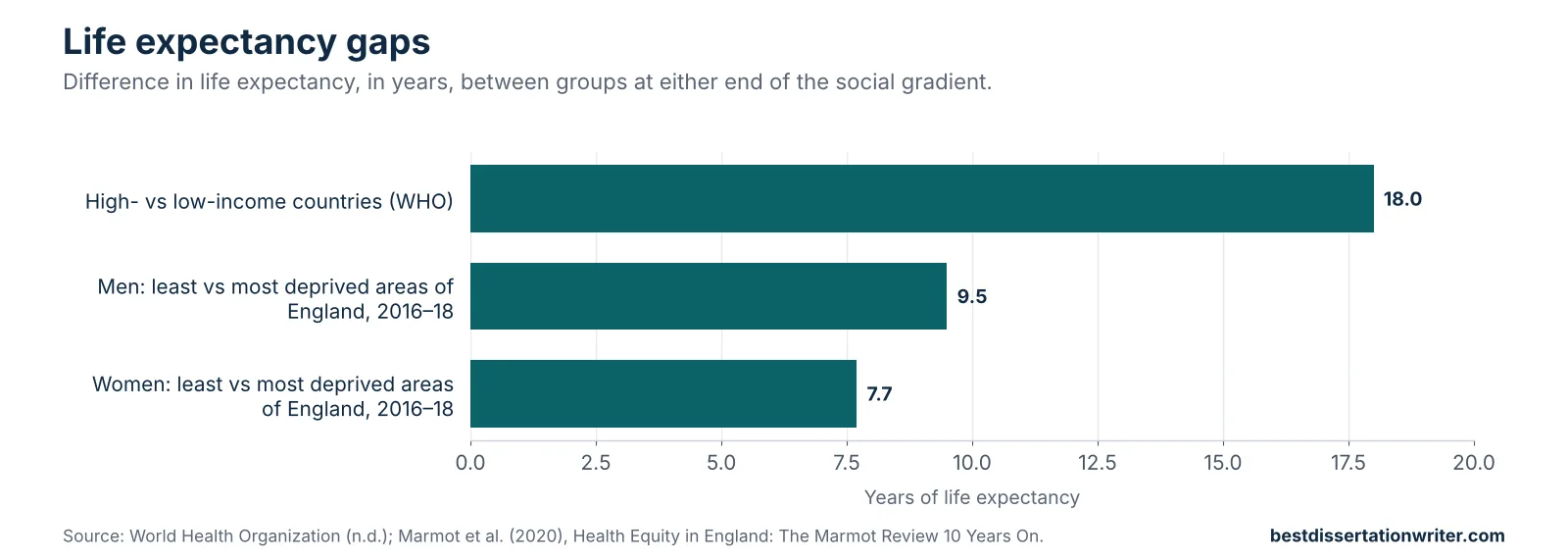
The review also found marked regional differences in life expectancy, particularly among people living in more deprived areas, with the North East having the lowest life expectancy and London the highest. The report therefore shows that health inequalities are not only a feature of poor countries, but persist, and can widen, in a wealthy country with a universal health service.
The WHO presents the same pattern globally. The 18-year gap in life expectancy between high- and low-income countries, and the concentration of premature deaths from noncommunicable diseases in low- and middle-income countries, show that social conditions shape health across the world. The two sources agree that these differences are patterned by social position rather than random.
Theme 2: The Case for Action on the Social Determinants of Health
The 2008 Commission report argued that action on the social determinants of health is both possible and necessary, and that governments and the WHO should lead it. Its recommendations, repeated on the current WHO page, concern living conditions, the distribution of power and money, and measurement. The emphasis on measurement is important for nursing, because it implies that services should collect data on who they reach and who they miss, so that inequalities can be seen and reduced.
The principle of action proportionate to disadvantage also has practical meaning. A universal service, such as health visiting or school nursing, can be offered to everyone but with extra contact and support for those in greatest need. This approach is considered further in the review of health visiting, and further information is available from the WHO social determinants of health page. It avoids both stigma, because the service is open to all, and neglect, because resources follow need.
Theme 3: The Role of Nurses
The report The Future of Nursing 2020–2030, produced by a committee of the US National Academy of Medicine, states the committee’s position that all nurses, at all levels and in any setting, have a duty and responsibility to work with other health professionals and sectors to address the social determinants of health and help achieve health equity. The preface states that nurses are well prepared to create, partner in and lead the complex work of integrating the social and health sectors.
McGowan et al. (2023) examined how primary health care nurses in developed countries screen for social determinants in an integrative review of 15 studies. They found that nurses rarely use standardised screening tools or other objective methods, and that their screening practices are poorly defined and not well understood. Three main themes emerged: nurses need organisational and health system support, nurses are often reluctant to conduct screening, and interpersonal relationships are important.
The authors recommended that therapeutic relationships should be valued, that education on the social determinants of health should be provided, and that screening should be encouraged by health systems and professional bodies. They also noted that more research is needed to identify the best method of screening. This evidence suggests a gap between the aspiration set out in policy and the support available to nurses in practice.
Discussion
This narrative review shows strong agreement on the problem and on the principle, but much less evidence on what nurses should do. The sources agree that health inequalities are large, that they follow the social gradient, and that they are driven by conditions outside the health service. They also agree that nurses should be involved. What is missing is a body of tested interventions showing which nursing actions reduce inequalities.
The findings of McGowan et al. (2023) are particularly informative. If nurses rarely use standardised tools and are sometimes reluctant to ask about social circumstances, the explanation may lie in lack of time, uncertainty about what to do with the answers, or concern about intruding. Asking about housing or money is of little value if there are no referral routes, and so screening has to be linked to practical help.
The Marmot findings caution against assuming progress. Life expectancy stalled and inequalities widened over a decade, which shows that a universal health service does not by itself prevent inequalities from growing. Nurses cannot reverse such trends on their own, and it would be unfair to hold individual nurses responsible for outcomes that depend on national policy. The appropriate expectation is that nurses contribute within their sphere and make the effects of policy visible.
Taken together, the sources suggest that work on the social determinants of health requires both knowledge and permission. Nurses need to understand why social conditions matter, and they need to feel that organisations expect and support this work, rather than treating it as an optional extra squeezed in alongside clinical tasks. Without that backing, individual commitment is likely to be uneven and difficult to sustain.
The relationship between individual care and structural change deserves attention. A nurse who helps a family to claim benefits or to obtain safe housing can improve that family’s situation, but this does not change the system that produced the need. Both levels matter. Nurses can combine direct help with advocacy, by recording the conditions they see, sharing data with public health teams and contributing to local planning.
Measurement is a further challenge. Nurses are rarely given the time or the systems to record social needs in a consistent form, and without such records the effect of their work cannot be shown. Simple, agreed ways of recording housing, income and employment concerns, linked to action, would help services to understand their population and to demonstrate what difference they make.
There are limitations. A narrative review is subjective in its selection and interpretation, and the five sources are not exhaustive. They come mainly from the United Kingdom, the United States and global agencies, and their relevance to other contexts may differ. This review relied on openly accessible, English-language sources, and it did not use a formal search of all databases. Future research should evaluate nursing interventions that address social needs, including their effect on outcomes and costs.
Implications of Social Determinants Evidence for Practice
For practice, the evidence supports asking sensitively about social circumstances, knowing local sources of help, building trusting relationships and recording the issues that affect patients’ health. These activities connect with other public health areas, for example the work on obesity prevention programmes and the support described in the review of smoking cessation, both of which need to be offered in ways that reach people in disadvantaged circumstances.
Education has a central part to play. Programmes that prepare nurses should teach the evidence on the social determinants of health, the skills of sensitive enquiry and the principles of advocacy, and should give students placements in community settings where social causes of illness are visible. Continuing education can then help experienced nurses to update their practice and to share what they learn with colleagues.
Employers and educators should provide time, tools and training so that nurses feel confident to ask about social needs and to respond. Referral pathways to housing, welfare, debt and employment services need to be clear, and data should be collected so that services can monitor who is reached and whether inequalities are narrowing.
Conclusion
This narrative review examined evidence on the social determinants of health and the role of nursing. Health inequalities are large and persistent, they are driven by social conditions, and nurses are widely expected to help address them. The evidence on how they should do so is still limited.
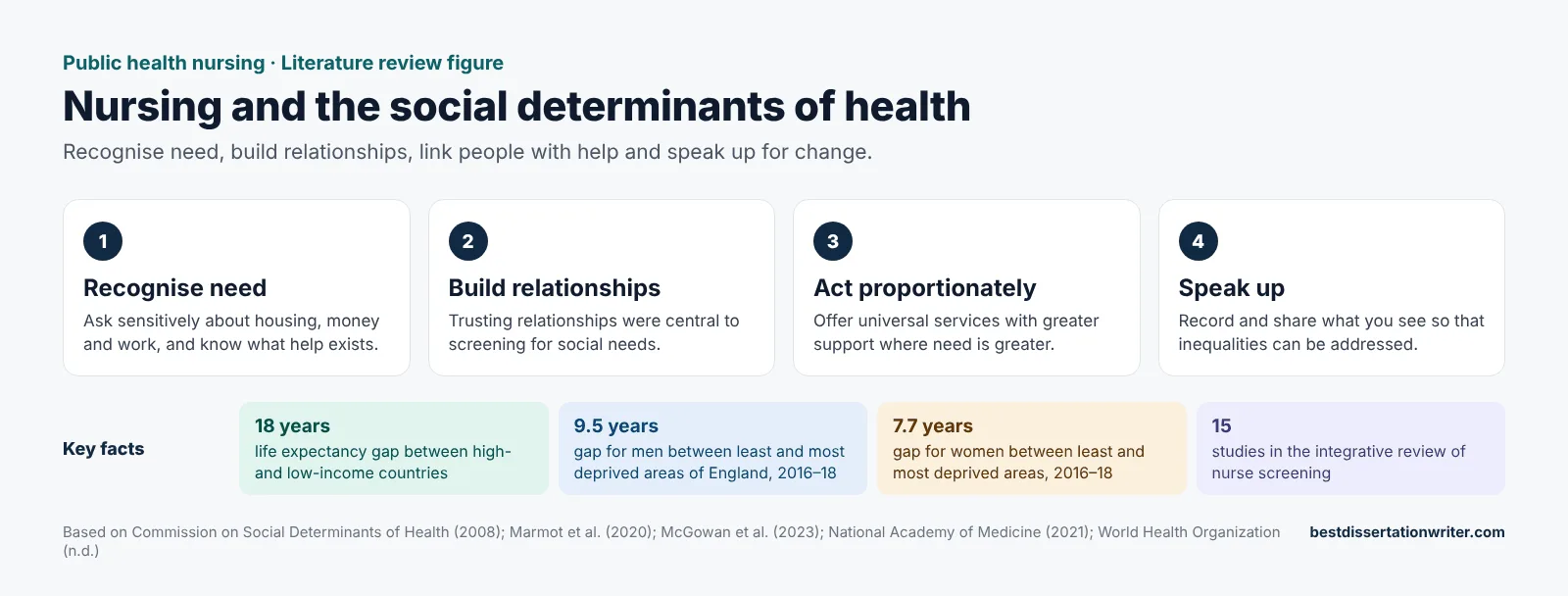
Nurses can contribute to the social determinants of health agenda by recognising need, building trusting relationships, linking people with help and speaking up for change. With organisational support, appropriate education and better research, nursing can play a fuller part in achieving health equity.
References
Commission on Social Determinants of Health. (2008). Closing the gap in a generation: Health equity through action on the social determinants of health. Final report of the Commission on Social Determinants of Health. World Health Organization. https://www.who.int/publications/i/item/9789241563703
Marmot, M., Allen, J., Boyce, T., Goldblatt, P., & Morrison, J. (2020). Health equity in England: The Marmot Review 10 years on. Institute of Health Equity. https://www.instituteofhealthequity.org/resources-reports/marmot-review-10-years-on/the-marmot-review-10-years-on-executive-summary.pdf
McGowan, D. A., Mather, C., & Stirling, C. (2023). Use of social determinants of health screening among primary health care nurses of developed countries: An integrative review. Nursing Reports, 13(1), 194–213. https://doi.org/10.3390/nursrep13010020
National Academy of Medicine. (2021). The future of nursing 2020–2030: Charting a path to achieve health equity (M. K. Wakefield, D. R. Williams, S. Le Menestrel, & J. L. Flaubert, Eds.). National Academies Press. https://www.nationalacademies.org/read/25982/chapter/1
World Health Organization. (n.d.). Social determinants of health [Health topic]. https://www.who.int/health-topics/social-determinants-of-health
Cite this example
Best Dissertation Writers (2026) Addressing Health Inequalities and the Social Determinants of Health Through Nursing Practice: A Narrative Review. Available at: https://bestdissertationwriter.com/social-determinants-of-health-review/
Best Dissertation Writers
Get expert help with your nursing literature review
Share your topic and deadline with Best Dissertation Writers and get support tailored to your module brief.