

Community Treatment Orders in England: Outcomes and the Experiences of Patients and Clinicians
 By Dr. Robertson Prime, Research Fellow
This dissertation is a worked example that shows the structure and standard of a 5,000-word literature-based Independent Project. It is provided for learning and is not to be submitted as a student’s own work.
Abstract
Background: Community treatment orders allow people detained in hospital to be treated in the community while liable to recall, and nurses help to monitor them while holding a professional duty of partnership. Less is known about what studies in England show about the outcomes of orders and the experiences of patients, carers and clinicians.
Aim: To critically review evidence from England on the outcomes of community treatment orders and the experiences of patients, carers and clinicians.
Methods: A structured literature review using the Population, Exposure and Outcome framework. OpenAlex was searched twice on 26 November 2026, because CINAHL could not be accessed and a planned MEDLINE search was not completed. The first 40 records of each search were screened: 80 records were identified, 61 screened after the removal of duplicates and 10 studies set in England included. Quality was considered using Critical Appraisal Skills Programme questions, and findings were combined by thematic synthesis.
Findings: The included studies of community treatment orders (n = 10) comprised a randomised trial programme, a follow-up, observational analyses and interview studies. The trial found no difference in readmission, observational studies found longer hospital stays but lower mortality, use varied widely between trusts, and patients and carers described limited information and involvement.
Conclusions and implications for practice: For nursing practice, nurses can make sure that patients understand their order and rights, involve carers at each stage, and record why an order was chosen. The evidence is limited by the restricted search, single-reviewer screening, reliance on abstracts and the overlap between reports.
Keywords: community treatment orders; compulsory community treatment; Mental Health Act; mental health nursing; literature review.
Brief at a glance
- Framework
- PEO
- Design
- Literature review (PEO)
- Studies included
- 10
Introduction
Community treatment orders allow a person who has been detained in hospital to be discharged and treated in the community while remaining liable to recall. The Mental Health Act 2007 inserted the power into the Mental Health Act 1983, and the responsible clinician may make an order only if an approved mental health professional agrees in writing (UK Parliament, 2007). Nurses are often the clinicians who see people on orders most often, and the Code of the Nursing and Midwifery Council tells them to work in partnership with people and to encourage them to share in decisions (NMC, 2018). Compulsion in the community therefore sits alongside a professional duty of partnership, a tension that also appears in the duty described in service user involvement. Whether orders achieve their aims, and how they are experienced, is a question for research.
This dissertation reviews research from England on the outcomes of community treatment orders and the experiences of patients, carers and clinicians. A literature review suits the question because the evidence is scattered across a randomised trial programme, analyses of routine data and interview studies, and a structured process makes each choice visible and open to challenge (Aveyard, 2023). The review is limited to England, or to England and Wales together, so that its conclusions can be read against one statute and one professional code (UK Parliament, 2007; NMC, 2018). It asks what the studies show about hospital use, mortality and continuity of care, and how people describe being subject to an order. It then considers what the findings mean for nursing practice, and it notes where the evidence is thin so that readers can judge how far the conclusions can be trusted (Aveyard, 2023).
Background and Justification
Community treatment orders were introduced in England and Wales by the Mental Health Act 2007, which inserted sections 17A to 17G into the Mental Health Act 1983, and the new sections came into force in 2008 (UK Parliament, 1983; UK Parliament, 2007). Under section 17A, the responsible clinician may discharge a detained patient from hospital subject to the patient being liable to recall, and may do so by making a community treatment order. The clinician may not make the order unless, in their opinion, the relevant criteria are met and an approved mental health professional states in writing that they agree with that opinion and that it is appropriate to make the order (UK Parliament, 2007). The power therefore requires two professional judgements and not one.
The criteria are set out in the same section. The patient must need medical treatment for their mental disorder for their own health or safety or for the protection of others, it must be necessary that the responsible clinician can exercise the power to recall the patient to hospital, and appropriate medical treatment must be available (UK Parliament, 2007). Section 17B requires every order to specify conditions to which the patient is subject, allows the responsible clinician to vary the conditions by order in writing, and also allows the clinician to suspend any condition (UK Parliament, 1983). The conditions and the power of recall are what separate an order from voluntary aftercare, and they are the features that research has sought to evaluate.
For nurses, the legal power sits beside professional duties. The Code of the Nursing and Midwifery Council applies to every registered nurse and requires nurses to work in partnership with people, to recognise the contribution that people can make to their own health and wellbeing, and to encourage and empower people to share in decisions about their treatment and care (NMC, 2018). It also asks nurses to respect the level to which people want to be involved. A nurse who helps to monitor an order must therefore combine a legal power of recall with a duty of partnership, a combination that raises the questions about compulsion and consent that are discussed in restrictive practice (NMC, 2018; UK Parliament, 1983).
The law has since changed. The Mental Health Act 2025 received Royal Assent at the end of 2025, and it revises the criteria for detention under the Mental Health Act 1983 so that clear evidence of the risk of serious harm is required before detention can occur (Royal College of Psychiatrists, 2026). The Royal College of Psychiatrists reports that the Act revises the criteria for these orders in line with the new detention criteria, requires a written agreement from the community clinician before an order is implemented, and allows the mental health tribunal to recommend that the responsible clinician reconsiders an order (Royal College of Psychiatrists, 2026). These changes show that the use of orders is a live question for policy as well as for practice (NHS Providers, 2026).
The Act will not take effect at once. NHS Providers reports that the Act applies to England and Wales and will be phased in over eight to ten years, and that there will be a consultation on a possible new category of authorised person and a review into the orders (NHS Providers, 2026). Until the relevant provisions are brought into force, the Mental Health Act 1983 as amended continues to apply (UK Parliament, 1983). Evidence about how orders work in practice is therefore likely to inform both the review and the training that nurses will need, and a clear account of what is already known has practical value for the services that will be asked to change.
This review therefore examines research from England on community treatment orders against the legal and professional context described above. It is limited to England, or to England and Wales together, so that the findings can be read against the statute and the Code of the Nursing and Midwifery Council (NMC, 2018). A structured review can bring together studies of different designs if it states its method and limits (Aveyard, 2023), using a framework that separates the population, the exposure and the outcome (Methley et al., 2014). The review looks at outcomes such as readmission, days in hospital, mortality and continuity of care, and at how patients, carers and clinicians describe orders. It does not assess compulsory treatment in other countries, which has its own law and evidence.
Title, Aim and Objectives
What do studies in England show about the outcomes of community treatment orders and the experiences of patients, carers and clinicians?
Title explained
The title names the focus on community treatment orders, the setting of England, the two kinds of evidence sought, outcomes and experiences, and the literature review design that structures the whole work.
Aim
To critically review evidence from England on the outcomes of community treatment orders and the experiences of patients, carers and clinicians.
Objectives
- To identify and appraise studies of community treatment orders.
- To synthesise findings on outcomes and experiences.
- To make recommendations for nursing practice.
Methodology
This literature-based dissertation is a structured review of published primary research on community treatment orders. It aims to be transparent and reproducible, but it is smaller in scope than a full systematic review, which would normally involve several reviewers, many more databases and exhaustive searching (Aveyard, 2023). The review is reported with reference to the PRISMA 2020 statement, which lists the items that should be described and recommends a flow diagram showing how records move through identification, screening and inclusion (Page et al., 2021). Appendix D presents that flow diagram, Appendix A records each search string, Appendix B tabulates the included studies and Appendix C gives a worked critical appraisal. Together, the appendices allow another reader to check each decision and to repeat the process.
The review question was framed using the Population, Exposure and Outcome (PEO) structure, which suits questions about experiences and influencing factors rather than the effects of a treatment. The population was people subject to community treatment orders in England, together with their carers and the clinicians who use the orders. The exposure was the use of community treatment orders, and the outcomes were measures of hospital use, mortality and continuity of care, and the experiences of patients, carers and clinicians. Structured frameworks help to translate a broad topic into searchable concepts, although the choice of framework affects how sensitive a search is (Methley et al., 2014; Aveyard, 2023). Because the evidence included a trial programme, analyses of routine data and interview studies, quantitative and qualitative research was eligible for inclusion.
Two searches were run on 26 November 2026 in OpenAlex, an open index of scholarly works that covers a large and growing proportion of the published literature (Priem et al., 2022). The first search used the words community treatment orders. The second combined the words community treatment orders, England, outcomes, patient and clinician experiences, to bring studies of outcomes and experiences higher in the results. Both searches were limited to open-access records published between 2015 and 2026 with at least one author affiliated to a UK institution. Both searches were restricted to journal articles. Combining more than one source is advised because a single database misses relevant studies (Bramer et al., 2017). The exact strings and settings are given in Appendix A.
CINAHL, the main nursing database, could not be accessed, and a planned search of MEDLINE through Europe PMC was not completed because the service refused repeated requests on the day of searching. The second OpenAlex search was therefore used in its place. These gaps mean that some relevant nursing studies may not have been found, a risk that is well recognised when the combination of databases is restricted (Bramer et al., 2017). OpenAlex matches terms anywhere in the text, so many records were not relevant. It also ranks records by relevance, and the two searches matched 19,916 and 1,011 records. Only the first 40 records of the first search and the first 40 of the second, 80 in total, were screened, so the review should be read as a structured sample of the literature and not as a complete search (Aveyard, 2023).
Studies were eligible if they reported outcomes of community treatment orders, or the experiences of patients, carers or clinicians, in England or in England and Wales together. Reports had to be peer-reviewed, written in English, open access and published from 2015 onwards. UK origin was judged from the stated setting and, where the abstract did not name one, from author affiliations. Reviews, protocols, commentaries, studies without a usable abstract, studies set outside the UK and surveys across all four UK nations were excluded. Clear criteria applied consistently reduce selection bias and allow the decisions to be audited. The extraction table is presented in Appendix B so that readers can compare studies at a glance (Page et al., 2021; Aveyard, 2023).
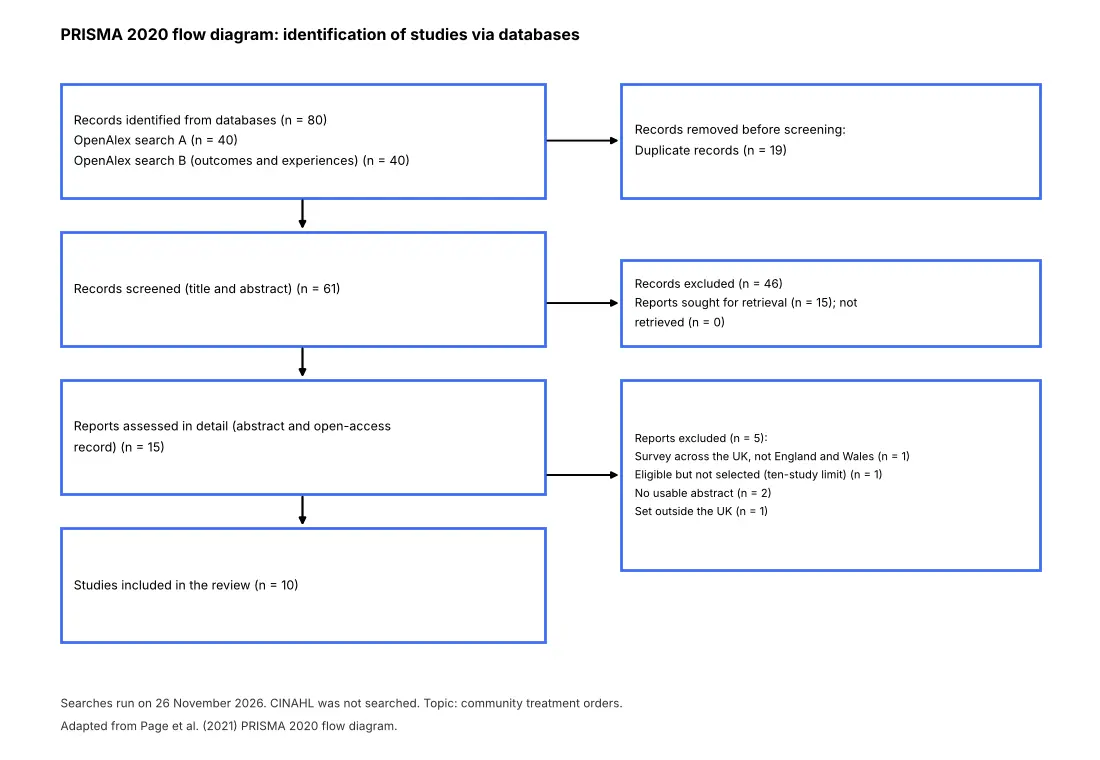
All 80 records were exported into a screening log, and 19 duplicates were removed, leaving 61 titles to screen. Titles about other countries, protocols, commentaries and unrelated topics were excluded here, and several records matched only because of the word community. That left 15 reports for closer assessment against the criteria. The abstract and open-access record of each of these reports were read, and the reason for every exclusion was recorded. The log lists every record by its identifier, the search in which it appeared and the decision reached, so that each exclusion can be traced. Ten studies met the criteria, and the numbers at each stage reconcile in the flow diagram (Page et al., 2021). Screening was carried out by one reviewer, which is a recognised limitation of student reviews because a second reviewer would normally check each decision (Aveyard, 2023).
Quality was considered using the Critical Appraisal Skills Programme checklists, which ask structured questions about the aims, design, conduct, results and value of a study (CASP, 2024). The qualitative checklist was completed in full for one interview study, as a worked example in Appendix C, and indicative quality notes for every study are recorded in Appendix B. Those notes are based on the abstract and, for one study, the open full text, so they are judgements of reporting and not a full audit of how the research was conducted. No study was excluded on quality alone, since appraisal was used to weigh the strength of the findings, which is a common approach in nursing reviews (Aveyard, 2023).
Data were extracted into a standard table covering aims, design, sample, setting, methods, findings and limitations. Numerical results were copied as reported and were not recalculated, and extraction was rechecked once against the source records, a step that reduces transcription errors but does not replace independent checking. Findings were grouped into themes by thematic synthesis, with the quantitative results reported alongside the qualitative themes because the review combined studies of different designs (Thomas and Harden, 2008; Braun and Clarke, 2006). The review used published data only and involved no participants, so ethical approval was not required, although the findings of the included studies are reported accurately and with full attribution (Aveyard, 2023).
Findings
Ten studies met the inclusion criteria, published between 2015 and 2021. Three were qualitative interview studies of patients, carers and clinicians, one was a randomised trial programme, one was a follow-up of the trial cohort, and five were observational analyses of routine, audit or register data. All were set in England, except one audit of England and Wales together. Each is described below by theme, and the section ends with the quality and limits of the evidence. Because the designs differ, results are presented side by side and are not combined (Burns et al., 2016; Trevithick et al., 2018; Rugkåsa and Canvin, 2017).
How often and for whom orders are used
A national analysis of involuntary detention and order data for NHS trusts in England between 2009 and 2014 found that new orders each year ranged from 3,834 to 4,647. The rate rose from 6.4 per 100,000 population in 2009/10 to 10.0 in 2013/14, use varied considerably between trusts, and patients on forensic sections were more likely to be discharged from orders than those on civil sections (Trevithick et al., 2018). A secondary analysis of National Audit of Psychosis data in England and Wales found that the share of patients on an order ranged from 1.1% to 20.2% across trusts, and that male gender, younger age, greater use of inpatient services, co-occurring substance misuse and cognition predicted use (Lei et al., 2019).
A multilevel analysis of data from 61 NHS mental health provider trusts, covering 69,832 eligible patients, found that use of orders varied significantly between providers and areas, mostly because of the differing practice of a small number of providers (Weich et al., 2020). In the audit data, patients on an order were more likely to be screened for physical health, to have a current care plan, to be given crisis contact details and to be offered cognitive behavioural therapy (Lei et al., 2019). The audit cannot show whether the orders caused better care or whether teams gave more attention to the patients they chose to place on orders. Both studies are observational, so differences between trusts may reflect differences between the patients treated in them.
Hospital use and continuity of care
The Oxford trial enrolled 336 patients with psychosis who were detained involuntarily and considered for ongoing supervision. The primary outcome was psychiatric readmission, which occurred in 59 of 166 patients (36%) in the order group and 60 of 167 (36%) in the comparison group (adjusted risk ratio 1.0, 95% confidence interval 0.75 to 1.33), with no differences in other outcomes or subgroups, and the authors found no evidence that orders deliver functional benefits (Burns et al., 2016). A three-year follow-up of the same cohort, in which 197 of 333 patients (61%) were made subject to an order, found that having an order regardless of randomisation was associated with fewer 60-day breaks without community contact, although evidence for other measures was limited (Puntis et al., 2017).
Observational studies reached less favourable conclusions on hospital use. Among 69,832 patients, readmission after the start of an order was 36.9% for patients on orders and 35.6% for others, time to first readmission did not differ, and patients on orders spent 7.5 days longer in hospital on average (Weich et al., 2020). In a case register study from South London of 830 patients on orders and 3,659 controls, order status was associated with readmission in adjusted models (hazard ratio 1.60, 95% confidence interval 1.42 to 1.80) and with 17.3 more days in hospital (Barkhuizen et al., 2020). Neither study was randomised, and the authors of the national study concluded that their findings did not support the view that orders reduce future admissions.
Mortality and suicide
Three studies reported lower mortality for people on orders. In the national study, patients on orders were less likely to die after accounting for other factors (odds ratio 0.69, 95% credible interval 0.60 to 0.81), although the authors called the association preliminary and possibly the result of confounding by indication (Weich et al., 2020). In the South London register, order status was associated with lower mortality (hazard ratio 0.66, 95% confidence interval 0.50 to 0.88), and the mean duration of an order was 3.2 years (Barkhuizen et al., 2020). In a national case series of people who died by suicide within 12 months of contact with services, the rate among patients on an order at the time of death was 191.3 per 100,000 patients, lower than 482.3 per 100,000 discharges for all discharged patients (Hunt et al., 2021).
The authors of the suicide study concluded that orders may be effective in reducing suicide risk, that the benefit of intensive aftercare seemed to depend on time, being smaller in the first 12 months after discharge and greater thereafter, and that use of orders requires a balance between safety and autonomy (Hunt et al., 2021). The comparison was not randomised, and the trial found no difference in readmission, so lower mortality may reflect which patients were chosen for orders and not an effect of the order itself (Burns et al., 2016). The mortality and suicide findings therefore point in a different direction from the trial result on readmission, and the studies cannot settle the difference.
The experiences of patients and carers
In one NHS trust in England, 72 semi-structured interviews in 2012 with practitioners, service users and nearest relatives found that users were often poorly informed about their order and their legal rights, and generally had little opportunity to make choices or to be involved in setting their conditions. Looking back, some users felt the restrictions were beneficial for their recovery and reported greater involvement in decisions at the review stage, and the authors identified good practice that could be built into orders (Banks et al., 2015). The accounts of limited information match carers’ accounts of being informed rather than involved at the start of an order (Rugkåsa and Canvin, 2017).
Interviews with 24 family carers found that involvement varied in type and extent across initiation, recall to hospital, renewal, tribunal hearings and discharge. Some carers were satisfied while others felt excluded or wanted more, and the factors involved included the patient’s preferences, concern about the relationship with the patient, carers’ knowledge of their role, access to professionals, confidentiality and professionals limiting involvement. Carers took on roles such as proxy decision-maker, gatekeeper and expert carer, which could conflict, and the authors concluded that orders have not met their ambition of involving carers (Rugkåsa and Canvin, 2017). The sample was recruited through carer organisations, so it may over-represent carers in contact with services, and the accounts of exclusion echo those of patients who were poorly informed (Banks et al., 2015).
An empirical ethics analysis based on 75 interviews with psychiatrists, patients and family carers in community mental health services in England found that ethical considerations varied with how orders were used in practice, so that no general justification for orders could be provided. The authors suggested that a justification based on promoting autonomy could give practitioners an ethical reason to use orders in some limited circumstances (Dunn et al., 2016). The trial programme reported that the perceived focus of orders on medication adherence may shape how they are experienced, and that informal coercion appeared widespread, with about 35% of one cross-sectional sample reporting lifetime experiences of coercion (Burns et al., 2016).
Patterns across the studies
Three patterns appeared across the studies. First, the randomised trial found no effect of orders on readmission, whereas observational studies found associations that differed by outcome, with longer hospital stays but lower mortality (Burns et al., 2016). Second, use varied widely between trusts (Trevithick et al., 2018). Third, patients and carers described limited information and involvement (Banks et al., 2015). The first pattern appeared in several reports, whereas the third rests on qualitative studies with small samples, so the patterns should be read as descriptive and not as firm conclusions. Each pattern is reported by the studies themselves and has not been tested here against other evidence.
Quality and limits of the evidence
Several limits qualify these findings. Five of the ten studies were observational analyses of routine, audit or register data, which cannot separate the effect of an order from the characteristics of the people chosen for it (Weich et al., 2020). Four reports shared authors from one Oxford research group, and at least three used the trial cohort or programme, so their agreement is not independent (Burns et al., 2016). The qualitative studies used small, volunteer or single-trust samples (Banks et al., 2015). The studies describe use, outcomes and experience at the time they were done, so they cannot show how orders change over the course of a person’s life.
The full-text appraisal in Appendix C of the carer interview study by Rugkåsa and Canvin (2017) found a clear aim, purposive sampling through carer organisations, long audio-recorded interviews transcribed verbatim and checked, ethics approval, written consent including separate consent for quotations, and analysis by two authors. Its weaknesses were that no reflexivity statement was given, the choice of a qualitative design was not justified, saturation and member checking of the findings were not reported, and the ethics declaration refers to patients although the sample was carers. The other nine studies were appraised from abstracts only, so their quality notes in Appendix B are indicative and not a full audit (Weich et al., 2020).
Search and selection limits also apply. Five further reports were assessed in detail and excluded, one because it surveyed psychiatrists across the UK and not England and Wales, one because it was eligible but not selected under the ten-study limit, two because no usable abstract was available and one because it was set in Australia. Only the first 40 records of each search were screened, so relevant studies may have been missed. The audit by Lei et al. (2019) covered England and Wales together, which was accepted because the Mental Health Act applies in both, and the study by Barkhuizen et al. (2020) used data from one area of London.
Wider Discussion
The findings suggest that community treatment orders did not reduce readmission in the one randomised trial (Burns et al., 2016), and that observational studies found longer hospital stays alongside lower mortality (Weich et al., 2020; Hunt et al., 2021). These results do not agree, and the studies cannot say whether the difference arises from the design of the studies or from the people chosen for orders. The balance of evidence does not support the view that orders reduce admissions, but it does not show that they cause harm either, and the mortality findings deserve cautious attention and further testing in better-controlled studies, so the question remains open.
Use of orders varied widely between trusts (Trevithick et al., 2018), and the new law will revise the criteria for orders and require the written agreement of the community clinician (Royal College of Psychiatrists, 2026). Variation of this size suggests that practice is shaped by local culture as well as by patient need, and the new criteria may narrow it. Teams that provide intensive community support, as described in crisis resolution teams, may offer comparison for what an order adds, although the studies reviewed here did not compare the two. The review into orders announced with the Act could use the evidence summarised here (NHS Providers, 2026), and a change in law is also a chance to collect better evidence on how orders are experienced.
Three priorities follow for nursing practice. First, nurses can make sure that patients understand their order, their conditions and their legal rights, since users were often poorly informed (Banks et al., 2015). Second, teams can involve carers at each stage, including initiation, recall and renewal, since carers described being informed rather than involved (Rugkåsa and Canvin, 2017). Third, services can record why an order was chosen and how it was reviewed, since use varied between trusts (Trevithick et al., 2018). Each priority is within reach of a team and none depends on new national policy, and each could be checked by a local audit of how many patients were given written information about their order, with the results shared with the whole team.
Several limitations qualify these conclusions. Only OpenAlex was searched, in two searches, CINAHL was not accessible and a planned search of MEDLINE through Europe PMC was not completed, so relevant nursing studies may have been missed (Bramer et al., 2017). Only the first 40 records of each search were screened and one reviewer made all decisions, which is a recognised limitation of student reviews (Aveyard, 2023). Appraisal relied on abstracts for nine studies, half of the evidence is observational, and the qualitative work is small and local, so the conclusions are offered as a structured sample of the evidence and not as a complete account.
Reflection
I began this review expecting that community treatment orders would turn out either clearly helpful or clearly harmful, because the debate is often described in those terms. The studies changed that expectation. The trial found no difference in readmission, while the observational studies found longer hospital stays and lower mortality, and I could not make these fit together. I had thought of evidence as something that settles a question, and I now see that it can leave a question open. I became more aware that my own placements may have shaped what I notice, and that I have rarely asked a person on an order what it meant for them.
The search was harder than I expected. The topic produced nearly twenty thousand records, many of them about other countries, other legal systems or other uses of the word community, and I had to decide quickly which concerned orders in England. Several relevant papers came from one research group, and I had to leave some out under my own ten-study limit. That was uncomfortable, because each excluded paper had something to teach, and I had to check that I was not choosing studies that supported what I already believed. Writing down each decision was slow, but it showed me how much a review depends on its rules.
Appraising the carer interview study was the most instructive part of the work. It described its recruitment, interviews, consent and analysis clearly, yet it gave no reflexivity statement and the ethics declaration spoke of patients when the sample was carers. I had assumed that a study with such a careful method would be consistent throughout, and I was surprised that it was not. I realise that I tend to trust a paper that sounds careful, and that is a habit I need to change. I now ask what a paper leaves out before I ask what it found, and I check whether the authors were close to the people they studied.
In practice, I will check that a person on an order has been told, in words they understand, what the conditions are and what their rights are. I will also ask whether their carer has been involved at each review. I need to improve my skills in reading studies of routine data, and I want to learn more about how legal powers are reviewed in practice. I will review these goals at the end of each placement with my practice supervisor, and I will keep a short note of what I have seen, so that I can see whether my practice changes over time. This review has shown me that a legal power is only as fair as the conversation around it.
Conclusion
This dissertation set out to review evidence from England on the outcomes of community treatment orders and the experiences of patients, carers and clinicians. Ten studies, comprising a randomised trial programme, a follow-up, five observational analyses and three interview studies, showed that orders did not reduce readmission in the trial, that observational studies found longer hospital stays but lower mortality, that use varied widely between trusts, and that patients and carers described limited information and involvement. The review was limited to England and to a small number of studies, so its findings are offered with care and should not be over-read.
These results come from studies of different designs, so they do not give one answer. The strongest finding is the null result of the trial on readmission, and the weakest is the lower mortality, which rests on observational data that may reflect which patients were chosen. Their value lies in showing what is known and what is not, and not in proving that orders work or do not. Local review of how orders are explained and reviewed would be a practical first step, and it would be low in cost.
For nursing practice, the review supports making sure that patients understand their order and rights, involving carers at each stage, and recording why an order was chosen. The strength of this evidence is limited by the restricted search, single-reviewer screening, reliance on abstracts and the overlap between reports. This review therefore offers a starting point for local discussion and not a final judgement. Future research could compare orders with intensive voluntary support and ask patients and carers about their effects.
Reference List
Aveyard, H. (2023) Doing a literature review in health and social care: a practical guide. 5th edn. Open University Press.
Banks, L.C., Stroud, J. and Doughty, K. (2015) ‘Community treatment orders: exploring the paradox of personalisation under compulsion’, Health and Social Care in the Community, 24(6), pp. e181-e190. doi:10.1111/hsc.12268.
Barkhuizen, W. et al. (2020) ‘Community treatment orders and associations with readmission rates and duration of psychiatric hospital admission: a controlled electronic case register study’, BMJ Open, 10(3), e035121. doi:10.1136/bmjopen-2019-035121.
Bramer, W.M. et al. (2017) ‘Optimal database combinations for literature searches in systematic reviews: a prospective exploratory study’, Systematic Reviews, 6, article 245. doi:10.1186/s13643-017-0644-y.
Braun, V. and Clarke, V. (2006) ‘Using thematic analysis in psychology’, Qualitative Research in Psychology, 3(2), pp. 77-101. doi:10.1191/1478088706qp063oa.
Burns, T. et al. (2016) ‘Coercion in mental health: a trial of the effectiveness of community treatment orders and an investigation of informal coercion in community mental health care’, Programme Grants for Applied Research, 4(21), pp. 1-354. doi:10.3310/pgfar04210.
CASP (2024) CASP checklists. Oxford: Critical Appraisal Skills Programme. Available at: https://casp-uk.net/casp-checklists/ (Accessed: 9 November 2026).
Dunn, M. et al. (2016) ‘An empirical ethical analysis of community treatment orders within mental health services in England’, Clinical Ethics, 11(4), pp. 130-139. doi:10.1177/1477750916657654.
Hunt, I.M. et al. (2021) ‘Suicide rates among patients subject to community treatment orders in England during 2009-2018’, BJPsych Open, 7(6), e180. doi:10.1192/bjo.2021.1021.
Lei, H.Y.H. et al. (2019) ‘Factors influencing use of community treatment orders and quality of care that people receive: results of a national survey in England and Wales’, BJPsych Bulletin, 43(5), pp. 227-235. doi:10.1192/bjb.2019.23.
Methley, A.M. et al. (2014) ‘PICO, PICOS and SPIDER: a comparison study of specificity and sensitivity in three search tools for qualitative systematic reviews’, BMC Health Services Research, 14, article 579. doi:10.1186/s12913-014-0579-0.
NHS Providers (2026) The Mental Health Act 2025: what you need to know. London: NHS Providers. Available at: https://nhsproviders.org/resources/the-mental-health-act-2025-what-you-need-to-know (Accessed: 26 November 2026).
Nursing and Midwifery Council (NMC) (2018) The Code: professional standards of practice and behaviour for nurses, midwives and nursing associates. London: NMC. Available at: https://www.nmc.org.uk/standards/code/ (Accessed: 26 November 2026).
Page, M.J. et al. (2021) ‘The PRISMA 2020 statement: an updated guideline for reporting systematic reviews’, BMJ, 372, article n71. doi:10.1136/bmj.n71.
Priem, J., Piwowar, H. and Orr, R. (2022) ‘OpenAlex: a fully-open index of scholarly works, authors, venues, institutions, and concepts’, arXiv, 2205.01833. doi:10.48550/arXiv.2205.01833.
Puntis, S.R., Rugkåsa, J. and Burns, T. (2017) ‘Associations between compulsory community treatment and continuity of care in a three year follow-up of the Oxford Community Treatment Order Trial (OCTET) cohort’, BMC Psychiatry, 17, article 151. doi:10.1186/s12888-017-1319-x.
Royal College of Psychiatrists (2026) Mental Health Bill (England and Wales) receives Royal Assent. London: Royal College of Psychiatrists. Available at: https://www.rcpsych.ac.uk/news-and-features/latest-news/detail/2026/01/14/mental-health-bill-(england-and-wales)-receives-royal-assent (Accessed: 26 November 2026).
Rugkåsa, J. and Canvin, K. (2017) ‘Carer involvement in compulsory out-patient psychiatric care in England’, BMC Health Services Research, 17, article 762. doi:10.1186/s12913-017-2716-z.
Thomas, J. and Harden, A. (2008) ‘Methods for the thematic synthesis of qualitative research in systematic reviews’, BMC Medical Research Methodology, 8, article 45. doi:10.1186/1471-2288-8-45.
Trevithick, L. et al. (2018) ‘Community treatment orders: an analysis of the first five years of use in England’, The British Journal of Psychiatry, 212(3), pp. 175-179. doi:10.1192/bjp.2017.51.
UK Parliament (1983) Mental Health Act 1983, c. 20. London: The Stationery Office. Available at: https://www.legislation.gov.uk/ukpga/1983/20/contents (Accessed: 26 November 2026).
UK Parliament (2007) Mental Health Act 2007, c. 12. London: The Stationery Office. Available at: https://www.legislation.gov.uk/ukpga/2007/12/contents (Accessed: 26 November 2026).
Weich, S. et al. (2020) ‘Use of community treatment orders and their outcomes: an observational study’, Health Services and Delivery Research, 8(9), pp. 1-76. doi:10.3310/hsdr08090.
Appendix A: Search strategy
This appendix records the searches run for the community treatment orders review so that the process can be repeated and checked.
Two searches on community treatment orders were run on 26 November 2026 using the OpenAlex works API. The first 40 records of the first search and the first 40 of the second, ranked by relevance, were retrieved and screened by title and abstract.
| Database | Platform | Date run | Search string | Limiters | Hits |
|---|---|---|---|---|---|
| OpenAlex search A | OpenAlex API | 26 November 2026 | search=community treatment orders | Filter: authorships.countries:GB; is_oa:true; publication_year:2015-2026; type:article. 19,916 matches in total; the first 40 by relevance were screened. | 40 |
| OpenAlex search B (outcomes and experiences) | OpenAlex API | 26 November 2026 | search=community treatment orders England outcomes patient clinician experiences | Filter: authorships.countries:GB; is_oa:true; publication_year:2015-2026; type:article. 1,011 matches in total; the first 40 by relevance were screened. | 40 |
CINAHL could not be accessed and was not searched, so no CINAHL results are reported. A planned MEDLINE search through Europe PMC was attempted on the same day but the service refused repeated requests, so it was not completed for community treatment orders; search B, which targeted outcomes and experiences, was used instead.
OpenAlex matches search terms in the title, abstract or full text, and the country filter matches any record with at least one author affiliated to a UK institution. UK setting and relevance were therefore checked for each study at the assessment stage. Records identified: 80 (40 + 40); duplicates removed: 19; records screened: 61.
Appendix B: Data extraction table
The table summarises each study included in this community treatment orders review: its aim, design, sample, methods, key findings, limitations and relevance to community treatment orders.
| Author / year / country | Aim | Design | Sample and setting | Methods | Key findings | Limitations / quality | Relevance to community treatment orders |
|---|---|---|---|---|---|---|---|
| Banks et al. (2015), England (one NHS trust) | To examine how personalisation policy sits alongside compulsory community powers. | Qualitative interview study of community treatment orders. | 72 interviews with practitioners, service users and nearest relatives; 30 approved mental health practitioners in a follow-on study. | Semi-structured interviews in 2012 on community treatment orders, analysed thematically. | Community treatment orders: users poorly informed; little involvement in setting conditions; some later saw restrictions as helpful. | Indicative (abstract only): one trust; group sizes not given; published online 2015. | Patient experience of community treatment orders. |
| Dunn et al. (2016), England (community mental health services) | To analyse the ethics of community treatment orders in practice. | Empirical ethics analysis of community treatment orders based on interviews. | 75 interviews with psychiatrists, patients and family carers. | Interviews analysed in an empirical ethics approach on community treatment orders. | Community treatment orders: ethical considerations varied with use; no general justification; autonomy-based justification in limited circumstances. | Indicative (abstract only): numbers by group not given; no limitations stated; same research group as Burns et al. (2016). | Ethics of community treatment orders. |
| Burns et al. (2016), England (community mental health services) | To test the effectiveness of community treatment orders and investigate informal coercion. | Programme of linked studies including a randomised trial (OCTET) of community treatment orders. | 336 patients in the trial; 417 in a cross-sectional study of leverage (ULTIMA). | Randomised trial with 12-month follow-up extended to 36 months, cross-sectional study, economic, qualitative, ethical and legal work. | Community treatment orders: readmission 36% in both groups (adjusted risk ratio 1.0, 95% CI 0.75 to 1.33); informal coercion widespread. | Indicative (abstract only): long report summarised from the abstract; patients detained and considered for supervision; same programme as Puntis et al. (2017). | Trial evidence on community treatment orders. |
| Puntis et al. (2017), England (OCTET trial cohort) | To examine associations between compulsory community treatment and continuity of care. | Prospective three-year follow-up cohort study of community treatment orders. | 333 patients recruited to the OCTET trial; 197 (61%) subject to an order. | Eight continuity measures analysed by randomisation arm and by order exposure. | Community treatment orders: fewer 60-day breaks without community contact; limited evidence for other measures. | Indicative (abstract only): overlaps with Burns et al. (2016); admissions may mediate. | Continuity of care and community treatment orders. |
| Rugkåsa and Canvin (2017), England (carers across different parts of England) | To examine how family carers are involved at each stage of community treatment orders. | Qualitative interview study of carers of people on community treatment orders using a modified grounded theory approach. | 24 family carers (including three couples), recruited through carer organisations. | In-depth interviews in 2012, audio-recorded and transcribed, analysed thematically. | Community treatment orders: involvement varied by stage; some carers satisfied, others excluded; roles conflicted. | CASP qualitative appraisal in Appendix C (open full text). Volunteer carers in contact with services; no reflexivity statement; saturation not reported. | Carer involvement in community treatment orders. |
| Trevithick et al. (2018), England (NHS trusts) | To analyse the first five years of use of community treatment orders in England. | Analysis of national detention and community treatment orders data. | Detentions and orders across NHS trusts in England, 2009 to 2014 (total not given in the abstract). | Rates and ratios calculated for each trust. | Community treatment orders: 3,834 to 4,647 new orders a year; rate rose from 6.4 to 10.0 per 100,000; wide variation between trusts. | Indicative (abstract only): routine data; no outcomes measured; published online 2018. | Use of community treatment orders. |
| Lei et al. (2019), England and Wales (National Audit of Psychosis) | To identify factors linked to use of community treatment orders and the quality of care received. | Secondary analysis of national audit data on community treatment orders. | Patients in the National Audit of Psychosis (number not given in the abstract). | Analysis of factors predicting use and of quality-of-care indicators. | Community treatment orders: 1.1% to 20.2% of patients across trusts; predictors included male gender and substance misuse; better care process indicators. | Indicative (abstract only): England and Wales together; cross-sectional; no limitations stated. | Quality of care under community treatment orders. |
| Weich et al. (2020), England (61 NHS provider trusts) | To describe use of community treatment orders and their outcomes. | Observational multilevel study of community treatment orders using linked routine data. | 69,832 eligible patients. | Mental Health Services Data Set linked to mortality records and deprivation statistics. | Community treatment orders: readmission 36.9% v 35.6%; 7.5 more days in hospital; mortality odds ratio 0.69 (95% credible interval 0.60 to 0.81). | Indicative (abstract only): confounding by indication acknowledged; mortality finding preliminary. | Outcomes of community treatment orders. |
| Barkhuizen et al. (2020), England (South London) | To compare outcomes for patients on community treatment orders with patients discharged to voluntary care. | Controlled observational case register study of community treatment orders. | 830 patients on orders and 3,659 controls. | Deidentified electronic health record data, 2008 to 2014; time to readmission, days in hospital and mortality. | Community treatment orders: readmission hazard ratio 1.60 (95% CI 1.42 to 1.80); 17.3 more days in hospital; mortality hazard ratio 0.66. | Indicative (abstract only): one area; not randomised; mean order duration 3.2 years. | Hospital use and mortality under community treatment orders. |
| Hunt et al. (2021), England (national confidential inquiry) | To compare suicide rates among patients on community treatment orders and other discharged patients. | National case series of suicide in people in contact with services, with comparison groups. | People who died by suicide within 12 months of contact, England, 2009 to 2018. | Rates per 100,000 for patients on orders, all discharged patients and order-eligible patients. | Community treatment orders: suicide rate 191.3 per 100,000 v 482.3 for all discharges; benefit appeared time-dependent. | Indicative (abstract only): not randomised; some comparisons unclear in the abstract and not used. | Suicide and community treatment orders. |
Appendix C: Critical appraisal checklist
CASP qualitative studies checklist (CASP, 2024), completed for Rugkåsa and Canvin (2017), a study included in this community treatment orders review. Answers: Yes, No or Can’t tell, each with a short justification.
| # | Question | Answer | Justification |
|---|---|---|---|
| Section A: Are the results valid? | |||
| 1 | Was there a clear statement of the aims of the research? | Yes | The aim is stated clearly: to examine how family carers are involved at each stage of community treatment orders in England, to identify the factors that shape involvement and to compare the findings with policy ambitions. |
| 2 | Is a qualitative methodology appropriate? | Can’t tell | Interviews with carers suit a question about experience of community treatment orders, and a modified grounded theory approach is named, but the paper gives no explicit justification for choosing a qualitative design. |
| 3 | Was the research design appropriate to address the aims of the research? | Yes | In-depth interviews with a purposive sample suit the aim, and the topic guide, which covered experiences and views of community treatment orders and changes over time, is provided as an additional file. |
| 4 | Was the recruitment strategy appropriate to the aims of the research? | Yes | About 40 carer organisations circulated information, 20 carers responded and four were recruited at events, which suits a sample of carers of people on community treatment orders, but the number approached and the reasons for declining are not reported. |
| 5 | Was the data collected in a way that addressed the research issue? | Yes | Interviews in 2012 were conducted by the first author, lasted about 90 minutes, were audio-recorded and transcribed verbatim and checked against the recordings, although interview setting, field notes and saturation are not reported. |
| 6 | Has the relationship between researcher and participants been adequately considered? | No | There is no reflexivity statement, and the researchers’ background, any prior relationship with participants and their influence on the interviews about community treatment orders are not described. |
| Section B: What are the results? | |||
| 7 | Have ethical issues been taken into consideration? | Yes | A National Health Service ethics committee approved the study, carers gave written consent to take part and to recording, could edit transcripts and gave separate consent for quotations, although the ethics declaration refers to patients and not carers. |
| 8 | Was the data analysis sufficiently rigorous? | Can’t tell | Deductive coding by one author was followed by joint analysis with a second and inductive re-reading, but software, an audit trail, member checking of findings and a structured negative-case process for community treatment orders are not reported. |
| 9 | Is there a clear statement of findings? | Yes | Findings are set out by stage of the order and by factor, with quotations attributed to pseudonyms, and the authors discuss divergent experiences and conclude that orders have not met their ambition of involving carers. |
| Section C: Will the results help locally? | |||
| 10 | How valuable is the research? | Yes | The study adds to knowledge of carer involvement in community treatment orders and states its limits, including volunteer carers in contact with a service and few from ethnic minorities; it was funded by a national research programme and declares no competing interests. |
Appendix D: PRISMA flow diagram
This dissertation is a worked example that shows the structure and standard of a 5,000-word literature-based Independent Project. It is provided for learning and is not to be submitted as a student’s own work.