

Experiences of Early Intervention Services for First Episode Psychosis in England: A Literature Review
 By Dr. Robertson Prime, Research Fellow
This dissertation is a worked example that shows the structure and standard of a 5,000-word literature-based Independent Project. It is provided for learning and is not to be submitted as a student’s own work.
Abstract
Background: Early intervention services are expected to start treatment quickly for people with first episode psychosis and to work in partnership with carers, and nurses are central to these teams. Less is known about what studies in England show about the experiences of these services among people with first episode psychosis, their carers and staff.
Aim: To critically review evidence from England on experiences of early intervention services for people with first episode psychosis, their carers and staff.
Methods: A structured literature review using the Population, Exposure and Outcome framework. OpenAlex was searched twice on 26 November 2026, because CINAHL could not be accessed and a planned MEDLINE search was not completed. The first 40 records of each search were screened: 80 records were identified, 72 screened after the removal of duplicates and 10 studies set in England included. Quality was considered using Critical Appraisal Skills Programme questions, and findings were combined by thematic synthesis.
Findings: The included studies of first episode psychosis care (n = 10) comprised interviews, a Q-methodology study and a service evaluation. The therapeutic relationship mattered most to service users and staff, carers gained knowledge but could feel unheard, and discharge and the move to primary care were points of difficulty. None of the studies measured clinical outcomes.
Conclusions and implications for practice: For nursing practice, teams can protect time for consistent relationships, ask carers about their own needs and safety, and plan discharge jointly with primary care. The evidence is limited by the restricted search, single-reviewer screening, reliance on abstracts and the absence of outcome measures.
Keywords: first episode psychosis; early intervention in psychosis; carers; mental health nursing; literature review.
Brief at a glance
- Framework
- PEO
- Design
- Literature review (PEO)
- Studies included
- 10
Introduction
A first episode of psychosis is a point at which services are expected to act quickly, because the National Institute for Health and Care Excellence (NICE) states that treatment should be reached as soon as possible to reduce the duration of untreated psychosis (NICE, 2015). Adults with a first episode of psychosis should start treatment in early intervention services within two weeks of referral, and the guideline asks that carers receive information and support (NICE, 2014). Nurses work in these teams, and the Code of the Nursing and Midwifery Council tells them to work in partnership with people and to encourage them to share in decisions (NMC, 2018). Care for people with first episode psychosis is therefore a matter of professional duty as well as policy, and it connects with the wider duty described in service user involvement. What people experience in these services is a question for research.
This dissertation reviews research from England on the experiences of early intervention services for people with first episode psychosis, their carers and the staff who work with them. A literature review suits the question because the evidence is scattered across interviews, surveys and service evaluations, and a structured process makes each choice visible and open to challenge (Aveyard, 2023). The review is limited to England so that its conclusions can be read against one guideline and one professional code (NICE, 2014; NMC, 2018). It asks how people describe the support they received, what carers and staff report, and where services are found wanting. It then considers what the findings mean for nursing practice, and it notes where the evidence is thin so that readers can judge how far the conclusions can be trusted (Aveyard, 2023).
Background and Justification
The National Institute for Health and Care Excellence (NICE) published its guideline on psychosis and schizophrenia in adults in 2014, and the guideline includes recommendations for early intervention in psychosis services (NICE, 2014). It asks practitioners to work in partnership with people with psychosis and their carers, and to offer help, treatment and care in an atmosphere of hope and optimism. A quality standard followed in 2015, which states that adults with a first episode of psychosis start treatment in early intervention in psychosis services within two weeks of referral (NICE, 2015). The quality standard adds that these services can improve clinical outcomes such as admission rates, symptoms and relapse, and that treatment should be reached as soon as possible to reduce the duration of untreated psychosis.
NHS England set an access and waiting time standard for early intervention in psychosis. It initially required that, from 2016, at least half of the people experiencing a first episode of psychosis started treatment with a NICE-recommended package of care in a specialist early intervention in psychosis service within a maximum of two weeks from referral to the start of treatment (NHS England, 2026). The standard is aimed at people aged 14 to 65, although services may also be clinically appropriate for people outside that range (NHS England, 2026). It builds on the NICE quality statement on referral to these services (NICE, 2015). Access, speed and the content of care are therefore all defined nationally, which gives a clear benchmark against which the experience of care can be judged.
The guideline gives particular weight to carers. It recommends that carers are given written and verbal information in an accessible format about diagnosis and management, positive outcomes and recovery, types of support for carers, and the role of teams and services, and that a carer-focused education and support programme is offered as early as possible to all carers (NICE, 2014). The quality standard separately states that family members of adults with psychosis or schizophrenia are offered family intervention, and that carers are offered carer-focused education and support programmes (NICE, 2015). Carers are therefore expected to be partners in early intervention and not only bystanders, and their experience of services is a legitimate measure of quality alongside that of the person who is unwell.
The quality standard also describes the other parts of care that early intervention services are expected to provide. Adults with psychosis or schizophrenia are to be offered cognitive behavioural therapy for psychosis, supported employment programmes if they wish to find or return to work, specific comprehensive physical health assessments, and combined healthy eating and physical activity programmes with help to stop smoking (NICE, 2015). NHS England publishes guidance on recording and reporting these interventions using clinical codes (NHS England, 2026). The range of expected interventions means that the experience of care can be examined at several points, including treatment, relationships and support at transitions, and each of these points can be compared with what the guidance sets out.
The Code of the Nursing and Midwifery Council applies to every registered nurse who works in these services. It requires nurses to work in partnership with people, to recognise the contribution that people can make to their own health and wellbeing, and to encourage and empower people to share in decisions about their treatment and care (NMC, 2018). It also asks nurses to respect the level to which people want to be involved. Nursing in early intervention is therefore expected to combine the clinical standards in the guideline with the relational standards of the Code (NICE, 2014; NMC, 2018). Services that look after people in a crisis, as described in crisis resolution teams, work under the same professional duties, and the same code applies to nursing assistants and associates.
This review therefore examines research from England on experiences of early intervention services against the national context described above. It is limited to England so that the findings can be read against the national guidance and the Code of the Nursing and Midwifery Council (NMC, 2018). A structured review can bring together studies of different designs if it states its method and limits (Aveyard, 2023), using a framework that separates the population, the exposure and the outcome (Methley et al., 2014). The review looks at how people with first episode psychosis, their carers and staff describe early intervention care, and at what the studies show about engagement, support and discharge. It does not assess drug treatments or trials of individual therapies, which are covered by their own bodies of evidence.
Title, Aim and Objectives
What do studies in England show about the experiences of early intervention services for people with first episode psychosis, their carers and staff?
Title explained
The title names the focus on first episode psychosis, the service under review, early intervention, the setting of England and the literature review design that structures the whole work.
Aim
To critically review evidence from England on experiences of early intervention services for people with first episode psychosis, their carers and staff.
Objectives
- To identify and appraise studies of early intervention services.
- To synthesise the experiences of service users, carers and staff.
- To make recommendations for nursing practice.
Methodology
This literature-based dissertation is a structured review of published primary research on first episode psychosis. It aims to be transparent and reproducible, but it is smaller in scope than a full systematic review, which would normally involve several reviewers, many more databases and exhaustive searching (Aveyard, 2023). The review is reported with reference to the PRISMA 2020 statement, which lists the items that should be described and recommends a flow diagram showing how records move through identification, screening and inclusion (Page et al., 2021). Appendix D presents that flow diagram, Appendix A records each search string, Appendix B tabulates the included studies and Appendix C gives a worked critical appraisal. Together, the appendices allow another reader to check each decision and to repeat the process.
The review question was framed using the Population, Exposure and Outcome (PEO) structure, which suits questions about experiences and influencing factors rather than the effects of a treatment. The population was people with first episode psychosis in England, together with the carers and staff who work with them. The exposure was care in early intervention services, and the outcome was the experiences of that care as described by each group. Structured frameworks help to translate a broad topic into searchable concepts, although the choice of framework affects how sensitive a search is (Methley et al., 2014; Aveyard, 2023). Because the evidence included interviews, a Q-methodology study and a service evaluation, qualitative and mixed designs were eligible for inclusion.
Two searches were run on 26 November 2026 in OpenAlex, an open index of scholarly works that covers a large and growing proportion of the published literature (Priem et al., 2022). The first search used the words first episode psychosis, early intervention and experiences. The second combined the words early intervention, psychosis, service user, carer, experiences and outcomes, to bring studies of service and carer views higher in the results. Both searches were limited to open-access records published between 2015 and 2026 with at least one author affiliated to a UK institution. Both searches were restricted to journal articles. Combining more than one source is advised because a single database misses relevant studies (Bramer et al., 2017). The exact strings and settings are given in Appendix A.
CINAHL, the main nursing database, could not be accessed, and a planned search of MEDLINE through Europe PMC was not completed because the service refused repeated requests on the day of searching. The second OpenAlex search was therefore used in its place. These gaps mean that some relevant nursing studies may not have been found, a risk that is well recognised when the combination of databases is restricted (Bramer et al., 2017). OpenAlex matches terms anywhere in the text, so many records were not relevant. It also ranks records by relevance, and the two searches matched 5,014 and 3,972 records. Only the first 40 records of the first search and the first 40 of the second, 80 in total, were screened, so the review should be read as a structured sample of the literature and not as a complete search (Aveyard, 2023).
Studies were eligible if they reported the experiences of people with first episode psychosis, their carers or the staff who work with them in early intervention services or on inpatient wards in England. Reports had to be peer-reviewed, written in English, open access and published from 2015 onwards. UK origin was judged from the stated setting and, where the abstract did not name one, from author affiliations. Reviews, protocols, expert consensus studies, personal accounts, trials of individual therapies, studies set outside England or in several countries and reports without a usable abstract were excluded. Clear criteria applied consistently reduce selection bias and allow the decisions to be audited. The extraction table is presented in Appendix B so that readers can compare studies at a glance (Page et al., 2021; Aveyard, 2023).
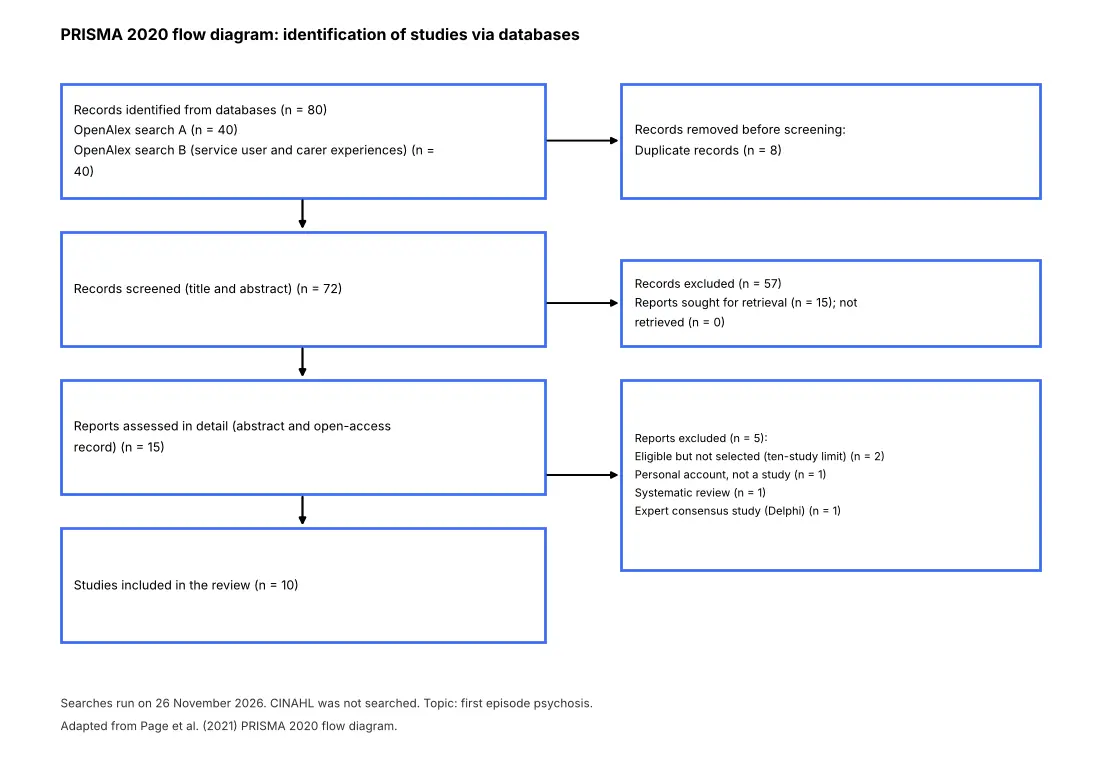
All 80 records were exported into a screening log, and 8 duplicates were removed, leaving 72 titles to screen. Titles about other countries, protocols, trials of therapies, risk factors, imaging and other topics were excluded here. That left 15 reports for closer assessment against the criteria. The abstract and open-access record of each of these reports were read, and the reason for every exclusion was recorded. The log lists every record by its identifier, the search in which it appeared and the decision reached, so that each exclusion can be traced. Ten studies met the criteria, and the numbers at each stage reconcile in the flow diagram (Page et al., 2021). Screening was carried out by one reviewer, which is a recognised limitation of student reviews because a second reviewer would normally check each decision (Aveyard, 2023).
Quality was considered using the Critical Appraisal Skills Programme checklists, which ask structured questions about the aims, design, conduct, results and value of a study (CASP, 2024). The qualitative checklist was completed in full for one interview study, as a worked example in Appendix C, and indicative quality notes for every study are recorded in Appendix B. Those notes are based on the abstract and, for one study, the open full text, so they are judgements of reporting and not a full audit of how the research was conducted. No study was excluded on quality alone, since appraisal was used to weigh the strength of the findings, which is a common approach in nursing reviews (Aveyard, 2023).
Data were extracted into a standard table covering aims, design, sample, setting, methods, findings and limitations. Numerical results were copied as reported and were not recalculated, and extraction was rechecked once against the source records, a step that reduces transcription errors but does not replace independent checking. Findings were grouped into themes by thematic synthesis, with the Q-methodology and service evaluation results reported alongside the interview themes because the review combined studies of different designs (Thomas and Harden, 2008; Braun and Clarke, 2006). The review used published data only and involved no participants, so ethical approval was not required, although the findings of the included studies are reported accurately and with full attribution (Aveyard, 2023).
Findings
Ten studies set in England met the inclusion criteria, published between 2015 and 2025. Eight were interview studies, one was a Q-methodology study and one was a service evaluation that combined interviews with a focus group. They covered the views of people with psychosis, carers, nursing staff, case managers, general practitioners and team members, in early intervention services and on an inpatient ward. Most studies were small and drew on one service or one trust. Each is described below by theme, and the section ends with the quality and limits of the evidence. Because the designs differ, results are presented side by side and are not combined (Barr et al., 2015; Watkins et al., 2018; Lavis et al., 2015).
What service users value
Two studies asked what people value in early intervention. Using Q-methodology with 20 people aged 18 to 35 who were experiencing a first episode of psychosis, Barr et al. (2015) found four factors: a therapeutic relationship, medical care, psychological interventions, and support with coping and recovery. The relationship explained the most variance, which the authors took to show the importance of non-specific factors such as care and recovery. In a service evaluation with nine interviews and one focus group of seven participants, Watkins et al. (2018) identified three themes, consistency and communication, facilitating therapeutic relationships and pushing boundaries, and found that participants valued consistent, flexible support and meeting peers with similar experiences. Both studies used small samples, so the findings may not apply to other services.
Decision-making in treatment was explored in interviews with seven service users with non-affective psychosis, analysed using interpretative phenomenological analysis. Four themes emerged: the need to feel listened to; how psychotic experiences and stigma shape treatment decisions; communication and support; and differing conceptions of recovery. An overarching theme of empowerment ran through participants’ accounts, and the authors suggested that clinicians should attend closely to disempowering aspects of care (Stovell et al., 2016). The sample was small and was not confined to early intervention services, so it speaks to psychosis care in general. The wish to be listened to matches the value placed on the therapeutic relationship in the Q-methodology study (Barr et al., 2015).
The experiences of carers
Two studies looked at carers. Semi-structured longitudinal interviews with 80 carers of young people treated through English early intervention services found that the services helped carers, especially by providing knowledge about medications. However, carers’ emotions could go unacknowledged, which compounded an existing lack of help-seeking (Lavis et al., 2015). A smaller study interviewed eight carers of people with first episode psychosis, recruited from a specialist early psychosis service. Most were female, parents and from Black and minority ethnic backgrounds, and they described violence ranging from being kicked to having weapons used against them, usually at home with no one else present, with effects on their emotional and physical functioning (Onwumere et al., 2018). The second study used a convenience sample from one service, so it shows what is possible and not how often it occurs.
Discharge and the interface with primary care were examined in a qualitative study in England using interviews with service users, carers, general practitioners and practitioners. Most service users and carers described early intervention care positively but raised concerns about access and discharge, and discharge to primary care was often difficult and linked to feelings of abandonment. General practitioners reported difficulty referring people into services, little contact with people while they were in the service and exclusion from care planning, and the authors suggested a joint consultation with the service user, carer, care coordinator and general practitioner (Rickett et al., 2024). The abstract gave no sample size, so the weight of each group’s views cannot be judged. The positive views about knowledge and support agree with the account of carers in the longitudinal study (Lavis et al., 2015).
The experiences of nursing staff and teams
Two studies reported the views of nursing staff. Nine inpatient staff, six of them registered mental health nurses and three nursing assistants, took part in interviews about caring for young people with early psychosis on adult acute wards. Interpretative phenomenological analysis produced five themes, including learning in a new and unpredictable environment, conflict within intergenerational relationships, motivation and hope, and coping and self-preservation. The authors concluded that the relational part of the work was central and that the conventional acute model was unlikely to give the best therapeutic outcomes (Thompson et al., 2019). The finding that relationships matter to staff as well as to service users agrees with the Q-methodology result (Barr et al., 2015).
Case managers with mental health nursing backgrounds, in a single NHS trust in North England, were interviewed about engaging people with first episode psychosis. Hermeneutic interpretative phenomenological analysis produced five master themes: being on the same page; engagement as an interpersonal relationship; managing one’s own emotions; the practicalities of engagement; and organisational factors. Engagement was described as multifaceted, complex and changeable, and helpful strategies included building trust, therapeutic dialogue, shared understanding, collaboration and practical approaches (Henderson et al., 2025). The abstract did not state the number of case managers, so the depth of the sample is unclear. Both nursing studies place the relationship at the centre of the work (Thompson et al., 2019).
Peer support in early intervention was explored through interviews with seven participants, analysed thematically. A central theme was destigmatising psychotic experiences, and participants saw peer support as a source of hope and practical help with benefits for both service users and workers. Other themes covered mutuality, bridging services and peers, ideal worker requirements, and team-working and role clarity (Nguyen et al., 2022). The authors recommended research on the views of ethnic minority groups. The value placed on meeting peers agrees with the service evaluation, in which participants said that meeting others with similar experiences normalised and validated psychosis (Watkins et al., 2018).
The organisational climate of early intervention teams was studied through interviews with 42 team members across four teams in four NHS trusts, in the context of introducing cognitive remediation therapy. Teams differed in leadership style, involvement in decisions and willingness to adopt the therapy, and resource shortages were the main barrier in all teams. Teams with more democratic leadership and staff knowledge of the therapy seemed better placed to integrate it, and the authors concluded that clear communication was key despite limited resources (Lammas et al., 2022). The study was designed around one therapy, so it describes how teams take up new treatments and not how service users experience care. The resource problems fit the concern of case managers about organisational factors (Henderson et al., 2025).
Patterns across the studies
Three patterns appeared across the studies. First, the therapeutic relationship was central for service users, carers and staff alike (Barr et al., 2015). Second, transitions, especially discharge and the move to primary care, were described as points of difficulty and abandonment (Rickett et al., 2024). Third, resources and organisational factors shaped what teams could offer (Lammas et al., 2022). The first pattern appeared in several reports, whereas the second rests mainly on one study and the third on one study of a single therapy, and several studies used small samples, so the patterns should be read as descriptive and not as firm conclusions.
Quality and limits of the evidence
Several limits qualify these findings. All ten studies were qualitative or used Q-methodology, most were small and from one trust or service, and none measured outcomes such as relapse, admission or recovery, so they describe experience but cannot show how well early intervention works (Lavis et al., 2015; Rickett et al., 2024). Participants in several studies were volunteers or a convenience sample, which may favour people who engaged well with services (Onwumere et al., 2018). Interview studies of this kind are useful for describing how care is felt but cannot estimate how common an experience is, and none of the reports followed people for long after discharge, although one did re-interview some of them.
The full-text appraisal in Appendix C of the interview study by Thompson et al. (2019) found a clear aim, a suitable design, purposive homogeneous sampling with stated inclusion criteria, ethics approval and informed consent, and analysis steps with peer comparison and supervision of the audit trail. Its weaknesses were that recruitment methods, interview length, topic guide detail and funding were not reported, there was no reflexive statement although the third author provided access and clinical supervision for interviewees, and member checking was not reported. The other nine studies were appraised from abstracts only, so their quality notes in Appendix B are indicative and not a full audit (Lavis et al., 2015).
Search and selection limits also apply. Five further reports were assessed in detail and excluded, two because they were eligible but not selected under the ten-study limit, one because it was a personal account, one because it was a systematic review and one because it was an expert consensus study. Only the first 40 records of each search were screened, so relevant studies may have been missed. The abstracts of Barr et al. (2015), Stovell et al. (2016) and Nguyen et al. (2022) did not state a setting, so England was judged from the authors’ affiliations, and this judgement could be wrong for any of them.
Wider Discussion
The findings suggest that what people value most in English early intervention services is the therapeutic relationship, consistency and being listened to (Barr et al., 2015). Nursing staff described the same relational core from the other side of the relationship (Thompson et al., 2019). This fits the expectation in the NICE guideline that practitioners work in partnership with people and their carers in an atmosphere of hope and optimism (NICE, 2014). The studies do not show whether stronger relationships lead to better clinical outcomes, because none of them measured outcomes, so the link between the relationship and recovery is an inference and not a finding. Because the studies were drawn only from England, the picture may differ in other parts of the UK.
Carers and transitions were the areas where services fell short. Carers gained knowledge but their emotions could go unacknowledged (Lavis et al., 2015), and the carer-focused education and support recommended by the guideline would be expected to address this (NICE, 2014). Discharge to primary care was described as difficult, with general practitioners excluded from care planning (Rickett et al., 2024). The authors proposed a role for general practitioners in monitoring and managing physical health, a topic explored further in physical health in psychosis. Taken together, these accounts suggest that gaps appear at the edges of the service, especially at discharge, more than within the treatment itself, although this reading rests on few studies.
Three priorities follow for nursing practice. First, nurses can protect time for consistent relationships and make sure that people are listened to in decisions about treatment (Stovell et al., 2016). Second, teams can ask carers about their own emotional needs and about safety, since carers described violence and kept quiet about it (Onwumere et al., 2018). Third, teams can plan discharge jointly, including the general practitioner, as the joint consultation proposal suggests (Rickett et al., 2024). Each priority is within reach of a team and none depends on new national policy, and each could be checked by a local audit of how many carers have been asked about their own needs.
Several limitations qualify these conclusions. Only OpenAlex was searched, in two searches, CINAHL was not accessible and a planned search of MEDLINE through Europe PMC was not completed, so relevant nursing studies may have been missed (Bramer et al., 2017). Only the first 40 records of each search were screened and one reviewer made all decisions, which is a recognised limitation of student reviews (Aveyard, 2023). Appraisal relied on abstracts for nine studies, the evidence is entirely qualitative and local, and none of the studies reported clinical outcomes, so the conclusions are offered as a structured sample of the evidence and not as a complete account of first episode psychosis care.
Reflection
I began this review expecting that experiences of early intervention would be described mainly in terms of treatment, because the national standards are written in terms of waiting times and packages of care. The studies changed that expectation. People described relationships, being listened to and being supported at the end of care far more often than the content of treatment. I had thought of the service as something delivered to a person, and I now see that it is also something built between people over time. I became more aware that my own placements may have shaped what I notice, and that I have rarely asked what a service felt like to the person using it.
The search was harder than I expected. The topic produced thousands of records, many of them trials, protocols and studies of individual therapies, and I had to decide quickly which concerned experiences of services in England. Several relevant papers came from one research group, and I had to leave some out under my own ten-study limit. That was uncomfortable, because each excluded paper had something to teach, and I had to check that I was not choosing studies that supported what I already believed. Writing down each decision was slow, but it showed me how much a review depends on its rules. In future I will record each exclusion at the time it is made, because reconstructing the reasons later would be harder and less honest.
Appraising the interview study of nursing staff was the most instructive part of the work. It stated its inclusion criteria, its ethics approval and its analysis steps clearly, yet it did not report how participants were recruited, how long interviews lasted or who funded the work. I had assumed that a study with such a careful method would report everything, and I was surprised that it did not. I realise that I tend to trust a paper that sounds careful, and that is a habit I need to change. I now ask what a paper leaves out before I ask what it found, and I check whether the authors were close to the people they studied. A checklist helps me to slow down and to read each study on its own terms.
In practice, I will ask carers how they are coping as well as how the person is, and I will ask what they would want to know before discharge. I will also ask supervisors how the team plans the move to primary care. I need to improve my skills in reading qualitative studies critically, and I want to learn more about how teams support carers in practice. I will review these goals at the end of each placement with my practice supervisor, and I will keep a short note of what I have seen, so that I can see whether my practice changes over time. This review has shown me that a service is only as good as the conversations within it.
Conclusion
This dissertation set out to review evidence from England on experiences of early intervention services for people with first episode psychosis, their carers and staff. Ten studies, comprising interviews, a Q-methodology study and a service evaluation, showed that the therapeutic relationship mattered most to service users and staff, that carers gained knowledge but could feel unheard, and that discharge and the move to primary care were points of difficulty. The review was limited to England and to a small number of studies, so its findings are offered with care.
These results come from small and local studies, so they do not show how common each experience is or whether better experiences lead to better outcomes. The strongest finding is the central place of the relationship, which appeared in several studies, and the weakest is the account of discharge, which rests mainly on one study. Their value lies in showing where services are felt to work and where they are not, and not in proving that one approach is best. Local review of how first episode psychosis care is experienced at discharge would be a practical first step, and it would be low in cost.
For nursing practice, the review supports protecting time for consistent relationships, asking carers about their own needs and about safety, and planning discharge jointly with primary care. The strength of this evidence is limited by the restricted search, single-reviewer screening, reliance on abstracts and the absence of outcome measures. This review therefore offers a starting point for local discussion and not a final judgement. Future research could follow people with first episode psychosis and their carers through discharge and measure both experience and outcome.
Reference List
Aveyard, H. (2023) Doing a literature review in health and social care: a practical guide. 5th edn. Open University Press.
Barr, K. et al. (2015) ‘An exploration of what service users value about early intervention in psychosis services’, Psychology and Psychotherapy: Theory, Research and Practice, 88(4), pp. 468-480. doi:10.1111/papt.12051.
Bramer, W.M. et al. (2017) ‘Optimal database combinations for literature searches in systematic reviews: a prospective exploratory study’, Systematic Reviews, 6, article 245. doi:10.1186/s13643-017-0644-y.
Braun, V. and Clarke, V. (2006) ‘Using thematic analysis in psychology’, Qualitative Research in Psychology, 3(2), pp. 77-101. doi:10.1191/1478088706qp063oa.
CASP (2024) CASP checklists. Oxford: Critical Appraisal Skills Programme. Available at: https://casp-uk.net/casp-checklists/ (Accessed: 9 November 2026).
Henderson, P. et al. (2025) ‘Case managers’ experiences of engagement with service users in UK early intervention services for first-episode psychosis: a hermeneutic interpretive phenomenological analysis study’, Early Intervention in Psychiatry, 19(10), e70098. doi:10.1111/eip.70098.
Lammas, F. et al. (2022) ‘The organisational climate of NHS Early Intervention Services (EIS) for psychosis: a qualitative analysis’, BMC Health Services Research, 22, article 509. doi:10.1186/s12913-022-07790-0.
Lavis, A. et al. (2015) ‘Layers of listening: qualitative analysis of the impact of early intervention services for first-episode psychosis on carers’ experiences’, The British Journal of Psychiatry, 207(2), pp. 135-142. doi:10.1192/bjp.bp.114.146415.
Methley, A.M. et al. (2014) ‘PICO, PICOS and SPIDER: a comparison study of specificity and sensitivity in three search tools for qualitative systematic reviews’, BMC Health Services Research, 14, article 579. doi:10.1186/s12913-014-0579-0.
National Institute for Health and Care Excellence (NICE) (2014) Psychosis and schizophrenia in adults: prevention and management (NICE guideline CG178). London: NICE. Available at: https://www.nice.org.uk/guidance/cg178 (Accessed: 26 November 2026).
National Institute for Health and Care Excellence (NICE) (2015) Psychosis and schizophrenia in adults (NICE quality standard QS80). London: NICE. Available at: https://www.nice.org.uk/guidance/qs80 (Accessed: 26 November 2026).
Nguyen, J. et al. (2022) ‘Peer support in early intervention in psychosis: a qualitative research study’, Journal of Mental Health, 31(2), pp. 196-202. doi:10.1080/09638237.2021.1922647.
NHS England (2026) Early intervention in psychosis: recording and reporting on NICE-recommended interventions using SNOMED CT codes. London: NHS England. Available at: https://www.england.nhs.uk/mental-health/adults/early-intervention-in-psychosis/ (Accessed: 26 November 2026).
Nursing and Midwifery Council (NMC) (2018) The Code: professional standards of practice and behaviour for nurses, midwives and nursing associates. London: NMC. Available at: https://www.nmc.org.uk/standards/code/ (Accessed: 26 November 2026).
Onwumere, J. et al. (2018) ‘The last taboo: the experience of violence in first-episode psychosis caregiving relationships’, Psychology and Psychotherapy: Theory, Research and Practice, 92(1), pp. 1-19. doi:10.1111/papt.12173.
Page, M.J. et al. (2021) ‘The PRISMA 2020 statement: an updated guideline for reporting systematic reviews’, BMJ, 372, article n71. doi:10.1136/bmj.n71.
Priem, J., Piwowar, H. and Orr, R. (2022) ‘OpenAlex: a fully-open index of scholarly works, authors, venues, institutions, and concepts’, arXiv, 2205.01833. doi:10.48550/arXiv.2205.01833.
Rickett, M. et al. (2024) ‘Collaboration across the primary and specialist care interface in Early Intervention in Psychosis services: a qualitative study’, British Journal of General Practice, 74(747), pp. e709-e716. doi:10.3399/bjgp.2023.0558.
Stovell, D. et al. (2016) ‘Service users’ experiences of the treatment decision-making process in psychosis: a phenomenological analysis’, Psychosis, 8(4), pp. 311-323. doi:10.1080/17522439.2016.1145730.
Thomas, J. and Harden, A. (2008) ‘Methods for the thematic synthesis of qualitative research in systematic reviews’, BMC Medical Research Methodology, 8, article 45. doi:10.1186/1471-2288-8-45.
Thompson, J. et al. (2019) ‘The experiences of inpatient nursing staff caring for young people with early psychosis’, Journal of Research in Nursing, 24(1-2), pp. 75-85. doi:10.1177/1744987118818857.
Watkins, S., Sanderson, C. and Richards, V. (2018) ‘Service user perspectives of an early intervention in psychosis service: a service evaluation’, Mental Health Review Journal, 23(3), pp. 156-164. doi:10.1108/mhrj-09-2017-0037.
Appendix A: Search strategy
This appendix records the searches run for the first episode psychosis review so that the process can be repeated and checked.
Two searches on first episode psychosis were run on 26 November 2026 using the OpenAlex works API. The first 40 records of the first search and the first 40 of the second, ranked by relevance, were retrieved and screened by title and abstract.
| Database | Platform | Date run | Search string | Limiters | Hits |
|---|---|---|---|---|---|
| OpenAlex search A | OpenAlex API | 26 November 2026 | search=first episode psychosis early intervention experiences | Filter: authorships.countries:GB; is_oa:true; publication_year:2015-2026; type:article. 5,014 matches in total; the first 40 by relevance were screened. | 40 |
| OpenAlex search B (service user and carer experiences) | OpenAlex API | 26 November 2026 | search=early intervention psychosis service user carer experiences outcomes | Filter: authorships.countries:GB; is_oa:true; publication_year:2015-2026; type:article. 3,972 matches in total; the first 40 by relevance were screened. | 40 |
CINAHL could not be accessed and was not searched, so no CINAHL results are reported. A planned MEDLINE search through Europe PMC was attempted on the same day but the service refused repeated requests, so it was not completed for first episode psychosis; search B, which targeted service user and carer experiences, was used instead.
OpenAlex matches search terms in the title, abstract or full text, and the country filter matches any record with at least one author affiliated to a UK institution. UK setting and relevance were therefore checked for each study at the assessment stage. Records identified: 80 (40 + 40); duplicates removed: 8; records screened: 72.
Appendix B: Data extraction table
The table summarises each study included in this first episode psychosis review: its aim, design, sample, methods, key findings, limitations and relevance to first episode psychosis.
| Author / year / country | Aim | Design | Sample and setting | Methods | Key findings | Limitations / quality | Relevance to first episode psychosis |
|---|---|---|---|---|---|---|---|
| Barr et al. (2015), England (early intervention services; judged from affiliations) | To explore what service users value about early intervention in psychosis services. | Q-methodology study of first episode psychosis service experiences. | 20 people aged 18 to 35 experiencing a first episode of psychosis. | Q-sort with factor analysis of statements about early intervention services on first episode psychosis care. | First episode psychosis: four factors (therapeutic relationship, medical care, psychological interventions, coping and recovery); relationship explained most variance. | Indicative (abstract only): small sample; setting not stated in the abstract; no limitations stated. | What people with first episode psychosis value in services. |
| Watkins et al. (2018), England (one NHS trust) | To gather the views of people using an early intervention in psychosis service. | Service evaluation of first episode psychosis care with inductive thematic analysis. | Nine individual interviews and one focus group of seven participants. | Interviews and a focus group analysed by inductive thematic analysis on first episode psychosis care. | First episode psychosis: three themes (consistency and communication, therapeutic relationships, pushing boundaries); valued flexible support and peers. | Indicative (abstract only): one service; service evaluation not research; no limitations stated. | Service user views of first episode psychosis care. |
| Stovell et al. (2016), England (judged from affiliations) | To explore how people with non-affective psychosis experience treatment decision-making. | Qualitative interview study of psychosis, including first episode psychosis, using interpretative phenomenological analysis. | Seven service users with non-affective psychosis. | In-depth semi-structured interviews analysed by interpretative phenomenological analysis on first episode psychosis care. | Four themes (being listened to, stigma, communication, recovery) with overarching empowerment; first episode psychosis not specified. | Indicative (abstract only): small sample; not confined to early intervention; setting not stated in the abstract. | Treatment decisions in psychosis. |
| Lavis et al. (2015), England (early intervention services) | To analyse the impact of early intervention services on carers’ experiences. | Qualitative longitudinal interview study of carers of people with first episode psychosis. | 80 carers of young people treated through English early intervention services. | Semi-structured longitudinal interviews analysed qualitatively on first episode psychosis care. | First episode psychosis services helped carers with knowledge about medications; carers’ emotions could go unacknowledged, compounding a lack of help-seeking. | Indicative (abstract only): carers only; part of a larger programme; no limitations stated. | Carers of people with first episode psychosis. |
| Onwumere et al. (2018), England (a specialist early psychosis service) | To explore carers’ experience of violence in first episode psychosis caregiving relationships. | Cross-sectional qualitative interview study of first episode psychosis carers. | Eight carers, mostly female parents from Black and minority ethnic backgrounds (convenience sample). | Semi-structured interviews analysed by interpretative phenomenological analysis. | First episode psychosis carers described violence, fear and keeping quiet; effects on emotional and physical functioning and safety. | Indicative (abstract only): convenience sample from one service; published online 2018 (issue 92(1)). | Violence in first episode psychosis caregiving. |
| Rickett et al. (2024), England (interviews with service users, carers, general practitioners and practitioners) | To explore the role of general practitioners in supporting people with psychosis within early intervention services. | Qualitative interview study of first episode psychosis services and primary care with thematic analysis. | Not stated in the abstract (service users, carers, general practitioners and practitioners). | Semi-structured interviews to information power, thematic analysis with constant comparison on first episode psychosis care. | First episode psychosis care described positively but concerns about access and discharge; general practitioners excluded from care planning; abandonment at discharge. | Indicative (abstract only): sample size not stated; related to a longer programme by the same team. | Discharge from first episode psychosis services. |
| Thompson et al. (2019), England (two adult acute inpatient units in one NHS trust) | To understand the process of hospitalisation in early psychosis from the perspective of inpatient nursing staff. | Qualitative interview study of first episode psychosis hospitalisation using interpretative phenomenological analysis. | Nine inpatient staff (six registered mental health nurses, three nursing assistants). | Semi-structured interviews transcribed and analysed by interpretative phenomenological analysis on first episode psychosis care. | First episode psychosis on adult wards: five themes; relational care central; conventional acute model unlikely to give best outcomes. | CASP qualitative appraisal in Appendix C (open full text). One trust; recruitment, topic guide, interview length and funding not reported; no reflexive statement. | Nursing care in first episode psychosis admissions. |
| Henderson et al. (2025), England (a single NHS trust in North England) | To examine how case managers experience engaging people with first episode psychosis. | Qualitative interview study of first episode psychosis engagement using hermeneutic interpretative phenomenological analysis. | Not stated in the abstract (case managers with mental health nursing backgrounds). | Semi-structured interviews with a purposive sample, analysed by hermeneutic interpretative phenomenological analysis. | First episode psychosis engagement: five master themes; helpful strategies were trust, dialogue, shared understanding and collaboration. | Indicative (abstract only): sample size not stated; one trust; further research suggested. | Nurse case managers and first episode psychosis. |
| Nguyen et al. (2022), England (judged from affiliations) | To explore the key elements of peer support in early intervention in psychosis services. | Qualitative interview study of first episode psychosis services and peer support with thematic analysis. | Seven participants chosen by purposive sampling. | Interviews analysed thematically on first episode psychosis care. | First episode psychosis peer support seen as destigmatising, hopeful and practical; themes of mutuality and role clarity. | Indicative (abstract only): small sample; setting not stated in the abstract; published online 2021. | Peer support in first episode psychosis. |
| Lammas et al. (2022), England (four NHS trusts) | To examine the organisational climate of early intervention teams and barriers to introducing cognitive remediation. | Qualitative interview study of first episode psychosis teams using thematic analysis. | 42 team members across four early intervention teams in four NHS trusts. | Semi-structured interviews analysed by thematic analysis on first episode psychosis care. | Teams differed in leadership and involvement in decisions; resource shortages the main barrier; democratic leadership helped adoption in first episode psychosis teams. | Indicative (abstract only): about one therapy, not service user experience; no limitations stated. | Team climate in first episode psychosis services. |
Appendix C: Critical appraisal checklist
CASP qualitative studies checklist (CASP, 2024), completed for Thompson et al. (2019), a study included in this first episode psychosis review. Answers: Yes, No or Can’t tell, each with a short justification.
| # | Question | Answer | Justification |
|---|---|---|---|
| Section A: Are the results valid? | |||
| 1 | Was there a clear statement of the aims of the research? | Yes | The aim is stated clearly: to understand the process of hospitalisation in first episode psychosis from the perspective of inpatient nursing staff, especially their experience of working with younger people on adult acute wards. |
| 2 | Is a qualitative methodology appropriate? | Yes | A qualitative design using interpretative phenomenological analysis suits a question about how staff experience care of people with first episode psychosis, and the authors explain that it gives depth from a small sample in a defined context. |
| 3 | Was the research design appropriate to address the aims of the research? | Yes | Semi-structured interviews with a purposive, homogeneous sample suit the aim and sit within a larger study of several perspectives, although the topic guide is described only in general terms. |
| 4 | Was the recruitment strategy appropriate to the aims of the research? | Can’t tell | Nine staff who had worked with early intervention service users in the previous 12 months, and had at least 18 months of inpatient experience, were included, but the way they were recruited and any exclusion criteria are not reported. |
| 5 | Was the data collected in a way that addressed the research issue? | Can’t tell | Interviews were conducted by the first author at two units in one trust and transcribed and anonymised, but the length of interviews, the recording method and whether saturation was reached are not reported. |
| 6 | Has the relationship between researcher and participants been adequately considered? | No | There is no explicit reflexive statement, and the third author gave access and clinical supervision for interviewees, but the effect of that relationship on participants or interpretation is not discussed. |
| Section B: What are the results? | |||
| 7 | Have ethical issues been taken into consideration? | Yes | Approval came from a full review by an NHS research ethics committee and all participants gave informed consent, and transcripts were anonymised, although the handling of distress in interviews about first episode psychosis care is not described. |
| 8 | Was the data analysis sufficiently rigorous? | Yes | Analysis moved from line-by-line coding to cross-case themes, the analysis was compared with two co-authors and an experienced supervisor monitored the audit trail, but member checking and independent second coding are not reported. |
| 9 | Is there a clear statement of findings? | Yes | Five themes are set out with extracts attributed by pseudonym, which show how staff saw first episode psychosis admissions, and the findings are discussed in relation to organisations, staff, families and young people. |
| Section C: Will the results help locally? | |||
| 10 | How valuable is the research? | Can’t tell | The study adds to knowledge of nursing care in first episode psychosis admissions and notes the trade-off between depth and context in small studies, but it has no limitations section and reports no funding or competing interests statement. |
Appendix D: PRISMA flow diagram
This dissertation is a worked example that shows the structure and standard of a 5,000-word literature-based Independent Project. It is provided for learning and is not to be submitted as a student’s own work.