

Reducing Restrictive Practice in Mental Health Inpatient Settings: Staff and Service User Perspectives
 By Dr. Robertson Prime, Research Fellow
This dissertation is a worked example that shows the structure and standard of a 5,000-word literature-based Independent Project. It is provided for learning and is not to be submitted as a student’s own work.
Abstract
Background: Restraint and seclusion are among the most contested parts of inpatient mental health care, and the law requires units to reduce and record the use of force. Less is known about what UK studies show about the views and experiences of staff and service users of restrictive practice.
Aim: To critically review UK evidence on the views and experiences of staff and service users of restrictive practice on mental health inpatient units.
Methods: A structured literature review using the Population, Exposure and Outcome framework. OpenAlex was searched twice on 15 November 2026, because CINAHL could not be accessed and a planned MEDLINE search was not completed. The first 40 records of each search were screened: 80 records were identified, 73 screened after the removal of duplicates and 10 UK studies included. Quality was considered using Critical Appraisal Skills Programme questions, and findings were combined by thematic synthesis.
Findings: The included studies of restrictive practice (n = 10) comprised interview studies, a staff survey and a ward evaluation. People who were restrained described fear, powerlessness and distress before and after restraint, staff described strain and varied attitudes, and one ward reported fewer restraints and seclusions after introducing safety huddles. Together, these accounts suggest that restrictive interventions leave a mark on everyone involved. The studies were small and mostly qualitative, so they describe what was experienced and not how often it happens.
Conclusions and implications for practice: For nursing practice, services can offer a debrief after every restraint that includes the person, review routine restrictions and support staff with training on attitudes. The evidence is limited by the restricted search, single-reviewer screening, reliance on abstracts and small samples.
Keywords: restrictive practice; physical restraint; seclusion; mental health nursing; literature review.
Brief at a glance
- Framework
- PEO
- Design
- Literature review (PEO)
- Studies included
- 10
Introduction
Restraint, seclusion and other restrictive interventions are used on inpatient mental health wards when staff judge that a person is a risk to themselves or to others, and they are among the most contested parts of nursing care. The Mental Health Units (Use of Force) Act 2018 was passed to reduce the inappropriate use of force and to increase oversight of its use (DHSC, 2021). The guideline from the National Institute for Health and Care Excellence (NICE) on violence and aggression includes advice on using restrictive interventions in inpatient psychiatric settings (NICE, 2015). Nurses and healthcare support workers carry out much of this work on the ward, and the Code of the Nursing and Midwifery Council requires them to treat people with dignity (NMC, 2018). Restrictive practice is therefore a professional duty as well as a matter of ward policy.
This dissertation reviews UK research on the views and experiences of staff and of people who have been restrained or secluded, together with the reported use of restrictive interventions. A literature review suits the question because the evidence is scattered across interviews, a survey and a ward evaluation, and a structured process makes each choice visible and open to challenge (Aveyard, 2023). The review is limited to the UK so that its conclusions can be read against one law and one guideline (DHSC, 2021; NICE, 2015). It asks how people describe being restrained, how staff describe their part in it, and what is known about reducing it. It then considers what this means for mental health nursing practice. Their views are evidence that can show whether the changes required by law are felt on the ward.
Background and Justification
Violence and aggression are relatively common in health and social care, and they fall most heavily on mental health services. NICE reported that between 2013 and 2014 there were 68,683 assaults on NHS staff in England, and that 69% of them were in mental health or learning disability settings, with violence and aggression in mental health care occurring most often in inpatient settings (NICE, 2015). The guideline was written to safeguard both staff and people who use services, and it contains a section on using restrictive interventions in inpatient psychiatric settings. Restraint and seclusion are therefore discussed in national guidance as part of the management of violence, and not as separate topics (NICE, 2015; NMC, 2018). Violence prevention and restrictive interventions are thus linked in national guidance.
The Mental Health Units (Use of Force) Act 2018 defines the territory in law. Its statutory guidance explains that the use of force includes the physical, mechanical or chemical restraint of a patient, and the isolation of a patient, including seclusion and segregation (DHSC, 2021). The aim of the Act and the guidance is to reduce the use of force and to ensure accountability and transparency about it in mental health units. The Act applies in England and Wales, and the guidance is addressed to NHS and independent hospitals providing NHS-funded care in England (UK Parliament, 2018; DHSC, 2021). These definitions shape which practices count as restrictive in the studies reviewed here. The Act covers drugs and devices as well as physical holds, so the studies reviewed describe only part of what the law treats as force (DHSC, 2021).
The Act places specific duties on every mental health unit. A responsible person must be appointed, and a policy on the use of force must be published that sets out the steps to be taken to reduce it (UK Parliament, 2018). Staff must be trained, and each use of force must be recorded, including any efforts made to avoid it, with the record kept for three years. The Secretary of State must publish annual statistics on the use of force (UK Parliament, 2018). The guidance adds that the policy should be developed in consultation with current and former patients, their families and carers (DHSC, 2021). These duties make the experience of those who are restrained a matter for ward planning.
Training under the Act must cover how to involve patients in the planning, development and delivery of care, and how to show respect for their past and present wishes and feelings (UK Parliament, 2018). The statutory guidance also lists the impact of trauma and the impact of any use of force on a patient’s mental and physical health among the topics that training should address (DHSC, 2021). service user involvement is therefore built into the law as well as into good practice. This means that the views of people who have been restrained are evidence about whether the law is working as intended, and they are not an optional addition to it.
The Code of the Nursing and Midwifery Council applies to every registered nurse working on these wards. It requires nurses to treat people as individuals and to respect their dignity, and to recognise and work within the limits of their competence, which includes knowing when a restrictive intervention goes beyond what is needed (NMC, 2018). Research on how staff and people who use services describe these interventions is spread across several designs, and a structured review can bring it together if it states its method and limits (Aveyard, 2023). Studies of people, their exposures and their outcomes fit a framework that separates the population, the exposure and the outcome (Methley et al., 2014).
This review therefore examines UK research on restrictive practice against the national context described above. It is limited to UK studies so that the findings can be read against the Act, the guideline and the Code of the Nursing and Midwifery Council (DHSC, 2021; NICE, 2015; NMC, 2018). It looks at three linked questions: how people who were restrained or secluded describe the experience, how staff describe their own views and distress, and what a local evaluation reported when a ward tried to reduce the use of restrictive interventions. It does not assess whether any one reduction programme works better than another. Studies of staff and service users are read together so that the same practices can be seen from both sides.
Title, Aim and Objectives
What do UK studies show about the views and experiences of staff and service users of restrictive practice on mental health inpatient units?
Title explained
The title names the focus on reducing restrictive practice, the mental health inpatient setting, the two groups whose perspectives are reviewed and the literature review design that structures the whole work.
Aim
To critically review UK evidence on staff and service user views of restrictive practice on mental health inpatient units.
Objectives
- To identify and appraise UK research on restrictive practice.
- To synthesise findings on experiences, attitudes and reported use.
- To make recommendations for nursing practice.
Methodology
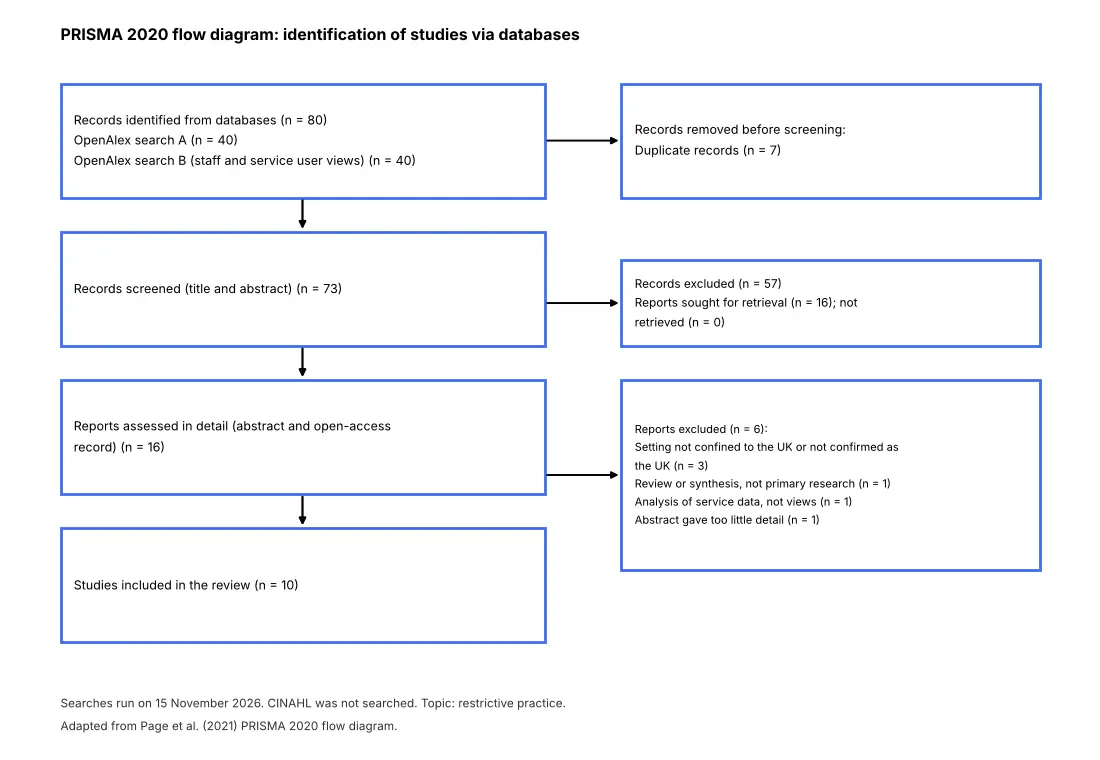
This literature-based dissertation is a structured review of published primary research on restrictive practice. It aims to be transparent and reproducible, but it is smaller in scope than a full systematic review, which would normally involve several reviewers, many more databases and exhaustive searching (Aveyard, 2023). The review is reported with reference to the PRISMA 2020 statement, which lists the items that should be described and recommends a flow diagram showing how records move through identification, screening and inclusion (Page et al., 2021). Appendix D presents that flow diagram, Appendix A records each search string, Appendix B tabulates the included studies and Appendix C gives a worked critical appraisal. Together, the appendices allow another reader to check each decision and to repeat the process.
The review question was framed using the Population, Exposure and Outcome (PEO) structure, which suits questions about experiences and influencing factors rather than the effects of a treatment. The population was staff and people who use services on mental health inpatient units in the UK, including young people. The exposure was restrictive practice, meaning restraint, seclusion and other restrictions on freedom, and the outcomes were their views, experiences, attitudes and reported use of restrictive interventions. Structured frameworks help to translate a broad topic into searchable concepts, although the choice of framework affects how sensitive a search is (Methley et al., 2014; Aveyard, 2023). Because the evidence included interviews, a survey and a ward evaluation, qualitative, quantitative and mixed-methods research was eligible for inclusion.
Two searches were run on 15 November 2026 in OpenAlex, an open index of scholarly works that covers a large and growing proportion of the published literature (Priem et al., 2022). The first search used the words restrictive practice. The second combined the words restrictive practice, mental health, inpatient, staff, service user and experiences, to bring studies of views on wards higher in the results. Both searches were limited to open-access records published between 2015 and 2026 with at least one author affiliated to a UK institution. Both searches were restricted to journal articles. Combining more than one source is advised because a single database misses relevant studies (Bramer et al., 2017). The exact strings and settings are given in Appendix A.
CINAHL, the main nursing database, could not be accessed, and a planned search of MEDLINE through Europe PMC was not completed because the service refused repeated requests on the day of searching. The second OpenAlex search was therefore used in its place. These gaps mean that some relevant nursing studies may not have been found, a risk that is well recognised when the combination of databases is restricted (Bramer et al., 2017). OpenAlex matches terms anywhere in the text, so many records were not relevant. It also ranks records by relevance, and the two searches matched 34,162 and 720 records. Only the first 40 records of the first search and the first 40 of the second, 80 in total, were screened, so the review should be read as a structured sample of the literature and not as a complete search (Aveyard, 2023).
Studies were eligible if they reported the views or experiences of staff or of people who use services, or the reported use of restrictive interventions, on mental health inpatient units in the UK. Reports had to be peer-reviewed, written in English, open access and published from 2015 onwards. UK origin was judged from the stated setting and, where the abstract did not name one, from author affiliations. Reviews, protocols, studies of service data without views, studies set outside the UK or in several countries and reports without a usable abstract were excluded. Clear criteria applied consistently reduce selection bias and allow the decisions to be audited. The extraction table is presented in Appendix B so that readers can compare studies at a glance (Page et al., 2021; Aveyard, 2023).
All 80 records were exported into a screening log, and 7 duplicates were removed, leaving 73 titles to screen. Titles about other countries, other settings such as schools and dementia care, and other topics were excluded here, and many records matched only because of the word restrictive. That left 16 reports for closer assessment against the criteria. The abstract and open-access record of each of these reports were read, and the reason for every exclusion was recorded. The log lists every record by its identifier, the search in which it appeared and the decision reached, so that each exclusion can be traced. Ten studies met the criteria, and the numbers at each stage reconcile in the flow diagram (Page et al., 2021). Screening was carried out by one reviewer, which is a recognised limitation of student reviews because a second reviewer would normally check each decision (Aveyard, 2023).
Quality was considered using the Critical Appraisal Skills Programme checklists, which ask structured questions about the aims, design, conduct, results and value of a study (CASP, 2024). The qualitative checklist was completed in full for one interview study, as a worked example in Appendix C, and indicative quality notes for every study are recorded in Appendix B. Those notes are based on the abstract and, for one study, the open full text, so they are judgements of reporting and not a full audit of how the research was conducted. No study was excluded on quality alone, since appraisal was used to weigh the strength of the findings, which is a common approach in nursing reviews (Aveyard, 2023).
Data were extracted into a standard table covering aims, design, sample, setting, methods, findings and limitations. Numerical results were copied as reported and were not recalculated, and extraction was rechecked once against the source records, a step that reduces transcription errors but does not replace independent checking. Findings were grouped into themes by thematic synthesis, with the survey and evaluation results reported alongside the qualitative themes because the review combined studies of different designs (Thomas and Harden, 2008; Braun and Clarke, 2006). The review used published data only and involved no participants, so ethical approval was not required, although the findings of the included studies are reported accurately and with full attribution (Aveyard, 2023).
Findings
Ten UK studies met the inclusion criteria, published between 2020 and 2026. Eight were qualitative interview studies, one was a cross-sectional survey of staff and one was a ward evaluation reported in a conference abstract. They covered adult acute wards, medium secure services and units for young people, and the views of women, forensic inpatients, young people and staff. Each is described below by theme, and the section ends with the quality and limits of the evidence. The number of participants ranged from six to 106. Because the designs differ, results are presented side by side and are not combined (Krayem et al., 2025; Chaudhry and Lekka, 2021).
Experiences of people who were restrained or secluded
Two studies of women described powerlessness. In interviews with 20 women, three themes were powerlessness, dehumanisation, and relationships and communication, and the authors recommended gender-aware, trauma-informed training for all staff, a review of policies on invasive searches and sanitary products in seclusion (Scholes et al., 2022). In interviews with 22 women who were current inpatients, powerlessness was again the overarching theme, with restrictions seen as punitive and a sense of having no voice, although restrictions also gave some a sense of safety (Tully et al., 2023). The two studies came from related research teams and used thematic analysis, so their agreement may not be independent. Both recruited women only, so they cannot show whether men describe the same powerlessness, although the secure-service study below included other participants (Askew et al., 2020).
Seclusion was described in terms of fear. Seven forensic inpatients in a medium secure hospital described intense fear, not getting the care they needed, feeling abused and a power struggle with staff, and the authors recommended that observation be carried out discreetly and sensitively (Askew et al., 2020). The abstract did not state the country of the hospital, so the UK setting was judged from the affiliations of the authors. A further study of five service users and five staff in a UK secure service found that, after physical restraint, service users described emotional impact, changes to the relationship with staff and a view of whether restraint was necessary (Duffy et al., 2023).
Young people described restraint as a process that began before any touch. In interviews with eight young people aged 10 to 13 on three units in England, the authors set out three themes in the form of a thunderstorm: the gathering before escalation, the restraint itself and the aftermath. Some young people felt that restraint was used instead of de-escalation, and many were left with unanswered questions and lasting distress (Nielson et al., 2026). Five of the eight felt that restraint had either not helped them or had made their time in hospital worse. The sample was small and the young people were younger than most inpatients, so the study cannot show how older adolescents or adults would describe the same stages (Askew et al., 2020).
Two studies looked at safety and its limits. In interviews with 18 former patients who had left hospital more than six months earlier, care was described as reactive and not proactive, the environment as chaotic and the relationship with staff as one of unequal power, and the authors concluded that containing risk should not come at the expense of psychological safety (Griffin et al., 2025). In seven service users who had been prevented from self-harming, participants described emotional and behavioural responses to the restriction and positioned self-harm as secondary to distress (Thomas et al., 2025). The interviews took place at least six months after discharge, so accounts may reflect later reflection and not events at the time (Griffin et al., 2025). Both studies suggest that restrictions that protect physical safety can affect psychological safety.
Perspectives of staff
Staff in the secure service described their own side of restraint. They spoke of the response of the staff member, of balancing professional roles and responsibilities, and of moving forward, and the authors concluded that the findings support continuing to reduce restrictive interventions and considering their impact on everyone involved (Duffy et al., 2023). Six staff on two medium secure wards described frustration, powerlessness and anxiety when trying to manage weight in the least restrictive way, which the authors linked to moral distress (Lloyd et al., 2024). The second study was about obesity and not restraint, so it speaks to restrictive practice more broadly than the other studies, and its sample of six is the smallest of the ten.
A survey of 106 nursing and healthcare staff on UK inpatient wards examined attitudes to containment. Attitudes were significantly associated with age, gender, years of experience, therapeutic optimism, educational attainment and personal experience of mental illness. Educational attainment was positively correlated with therapeutic optimism, and stigmatising attitudes were negatively correlated with it (Krayem et al., 2025). The abstract did not name the statistical methods or report the response rate, so the strength of these associations cannot be judged, and the number of wards was not given either. The study does suggest that attitudes of staff are not fixed, which links to the staff distress described by Lloyd et al. (2024).
Reducing restrictive practice: a local evaluation
One study evaluated a local change. Safety huddles were introduced on a general adult acute ward, and restrictive incidents were compared across two three-month periods in 2020. Restraint episodes fell from 47 to 21, seclusion episodes from 19 to 2 and rapid tranquillisation episodes from 10 to 3. All nine staff who answered a short questionnaire believed that huddles had positive potential, but barriers included low or late participation and cancellation because of clinical demands (Chaudhry and Lekka, 2021). The report was a conference abstract, with no control group or statistical test, so the falls cannot be attributed to the huddles with confidence. The pattern fits the survey finding that attitudes to containment varied between staff (Krayem et al., 2025).
Patterns across the studies
Three patterns appeared across the studies. First, people who were restrained or secluded described fear, powerlessness and a loss of voice, whether they were women, young people or forensic inpatients (Scholes et al., 2022). Second, restraint was experienced as extending beyond the incident itself, with a build-up before it and distress after it (Nielson et al., 2026). Third, staff described the strain of restrictive interventions and attitudes that varied between individuals (Duffy et al., 2023). Each pattern appeared in more than one report, although the samples were small, and the studies of service users and of staff did not examine the same incidents.
Differences between settings are also informative. The secure-service studies described fear and a power struggle during seclusion and a changed relationship after restraint (Askew et al., 2020; Duffy et al., 2023), whereas the study of adult inpatient services described reactive care and a chaotic environment (Griffin et al., 2025). These views do not conflict. They suggest that restrictive interventions are experienced at several levels, from the incident itself to the climate of the ward, and that reduction work may need to address both. The studies did not compare settings directly, so the contrast is an interpretation and not a finding.
Quality and limits of the evidence
Several limits qualify these findings. Most studies were qualitative with small samples, from seven to 22 people, so they describe experience in depth but cannot show how common it is. Several were set in secure services, which differ from general acute wards (Askew et al., 2020), and one was a conference abstract (Chaudhry and Lekka, 2021). The two studies of women may overlap in team and method (Tully et al., 2023), and their findings should be read together and not as separate confirmations. Studies of this kind are useful for describing experience but cannot estimate its extent, and none followed participants over time, so it is not known whether views changed after the events described.
The full-text appraisal in Appendix C of the interview study of young people by Nielson et al. (2026) found a clear aim, a suitable interpretative design, public consultation with young people and families, approval from the university and the Health Research Authority, parental consent with the assent of the young people, and line-by-line coding. Its weaknesses were that the numbers approached were not clear in the extracts read, the interviewer was a mental health nurse not known to the participants without a full account of how that shaped the interviews, and there was no mention of a second analyst. The other nine studies were appraised from abstracts only, so their quality notes in Appendix B are indicative and not a full audit (Krayem et al., 2025).
Search and selection limits also apply. Six further reports were assessed in detail and excluded, three because they were set in several countries or in a setting that could not be confirmed as the UK, one because it was a review, one because it analysed service data and not views, and one because its abstract gave too little detail. Studies of restrictive interventions in schools, dementia care and other settings were not eligible, so the review does not cover them. Only the first 40 records of each search were screened, so relevant UK studies may have been missed (Griffin et al., 2025; Nielson et al., 2026).
Wider Discussion
The findings suggest that people who are restrained or secluded on UK inpatient units experience it as frightening and disempowering, and that distress can begin before the intervention and continue after it. Women described powerlessness and dehumanisation (Scholes et al., 2022), and young people described a long aftermath (Nielson et al., 2026). These accounts agree with the aim of the Act to reduce force and to make its use accountable (DHSC, 2021). They suggest that recording an incident of restrictive practice is not the same as understanding its effect on the person, and that debriefing deserves as much attention as prevention. The findings are consistent with the principle that restrictive interventions should be a last resort, although none of the studies tested that principle directly. Staff and service users may also disagree about whether a given restraint was necessary, and the studies did not ask them about the same incident.
Staff accounts show that the strain is shared. Staff on secure wards described moral distress (Lloyd et al., 2024), while a survey showed that attitudes varied with education and optimism (Krayem et al., 2025). The studies did not test whether changing attitudes changes practice, so that link is an inference and not a finding. The evaluation of safety huddles suggests that a ward can reduce restraint and seclusion with a simple change, although the report was a short conference abstract and cannot prove cause (Chaudhry and Lekka, 2021), so replication on other wards would be needed. Wider programmes such as the safewards model are reviewed separately.
Three priorities follow for practice. First, services can offer a debrief after every restraint that includes the person, as the experiences of young people suggest (Nielson et al., 2026). Second, teams can review practices such as searches and routine restrictions, which women experienced as punitive (Tully et al., 2023). Third, services can offer staff support and training on attitudes, since the attitudes and distress of staff varied (Krayem et al., 2025). Each priority is within the reach of a ward team, and none depends on new national policy, although each would need local leaders and managers to protect the time and to support staff who take part.
Several limitations qualify these conclusions. Only OpenAlex was searched, in two searches, CINAHL was not accessible and a planned search of MEDLINE through Europe PMC was not completed, so relevant nursing studies may have been missed (Bramer et al., 2017). Only the first 40 records of each search were screened, one reviewer made all decisions, and the evidence is mostly small qualitative studies, which is a recognised limitation of student reviews (Aveyard, 2023). Appraisal relied on abstracts for nine studies, and the evidence for reducing restrictive practice comes from a single conference abstract, so the conclusions are offered as a structured sample of the evidence and not as a complete account.
Reflection
I began this review expecting that the evidence would be mostly about staff and about how to reduce restraint. The studies changed that expectation. Most of them gave the account of people who had been restrained, and their descriptions of fear, powerlessness and being left with unanswered questions were more vivid than anything I had read in policy documents. I had thought of restrictive practice as an event that begins and ends within minutes, and the young people who described a long build-up and a long aftermath made me rethink that. I became more aware that my own placements may have shaped what I noticed on the ward and what I did not, and that I have rarely asked a patient how it felt.
The search was harder than I expected. The topic produced thousands of records from many settings, including schools and dementia care, and I had to decide quickly which concerned mental health inpatient units in the UK. Several relevant papers were international or did not say where they were set, so I excluded them under my own rules. That was uncomfortable, because each of them had something to teach, and I had to check that I was not choosing studies that supported what I already believed. Writing down each decision was slow, but it showed me how much a review depends on its rules. I also learned to leave a decision for a day and to look at it again before I confirmed it.
Appraising the study of young people was the most instructive part of the work. It involved young people and families in its design, had two approvals and explained consent and assent carefully, yet it did not describe how the interviewer’s own role as a mental health nurse might have shaped the conversations. I had assumed that a study with so much care in its design would report everything, and I was surprised that it did not. I realise that I tend to trust a paper that sounds careful, and that is a habit I need to change. I now ask what a paper leaves out before I ask what it found.
In practice, I will ask whether a person has been offered a debrief after any restraint or seclusion that I witness, and I will ask how they felt about it. I will also ask supervisors how the ward reviews its routine restrictions. I need to improve my skills in reading survey data, since the staff survey here was hard to compare with the interviews, and I want to learn more about how debriefing is done well, including who should lead it and when it should happen. I will review these goals at the end of each placement with my practice supervisor, and I will keep a short note of what I have seen, so that I can see whether my practice changes over time.
Conclusion
This dissertation set out to review UK evidence on the views and experiences of staff and service users of restrictive practice on mental health inpatient units. Ten UK studies, comprising eight interview studies, a survey and a ward evaluation, showed that people described fear, powerlessness and distress that extended before and after restraint, that staff described strain and varied attitudes, and that one ward reported fewer restraints and seclusions after introducing safety huddles.
These results come from small studies and do not prove cause. The strongest finding is the consistency of the accounts of people who were restrained, and the weakest is the single evaluation of a reduction programme, which was reported only as a conference abstract. Their value lies in showing what matters to people and where ward teams can act, and not in proving that one approach is best. Local review of how restrictive practice is debriefed and recorded would be a practical first step, and it would be low in cost, because most of the information is already recorded under the Act. Such a review would also give the ward evidence of its own to set beside the studies described here.
For nursing practice, the review supports a debrief after every restraint that includes the person, a review of routine restrictions and support for staff and training on attitudes. The strength of this evidence is limited by the restricted search, single-reviewer screening, reliance on abstracts and the small samples. Future research could follow wards that introduce reduction programmes over time and could ask patients and staff about the same incidents, so that the two accounts could be compared directly. It could also test whether a debrief changes how people describe the aftermath of restraint.
Reference List
Askew, L., Fisher, P. and Beazley, P. (2020) ‘Being in a seclusion room: the forensic psychiatric inpatients’ perspective’, Journal of Psychiatric and Mental Health Nursing, 27(3), pp. 272-280. doi:10.1111/jpm.12576.
Aveyard, H. (2023) Doing a literature review in health and social care: a practical guide. 5th edn. Open University Press.
Bramer, W.M. et al. (2017) ‘Optimal database combinations for literature searches in systematic reviews: a prospective exploratory study’, Systematic Reviews, 6, article 245. doi:10.1186/s13643-017-0644-y.
Braun, V. and Clarke, V. (2006) ‘Using thematic analysis in psychology’, Qualitative Research in Psychology, 3(2), pp. 77-101. doi:10.1191/1478088706qp063oa.
CASP (2024) CASP checklists. Oxford: Critical Appraisal Skills Programme. Available at: https://casp-uk.net/casp-checklists/ (Accessed: 9 November 2026).
Chaudhry, S. and Lekka, N.P. (2021) ‘Establishing safety huddles on a general adult acute psychiatric ward: staff’s views and relation with restrictive practice’, BJPsych Open, 7(S1), pp. S178-S179. doi:10.1192/bjo.2021.485.
Department of Health and Social Care (DHSC) (2021) Mental Health Units (Use of Force) Act 2018: statutory guidance for NHS organisations in England, and police forces in England and Wales. London: DHSC. Available at: https://www.gov.uk/government/publications/mental-health-units-use-of-force-act-2018 (Accessed: 15 November 2026).
Duffy, M. et al. (2023) ‘An interpretative phenomenological analysis of the experience of the therapeutic relationship between service users and staff after physical restraint in a secure mental health service’, International Journal of Forensic Mental Health, 23(2), pp. 127-141. doi:10.1080/14999013.2023.2223178.
Griffin, B.L. et al. (2025) ‘Exploring how the psychological safety of patients is impacted by restrictive practices in inpatient mental healthcare: a qualitative study’, International Journal of Mental Health Nursing, 34(6), article e70148. doi:10.1111/inm.70148.
Krayem, A. et al. (2025) ‘Survey of staff attitudes towards restrictive practices on mental health inpatient wards’, Journal of Psychiatric Intensive Care, 21(1), pp. 7-15. doi:10.20299/jpi.2024.010.
Lloyd, A. et al. (2024) ‘Staff’s understanding of the role of least restrictive practice in the development of obesity in secure psychiatric inpatients’, The Journal of Mental Health Training, Education and Practice, 19(6), pp. 305-314. doi:10.1108/jmhtep-08-2023-0076.
Methley, A.M. et al. (2014) ‘PICO, PICOS and SPIDER: a comparison study of specificity and sensitivity in three search tools for qualitative systematic reviews’, BMC Health Services Research, 14, article 579. doi:10.1186/s12913-014-0579-0.
National Institute for Health and Care Excellence (NICE) (2015) Violence and aggression: short-term management in mental health, health and community settings (NICE guideline NG10). London: NICE. Available at: https://www.nice.org.uk/guidance/ng10 (Accessed: 15 November 2026).
Nielson, S. et al. (2026) ”In the midst of a thunderstorm’: young people’s experiences of physical restraint in inpatient mental health services in the UK’, International Journal of Mental Health Nursing, 35(1), article e70209. doi:10.1111/inm.70209.
Nursing and Midwifery Council (NMC) (2018) The Code: professional standards of practice and behaviour for nurses, midwives and nursing associates. London: NMC. Available at: https://www.nmc.org.uk/standards/code/ (Accessed: 15 November 2026).
Page, M.J. et al. (2021) ‘The PRISMA 2020 statement: an updated guideline for reporting systematic reviews’, BMJ, 372, article n71. doi:10.1136/bmj.n71.
Priem, J., Piwowar, H. and Orr, R. (2022) ‘OpenAlex: a fully-open index of scholarly works, authors, venues, institutions, and concepts’, arXiv, 2205.01833. doi:10.48550/arXiv.2205.01833.
Scholes, A. et al. (2022) ‘Women’s experiences of restrictive interventions within inpatient mental health services: a qualitative investigation’, International Journal of Mental Health Nursing, 31(2), pp. 379-389. doi:10.1111/inm.12966.
Thomas, J. and Harden, A. (2008) ‘Methods for the thematic synthesis of qualitative research in systematic reviews’, BMC Medical Research Methodology, 8, article 45. doi:10.1186/1471-2288-8-45.
Thomas, J. et al. (2025) ‘A thematic exploration of the experience of inpatient mental-health service-users who are prevented from self-harming’, Issues in Mental Health Nursing, 46(7), pp. 702-710. doi:10.1080/01612840.2025.2492695.
Tully, S. et al. (2023) ”My life isn’t my life, it’s the systems’: a qualitative exploration of women’s experiences of day-to-day restrictive practices as inpatients’, Journal of Psychiatric and Mental Health Nursing, 30(1), pp. 110-122. doi:10.1111/jpm.12855.
UK Parliament (2018) Mental Health Units (Use of Force) Act 2018, c. 27. London: The Stationery Office. Available at: https://www.legislation.gov.uk/ukpga/2018/27/contents (Accessed: 15 November 2026).
Appendix A: Search strategy
This appendix records the searches run for the restrictive practice review so that the process can be repeated and checked.
Two searches on restrictive practice were run on 15 November 2026 using the OpenAlex works API. The first 40 records of the first search and the first 40 of the second, ranked by relevance, were retrieved and screened by title and abstract.
| Database | Platform | Date run | Search string | Limiters | Hits |
|---|---|---|---|---|---|
| OpenAlex search A | OpenAlex API | 15 November 2026 | search=restrictive practice | Filter: authorships.countries:GB; is_oa:true; publication_year:2015-2026; type:article. 34,162 matches in total; the first 40 by relevance were screened. | 40 |
| OpenAlex search B (staff and service user views) | OpenAlex API | 15 November 2026 | search=restrictive practice mental health inpatient staff service user experiences | Filter: authorships.countries:GB; is_oa:true; publication_year:2015-2026; type:article. 720 matches in total; the first 40 by relevance were screened. | 40 |
CINAHL could not be accessed and was not searched, so no CINAHL results are reported. A planned MEDLINE search through Europe PMC was attempted on the same day but the service refused repeated requests, so it was not completed for restrictive practice; search B, which targeted the views of staff and service users, was used instead.
OpenAlex matches search terms in the title, abstract or full text, and the country filter matches any record with at least one author affiliated to a UK institution. UK setting and relevance were therefore checked for each study at the assessment stage. Records identified: 80 (40 + 40); duplicates removed: 7; records screened: 73.
Appendix B: Data extraction table
The table summarises each study included in this restrictive practice review: its aim, design, sample, methods, key findings, limitations and relevance to restrictive practice.
| Author / year / country | Aim | Design | Sample and setting | Methods | Key findings | Limitations / quality | Relevance to restrictive practice |
|---|---|---|---|---|---|---|---|
| Askew et al. (2020), UK (medium secure hospital; country judged from affiliations) | To explore the experience of being in a seclusion room from the perspective of forensic psychiatric inpatients. | Qualitative interview study of restrictive practice (seclusion) using interpretative phenomenological analysis. | 7 forensic psychiatric inpatients in a medium secure hospital. | Interviews about seclusion, a form of restrictive practice, analysed by interpretative phenomenological analysis. | Four themes on seclusion as restrictive practice: intense fear, not getting the care needed, feeling abused and a power struggle; recommended discreet, sensitive observation. | Indicative (abstract only): seven forensic inpatients in one secure hospital; country not stated; no limitations stated; published online 2019. | Seclusion as restrictive practice from the view of service users. |
| Chaudhry and Lekka (2021), UK (general adult acute ward; judged from affiliation, Sheffield) | To evaluate safety huddles on a general adult acute ward and staff views of them in relation to restrictive practice. | Ward evaluation (conference abstract) comparing restrictive practice incidents in two three-month periods, with a short staff questionnaire. | One ward; 9 staff completed the questionnaire. | Counts of restraint, seclusion and rapid tranquillisation before and after safety huddles; anonymous questionnaire; no statistical test reported. | Restrictive practice fell: restraint from 47 to 21, seclusion from 19 to 2 and rapid tranquillisation from 10 to 3; all nine staff saw positive potential; barriers were low or late participation and cancellations. | Indicative (abstract only): conference abstract; one ward; no control; no statistical test; nine respondents. | Local reduction of restrictive practice. |
| Duffy et al. (2023), UK (low to medium secure service) | To explore the therapeutic relationship between service users and staff after physical restraint. | Qualitative interview study of restrictive practice (physical restraint) using interpretative phenomenological analysis. | 10 participants: 5 service users and 5 staff; all service users had been restrained. | Semi-structured interviews about restraint, a form of restrictive practice, analysed by interpretative phenomenological analysis. | Service users: emotional impact, changes to the relationship and appraisal of necessity; staff: staff response, balancing roles and moving forward. | Indicative (abstract only): one secure service; small sample; no limitations stated. | Staff and service user views of restraint. |
| Scholes et al. (2022), UK (inpatient mental health services; wards not stated) | To explore women’s experiences of restrictive interventions within inpatient mental health services. | Qualitative interview study of restrictive practice with thematic analysis. | 20 women. | Semi-structured interviews about restrictive practice, analysed thematically. | Three themes about restrictive practice: powerlessness, dehumanisation, and relationships and communication; recommended trauma-informed training and review of searches. | Indicative (abstract only): restrictive practice in women only; wards not stated; no limitations stated; published online 2021. | Women’s experience of restrictive practice. |
| Tully et al. (2023), UK (inpatient wards; country judged from affiliations) | To explore women’s experiences of day-to-day restrictive practices as inpatients. | Qualitative interview study of restrictive practice with thematic analysis. | 22 women who were current inpatients. | Interviews about day-to-day restrictive practice, analysed thematically. | Powerlessness overall, with restrictions seen as punitive, no voice, impact on relationships and provision of safety; restrictions could increase self-harm. | Indicative (abstract only): women only; country not stated; related team to Scholes et al. (2022); published online 2022. | Everyday restrictive practice for women. |
| Lloyd et al. (2024), UK (two medium secure wards) | To explore staff views of the role of least restrictive practice in the development of obesity in secure inpatients. | Qualitative interview study of staff views of restrictive practice using interpretative phenomenological analysis. | 6 staff, recruited by opportunity sampling. | Semi-structured interviews about managing weight in the least restrictive way, analysed by interpretative phenomenological analysis. | Staff described frustration, powerlessness and anxiety that the authors linked to moral distress. | Indicative (abstract only): six staff; two wards; restrictive practice linked to obesity; focus on obesity and not restraint; authors call for further work. | Staff distress and restrictive practice. |
| Griffin et al. (2025), UK (adult inpatient services; one author affiliated in Australia) | To explore how the psychological safety of patients is affected by restrictive practice in inpatient mental healthcare. | Qualitative interview study of restrictive practice with reflexive thematic analysis. | 18 former patients aged 20 to 60, discharged more than six months earlier. | Semi-structured interviews about restrictive practice, analysed by reflexive thematic analysis. | Four themes: reactive not proactive care, a chaotic environment, a power imbalance and a linked emotional climate; containing risk should not cost psychological safety. | Indicative (abstract only): former patients recalling care; no limitations stated; one author affiliated outside the UK. | Psychological safety and restrictive practice. |
| Krayem et al. (2025), UK (inpatient mental health wards) | To survey staff attitudes towards restrictive practice on mental health inpatient wards. | Cross-sectional online survey of staff about restrictive practice. | 106 nursing and healthcare staff. | Online questionnaire; analysis methods not named in the abstract. | Attitudes to containment were associated with age, gender, experience, therapeutic optimism, education and personal experience of mental illness. | Indicative (abstract only): staff attitudes to restrictive practice; self-selected; response rate and methods not stated; no limitations stated. | Staff attitudes to restrictive practice. |
| Thomas et al. (2025), UK (inpatient psychiatric hospitals; country judged from affiliations) | To explore the experience of inpatients who are prevented from self-harming. | Qualitative interview study of restrictions as restrictive practice with reflexive thematic analysis. | 7 people with a history of self-harm who had been admitted to a psychiatric hospital. | Semi-structured interviews, analysed by reflexive thematic analysis. | Participants described emotional and behavioural responses to being unable to self-harm; self-harm was seen as secondary to distress. | Indicative (abstract only): seven participants; country not stated; no limitations stated. | Means restriction as restrictive practice. |
| Nielson et al. (2026), UK (three inpatient mental health units in England) | To explore young people’s experiences of physical restraint in inpatient mental health services. | Qualitative interview study of restrictive practice (physical restraint) using interpretative phenomenological analysis. | 8 young people aged 10 to 13 (five boys and three girls) from three units. | Individual, face-to-face, augmented, audio-recorded semi-structured interviews about restrictive practice, analysed by interpretative phenomenological analysis. | Three themes: the gathering, the thunderstorm and the aftermath; restraint was emotional, traumatic and confusing, and sometimes used instead of de-escalation. | CASP qualitative appraisal in Appendix C (open full text, read as extracts). Small sample; numbers approached unclear; interviewer’s role not fully reflected on; no second analyst mentioned. | Young people and restrictive practice. |
Appendix C: Critical appraisal checklist
CASP qualitative studies checklist (CASP, 2024), completed for Nielson et al. (2026), a study included in this restrictive practice review. Answers: Yes, No or Can’t tell, each with a short justification.
| # | Question | Answer | Justification |
|---|---|---|---|
| Section A: Are the results valid? | |||
| 1 | Was there a clear statement of the aims of the research? | Yes | The aim is stated clearly: to explore young people’s experiences of physical restraint, a form of restrictive practice, in inpatient mental health services, on the grounds that little is known about their experiences or perspectives. |
| 2 | Is a qualitative methodology appropriate? | Yes | A qualitative approach suits a question about lived experience, and the authors state a constructivist position and explain the use of interpretative phenomenological analysis for a small sample. |
| 3 | Was the research design appropriate to address the aims of the research? | Yes | Individual interviews with an augmented, child-friendly approach suit the aim, and the interview schedule of ten broad questions was shaped by a public consultation with nine young people and eight family members. |
| 4 | Was the recruitment strategy appropriate to the aims of the research? | Can’t tell | Young people were recruited from three units in England, with exclusion criteria for those for whom taking part was judged therapeutically unsuitable or who had safeguarding concerns, but the extracts read did not show how many were approached. |
| 5 | Was the data collected in a way that addressed the research issue? | Yes | Interviews were held in a quiet room on the unit, a parent could choose to be present, they were audio recorded and eight young people took part, with the topic of restrictive practice explored through child-centred questions. |
| 6 | Has the relationship between researcher and participants been adequately considered? | Can’t tell | The interviewer was the lead author, a white male mental health nurse not known to the young people, and the paper acknowledges this position, but the extracts read did not show how it might have shaped the interviews. |
| Section B: What are the results? | |||
| 7 | Have ethical issues been taken into consideration? | Yes | The study was approved by the sponsor university and by the Health Research Authority; written parental consent was required, the young person had at least 24 hours to consider and gave written assent, and the options of declining and withdrawing were explained. |
| 8 | Was the data analysis sufficiently rigorous? | Can’t tell | Analysis followed interpretative phenomenological analysis, with line-by-line coding producing more than 80 codes that were clustered into themes using the children’s own words, but no second analyst or other check is mentioned in the extracts read. |
| 9 | Is there a clear statement of findings? | Yes | Three themes about restrictive practice are set out with extracts from the interviews, and the findings are discussed against earlier research and linked to a model of the stages of restraint. |
| Section C: Will the results help locally? | |||
| 10 | How valuable is the research? | Yes | The study adds to knowledge about restrictive practice in children’s services and states its strengths and limits, including a small sample that the authors say is in line with the method and the range of sites; transferability to older groups is not claimed. |
Appendix D: PRISMA flow diagram
This dissertation is a worked example that shows the structure and standard of a 5,000-word literature-based Independent Project. It is provided for learning and is not to be submitted as a student’s own work.