

Self-Monitoring of Blood Pressure in Adults with Hypertension in UK Primary Care: Effectiveness and Patient Experience
 By Dr. Robertson Prime, Research Fellow
This dissertation is a worked example that shows the structure and standard of a 5,000-word literature-based Independent Project. It is provided for learning and is not to be submitted as a student’s own work.
Abstract
Background: Hypertension is one of the most common long-term conditions in England. Self-monitoring of blood pressure is increasingly used to confirm diagnosis and track control, but its effect depends on how it is supported, and patients’ experiences are less well understood.
Aim: To critically review UK evidence on the effectiveness and patient experience of self-monitoring of blood pressure in adults with hypertension in primary care.
Methods: A structured literature review using the Population, Intervention, Comparison and Outcome framework. OpenAlex was searched twice on 9 November 2026, because CINAHL could not be accessed and a planned MEDLINE search was not completed. 60 records were identified, 47 screened after duplicates were removed and 6 UK studies included. Quality was considered using Critical Appraisal Skills Programme questions, and findings were combined by thematic synthesis.
Findings: The included studies (n = 6) comprised three qualitative studies, one randomised trial, one pooled analysis of four trials and one trial sub-analysis, with between 16 and 21,104 participants. In the trial, hypertension self-monitoring lowered systolic pressure by 3.5 mmHg, and by 4.7 mmHg with telemonitoring, compared with usual care at 12 months. Pooled data showed greater odds of treatment intensification with hypertension self-monitoring plus support. Patients monitored for reassurance and curiosity and rarely discussed readings with clinicians. Monitor ownership was lower in deprived areas.
Conclusions and implications for practice: Hypertension self-monitoring is most effective when readings are used in medication decisions. Nurses can ask routinely about home readings, check devices and technique, and offer structured support, with attention to people who lack access. The evidence is limited by the restricted search, single-reviewer screening and reliance on abstracts.
Keywords: hypertension self-monitoring; blood pressure; primary care; patient experience; adult nursing; literature review.
Brief at a glance
- Framework
- PICO
- Design
- Literature review (PICO)
- Studies included
- 6
- Field
- Adult Nursing
Introduction
Hypertension is among the most common long-term conditions managed by the NHS. In 2024-25 the recorded prevalence of hypertension among registered patients in England was 15.2% (NHS England, 2025). Survey data suggest that the true burden is greater, because 30% of adults in the 2021 Health Survey for England had hypertension, including 15% of adults whose hypertension was untreated (NHS Digital, 2023). Raised blood pressure usually causes no symptoms, so diagnosis and monitoring depend on measurement, and clinic readings alone can be misleading. Hypertension self-monitoring, in which patients measure their own blood pressure at home with a validated device, has therefore attracted growing interest as a way of confirming diagnosis, tracking control and involving patients in their care (NICE, 2019). Measurement is therefore not a minor technical task but the basis of clinical decisions.
Nurses are central to this work. Practice nurses and healthcare assistants are often the first to measure blood pressure and may advise patients about home monitors, and registered nurses are expected to promote health, prevent ill health and evaluate the care they provide (NMC, 2018). The NICE hypertension guideline recommends home monitoring as an alternative to ambulatory monitoring when diagnosing hypertension (NICE, 2019), yet it is less clear what self-monitoring achieves once treatment has started, or how patients experience it. Supporting people to manage their own condition is a theme across adult nursing, from stroke rehabilitation to long-term disease care. This matters in primary care, where hypertension is recorded and reviewed through routine appointments. This dissertation reviews UK evidence on hypertension self-monitoring in adults in primary care, appraises the quality of that evidence and considers what it means for nursing practice.
Background and Justification
Hypertension is persistently raised blood pressure, and its burden in England can be described in two ways. Quality and Outcomes Framework data record the diagnoses held by general practices, and these gave a prevalence of 15.2% in 2024-25 (NHS England, 2025). The 2021 Health Survey for England instead measured blood pressure in a sample of adults and found that 30% had hypertension, including 15% of adults whose hypertension was untreated (NHS Digital, 2023). The two figures count different things, but together they suggest that many people live with raised blood pressure and that a substantial group is untreated. Whichever measure is used, hypertension affects a large part of the adult population that nurses care for. Understanding how patients take part in monitoring is therefore a practical concern for nursing.
National guidance sets out how hypertension is diagnosed and managed in adults. For adults whose clinic blood pressure is between 140/90 mmHg and 180/120 mmHg, the guideline advises offering ambulatory blood pressure monitoring to confirm the diagnosis, with home blood pressure monitoring as an alternative for people who cannot tolerate it (NICE, 2019). Both are regarded as more accurate than clinic readings alone, which lowers the risk of overdiagnosis. Hypertension self-monitoring, as studied in trials of treated patients, means that patients measure their own blood pressure, sometimes with additional support such as telemonitoring or help with adjusting medication (Tucker et al., 2017). This distinction between measurement for diagnosis and measurement during treatment is central to the review question. Self-monitoring may also be used by people who are already receiving treatment.
The trial evidence on treated hypertension has been combined in an individual patient data meta-analysis. Searches of three databases identified 2,846 articles, of which 36 trials were eligible, and individual data were provided for 25 trials (Tucker et al., 2017). At 12 months, self-monitoring was associated with a reduction in clinic systolic blood pressure of 3.2 mmHg compared with usual care. The effect depended on support. Self-monitoring alone reduced systolic pressure by 1.0 mmHg, a difference that could have arisen by chance, whereas self-monitoring combined with intensive support, such as systematic medication titration, reduced it by 6.1 mmHg (Tucker et al., 2017). Guidance on diagnosis (NICE, 2019) does not, by itself, tell nurses how to support patients who measure their own blood pressure after diagnosis. These results provide a benchmark against which UK studies can be compared.
The same meta-analysis found that benefit was greater in patients taking fewer antihypertensive drugs and in those with higher starting blood pressure, up to 170 mmHg, and that results differed little by sex or by most comorbidities (Tucker et al., 2017). The authors noted considerable heterogeneity between trials, in part because inclusion criteria, monitoring regimens and blood pressure targets differed. These findings imply that how hypertension self-monitoring is organised matters at least as much as whether it is offered. They also show why patients’ experiences are important, since the benefit of home measurement depends on what patients and clinicians do with the readings, and on whether the 15% of adults with untreated hypertension are reached at all (NHS Digital, 2023). A review should therefore ask what support accompanied monitoring in each study.
Registered nurses are expected to promote health and prevent ill health and to provide and evaluate care, as set out in Platforms 2 and 4 of the Nursing and Midwifery Council standards of proficiency (NMC, 2018). Both platforms apply directly to blood pressure monitoring, because nurses explain why measurement matters, check the accuracy of home readings and help patients to act on them. In practice a home reading is only useful if it is accurate and acted upon. Many patients with hypertension also have other long-term conditions, a challenge examined in work on multimorbidity management, where several medicines and review schedules must be coordinated (NMC, 2018; NICE, 2019). Nurses must therefore fit home monitoring around each person’s wider needs. They are also well placed to see how medicines and monitoring interact in daily life.
Two features of the existing evidence shaped this review. First, the main synthesis described above is drawn from trials of treated patients and from many countries (Tucker et al., 2017), so it says little about how patients in UK primary care experience hypertension self-monitoring. Second, qualitative and survey research on patient choices and device use is published separately and is not combined with the trial evidence. A structured review that considers effectiveness and experience together can show where the findings agree and where they point in different directions (Aveyard, 2023). This review therefore examines UK primary research on hypertension self-monitoring, using a framework that separates the population, intervention, comparison and outcomes, and relates its conclusions to nursing practice. The review question was framed to include both kinds of evidence.
Title, Aim and Objectives
In adults with hypertension in UK primary care, does self-monitoring of blood pressure, compared with usual care, improve blood pressure control and patient experience?
Title explained
The title names the intervention, the population and setting, and the two outcomes of effectiveness and patient experience, within a literature review design.
Aim
To critically review UK evidence on the effectiveness and patient experience of self-monitoring of blood pressure in adults with hypertension.
Objectives
- To identify and appraise UK trials and qualitative studies of blood pressure self-monitoring.
- To compare reported effects on blood pressure control and patient experience.
- To make recommendations for nursing practice in primary care.
Methodology
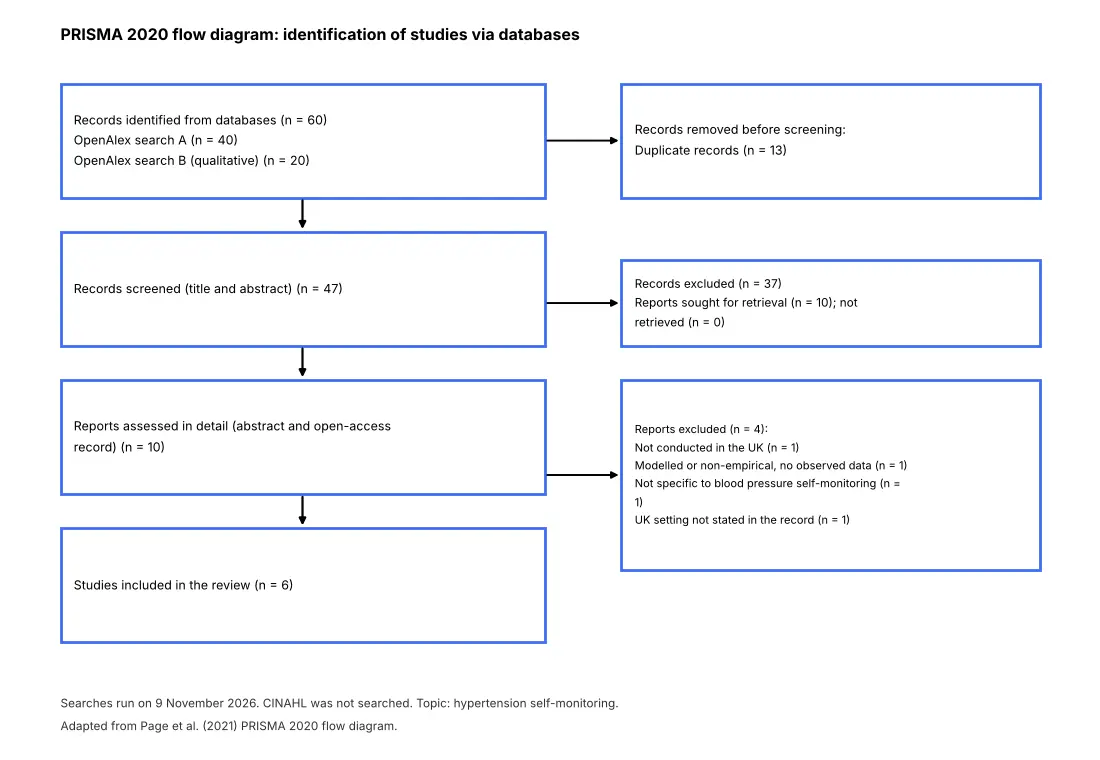
This literature-based dissertation is a structured review of published primary research on hypertension self-monitoring. It aims to be transparent and reproducible, but it is smaller in scope than a full systematic review, which would normally involve several reviewers, many more databases and exhaustive searching (Aveyard, 2023). The review is reported with reference to the PRISMA 2020 statement, which lists the items that should be described and recommends a flow diagram showing how records move through identification, screening and inclusion (Page et al., 2021). Appendix D presents that flow diagram, Appendix A records each search string, Appendix B tabulates the included studies and Appendix C gives a worked critical appraisal. Together, the appendices allow another reader to check each decision and to repeat the process.
The review question was framed using the Population, Intervention, Comparison and Outcome (PICO) structure, which suits questions about the effects of an intervention compared with usual care. The population was adults with hypertension in UK primary care. The intervention was self-monitoring of blood pressure, with or without telemonitoring or support. The comparison was usual care with clinic monitoring, and the outcomes were blood pressure control and patient experience. Structured frameworks help to translate a broad topic into searchable concepts, although the choice of framework affects how sensitive a search is (Methley et al., 2014; Aveyard, 2023). Because the question covered both effectiveness and experience, trials, qualitative studies and other primary research were all eligible for inclusion.
Two searches were run on 9 November 2026 in OpenAlex, an open index of scholarly works that covers a large and growing proportion of the published literature (Priem et al., 2022). The first search combined the phrases self-monitoring and blood pressure with the word trial. The second combined the same two phrases with the word qualitative, to capture studies of patient experience. Both searches were limited to open-access records published between 2015 and 2026 with at least one author affiliated to a UK institution. The first search was restricted to journal articles. Requests for more than 20 records of the second search were repeatedly refused, so only 20 were screened. Combining more than one source is advised because a single database misses relevant studies (Bramer et al., 2017). The exact strings and settings are given in Appendix A.
CINAHL, the main nursing database, could not be accessed, and a planned search of MEDLINE through Europe PMC was not completed because the service refused repeated requests on the day of searching. The second OpenAlex search was therefore used in its place. These gaps mean that some relevant nursing studies may not have been found, a risk that is well recognised when the combination of databases is restricted (Bramer et al., 2017). OpenAlex matches terms anywhere in the text, so many records were not relevant. It also ranks records by relevance, and the two searches matched 1,489 and 1,592 records. Only the first 40 records of the first search and the first 20 of the second, 60 in total, were screened, so the review should be read as a structured sample of the literature and not as a complete search (Aveyard, 2023).
Studies were eligible if they involved adults with hypertension, examined self-monitoring or home monitoring of blood pressure, were set in UK primary care or community settings and reported blood pressure, treatment or patient experience outcomes. Reports had to be peer-reviewed, written in English, open access and published from 2015 onwards. UK origin was judged from the stated setting and, where the abstract did not name one, from author affiliations. Protocols, reviews, economic models, studies of pregnancy, studies outside the UK and studies not centred on blood pressure were excluded. Clear criteria applied consistently reduce selection bias and allow the decisions to be audited. The extraction table is presented in Appendix B so that readers can compare studies at a glance (Page et al., 2021; Aveyard, 2023).
All 60 records were exported into a screening log, and 13 duplicates were removed, leaving 47 titles to screen. Titles that clearly concerned pregnancy, another condition, physical activity or weight management, or that described protocols or reviews, were excluded at this stage. That left 10 reports for closer assessment against the criteria. The abstract and open-access record of each of these reports were read, and the reason for every exclusion was recorded. The log lists every record by its identifier, the search in which it appeared and the decision reached, so that each exclusion can be traced. Six studies met the criteria, and the numbers at each stage reconcile in the flow diagram (Page et al., 2021). Screening was carried out by one reviewer, which is a recognised limitation of student reviews because a second reviewer would normally check each decision (Aveyard, 2023).
Quality was considered using the Critical Appraisal Skills Programme checklists, which ask structured questions about the aims, design, conduct, results and value of a study (CASP, 2024). The qualitative checklist was completed in full for one study, as a worked example in Appendix C, and indicative quality notes for every study are recorded in Appendix B. Those notes are based on the abstract and, for one study, the open full text, so they are judgements of reporting and not a full audit of how the research was conducted. No study was excluded on quality alone, since appraisal was used to weigh the strength of the findings, which is a common approach in nursing reviews (Aveyard, 2023).
Data were extracted into a standard table covering aims, design, sample, setting, methods, findings and limitations. Numerical results were copied as reported and were not recalculated, and extraction was rechecked once against the source records, a step that reduces transcription errors but does not replace independent checking. Findings were grouped into themes by thematic synthesis, with numerical results reported alongside qualitative themes because the review combined trial data with interview studies (Thomas and Harden, 2008; Braun and Clarke, 2006). The review used published data only and involved no participants, so ethical approval was not required, although the findings of the included studies are reported accurately and with full attribution (Aveyard, 2023).
Findings
Six UK studies met the inclusion criteria, published between 2015 and 2022. Three used qualitative methods. One interviewed 16 patients from four West Midlands practices (Grant et al., 2015), a second interviewed 29 recently diagnosed patients from two practices (Tompson et al., 2018), and a third used observation and interviews with 31 people who had used a consumer blood pressure monitor (Weiner and Will, 2018). These studies describe why patients monitor, how they use readings and how monitoring fits into home life, and they provide the main evidence on patient experience in this review. Appendix B summarises each study in more detail.
The remaining three studies were quantitative. One was a randomised controlled trial of 1,182 participants (McManus et al., 2018), one pooled individual participant data from four UK trials with a combined sample of 2,590 (Bryant et al., 2020), and one analysed enrolment data from a trial of 21,104 participants (Anbarasan et al., 2022). The first two addressed effectiveness, and the third described access to home monitors. The participants were mainly older adults: in the pooled analysis the mean age was 66.6 years and 95.6% were white, and in the ownership analysis the mean age was 67.7 years and 57.5% were male (Bryant et al., 2020; Anbarasan et al., 2022).
Effects of hypertension self-monitoring on blood pressure and treatment
The randomised trial compared self-monitoring, self-monitoring with telemonitoring and usual care in 142 UK general practices. Participants were adults over 35 years with blood pressure above 140/90 mmHg who were willing to self-monitor, and 1,003 of the 1,182 randomised (85%) were included in the primary analysis. At 12 months, mean clinic systolic pressure was 137.0 mmHg with self-monitoring, 136.0 mmHg with telemonitoring and 140.4 mmHg with usual care. Adjusted differences from usual care were -3.5 mmHg (95% confidence interval -5.8 to -1.2) for self-monitoring and -4.7 mmHg (-7.0 to -2.4) for telemonitoring, and the two intervention groups did not differ significantly. Adverse events were similar across the three groups (McManus et al., 2018). These reductions can be set beside the treatment changes reported in the pooled analysis (Bryant et al., 2020).
The pooled analysis of four UK trials examined the processes that lie behind these effects. Compared with usual care, the odds of antihypertensive intensification at 12 months were 1.8 (95% confidence interval 1.2 to 2.6) with self-monitoring plus feedback alone, and 3.3 (2.5 to 4.2) with telemonitoring or self-management (Bryant et al., 2020). Simulated five-year control below 140/90 mmHg was 33.4% with usual care, 33.9% after one year of feedback alone and 39.0% after one year of telemonitoring or self-management. If monitoring continued for five years, the simulated figures rose to 52.4% and 72.1% respectively. Both analyses therefore linked benefit to the use of readings in medication decisions (McManus et al., 2018; Bryant et al., 2020).
Why patients choose hypertension self-monitoring
Patients gave several reasons for measuring their own blood pressure. In interviews with 16 patients from four West Midlands practices, three themes emerged, covering living with an asymptomatic condition, views and practice of self-monitoring, and the relationship between patient and general practitioner. Some people monitored as a protective tool against the fear of a silent but serious condition, whereas others did so out of curiosity (Grant et al., 2015). Among 29 recently diagnosed patients, readings were used as evidence that blood pressure was controlled or that medication was unnecessary, and a minority used them to guide drug holidays (Tompson et al., 2018).
Contact with clinicians shaped how self-monitoring developed. People who monitored tended not to discuss it with their nurse or doctor, partly because they perceived little or no interest from clinicians and partly because they feared being prescribed more medication (Grant et al., 2015). Monitoring intensity fell after diagnosis as initial anxiety, and patient and doctor interest, declined (Tompson et al., 2018). The authors of the first study concluded that the decision to self-monitor was often an individual choice, with no schedule or system to link it to other care (Grant et al., 2015). The trial data suggest a different model, in which readings feed into medication changes (Bryant et al., 2020).
Hypertension self-monitoring at home and in routine care
Home and waiting room measurement played different roles. Of 29 interviewees in two UK surgeries, 9 (31%) had used the waiting room monitor and 22 (76%) had monitored at home. Printed slips from the waiting room monitor made results seem more trustworthy, and the monitor let patients who were unsure of their equipment or technique double-check readings. Home monitoring allowed a more intensive or flexible schedule for investigating fluctuations and the effects of medication and lifestyle changes. The authors concluded that waiting room monitors may help patients who are unwilling or unable to measure and record readings at home (Tompson et al., 2018). Reassurance outside the clinic was also a motive in the earlier interview study (Grant et al., 2015).
A sociological study of 31 people who had used a consumer blood pressure monitor drew on observation and interviews. It argued that devices become part of everyday life through a care infrastructure, in which a personal device can be a shared practice that expresses care for oneself and for others (Weiner and Will, 2018). The concept also highlighted links between the device and the other objects and spaces involved in monitoring, and it kept attention on both the material and the social elements of the practice (Weiner and Will, 2018). This view helps to explain why patients in the interview studies treated home readings as part of daily routines rather than as clinical data (Grant et al., 2015).
Taken together, the studies describe two linked parts of hypertension self-monitoring. The first is measurement, which patients carry out and value for reassurance, flexibility and trust in the device (Tompson et al., 2018). The second is the response to the reading, in which results are reviewed and medication is adjusted, as in the trial arms with telemonitoring or self-management (McManus et al., 2018). Where patients measured without discussion, as in much of the interview evidence, the readings appeared to have little influence on their care (Grant et al., 2015). The benefit seen in the trial therefore seems to depend on the second part as much as the first.
Access to equipment also varied. Of 21,104 participants randomised in a large UK trial, 11,434 (54.2%) reported owning a home blood pressure monitor. Higher odds of ownership were linked to being male (odds ratio 1.47, 95% confidence interval 1.39 to 1.56) and to living in a less deprived area (1.31, 1.23 to 1.40). Lower odds were linked to a history of diabetes (0.74, 0.64 to 0.86) and to current smoking (0.71, 0.62 to 0.82) (Anbarasan et al., 2022). The authors recommended qualitative research on the barriers faced by patients, and the interview studies in this review begin to address that call (Grant et al., 2015; Tompson et al., 2018).
Patterns across hypertension self-monitoring studies
Three patterns ran through the studies. First, benefit for blood pressure depended on support, since self-monitoring with telemonitoring or self-management and the use of readings in medication decisions were associated with the largest effects (McManus et al., 2018; Bryant et al., 2020). Second, patients’ reasons for monitoring were personal and varied, spanning reassurance, curiosity and a wish to control medication (Grant et al., 2015). Third, communication with clinicians was weak, so patients’ readings were often not shared, discussed or acted on. Together, these patterns suggest that the gap lies less in the devices than in how services respond to the readings that patients produce.
Equity was only partly visible. In the pooled trial data, 95.6% of participants were white (Bryant et al., 2020), so conclusions about other groups are limited. Ownership of a home monitor was lower among people in more deprived areas, current smokers and those with diabetes (Anbarasan et al., 2022). The abstracts of the interview studies did not report ethnicity or deprivation in detail, although one study sought variation in age, sex, ethnicity and deprivation when sampling (Grant et al., 2015). It is therefore not possible to judge from this evidence whether home monitoring reaches the people at greatest risk of poorly controlled blood pressure. Reporting in the abstracts was limited, so this gap may reflect what was reported and not what was studied.
The trial evidence was stronger in design but not free of limitations. Participants and investigators were not masked, and 15% of participants were missing from the primary analysis, which used available cases (McManus et al., 2018). Participants had to be willing to self-monitor, so the results may not apply to patients who decline. The pooled analysis relied partly on simulation for its five-year results, which are estimates and not observed outcomes (Bryant et al., 2020). Both studies therefore indicate the direction and approximate size of benefit, but they cannot give precise long-term effects. These design features reduce confidence in the exact size of the effect, although its direction was consistent.
The qualitative and survey studies had their own limits. The first interview study was small and regional, included only two former monitors and gave no account of the researchers’ influence on the data (Grant et al., 2015). The second drew on two practices and on patients who were already taking part in a feasibility study (Tompson et al., 2018). The ownership analysis rested on self-reported data from trial volunteers, so it shows association and not cause (Anbarasan et al., 2022). The findings should therefore be read as a consistent pattern across UK settings and not as precise estimates, and none of the studies could be judged free of limitation. Because the studies differ so much in design, their results are best compared by theme and not pooled.
Wider Discussion
The findings agree closely with the wider evidence that the value of hypertension self-monitoring depends on what accompanies it. In the meta-analysis of 25 trials, self-monitoring alone reduced clinic systolic pressure by 1.0 mmHg, compared with 6.1 mmHg when it was combined with intensive support (Tucker et al., 2017). The UK trial and the pooled UK analysis reached a similar position, with the largest effects and the highest odds of treatment intensification where readings were linked to telemonitoring or self-management (McManus et al., 2018; Bryant et al., 2020). The agreement between an international synthesis and UK studies increases confidence in this conclusion. Nurses should therefore regard a home monitor as a starting point for a conversation about treatment, and not as a self-contained intervention.
The interview studies show why that conversation does not always happen. Patients monitored for personal reasons and often kept the results to themselves, fearing extra medication or sensing little interest from clinicians (Grant et al., 2015). Interest also fell after diagnosis, which may explain why monitoring becomes irregular (Tompson et al., 2018). Registered nurses are expected to promote health and to evaluate care (NMC, 2018), so asking routinely about home readings, and recording how they are used, fits existing professional duties. Where readings are shared, they can inform decisions about whether a dose should change, and they allow the nurse to check technique at the same time. Asking is a small change in routine, but it signals the clinical interest that patients described as missing, and it brings hypertension self-monitoring into the consultation.
For nursing practice, the review suggests three priorities. The first is to ask every patient with hypertension whether they monitor at home, and to review the readings with them. The second is to check devices and technique, because some patients were unsure of their equipment and used the waiting room monitor to double-check readings (Tompson et al., 2018). The third is to offer structured support, including telemonitoring or agreed medication changes where local services allow (McManus et al., 2018), while attending to people who may lack monitors, such as those in deprived areas or with diabetes (Anbarasan et al., 2022). The same approach to self-management applies in pulmonary rehabilitation. Each priority can be delivered within existing nursing roles, although local protocols for escalating abnormal readings would be needed.
Several limitations qualify these conclusions. Only one database, OpenAlex, was searched, in two searches, and CINAHL was not accessible, so relevant studies may have been missed. Sixty records were identified, 47 were screened after duplicates were removed and only the first 20 results of the second search could be retrieved. Eligibility was judged by a single reviewer and most appraisal relied on abstracts, which is reported in line with PRISMA (Page et al., 2021). Most participants in the pooled trials were white (Bryant et al., 2020), so future research on hypertension self-monitoring should include more diverse groups, test nurse-led models and consider older adults with several conditions. The evidence is also drawn from UK settings only, so it may not transfer to other health systems.
Reflection
Writing this review changed my view of what self-monitoring is for. At the start I assumed that the key question was whether home measurement lowers blood pressure, and that a single trial result would answer it. The evidence showed that effects depended on what happened to the readings afterwards, and that patients had their own reasons for measuring, which clinicians often did not know about. That moved my attention from the device to the conversation around it. As a student nurse I have often recorded a reading without asking where it came from, and I now see that this question may matter as much as the number itself. I also noticed how rarely I had questioned a figure that arrived in a patient’s notebook.
The search taught me how fragile a literature search can be. Many of the first records returned were about physical activity, weight loss or pregnancy because the search engine matched terms anywhere in the text, and I had to read hundreds of titles to find the few relevant studies on hypertension self-monitoring. When requests for further results from the second search were refused, I accepted that I could screen only 20 records from it, and I recorded this plainly in the methodology and Appendix A. I would rather report a limited search honestly than present it as complete, and I learned that transparency is part of the quality of a review. That experience made me value the audit trail that I kept for each record.
Appraisal was the most demanding stage. Completing the CASP checklist in full for one qualitative study showed me how much a paper can leave unsaid. The study gave detail on ethics and sampling but said nothing about the researchers’ influence, and I could not tell how many people had been invited or had declined. I also decided to exclude an economic model, even though its results were attractive, because it contained no observed patient outcomes. These choices made me more careful to separate what a study measured from what it estimated, and to describe my own appraisal as indicative when I could read only an abstract. I now think a careful reader should be told which parts of a table come from the full text and which from the abstract.
Looking ahead, I will bring three things to practice. I will ask patients whether they measure at home and how they use the results, I will check that devices and technique are sound, and I will make sure that readings are documented and discussed instead of left in a notebook. I also need to strengthen my skills in synthesising different kinds of study, because combining trial results with interview themes was harder than I expected. I can review these goals with my practice supervisor and academic tutor, and I intend to return to them as my confidence and experience develop. Finally, I want to keep asking what patients make of their own readings.
Conclusion
This dissertation set out to review UK evidence on the effectiveness and patient experience of self-monitoring of blood pressure in adults with hypertension. Six UK studies, comprising a trial, a pooled analysis of trials, a large trial sub-analysis and three qualitative studies, showed that hypertension self-monitoring lowers blood pressure most when readings are used in medication decisions, and that patients’ reasons for monitoring are personal and varied. The review therefore answers the question by showing that the intervention works through the support that surrounds it, and not through the device alone. The evidence is consistent across a randomised trial, a pooled analysis and qualitative work.
On effectiveness, self-monitoring with or without telemonitoring led to lower systolic pressure at 12 months than usual care, and it raised the likelihood that medication was intensified. On experience, patients monitored for reassurance and curiosity, rarely discussed readings with clinicians, and valued flexibility and trust in the device. Ownership of monitors was lower among people in deprived areas, current smokers and those with diabetes. These findings suggest that hypertension self-monitoring should be organised and supported, and not simply recommended to patients. These patterns were consistent across studies of different design.
For nursing practice, the review supports asking routinely about home readings, checking devices and technique, and offering structured support linked to treatment decisions, with attention to people who may lack access. The strength of this evidence is limited by the restricted search, single-reviewer screening and reliance on abstracts, so the conclusions are best treated as a well-evidenced starting point for local audit. Nurses can act on these findings immediately within their current roles. Future research should include more diverse populations and should test nurse-led models of support.
Reference List
Anbarasan, T. et al. (2022) ‘Factors influencing home blood pressure monitor ownership in a large clinical trial’, Journal of Human Hypertension, 36(3), pp. 325-332. doi:10.1038/s41371-021-00511-w.
Aveyard, H. (2023) Doing a literature review in health and social care: a practical guide. 5th edn. Open University Press.
Bramer, W.M. et al. (2017) ‘Optimal database combinations for literature searches in systematic reviews: a prospective exploratory study’, Systematic Reviews, 6, article 245. doi:10.1186/s13643-017-0644-y.
Braun, V. and Clarke, V. (2006) ‘Using thematic analysis in psychology’, Qualitative Research in Psychology, 3(2), pp. 77-101. doi:10.1191/1478088706qp063oa.
Bryant, K.B. et al. (2020) ‘Impact of self-monitoring of blood pressure on processes of hypertension care and long-term blood pressure control’, Journal of the American Heart Association, 9(15), article e016174. doi:10.1161/JAHA.120.016174.
CASP (2024) CASP checklists. Oxford: Critical Appraisal Skills Programme. Available at: https://casp-uk.net/casp-checklists/ (Accessed: 9 November 2026).
Grant, S. et al. (2015) ‘Improving management and effectiveness of home blood pressure monitoring: a qualitative UK primary care study’, British Journal of General Practice, 65(640), pp. e776-e783. doi:10.3399/bjgp15X687433.
McManus, R.J. et al. (2018) ‘Efficacy of self-monitored blood pressure, with or without telemonitoring, for titration of antihypertensive medication (TASMINH4): an unmasked randomised controlled trial’, The Lancet, 391(10124), pp. 949-959. doi:10.1016/S0140-6736(18)30309-X.
Methley, A.M. et al. (2014) ‘PICO, PICOS and SPIDER: a comparison study of specificity and sensitivity in three search tools for qualitative systematic reviews’, BMC Health Services Research, 14, article 579. doi:10.1186/s12913-014-0579-0.
National Institute for Health and Care Excellence (NICE) (2019) Hypertension in adults: diagnosis and management (NICE guideline NG136). London: NICE. Updated 2023. Available at: https://www.nice.org.uk/guidance/ng136 (Accessed: 9 November 2026).
NHS Digital (2023) Health Survey for England, 2021 part 2: adults’ health: hypertension. Available at: https://digital.nhs.uk/data-and-information/publications/statistical/health-survey-for-england/2021-part-2/adult-health-hypertension (Accessed: 9 November 2026).
NHS England (2025) Quality and Outcomes Framework, 2024-25. Available at: https://digital.nhs.uk/data-and-information/publications/statistical/quality-and-outcomes-framework-achievement-prevalence-and-exceptions-data/2024-25 (Accessed: 9 November 2026).
Nursing and Midwifery Council (NMC) (2018) Future nurse: standards of proficiency for registered nurses. London: NMC.
Page, M.J. et al. (2021) ‘The PRISMA 2020 statement: an updated guideline for reporting systematic reviews’, BMJ, 372, article n71. doi:10.1136/bmj.n71.
Priem, J., Piwowar, H. and Orr, R. (2022) ‘OpenAlex: a fully-open index of scholarly works, authors, venues, institutions, and concepts’, arXiv, 2205.01833. doi:10.48550/arXiv.2205.01833.
Thomas, J. and Harden, A. (2008) ‘Methods for the thematic synthesis of qualitative research in systematic reviews’, BMC Medical Research Methodology, 8, article 45. doi:10.1186/1471-2288-8-45.
Tompson, A.C. et al. (2018) ‘Patient experience of home and waiting room blood pressure measurement: a qualitative study of patients with recently diagnosed hypertension’, British Journal of General Practice, 68(677), pp. e835-e843. doi:10.3399/bjgp18X699761.
Tucker, K.L. et al. (2017) ‘Self-monitoring of blood pressure in hypertension: a systematic review and individual patient data meta-analysis’, PLoS Medicine, 14(9), article e1002389. doi:10.1371/journal.pmed.1002389.
Weiner, K. and Will, C. (2018) ‘Thinking with care infrastructures: people, devices and the home in home blood pressure monitoring’, Sociology of Health and Illness, 40(2), pp. 270-282. doi:10.1111/1467-9566.12590.
Appendix A: Search strategy
This appendix records the searches run for the hypertension self-monitoring review so that the process can be repeated and checked.
Two searches on hypertension self-monitoring were run on 9 November 2026 using the OpenAlex works API. The first 40 records of the first search and the first 20 of the second, ranked by relevance, were retrieved and screened by title and abstract.
| Database | Platform | Date run | Search string | Limiters | Hits |
|---|---|---|---|---|---|
| OpenAlex search A | OpenAlex API | 9 November 2026 | search=”self-monitoring” AND “blood pressure” AND trial | Filter: authorships.countries:GB; is_oa:true; publication_year:2015-2026; type:article. 1,489 matches in total; the first 40 by relevance were screened. | 40 |
| OpenAlex search B (qualitative) | OpenAlex API | 9 November 2026 | search=”blood pressure” AND “self-monitoring” AND qualitative | Filter: authorships.countries:GB; is_oa:true; publication_year:2015-2026; no document-type restriction. 1,592 matches in total; the first 20 by relevance were screened. | 20 |
CINAHL could not be accessed and was not searched, so no CINAHL results are reported. A planned MEDLINE search through Europe PMC was attempted on the same day but the service refused repeated requests, so it was not completed for hypertension self-monitoring; search B, which targeted qualitative studies, was used instead.
OpenAlex matches search terms in the title, abstract or full text, and the country filter matches any record with at least one author affiliated to a UK institution. UK setting and relevance were therefore checked for each study at the assessment stage. Records identified: 60 (40 + 20); duplicates removed: 13; records screened: 47.
Appendix B: Data extraction table
The table summarises each study included in this hypertension self-monitoring review: its aim, design, sample, methods, key findings, limitations and relevance to hypertension self-monitoring.
| Author / year / country | Aim | Design | Sample and setting | Methods | Key findings | Limitations / quality | Relevance to hypertension self-monitoring |
|---|---|---|---|---|---|---|---|
| Grant et al. (2015), UK (West Midlands) | To identify psychological factors or processes that prompt patients with hypertension to begin hypertension self-monitoring. | Qualitative interview study with thematic analysis and constant comparison. | 16 patients from four general practices (6 currently monitoring, 2 former monitors, 8 who had never self-monitored), recruited from earlier survey respondents; aged 49 to 80. | In-depth interviews of 30 to 60 minutes in participants’ homes, audio-recorded and transcribed; purposive sampling for maximum variation; sampling to saturation. | Three themes: living with an asymptomatic condition, self-monitoring behaviour and medication, and the GP-patient transaction. Some patients used hypertension self-monitoring as protection against a silent condition and others from curiosity; most did not discuss readings with clinicians, partly through fear of more medication. | CASP qualitative appraisal in Appendix C (open full text). Small regional sample; practices may have been keen on hypertension self-monitoring; researcher influence not discussed. | Patient reasons for hypertension self-monitoring and the role of clinicians. |
| Tompson et al. (2018), UK (two general practices) | To examine patient experience of home and waiting room blood pressure measurement, a form of hypertension self-monitoring, before, during and after diagnosis. | Cross-sectional qualitative interview study nested in a feasibility study of waiting room blood pressure measurement. | 29 patients recently added to the hypertension registers of two UK general practices. | Interviews about hypertension self-monitoring, recorded, transcribed and coded thematically. | 9 (31%) had used the waiting room monitor and 22 (76%) had monitored at home. Readings were used as evidence of control or of no need for medication; printed slips increased trust; home monitoring allowed flexible schedules; hypertension self-monitoring fell after diagnosis. | Indicative (abstract only): two practices; participants were taking part in a feasibility study; ethnicity of those practising hypertension self-monitoring not given in the abstract. | Experience of home and waiting room measurement in hypertension self-monitoring. |
| Weiner and Will (2018), UK | To examine how consumer blood pressure monitors become part of everyday life, as in hypertension self-monitoring, using the concept of care infrastructure. | Qualitative study using observations and interviews, interpreted through science and technology studies and medical sociology. | 31 people who had used a consumer blood pressure monitor. | Observations and interviews about hypertension self-monitoring; conceptual analysis of devices, people and the home. | Hypertension self-monitoring can be a shared practice that expresses care for oneself and others; the concept links the device with other objects and spaces and keeps both material and social elements in view. | Indicative (abstract only): participants not described as having a hypertension diagnosis in the abstract; sociological focus on hypertension self-monitoring rather than clinical outcomes. | How hypertension self-monitoring fits into home life. |
| McManus et al. (2018), UK (142 general practices) | To test hypertension self-monitoring, with or without telemonitoring, for titration of antihypertensive medication against usual care. | Parallel three-arm unmasked randomised controlled trial (TASMINH4). | 1,182 adults over 35 years with blood pressure above 140/90 mmHg, willing to self-monitor, randomised 1:1:1 (395 self-monitoring, 393 telemonitoring, 394 usual care); 1,003 (85%) analysed. | Hypertension self-monitoring compared with usual care; primary outcome clinic systolic blood pressure at 12 months; available-case analysis with sensitivity analyses. | With hypertension self-monitoring, telemonitoring and usual care, systolic pressure was 137.0, 136.0 and 140.4 mmHg; adjusted differences from usual care -3.5 mmHg (95% CI -5.8 to -1.2) for self-monitoring and -4.7 mmHg (-7.0 to -2.4) for telemonitoring; adverse events similar. | Indicative (abstract only): unmasked; 15% missing from the primary analysis; participants willing to take up hypertension self-monitoring; part-funded by a device manufacturer. | Effectiveness of hypertension self-monitoring in UK primary care. |
| Bryant et al. (2020), UK (four trials) | To estimate the effect of hypertension self-monitoring on antihypertensive intensification and long-term blood pressure control. | Pooled analysis of individual participant data from four randomised trials, with simulation of five-year control. | 2,590 participants; mean age 66.6 years (SD 9.5); 53.9% male; 95.6% white; mean baseline blood pressure 151.8/85.0 mmHg. | Comparison of usual care, hypertension self-monitoring with feedback alone, and telemonitoring or self-management; modelled five-year control. | Odds of intensification at 12 months with hypertension self-monitoring were 1.8 (95% CI 1.2 to 2.6) with feedback alone and 3.3 (2.5 to 4.2) with telemonitoring or self-management; simulated five-year control 33.4% (usual care) to 72.1% (five years of telemonitoring or self-management). | Indicative (abstract only): secondary analysis of hypertension self-monitoring trials; five-year figures are simulated; mostly white older adults. | Mechanisms behind the effect of hypertension self-monitoring. |
| Anbarasan et al. (2022), UK (TIME trial) | To identify patient characteristics associated with owning a home monitor for hypertension self-monitoring. | Cross-sectional analysis of enrolment data from a randomised trial, using multivariable logistic regression. | 21,104 randomised adults with hypertension; mean age 67.7 years (SD 9.3); 57.5% male. | Ownership of equipment for hypertension self-monitoring reported at online registration; odds ratios for patient characteristics. | 11,434 (54.2%) had the equipment for hypertension self-monitoring. Higher odds: male (OR 1.47, 1.39 to 1.56) and less deprived area (OR 1.31, 1.23 to 1.40). Lower odds: diabetes (OR 0.74, 0.64 to 0.86) and current smoking (OR 0.71, 0.62 to 0.82). | Indicative (abstract only): self-reported ownership of equipment for hypertension self-monitoring; trial volunteers; association not cause. | Access to equipment for hypertension self-monitoring. |
Appendix C: Critical appraisal checklist
CASP qualitative studies checklist (CASP, 2024), completed for Grant et al. (2015), a study included in this hypertension self-monitoring review. Answers: Yes, No or Can’t tell, each with a short justification.
| # | Question | Answer | Justification |
|---|---|---|---|
| Section A: Are the results valid? | |||
| 1 | Was there a clear statement of the aims of the research? | Yes | The aim is stated clearly: to identify psychological factors or processes that prompt patients to decide to self-monitor blood pressure, set against limited understanding of why patients engage in hypertension self-monitoring. |
| 2 | Is a qualitative methodology appropriate? | Yes | Qualitative methods suit a question about why people adopt hypertension self-monitoring, and the authors justify them by the gap in understanding and by the aim of generating rather than testing hypotheses. |
| 3 | Was the research design appropriate to address the aims of the research? | Can’t tell | In-depth interviews with thematic analysis and constant comparison were used to study hypertension self-monitoring, but no theoretical stance is stated and there is no explanation of why interviews were chosen over alternatives such as focus groups. |
| 4 | Was the recruitment strategy appropriate to the aims of the research? | Can’t tell | For hypertension self-monitoring, sampling was purposive for maximum variation, and 16 of 44 survey respondents who had agreed to further contact were interviewed until saturation, but the number invited and the number who declined are not reported, and practices keen on hypertension self-monitoring may be over-represented. |
| 5 | Was the data collected in a way that addressed the research issue? | Yes | On hypertension self-monitoring, one-to-one interviews of 30 to 60 minutes were held in participants’ homes, audio-recorded and transcribed verbatim, with a flexible topic guide and field notes; saturation was reported by the sixteenth interview. |
| 6 | Has the relationship between researcher and participants been adequately considered? | No | The hypertension self-monitoring paper gives no account of the researchers’ positions, assumptions or relationship with participants, although several authors had worked on earlier research on hypertension self-monitoring. |
| Section B: What are the results? | |||
| 7 | Have ethical issues been taken into consideration? | Yes | For this hypertension self-monitoring study, approval from the South Birmingham Research Ethics Committee is reported, and written consent was obtained before each interview. |
| 8 | Was the data analysis sufficiently rigorous? | Can’t tell | In the hypertension self-monitoring data, transcripts were checked against recordings, themes were identified independently by the authors and refined by constant comparison, but the number of coders, the handling of disagreement and any search for contradictory cases are not described. |
| 9 | Is there a clear statement of findings? | Yes | Three hypertension self-monitoring themes with subthemes are presented with labelled verbatim quotations, and participants were sent a summary for feedback, although the number of replies is not reported. |
| Section C: Will the results help locally? | |||
| 10 | How valuable is the research? | Yes | The study adds UK evidence on why patients adopt hypertension self-monitoring and why they rarely share results, and the authors discuss implications for shared decision-making and state the limits of transferability. |
Appendix D: PRISMA flow diagram
This dissertation is a worked example that shows the structure and standard of a 5,000-word literature-based Independent Project. It is provided for learning and is not to be submitted as a student’s own work.