

Barriers to and Facilitators of Cardiac Rehabilitation Uptake and Completion: A Literature Review of UK Evidence
 By Dr. Robertson Prime, Research Fellow
This dissertation is a worked example that shows the structure and standard of a 5,000-word literature-based Independent Project. It is provided for learning and is not to be submitted as a student’s own work.
Abstract
Background: Cardiac rehabilitation reduces cardiovascular mortality and hospital admissions in people with coronary heart disease, but benefit depends on patients being referred, starting and completing a programme. Little is known about how patient, professional and service factors combine to shape uptake of cardiac rehabilitation in the UK.
Aim: To critically review UK evidence on the factors that influence uptake of and completion of cardiac rehabilitation.
Methods: A structured literature review using the Population, Exposure and Outcome framework. OpenAlex was searched twice on 9 November 2026, because CINAHL could not be accessed and a planned MEDLINE search was not completed. The first 40 records of each search were screened: 80 records were identified, 67 screened after duplicates were removed and 10 UK studies included. Quality was considered using Critical Appraisal Skills Programme questions, and findings were combined by thematic synthesis.
Findings: The included studies (n = 10) comprised five analyses of a national audit with between 95,638 and 421,281 patients, a service evaluation, an implementation study and three interview studies. Receiving an invitation was the strongest predictor of attendance, and misconceptions about suitability kept some patients away. Older, single and unemployed patients and those with diabetes were less likely to start, and home-based delivery was linked to lower completion.
Conclusions and implications for practice: Uptake of cardiac rehabilitation depends on invitation, understanding and the way programmes are delivered. Nurses can ask patients what they understand, correct misconceptions, protect time for psychological support and monitor who is invited, who starts and who completes. The evidence is limited by the restricted search, single-reviewer screening, overlap between the audit analyses and reliance on abstracts.
Keywords: cardiac rehabilitation; uptake and completion; heart disease; adult nursing; literature review.
Brief at a glance
- Framework
- PEO
- Design
- Literature review (PEO)
- Studies included
- 10
- Field
- Adult Nursing
Introduction
Cardiac rehabilitation is a programme of exercise, education and psychological support for people with heart disease, and it is well evidenced as a way of helping them to recover and to reduce the risk of further events. A Cochrane review of 63 randomised trials with 14,486 participants found that exercise-based rehabilitation reduced cardiovascular mortality (relative risk 0.74) and hospital admissions (relative risk 0.82) in people with coronary heart disease (Anderson et al., 2016). In the UK, roughly 110,000 men and 65,000 women have an acute myocardial infarction each year, and international guidelines recommend rehabilitation for them (Dalal et al., 2015). A benefit that is not received cannot help, so the question of who takes it up matters as much as the question of whether it works (NICE, 2020). Understanding why some patients decline or leave early is therefore a practical concern for nurses.
Nurses are central to this question. Specialist nurses and physiotherapists usually deliver rehabilitation within a multidisciplinary team (Dalal et al., 2015), and registered nurses are expected to promote health, prevent ill health and assess needs (NMC, 2018). Nurses meet patients before and during rehabilitation, so what they understand about the factors that shape attendance can change who attends. This dissertation reviews UK research on the patient, professional and service factors that influence referral to, uptake of and completion of cardiac rehabilitation. Another review examines urinary catheter care, a different area in which nursing practice shapes patient outcomes. The review follows a structured process so that each decision can be checked, and it uses the framework of population, exposure and outcome to separate the factors that influence rehabilitation from the results that follow from them.
Background and Justification
Cardiac rehabilitation is a complex intervention that combines health education, advice on reducing cardiovascular risk, physical activity and stress management (Dalal et al., 2015). NICE advises that programmes should offer a range of options that include an exercise component, health education and stress management, and that complex psychological therapies such as cognitive behavioural therapy are not routinely recommended within them (NICE, 2020). Rehabilitation is usually delivered in supervised outpatient settings, starting two to four weeks after percutaneous coronary intervention or four to six weeks after surgery, and programmes typically involve specialist nurses and physiotherapists, ideally within a multidisciplinary team (Dalal et al., 2015).
The case for rehabilitation rests on trial evidence. In the Cochrane review of 63 trials, exercise-based rehabilitation reduced cardiovascular mortality, with a relative risk of 0.74 (95% CI 0.64 to 0.86), and hospital admissions, with a relative risk of 0.82 (95% CI 0.70 to 0.96), although total mortality, myocardial infarction and revascularisation did not change significantly (Anderson et al., 2016). Fourteen of 20 studies reporting quality of life found higher scores in at least one domain, and the benefits were consistent across patient groups and intervention types and did not depend on study quality, setting or publication date. International guidelines therefore recommend rehabilitation for people with heart disease (Dalal et al., 2015).
NICE recommends that everyone who has had a myocardial infarction should be advised about rehabilitation and offered it regardless of age, and that it should begin as early as possible, ideally before the person leaves hospital, with an invitation to a session within 10 days of discharge (NICE, 2020). That timing sits comfortably with the usual start of supervised programmes within weeks of an event (Dalal et al., 2015). The guideline also sets out how to improve uptake: delivering programmes in a respectful, non-judgemental and culturally sensitive way, learning about each person’s health beliefs and concerns, discussing barriers such as transport, offering a choice of venues and times, and sending reminders to people who do not start or stop attending.
NICE also asks services to make rehabilitation accessible to groups that are less likely to attend, including ethnic minority communities, older people, women, lower-income groups, rural communities and people with learning disabilities or mental or physical health conditions, and to encourage all staff, including senior doctors, to promote it (NICE, 2020). Because the benefits of rehabilitation were consistent across patient groups (Anderson et al., 2016), unequal participation means that the people who miss out are not those who would gain least, and the problem is one of reach and not of benefit. Services also need to monitor who is invited and who attends if they are to know whether the groups named in the guideline are being reached.
Professional standards give nurses a clear part in this work. The Nursing and Midwifery Council standards of proficiency require registered nurses to promote health and prevent ill health (Platform 2) and to assess needs and plan care (Platform 3) (NMC, 2018). In rehabilitation these standards apply in several ways, such as assessing a patient’s needs and beliefs, explaining the programme, planning care around work and transport, and coordinating with the multidisciplinary team in which specialist nurses are usually involved (Dalal et al., 2015). Learning each person’s health beliefs before advising them is a nursing skill as much as a service duty (NICE, 2020).
Many people referred for rehabilitation have other long-term conditions, which can affect whether they are able to attend and what a programme must offer. NICE notes that exercise can be adapted for people with other conditions and that people who are stable can exercise safely even when their heart function is reduced (NICE, 2020). The review of trials found no suggestion that benefit differed between patient groups (Anderson et al., 2016). Understanding how comorbidity shapes participation links this review with multimorbidity management, where coordination across conditions is the central concern. A programme that cannot be adapted to coexisting conditions may therefore exclude some of the people it is meant to help.
Trials and guidelines say what rehabilitation should offer and what it achieves, but not who takes it up or why. Audit data can show patterns of participation, and interview studies can show why patients attend, decline or drop out, so a question about uptake and completion benefits from both (Aveyard, 2023). This review therefore examines UK primary research on the factors that influence referral to, uptake of and completion of cardiac rehabilitation, using a framework that separates the population, the exposure and the outcome (Methley et al., 2014). It focuses on the UK so that its conclusions fit the NHS service model, although that choice excludes research from other health systems.
Title, Aim and Objectives
What patient, professional and service factors influence referral to, uptake of and completion of cardiac rehabilitation in the UK?
Title explained
The title names the focus on barriers and facilitators, the outcomes of uptake and completion, the setting of cardiac rehabilitation, the UK evidence base, and the literature review design that structures the whole work.
Aim
To critically review UK evidence on the factors that influence uptake of and completion of cardiac rehabilitation.
Objectives
- To identify and appraise UK research on uptake of and completion of cardiac rehabilitation.
- To synthesise patient, professional and service factors.
- To make recommendations for nursing practice.
Methodology
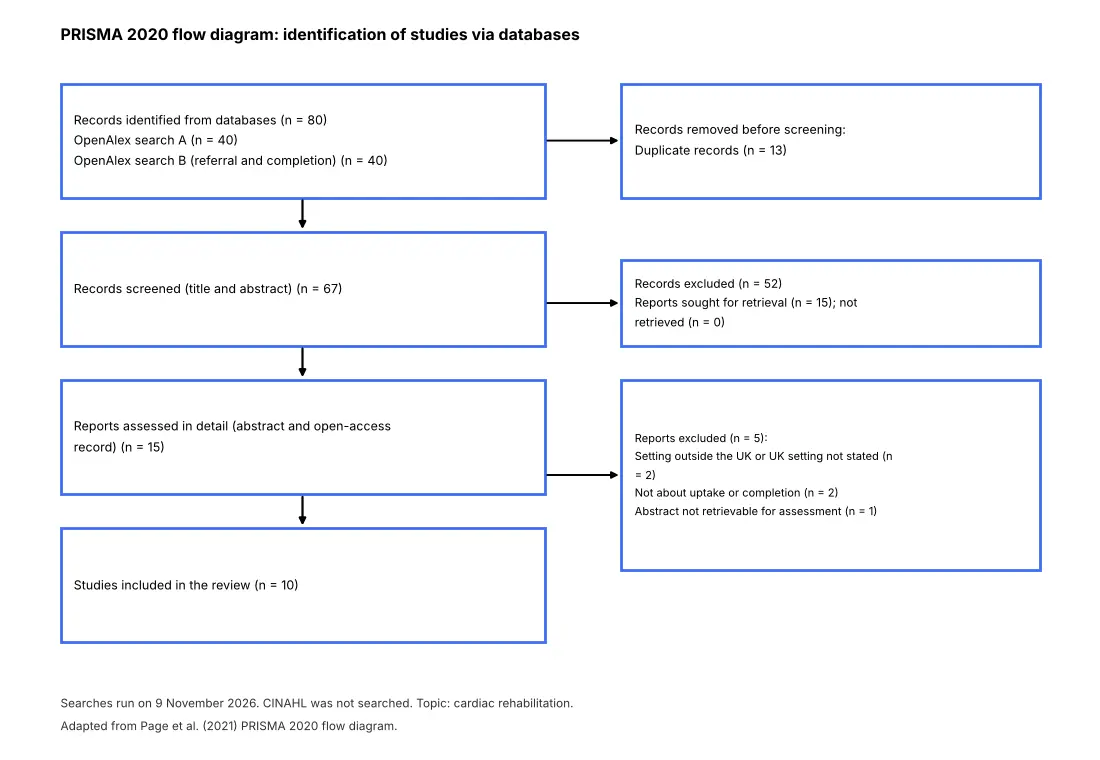
This literature-based dissertation is a structured review of published primary research on cardiac rehabilitation. It aims to be transparent and reproducible, but it is smaller in scope than a full systematic review, which would normally involve several reviewers, many more databases and exhaustive searching (Aveyard, 2023). The review is reported with reference to the PRISMA 2020 statement, which lists the items that should be described and recommends a flow diagram showing how records move through identification, screening and inclusion (Page et al., 2021). Appendix D presents that flow diagram, Appendix A records each search string, Appendix B tabulates the included studies and Appendix C gives a worked critical appraisal. Together, the appendices allow another reader to check each decision and to repeat the process.
The review question was framed using the Population, Exposure and Outcome (PEO) structure, which suits questions about experiences and influencing factors rather than the effects of a treatment. The population was adults eligible for rehabilitation after a heart event, together with the professionals who refer them and deliver the programme. The exposures were patient, professional and service factors, and the outcomes were referral, uptake, completion and experiences of rehabilitation. Structured frameworks help to translate a broad topic into searchable concepts, although the choice of framework affects how sensitive a search is (Methley et al., 2014; Aveyard, 2023). Because the question concerned factors rather than the effects of a treatment, qualitative, quantitative and mixed-methods research was eligible for inclusion.
Two searches were run on 9 November 2026 in OpenAlex, an open index of scholarly works that covers a large and growing proportion of the published literature (Priem et al., 2022). The first search combined the words cardiac rehabilitation with the word barriers. The second combined the same words with referral and completion. Both searches were limited to open-access records published between 2015 and 2026 with at least one author affiliated to a UK institution. A first version of the second search that added the word qualitative returned mostly unrelated records and was replaced by the version reported here. Both searches were restricted to journal articles. Combining more than one source is advised because a single database misses relevant studies (Bramer et al., 2017). The exact strings and settings are given in Appendix A.
CINAHL, the main nursing database, could not be accessed, and a planned search of MEDLINE through Europe PMC was not completed because the service refused repeated requests on the day of searching. The second OpenAlex search was therefore used in its place. These gaps mean that some relevant nursing studies may not have been found, a risk that is well recognised when the combination of databases is restricted (Bramer et al., 2017). OpenAlex matches terms anywhere in the text, so many records were not relevant. It also ranks records by relevance, and the two searches matched 2,892 and 1,321 records. Only the first 40 records of the first search and the first 40 of the second, 80 in total, were screened, so the review should be read as a structured sample of the literature and not as a complete search (Aveyard, 2023).
Studies were eligible if they involved adults eligible for cardiac rehabilitation in the UK and examined factors associated with referral to, uptake of, adherence to or completion of rehabilitation, from the perspective of patients, professionals or routine data. Reports had to be peer-reviewed, written in English, open access and published from 2015 onwards. UK origin was judged from the stated setting and, where the abstract did not name one, from author affiliations. Reviews, protocols, commentaries, trials of treatment effects, studies of outcomes after rehabilitation and studies of other populations were excluded. Clear criteria applied consistently reduce selection bias and allow the decisions to be audited. The extraction table is presented in Appendix B so that readers can compare studies at a glance (Page et al., 2021; Aveyard, 2023).
All 80 records were exported into a screening log, and 13 duplicates were removed, leaving 67 titles to screen. Titles that clearly described reviews, protocols, outcomes of rehabilitation, other conditions or non-UK settings were excluded at this stage. That left 15 reports for closer assessment against the criteria. The abstract and open-access record of each of these reports were read, and the reason for every exclusion was recorded. The log lists every record by its identifier, the search in which it appeared and the decision reached, so that each exclusion can be traced. Ten studies met the criteria, and the numbers at each stage reconcile in the flow diagram (Page et al., 2021). Screening was carried out by one reviewer, which is a recognised limitation of student reviews because a second reviewer would normally check each decision (Aveyard, 2023).
Quality was considered using the Critical Appraisal Skills Programme checklists, which ask structured questions about the aims, design, conduct, results and value of a study (CASP, 2024). The qualitative checklist was completed in full for one study, as a worked example in Appendix C, and indicative quality notes for every study are recorded in Appendix B. Those notes are based on the abstract and, for one study, the open full text, so they are judgements of reporting and not a full audit of how the research was conducted. No study was excluded on quality alone, since appraisal was used to weigh the strength of the findings, which is a common approach in nursing reviews (Aveyard, 2023).
Data were extracted into a standard table covering aims, design, sample, setting, methods, findings and limitations. Numerical results were copied as reported and were not recalculated, and extraction was rechecked once against the source records, a step that reduces transcription errors but does not replace independent checking. Findings were grouped into themes by thematic synthesis, with the audit results reported alongside the qualitative themes because the review combined interview, service and routine-data evidence (Thomas and Harden, 2008; Braun and Clarke, 2006). The review used published data only and involved no participants, so ethical approval was not required, although the findings of the included studies are reported accurately and with full attribution (Aveyard, 2023).
Findings
Ten UK studies met the inclusion criteria, published between 2016 and 2026, with varied designs, so the findings below are grouped by design before themes are drawn out. Five analysed routinely collected data from the National Audit of Cardiac Rehabilitation. The first covered 234,736 patients referred between 2012 and 2015, of whom 141,648 were enrolled and 97,406 initiated rehabilitation (Sumner et al., 2016). A second analysed 95,638 patients referred between 2013 and 2016 to compare the predictors of attendance in men and women (Galdas et al., 2018), and a third examined more than 121,000 patients to compare entry into rehabilitation with and without diabetes (Harrison et al., 2018).
The fourth audit analysis included 182,722 patients with coronary heart disease who started core rehabilitation between 2014 and 2019 and compared completion across centre-based, home-based and hybrid delivery (Tang et al., 2022). The fifth covered the years 2014 to 2023 and included 421,281 patients referred in England after myocardial infarction, percutaneous coronary intervention or bypass surgery, of whom 37,448 were South Asian and 383,833 were White European (McAllister et al., 2026). Together the five analyses cover very large numbers of patients, but they draw on one national dataset over overlapping years. Because the same registry supplied all five, the sample sizes should not be added together as if they described different patients.
Two studies examined services. A single-centre evaluation at an NHS trust compared two cohorts of 350 patients before and after a technology-enabled redesign of the service (McCartan et al., 2017). A mixed-methods study of a home-based programme for heart failure, REACH-HF, interviewed 17 staff at four early-adopter sites and surveyed professionals from 45 NHS teams across the UK and Ireland who had attended online training, with 17 survey responses, a response rate of 20% (Daw et al., 2022). The first study examined uptake and completion directly, whereas the second concerned the implementation of rehabilitation within existing services. The two service studies cannot represent the range of programmes delivered across the UK.
Three studies used interviews. In England, 18 patients and 7 nurses who had taken part in a pilot trial of enhanced psychological support were interviewed, and the nurses had each delivered the intervention to at least one patient (Turner et al., 2017). In Scotland, 25 patients who had not attended or had not completed a programme were interviewed from three hospitals, in a study nested in a larger mixed-methods project (Herber et al., 2017). In north east England, 20 patients with aortic stenosis, aged in their eighties, were interviewed about uptake (Nichol et al., 2024). Together these studies give patient and nurse views from three regions of the UK, although none of them covers Wales or Northern Ireland.
Who takes up cardiac rehabilitation
In the first audit analysis, 37.2% of those who initiated rehabilitation completed a programme of at least eight weeks. Initiation was more likely among patients who had a partner (odds ratio 1.31) or had undergone coronary artery bypass graft surgery (odds ratio 1.64) and less likely among those who were medically managed after myocardial infarction (odds ratio 0.57), and enrolment did not meet NHS England targets (Sumner et al., 2016). Patients with diabetes were significantly less likely to enter rehabilitation than those without (p < 0.001), by about 7% under 40 years and 15% between 61 and 80 years, and loss between referral and rehabilitation was about 13% for both sexes (Harrison et al., 2018).
Gender made little difference to the predictors of attendance, since 14 of 15 factors applied to both men and women. Older age, South Asian or non-white (non-Black) ethnicity and being single lowered the likelihood of attending an initial assessment in both sexes, diabetes lowered engagement by 11% in men only, and receiving an invitation was the strongest determinant for men (odds ratio 4.223) and women (odds ratio 4.033) (Galdas et al., 2018). Of 421,281 patients, 53% participated and 77% of those completed, and South Asian users were 12% more likely to participate but 22% less likely to complete, with deprivation, diabetes and being single the strongest links to non-completion in both groups (McAllister et al., 2026).
Patient experiences of rehabilitation
Patients who did not attend or complete described three kinds of influence: personal, programme and practical factors. A key barrier was seeing oneself as unsuitable, which was linked to a lack of knowledge or to misconceptions about rehabilitation, and the authors concluded that nurses are well placed to identify and correct these misconceptions (Herber et al., 2017). Octogenarians with aortic stenosis described four themes: perceptions and understanding of rehabilitation, delivery and accessibility, the perceived impact of exercise on health and life, and transportation, and understanding of its purpose, whether it was offered and social support were key influences (Nichol et al., 2024).
Patients in the pilot trial saw psychological support as central to good rehabilitation, described the immediate adverse effect that a cardiac event can have on mental well-being and valued attention to both mental and physical health (Turner et al., 2017). Nurses were committed to providing psychological support and wanted it delivered within programmes and not as a parallel service, but found it challenging because of time constraints and existing workloads. Participants in the Scottish study also suggested changes to programmes, which shows that patients who disengage have views about what would make rehabilitation more acceptable (Herber et al., 2017). Both groups therefore wanted psychological care to be part of the programme itself.
Service and delivery factors in cardiac rehabilitation
Delivery mode was associated with completion. Of 182,722 patients, 72.8% were in centre-based programmes, 8.3% in home-based programmes and 18.9% in hybrid programmes, and home-based patients included higher proportions of women, single, White and unemployed patients and were less likely to complete than centre-based patients (odds ratio 0.66, 95% confidence interval 0.48 to 0.91), whereas hybrid delivery did not differ (Tang et al., 2022). After the redesign of one service, more referred patients entered rehabilitation (84.3% against 76.0%) and completion rose from 47.4% to 75.6%, the median time from discharge to entry fell from 46 to 35 days, and emergency readmission within six months fell from 8.9% to 4.3% (McCartan et al., 2017).
Staff interest in heart failure and close working with the clinical team supported the implementation of a home-based programme, whereas context, such as urban or rural location, timing during the COVID-19 pandemic and factors outside the team, such as the quality of training, could help or hinder it, and the main output was a refined Service Delivery Guide (Daw et al., 2022). Nurses delivering psychological support in the pilot trial likewise described time and workload as the main constraints on what they could offer within rehabilitation (Turner et al., 2017). These findings concern the implementation of programmes more than their uptake by patients, so they complement and do not replace the patient-level evidence.
Patterns across the studies
Three patterns ran through the studies. First, being invited and understanding the programme mattered, since receiving an invitation was the strongest predictor of attendance (Galdas et al., 2018) and misconceptions about suitability kept some patients away (Herber et al., 2017). Second, participation and completion were unequal, with older, single and unemployed patients and those with diabetes less likely to start (Sumner et al., 2016). Third, how a programme was delivered, including its mode and the time available to staff, was linked to completion and to what nurses could offer, although the evidence for this is observational. Taken together, these patterns point to factors that services can change.
Quality and limits of the evidence
Several limits qualify these findings. Five analyses drew on the same national audit over overlapping years, so their results are not independent and their agreement is partly a product of shared data (Sumner et al., 2016; Galdas et al., 2018; Tang et al., 2022). Audit data are observational, so the associations described cannot show that a factor causes non-attendance, and the abstracts did not report how missing data were handled. The audit analyses also describe who took part and not why, so the interview studies are needed to interpret them, and the appraisal in Appendix B is therefore indicative and not a full audit.
The interview studies had limits of their own. The pilot trial study did not achieve its planned purposive sampling, interviewed only White British patients, could not be confident that saturation was reached and used an interviewer who knew the nurses, as the worked appraisal in Appendix C shows (Turner et al., 2017). The Scottish study was nested in a larger project and recruited between 2012 and 2014 (Herber et al., 2017), and the octogenarian study included only patients with aortic stenosis from one NHS Trust (Nichol et al., 2024), so each speaks for a narrow group. Taken together, these limits suggest that the interview findings are best used to generate ideas for practice and not to estimate how common each view is.
The service studies also had weaknesses. The Buckinghamshire evaluation was a single-centre before-and-after comparison, several of its authors were employed by a pharmaceutical company and the final sentence of its abstract is incomplete, so its large gains in completion should be read cautiously (McCartan et al., 2017). The implementation study of the home-based heart failure programme had a survey response rate of 20% and took place partly during the pandemic (Daw et al., 2022). These limits do not make the evidence unusable, but they mean that no single result should carry too much weight. Each design answers a different part of the question and none answers all of it.
Wider Discussion
The findings suggest that participation in cardiac rehabilitation is shaped by whether patients are invited, whether they understand the programme and whether it is delivered in a form that fits their lives. Receiving an invitation was the strongest predictor of attendance in both men and women (Galdas et al., 2018), and patients who did not attend often saw themselves as unsuitable because of misconceptions about the programme (Herber et al., 2017). These findings agree with NICE advice to learn about each person’s health beliefs and to explain the benefits of rehabilitation (NICE, 2020), and they place a clear responsibility on nurses, who are in contact with patients before and during the programme. Taken together, the studies suggest that non-attendance is often a product of how the offer is made and understood and not simply of patient choice.
Inequalities in participation and completion ran across the studies. Older, single and unemployed patients and those with diabetes were less likely to start (Sumner et al., 2016), South Asian service users participated more than White European users but completed less (McAllister et al., 2026), and home-based delivery was associated with lower completion than centre-based delivery (Tang et al., 2022). Services therefore need to match a choice of delivery mode with support to complete. Respectful, culturally sensitive delivery, a theme of dignity in care, is part of that support, because patients who feel unsuitable or unwelcome are unlikely to stay. The audit studies cannot say which of these gaps services can close, so the figures are best treated as a prompt for local review.
For nursing practice, three priorities follow. First, nurses can ask patients what they understand about rehabilitation and correct misconceptions about suitability, intensity and purpose, because these shaped attendance (Herber et al., 2017; Nichol et al., 2024). Second, services should protect nurse time for psychological support and for the follow-up that supports completion, since nurses valued the work but found it hard to deliver within their workloads (Turner et al., 2017). Third, services should monitor who is invited, who starts and who completes, by sex, ethnicity, diabetes status and delivery mode, so that gaps can be addressed, as the audit analyses show is possible. None of these steps requires new evidence, but each depends on services giving nurses the time and the data to act on it.
Several limitations qualify these conclusions. Only OpenAlex was searched, in two searches, and CINAHL was not accessible, so relevant studies may have been missed (Bramer et al., 2017). One report on comorbidity and referral could not be assessed because its abstract could not be retrieved, and only the first 40 records of each search were screened. Five of the ten studies drew on the same national audit, so their agreement is partly an artefact of shared data. Eligibility was judged by one reviewer, and most appraisal relied on abstracts, which is a recognised limitation of student reviews (Aveyard, 2023). A review with a wider search, a second reviewer and full-text appraisal of every study would give a firmer basis for practice.
Reflection
Writing this review changed how I think about low attendance at cardiac rehabilitation. I began by assuming that it was mainly a matter of patient motivation, and I expected the evidence to describe people who could not be bothered. The studies showed something different: whether a patient was invited, whether they understood what the programme was for and whether the mode of delivery suited their life explained more than motivation. That moved me from asking why patients do not attend to asking what services do before, during and after the invitation. That change in question is the most useful thing the review has taught me. I now see that the first question to ask about any low-uptake service is what the service did to make attendance possible.
The search taught me how much a single dataset can dominate a topic. Two searches returned 80 records, and five of the ten studies I included analysed the same national audit. I considered keeping only one of them, but each asked a different question, so I kept them and wrote down that they overlap. I also had to exclude a report because I could not retrieve its abstract, which reminded me that a review can only be as complete as the records its reviewer is able to read. That decision taught me that transparency about overlap matters more than a tidy count of independent studies.
Appraisal was the most demanding stage. Completing the CASP checklist in full for the pilot trial interview study showed me how much a paper can leave unsaid. The authors reported their ethics approval, their sampling plan and their coding method clearly, yet the interviewer had observed the nurses’ training and the paper did not discuss how that might have shaped the interviews. I also noticed that I found a large registry analysis more persuasive than an interview study of 18 patients, and I had to remind myself that size does not remove bias. Next time I will agree my appraisal approach in advance and test it on one study before applying it to the rest. I also learned to record my reasons for each decision as I went, because I could not reconstruct them afterwards.
Looking ahead, I will bring three things to practice. I will ask patients what they understand about rehabilitation before I explain it, I will notice which patients are not being invited or are dropping out, and I will raise any gaps with my team. I also need to strengthen my skills in reading routine-data studies, because I found odds ratios and registry analyses harder to interpret than interview themes, and I want to learn to search more databases than I could here. These are modest goals, but they are the ones the evidence most clearly supports, and they are within the reach of a single nurse.
Conclusion
This dissertation set out to review UK evidence on the patient, professional and service factors that influence referral to, uptake of and completion of cardiac rehabilitation. Ten UK studies, comprising five analyses of a national audit, a service evaluation, an implementation study and three interview studies, showed that attendance depended on being invited, on understanding what the programme was for and on the way it was delivered. Participation and completion were unequal across age, ethnicity, diabetes status and delivery mode. The review therefore treats uptake as something services influence and not only as a patient choice.
Patients who did not attend often saw themselves as unsuitable because of misconceptions, and nurses were well placed to correct them. Nurses valued psychological support within programmes but found it difficult to provide within their workloads. Home-based delivery was linked to lower completion, a redesigned service at one trust was linked to higher entry and completion, and the implementation of new programmes depended on staff interest, training and context. These links are associations in observational data and do not prove cause.
For nursing practice, the review supports asking patients what they understand about rehabilitation and correcting misconceptions, protecting nurse time for psychological support and follow-up, and monitoring who is invited, who starts and who completes. The strength of this evidence is limited by the restricted search, single-reviewer screening, overlap between the audit analyses and reliance on abstracts, so the conclusions are best treated as a well-founded starting point and not as a final answer. Future reviews with wider searches and independent reviewers could test whether the same factors appear across other databases. Taken together, the findings give nurses practical ways to reduce the gap between those who could benefit and those who attend.
Reference List
Anderson, L. et al. (2016) ‘Exercise-based cardiac rehabilitation for coronary heart disease: Cochrane systematic review and meta-analysis’, Journal of the American College of Cardiology, 67(1), pp. 1-12. doi:10.1016/j.jacc.2015.10.044.
Aveyard, H. (2023) Doing a literature review in health and social care: a practical guide. 5th edn. Open University Press.
Bramer, W.M. et al. (2017) ‘Optimal database combinations for literature searches in systematic reviews: a prospective exploratory study’, Systematic Reviews, 6, article 245. doi:10.1186/s13643-017-0644-y.
Braun, V. and Clarke, V. (2006) ‘Using thematic analysis in psychology’, Qualitative Research in Psychology, 3(2), pp. 77-101. doi:10.1191/1478088706qp063oa.
CASP (2024) CASP checklists. Oxford: Critical Appraisal Skills Programme. Available at: https://casp-uk.net/casp-checklists/ (Accessed: 9 November 2026).
Dalal, H.M., Doherty, P. and Taylor, R.S. (2015) ‘Cardiac rehabilitation’, BMJ, 351, article h5000. doi:10.1136/bmj.h5000.
Daw, P. et al. (2022) ‘Barriers and facilitators to implementation of a home-based cardiac rehabilitation programme for patients with heart failure in the NHS: a mixed-methods study’, BMJ Open, 12(7), article e060221. doi:10.1136/bmjopen-2021-060221.
Galdas, P., Harrison, A. and Doherty, P. (2018) ‘Gender differences in the factors predicting initial engagement at cardiac rehabilitation’, Open Heart, 5(1), article e000764. doi:10.1136/openhrt-2017-000764.
Harrison, A.S., Doherty, P. and Phillips, A. (2018) ‘An analysis of barriers to entry of cardiac rehabilitation in patients with diabetes: using data from the National Audit of Cardiac Rehabilitation’, Diabetes and Vascular Disease Research, 15(2), pp. 145-149. doi:10.1177/1479164117744490.
Herber, O.R. et al. (2017) ‘”Just not for me”: contributing factors to nonattendance/noncompletion at phase III cardiac rehabilitation in acute coronary syndrome patients: a qualitative enquiry’, Journal of Clinical Nursing, 26(21-22), pp. 3529-3542. doi:10.1111/jocn.13722.
McAllister, J. et al. (2026) ‘Health inequalities in cardiac rehabilitation: a national cohort study in England’, European Journal of Preventive Cardiology, advance online publication. doi:10.1093/eurjpc/zwag092.
McCartan, F. et al. (2017) ‘Introduction of a novel service model to improve uptake and adherence with cardiac rehabilitation within Buckinghamshire Healthcare NHS Trust’, BMC Cardiovascular Disorders, 17, article 184. doi:10.1186/s12872-017-0606-2.
Methley, A.M. et al. (2014) ‘PICO, PICOS and SPIDER: a comparison study of specificity and sensitivity in three search tools for qualitative systematic reviews’, BMC Health Services Research, 14, article 579. doi:10.1186/s12913-014-0579-0.
National Institute for Health and Care Excellence (NICE) (2020) Acute coronary syndromes (NICE guideline NG185). London: NICE. Available at: https://www.nice.org.uk/guidance/ng185 (Accessed: 9 November 2026).
Nichol, C. et al. (2024) ‘A qualitative study of barriers and facilitators to the uptake of cardiac rehabilitation in octogenarians’, Geriatrics, 9(6), article 161. doi:10.3390/geriatrics9060161.
Nursing and Midwifery Council (NMC) (2018) Future nurse: standards of proficiency for registered nurses. London: NMC.
Page, M.J. et al. (2021) ‘The PRISMA 2020 statement: an updated guideline for reporting systematic reviews’, BMJ, 372, article n71. doi:10.1136/bmj.n71.
Priem, J., Piwowar, H. and Orr, R. (2022) ‘OpenAlex: a fully-open index of scholarly works, authors, venues, institutions, and concepts’, arXiv, 2205.01833. doi:10.48550/arXiv.2205.01833.
Sumner, J. et al. (2016) ‘Predictors of cardiac rehabilitation utilization in England: results from the National Audit’, Journal of the American Heart Association, 5(10), article e003903. doi:10.1161/JAHA.116.003903.
Tang, L.H. et al. (2022) ‘Are patient characteristics and modes of delivery associated with completion of cardiac rehabilitation? A national registry analysis’, International Journal of Cardiology, 361, pp. 7-13. doi:10.1016/j.ijcard.2022.05.007.
Thomas, J. and Harden, A. (2008) ‘Methods for the thematic synthesis of qualitative research in systematic reviews’, BMC Medical Research Methodology, 8, article 45. doi:10.1186/1471-2288-8-45.
Turner, K.M. et al. (2017) ‘Patients’ and nurses’ views on providing psychological support within cardiac rehabilitation programmes: a qualitative study’, BMJ Open, 7(9), article e017510. doi:10.1136/bmjopen-2017-017510.
Appendix A: Search strategy
This appendix records the searches run for the cardiac rehabilitation review so that the process can be repeated and checked.
Two searches on cardiac rehabilitation were run on 9 November 2026 using the OpenAlex works API. The first 40 records of the first search and the first 40 of the second, ranked by relevance, were retrieved and screened by title and abstract.
| Database | Platform | Date run | Search string | Limiters | Hits |
|---|---|---|---|---|---|
| OpenAlex search A | OpenAlex API | 9 November 2026 | search=cardiac rehabilitation barriers | Filter: authorships.countries:GB; is_oa:true; publication_year:2015-2026; type:article. 2,892 matches in total; the first 40 by relevance were screened. | 40 |
| OpenAlex search B (referral and completion) | OpenAlex API | 9 November 2026 | search=cardiac rehabilitation referral completion | Filter: authorships.countries:GB; is_oa:true; publication_year:2015-2026; type:article. 1,321 matches in total; the first 40 by relevance were screened. | 40 |
CINAHL could not be accessed and was not searched, so no CINAHL results are reported. A planned MEDLINE search through Europe PMC was attempted on the same day but the service refused repeated requests, so it was not completed for cardiac rehabilitation; search B, which targeted referral and completion, was used instead.
OpenAlex matches search terms in the title, abstract or full text, and the country filter matches any record with at least one author affiliated to a UK institution. UK setting and relevance were therefore checked for each study at the assessment stage. Records identified: 80 (40 + 40); duplicates removed: 13; records screened: 67.
Appendix B: Data extraction table
The table summarises each study included in this cardiac rehabilitation review: its aim, design, sample, methods, key findings, limitations and relevance to cardiac rehabilitation.
| Author / year / country | Aim | Design | Sample and setting | Methods | Key findings | Limitations / quality | Relevance to cardiac rehabilitation |
|---|---|---|---|---|---|---|---|
| Sumner et al. (2016), UK (England) | To investigate how much cardiac rehabilitation was used in England and which factors, including social deprivation, were associated with initiation. | Analysis of National Audit of Cardiac Rehabilitation data (2012 to 2015) with logistic regression. | 234,736 patients referred; 141,648 enrolled; 97,406 initiated cardiac rehabilitation. | Utilisation by deprivation quintile; logistic regression with robust standard errors for nested data; cardiac rehabilitation initiation as the outcome. | Of those who initiated cardiac rehabilitation, 37.2% completed at least eight weeks; initiation was more likely with a partner (OR 1.31) or bypass surgery (OR 1.64) and less likely if medically managed after myocardial infarction (OR 0.57); enrolment fell short of NHS England targets. | Indicative (abstract only): observational audit data on cardiac rehabilitation; deprivation results not reported in the abstract; overlaps with other audit analyses. | Shows who initiates cardiac rehabilitation in England. |
| Turner et al. (2017), UK (England: South West and East Midlands) | To explore patients’ and nurses’ views on the feasibility and acceptability of providing psychological care within cardiac rehabilitation. | Qualitative interview study with thematic analysis, nested in a pilot trial of enhanced psychological support. | 18 patients (12 intervention, 6 usual care) from seven cardiac rehabilitation teams and 7 nurses from four teams; all patients White British. | Audio-recorded, fully transcribed interviews, most by telephone; framework-style thematic analysis; two researchers independently coded a sample of transcripts. | Patients saw psychological support as central to good cardiac rehabilitation and valued attention to mental and physical health; nurses were committed to it and wanted it delivered within programmes but found it challenging because of time constraints and workloads. | CASP qualitative appraisal in Appendix C (open full text). Small sample; purposive sampling not achieved; saturation uncertain; no member checking; interviewer knew the nurses; limited to cardiac rehabilitation teams in the trial. | Patient and nurse views of delivering cardiac rehabilitation with psychological support. |
| Herber et al. (2017), UK (Scotland) | To explore the reasons that non-attenders and non-completers give for their participation in cardiac rehabilitation and how uptake could improve. | Qualitative study with thematic analysis, nested in a larger mixed-methods study. | 25 patients with acute coronary syndrome, a purposive subsample of 214 consenting patients from three Scottish hospitals (recruited 2012 to 2014). | Semi-structured interviews about phase III cardiac rehabilitation. | Three influences: personal, programme and practical factors; patients who saw themselves as unsuitable lacked knowledge or held misconceptions about cardiac rehabilitation; nurses were well placed to correct misconceptions. | Indicative (abstract only): nested in a larger study; Scottish hospitals only; recruitment ended in 2014. | Patient reasons for non-attendance at cardiac rehabilitation and the nursing role. |
| McCartan et al. (2017), UK (Buckinghamshire) | To evaluate a redesigned, technology-enabled cardiac rehabilitation service in one NHS trust. | Single-centre observational study and service evaluation comparing a retrospective and a prospective cohort. | 350 patients in each of two 12-month cohorts, seasonally matched, at Wycombe Hospital. | Compared entry, time to entry, readmission, completion and duration of cardiac rehabilitation. | More referred patients entered cardiac rehabilitation (84.3% against 76.0%, P=0.006); completion 75.6% against 47.4% (P<0.001); median time to entry 35 against 46 days; emergency readmission within six months 4.3% against 8.9% (P=0.015). | Indicative (abstract only): single centre; before-and-after design for cardiac rehabilitation; several authors employed by a pharmaceutical company; the final sentence of the abstract is incomplete. | A service change associated with higher uptake and completion of cardiac rehabilitation. |
| Galdas et al. (2018), UK (national audit) | To determine whether the predictors of attendance at cardiac rehabilitation differ by gender. | Analysis of National Audit of Cardiac Rehabilitation data with separate logistic regression models for men and women. | 95,638 patients referred to cardiac rehabilitation between 2013 and 2016. | Eighteen factors in four groups: sociodemographic, cardiac risk, medical status and service level. | Fourteen of 15 predictors applied to both sexes; older age, South Asian or non-white (non-Black) ethnicity and being single lowered attendance at the baseline assessment; diabetes lowered engagement by 11% in men only; receiving an invitation was the strongest determinant (OR 4.223 men, 4.033 women). | Indicative (abstract only): routine audit data on cardiac rehabilitation; overlaps with other audit analyses. | Identifies the invitation as the key factor in engagement with cardiac rehabilitation. |
| Harrison et al. (2018), UK (England) | To compare uptake of cardiac rehabilitation between patients with and without diabetes. | Analysis of National Audit of Cardiac Rehabilitation data. | More than 121,000 patients. | Proportions entering cardiac rehabilitation by age, sex and diagnosis. | Patients with diabetes were significantly less likely to enter cardiac rehabilitation (p<0.001), by about 7% under 40 years to 15% at 61 to 80 years; loss between referral and rehabilitation was about 13% for both sexes. | Indicative (abstract only): descriptive proportions for cardiac rehabilitation; overlaps with other audit analyses. | Quantifies a diabetes gap in cardiac rehabilitation uptake. |
| Tang et al. (2022), UK (national audit) | To compare patient characteristics and completion across centre-based, home-based and hybrid cardiac rehabilitation. | Registry analysis of National Audit of Cardiac Rehabilitation data with logistic regression. | 182,722 patients with coronary heart disease who started core cardiac rehabilitation between 2014 and 2019. | Completion by delivery mode, adjusted for demographics. | 72.8% centre-based, 8.3% home-based and 18.9% hybrid cardiac rehabilitation; home-based completion was lower than centre-based (OR 0.66, 95% CI 0.48 to 0.91); hybrid did not differ (OR 1.18, 95% CI 0.92 to 1.51). | Indicative (abstract only): observational registry data on cardiac rehabilitation; delivery mode not randomised; overlaps with other audit analyses. | Links delivery mode to completion of cardiac rehabilitation. |
| Daw et al. (2022), UK (four sites; training teams from the UK and Ireland) | To identify barriers and facilitators to implementing the REACH-HF home-based programme within cardiac rehabilitation services. | Mixed-methods study (interviews and survey) using Normalisation Process Theory. | 17 staff interviewed at four early-adopter sites; 17 survey responses (20% response rate); 85 professionals from 45 NHS teams attended online training. | Semi-structured interviews and a survey about delivering cardiac rehabilitation for heart failure. | Staff interest in heart failure and close working with the clinical team supported implementation; context (urban or rural), timing during the pandemic and training quality could help or hinder; a refined Service Delivery Guide was the main output. | Indicative (abstract only): low survey response; early-adopter sites; delivered partly during the pandemic; cardiac rehabilitation for heart failure only. | Service factors in delivering cardiac rehabilitation for heart failure. |
| Nichol et al. (2024), UK (north east England) | To explore barriers and facilitators to the uptake of cardiac rehabilitation among octogenarians. | Qualitative interview study. | 20 patients with aortic stenosis (12 women, 8 men) at a large NHS Trust. | Interviews about uptake of cardiac rehabilitation. | Four themes: perceptions and understanding of cardiac rehabilitation, delivery and accessibility, perceived impact of exercise, and transportation; understanding of purpose, whether it was offered and social support were key influences. | Indicative (abstract only): one NHS Trust; patients with aortic stenosis only; octogenarians only, so limited to one group in cardiac rehabilitation. | Older patients’ views of the uptake of cardiac rehabilitation. |
| McAllister et al. (2026), UK (England) | To compare participation in and completion of cardiac rehabilitation between South Asian and White European service users and to identify factors linked to non-completion. | Cohort study of National Audit of Cardiac Rehabilitation data (2014 to 2023) with logistic regression. | 421,281 patients referred after myocardial infarction, percutaneous coronary intervention or bypass surgery (383,833 European; 37,448 South Asian). | Backwards selection; adjusted for age, sex, deprivation and comorbidities; cardiac rehabilitation participation and completion as outcomes. | 53% participated and 77% of participants completed cardiac rehabilitation; South Asian users were 12% more likely to participate (adjusted OR 1.12) but 22% less likely to complete (adjusted OR 0.78); deprivation, diabetes and being single were the strongest links to non-completion in both groups. | Indicative (abstract only): observational data on cardiac rehabilitation; volume and page numbers not available in the record; overlaps with other audit analyses. | Shows inequity in completion of cardiac rehabilitation. |
Appendix C: Critical appraisal checklist
CASP qualitative studies checklist (CASP, 2024), completed for Turner et al. (2017), a study included in this cardiac rehabilitation review. Answers: Yes, No or Can’t tell, each with a short justification.
| # | Question | Answer | Justification |
|---|---|---|---|
| Section A: Are the results valid? | |||
| 1 | Was there a clear statement of the aims of the research? | Yes | The aim is stated clearly: to explore patients’ and nurses’ views on the feasibility and acceptability of providing psychological care within cardiac rehabilitation. |
| 2 | Is a qualitative methodology appropriate? | Yes | Qualitative methods suit a question about views and acceptability, and the authors justify them by the need to understand how patients and nurses experience psychological support within cardiac rehabilitation. |
| 3 | Was the research design appropriate to address the aims of the research? | Yes | In-depth interviews suit the aims, and topic guides for patients and nurses were based on the aims, a literature review and the team’s expertise, although no piloting of the guides is reported. |
| 4 | Was the recruitment strategy appropriate to the aims of the research? | Can’t tell | All 15 intervention patients and 6 usual-care patients were approached, and 18 were interviewed with 7 nurses, but the planned purposive sampling was not achieved because recruitment was slow, and no ethnic minority patients took part. |
| 5 | Was the data collected in a way that addressed the research issue? | Yes | Interviews with both groups about cardiac rehabilitation were audio-recorded and fully transcribed, with separate guides, although most were done by telephone and the authors cannot be sure that saturation was reached. |
| 6 | Has the relationship between researcher and participants been adequately considered? | No | One researcher conducted every interview and had observed the nurses’ training, so she was known to them, but the authors do not discuss how this affected the interviews on cardiac rehabilitation and give no formal reflexivity statement. |
| Section B: What are the results? | |||
| 7 | Have ethical issues been taken into consideration? | Yes | Approval from a National Research Ethics Service committee in the South West is reported with its reference, and written consent was obtained at interview or by a returned form. |
| 8 | Was the data analysis sufficiently rigorous? | Yes | Two researchers independently coded a sample of transcripts, separate coding frames were agreed for patients and nurses, deviant cases were sought and the datasets were compared, although member checking is not reported. |
| 9 | Is there a clear statement of findings? | Yes | Findings on cardiac rehabilitation are presented as themes with many labelled quotations from patients and nurses, and the two groups’ views are compared. |
| Section C: Will the results help locally? | |||
| 10 | How valuable is the research? | Yes | The study is the first to describe both patient and nurse views on psychological care within cardiac rehabilitation, and the authors state limits such as the small sample and the influence of the trial. |
Appendix D: PRISMA flow diagram
This dissertation is a worked example that shows the structure and standard of a 5,000-word literature-based Independent Project. It is provided for learning and is not to be submitted as a student’s own work.