

Improving Hand Hygiene Compliance among Healthcare Staff in UK Hospitals: A Service-Improvement Review
 By Dr. Robertson Prime, Research Fellow
This dissertation is a worked example that shows the structure and standard of a 5,000-word literature-based Independent Project. It is provided for learning and is not to be submitted as a student’s own work.
Abstract
Background: Hand hygiene is a basic precaution against healthcare-associated infection, yet national guidance accepts that good practice is not universal. Less is known about how UK studies measure hand hygiene compliance among hospital staff and how they improve it.
Aim: To critically review UK evidence on how hand hygiene compliance among healthcare staff in hospitals is measured and improved.
Methods: A structured literature review using the Population, Exposure and Outcome framework. OpenAlex was searched twice on 15 November 2026, because CINAHL could not be accessed and a planned MEDLINE search was not completed. The first 40 records of each search were screened: 80 records were identified, 74 screened after the removal of duplicates and 9 UK studies included. Quality was considered using Critical Appraisal Skills Programme questions, and findings were combined by thematic synthesis.
Findings: The included studies of hand hygiene compliance (n = 9) comprised observation and electronic monitoring studies, an interview study, behavioural and training interventions, an education programme for nursing students, a cost model and a study of barriers during the pandemic. Single observation audits could mislead, staff involvement and environmental prompts were linked with better compliance, and workload and time were repeated barriers.
Conclusions and implications for practice: For hand hygiene compliance, teams can use audit alongside other measures, involve staff in designing prompts and training, and examine workload and dispenser placement. The evidence is limited by the restricted search, single-reviewer screening, reliance on abstracts and the lack of long-term follow-up.
Keywords: hand hygiene compliance; infection prevention and control; healthcare-associated infections; adult nursing; literature review.
Brief at a glance
- Framework
- PEO
- Design
- Literature review (PEO)
- Studies included
- 9
- Field
- Adult Nursing
Introduction
Hand hygiene is a basic precaution that every member of a care team is expected to take. National guidance states that effective hand decontamination, even after gloves have been worn, reduces the carriage of potential pathogens on the hands and decreases the incidence of preventable healthcare-associated infection, which in turn reduces illness and death (NICE, 2014). The WHO guideline was written to give health workers, managers and authorities an evidence review and recommendations for improving practice, with the aim of reducing the spread of microbes to patients and staff (WHO, 2009). Even so, national guidance accepts that good practice is not yet universal. Hand hygiene compliance is therefore a continuing question for nursing, because the benefit depends on the action being taken at every contact and not merely on its being known in principle.
Nurses spend more time in direct contact with patients than most other staff, and the Nursing and Midwifery Council expects them to preserve safety and to practise effectively (NMC, 2018). Infection risks are especially clear in procedures such as the insertion and care of devices, as described in urinary catheter care. This dissertation reviews UK research on how hand hygiene compliance among healthcare staff is measured and how it can be improved. It follows a structured process so that each decision can be checked. The review is limited to UK hospital and teaching settings so that its conclusions fit NHS services, and it includes qualitative, quantitative and economic studies. National standards ask services to carry out regular hand hygiene observation audits (NICE, 2014), so the review also considers how far such audits can be trusted. It asks what the evidence implies for nursing practice.
Background and Justification
Healthcare-associated infections are a risk to every person who receives care in a hospital. The national quality standard on infection prevention and control sets out a statement on hand decontamination: people should receive healthcare from workers who decontaminate their hands immediately before and after every episode of direct contact or care. Its rationale notes that hand hygiene has improved but that misconceptions remain and good practice is still not universal (NICE, 2014). The WHO guideline from 2009 aimed to reduce the spread of disease-causing microbes to patients and health workers, and it was meant for any setting in which care is given (WHO, 2009). Improvement is therefore both a clinical and a managerial task.
The standard also describes what services must provide. Providers are expected to ensure that workers are trained in effective decontamination techniques and that handrub and handwashing facilities are available, workers are expected to decontaminate their hands even when gloves have been worn, and commissioners are expected to commission services that do so (NICE, 2014). The suggested measures include local arrangements for facilities, training for all healthcare workers and regular local hand hygiene observation audits. An alcohol-based handrub is the usual choice, with soap and water required in specified situations (NICE, 2014). Observation audit therefore sits within the standard itself, which makes the accuracy of audit an important question for services. The WHO guideline likewise presented recommendations for improving hand hygiene practice (WHO, 2009), and a review has to ask how well compliance can be known.
Earlier guidance for primary and community care is more specific about timing. It states that hands must be decontaminated immediately before every episode of direct patient contact or care, including aseptic procedures, and immediately after every episode. They must also be decontaminated after any exposure to body fluids, after other contact with a patient’s surroundings that could contaminate the hands, and after gloves are removed (NICE, 2012). It asks that staff are educated about the benefits of hand decontamination, the correct technique and timing, when to use soap or handrub, the availability of facilities and their own role in maintaining standards (NICE, 2012). These expectations define what compliance means in practice, and the national quality standard asks for the same practice before and after every episode of direct contact (NICE, 2014). They also show why timing matters as much as technique.
Professional standards give nurses a clear part in this work. The Code of the Nursing and Midwifery Council asks nurses to prioritise people, practise effectively, preserve safety and promote professionalism and trust (NMC, 2018), and hand hygiene belongs naturally to the third of these. Responsibility is also organisational. The quality standard asks provider organisations to have a strategy for continuous improvement in infection prevention and control, with accountable leadership, multi-agency working and the use of surveillance systems (NICE, 2014). Compliance is therefore not only a matter of individual conscientiousness, because it also depends on leadership, resources and the working environment. Improving practice is therefore a task for teams and organisations as well as for individuals.
Hand hygiene is not confined to registered nurses. Doctors, therapists, students and support staff all come into contact with patients, and the contribution of unregistered staff is reviewed in healthcare support workers. The WHO guideline was written for health workers and administrators in general rather than for one profession (WHO, 2009), and the national quality standard likewise refers to healthcare workers and to the commissioners and providers who organise care (NICE, 2014). A review therefore has to consider several staff groups and the systems around them. Education is also part of the standard, which includes a separate statement on educating people about infection prevention and control (NICE, 2014).
Guidance describes what should happen, but it says less about what UK studies show of how compliance is measured and how it can be improved. Evidence is spread across observational audits, electronic monitoring, behavioural experiments, training studies and economic models. A literature review can bring it together if it follows a transparent method and states its limits (Aveyard, 2023). This review used a structure that separates the population, the exposure and the outcome, because the exposures of interest were varied and not a single intervention (Methley et al., 2014). Restricting the review to UK studies allows the findings to be read against one health system and one set of national standards (NICE, 2014). The question was framed to cover measurement as well as improvement, because compliance cannot be improved if it cannot be measured well.
Title, Aim and Objectives
What do UK studies show about how hand hygiene compliance among healthcare staff in hospitals is measured and improved?
Title explained
The title names the focus on hand hygiene compliance among healthcare staff, the UK hospital setting, the service-improvement purpose of the review, and the literature review design that structures the whole work.
Aim
To critically review UK evidence on how hand hygiene compliance among healthcare staff in hospitals is measured and improved.
Objectives
- To identify and appraise UK research on hand hygiene compliance.
- To synthesise findings on measurement, interventions and barriers.
- To make recommendations for nursing practice.
Methodology
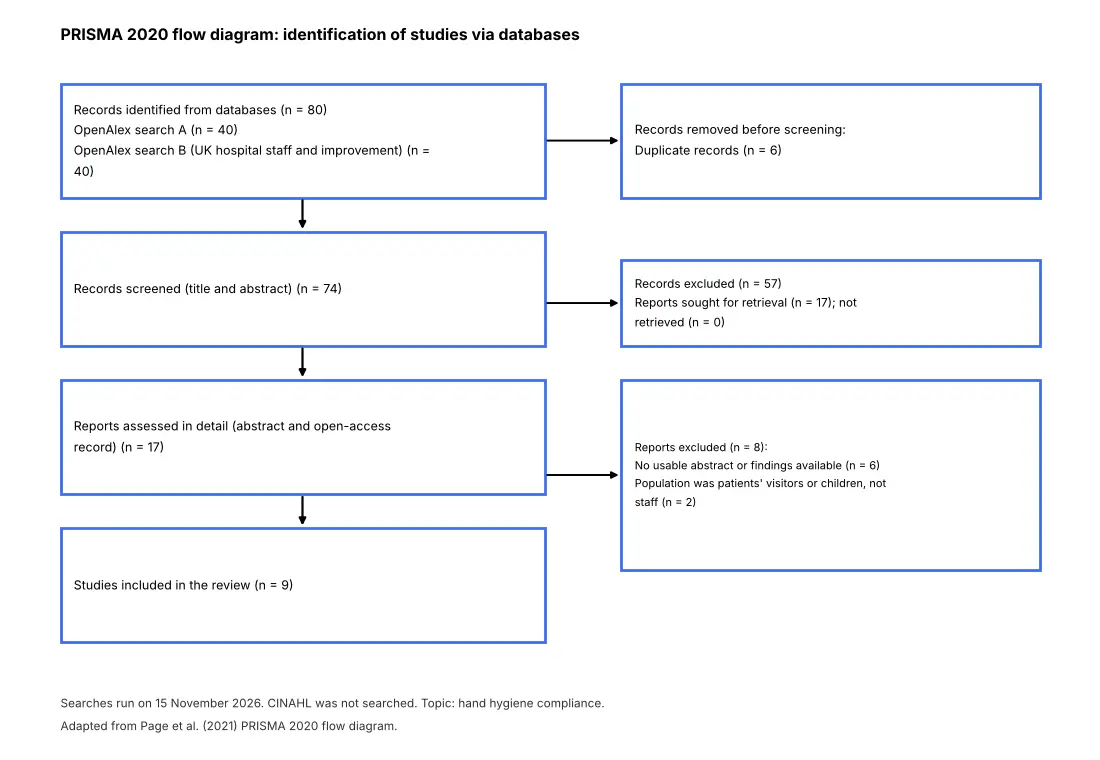
This literature-based dissertation is a structured review of published primary research on hand hygiene compliance. It aims to be transparent and reproducible, but it is smaller in scope than a full systematic review, which would normally involve several reviewers, many more databases and exhaustive searching (Aveyard, 2023). The review is reported with reference to the PRISMA 2020 statement, which lists the items that should be described and recommends a flow diagram showing how records move through identification, screening and inclusion (Page et al., 2021). Appendix D presents that flow diagram, Appendix A records each search string, Appendix B tabulates the included studies and Appendix C gives a worked critical appraisal. Together, the appendices allow another reader to check each decision and to repeat the process.
The review question was framed using the Population, Exposure and Outcome (PEO) structure, which suits questions about experiences and influencing factors rather than the effects of a treatment. The population was healthcare staff, including nurses, doctors and nursing students, working or training in UK hospitals. The exposures were the interventions, monitoring systems, training and workplace conditions that might influence staff behaviour, and the outcomes were observed compliance, staff views and the costs of improvement. Structured frameworks help to translate a broad topic into searchable concepts, although the choice of framework affects how sensitive a search is (Methley et al., 2014; Aveyard, 2023). Because the evidence included observational audits, trials, interviews, an economic model and service-improvement reports, qualitative, quantitative and mixed-methods research was eligible for inclusion.
Two searches were run on 15 November 2026 in OpenAlex, an open index of scholarly works that covers a large and growing proportion of the published literature (Priem et al., 2022). The first search used the words hand hygiene compliance. The second combined the words hand hygiene, NHS, hospital, staff and improvement, to bring studies of UK hospital staff and service improvement higher in the results. Both searches were limited to open-access records published between 2015 and 2026 with at least one author affiliated to a UK institution. Both searches were restricted to journal articles. Combining more than one source is advised because a single database misses relevant studies (Bramer et al., 2017). The exact strings and settings are given in Appendix A.
CINAHL, the main nursing database, could not be accessed, and a planned search of MEDLINE through Europe PMC was not completed because the service refused repeated requests on the day of searching. The second OpenAlex search was therefore used in its place. These gaps mean that some relevant nursing studies may not have been found, a risk that is well recognised when the combination of databases is restricted (Bramer et al., 2017). OpenAlex matches terms anywhere in the text, so many records were not relevant. It also ranks records by relevance, and the two searches matched 5,260 and 1,145 records. Only the first 40 records of the first search and the first 40 of the second, 80 in total, were screened, so the review should be read as a structured sample of the literature and not as a complete search (Aveyard, 2023).
Studies were eligible if they involved healthcare staff or nursing students in UK hospital or university settings and examined hand hygiene compliance, its measurement, its influences or interventions to improve it. Reports had to be peer-reviewed, written in English, open access and published from 2015 onwards. UK origin was judged from the stated setting and, where the abstract did not name one, from author affiliations. Reviews, protocols, commentaries, studies of patients, visitors or the public, studies set outside the UK and reports without a usable abstract were excluded. Clear criteria applied consistently reduce selection bias and allow the decisions to be audited. The extraction table is presented in Appendix B so that readers can compare studies at a glance (Page et al., 2021; Aveyard, 2023).
All 80 records were exported into a screening log, and 6 duplicates were removed, leaving 74 titles to screen. Titles describing other countries, the general public, food handling, other infection topics or non-clinical settings were excluded at this stage. That left 17 reports for closer assessment against the criteria. The abstract and open-access record of each of these reports were read, and the reason for every exclusion was recorded. The log lists every record by its identifier, the search in which it appeared and the decision reached, so that each exclusion can be traced. Nine studies met the criteria, and the numbers at each stage reconcile in the flow diagram (Page et al., 2021). Screening was carried out by one reviewer, which is a recognised limitation of student reviews because a second reviewer would normally check each decision (Aveyard, 2023).
Quality was considered using the Critical Appraisal Skills Programme checklists, which ask structured questions about the aims, design, conduct, results and value of a study (CASP, 2024). The qualitative checklist was completed in full for one interview study, as a worked example in Appendix C, and indicative quality notes for every study are recorded in Appendix B. Those notes are based on the abstract and, for one study, the open full text, so they are judgements of reporting and not a full audit of how the research was conducted. No study was excluded on quality alone, since appraisal was used to weigh the strength of the findings, which is a common approach in nursing reviews (Aveyard, 2023).
Data were extracted into a standard table covering aims, design, sample, setting, methods, findings and limitations. Numerical results were copied as reported and were not recalculated, and extraction was rechecked once against the source records, a step that reduces transcription errors but does not replace independent checking. Findings were grouped into themes by thematic synthesis, with the observational, trial, economic and interview results reported alongside one another because the review combined studies of different designs (Thomas and Harden, 2008; Braun and Clarke, 2006). The review used published data only and involved no participants, so ethical approval was not required, although the findings of the included studies are reported accurately and with full attribution (Aveyard, 2023).
Findings
Nine UK studies met the inclusion criteria, published between 2016 and 2025. Six were set in NHS hospitals or trusts, one in a university teaching suite and one in a modelled hospital in England, and one has a setting judged from author affiliations. Two examined electronic monitoring systems, one examined observation in anaesthetics, one tested an electronic prompt device, one a training game, one a behavioural intervention and one an education programme for nursing students, while one explored barriers during the pandemic. Each is described below, and the section ends with the quality and limits of the evidence. One of the nine modelled costs for a hospital in England (Guest et al., 2019), and the observation study in anaesthetics was the only one set in a single specialty (Jeanes et al., 2018).
Measuring hand hygiene compliance
Direct observation proved difficult in one specialty. A senior infection control practitioner observed one anaesthetist for 55 minutes, during which there were about 58 hand hygiene opportunities and a compliance rate of 16%. The pace and frequency of tasks made observation hard and potentially unreliable, and in several situations stopping to use gel or wash hands would have posed a risk to patients. The authors judged direct observation invalid and unreliable for this specialty and suggested that cleaning the work environment may reduce exposure to micro-organisms (Jeanes et al., 2018). The finding is from a single observation of one anaesthetist, so it is best read as a warning about audit and not as a measure of anaesthetists generally. By contrast, an electronic system could record events continuously (Gould et al., 2020).
An electronic monitoring system was tested against manual observation on a 31-bed acute medical ward in a London trust. In five sessions, 294 hand hygiene events were observed, and agreement between manual observation and the system was 84%. Observed adherence rose from 24% to 76% across the five sessions, whereas the system’s measurements taken just before the observer arrived stayed constant, which the authors read as a clear Hawthorne effect (Gould et al., 2020). In other words, staff washed their hands more often when watched, and manual audit may therefore overestimate everyday performance. The electronic system avoided this effect when the observer was not present, and the difficulty of observation was also reported in anaesthetics (Jeanes et al., 2018).
Electronic monitoring and staff views
Staff views of monitoring were mixed. A study of an electronic monitoring and prompt device used observation before, during and after installation and interviewed 12 practitioners. Compliance improved while the device was installed, and practitioners said that it increased awareness, enhanced their empathy for patients and encouraged patients and colleagues to prompt them, but also described gaming of the system and irritation (Dyson and Madeo, 2017). In interviews with 11 staff after 12 months of using the system on the medical ward, informants valued hand hygiene and welcomed technology, but they cited workload, emergencies and the placement of dispensers as barriers (Kelly et al., 2021).
The interviews with 11 staff gave five themes: embracing change, hand hygiene as a marker of professional practice, factors influencing adherence, interpreting electronic audit findings and issues with feedback. Nine of the 11 were registered nurses and two were healthcare assistants. Some staff thought that the readings were accurate and that the system increased personal accountability, whereas others reported problems and ignored feedback or the data altogether. They found it hard to see why poor performance was recorded when the system could not relate omissions to the context of care (Kelly et al., 2021). Gaming and irritation were also reported for the earlier device (Dyson and Madeo, 2017).
Interventions to improve hand hygiene compliance
Two interventions drew on behavioural science and training. Clinical staff at one London trust co-designed three stickers, called visual primes, and placed them where non-compliance had been seen. Eighteen hours of observation on three inpatient wards before and after implementation showed that compliance rose by 11% overall six weeks later (N = 1,285, p < 0.001). The rise was 15% for Moment 1 (N = 667, p < 0.001) and 11% for Moment 5 (N = 652, p = 0.06), so the change for Moment 5 was not clearly significant on the figures reported (Blair et al., 2024). Co-design was valued by the authors for engaging staff as well as for its effect, and the training campaign described next also relied on engaging staff directly (Lacey et al., 2016).
A training campaign at the Royal Infirmary of Edinburgh used gesture-recognition software, and it ran in two three-month phases. Staff completed more than 2,010 training sessions, over 30% of them outside office hours, averaging 2.72 sessions per person, and about 90% passed the assessment. Senior staff described a shift in culture driven by friendly competition, although the authors concluded that success depended on a structured set of incentives and a plan (Lacey et al., 2016). Among 825 first-year pre-registration nursing students, an education programme with emphasis on hand drying produced a first-attempt pass rate of 94.4%, and 99.6% complied with recommended drying standards (Gammon et al., 2024).
Barriers, costs and context
The pandemic gave a context in which compliance could be examined. A mixed-methods study in one acute trust of about 750 beds collected data for ten months on COVID-19 cases and on hand hygiene and PPE compliance, and then interviewed four staff from each of two wards. Compliance showed a downward trend over the period. Barriers and facilitators concerned staff numbers, information, training, safety and accessibility, and time was the most common theme, with the policy seen as too time-consuming (Kaye and Marais, 2025). The same sense of workload pressure appeared in the ward interviews about electronic monitoring (Kelly et al., 2021).
Costs were examined in one modelling study of a hypothetical general hospital in England. The model assumed that 4.7% of adult inpatients and 1.72% of healthcare practitioners acquire a healthcare-associated infection, and it estimated that an electronic audit and feedback system that reduced infections by 5% to 25% would avoid between 184 and 921 infections a year, including 6 to 31 deaths, and free 7,794 bed days. If infections fell by at least 15%, the probability that the system was cost-effective for the NHS was at least 0.75 (Guest et al., 2019). The model rests on assumptions, and its authors included an author working on the electronic system studied in the ward reports (Gould et al., 2020).
Patterns across the studies
Three patterns ran through the studies. First, measurement shaped what was known, because manual observation was subject to a Hawthorne effect on a ward (Gould et al., 2020). Second, interventions that changed the environment or involved staff, such as co-designed primes, were associated with improvement (Blair et al., 2024). Third, workload and time were repeatedly named as barriers (Kaye and Marais, 2025). The ward interviews pointed the same way, although they are not counted as a separate pattern. Together, these patterns suggest that hand hygiene compliance depends on systems and conditions as well as on individual intentions, although the evidence is mostly small and local.
Differences between the studies are also informative. Electronic systems were welcomed for accountability by some staff yet disliked by others for irritation and for feedback that ignored clinical context (Kelly et al., 2021). Educational interventions reached near-universal compliance in a controlled teaching suite (Gammon et al., 2024), whereas compliance in clinical wards was lower and fell during the pandemic (Kaye and Marais, 2025). These contrasts suggest that results from training or simulation settings may not carry over to busy wards, and they are a reason why the studies were reported side by side and not combined into a single estimate.
Quality and limits of the evidence
Several limits qualify these findings. Most studies were small, local and observational, with no randomised comparison. The anaesthetic study observed one clinician (Jeanes et al., 2018), and the electronic monitoring study took place on one ward (Gould et al., 2020), so neither can show typical practice across a hospital. Observed compliance is also vulnerable to the Hawthorne effect that one study demonstrated, so before-and-after observation, as in the sticker study, may overstate lasting change (Blair et al., 2024). Short follow-up of six weeks limits what can be said about whether improvement lasts (Blair et al., 2024), and most other studies did not report follow-up at all.
The appraisal in Appendix B is based on abstracts for eight studies, so it is indicative and not a full audit. The worked appraisal in Appendix C of the interview study of electronic monitoring found a clear aim, an independent interviewer, two coders and clear themes, but the number of staff invited was not reported, the ward was chosen because staff were receptive to innovation, no reflexivity statement was given, and two authors received travel funding from the maker of the system (Kelly et al., 2021). One author of the accuracy study was also affiliated with a company (Gould et al., 2020). These points do not make the findings unusable, but they show why results from commercial systems need cautious reading.
The studies also overlap. The report of electronic monitoring accuracy and the interview study appear to describe the same system on a medical ward in a London trust, and the cost model shares authors with both, so their agreement is not necessarily independent (Gould et al., 2020; Kelly et al., 2021; Guest et al., 2019). In addition, the setting of one study was judged to be the UK only from author affiliations. Six further UK reports had no usable abstract and could not be included, so relevant evidence has been lost. Findings from each included report should therefore be read with care.
Wider Discussion
The findings suggest that hand hygiene compliance depends as much on how it is measured and organised as on staff knowledge. Observed compliance of 16% in anaesthetics, and adherence that tripled when staff knew they were being watched, show that single audits can mislead (Jeanes et al., 2018; Gould et al., 2020). This fits the national standard, which includes regular observation audits as a measure of quality (NICE, 2014). None of these sources proves that audit should be abandoned, but together they support using audit with care, alongside other measures such as electronic data and staff feedback, and reading audit results as indications and not as exact rates. Services that report hand hygiene compliance to boards should say how it was measured, because a rate obtained by observation is not comparable with one obtained electronically.
Staff involvement and the working environment appear central. Co-designed visual primes raised compliance (Blair et al., 2024), while time pressure and workload were the commonest barrier during the pandemic (Kaye and Marais, 2025). The Code of the Nursing and Midwifery Council expects nurses to preserve safety (NMC, 2018), and this implies that organisations should make safe practice easy by providing dispensers where they are needed and staffing that leaves time to use them. Improving compliance is therefore partly a matter of design and workload. The same demands arose for frontline staff in the pandemic, as described in nurses during covid-19.
Three priorities follow for practice. First, teams can use audit alongside electronic or other measures and treat observed rates as indicative, since observation changed behaviour on a ward (Gould et al., 2020). Second, services can involve staff in designing low-cost prompts and training, because co-designed primes improved compliance in a London trust (Blair et al., 2024). Third, managers can look at workload and dispenser placement, since both were named as barriers (Kelly et al., 2021). Each priority needs protected time and cooperation across services, and each is within the reach of local teams. None needs new legislation, but each needs a manager who owns it.
Several limitations qualify these conclusions. Only OpenAlex was searched, in two searches, CINAHL was not accessible and a planned search of MEDLINE through Europe PMC was not completed, so relevant nursing studies may have been missed (Bramer et al., 2017). Only the first 40 records of each search were screened, one reviewer made all decisions, and six UK reports were excluded because no usable abstract was available, which is a recognised limitation of student reviews (Aveyard, 2023). Most appraisal relied on abstracts and no study followed compliance for longer than a few months, so the conclusions are offered as a structured sample of the evidence and not as a complete account.
Reflection
I began this review thinking that hand hygiene compliance was mostly a matter of knowing the five moments and remembering to use them. The studies showed otherwise, and that was an uncomfortable realisation. Staff cited workload, emergencies and the position of dispensers, and one study found that compliance rose threefold when staff knew they were being observed. Those findings changed how I think about my own practice, because I know that I clean my hands more carefully when someone is watching. I became more aware that good intentions are not the same as consistent behaviour, and that the environment can help or hinder me. This made me question my own habits more honestly than reading a policy would have done.
The search was harder than I expected. Several relevant UK reports, including studies of audit validity, monitoring and emergency department practice, had no abstract in the records I could reach, so I could not judge them and I excluded them for that reason. Many other records were set in other countries or concerned visitors and the public, and I excluded them under the criteria. Writing down each decision was slow, but it showed me that a review can lose useful evidence simply because of how records are indexed. Next time I will plan to retrieve full texts when abstracts are missing.
Appraising the interview study of electronic monitoring was the most instructive part of the work. The study was clear and its themes were convincing, which I found reassuring, yet the ward had been chosen because staff were receptive to innovation, and the funding statement mentioned travel support from the maker of the system. I had assumed that a published qualitative study would be neutral. Instead I saw that a good study can still carry a commercial link, and I realised that I read funding statements last. This made me more careful about asking who paid for the work. I now try to ask who benefits before I ask what was found.
In practice, I will clean my hands as I would if I were being observed, and I will say so to students and colleagues when I see a barrier such as an empty dispenser. I will also pay attention to how busy shifts affect safe habits, because several studies suggested that time and workload shaped behaviour. I need to improve my skills in reading statistical tests and in finding full texts, since I found some of the figures hard to interpret. I also want to learn more about behaviour change, because the visual primes interested me. These goals are modest, but they are within the reach of any nurse, and I can review them at the end of each placement with my practice supervisor.
Conclusion
This dissertation set out to review UK evidence on how hand hygiene compliance among healthcare staff in hospitals is measured and improved. Nine UK studies, comprising observation and electronic monitoring studies, an interview study, behavioural and training interventions, an education programme for nursing students, a cost model and a study of barriers during the pandemic, showed that single observation audits can mislead, that staff involvement and environmental prompts were linked with better compliance, and that workload and time were repeated barriers. The evidence on cost came from a model and not from a trial, which limits how far it can be relied on.
Staff valued technology that improved adherence but disliked feedback that ignored the context of care, and a cost model suggested that electronic audit might be affordable if it reduced infections by at least 15%. These results come from small local studies, mostly observational, and do not prove cause, but they agree in pointing to measurement with care, staff involvement and attention to workload. Taken together, the studies show that compliance depends on systems and conditions as well as on individual nurses. Their value lies in showing where services can act, and not in proving that one intervention is best.
For nursing practice, the review supports using audit alongside other measures and reading observed rates as indications, involving staff in designing prompts and training, and examining workload and the placement of dispensers. The strength of this evidence is limited by the restricted search, single-reviewer screening and reliance on abstracts, so the conclusions are best treated as a well-founded starting point and not as a final answer. Further research that follows compliance over longer periods and tests interventions in clinical wards would show which approaches work best. Teams that act on these points may also improve hand hygiene compliance on their own wards.
Reference List
Aveyard, H. (2023) Doing a literature review in health and social care: a practical guide. 5th edn. Open University Press.
Blair, C.-J. et al. (2024) ‘A helping hand: applying behavioural science and co-design methodology to improve hand hygiene compliance in the hospital setting’, PLOS ONE, 19(12), article e0310768. doi:10.1371/journal.pone.0310768.
Bramer, W.M. et al. (2017) ‘Optimal database combinations for literature searches in systematic reviews: a prospective exploratory study’, Systematic Reviews, 6, article 245. doi:10.1186/s13643-017-0644-y.
Braun, V. and Clarke, V. (2006) ‘Using thematic analysis in psychology’, Qualitative Research in Psychology, 3(2), pp. 77-101. doi:10.1191/1478088706qp063oa.
CASP (2024) CASP checklists. Oxford: Critical Appraisal Skills Programme. Available at: https://casp-uk.net/casp-checklists/ (Accessed: 9 November 2026).
Dyson, J. and Madeo, M. (2017) ‘Investigating the use of an electronic hand hygiene monitoring and prompt device: influence and acceptability’, Journal of Infection Prevention, 18(6), pp. 278-287. doi:10.1177/1757177417714045.
Gammon, J. et al. (2024) ‘Impact of an educational intervention on hand hygiene practice among nursing students, with a focus on hand drying efficacy’, Journal of Infection Prevention, 25(1-2), pp. 3-10. doi:10.1177/17571774231224695.
Gould, D.J. et al. (2020) ‘Electronic hand hygiene monitoring: accuracy, impact on the Hawthorne effect and efficiency’, Journal of Infection Prevention, 21(4), pp. 136-143. doi:10.1177/1757177420907999.
Guest, J.F. et al. (2019) ‘Modelling the costs and consequences of reducing healthcare-associated infections by improving hand hygiene in an average hospital in England’, BMJ Open, 9(10), article e029971. doi:10.1136/bmjopen-2019-029971.
Jeanes, A. et al. (2018) ‘Hand hygiene compliance monitoring in anaesthetics: feasibility and validity’, Journal of Infection Prevention, 19(3), pp. 116-122. doi:10.1177/1757177418755306.
Kaye, G. and Marais, D. (2025) ‘Why do staff comply? A study to determine factors influencing staff adherence to PPE and hand hygiene policy and standards within an acute healthcare setting’, Journal of Infection Prevention, 26(4), pp. 161-166. doi:10.1177/17571774251334045.
Kelly, D. et al. (2021) ‘Electronic hand hygiene monitoring systems can be well-tolerated by health workers: findings of a qualitative study’, Journal of Infection Prevention, 22(6), pp. 246-251. doi:10.1177/17571774211012781.
Lacey, G. et al. (2016) ‘The impact of structured incentives on the adoption of a serious game for hand hygiene training in a hospital setting’, Studies in Health Technology and Informatics, 220, pp. 179-184. Available at: https://pubmed.ncbi.nlm.nih.gov/27046575 (Accessed: 15 November 2026).
Methley, A.M. et al. (2014) ‘PICO, PICOS and SPIDER: a comparison study of specificity and sensitivity in three search tools for qualitative systematic reviews’, BMC Health Services Research, 14, article 579. doi:10.1186/s12913-014-0579-0.
National Institute for Health and Care Excellence (NICE) (2012) Healthcare-associated infections: prevention and control in primary and community care (CG139). London: NICE. Available at: https://www.nice.org.uk/guidance/cg139 (Accessed: 15 November 2026).
National Institute for Health and Care Excellence (NICE) (2014) Infection prevention and control (NICE quality standard QS61). London: NICE. Available at: https://www.nice.org.uk/guidance/qs61 (Accessed: 15 November 2026).
Nursing and Midwifery Council (NMC) (2018) The Code: professional standards of practice and behaviour for nurses, midwives and nursing associates. London: NMC. Available at: https://www.nmc.org.uk/standards/code/ (Accessed: 15 November 2026).
Page, M.J. et al. (2021) ‘The PRISMA 2020 statement: an updated guideline for reporting systematic reviews’, BMJ, 372, article n71. doi:10.1136/bmj.n71.
Priem, J., Piwowar, H. and Orr, R. (2022) ‘OpenAlex: a fully-open index of scholarly works, authors, venues, institutions, and concepts’, arXiv, 2205.01833. doi:10.48550/arXiv.2205.01833.
Thomas, J. and Harden, A. (2008) ‘Methods for the thematic synthesis of qualitative research in systematic reviews’, BMC Medical Research Methodology, 8, article 45. doi:10.1186/1471-2288-8-45.
World Health Organization (WHO) (2009) WHO guidelines on hand hygiene in health care. Geneva: WHO. Available at: https://www.who.int/publications/i/item/9789241597906 (Accessed: 15 November 2026).
Appendix A: Search strategy
This appendix records the searches run for the hand hygiene compliance review so that the process can be repeated and checked.
Two searches on hand hygiene compliance were run on 15 November 2026 using the OpenAlex works API. The first 40 records of the first search and the first 40 of the second, ranked by relevance, were retrieved and screened by title and abstract.
| Database | Platform | Date run | Search string | Limiters | Hits |
|---|---|---|---|---|---|
| OpenAlex search A | OpenAlex API | 15 November 2026 | search=hand hygiene compliance | Filter: authorships.countries:GB; is_oa:true; publication_year:2015-2026; type:article. 5,260 matches in total; the first 40 by relevance were screened. | 40 |
| OpenAlex search B (UK hospital staff and improvement) | OpenAlex API | 15 November 2026 | search=hand hygiene NHS hospital staff improvement | Filter: authorships.countries:GB; is_oa:true; publication_year:2015-2026; type:article. 1,145 matches in total; the first 40 by relevance were screened. | 40 |
CINAHL could not be accessed and was not searched, so no CINAHL results are reported. A planned MEDLINE search through Europe PMC was attempted on the same day but the service refused repeated requests, so it was not completed for hand hygiene compliance; search B, which targeted UK hospital staff and service improvement, was used instead.
OpenAlex matches search terms in the title, abstract or full text, and the country filter matches any record with at least one author affiliated to a UK institution. UK setting and relevance were therefore checked for each study at the assessment stage. Records identified: 80 (40 + 40); duplicates removed: 6; records screened: 74.
Appendix B: Data extraction table
The table summarises each study included in this hand hygiene compliance review: its aim, design, sample, methods, key findings, limitations and relevance to hand hygiene compliance.
| Author / year / country | Aim | Design | Sample and setting | Methods | Key findings | Limitations / quality | Relevance to hand hygiene compliance |
|---|---|---|---|---|---|---|---|
| Lacey et al. (2016), UK (Royal Infirmary of Edinburgh) | To describe a hand hygiene improvement campaign using gesture-recognition training software and to test how incentives affected its adoption by staff. | Service-improvement campaign on hand hygiene compliance in two three-month phases. | Staff across hospital units, with more than 2,010 training sessions logged, in a campaign on hand hygiene compliance. | Training with gesture-recognition software; first phase evaluated the technology, second rotated staff and changed incentives. | More than 30% of sessions were outside office hours; 2.72 sessions per person; about 90% passed; senior staff reported a culture shift through friendly competition; success needed structured incentives and a plan. | Indicative (abstract only): no comparison group; uptake and pass rates, not clinical compliance, were reported; authors include company staff; hand hygiene compliance outcomes not measured in the abstract. | Training to improve hand hygiene compliance. |
| Dyson and Madeo (2017), UK (NHS hospitals) | To examine the influence of an electronic prompt device on hand hygiene compliance, behaviour and staff experience. | Mixed-methods observation and interview study. | 12 healthcare practitioners interviewed; observation of soap and alcohol rub use. | Observation of hand hygiene compliance before, during and after installation, plus the device’s own data and interviews. | Hand hygiene compliance improved while the device was installed; practitioners reported greater awareness, empathy for patients and prompting by patients and colleagues, but also gaming and irritation. | Indicative (abstract only): 12 interviewees; setting within the hospital not stated in the abstract; possible Hawthorne effect on observed hand hygiene compliance. | Electronic prompting and acceptability. |
| Jeanes et al. (2018), UK (acute NHS hospital) | To test whether regular, valid measurement of hand hygiene compliance is feasible in anaesthetics. | Direct observation case study. | One anaesthetist observed for 55 minutes (about 58 opportunities). | Direct observation by a senior infection control practitioner using the WHO five moments framework. | Compliance 16%; observation was hard and unreliable because of pace and frequency of tasks; stopping to clean hands would sometimes risk patients; environmental cleaning suggested. | Indicative (abstract only): one clinician and one session; cannot show typical hand hygiene compliance in anaesthetics. | Measurement of hand hygiene compliance in a specialty. |
| Guest et al. (2019), UK (England) | To estimate the clinical and economic impact of adding an electronic audit and feedback system to improve hand hygiene compliance in a hospital in England. | Decision-analytic cost model of hand hygiene compliance. | Hypothetical general hospital in England; no participants. | Model of effects on healthcare-associated infections for patients and practitioners, with assumed infection rates of 4.7% and 1.72%. | A 5% to 25% fall in infections avoids 184 to 921 infections, 6 to 31 deaths and frees 7,794 bed days; probability of cost-effectiveness at least 0.75 if infections fall by 15% or more. | Indicative (abstract only): hypothetical hospital; assumptions; funding not stated in the abstract; shares authors with the monitoring studies of hand hygiene compliance. | Costs of improving hand hygiene compliance. |
| Gould et al. (2020), UK (London NHS trust) | To evaluate the accuracy of an electronic system for measuring hand hygiene compliance and its ability to avoid the Hawthorne effect. | Observational comparison of manual and electronic measurement. | Staff on a 31-bed acute medical ward; 294 hand hygiene events in five sessions. | Manual observation by an observer unknown to the ward, compared with continuous electronic measurement of hand hygiene compliance. | Agreement between methods was 84%; observed adherence rose from 24% to 76% while electronic readings stayed constant, showing a Hawthorne effect. | Indicative (abstract only): one ward; an author affiliated with the system’s maker; same ward and system as Kelly et al. (2021) on hand hygiene compliance. | Accuracy of hand hygiene compliance measurement. |
| Kelly et al. (2021), UK (London NHS trust) | To evaluate the acceptability of an electronic hand hygiene monitoring system to frontline health workers. | Qualitative interview study of hand hygiene compliance monitoring. | 11 staff (nine registered nurses, two healthcare assistants) on one acute medical ward. | Semi-structured interviews after 12 months of use; inductive thematic analysis of hand hygiene compliance data. | Five themes; staff valued hand hygiene and welcomed technology; barriers were workload, emergencies and dispenser position; views of accuracy and feedback differed. | CASP qualitative appraisal in Appendix C (open full text). One ward chosen for receptiveness; invitations not reported; no reflexivity statement; two authors received travel funding from the system’s maker. | Staff acceptance of monitoring hand hygiene compliance. |
| Gammon et al. (2024), UK (Wales; university teaching suite) | To evaluate an educational intervention on hand hygiene compliance skills among first-year nursing students, with emphasis on hand drying. | Quantitative observational study. | 825 first-year pre-registration nursing students. | Observation and assessment against set criteria in a university suite, analysed in SPSS. | 94.4% passed first time; 45 of 46 passed on a second attempt, giving 99.9% overall; 99.6% met hand drying standards. | Indicative (abstract only): teaching suite, not clinical wards; no comparison group; online year 2023 (print 2024); skills, not routine hand hygiene compliance. | Education for hand hygiene compliance. |
| Blair et al. (2024), UK (London NHS trust) | To use co-design and behavioural science to improve hand hygiene compliance at one London trust. | Pre-post observational study of hand hygiene compliance. | Three inpatient wards; 18 hours of observation before and 18 hours after. | Staff co-designed three sticker prompts, called visual primes; chi-squared comparison of compliance for WHO Moments 1 and 5. | Compliance rose by 11% overall after six weeks (p < 0.001); Moment 1 rose 15% (p < 0.001); Moment 5 rose 11% (p = 0.06). | Indicative (abstract only): no control wards; six-week follow-up; observed hand hygiene compliance may be affected by being watched. | Behavioural intervention for hand hygiene compliance. |
| Kaye and Marais (2025), UK (author affiliations) | To identify factors that help or hinder staff compliance with PPE and hand hygiene standards. | Sequential explanatory mixed-methods study. | All inpatient wards (about 750 beds) of one acute trust for ten months; eight staff interviewed from two wards. | Routine data on COVID-19 cases, hand hygiene and PPE compliance, followed by interviews analysed thematically. | Hand hygiene compliance trended downward; themes were staff numbers, information, training, safety and accessibility; time was the commonest barrier. | Indicative (abstract only): eight interviewees; UK judged from author affiliations; PPE and hand hygiene compliance combined. | Barriers to hand hygiene compliance. |
Appendix C: Critical appraisal checklist
CASP qualitative studies checklist (CASP, 2024), completed for Kelly et al. (2021), a study included in this hand hygiene compliance review. Answers: Yes, No or Can’t tell, each with a short justification.
| # | Question | Answer | Justification |
|---|---|---|---|
| Section A: Are the results valid? | |||
| 1 | Was there a clear statement of the aims of the research? | Yes | The aim is stated clearly: to evaluate the acceptability of a new electronic hand hygiene monitoring system to frontline health workers in an NHS trust, which bears on hand hygiene compliance. |
| 2 | Is a qualitative methodology appropriate? | Yes | A qualitative method suits a question about how staff experience and accept monitoring, and the authors argue that in-depth interviews can probe sensitive reactions to poor feedback on hand hygiene compliance. |
| 3 | Was the research design appropriate to address the aims of the research? | Yes | Semi-structured interviews on hand hygiene compliance with inductive thematic analysis suit the aim, and the authors explain why interviews were preferred to questionnaires. |
| 4 | Was the recruitment strategy appropriate to the aims of the research? | Can’t tell | Eleven staff reporting on hand hygiene compliance, nine registered nurses and two healthcare assistants, were interviewed from one ward chosen because it was receptive to innovation, but the number invited and the recruitment method are not reported. |
| 5 | Was the data collected in a way that addressed the research issue? | Yes | Interviews took place about 12 months after the system started, in an office near the ward, with an independent interviewer, audio-recording and verbatim transcription, although the length and topic guide are not given. |
| 6 | Has the relationship between researcher and participants been adequately considered? | No | No formal reflexivity statement is given, and the links of several authors to hand hygiene monitoring and to the trust are not discussed. |
| Section B: What are the results? | |||
| 7 | Have ethical issues been taken into consideration? | Yes | The lead university’s research ethics committee approved the study and all participants gave consent, although no reference number is given for work on hand hygiene compliance. |
| 8 | Was the data analysis sufficiently rigorous? | Yes | Two researchers coded the hand hygiene compliance transcripts with third-party arbitration and saturation is claimed, although no software is named and member checking is not reported. |
| 9 | Is there a clear statement of findings? | Yes | Five themes are presented with short quotations attributed by role, and they address hand hygiene compliance and feedback from the system. |
| Section C: Will the results help locally? | |||
| 10 | How valuable is the research? | Yes | The study adds to knowledge of staff views on monitoring hand hygiene compliance and states its limits, but two authors received travel funding from the system’s manufacturer and only nursing staff took part. |
Appendix D: PRISMA flow diagram
This dissertation is a worked example that shows the structure and standard of a 5,000-word literature-based Independent Project. It is provided for learning and is not to be submitted as a student’s own work.