

Self-Management and Nurse-Led Care for People Living with Lymphoedema: A Literature Review
 By Dr. Robertson Prime, Research Fellow
This dissertation is a worked example that shows the structure and standard of a 5,000-word literature-based Independent Project. It is provided for learning and is not to be submitted as a student’s own work.
Abstract
Background: Lymphoedema is a long-term condition that is often cared for by specialist nurses, and national guidance emphasises information, early referral and compression. Less is known about how UK studies describe lymphoedema management, self-management and nurse-led care.
Aim: To critically review UK evidence on lymphoedema management, with a focus on self-management and nurse-led care.
Methods: A structured literature review using the Population, Exposure and Outcome framework. OpenAlex was searched twice on 15 November 2026, because CINAHL could not be accessed and a planned MEDLINE search was not completed. The first 40 records of each search were screened: 80 records were identified, 72 screened after the removal of duplicates and 10 UK studies included. Quality was considered using Critical Appraisal Skills Programme questions, and findings were combined by thematic synthesis.
Findings: The included studies of lymphoedema management (n = 10) comprised focus groups, interviews, a narrative inquiry, two feasibility trials, a survey, a cohort study, a measurement study and a service evaluation. People often felt unprepared and unheard, access to specialist help was uneven, and self-management was said to depend on early, tailored information and open access to therapists.
Conclusions and implications for practice: For nursing practice, nurses can give early and tailored information, allow time to listen and refer early. The evidence is limited by the restricted search, single-reviewer screening, reliance on abstracts and the absence of trials that test information or access as interventions.
Keywords: lymphoedema management; lymphoedema self-management; nurse-led care; adult nursing; literature review.
Brief at a glance
- Framework
- PEO
- Design
- Literature review (PEO)
- Studies included
- 10
- Field
- Adult Nursing
Introduction
Lymphoedema is a long-term condition in which fluid collects in the tissues and causes swelling, and in the UK its care is often led by specialist nurses. National guidance for people treated for breast cancer advises that they are told about the risk of swelling and its early signs, that those who develop it are referred to a specialist service as soon as possible, and that compression therapy is offered as the first stage of treatment (NICE, 2018). A national survey found that services are most often small regional nurse-led clinics (Brown and Sneddon, 2020). Nurses in other settings, such as practice nurses, may also meet people who live with swelling, and the Code of the Nursing and Midwifery Council applies to all of them (NMC, 2018). Lymphoedema management is therefore a matter for the wider nursing workforce.
This dissertation reviews UK research on lymphoedema management, with a focus on self-management and nurse-led care. A literature review suits the question because the evidence is scattered across interviews, surveys, small trials and service evaluations, and a structured process makes each choice visible and open to challenge (Aveyard, 2023). The review is limited to the UK so that its conclusions can be read against national guidance and one professional code. It asks how people describe living with lymphoedema, what the evidence says about self-management and about access to services, and what small trials and measurement studies can currently tell nurses. It then considers what this means for nursing practice and education. The review builds on guidance that advises early information, prompt referral and compression (NICE, 2018), and it asks whether the studies show that people receive these in practice. The answer matters for any nurse who supports people with swelling.
Background and Justification
National guidance on lymphoedema after breast cancer treatment is set out in the guideline of the National Institute for Health and Care Excellence on early and locally advanced breast cancer. It advises that people are told about the risk of lymphoedema, its early signs and how to monitor for them, and that they are reassured that physical activity does not cause or worsen the condition. It also advises against offering compression to reduce the risk of developing it (NICE, 2018). These recommendations place information and reassurance early in the pathway, before swelling appears. The guideline concerns breast cancer, so it does not cover lymphoedema from other causes, and the Code requires nurses to work within the limits of their competence (NMC, 2018). Recommendations written for one group of patients may still guide nurses who meet similar problems, but they should be applied with care.
For people who develop swelling, the guideline advises referral to a specialist lymphoedema service as soon as possible, after other treatable causes have been checked for first. It advises that compression therapy is offered as the first stage of treatment, with the choice made jointly with the person, and that education covers management options, skin care, support groups and how to recognise cellulitis or a blood clot (NICE, 2018). Referral and treatment therefore depend on nurses who recognise the problem and who know when to pass care to a specialist, which the Code describes as working within the limits of competence (NMC, 2018). The guideline contains no separate recommendation on self-management, although education and support groups are included.
Evidence on how services are organised comes from a national survey of members of the British Lymphology Society, in which 111 of 382 members responded, a response of 29%. Services were most often small regional nurse-led clinics, 74.8% reported treating all types of lymphoedema, and 49.5% reported moderate or severe delays in obtaining compression garments. About 70% of services accepted people with a body mass index over 40 (Brown and Sneddon, 2020). The authors concluded that access to treatment was not equitable. The response was low, about half of services were not represented and the trustees of the society declared a conflict of interest, so the figures describe responding services and not the whole country, and they sit alongside the guidance (NICE, 2018).
Self-management is not a separate topic from nursing care. When people are told about early signs, skin care and exercise, the guidance expects them to act on that information in daily life (NICE, 2018), and the Code expects nurses to treat people as individuals and to support them in making decisions (NMC, 2018). Self-management is also central to other long-term conditions, such as those discussed in chronic breathlessness, where nurses help people to build skills and confidence. For lymphoedema management, this raises the question of how well people feel prepared, which a review of experience can address more directly than guidance can. People who are prepared are more likely to notice change early and to seek help, and people who are not prepared may only learn what to look for once swelling has become established (NICE, 2018).
Evidence on these questions is spread across interviews, surveys, small trials and service evaluations, so a structured literature review can bring it together if it states its method and limits (Aveyard, 2023). Questions about people, their exposures and their outcomes fit a framework that separates the population, the exposure and the outcome better than one built around a single treatment (Methley et al., 2014). That framework also keeps the review on the experience of living with lymphoedema and on the care available, and not on one product or technique. Studies from different designs are therefore read side by side and are not combined into one estimate. A review of this kind cannot say which treatment works best, but it can show where the evidence is thin and where nurses can act on what is known (Aveyard, 2023). That is a reasonable purpose for a literature-based dissertation.
This review therefore examines UK research on lymphoedema management against the guidance described above. It is limited to UK studies so that the findings can be read against national guidance and the Code of the Nursing and Midwifery Council (NICE, 2018; NMC, 2018). It looks at three linked questions: how people describe living with lymphoedema, what the studies show about self-management and about access to services, and what small trials and measurement work add. The national survey treats access as a concern for services, and the review follows that approach (Brown and Sneddon, 2020). It does not assess the effectiveness of particular treatments, which would need different evidence. The guidance names compression, skin care and education, and the studies are read for how people receive these (NICE, 2018).
Title, Aim and Objectives
What do UK studies show about the experiences, self-management and nurse-led care of people living with lymphoedema?
Title explained
The title names the two aspects of care that are reviewed (self-management and nurse-led care), the population of people living with lymphoedema, the UK boundary of the evidence and the literature review design that structures the whole work.
Aim
To critically review UK evidence on lymphoedema management, with a focus on self-management and nurse-led care.
Objectives
- To identify and appraise UK research on people living with lymphoedema.
- To synthesise findings on experiences, self-management and services.
- To make recommendations for nursing practice.
Methodology
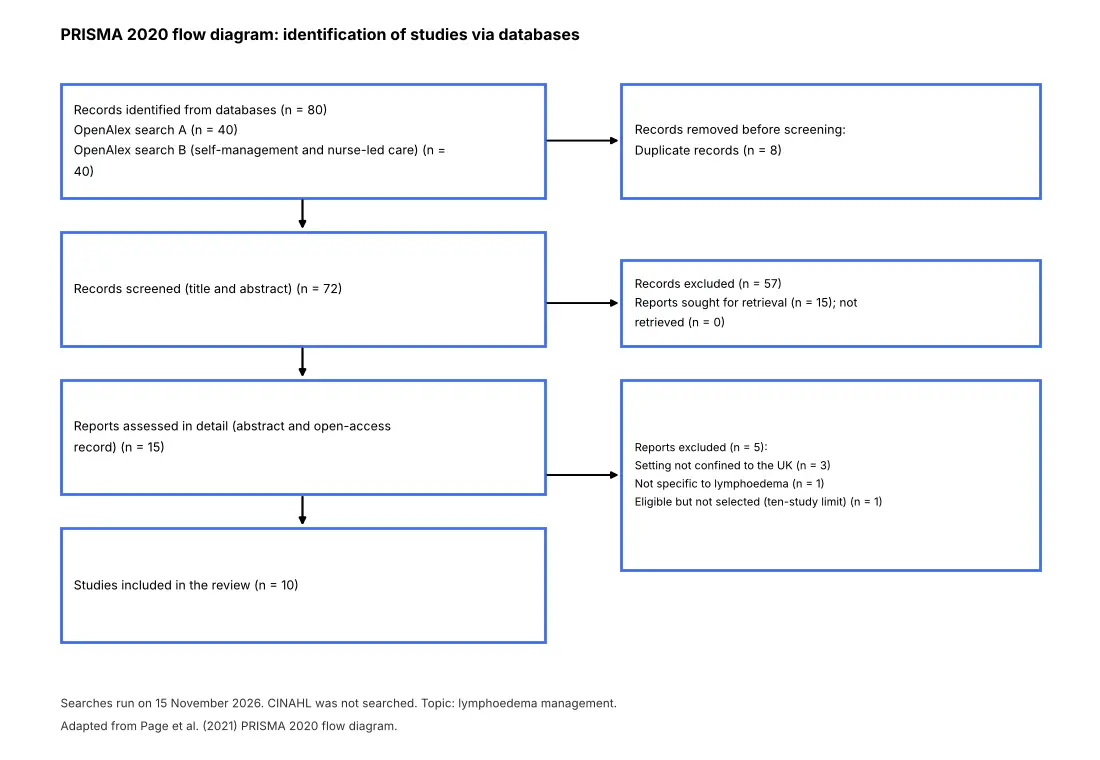
This literature-based dissertation is a structured review of published primary research on lymphoedema management. It aims to be transparent and reproducible, but it is smaller in scope than a full systematic review, which would normally involve several reviewers, many more databases and exhaustive searching (Aveyard, 2023). The review is reported with reference to the PRISMA 2020 statement, which lists the items that should be described and recommends a flow diagram showing how records move through identification, screening and inclusion (Page et al., 2021). Appendix D presents that flow diagram, Appendix A records each search string, Appendix B tabulates the included studies and Appendix C gives a worked critical appraisal. Together, the appendices allow another reader to check each decision and to repeat the process.
The review question was framed using the Population, Exposure and Outcome (PEO) structure, which suits questions about experiences and influencing factors rather than the effects of a treatment. The population was adults living with lymphoedema in the UK, including people whose swelling followed cancer treatment. The exposures were self-management, nurse-led or specialist services and the treatments and supports they offer, and the outcomes were experiences, access to care, feasibility, costs and self-care. Structured frameworks help to translate a broad topic into searchable concepts, although the choice of framework affects how sensitive a search is (Methley et al., 2014; Aveyard, 2023). Because the evidence included interviews, focus groups, surveys, feasibility trials, a cohort study and a service evaluation, qualitative, quantitative and mixed-methods research was eligible for inclusion.
Two searches were run on 15 November 2026 in OpenAlex, an open index of scholarly works that covers a large and growing proportion of the published literature (Priem et al., 2022). The first search used the words lymphoedema management. The second combined the words lymphoedema, self-management, nurse-led care and experiences, to bring studies of people and services higher in the results. Both searches were limited to open-access records published between 2015 and 2026 with at least one author affiliated to a UK institution. Both searches were restricted to journal articles. Combining more than one source is advised because a single database misses relevant studies (Bramer et al., 2017). The exact strings and settings are given in Appendix A.
CINAHL, the main nursing database, could not be accessed, and a planned search of MEDLINE through Europe PMC was not completed because the service refused repeated requests on the day of searching. The second OpenAlex search was therefore used in its place. These gaps mean that some relevant nursing studies may not have been found, a risk that is well recognised when the combination of databases is restricted (Bramer et al., 2017). OpenAlex matches terms anywhere in the text, so many records were not relevant. It also ranks records by relevance, and the two searches matched 942 and 157 records. Only the first 40 records of the first search and the first 40 of the second, 80 in total, were screened, so the review should be read as a structured sample of the literature and not as a complete search (Aveyard, 2023).
Studies were eligible if they involved adults with lymphoedema in the UK, or the services that care for them, and examined self-management, services, treatments, outcome measures or the experiences of people living with the condition. Reports had to be peer-reviewed, written in English, open access and published from 2015 onwards. UK origin was judged from the stated setting and, where the abstract did not name one, from author affiliations. Reviews, protocols, descriptive or opinion articles without methods, studies not specific to lymphoedema, studies set outside the UK or in several countries and reports without a usable abstract were excluded. Clear criteria applied consistently reduce selection bias and allow the decisions to be audited. The extraction table is presented in Appendix B so that readers can compare studies at a glance (Page et al., 2021; Aveyard, 2023).
All 80 records were exported into a screening log, and 8 duplicates were removed, leaving 72 titles to screen. Titles about other countries, other conditions or other populations were excluded here, and where more than ten eligible studies existed, those most about self-management, services and experience were preferred. That left 15 reports for closer assessment against the criteria. The abstract and open-access record of each of these reports were read, and the reason for every exclusion was recorded. The log lists every record by its identifier, the search in which it appeared and the decision reached, so that each exclusion can be traced. Ten studies met the criteria, and the numbers at each stage reconcile in the flow diagram (Page et al., 2021). Screening was carried out by one reviewer, which is a recognised limitation of student reviews because a second reviewer would normally check each decision (Aveyard, 2023).
Quality was considered using the Critical Appraisal Skills Programme checklists, which ask structured questions about the aims, design, conduct, results and value of a study (CASP, 2024). The qualitative checklist was completed in full for one focus group study, as a worked example in Appendix C, and indicative quality notes for every study are recorded in Appendix B. Those notes are based on the abstract and, for one study, the open full text, so they are judgements of reporting and not a full audit of how the research was conducted. No study was excluded on quality alone, since appraisal was used to weigh the strength of the findings, which is a common approach in nursing reviews (Aveyard, 2023).
Data were extracted into a standard table covering aims, design, sample, setting, methods, findings and limitations. Numerical results were copied as reported and were not recalculated, and extraction was rechecked once against the source records, a step that reduces transcription errors but does not replace independent checking. Findings were grouped into themes by thematic synthesis, with the numerical results reported alongside the qualitative themes because the review combined studies of different designs (Thomas and Harden, 2008; Braun and Clarke, 2006). The review used published data only and involved no participants, so ethical approval was not required, although the findings of the included studies are reported accurately and with full attribution (Aveyard, 2023).
Findings
Ten UK studies met the inclusion criteria, published between 2016 and 2025. Four were qualitative, using focus groups, interviews or narrative inquiry, two were feasibility randomised trials, and one each was a survey of services, a cohort study of hospice activity, a validation of a patient-reported measure and a service evaluation. Five concerned lymphoedema after cancer treatment, one concerned men with lymphoedema not caused by cancer, and four concerned lymphoedema services or measures more generally. Each is described below by theme, and the section ends with the quality and limits of the evidence. Because the designs differ, results are reported side by side and are not combined (Smith et al., 2025; Dunn et al., 2019).
Experiences of living with lymphoedema
Two qualitative studies described how people felt about lymphoedema after cancer treatment. In interviews with 14 women who had breast or trunk lymphoedema, the women felt unprepared, said that their concerns were dismissed and described delays before diagnosis (Ulman et al., 2024). De Valois et al. (2016) held focus groups at a drop-in centre in north-west London with 23 survivors of breast or head and neck cancer, and found that people felt disempowered by cancer treatment and its consequences, valued time with a practitioner who listened, and described increased personal control and motivation to look after themselves. The two studies agree that being heard shaped how people coped.
A narrative inquiry gave a different view by studying 12 men in the UK who lived with lymphoedema not caused by cancer. Online interviews of 45 to 90 minutes described disruption to everyday life, adaptation over time and an evolving sense of masculinity (Cooper-Stanton et al., 2025). Most other studies in this review concerned cancer survivors, and the women interviewed by Ulman et al. (2024) had also been treated for cancer. The men’s accounts therefore show that lymphoedema management concerns people outside cancer services, whose experiences are less often studied. The focus groups of De Valois et al. (2016) were also held with people connected to cancer care.
Self-management and head and neck lymphoedema
Fourteen survivors of head and neck cancer who had lymphoedema were interviewed remotely in Ulster and Belfast. Their accounts centred on competency to self-manage and on adherence, and they asked for early, tailored information and open access to therapists. Barriers included limited education and the low priority that lymphoedema was given beside cancer treatment (Mullan et al., 2025). These findings echo the women who felt unprepared after breast cancer (Ulman et al., 2024), and they suggest that self-management depends on what people are told, when they are told it and whether they can return to a therapist when problems arise. The study was small and set in one region, so these views cannot be taken as typical of all survivors.
A UK survey of services for head and neck lymphoedema received 169 responses, of which 134 were analysed. Many patients were not referred to lymphoedema services, and assessment and treatment differed between services (Smith et al., 2025). Uneven access of this kind is also suggested by the hospice and garment studies described below (Brown et al., 2019). The survey describes what services reported and does not show how patients fared. Taken with the interviews of Mullan et al. (2025), it suggests that people may be asked to self-manage without a clear route to specialist help, which is a concern for nurse-led care.
Services, access and cost
A cohort study of independent hospices in North East England described lymphoedema management in 2017/18, covering 13,914 appointments and 12,965 patients. Women outnumbered men by 3.3 to 1, 54.5% of patients were aged over 65, and 66% of activity was not related to secondary cancer. The authors described a high-volume service that is largely invisible (Brown et al., 2019). The study counted appointments and patients and did not measure outcomes or patient experience. Its finding that most activity was not linked to secondary cancer agrees with the narrative inquiry of men whose lymphoedema was not caused by cancer (Cooper-Stanton et al., 2025), and it suggests that hospices carry a share of lymphoedema management that national services may not see.
A service evaluation at two services in Wales examined a change from prescribing compression garments to procuring them. Using 5,392 forms, it reported savings of £71.10 per patient (P < 0.001) after the change (Thomas et al., 2021). The result concerns the cost of supplying garments, which is one part of how services provide compression. It says nothing about whether people used their garments as advised or whether their swelling improved, and it came from two services in one nation. The hospice cohort in England counted activity but not cost per patient (Brown et al., 2019), so the two studies cannot be compared directly, and neither reported how long people waited for garments.
Interventions and measurement
Two feasibility trials tested supports that people could use themselves. In a South Wales outpatient clinic, 20 people were randomised to home intermittent pneumatic compression plus standard care (n = 10) or standard care alone (n = 10) for six months, and recruitment reached 80% (Dunn et al., 2019). The BE-WEL trial randomised 57 women with overweight or obesity and breast cancer-related lymphoedema to four groups. Uptake was 16%, 85% were retained (49 completed) and changes were modest, so the study showed feasibility only (Harvie et al., 2024). Neither trial was designed to show effectiveness, and both were small, so they say little about whether these supports help people to manage swelling in daily life.
A validation study in Swansea developed a patient-reported outcome measure for adults with lymphoedema, guided by consensus standards for measurement instruments. Content validity indices ranged from 0.83 to 1.00, with an average of 0.94, correlation with a general quality of life measure was moderate and in the expected direction, test-retest reliability for the total score was 0.919, and a Welsh translation was prepared (Thomas et al., 2025). A reliable measure matters because the feasibility trials reported only modest changes (Harvie et al., 2024) and the earlier trial relied on a small sample (Dunn et al., 2019). A measure designed for lymphoedema could allow later studies to compare outcomes that matter to people, although the abstract does not describe how many people took part.
Patterns across the studies
Three patterns appeared across the studies. First, people felt unprepared and unheard, and some waited for a diagnosis (Ulman et al., 2024). Second, access to specialist help was uneven, with many patients not referred (Smith et al., 2025). Third, self-management was said to depend on early, tailored information and open access to therapists (Mullan et al., 2025). Each pattern came from a different study, so none was confirmed by a second UK study of the same population, although the three fit together. Together they describe people who are expected to manage a long-term condition without always being prepared or supported to do so.
Differences between designs are also informative. The interviews describe what people need, whereas the two feasibility trials tested a device and a weight and exercise programme, and neither reported effects on preparedness or on confidence to self-manage (Dunn et al., 2019; Harvie et al., 2024). The qualitative studies suggest that information, time and access are central, yet no included study tested them as interventions. This gap between what people ask for and what has been trialled is an important finding in itself (Mullan et al., 2025). Nurse-led services could be a natural setting for such tests, because nurses already provide much of the information and follow-up that people asked for.
Quality and limits of the evidence
Several limits qualify these findings. Samples were small, with 14, 12, 14 and 23 people in the four qualitative studies and 20 in one trial, so the studies describe experience in depth but cannot show how common it is. Uptake in the BE-WEL trial was 16%, so those who joined may differ from those who did not (Harvie et al., 2024). In the survey of head and neck services, 134 of 169 responses were analysed and the response rate is unknown (Smith et al., 2025). The small trial noted risk of bias and attrition (Dunn et al., 2019). Studies of this kind are useful for generating ideas, but they cannot estimate how many people share a view.
The full-text appraisal in Appendix C of the focus group study by De Valois et al. (2016) found a clear aim, a suitable qualitative design, ethical approval, written consent, verbatim transcription and thematic analysis checked by a second researcher. Its weaknesses were that the researcher-acupuncturist role was not examined in depth, no member checking was described, groups were smaller than planned and the data were collected in 2009 and reported in 2016. The other nine studies were appraised from abstracts only, so their quality notes in Appendix B are indicative and should not be read as full audits (Ulman et al., 2024).
Design limits matter too. The hospice cohort covered one region and counted appointments and patients (Brown et al., 2019), the measure was developed in Swansea (Thomas et al., 2025), and the cost evaluation came from two Welsh services (Thomas et al., 2021). Most of the evidence concerned cancer survivors, and only one study addressed men with non-cancer lymphoedema. Five further reports were assessed in detail and excluded, including three set outside the UK or in several countries, one not specific to lymphoedema and one eligible diary study not selected under the ten-study limit, so relevant evidence may have been lost.
Wider Discussion
The findings suggest that preparation is central to lymphoedema management. National guidance advises that people are told about the risk of swelling and its early signs (NICE, 2018), yet women in one study felt unprepared and said that their concerns were dismissed (Ulman et al., 2024), and survivors of head and neck cancer asked for early, tailored information (Mullan et al., 2025). The studies do not show that guidance was ignored, because they did not audit what people were told, and the guideline itself concerns breast cancer. They do suggest that information given once may not be enough and that people need to be able to return to someone who will listen. Tailoring information to the person, rather than giving a leaflet, is also a theme. Preparation is a task that nurses in many settings can carry out.
Access is the second concern. Many patients with head and neck lymphoedema were not referred, and services assessed and treated differently (Smith et al., 2025), while hospice clinics provided a high-volume service that was largely invisible (Brown et al., 2019). Guidance advises referral to a specialist service as soon as possible (NICE, 2018), so these findings point to a gap between guidance and practice. Hospices are one example of a service that sits outside cancer pathways. The evidence reviewed here suggests that lymphoedema management depends on nurses who recognise swelling early and who know where to refer, and that services outside cancer pathways deserve attention. The national picture remains uneven.
Three priorities follow for practice. First, nurses can give early, tailored information and make clear how a person can return for help (Mullan et al., 2025). Second, nurses can allow time for people to describe how swelling affects them, since De Valois et al. (2016) found that being heard shaped coping. Third, nurses can refer early and check that referral has happened, because many patients were not referred (Smith et al., 2025). Pressures on nursing capacity, discussed in nurses during covid-19, make protected time for this harder, which is a patient safety matter. Each priority is within the reach of local teams, and none depends on new equipment. Good lymphoedema management begins with a conversation in which the person is heard.
Several limitations qualify these conclusions. Only OpenAlex was searched, in two searches, CINAHL was not accessible and a planned search of MEDLINE through Europe PMC was not completed, so relevant nursing studies may have been missed (Bramer et al., 2017). Only the first 40 records of each search were screened, one reviewer made all decisions, and where more than ten eligible studies existed those most about self-management and services were preferred, which is a recognised limitation of student reviews (Aveyard, 2023). Appraisal relied on abstracts for nine studies, and the evidence is small and mostly descriptive, so the conclusions are offered as a structured sample of the evidence and not as a complete account. A larger review with a second reviewer would reduce these risks.
Reflection
I began this review thinking that lymphoedema management was mostly about compression garments and skin care. The studies changed that view. People described feeling unprepared, having their concerns dismissed and waiting for a diagnosis, and survivors of head and neck cancer said that lymphoedema was given low priority beside their cancer treatment. I realised that my own knowledge of the condition was thin, and that I had met swelling on placement without asking what the person had been told. I became more aware that a clinical problem can look minor from the nurse’s side while it dominates daily life for the person living with it. I had not expected to feel so uncertain about something that appears on so many placements.
The search was harder than I expected. Several relevant papers were set in more than one country, and I excluded them because I could not be sure that their findings applied to the UK. One study of diary entries from men with non-cancer lymphoedema fitted the criteria, but it appeared to come from the same team and a similar sample as the narrative inquiry that I kept, so I left it out under the ten-study limit. That was uncomfortable, because each excluded paper had something to teach. I also noticed that I was tempted to keep studies that confirmed my expectations, and I had to check that I was not choosing them for that reason. Writing down each decision was slow, but it showed me how much a review depends on its rules, and next time I will agree them in advance.
Appraising the focus group study was the most instructive part of the work. It had a clear aim, ethical approval and a careful description of its analysis, yet the lead author was also the acupuncturist who had treated the participants, and the paper did not reflect on how that might shape the groups. I had assumed that a respected journal paper would deal with this, and I was surprised that it did not. I realised that I tend to trust a paper that sounds thorough, and that is a habit I need to change. I now try to ask what a paper leaves out before I ask what it found, and next time I will make that my first question when I read about lymphoedema management or any other topic.
In practice, I will ask people with swelling what they have been told and who they can contact, before I assume that they have been prepared, and I will check that a referral has been made. I need to improve my skills in reading feasibility trials, since the studies of compression and of weight and exercise were hard to compare, and I want to learn more about how specialist services are organised. These goals are modest, but they are within the reach of any student nurse, and I will review them at the end of each placement with my practice supervisor. I will also ask how people are supported after they leave a clinic.
Conclusion
This dissertation set out to review UK evidence on lymphoedema management, with a focus on self-management and nurse-led care. Ten UK studies, comprising focus groups, interviews, a narrative inquiry, two feasibility trials, a survey, a cohort study, a measurement study and a service evaluation, showed that people often felt unprepared and unheard, that access to specialist help was uneven, and that self-management was said to depend on early, tailored information and open access to therapists. Together these findings describe a long-term condition in which people are often left to manage with limited support. In this sense the care is as much about communication as about treatment.
These results come from small studies and a few surveys and do not prove cause, but they agree in pointing to preparation, access and listening. They also show that the two feasibility trials tested a device and a weight and exercise programme, while no included study tested information or access as interventions. This matters because the supports that people asked for have not yet been evaluated. Their value lies in showing where nurses and services can act and not in proving that one approach is best. Local audit of what people are told and how quickly they are referred would be a practical first step.
For nursing practice, the review supports early and tailored information, time to listen and early referral with a check that it has happened. The strength of this evidence is limited by the restricted search, single-reviewer screening and reliance on abstracts, so the conclusions are best treated as a well-founded starting point and not as a final answer. Further research that tests information and access as interventions, and follows people over time, would show which approaches work best, and services that act on these points may improve the care of people living with lymphoedema, including those outside cancer services. Such work is achievable within existing services.
Reference List
Aveyard, H. (2023) Doing a literature review in health and social care: a practical guide. 5th edn. Open University Press.
Bramer, W.M. et al. (2017) ‘Optimal database combinations for literature searches in systematic reviews: a prospective exploratory study’, Systematic Reviews, 6, article 245. doi:10.1186/s13643-017-0644-y.
Braun, V. and Clarke, V. (2006) ‘Using thematic analysis in psychology’, Qualitative Research in Psychology, 3(2), pp. 77-101. doi:10.1191/1478088706qp063oa.
Brown, A. et al. (2019) ‘Lymphoedema management by independent hospices: a cohort study’, BMJ Supportive & Palliative Care, 9(4), pp. 389-396. doi:10.1136/bmjspcare-2019-001896.
Brown, S. and Sneddon, M. (2020) ‘Lymphoedema service provision across the UK: a national survey’, Journal of Lymphoedema, 15(1), pp. 16-21. Available at: https://woundsinternational.com/wp-content/uploads/2023/02/7b3eec4952793b68cebae1f2028db309.pdf (Accessed: 15 November 2026).
CASP (2024) CASP checklists. Oxford: Critical Appraisal Skills Programme. Available at: https://casp-uk.net/casp-checklists/ (Accessed: 9 November 2026).
Cooper-Stanton, G. et al. (2025) ‘A narrative inquiry of men’s perceptions of support and masculinity: semi-structured interviews of men living with non-cancer-related lymphoedema in the United Kingdom’, Journal of Research in Nursing, 30(5-6), pp. 530-546. doi:10.1177/17449871251347841.
De Valois, B., Asprey, A. and Young, T. (2016) ”The monkey on your shoulder’: a qualitative study of lymphoedema patients’ attitudes to and experiences of acupuncture and moxibustion’, Evidence-Based Complementary and Alternative Medicine, 2016, article 4298420. doi:10.1155/2016/4298420.
Dunn, N. et al. (2019) ‘Home management of lower limb lymphoedema with an intermittent pneumatic compression device: a feasibility study’, Pilot and Feasibility Studies, 5, article 113. doi:10.1186/s40814-019-0496-4.
Harvie, M. et al. (2024) ‘BE-WEL trial (breast: evaluation of weight and exercise for lymphoedema) testing weight control and exercise programmes for women with breast cancer related lymphoedema: a feasibility trial’, Breast Cancer Research and Treatment, 207(1), pp. 203-212. doi:10.1007/s10549-024-07356-0.
Methley, A.M. et al. (2014) ‘PICO, PICOS and SPIDER: a comparison study of specificity and sensitivity in three search tools for qualitative systematic reviews’, BMC Health Services Research, 14, article 579. doi:10.1186/s12913-014-0579-0.
Mullan, L.J. et al. (2025) ‘Patients understanding, perceptions and experiences of head and neck lymphoedema management following treatment for head and neck cancer: a qualitative study’, Supportive Care in Cancer, 33(7), article 625. doi:10.1007/s00520-025-09668-3.
National Institute for Health and Care Excellence (NICE) (2018) Early and locally advanced breast cancer: diagnosis and management (NG101). London: NICE. Available at: https://www.nice.org.uk/guidance/ng101/chapter/Recommendations (Accessed: 15 November 2026).
Nursing and Midwifery Council (NMC) (2018) The Code: professional standards of practice and behaviour for nurses, midwives and nursing associates. London: NMC. Available at: https://www.nmc.org.uk/standards/code/ (Accessed: 15 November 2026).
Page, M.J. et al. (2021) ‘The PRISMA 2020 statement: an updated guideline for reporting systematic reviews’, BMJ, 372, article n71. doi:10.1136/bmj.n71.
Priem, J., Piwowar, H. and Orr, R. (2022) ‘OpenAlex: a fully-open index of scholarly works, authors, venues, institutions, and concepts’, arXiv, 2205.01833. doi:10.48550/arXiv.2205.01833.
Smith, A.J., Cherry, M.G. and Patterson, J.M. (2025) ‘Head and neck lymphoedema service provision in the UK: a survey of practice’, Supportive Care in Cancer, 33(12), article 1142. doi:10.1007/s00520-025-10107-6.
Thomas, J. and Harden, A. (2008) ‘Methods for the thematic synthesis of qualitative research in systematic reviews’, BMC Medical Research Methodology, 8, article 45. doi:10.1186/1471-2288-8-45.
Thomas, M. et al. (2021) ‘Changing the process of prescribing to procuring lymphoedema compression garments: a service evaluation’, Journal of Prescribing Practice, 3(12), pp. 490-498. doi:10.12968/jprp.2021.3.12.490.
Thomas, M. et al. (2025) ‘A new validated Lymphoedema-specific Patient Reported Outcome Measure (LYMPROM) for adults with Lymphoedema’, PLoS ONE, 20(5), article e0315314. doi:10.1371/journal.pone.0315314.
Ulman, J. et al. (2024) ‘Exploring women’s experiences of breast or trunk lymphoedema following treatment for breast cancer’, Journal of Psychosocial Oncology, 42(1), pp. 64-79. doi:10.1080/07347332.2023.2218374.
Appendix A: Search strategy
This appendix records the searches run for the lymphoedema management review so that the process can be repeated and checked.
Two searches on lymphoedema management were run on 15 November 2026 using the OpenAlex works API. The first 40 records of the first search and the first 40 of the second, ranked by relevance, were retrieved and screened by title and abstract.
| Database | Platform | Date run | Search string | Limiters | Hits |
|---|---|---|---|---|---|
| OpenAlex search A | OpenAlex API | 15 November 2026 | search=lymphoedema management | Filter: authorships.countries:GB; is_oa:true; publication_year:2015-2026; type:article. 942 matches in total; the first 40 by relevance were screened. | 40 |
| OpenAlex search B (self-management and nurse-led care) | OpenAlex API | 15 November 2026 | search=lymphoedema self-management nurse-led care experiences | Filter: authorships.countries:GB; is_oa:true; publication_year:2015-2026; type:article. 157 matches in total; the first 40 by relevance were screened. | 40 |
CINAHL could not be accessed and was not searched, so no CINAHL results are reported. A planned MEDLINE search through Europe PMC was attempted on the same day but the service refused repeated requests, so it was not completed for lymphoedema management; search B, which targeted self-management and nurse-led care, was used instead.
OpenAlex matches search terms in the title, abstract or full text, and the country filter matches any record with at least one author affiliated to a UK institution. UK setting and relevance were therefore checked for each study at the assessment stage. Records identified: 80 (40 + 40); duplicates removed: 8; records screened: 72.
Appendix B: Data extraction table
The table summarises each study included in this lymphoedema management review: its aim, design, sample, methods, key findings, limitations and relevance to lymphoedema management.
| Author / year / country | Aim | Design | Sample and setting | Methods | Key findings | Limitations / quality | Relevance to lymphoedema management |
|---|---|---|---|---|---|---|---|
| De Valois et al. (2016), UK (drop-in centre, north-west London) | To explore how patients with lymphoedema secondary to cancer treatment perceive and experience acupuncture and moxibustion, as part of lymphoedema management. | Qualitative focus group study of lymphoedema management, nested in a mixed-methods observational study. | 23 survivors of breast or head and neck cancer receiving lymphoedema management; six focus groups and one telephone interview. | Moderated focus groups transcribed verbatim and analysed thematically with NVivo; themes checked by a second researcher. | Participants felt disempowered by cancer treatment and lymphoedema, valued whole-person care and time with a practitioner, and reported empowerment, personal control and motivation to improve self-care. | CASP qualitative appraisal in Appendix C (open full text). Researcher-acupuncturist role not examined; no member checking; groups smaller than planned; data collected 2009; treatment-specific lymphoedema management. | Experience and self-care in lymphoedema management. |
| Brown et al. (2019), UK (independent hospices, North East England) | To describe lymphoedema management by independent hospices in North East England. | Cohort study of lymphoedema management activity. | 13,914 lymphoedema management appointments and 12,965 patients in 2017/18. | Descriptive analysis of hospice lymphoedema service records. | Women outnumbered men 3.3 to 1; 54.5% of patients were over 65; 66% of activity was not related to secondary cancer; the authors described a high-volume, largely invisible service. | Indicative (abstract only): one region; counts of activity, not outcomes; no limitations stated; lymphoedema management in hospices. | Services and access in lymphoedema management. |
| Dunn et al. (2019), UK (South Wales outpatient clinic) | To test the feasibility of home management of lower limb lymphoedema with an intermittent pneumatic compression device. | Feasibility randomised controlled trial of home lymphoedema management. | 20 participants in lymphoedema management: device plus standard care (n = 10) and standard care alone (n = 10). | Randomised comparison over six months; feasibility outcomes included recruitment. | Recruitment reached 80%; risk of bias and attrition were noted; the study was designed to show feasibility, not effectiveness. | Indicative (abstract only): 20 participants; one clinic; bias and attrition noted; feasibility only; lymphoedema management at home. | Interventions for lymphoedema management that people use themselves. |
| Ulman et al. (2024), UK (women treated for breast cancer; affiliations) | To explore women’s experiences of breast or trunk lymphoedema following treatment for breast cancer. | Qualitative interview study of lymphoedema management. | 14 women with breast or trunk lymphoedema who had experience of lymphoedema management. | Interviews analysed thematically. | Women felt unprepared, said their concerns were dismissed and described delayed diagnosis. | Indicative (abstract only): 14 women; breast cancer only; no limitations stated; print year 2024 (online 2023); lymphoedema management experience. | Experience and preparation for lymphoedema management. |
| Harvie et al. (2024), UK (BE-WEL feasibility trial) | To test the feasibility of weight control and exercise programmes for women with breast cancer-related lymphoedema. | Feasibility randomised controlled trial of lymphoedema management (four groups). | 57 women in a lymphoedema management trial, all with overweight or obesity and breast cancer-related lymphoedema. | Randomisation to four groups; feasibility outcomes included uptake and retention. | Uptake was 16% and retention 85% (49 completed); changes were modest; the trial showed feasibility only. | Indicative (abstract only): low uptake; small groups; feasibility only; lymphoedema management through weight and exercise. | Interventions for lymphoedema management that people use themselves. |
| Mullan et al. (2025), UK (Ulster and Belfast) | To explore patients’ understanding, perceptions and experiences of head and neck lymphoedema management after treatment for head and neck cancer. | Qualitative interview study of lymphoedema management. | 14 survivors of head and neck cancer with experience of lymphoedema management. | Remote interviews analysed thematically. | Themes of competency to self-manage and adherence; participants asked for early, tailored information and open access to therapists; barriers were limited education and low priority. | Indicative (abstract only): 14 participants; one region; no limitations stated; self-management in lymphoedema management. | Self-management and information in lymphoedema management. |
| Smith et al. (2025), UK (national survey) | To describe head and neck lymphoedema management service provision across the UK. | Cross-sectional survey of lymphoedema management practice. | 169 responses from lymphoedema management services; 134 analysed. | Survey of services with descriptive analysis. | Many patients were not referred to services; assessment and treatment differed between services. | Indicative (abstract only): response rate unknown; self-reported by services; no limitations stated; lymphoedema management services for head and neck cancer. | Access and services in lymphoedema management. |
| Thomas et al. (2025), UK (Swansea) | To develop and validate a lymphoedema-specific patient-reported outcome measure for adults (LYMPROM). | Measurement validation study of lymphoedema management outcomes, guided by consensus standards. | Adults in lymphoedema management; sample size not stated in the abstract. | Content validity, correlation with a general quality of life measure and test-retest reliability; Welsh translation. | Content validity indices 0.83 to 1.00 (average 0.94); correlation with the quality of life measure -0.577 to -0.435; test-retest reliability for the total score 0.919. | Indicative (abstract only): one centre; sample not stated; no limitations stated; measurement for lymphoedema management. | Measurement of outcomes in lymphoedema management. |
| Thomas et al. (2021), UK (two Welsh services) | To evaluate a change from prescribing to procuring compression garments. | Service evaluation of lymphoedema management supply. | 5,392 forms from two lymphoedema management services. | Comparison of costs before and after the change. | Savings of £71.10 per patient (P < 0.001) after the change. | Indicative (abstract only): two services in one nation; cost only; no outcomes for patients; lymphoedema management supply. | Services and cost in lymphoedema management. |
| Cooper-Stanton et al. (2025), UK (online interviews) | To explore men’s perceptions of support and masculinity when living with non-cancer-related lymphoedema. | Narrative inquiry of lymphoedema management with semi-structured interviews. | 12 men living with non-cancer-related lymphoedema and using lymphoedema management. | Online interviews of 45 to 90 minutes analysed as narratives. | Accounts of disruption, adaptation and an evolving sense of masculinity. | Indicative (abstract only): 12 men; self-selected; same team as an excluded diary study; no limitations stated; non-cancer lymphoedema management. | Experience of men in lymphoedema management without cancer. |
Appendix C: Critical appraisal checklist
CASP qualitative studies checklist (CASP, 2024), completed for De Valois et al. (2016), a study included in this lymphoedema management review. Answers: Yes, No or Can’t tell, each with a short justification.
| # | Question | Answer | Justification |
|---|---|---|---|
| Section A: Are the results valid? | |||
| 1 | Was there a clear statement of the aims of the research? | Yes | The aim is stated clearly: to explore how patients with lymphoedema secondary to cancer treatment perceive and experience acupuncture and moxibustion, through three questions on experience, wellbeing and attitude to lymphoedema management. |
| 2 | Is a qualitative methodology appropriate? | Yes | A qualitative method suits a question about meanings and perceptions, and the authors explain that focus groups were chosen to generate discussion and let participants clarify their views. |
| 3 | Was the research design appropriate to address the aims of the research? | Yes | A focus group design nested in a mixed-methods observational study suits the aim, and the authors justify groups over one-to-one interviews, although group sizes later fell below those planned. |
| 4 | Was the recruitment strategy appropriate to the aims of the research? | Can’t tell | Thirty-three people who had completed at least seven treatments were invited and 26 responded favourably, but not all could attend and 23 took part; group sizes were small and the counts in the table are not clearly reconciled with the total. |
| 5 | Was the data collected in a way that addressed the research issue? | Yes | Groups were held in meeting rooms at the cancer centre in 2009 using a questioning route, audio-recorded, transcribed verbatim and observed by a co-moderator, and one reluctant participant was interviewed by telephone. |
| 6 | Has the relationship between researcher and participants been adequately considered? | No | The moderator had little prior knowledge of the topic, but the lead author is the acupuncturist and sessions were held at the treating hospital, and the paper does not systematically reflect on how this might shape discussion. |
| Section B: What are the results? | |||
| 7 | Have ethical issues been taken into consideration? | Yes | A regional research ethics committee approved the study, written consent was taken before the groups began, and confidentiality and anonymity were assured. |
| 8 | Was the data analysis sufficiently rigorous? | Yes | Thematic analysis was carried out in NVivo through an iterative process, a second researcher checked the themes, and saturation is claimed, although member checking and an audit trail are not described. |
| 9 | Is there a clear statement of findings? | Yes | Findings are organised into themes with quotations identified by participant code and cancer type, and they are discussed alongside earlier research and the quantitative data. |
| Section C: Will the results help locally? | |||
| 10 | How valuable is the research? | Yes | The study adds to knowledge of how people with lymphoedema experience acupuncture and self-care, proposes a conceptual model and to lymphoedema management, and states its limits: English-speaking participants only, limited diversity, small groups and safety concerns not explored in depth. |
Appendix D: PRISMA flow diagram
This dissertation is a worked example that shows the structure and standard of a 5,000-word literature-based Independent Project. It is provided for learning and is not to be submitted as a student’s own work.