

Critical Appraisal: How to Critically Appraise Research Studies
 By Dr. Robertson Prime, Research Fellow
Updated November 16, 2026
15 min read
About 3,000 words
Critical appraisal is the process of carefully and systematically examining research to judge its trustworthiness, and its value and relevance in a particular context. In a literature review, it is what turns a pile of studies into evidence you can rely on, because it shows which findings are strong, which are weak and why.
This guide explains what critical appraisal of research involves, the three questions behind every appraisal and how to choose the right critical appraisal tools for each study design. It then walks you through a step-by-step method, with a critical appraisal checklist, a worked example and a summary table you can copy into your own chapter.
- The basics: what critical appraisal means, why it matters in a literature review and how it differs from simply summarizing a study.
- The tools: CASP and JBI checklists, RoB 2, AMSTAR 2 and the MMAT, and how to pick the right one for quantitative, qualitative and mixed methods studies.
- The method: seven steps to critically appraise research, a reusable checklist, a worked example and the most common appraisal mistakes.
On this page
Key takeaways
- Critical appraisal judges a study’s validity, results and relevance, not just what it found.
- Choose critical appraisal tools that match the study design, such as CASP or JBI checklists.
- Appraise every included study the same way and record your answers in a table.
- Use the appraisal in your writing: weigh strong evidence more heavily and explain why.
What Is Critical Appraisal?
The Critical Appraisal Skills Programme (CASP) defines critical appraisal as “the process of carefully and systematically examining research to judge its trustworthiness, and its value and relevance in a particular context.” Put simply, you ask how far you can believe a study and how far its findings apply to your own research question.
Critical appraisal began in evidence-based medicine and the health sciences, where clinicians needed to know which research findings were safe to act on. Today, students in nursing, education, psychology, business and the social sciences are expected to critically appraise research studies in every literature review.
- Why it matters: published research is not automatically good research. Peer review catches many problems, but studies still appear with small samples, biased designs or conclusions that go beyond their data, so you need your own way to evaluate them.
- What it is not: critical appraisal is not a search for reasons to reject a study, and it is not the same as writing a summary. It is a balanced judgment that names a study’s strengths as well as its methodological flaws.
- Where it fits: you appraise studies after you have searched and screened the literature, and before you synthesize what they found. The appraisal tells you how much weight each study deserves in your argument.
The Three Questions Behind Every Critical Appraisal
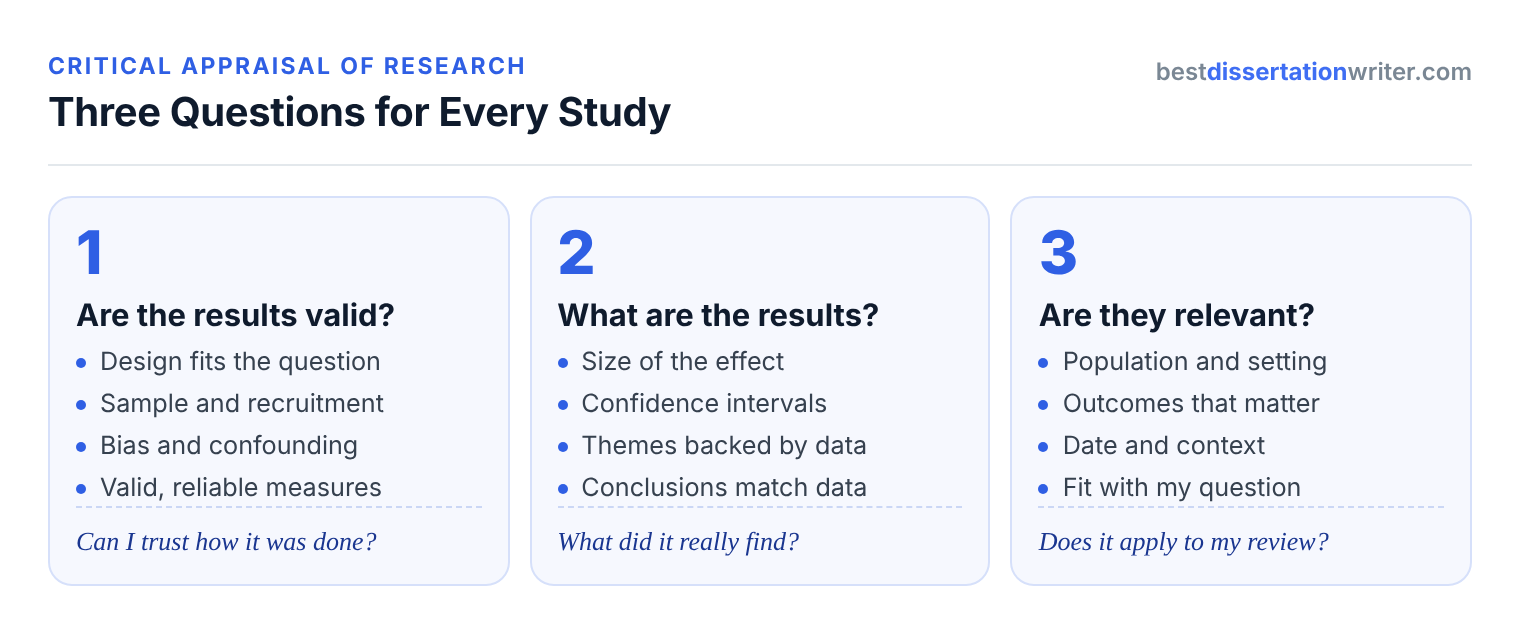
Every critical appraisal checklist, whatever its length, comes back to three questions. If you remember them, you can critically appraise research even before you have chosen a formal tool.
1. Are the results valid?
Validity asks whether the study measured what it claims to measure, in a way that is free from serious bias. This is usually the longest part of any appraisal.
- Design: check whether the study design suits the research question. A randomized controlled trial is strong for testing an intervention, while a qualitative study is better for understanding experiences.
- Sampling: ask who took part, how they were recruited and whether the sample size was large enough to give accurate results. A small or self-selected sample limits how far the findings can be trusted.
- Bias: look for selection bias, missing data, unblinded outcome assessment and conflicts of interest. CASP encourages you to ask whether any potential biases were accounted for in the design, data collection or data analysis.
2. What are the results?
Once you trust the method, look closely at what was actually found. Results are more than a headline conclusion.
- Size of the effect: in quantitative studies, look at effect sizes and confidence intervals, not just p-values. A result can be statistically significant but too small to matter in practice.
- Precision: wide confidence intervals suggest uncertainty, often because the sample was small. Note this, because it affects how strongly you can summarize the finding.
- Depth of findings: in qualitative studies, check whether themes are supported by data, such as quotations, and whether the authors considered alternative explanations.
3. Are the results relevant to my question?
A study can be valid and still not fit your review. Relevance asks whether the findings apply to your population, setting and scope.
- Population and setting: a study of hospital nurses in one country may not apply to community nurses elsewhere. Note differences that limit how far the findings travel.
- Outcomes: check whether the study measured outcomes that matter to your research question, or only related ones.
- Currency: older studies may reflect practices or policies that have since changed. Use them, but say so when you rely on them.
Critical Appraisal Tools: Which Checklist to Use
Critical appraisal tools give you a structured set of questions, so you appraise every study in the same way. The right tool depends on the study design, so identify the design of each paper first.
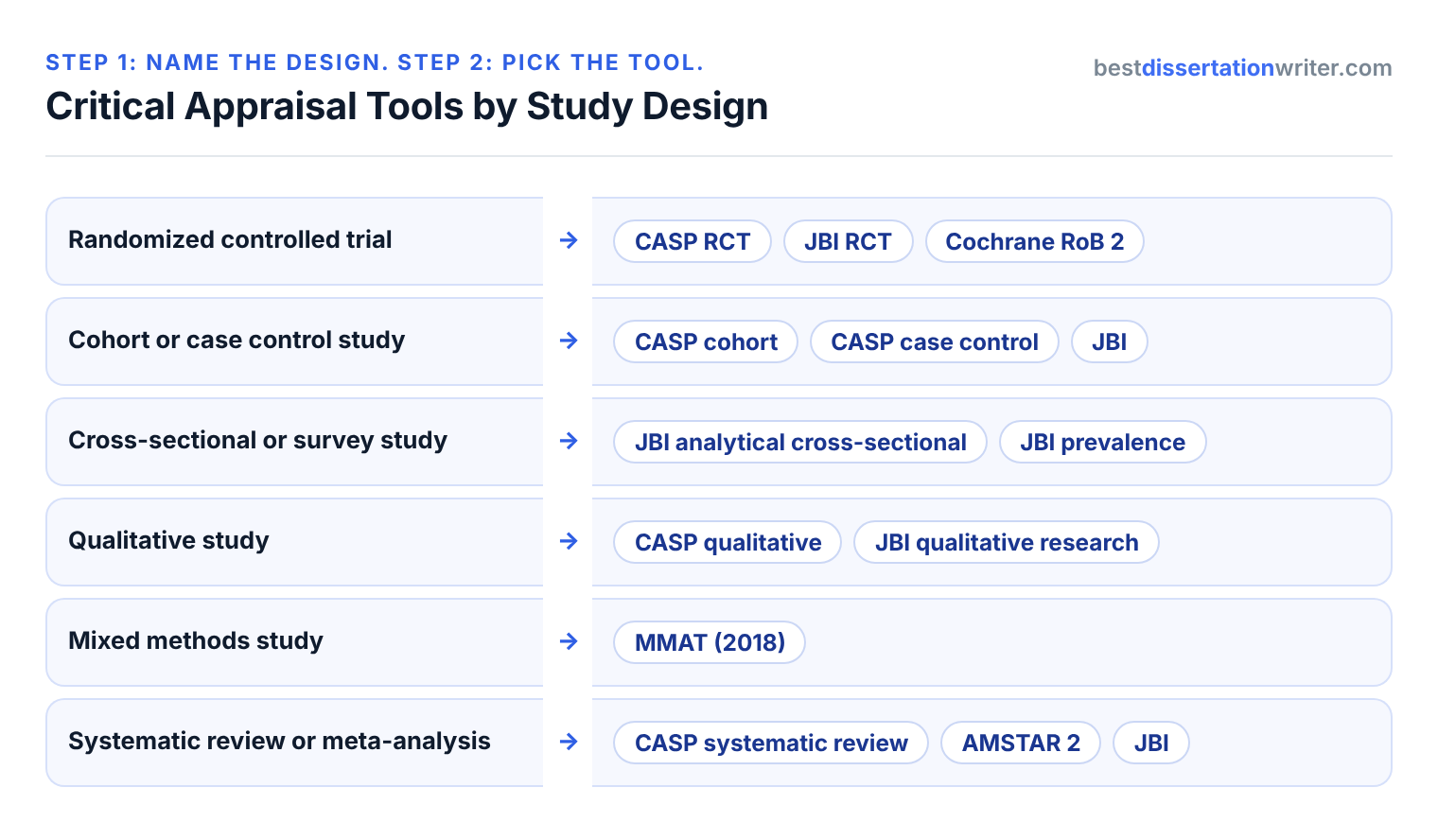
| Tool | Best for | What it covers |
|---|---|---|
| CASP checklists | Students and beginners in most fields | Eight free checklists, including systematic reviews, randomised controlled trials, cohort, case control, qualitative, diagnostic and economic studies |
| JBI checklists | A wider range of study designs | Checklists for designs such as cross-sectional, quasi-experimental, prevalence, case series, qualitative research and text and opinion |
| RoB 2 (Cochrane) | Randomized trials in systematic reviews | Risk of bias in randomization, deviations from intervention, missing data, measurement and reporting |
| AMSTAR 2 | Systematic reviews and meta-analyses | 16 items on how a review was planned, searched, appraised and synthesized |
| MMAT | Mixed methods reviews | One tool for qualitative, quantitative and mixed methods studies |
- CASP checklists: the CASP checklists are free to download and use under a Creative Commons license. Each one asks a short set of questions in plain language, which makes them the most popular choice for students writing a first literature review.
- JBI checklists: the JBI critical appraisal tools cover more study designs than CASP, including analytical cross-sectional and quasi-experimental studies. They are widely used in nursing and the health sciences.
- AMSTAR 2: if your literature review includes other reviews, use AMSTAR 2, published in the BMJ by Shea and colleagues in 2017. It is designed for systematic reviews of randomized or non-randomized studies of healthcare interventions.
- MMAT: the Mixed Methods Appraisal Tool, updated by Hong and colleagues in 2018, lets you appraise quantitative and qualitative studies with one instrument. It is helpful when your review mixes study types and you want consistent ratings.
How to Conduct a Critical Appraisal in 7 Steps
This step-by-step method works for any literature review, from an undergraduate project to a dissertation chapter or a scoping review. Follow the same steps for every included study, so your appraisal is fair and consistent.
- Restate your research question. Write your review question at the top of your appraisal sheet. Every judgment about relevance depends on it, so keep it in view while you read.
- Identify the study design. Read the abstract and methods and name the design: randomized trial, cohort, cross-sectional, qualitative, mixed methods or a review. If the authors describe it vaguely, decide from what they actually did.
- Choose the matching tool. Pick the CASP, JBI or other checklist for that design and save a copy for each study. Using an established tool also gives you something to cite in your methods.
- Read the whole paper, then answer each question. Read the full text once without judging it, then go through the checklist question by question. Answer yes, no or can’t tell, and write one line of evidence from the paper for each answer.
- Note strengths and limitations. List the two or three most important strengths and the most serious methodological flaws. Focus on problems that could change the results, not on minor reporting gaps.
- Make an overall judgment. Rate the study as high, moderate or low quality, or as low, some concerns or high risk of bias. Explain the rating in a sentence, so a reader can see how you reached it.
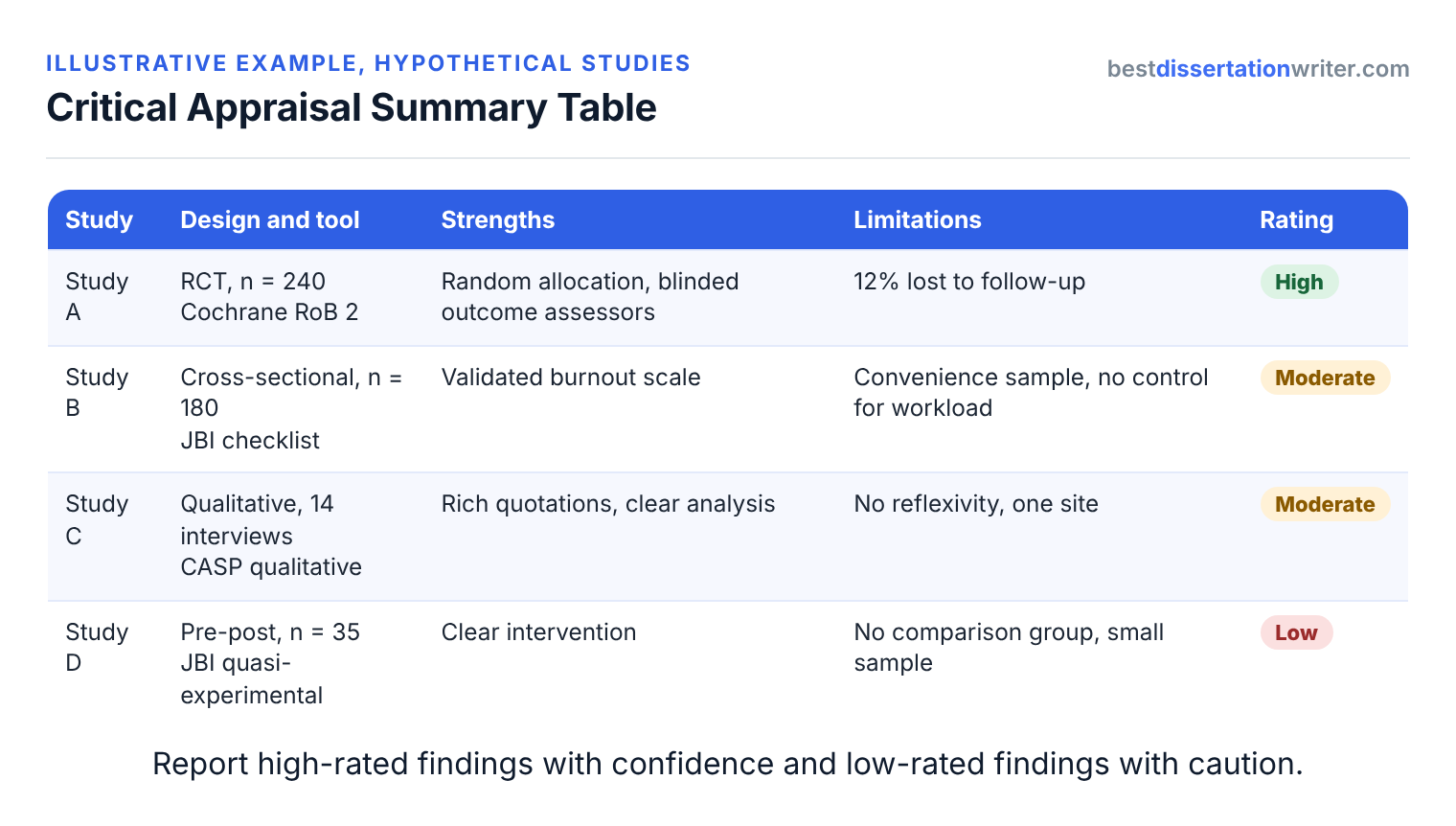
- Record it in a summary table. Add the study, design, key finding, strengths, limitations and overall rating to one table. This table becomes the backbone of your discussion of the evidence.
Template
Study: [author, year] | Design: [design] | Tool: [CASP / JBI / other] | Key finding: [one sentence] | Strengths: [two or three] | Limitations: [most serious flaws] | Overall rating: [high / moderate / low] | Relevance to my question: [one sentence]
See a worked critical appraisal example
The study: a hypothetical cross-sectional survey of 180 nurses in two hospitals, reporting that night-shift work was associated with higher burnout scores. The appraiser used the JBI checklist for analytical cross-sectional studies.
Strengths: a validated burnout scale and a clear definition of night-shift work. Limitations: a convenience sample, a 41% response rate and no adjustment for workload, so other factors could explain the link.
Overall: moderate quality. The finding is plausible and consistent with other studies, but the design cannot show cause and effect, so the review presents it as an association.
Resources to help you practice
Critical appraisal skills improve fastest when you practice on real papers and compare your judgments with someone else’s. These resources to help you build that skill are free or widely available.
- Checklist guidance notes: most CASP and JBI checklists include hints under each question that explain what to look for. Read them the first few times, because they show how each criterion should be applied.
- Published appraisals: systematic reviews in your field usually report the quality of every included study. Appraise one of those studies yourself, then compare your rating with the review’s to calibrate your judgment.
- Your supervisor or librarian: health sciences and subject librarians often run appraisal workshops. Ask whether your university offers one, and ask your supervisor which tools your department prefers.
A Critical Appraisal Checklist You Can Use for Any Study
Formal tools are best for a full review, but this general critical appraisal checklist helps you read any paper with a critical eye. Use it for a first pass, or when no specific tool fits.
| Area | Questions to ask |
|---|---|
| Question and aim | Is the research question clearly stated? Does the study design suit it? |
| Sample | Who took part, how were they recruited and was the sample size justified? |
| Methods | Were data collected in a valid and reliable way? Are the tools described? |
| Bias | Could selection, measurement, missing data or funding have biased the results? |
| Analysis | Is the analysis appropriate and clearly reported? Are effect sizes or themes supported? |
| Results | What are the main findings, and how precise or well supported are they? |
| Conclusions | Do the conclusions follow from the data, or go beyond it? |
| Relevance | Do the findings apply to my population, setting and research question? |
- For quantitative studies: pay most attention to sampling, control of confounding factors, the validity and reliability of measures and the precision of results. These are where quantitative studies most often go wrong.
- For qualitative studies: focus on whether the methodology fits the aim, how participants were chosen, how data were analyzed and whether the researchers reflected on their own role. Credibility and transparency matter more here than sample size.
- For reviews: check whether the review had a protocol, searched more than one database, appraised its included studies and synthesized them appropriately. A review or meta-analysis is only as good as the studies and methods behind it.
Two ways to report the same appraisal
Weak
Smith (2021) found that night shifts cause burnout in nurses.
No appraisal: the design, sample and limits are hidden, and an association is reported as a cause.
Strong
Smith’s (2021) cross-sectional survey of 180 nurses linked night shifts with higher burnout, but its convenience sample and lack of adjustment for workload mean the finding shows an association, not a cause.
The appraisal is woven into the sentence, so the reader knows how much weight the finding deserves.
Illustrative example; the study is hypothetical.
How to Use Critical Appraisal in Your Literature Review
Critical appraisal only adds value when it shapes what you write. Examiners look for evidence that you have weighed the studies, not just listed them, and that your evaluation of the research evidence drives your conclusions about the literature.
- Describe your method: in the methods or introduction of your review, name the critical appraisal tools you used and explain how you rated studies. A short paragraph is enough for most dissertations.
- Weigh the evidence: give more space and confidence to high-quality studies, and present findings from weaker studies with caution. Phrases such as “although limited by a small sample” show your judgment at work.
- Compare across studies: point out where strong and weak studies agree or disagree. If only low-quality studies support a claim, that is itself a finding worth reporting.
- Link to gaps: repeated methodological flaws, such as a lack of longitudinal designs, are a research gap. Use them to justify your own study.
- Include the table: put your appraisal summary table in the chapter or in an appendix. It shows your examiner the work behind your conclusions.
For more on writing with this kind of judgment, see our guides to the critical literature review and the criticality of a literature review. If your review follows a systematic method, our guide to systematic literature review structure shows where the appraisal section goes.
Common Mistakes When You Critically Appraise Research
Most weak appraisals share the same few problems. Check your work against this list before you submit.
- Summarizing instead of appraising: repeating a study’s aims and findings is not critical appraisal. Every paragraph about a study should say something about how much it can be trusted.
- Only listing weaknesses: an appraisal that finds nothing good in any study looks unbalanced. Name strengths as well, such as validated measures or a large sample.
- Treating every flaw as fatal: all studies have limitations. Focus on the flaws that could change the results, and explain why they matter.
- Using the wrong tool: a checklist designed for trials does not fit a qualitative study. Match the tool to the study design every time.
- Adding up scores blindly: a total score can hide one serious flaw, such as no control group. Use the checklist to guide a judgment, not to replace it.
- Appraising inconsistently: if you appraise some studies in depth and others not at all, your review looks biased. Use the same tool and the same level of detail for every study of the same design.
To see appraisal at work in a finished chapter, read our literature review example, and for the full process, see how to write a literature review. For the wider project, our guide on how to write a dissertation covers every chapter.
FAQs About Critical Appraisal
What are the 5 steps of critical appraisal?
A common five-step version is: identify the study design, choose a matching tool, assess validity, assess the results and judge relevance to your question. Some guides add a sixth step of recording an overall rating, which makes the appraisal easier to use in your writing.
Whatever the number of steps, the core is the same three questions: are the results valid, what are the results and do they apply to my context? Using an established checklist, such as CASP or JBI, keeps those steps consistent across every study you appraise.
What is an example of a critical appraisal?
An example is appraising a survey that links night-shift work with nurse burnout. Using the JBI cross-sectional checklist, you might note strengths such as a validated burnout scale, and limitations such as a convenience sample and no adjustment for workload.
You would then rate the study as moderate quality and explain that it shows an association, not a cause. In your literature review, you would report the finding with that caution, rather than presenting it as proof. That combination of judgment and reporting is what a good appraisal looks like.
What are the three C’s of critical appraisal?
Different courses use different memory aids, so there is no single official set of three C’s. A common version asks whether a study is credible, whether its results are clear and consistent, and whether its findings are clinically or contextually relevant to your question.
These match the three questions behind most critical appraisal tools: validity, results and relevance. If your course uses its own version, follow it, but make sure your appraisal still covers design, bias, findings and applicability. A memory aid is a starting point, not a replacement for a full checklist.
Which critical appraisal tool is best for students?
For most students, the CASP checklists are the best place to start. They are free, written in plain language and cover the most common study designs, including systematic reviews, randomized trials, cohort studies and qualitative studies.
If your review includes designs that CASP does not cover, such as cross-sectional or quasi-experimental studies, the JBI checklists are a good alternative. For reviews that mix study types, consider the MMAT. Whichever you choose, name it in your methods and use it consistently for every study of that design.
Best Dissertation Writers
Need help with your literature review?
Get a critical, well-structured review with current sources and a clear research gap.