

How to Write a Critical Literature Review in 6 Steps
 By Dr. Robertson Prime, Research Fellow
Updated November 16, 2026
13 min read
About 2,700 words
A critical literature review does more than report what earlier studies found. It evaluates the quality, assumptions and limits of the research, compares competing findings and builds an argument about what the evidence really shows. This guide explains how to write a critical literature review in six steps, with a five-part paragraph model and a full annotated example.
- The basics: what a critical literature review is and how it differs from descriptive, narrative and systematic reviews.
- The method: six steps, from defining your scope to writing and refining the final critical literature review.
- The tools: critical questions for every study, a paragraph structure, weak-vs-strong examples, a template and a checklist.
On this page
Key takeaways
- A critical literature review judges the strength of the evidence, not only what it says.
- Ask the same critical questions of every study: design, sample, measures, bias and fit with your question.
- Each paragraph should move from claim to evidence, comparison, evaluation and a link forward.
- The critical literature review ends by showing why your study is needed.
What Is a Critical Literature Review?
A critical literature review is a structured, evaluative discussion of the existing research on a topic. It asks how strong, consistent and relevant the evidence is, and why studies disagree.
- Evaluation, not description: a critical literature review weighs the strengths and weaknesses of each body of evidence.
- An argument: it takes a position on what the research shows and defends it with sources.
- Attention to method: it considers research methodology, sample size, setting and measures when judging findings.
- Engagement with theory: it examines the assumptions behind the theories that studies use.
- A clear purpose: in a thesis or dissertation, it justifies the gap your study will fill.
Critical literature review vs other types of review
Every good review has some critical analysis, but the depth and the method differ. The table compares the most common types.
| Type | Main aim | How sources are chosen | Depth of evaluation |
|---|---|---|---|
| Descriptive review | Report what studies found | Informal | Low |
| Narrative review | Discuss key themes and studies | Informal, judgment-based | Moderate |
| Critical literature review | Evaluate the evidence and build an argument | Purposive, with stated criteria | High |
| Systematic review | Answer a precise question with all eligible studies | Protocol, set databases, explicit criteria | High, with formal appraisal tools |
If your program expects a protocol, see the systematic literature review structure. For most dissertation chapters, a critical literature review organized by themes is the right choice.
When a thesis or research paper needs a critical literature review
Supervisors increasingly expect critical writing at every level. You will usually need a critical literature review in these cases.
- Dissertations and theses: Chapter 2 must show that you can evaluate your field, not only summarize it.
- Research papers: a short, critical literature review in the introduction justifies the study.
- Coursework: many assignments ask students to write a literature review that critiques a debate or method.
- Theory-heavy topics: where competing models exist, a critical review compares their assumptions.
Writing the literature review critically across disciplines
Critical evaluation looks slightly different in different disciplines and fields of study. The basic elements stay the same in every field of knowledge.
- Health and sciences: a critical literature review focuses on research methods, validity and the quality of research findings, often using checklists to assess each study.
- Social sciences: reviews compare different research traditions and ask how context shapes the relevant research.
- Humanities: reviews engage closely with scholars’ arguments in articles and books, and older work keeps its place.
- Postgraduate work: a research project or thesis expects a fuller critical evaluation than a course paper, where the review may be part of the introduction.
Whatever the field, a critical literature review should provide a critical account of the research on a topic, not a comprehensive list. A larger paper may include a literature review in one section, while review articles in a peer-reviewed journal contain a literature review as a standalone piece.
Getting Started: Critical Questions for Every Study
The quickest way to make a review critical is to ask the same questions of every source while reviewing literature on a particular topic. Record the answers in your synthesis matrix as you read.
- Relevance. Does the study address your research question, population and setting?
- Design. Is the research design suitable for the question, and what can it not show?
- Sample. Is the sample large and varied enough, and how were participants recruited?
- Measures. Are the measures valid and reliable, or self-reported and narrow?
- Analysis. Do the findings follow from the data, or do the authors overstate them?
- Bias. Who funded the study, and are there conflicts of interest?
- Context. When and where was it done, and does that limit how far it applies?
Design-specific checklists make these questions sharper. The free CASP checklists cover randomized trials, cohort studies, qualitative studies and systematic reviews.
How to Write a Critical Literature Review, Steps 1–3: Plan and Conduct a Literature Search
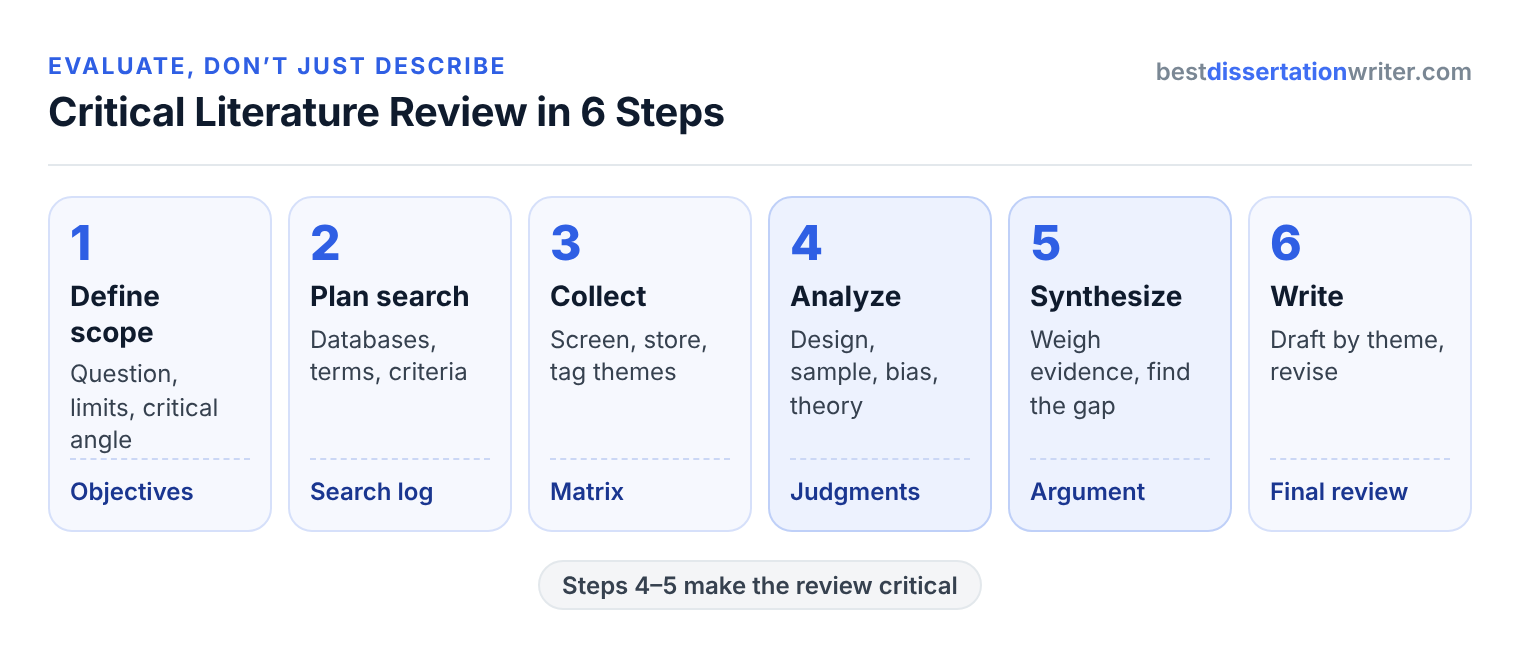
A critical literature review rests on a well-planned search. The first three steps decide which evidence you will judge.
Step 1: Define the research scope and objectives
Write down what your critical literature review must achieve. A clear objective tells you which studies matter.
- The question: state the research topic and the research question or debate the review addresses.
- The breadth: keep the review to one topic or debate, so its breadth matches the length you have.
- The boundaries: set limits on years, populations, settings and study types.
- The critical angle: decide what you will evaluate most, such as methods, theory or consistency of findings.
Step 2: Plan the review process and search strategy
Plan the literature search before you start. A written strategy makes your critical literature review transparent and repeatable.
- Databases: combine Google Scholar with subject databases such as PubMed, ERIC, APA PsycInfo or Scopus, and ask a librarian which library catalogue and databases suit your area of research.
- Search terms: list keywords and synonyms, use truncation, and combine them with AND, OR and NOT to find sources relevant to your topic.
- Criteria: write inclusion and exclusion criteria, such as peer-reviewed articles and scholarly articles only, leaving out popular media unless government reports or policy documents matter.
- A log: record each database, search string, date and number of results.
Step 3: Collect and organize the studies
Screen titles and abstracts, then read the full text of the studies that pass. Organizational habits at this stage save time when writing the review.
- Reference manager: store every source in Zotero, Mendeley or EndNote.
- Synthesis matrix: record aim, design, sample, findings, limitations and theme for each study.
- Early themes: tag each study with the theme or debate it belongs to.
- Summarize and synthesize: keep notes short and comparative, rather than listing and summarizing each journal article as in an annotated bibliography.
Steps 4–6: Analyze, Synthesize and Write the Critical Literature Review
These steps turn organized notes into a critical literature review. This is where evaluation and argument come together.
Step 4: Conduct a critical analysis of the sources
Apply your critical questions to every study, then step back and judge each theme as a whole.
- Judge each study: note its main strength and its main weakness in one line each.
- Judge each theme: decide whether the evidence for it is strong, mixed or thin, and how recent literature and new research change the picture.
- Explain disagreement: look for reasons, such as different samples, measures, settings or time periods.
- Question theory: ask whether the theories used fit the context and what they leave out.
Step 5: Synthesize the findings into an argument
Synthesis combines your judgments into one line of argument. In a critical literature review, the argument leads and the sources support it.
- State a claim per theme: for example, “the evidence for X is consistent but rests on weak designs”.
- Weigh the evidence: give more weight to stronger designs and larger, more varied samples.
- Find the gap: name what the research has not examined, or has examined poorly.
The 5 Cs of writing a literature review (cite, compare, contrast, critique and connect) are a useful check on each synthesized section.
Step 6: Writing the literature review and refining it
Writing the literature review starts with the body sections, theme by theme, then the introduction and conclusion of the critical literature review. Use subheadings that name each theme, and revise in passes.
- Draft by theme. Use the five-part paragraph structure below for every paragraph.
- Check the balance. Make sure evaluation takes up as much space as description.
- Check the tone. Critique methods and evidence, never the researchers themselves.
- Check the gap. Confirm the final section leads clearly to your research question.
- Check citations. Match every in-text citation to the reference list.
For sentence-level help with tone and tense, see our tips on writing a literature review. For the complete chapter process, read our guide on how to write a literature review.
The Critical Literature Review Paragraph: 5 Key Parts
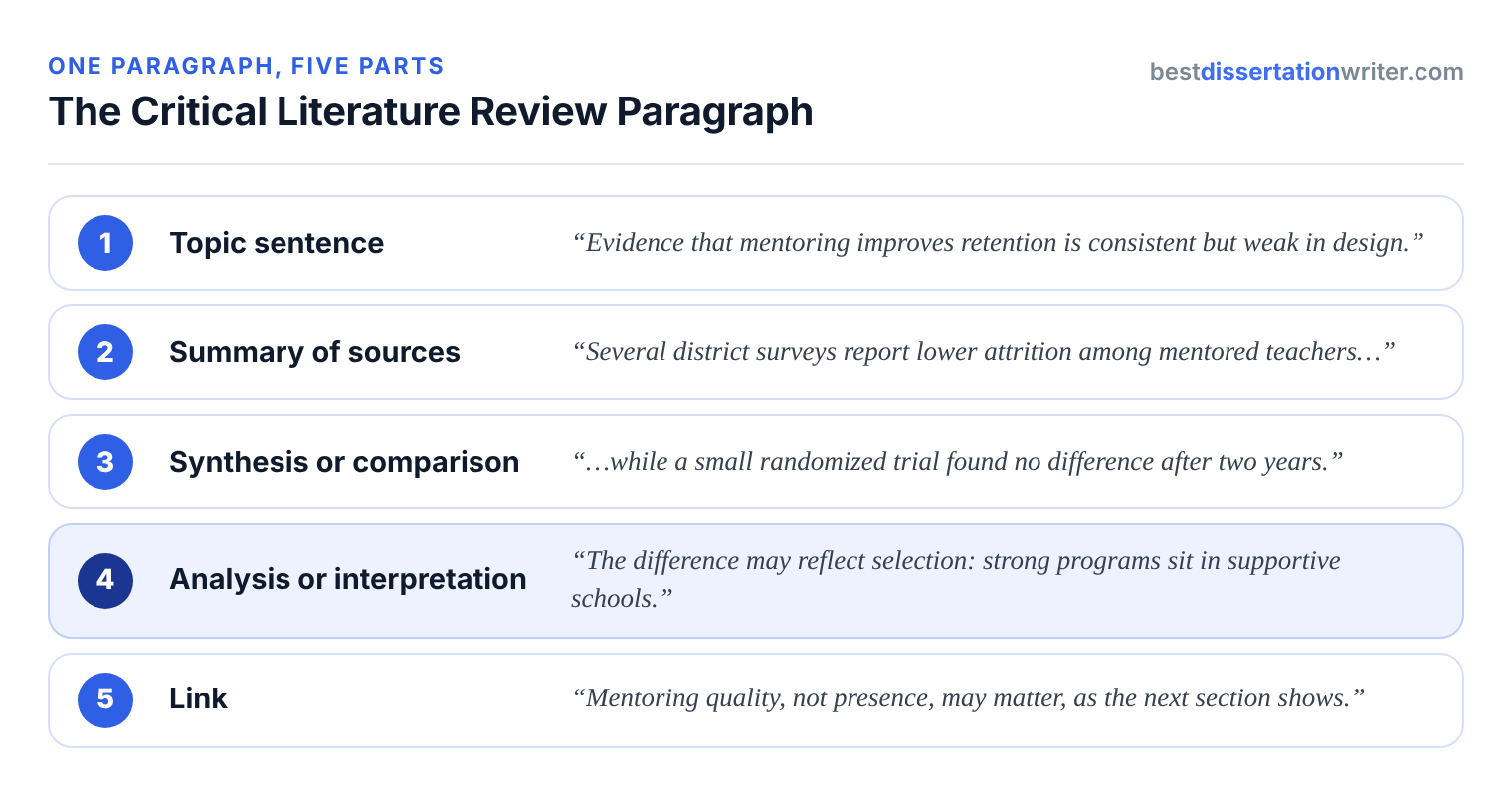
Most of a critical literature review is built from one kind of paragraph. Each paragraph has five parts, in this order.
| Part | What it does | Sample wording |
|---|---|---|
| 1. Topic sentence | States your claim about the theme | “Evidence that X improves Y is consistent but methodologically weak.” |
| 2. Summary of sources | Briefly presents the key studies | “Three surveys report…” |
| 3. Synthesis or comparison | Shows agreement and disagreement | “In contrast, a longitudinal study found…” |
| 4. Analysis or interpretation | Judges the evidence and explains it | “The difference likely reflects…” |
| 5. Link | Connects to the next point or the gap | “This raises the question of whether…” |
A critical literature review sentence
Weak
“Brown (2020) found that mentoring reduced teacher attrition.”
It reports a finding without judging it or relating it to other studies.
Strong
“Brown (2020) reported lower attrition among mentored teachers, but the study relied on one district and self-selected participants, which may overstate the effect.”
It reports, evaluates the design and explains what the limitation means.
Template
[Claim about the strength of the evidence]. [Source A] and [Source B] report [finding], while [Source C] found [different result]. This difference may reflect [design, sample or setting]. Because [main limitation], the evidence is [strong / mixed / limited], which leaves [gap] unresolved.
Critical Literature Review Example (Annotated)
The example below uses an illustrative topic, mentoring and early-career teacher retention. The citations are placeholders; in your own critical literature review, every claim must come from a real source.
See the full critical literature review paragraph (about 170 words)
Topic sentence: Evidence that mentoring improves early-career teacher retention is consistent, but much of it rests on designs that cannot separate the effect of mentoring from the schools that offer it.
Summary and synthesis: Several district surveys report lower attrition among mentored teachers [cite; cite]. A national longitudinal study found a similar pattern [cite], while a small randomized trial found no difference after two years [cite].
Analysis: The disagreement may reflect selection. Schools with strong mentoring programs also tend to have supportive leadership, which surveys rarely measure.
Link: The quality of mentoring, rather than its presence, may therefore be what matters, a question the next section examines.
See the same paragraph in point form
Claim: retention evidence is consistent but weak in design. Sources: district surveys and a national longitudinal study agree; a small trial disagrees. Evaluation: surveys cannot rule out school-level confounding.
Interpretation: mentoring quality may matter more than its presence. Link: the next section reviews research on mentoring quality.
For complete chapters, browse our literature review examples.
Critical Literature Review Checklist and Common Mistakes
Use this checklist before you submit. Each item reflects something supervisors look for in a critical literature review, a review of literature that shows real knowledge in the field.
- Argument. Each section opens with a claim about the evidence.
- Evaluation. Strengths and weaknesses are discussed for every theme.
- Comparison. Conflicting findings are explained, not just listed.
- Weighting. Stronger evidence is given more weight than weaker evidence.
- Theory. The assumptions of key theories are examined.
- Gap. The review ends by showing what is missing and why your study matters.
Mistakes to avoid when you write a literature review critically
These are the most common reasons a critical literature review reads as descriptive.
- Criticism without reasons: saying a study is “weak” without explaining why.
- Attacking authors: critique the research, not the researchers.
- Critiquing everything equally: focus on the limitations that change what the evidence means.
- Ignoring strengths: balanced evaluation names what studies do well too.
- Leaving the gap implicit: state it in plain words at the end.
For more techniques that make your writing critical, read our guide to the criticality of a literature review. The UNC Writing Center also has useful advice on literature reviews, and our guide on how to write a dissertation shows how Chapter 2 fits the whole project.
FAQs on the Critical Literature Review
What is a critical literature review?
A critical literature review is an evaluative discussion of the existing research on a topic. Instead of only summarizing studies, it judges how strong, consistent and relevant the evidence is, explains why studies disagree and examines the theories behind them.
It builds an argument about what the research shows and ends by identifying a gap. In a thesis or dissertation, a critical literature review usually forms Chapter 2 and justifies the research question your study will answer, so plan it as carefully as your methods.
How do you critically review literature?
Ask the same questions of every study: is it relevant, is the design suitable, is the sample adequate, are the measures valid, do the findings follow from the data, and is there any bias? Record the answers in a synthesis matrix with a column for limitations.
Then judge each theme as a whole. Decide whether the evidence is strong, mixed or thin, explain why studies disagree and give more weight to stronger designs. Finally, write paragraphs that open with your claim and evaluate the sources that support it.
What is the structure of a critical literature review paragraph?
A critical paragraph has five parts. It opens with a topic sentence that states your claim, then briefly summarizes the key sources. Next, it synthesizes them, showing where they agree and where they differ.
The fourth part analyzes and interprets the evidence, judging its strength and explaining any disagreement. The final sentence links the point to the next paragraph or to your research gap. Using this pattern for each paragraph keeps a critical literature review evaluative rather than descriptive, and easy to follow.
How is a critical review different from a systematic review?
Both evaluate evidence, but they differ in method. A systematic review follows a protocol, searches set databases, applies explicit criteria to every record and often uses formal appraisal tools and reporting guidelines. It aims to include all eligible studies on a precise question.
A critical literature review is more flexible. It selects the most relevant studies, often around themes or debates, and focuses on interpreting and judging them to build an argument. Most dissertation literature review chapters are critical rather than fully systematic.
Best Dissertation Writers
Need help with your literature review?
Get a critical, well-structured review with current sources and a clear research gap.