
Implementing Family-Centred Care in Paediatric Wards: An Integrative Review of Nursing Perspectives
 By Dr. Robertson Prime, Research Fellow
Updated October 12, 2026
15 min read
About 2,900 words
In this review
Abstract
Background: Family-centred care is an approach in which healthcare is planned around the whole family, with parents recognised as partners in their child’s care rather than visitors. Although it is embedded in professional standards and hospital policies, it is often described as easier to endorse than to deliver, and nurses are central to putting it into practice on the paediatric ward.
Aim: This integrative review aimed to examine what is known about implementing partnership with families in paediatric wards from the perspective of nurses, its effects on children and parents, and what helps or hinders its practice.
Methods: Evidence was identified through targeted searches of openly accessible bibliographic records, publisher websites and the reference lists of key reviews. Six sources published between 2012 and 2020 were included: two systematic reviews, two nurse surveys using mixed methods, one qualitative study and one concept synthesis. Following the Whittemore and Knafl framework, each source was appraised with a tool matched to its design and findings were synthesised thematically.
Findings: A Cochrane review found only one eligible trial in hospitalised children, while a meta-analysis of 15 randomised trials in neonatal intensive care showed reduced parental anxiety and stress, increased parents’ knowledge and skills, and fewer readmissions. Surveys of 234 nurses in Saudi Arabia and 142 paediatric nurses in Thailand found that nurses valued the approach but did not consistently practise it, particularly collaboration with parents. Unclear roles, hidden expectations, staff shortages and task-focused routines were recurring barriers.
Conclusion: Children’s nurses should negotiate roles explicitly with each family, share information openly and teach parents the skills they need at home. Lasting improvement requires adequate staffing, facilities for parents and organisational support for partnership in care.
Keywords: family-centred care, paediatric ward, partnership in care, child nursing
Introduction
This integrative review critically examines recent evidence on family-centred care and its implications for children’s nursing practice.
When a child is admitted to hospital, the whole family is affected. Parents worry about their child’s illness, juggle work and other children, and often stay at the bedside for long periods. Children depend on their parents for comfort, communication and a sense of safety, particularly when they are young, frightened or in pain. How hospitals involve and support families can therefore make a substantial difference to the experience and outcomes of care.
Family-centred care is an approach in which healthcare is planned around the whole family, with parents recognised as partners in their child’s care rather than visitors. It is a core principle of child nursing in many countries and is embedded in professional standards, hospital policies and nursing curricula. Nurses, who spend more time with children and families than any other professional group, are central to putting it into practice on the paediatric ward.
Despite its wide acceptance, family-centred care is often described as easier to endorse than to deliver. An integrative design was chosen because the evidence includes systematic reviews, surveys, mixed-methods studies and concept syntheses that need to be combined.
Review question
What is known about implementing family-centred care in paediatric wards from the perspective of nurses, what are its effects on children and parents, and what helps or hinders its practice?
Background to Family-Centred Care
The idea that parents should be closely involved in their hospitalised child’s care developed from mid-twentieth-century research showing the harm caused by separating young children from their parents. Restricted visiting gave way to open access, and over time the emphasis shifted from parents being present to parents participating in care and decision-making. Today, family-centred care is usually described in terms of respect, information sharing, participation and collaboration between families and professionals.
Professional bodies have reinforced these principles. Children’s nursing standards in many countries emphasise working in partnership with families, respecting their knowledge and supporting them to participate in decisions. Hospitals increasingly offer open visiting, overnight facilities for parents and involvement in ward rounds. However, the presence of policies does not guarantee that families experience care as genuinely collaborative, which is why the perspectives of nurses and families are so important.
Related concepts include partnership in care, which emphasises negotiation of roles between parents and nurses, and family-integrated care, which supports parents to deliver much of their child’s routine care with training and support. In a concept synthesis of 30 studies on involving parents in managing their child’s long-term condition, Smith et al. (2015) found that these models share central attributes: building trust, listening to parents’ concerns and valuing parents’ knowledge of their child. The same review identified unclear roles, entrenched professional practices and a lack of implementation guidelines as recurring problems.
These features make family-centred care both important and difficult to evaluate. It is a philosophy rather than a single intervention, so its effects depend on how it is interpreted and delivered. Understanding nurses’ perspectives is therefore essential, since they translate the philosophy into everyday practice on the paediatric ward. Their views reveal not only what they believe but also the practical conditions, such as workload, ward layout and team culture, that make partnership with families easier or harder to achieve.
Search Strategy and Methods
Evidence for this example was identified through targeted searches of openly accessible bibliographic records, publisher websites and the reference lists of key reviews. Search terms combined keywords for the approach (“family-centred care”, “family-centered care”, “partnership in care”, “parent participation”) with terms for setting and profession (“paediatric ward”, “child nursing”, “nurs*”, “hospitali*”), joined with the Boolean operators AND and OR. A full integrative review for assessment would run the same strategy in CINAHL, PubMed/MEDLINE, the Cochrane Library and Embase and report the number of records screened in a PRISMA flow diagram.
Sources were eligible if they examined the implementation, perceptions or outcomes of family-centred care for hospitalised children, with relevance to nursing practice. Systematic reviews, surveys, mixed-methods studies, qualitative studies and concept syntheses were included. Sources focused solely on community or school settings were excluded. Because high-quality trials of family-centred care in general paediatric wards are scarce, one meta-analysis from neonatal intensive care was included to illustrate measurable outcomes.
Six sources published between 2012 and 2020 were included: two systematic reviews, two nurse surveys using mixed methods, one qualitative study and one concept synthesis (Table 1). Following the Whittemore and Knafl framework for integrative reviews, each source was appraised with a tool matched to its design, data were extracted into a matrix and findings were compared and grouped into themes.
Key Findings on Family-Centred Care
Three themes were identified: the evidence on outcomes, the gap between nurses’ beliefs and practice, and the barriers and facilitators to implementation. Table 1 summarises the included sources, and Figure 1 shows the effects on parents reported in a meta-analysis of randomised trials.
| Author, year | Design | Setting and sample | Key finding |
|---|---|---|---|
| Shields et al. (2012) | Cochrane systematic review | Hospitalised children aged 0–12 years | Only one eligible trial (288 children): care-by-parent unit improved satisfaction and cost; high-quality evidence scarce. |
| Coyne (2015) | Qualitative study | Families and health professionals | Hidden expectations and unclear roles between families and professionals. |
| Smith et al. (2015) | Concept synthesis | 30 studies of parent involvement in long-term conditions | Shared attributes: trust, listening, valuing parents’ knowledge; barriers: unclear roles, entrenched practices. |
| Alabdulaziz et al. (2017) | Mixed-methods study | 234 nurses; six hospitals in Saudi Arabia | Elements rated necessary but significantly less often practised across all subscales. |
| Ding et al. (2019) | Systematic review and meta-analysis | 15 RCTs in neonatal intensive care | Improved weight gain, parent knowledge and skills, satisfaction; less anxiety, stress and readmission. |
| Prasopkittikun et al. (2020) | Mixed-methods study | 142 paediatric nurses; Thailand | Collaboration rated least important; system design least practised; staffing and cultural barriers. |
Theme 1: Outcomes of Family-Centred Care
Rigorous evidence on the outcomes of family-centred care in general paediatric wards is limited. A Cochrane review by Shields et al. (2012) searched for randomised trials of family-centred care for hospitalised children aged 0 to 12 years and found only one study that met its criteria: an unpublished trial of 288 children after tonsillectomy comparing a care-by-parent unit with standard care. Children in the care-by-parent unit were less likely to receive inadequate care, parents were more satisfied and costs were lower, with no evidence of harm. The authors concluded that high-quality quantitative research remains scarce.
Stronger quantitative evidence comes from neonatal intensive care, where the approach has been more widely tested. In a meta-analysis of 15 randomised trials, Ding et al. (2019) found that family-centred care interventions improved infant weight gain, reduced parental anxiety and stress, increased parents’ knowledge and caregiving skills, greatly increased parent satisfaction and reduced readmissions. Length of stay and neurobehavioural development did not differ significantly.
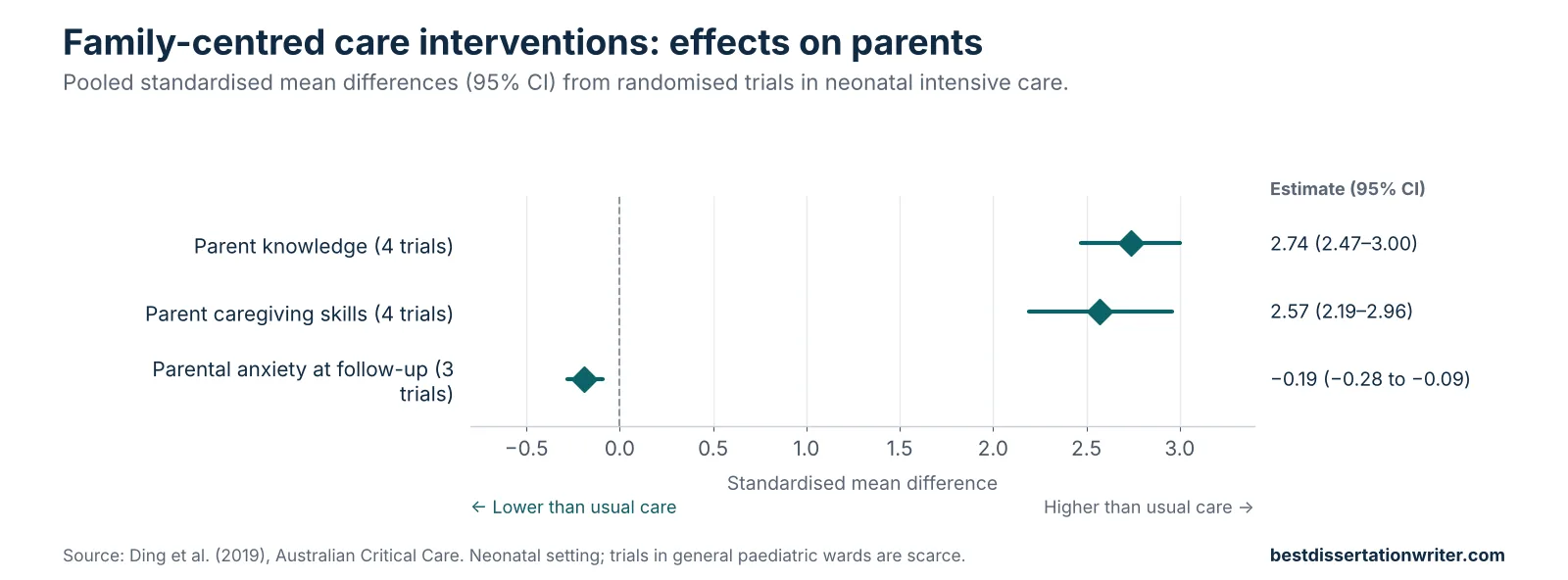
Although these results come from a neonatal setting, they suggest that structured approaches, in which parents are taught and supported to care for their child, can benefit both parents and children. The large improvements in parents’ knowledge and skills are particularly relevant to the paediatric ward, where parents often continue complex care at home after discharge.
The scarcity of trials on general wards reflects real methodological challenges. Family-centred care is difficult to standardise, cannot be blinded and is often already partly present in usual care, so control groups may receive some of the same elements. Outcomes such as trust, confidence and satisfaction are also harder to measure than clinical events. These challenges help to explain why most evidence comes from surveys, qualitative studies and neonatal units, where structured programmes are easier to define.
Theme 2: The Gap Between Belief and Practice
Surveys consistently show that nurses value this way of working but find it hard to put into practice. In a mixed-methods study of 234 nurses in six hospitals in Saudi Arabia, Alabdulaziz et al. (2017) found that nurses rated its core elements as necessary but were significantly less likely to incorporate them into practice, across all subscales of the questionnaire. Observation and interviews revealed that care was often organised around tasks and professional routines rather than families’ needs.
Similar findings emerged from a study of 142 paediatric nurses in a university hospital in Thailand. Prasopkittikun et al. (2020) found that nurses rated respect for family strengths and individuality as the most important and most practised element, but rated collaboration between parents and professionals as least important and the design of the healthcare delivery system as least practised. Interviews suggested that some nurses saw family-centred care as a Western concept, and that staff shortages and attitudes to the nursing role limited implementation.
These studies show that the gap between belief and practice is not limited to one country or health system. Nurses may agree with these principles while working in systems that make collaboration difficult, and without explicit support the default can easily revert to professionally led care.
Ward routines can reinforce this pattern. Fixed times for observations, medicine rounds and ward rounds are organised around staff schedules, and parents may be asked to leave during handover or procedures. Facilities for parents, such as beds, meals and washing facilities, are often limited, making it difficult for them to stay and participate. Changes such as inviting parents to bedside handover and ward rounds can signal that their contribution is valued and give them a clearer role in planning care.
Theme 3: Roles, Expectations and Support
Unclear roles are a recurring barrier. In a qualitative study of families and health professionals, Coyne (2015) reported hidden expectations and unclear roles: families and professionals held different and often unspoken assumptions about what parents should do in hospital. When such expectations are not discussed, parents may take on more or less care than they wish, and nurses may misjudge the help families need. Smith et al. (2015) similarly identified unclear roles as an antecedent to problems in partnership in care.
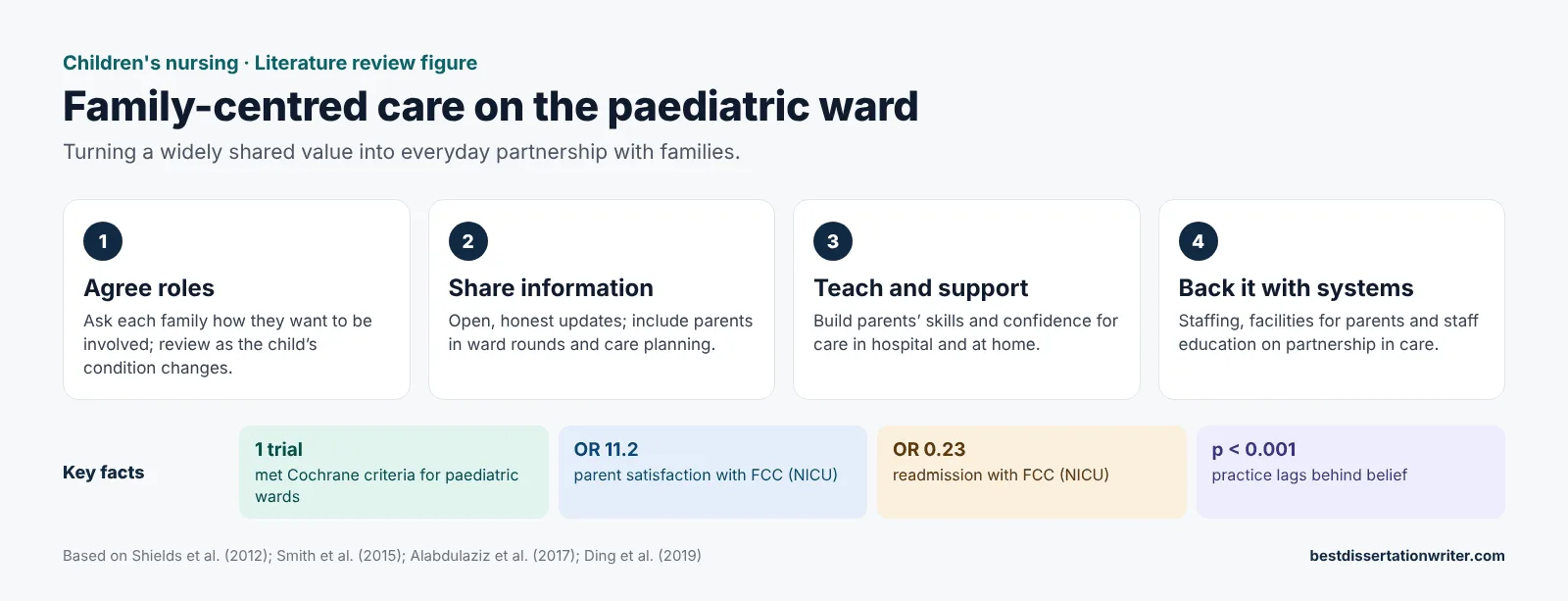
The facilitators identified across studies are consistent. Negotiating roles explicitly with each family, building trust, listening to parents and valuing their knowledge of their child support effective partnership (Smith et al., 2015). Adequate staffing, education for nurses and organisational support were also needed to move from good intentions to everyday practice (Alabdulaziz et al., 2017; Prasopkittikun et al., 2020).
Discussion
This review shows that family-centred care is widely valued by nurses but inconsistently practised in paediatric wards. Evidence from neonatal intensive care suggests that structured approaches can improve outcomes for both parents and children, but rigorous trials in general paediatric wards are almost absent. As a result, much of the case in this setting rests on its ethical foundations and on parents’ and nurses’ accounts rather than on measured outcomes.
A central finding is the gap between belief and practice. Nurses in different countries rated its elements as necessary but did not consistently apply them, particularly collaboration with parents. This suggests that individual commitment is not enough; organisational structures, staffing and culture shape whether it is delivered. Training that focuses only on attitudes may therefore have limited impact unless systems also change.
The issue of unclear roles deserves particular attention. When expectations are not discussed, parents may feel pressured to take on tasks they are not comfortable with, or excluded from tasks they want to do. Negotiating roles openly, and revisiting them as the child’s condition changes, is a simple but powerful step, and it can be documented in the care plan so that all staff understand what each family has agreed. This reflects the shift from family-centred care as a general philosophy to partnership in care as a practical process between nurses and individual families.
Cultural context also matters. The finding that some nurses viewed family-centred care as a Western concept (Prasopkittikun et al., 2020) highlights that models developed in one setting may need adaptation elsewhere. Families differ in how much they wish to participate and in who makes decisions, and care should respect these differences rather than impose a single model.
The evidence base has limitations. The Cochrane review found almost no eligible trials, the meta-analysis came from neonatal units, and the surveys used self-reported measures in single countries. This review relied on openly accessible, English-language sources, so relevant studies in other languages may have been missed. Future research should use rigorous designs to evaluate family-centred care in general paediatric wards and include children’s own views.
Children’s voices are notably absent from much of this evidence. Most studies asked nurses or parents about their experiences, yet children, especially older children and adolescents, have their own views about how much they want parents involved, what information they want and how decisions should be made. A truly family-centred approach recognises the child as part of the family unit with rights and preferences of their own, which may sometimes differ from those of their parents.
Implications of Family-Centred Care Evidence for Practice
For children’s nurses, the evidence supports asking each family on admission how they would like to be involved, agreeing roles explicitly and reviewing them regularly. Nurses should share information openly, value parents’ knowledge of their child, teach parents skills they will need at home and include them in ward rounds and care planning. Managers should support this through adequate staffing, facilities for parents such as space to stay overnight, and education for staff on partnership in care. Parents should be asked regularly about their experience, and their feedback used to improve ward routines, information and facilities.
Family-centred care underpins many other aspects of child nursing. It supports health promotion for childhood obesity, where parents shape children’s eating and activity, and it requires sensitivity when concerns about child abuse and neglect arise. Parents also play key roles in play therapy and in using pain assessment tools to recognise their child’s pain.
Conclusion
This integrative review examined the implementation of family-centred care in paediatric wards from the perspective of nursing. Nurses value family-centred care, but there is a persistent gap between belief and practice, driven by unclear roles, staffing pressures and organisational routines. Evidence from neonatal care suggests that structured approaches can improve outcomes, but trials in general paediatric wards are lacking.
Children’s nurses can strengthen partnership with families by negotiating roles with each family, sharing information openly and teaching parents the skills they need. Lasting improvement will also require organisations to provide the staffing, facilities and culture that make genuine partnership with families possible.
References
Alabdulaziz, H., Moss, C., & Copnell, B. (2017). Paediatric nurses’ perceptions and practices of family-centred care in Saudi hospitals: A mixed methods study. International Journal of Nursing Studies, 69, 66–77. https://doi.org/10.1016/j.ijnurstu.2017.01.011
Coyne, I. (2015). Families and health-care professionals’ perspectives and expectations of family-centred care: Hidden expectations and unclear roles. Health Expectations, 18(5), 796–808. https://doi.org/10.1111/hex.12104
Ding, X., Zhu, L., Zhang, R., Wang, L., Wang, T.-T., & Latour, J. M. (2019). Effects of family-centred care interventions on preterm infants and parents in neonatal intensive care units: A systematic review and meta-analysis of randomised controlled trials. Australian Critical Care, 32(1), 63–75. https://doi.org/10.1016/j.aucc.2018.10.007
Prasopkittikun, T., Srichantaranit, A., & Chunyasing, S. (2020). Thai nurses’ perceptions and practices of family-centered care: The implementation gap. International Journal of Nursing Sciences, 7(1), 74–80. https://doi.org/10.1016/j.ijnss.2019.09.013
Shields, L., Zhou, H., Pratt, J., Taylor, M., Hunter, J., & Pascoe, E. (2012). Family-centred care for hospitalised children aged 0–12 years. Cochrane Database of Systematic Reviews, (10), CD004811. https://doi.org/10.1002/14651858.CD004811.pub3
Smith, J., Swallow, V., & Coyne, I. (2015). Involving parents in managing their child’s long-term condition: A concept synthesis of family-centered care and partnership-in-care. Journal of Pediatric Nursing, 30(1), 143–159. https://doi.org/10.1016/j.pedn.2014.10.014
Cite this example
Best Dissertation Writers (2026) Implementing Family-Centred Care in Paediatric Wards: An Integrative Review of Nursing Perspectives. Available at: https://bestdissertationwriter.com/family-centred-care-literature-review/
Best Dissertation Writers
Get expert help with your nursing literature review
Share your topic and deadline with Best Dissertation Writers and get support tailored to your module brief.