Self-Management Education for Children and Young People with Asthma: A Systematic Review
 By Dr. Robertson Prime, Research Fellow
Updated October 12, 2026
16 min read
About 3,300 words
In this review
Abstract
Background: For young people with asthma, poorly controlled disease leads to night-time symptoms, missed school, emergency department attendances and hospital admissions, and asthma attacks can still be fatal. Much day-to-day management happens at home and at school, so self-management education supported by a personalised action plan, often delivered by nurses, is central to care.
Aim: This systematic review aimed to examine how effective self-management education, including asthma action plans, is in improving outcomes for children and young people, and what this means for children’s nursing.
Methods: Evidence was identified through targeted searches of openly accessible bibliographic records, publisher websites and the reference lists of key reviews. Seven sources published between 2003 and 2024 were included: a systematic review with meta-analysis, four Cochrane systematic reviews, a national confidential enquiry and a national clinical guideline, appraised with CASP checklists supplemented by Cochrane certainty ratings and synthesised narratively.
Findings: In 38 studies of children who had attended an emergency department, education reduced subsequent emergency visits (RR 0.73), hospital admissions (RR 0.79) and unscheduled doctor visits. Symptom-based action plans reduced acute care visits compared with peak flow-based plans, yet only 23% of 195 people who died from asthma in the United Kingdom had a personalised action plan. School-based programmes probably reduced admissions and may reduce emergency visits from 7.5% to 5.4% of children, whereas peer-led education for adolescents showed only weak, low-certainty benefits.
Conclusion: Nurses should give every child aged five and over structured, tailored self-management education and a documented action plan, renewed after every emergency attendance and at each review. The main gap lies in implementing this evidence rather than in the evidence itself.
Keywords: young people with asthma, self-management, action plan
Introduction
This systematic review critically examines recent evidence on young people with asthma and its implications for children’s nursing practice.
Asthma is one of the most common long-term conditions of childhood and adolescence. Most children and young people with asthma can live full and active lives, but poorly controlled asthma leads to night-time symptoms, missed school, restricted play and sport, emergency department attendances and hospital admissions. Asthma attacks can still be fatal, and national reviews of asthma deaths in the United Kingdom have repeatedly found that many deaths involve avoidable factors in routine care, recognition of risk and the response to a worsening attack.
Much of the day-to-day management of asthma takes place at home and at school rather than in clinical settings. Children, young people and their parents must take preventer medicines regularly, use inhalers correctly, avoid triggers, recognise deterioration and know when to seek help. Self-management education, usually supported by a written or personalised asthma action plan, aims to give families these skills. Children’s nurses, school nurses and practice nurses deliver much of this education, often at the point of diagnosis, after an emergency attendance or during annual review.
A systematic approach was chosen because the field contains several Cochrane reviews and meta-analyses that can be appraised and compared. Bringing this evidence together matters because self-management education is widely recommended, yet the content, setting and intensity of programmes vary greatly in practice.
Review question
How effective is self-management education, including asthma action plans, in improving outcomes for young people with asthma, and what are the implications for children’s nursing?
Background to Young People with Asthma
Asthma is a chronic inflammatory condition of the airways that causes variable wheeze, breathlessness, chest tightness and cough. Treatment combines regular inhaled corticosteroids, which reduce airway inflammation, with reliever inhalers for symptoms, and avoidance of triggers such as tobacco smoke, allergens and air pollution. Effective treatment depends heavily on what families do between appointments, which is why education and supported self-management are central to modern asthma care.
Supported self-management usually has three linked components: education about the condition and its treatment, regular review by a health professional, and a personalised action plan. The action plan is a written or digital document that explains which medicines to take every day, how to recognise worsening asthma using symptoms or peak flow readings, how to adjust treatment, and when to seek urgent help. For younger children, parents hold most of this responsibility, while adolescents are expected to manage more of their own care.
Adolescence brings particular challenges for young people with asthma. Teenagers may forget or decline preventer inhalers, feel embarrassed using inhalers in front of friends, experiment with smoking or vaping, and attend fewer reviews. Responsibility for medicines often passes from parents to the young person before the necessary knowledge and habits are in place. Education that is designed for parents of younger children may therefore not meet the needs of older children, and peer-led or school-based approaches have been developed partly to address this gap.
UK guidance now places self-management at the centre of care. The joint guideline from the British Thoracic Society, the National Institute for Health and Care Excellence (NICE) and the Scottish Intercollegiate Guidelines Network recommends offering a self-management programme, comprising a documented personalised action plan and education, to children and young people with asthma aged five years and over (NICE, 2024). Understanding the evidence behind this recommendation helps nurses to deliver education in ways most likely to improve outcomes.
Search Strategy and Methods
Evidence for this example was identified through targeted searches of openly accessible bibliographic records, publisher websites and the reference lists of key reviews. Search terms combined keywords for the population (“asthma”, “child*”, “adolescent*”, “young people with asthma”) with terms for the intervention and outcomes (“self-management”, “education”, “action plan”, “school-based”, “peer support”, “emergency department”, “hospital admission”), joined with the Boolean operators AND and OR. A full systematic review for assessment would run the same strategy in CINAHL, PubMed/MEDLINE, the Cochrane Library, PsycINFO and Embase and report the number of records screened in a PRISMA flow diagram.
Sources were eligible if they evaluated self-management education, asthma action plans or related educational interventions for children and young people with asthma aged up to 18 years, or reported national evidence on avoidable factors in asthma deaths that informs education. Cochrane reviews, systematic reviews with meta-analysis, national confidential enquiries and current clinical guidelines were prioritised. Studies of adults only, drug trials without an educational component and studies of acute hospital treatment alone were excluded.
Seven sources published between 2003 and 2024 were included: one systematic review with meta-analysis, four Cochrane systematic reviews, one national confidential enquiry and one national clinical guideline (Table 1). The quality of each source was appraised using the Critical Appraisal Skills Programme (CASP) checklist appropriate to its design, supplemented by the certainty ratings reported by the Cochrane authors, and findings were synthesised narratively and grouped into themes.
Key Findings on Young People with Asthma
Three themes were identified: the effects of self-management education on clinical outcomes, the role of written action plans and the lessons from asthma deaths, and the delivery of education in schools and through peers. Table 1 summarises the included sources, and Figure 1 presents pooled effects of asthma education on emergency and unplanned care.
| Author, year | Design | Setting and sample | Key finding |
|---|---|---|---|
| Guevara et al. (2003) | Systematic review and meta-analysis | 32 controlled trials, 3,706 children and adolescents aged 2–18 | Education improved lung function and self-efficacy and reduced school absence, restricted activity and emergency visits. |
| Bhogal et al. (2006) | Cochrane systematic review | 4 trials, 355 children; symptom-based vs peak flow-based action plans | Symptom-based plans reduced acute care visits (RR 0.73; NNT 9); no difference in other outcomes. |
| Boyd et al. (2009) | Cochrane systematic review | 38 studies, 7,843 children with an emergency attendance in the previous year | Education reduced emergency visits (RR 0.73), admissions (RR 0.79) and unscheduled doctor visits (RR 0.68). |
| Royal College of Physicians (2014) | National confidential enquiry | 195 asthma deaths across all ages, United Kingdom | Only 23% had a personalised action plan; 43% had no asthma review in the previous year. |
| Kew et al. (2017) | Cochrane systematic review | 5 trials, 1,146 adolescents aged 11–17; lay-led and peer support | Possible small gain in quality of life; benefits for control and exacerbations unproven; low certainty. |
| Harris et al. (2019) | Cochrane mixed methods systematic review | 55 studies; 33 trials with 12,623 children in school settings | Probably fewer admissions; emergency visits 7.5% vs 5.4% (OR 0.70); effect on school absence uncertain. |
| NICE (2024) | National clinical guideline (BTS, NICE, SIGN) | Children, young people and adults with asthma, United Kingdom | Offer a self-management programme with education and a personalised action plan from age five. |
Theme 1: Self-Management Education and Outcomes for Young People with Asthma
The foundational meta-analysis by Guevara et al. (2003) pooled 32 controlled trials involving 3,706 children and adolescents aged 2 to 18 years. Education for self-management was associated with moderate improvements in lung function (standardised mean difference [SMD] 0.50) and self-efficacy (SMD 0.36), and with reductions in school absence (SMD −0.14), days of restricted activity (SMD −0.29) and emergency department visits (SMD −0.21). The largest effects on morbidity were seen with peak flow-based programmes, individually targeted education and children with more severe asthma.
The authors concluded that educational programmes should be considered part of the routine care of young people with asthma. This conclusion has been highly influential, but the effects on absence and emergency visits were small, the trials were heterogeneous, and a reduction in disturbed nights appeared only under a fixed effects model. The review is also more than twenty years old, and treatment has changed since the included trials were conducted, so its findings need to be read alongside more recent evidence.
Young people with asthma who have already attended an emergency department are at particular risk of further attacks. In a Cochrane review of 38 studies involving 7,843 children who had attended an emergency department for asthma in the previous 12 months, Boyd et al. (2009) found that education reduced subsequent emergency department visits (risk ratio [RR] 0.73), hospital admissions (RR 0.79) and unscheduled doctor visits (RR 0.68). These results are consistent and clinically meaningful, and they support offering structured education after every emergency attendance rather than relying on discharge advice alone.
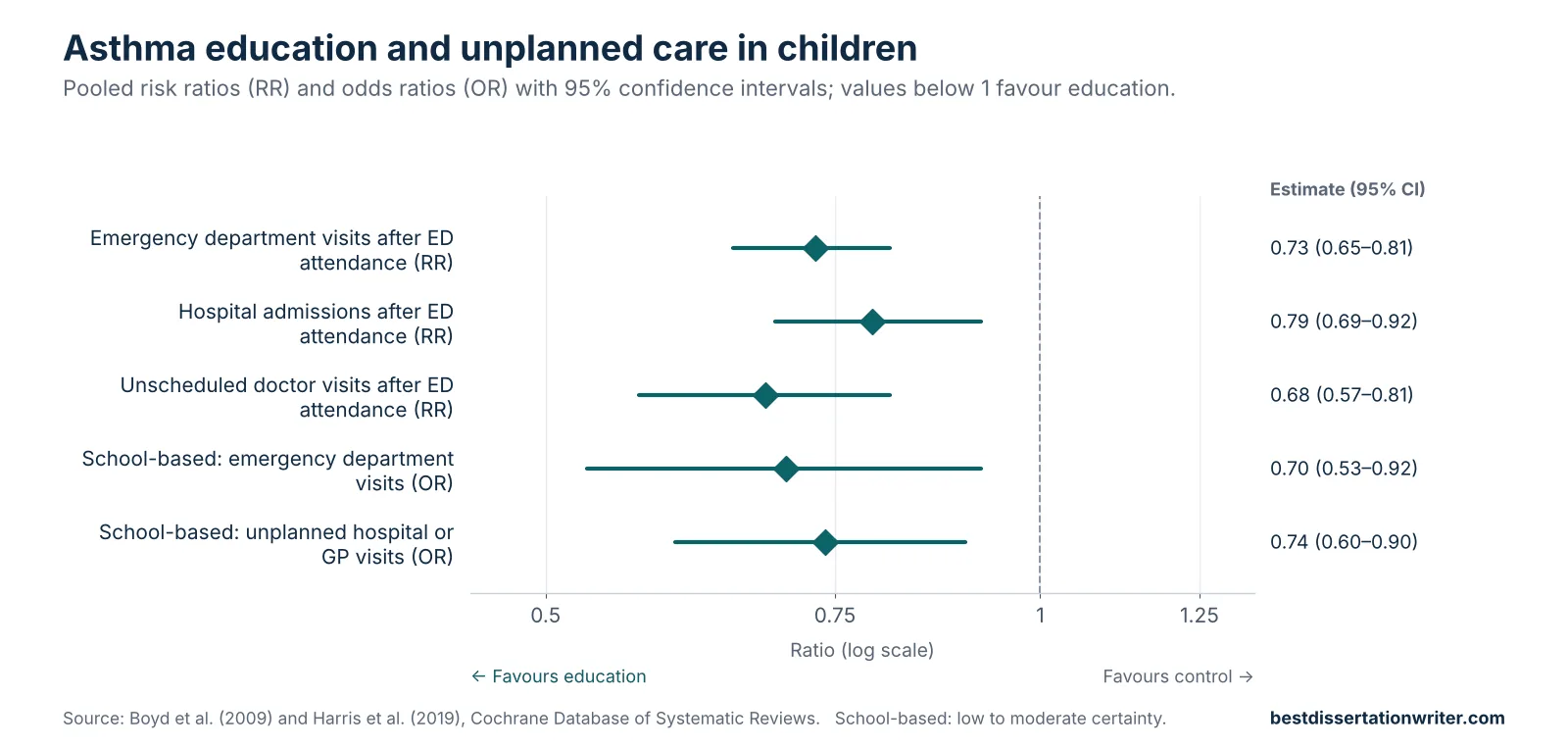
Figure 1 shows that the direction of effect is remarkably similar across the two reviews, with reductions in emergency and unplanned care of roughly a quarter to a third. However, the populations differ: Boyd et al. (2009) included children at high risk after an emergency attendance, whereas school-based programmes reach a broader population. The absolute benefit is therefore likely to be greatest when education is targeted at children with poorly controlled asthma or recent attacks.
Theme 2: Action Plans and Lessons from Asthma Deaths
Written action plans are a core part of self-management, but the evidence on their design is limited. In a Cochrane review of four trials involving 355 children, Bhogal et al. (2006) compared action plans based on symptoms with plans based on peak flow readings. Symptom-based plans reduced the risk of an exacerbation requiring an acute care visit (RR 0.73; number needed to treat 9), and children preferred symptom monitoring. There were no significant differences in oral steroid use, admissions, school absence, lung function or quality of life.
This review compared two types of action plan rather than an action plan with no plan, and the small number of trials makes its findings fragile. The authors were unable to tell whether the advantage of symptom-based plans reflected better adherence to monitoring, earlier recognition of deterioration or the specific treatment advice. Nevertheless, the finding is reflected in current guidance, which states that symptom-based plans are usually preferred for children (NICE, 2024).
The National Review of Asthma Deaths examined 195 deaths across all ages in the United Kingdom (Royal College of Physicians [RCP], 2014). Only 23% of those who died had a personalised asthma action plan, 43% had no evidence of an asthma review in the previous year, and 45% died without seeking medical help or before emergency care could be provided. Poor adherence to preventer treatment was recorded in 48% of cases. The report recommended that parents, children and those who care for or teach them should be educated on how and when to use asthma medicines and when to seek emergency help.
Although the review included adults as well as children, its findings show how gaps in education, review and action planning can combine with fatal consequences. The low proportion of deaths with an action plan is striking given that plans had been recommended for many years. For nurses, the review highlights that education is not a single event but must be renewed at every review and after every attack, so that families recognise danger signs and act quickly.
Theme 3: School-Based and Peer-Led Education
Schools offer an opportunity to reach many children and young people with asthma at once, including those who rarely attend clinics. In a Cochrane mixed methods review of 55 studies, Harris et al. (2019) found that school-based self-management interventions probably reduced hospital admissions (SMD −0.19; moderate certainty) and may reduce emergency department visits, from 7.5% to 5.4% of children over 12 months (odds ratio [OR] 0.70; low certainty). Unplanned visits fell from 26% to 21%, and asthma-related quality of life improved slightly, but the effect on school absence was uncertain.
The qualitative comparative analysis within the same review explored why some programmes were implemented more successfully than others. Interventions that were theory driven, involved parents, ensured that children were satisfied with the programme and were held during school time rather than in the child’s own time were more likely to be implemented well (Harris et al., 2019). These findings are useful for school nurses designing programmes, although the analysis was exploratory and relied on how well individual studies were reported.
Peer-led education has been proposed as a way to engage adolescents. In a Cochrane review of five trials involving 1,146 adolescents aged 11 to 17 years, Kew et al. (2017) found only weak evidence of a small improvement in asthma-related quality of life (mean difference 0.40, with a confidence interval crossing zero in the main analysis). Benefits for asthma control, exacerbations and adherence were unproven, and all findings were of low certainty. Peer approaches may be acceptable to teenagers, but they cannot yet be recommended as a replacement for professional education.
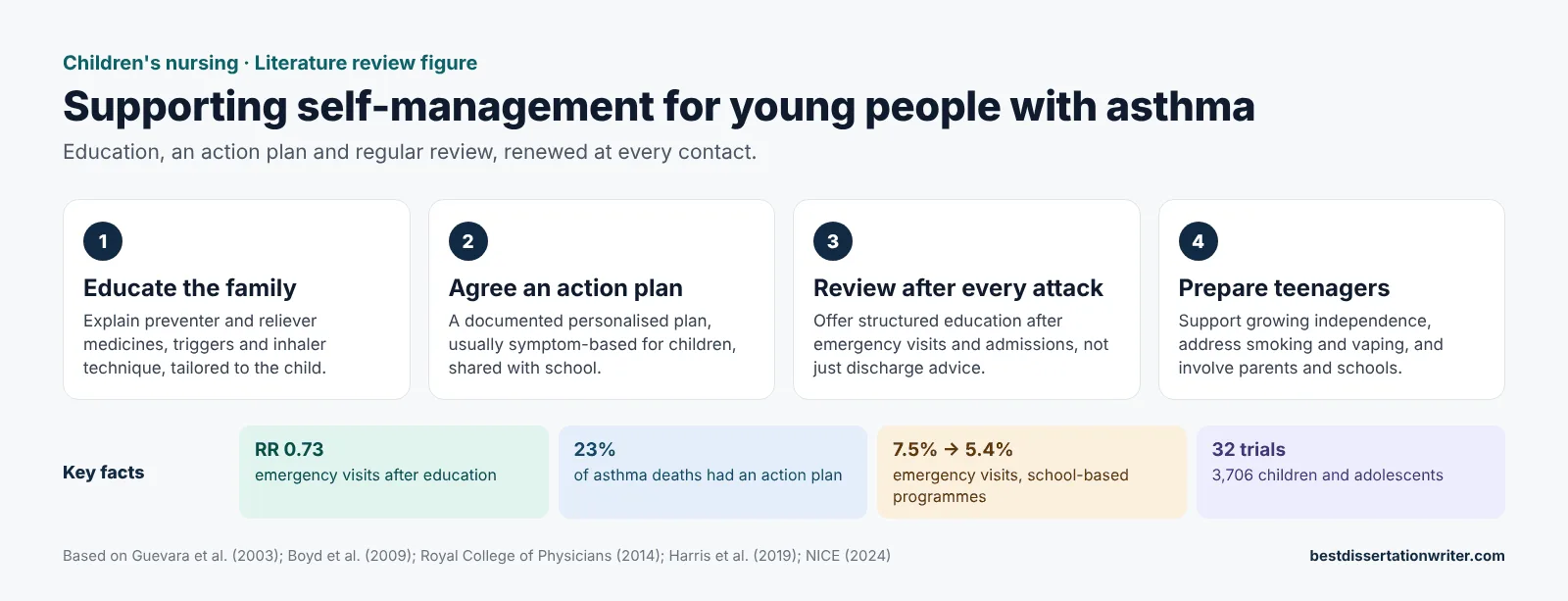
Discussion
This review found consistent evidence that self-management education improves important outcomes for young people with asthma. Education reduced emergency department visits, hospital admissions and unscheduled care in children at high risk, school-based programmes probably reduced admissions, and earlier meta-analysis linked education to better lung function, self-efficacy and fewer days of restricted activity. The direction of benefit was similar across settings and decades, which strengthens confidence that education itself, rather than any single programme, is effective.
However, the size of the benefit is modest and the certainty of evidence is often low. Effects on school absence were small or uncertain, trials were rarely blinded, and interventions varied widely in content, length and who delivered them. This heterogeneity makes it difficult to identify the active ingredients of a successful programme. The finding that individually targeted education produced larger effects (Guevara et al., 2003) suggests that tailoring education to the child’s own triggers, medicines and risk may matter more than the format used.
There is a clear tension between the evidence and practice. Action plans and education have been recommended for many years, yet fewer than a quarter of people who died from asthma had a personalised action plan (RCP, 2014). This gap suggests that the main challenge is implementation rather than a lack of evidence. Busy clinics, short consultations and missed reviews limit the time available for education, and the young people with asthma and families who are most at risk, including those facing social disadvantage, may be least likely to attend.
The evidence for adolescents is weaker than for younger children. Peer-led programmes have not yet shown clear benefits (Kew et al., 2017), and many trials included mixed age groups. Young people with asthma are at a stage when parents hand over responsibility, so education needs to address both generations and to recognise teenagers’ wish for independence and privacy. Approaches that combine professional education with digital tools, school support and attention to smoking and vaping may be more relevant to this group.
The evidence base has limitations. Two key reviews were published before 2010, the action plan review included only four small trials, and the national review of deaths covered all ages and was not designed to test interventions. This review relied on openly accessible, English-language sources and did not involve independent double screening or meta-analysis. Future research should test tailored self-management education for adolescents, evaluate digital action plans and measure long-term outcomes such as attacks, school attendance and confidence in self-care.
Implications of Young People with Asthma Evidence for Practice
For children’s nurses, the evidence supports giving every child and young person aged five and over structured self-management education and a documented personalised action plan, reviewed at every admission, emergency attendance and annual review (NICE, 2024). Symptom-based plans are usually preferable for children. Nurses should check inhaler technique, explain the difference between preventer and reliever medicines, discuss triggers, smoking and vaping, and make sure that the family knows when and how to seek urgent help. Education should be repeated and tailored, with particular priority for children who have attended an emergency department.
School nurses can work with schools to provide in-school education, involve parents and ensure that staff know each child’s action plan. Nurses should also prepare adolescents for growing independence and for the paediatric to adult healthcare transition, which brings similar challenges for those living with type 1 diabetes. Working in partnership with families reflects the principles of family-centred care, and the same skills of listening and addressing concerns are needed when nurses respond to parental vaccine hesitancy.
Conclusion
This systematic review examined the effectiveness of self-management education, including asthma action plans, for young people with asthma. Education reduces emergency visits, hospital admissions and unscheduled care, particularly for children at high risk, and school-based programmes probably reduce admissions, although the certainty of evidence is often low and effects on school absence are uncertain.
The most important gap lies between the evidence and everyday practice, as shown by the small number of people who died from asthma with a personalised action plan. Children’s nurses are well placed to close this gap by ensuring that all young people with asthma and their families receive repeated, tailored education and an up-to-date plan that they understand and can use.
References
Bhogal, S. K., Zemek, R. L., & Ducharme, F. (2006). Written action plans for asthma in children. Cochrane Database of Systematic Reviews, (3), CD005306. https://doi.org/10.1002/14651858.CD005306.pub2
Boyd, M., Lasserson, T. J., McKean, M. C., Gibson, P. G., Ducharme, F. M., & Haby, M. (2009). Interventions for educating children who are at risk of asthma-related emergency department attendance. Cochrane Database of Systematic Reviews, (2), CD001290. https://doi.org/10.1002/14651858.CD001290.pub2
Guevara, J. P., Wolf, F. M., Grum, C. M., & Clark, N. M. (2003). Effects of educational interventions for self management of asthma in children and adolescents: Systematic review and meta-analysis. BMJ, 326(7402), 1308. https://doi.org/10.1136/bmj.326.7402.1308
Harris, K., Kneale, D., Lasserson, T. J., McDonald, V. M., Grigg, J., & Thomas, J. (2019). School-based self-management interventions for asthma in children and adolescents: A mixed methods systematic review. Cochrane Database of Systematic Reviews, (1), CD011651. https://doi.org/10.1002/14651858.CD011651.pub2
Kew, K. M., Carr, R., & Crossingham, I. (2017). Lay-led and peer support interventions for adolescents with asthma. Cochrane Database of Systematic Reviews, (4), CD012331. https://doi.org/10.1002/14651858.CD012331.pub2
National Institute for Health and Care Excellence. (2024). Asthma: Diagnosis, monitoring and chronic asthma management (BTS, NICE, SIGN) (NICE guideline NG245). https://www.nice.org.uk/guidance/ng245
Royal College of Physicians. (2014). Why asthma still kills: The National Review of Asthma Deaths (NRAD) confidential enquiry report. Royal College of Physicians. https://www.rcp.ac.uk/improving-care/resources/why-asthma-still-kills/
Cite this example
Best Dissertation Writers (2026) Self-Management Education for Children and Young People with Asthma: A Systematic Review. Available at: https://bestdissertationwriter.com/young-people-with-asthma-review-review/
Best Dissertation Writers
Get expert help with your nursing literature review
Share your topic and deadline with Best Dissertation Writers and get support tailored to your module brief.