
The Impact of Screen Time on Child Development and the Role of Nurses in Parental Guidance: A Narrative Review
 By Dr. Robertson Prime, Research Fellow
Updated October 12, 2026
15 min read
About 3,000 words
In this review
Abstract
Background: Screen time is now part of everyday family life, and many children begin using televisions, tablets and smartphones in infancy. Parents often ask how much screen use is safe, yet guidance differs: the WHO and the American Academy of Pediatrics set age-based limits, whereas the Royal College of Paediatrics and Child Health concluded that the evidence was too weak to support a fixed limit.
Aim: This narrative review aimed to examine what is known about the impact of screen use on young children’s development and health, and how nurses can support parents to make informed decisions.
Methods: Evidence was identified through targeted searches of openly accessible bibliographic records, publisher websites and the reference lists of key reviews. Seven sources published between 2016 and 2022 were included: three professional or international guidelines, a systematic review of reviews, two systematic reviews with meta-analysis and a longitudinal cohort study, appraised with CASP checklists and synthesised narratively.
Findings: A meta-analysis of 63 studies found that only 24.7% of children younger than two years and 35.6% of children aged two to five years met international guidelines. Higher screen use at 24 and 36 months was associated with poorer developmental screening scores later, and greater use and background television were linked to poorer language, whereas educational programmes, co-viewing and a later start were linked to stronger language skills. Across childhood, higher use was associated with adiposity and depressive symptoms, although most evidence was observational and parent-reported, and effects were small.
Conclusion: Nurses should routinely ask about screen use, share age-based guidance for the youngest children and give balanced, non-judgemental advice that encourages co-viewing, high-quality content and the protection of sleep, play and family time.
Keywords: screen time, child development, digital media
Introduction
This narrative review critically examines recent evidence on screen time and its implications for children’s nursing practice.
Televisions, tablets, smartphones and games consoles are now part of everyday family life, and many children begin using screens in infancy. Digital media can entertain, connect children with distant relatives and, in some forms, support learning. At the same time, parents, teachers and health professionals have raised concerns that heavy use in the early years may displace the talk, play, physical activity and sleep that young children need for healthy growth and learning.
Parents frequently ask health professionals how much screen use is safe and what kinds of content are suitable, yet the advice they receive is often inconsistent. International guidance differs in tone and detail, and the research evidence is complex. Children’s nurses, health visitors and school nurses meet families at key moments, including developmental reviews, hospital admissions and immunisation appointments, so they are well placed to offer balanced, evidence-informed guidance on screen time and child development.
A narrative approach was chosen because the evidence includes guidelines, meta-analyses, a review of reviews and a cohort study that answer different questions and cannot be pooled. Clarifying what this evidence does and does not show matters because guidance on screen time that overstates harm may cause guilt, while guidance that understates it may leave real risks unaddressed.
Review question
What is known about the impact of screen time on young children’s development and health, and how can nurses support parents to make informed decisions?
Background to Screen Time
Screen time usually refers to the total time a child spends watching or using screen-based devices, including television, computers, tablets, smartphones and games consoles. Researchers increasingly distinguish between the quantity of use and its quality, including the content viewed, whether an adult watches alongside the child, and whether a television is left on in the background while the child plays. These distinctions matter because different patterns of use may have different effects.
The American Academy of Pediatrics (AAP) Council on Communications and Media (2016) advised that children younger than 18 months avoid screen media other than video-chatting, that parents of children aged 18 to 24 months who wish to introduce digital media choose high-quality programmes and watch with their child, and that children aged 2 to 5 years use no more than one hour a day of high-quality programming, ideally viewed with a parent. It also encouraged families to create a family media plan.
The World Health Organization (WHO, 2019) issued guidelines on physical activity, sedentary behaviour and sleep for children under five. Screen time was not recommended for infants under one year or for children aged one year, while for children aged two to four years sedentary screen use should be no more than one hour a day, with less being better. These limits sit within broader recommendations on daily physical activity, restraint in prams or seats, and sleep.
In contrast, the Royal College of Paediatrics and Child Health (RCPCH, 2019) concluded that the evidence was too weak to support a fixed limit on overall screen use. Its guidance encourages families to negotiate limits based on each child’s needs, to avoid screens for an hour before bedtime and to consider whether screen use displaces sleep, physical activity and family time. These different approaches form the background to the questions nurses face in practice.
Search Strategy and Methods
Evidence for this example was identified through targeted searches of openly accessible bibliographic records, publisher websites and the reference lists of key reviews. Search terms combined keywords for the exposure (“screen time”, “screen use”, “digital media”, “television”, “mobile device*”) with terms for outcomes and population (“child development”, “language”, “developmental screening”, “health”, “child*”, “infant*”, “preschool”), joined with the Boolean operators AND and OR. A full narrative review for assessment would run the same strategy in CINAHL, PubMed/MEDLINE, the Cochrane Library and Embase and report the number of records screened in a PRISMA flow diagram.
Sources were eligible if they examined the association between screen time and development or health in children, reported how many young children met screen time guidelines, or set out professional guidance for families and clinicians. Meta-analyses, reviews of reviews, large cohort studies and guidance from national and international bodies were prioritised. Studies focusing only on adolescents’ social media use were excluded, because this review concerns the early years, when parents largely control screen access.
Seven sources published between 2016 and 2022 were included: three professional or international guidelines, one systematic review of reviews, two systematic reviews with meta-analysis and one longitudinal cohort study (Table 1). The quality of each source was appraised using the Critical Appraisal Skills Programme (CASP) checklist appropriate to its design, and findings were synthesised narratively and grouped into themes.
Key Findings on Screen Time
Three themes were identified: how often young children exceed screen time guidelines, the associations between screen use and language and developmental outcomes, and the wider health effects of screens together with the guidance offered to parents. Table 1 summarises the included sources, and Figure 1 presents pooled correlations between different aspects of screen use and children’s language skills.
| Author, year | Design | Setting and sample | Key finding |
|---|---|---|---|
| AAP Council on Communications and Media (2016) | Professional policy statement | Children aged 0 to 5 years; United States | Avoid screens other than video-chatting before 18 months; up to 1 hour a day of high-quality, co-viewed content at 2 to 5 years. |
| Madigan et al. (2019) | Longitudinal cohort study | 2,441 mothers and children; Calgary, Canada; 24 to 60 months | Higher screen use predicted poorer developmental screening scores at the next time point. |
| RCPCH (2019) | Professional guidance | Children and young people; United Kingdom | Evidence too weak for a fixed limit; avoid screens an hour before bed; four questions for families. |
| Stiglic and Viner (2019) | Systematic review of reviews | 13 reviews; children and young people | Moderately strong evidence linking screen use with adiposity and depressive symptoms; weak evidence for thresholds. |
| WHO (2019) | International guideline | Children under 5 years | No screen use under 2 years; no more than 1 hour a day at 2 to 4 years, less is better. |
| Madigan et al. (2020) | Systematic review and meta-analysis | 42 studies; 18,905 children aged 12 years and under | More screen use and background TV linked to poorer language; co-viewing and educational content to better language. |
| McArthur et al. (2022) | Systematic review and meta-analysis | 63 studies; 89,163 children aged 5 years and under | Only 24.7% of under-2s and 35.6% of 2- to 5-year-olds met screen time guidelines. |
Theme 1: How Often Young Children Exceed Screen Time Guidelines
McArthur et al. (2022) conducted a systematic review and meta-analysis of 63 studies, covering 95 samples and 89,163 children aged five years and under, to estimate how many met international screen time guidelines. Only 24.7% of children younger than two years met the recommendation of no screen use, and only 35.6% of children aged two to five years met the recommendation of no more than one hour a day.
These findings show that most young children exceed the limits recommended by the WHO (2019) and the AAP (2016). Prevalence varied according to the year of data collection, the way screen use was measured and the types of devices included (McArthur et al., 2022). Because the searches ended in March 2020, the data largely predate the COVID-19 pandemic, during which family routines and the use of screens for schooling and contact with relatives changed considerably.
A key limitation is that screen use was reported through questionnaires or interviews rather than measured directly, and reported use may underestimate or overestimate actual use. Nonetheless, the consistency of the finding across countries suggests that guidelines are not being followed for most young children. This raises a practical question for nurses: whether advice should focus on strict limits that most families do not meet, or on the quality and context of digital media use.
Theme 2: Screen Time, Language and Child Development
In a longitudinal cohort of 2,441 mothers and children in Calgary, Canada, Madigan et al. (2019) examined screen use and performance on the Ages and Stages Questionnaire at 24, 36 and 60 months. Higher screen use at 24 months was associated with poorer developmental screening scores at 36 months, and higher use at 36 months with poorer scores at 60 months. The authors interpreted these findings as supporting a direction of effect from screen use to later development, rather than poorer development leading to more screen use.
The strength of this study lies in its repeated measures and cross-lagged design, which tested the direction of the association while accounting for stable differences between children. However, the associations were small and both screen use and developmental performance were reported by mothers, so shared reporting bias is possible (Madigan et al., 2019). The authors suggested that screens may displace interactions that support child development, but this mechanism was not directly tested.
Madigan et al. (2020) then pooled 42 studies including 18,905 children aged 12 years and under to examine language skills. Greater screen use and background television were associated with poorer language, whereas educational programmes, co-viewing with an adult and a later age of starting screen use were associated with stronger language skills. The pooled correlations were small, ranging from −0.19 for background television to 0.17 for later onset.
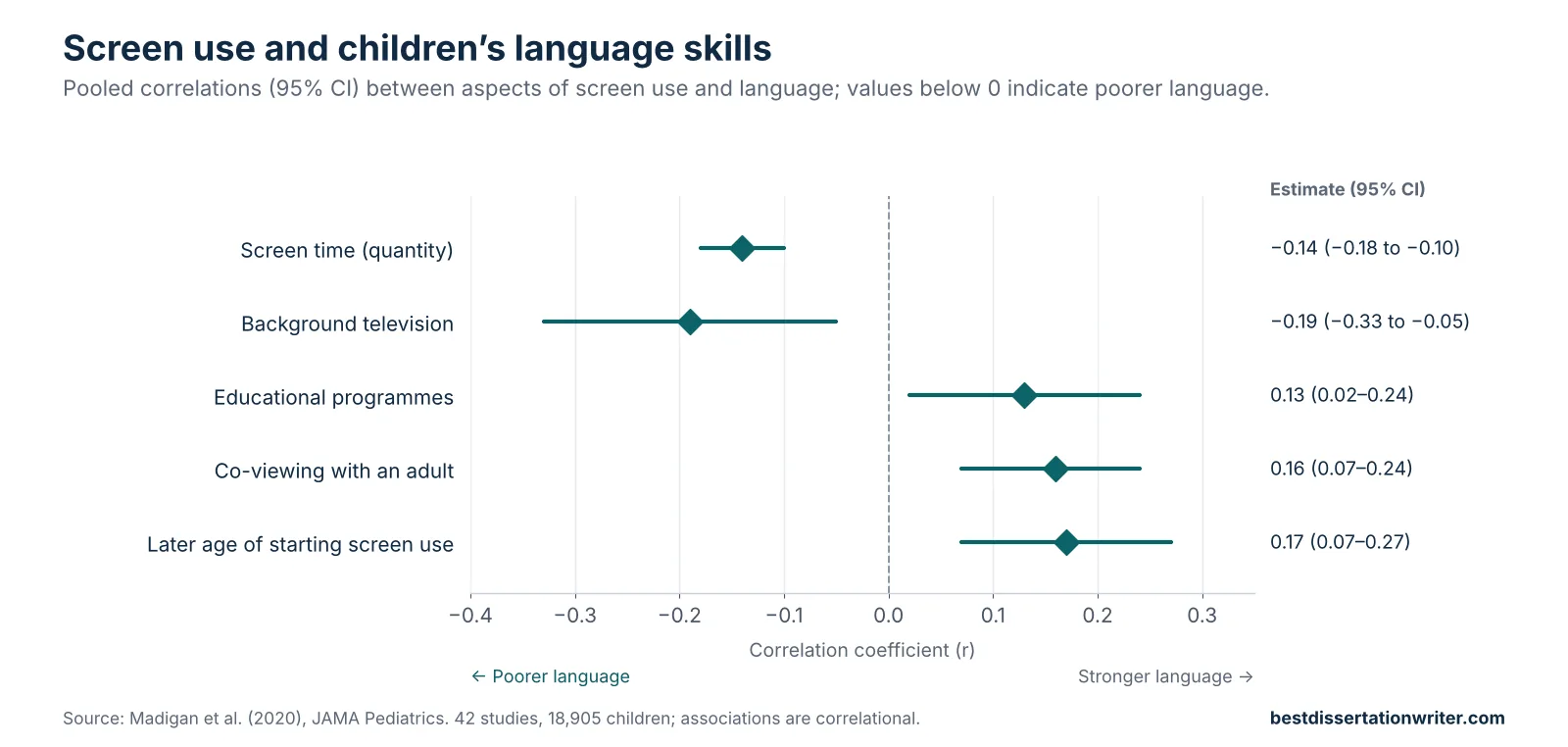
This meta-analysis is important for nursing practice because it shows that the quality and context of screen time matter as well as the quantity. Co-viewing and educational content were linked with better language, suggesting that parents who watch and talk with their child about what is on screen may reduce potential harm (Madigan et al., 2020). However, the included studies were mainly correlational, so the findings cannot establish that screen use causes poorer language.
Theme 3: Wider Health Effects and Guidance for Parents
Beyond development, Stiglic and Viner (2019) carried out a systematic review of 13 reviews on the health and well-being effects of screens in children and young people. They found moderately strong evidence that higher use was associated with obesity or adiposity and with more depressive symptoms, and moderate evidence for associations with higher energy intake, less healthy diet and poorer quality of life. Evidence for many other outcomes, including sleep and cognitive development, was weak.
Importantly, Stiglic and Viner (2019) found only weak evidence for threshold effects and weak evidence that small amounts of daily use were not harmful and might have some benefits. The review covered children and young people of all ages rather than focusing on the early years, and the quality of most included reviews was rated medium or low. These limitations informed the RCPCH (2019) decision not to recommend a fixed time limit for screens.
The guidance therefore diverges. The WHO (2019) and AAP (2016) offer age-based limits, whereas the RCPCH (2019) recommends that families consider whether screen use is controlled, whether it interferes with family activities or sleep, and whether snacking during screen use is controlled. For nurses, these approaches can be combined: age-based limits provide a clear benchmark for the youngest children, while the RCPCH questions help families judge whether their current use is causing problems.

Discussion
This review suggests that most young children exceed recommended limits on screen time, that higher use in the early years is associated with small reductions in language and developmental outcomes, and that higher use across childhood is linked with adiposity, unhealthy diet and depressive symptoms. At the same time, educational content, co-viewing and a later start appear to be associated with better language, indicating that how screens are used matters as well as how long.
The evidence has important weaknesses. Most studies are observational and rely on parent reports, effect sizes are small, and confounding by factors such as family income, parental education and stress cannot be ruled out. The longitudinal design of Madigan et al. (2019) strengthens the case that heavy early screen time may come before poorer development, but even this study could not show that reducing screen use would improve developmental outcomes.
These uncertainties help to explain why guidance differs. The WHO (2019) and AAP (2016) take a precautionary approach, setting limits for the youngest children, whereas the RCPCH (2019) emphasises the weakness of the evidence for thresholds and focuses on displacement of sleep, activity and family time. Neither approach is wrong, but nurses need to understand the reasoning behind each so that they can explain advice honestly and adapt it to each family.
Advice on digital media should also recognise family circumstances. Screens are sometimes used to occupy children while parents work, care for siblings or manage stress, and families with limited space, money or support may have fewer alternatives. Messages that blame parents are unlikely to change behaviour. A supportive, non-judgemental approach that starts with what families already do well, such as reading together or playing outdoors, may be more effective in protecting child development.
Nurses also need to model balanced attitudes in their own settings. Hospital wards, waiting rooms and clinics often rely on televisions and tablets to keep children occupied, which may send mixed messages to parents. Providing books, toys and space for play alongside screens, and inviting parents to join in, shows in practice how screen time can be one part of a varied day rather than its main activity. Health visitors and school nurses can reinforce the same message across settings, so that families hear consistent advice from different professionals over time.
The evidence base has limitations. Few studies examined interactive devices or video-chatting, most data predate the pandemic, and few studies included children with disabilities or from low-income countries. This review relied on openly accessible, English-language sources and did not involve independent double screening. Future research should test whether nurse-led guidance on screen time changes family media use, and should measure content and co-viewing, not only total hours, using objective methods where possible.
Implications of Screen Time Evidence for Practice
For children’s nurses, health visitors and school nurses, the evidence supports routinely asking about screen use during developmental reviews and other contacts, sharing age-based guidance for the youngest children, and encouraging co-viewing, high-quality content, screen-free mealtimes and no screens in the hour before bed. Nurses should help families make a simple media plan, look for signs that screens are displacing sleep, play or physical activity, and refer children with concerns about speech or development for assessment.
In hospital, screens can be a useful distraction, but they should complement rather than replace approaches such as play therapy, and nurses should continue to use validated pain assessment tools rather than assume that a child absorbed in a device is comfortable. Conversations about screens fit naturally alongside advice on infant nutrition, active play and sleep, and contribute to preventing childhood obesity.
Conclusion
This narrative review examined the impact of screen time on child development and the role of nurses in parental guidance. Most young children exceed recommended limits, and higher use is associated with small reductions in language and developmental outcomes and with adiposity and poorer mental health, although the evidence is largely observational and the size of the effects is modest.
Nurses can help parents by giving balanced, non-judgemental guidance that combines age-based limits for the youngest children with attention to content, co-viewing and the protection of sleep, play and family time. Treating screen time as a routine part of child health conversations offers a practical way to support healthy development in a digital world.
References
Council on Communications and Media. (2016). Media and young minds. Pediatrics, 138(5), e20162591. https://doi.org/10.1542/peds.2016-2591
Madigan, S., Browne, D., Racine, N., Mori, C., & Tough, S. (2019). Association between screen time and children’s performance on a developmental screening test. JAMA Pediatrics, 173(3), 244–250. https://doi.org/10.1001/jamapediatrics.2018.5056
Madigan, S., McArthur, B. A., Anhorn, C., Eirich, R., & Christakis, D. A. (2020). Associations between screen use and child language skills: A systematic review and meta-analysis. JAMA Pediatrics, 174(7), 665–675. https://doi.org/10.1001/jamapediatrics.2020.0327
McArthur, B. A., Volkova, V., Tomopoulos, S., & Madigan, S. (2022). Global prevalence of meeting screen time guidelines among children 5 years and younger: A systematic review and meta-analysis. JAMA Pediatrics, 176(4), 373–383. https://doi.org/10.1001/jamapediatrics.2021.6386
Royal College of Paediatrics and Child Health. (2019). The health impacts of screen time: A guide for clinicians and parents. https://www.rcpch.ac.uk/resources/health-impacts-screen-time-guide-clinicians-parents
Stiglic, N., & Viner, R. M. (2019). Effects of screentime on the health and well-being of children and adolescents: A systematic review of reviews. BMJ Open, 9(1), e023191. https://doi.org/10.1136/bmjopen-2018-023191
World Health Organization. (2019). Guidelines on physical activity, sedentary behaviour and sleep for children under 5 years of age. World Health Organization. https://www.who.int/publications/i/item/9789241550536
Cite this example
Best Dissertation Writers (2026) The Impact of Screen Time on Child Development and the Role of Nurses in Parental Guidance: A Narrative Review. Available at: https://bestdissertationwriter.com/screen-time-literature-review/
Best Dissertation Writers
Get expert help with your nursing literature review
Share your topic and deadline with Best Dissertation Writers and get support tailored to your module brief.